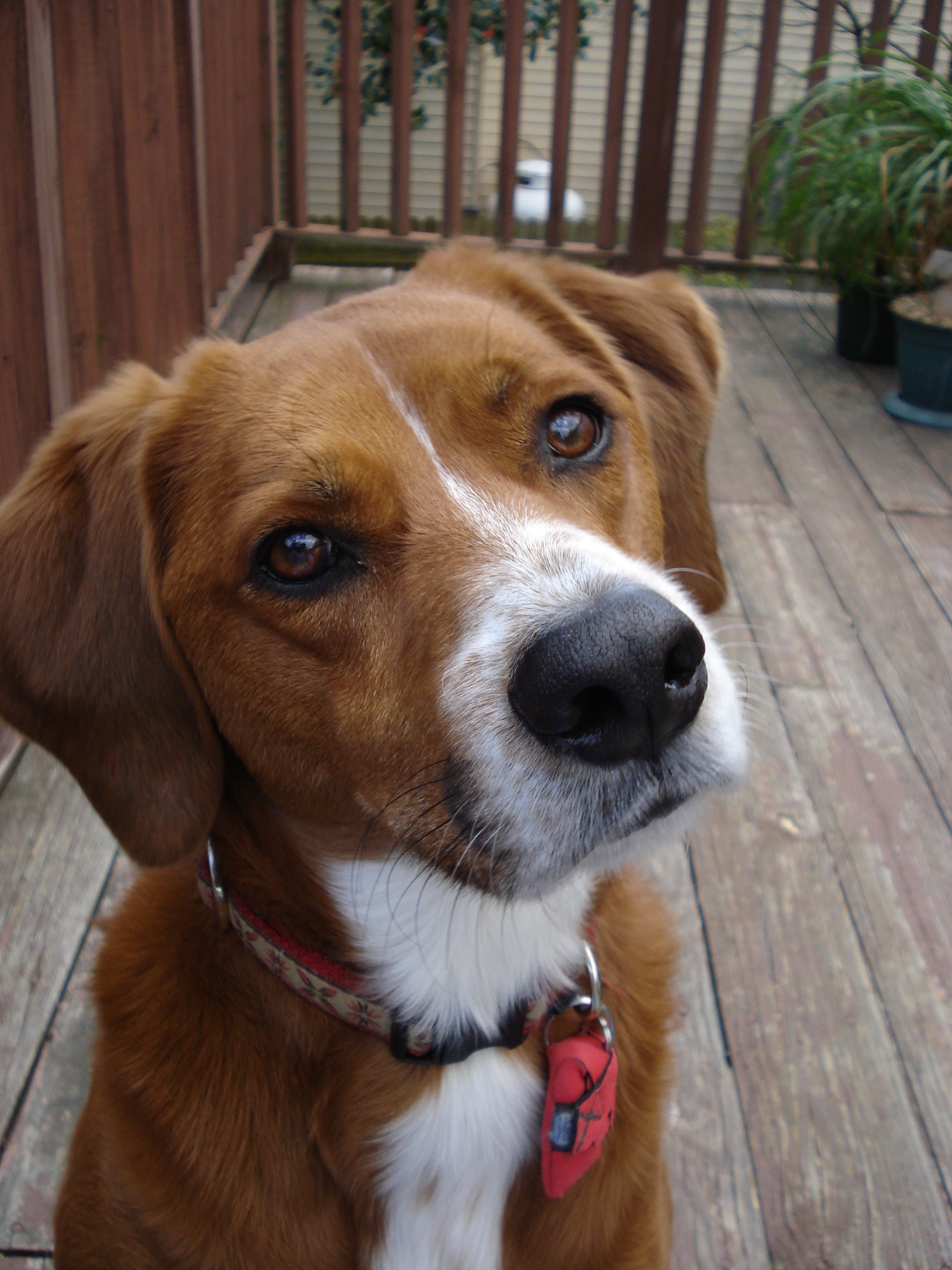
Courage!


The Cowardly Lion from "The Wizard of Oz"

Cowardly Lion: Courage! What makes a king out of a slave? Courage! What makes the flag on the mast to wave? Courage! What makes the elephant charge his tusk in the misty mist, or the dusky dusk? What makes the muskrat guard his musk? Courage! What makes the sphinx the seventh wonder? Courage! What makes the dawn come up like thunder? Courage! What makes the Hottentot so hot? What puts the “ape” in apricot? What have they got that I ain’t got?
Dorothy, Scarecrow, Tin Woodsman: Courage!
Cowardly Lion: You can say that again!

cour·age

[kur-ij, kuhr-]

noun

the quality of mind or spirit that enables a person to face difficulty, danger, pain, etc., without fear; bravery.

What Kind of People Have Courage?

Exactly what kind of people have courage? In my opinion, courage is not found in a specific “kind” of person, personality, gender, or culture. Courage can be found in the heart of any individual. Facing life develops courage in our hearts. I began thinking about courage this past week. I was waiting outside a classroom as I had arrived a bit early. I have no idea what kind of class was being held in room 406, but I heard the professor say, “When you think of someone who is courageous, who comes to mind?

I couldn’t hear all the responses, but some that I did hear included:

men and women in the armed forces

parents

law enforcement officers

and firefighters.

As I sat leaning against the wall eavesdropping on the class discussion, I thought about how I would answer that question should anyone ever ask me.

“People with disABILITIES have courage”

Part of the reason I love Fidos For Freedom so much is that the clients, trainers, and volunteers have become like family to me. There are a number of disABILITIES present in people who are “family” at this organization. People who are “differently-abled”. Some of the clients are deaf (or Deaf), some have balance problems, chronic fatigue syndrome, fibromyalgia, chronic pain (from accidents or illness), CRPS, MS, and the list goes on. No matter the background or current health status of any one individual, one thing I see in the face of ALL is – COURAGE.

How can we be SO different and struggle with such a wide variety of challenges, and yet all have courage? Bill Tipton said, “Increasing your courage to take calculated risks can improve your general well-being and attitude in life. Learning to transform the negative reaction of fear of failure to a positive sensation of opportunity can enhance your chances for success. I believe people with disabilities, or perceived differences, get more opportunities to demonstrate and practice courageousness” (Global Dialogue Center, 2011)

I believe when a person takes a “calculated” risk and strives to improve their life, courage results. I have seen people work very hard to train assistance dogs. I have seen people work very hard to train to be matched with an assistance dog. Different people have different obstacles, but all push on… reaching for that goal of more independence. I’ve seen clients training who are in obvious pain. I have seen people work hard at taking risks and learning new ways of doing things so that they may safely and confidently handle a dog partner. This is courage.

How Does One Find Courage?

Jayne Leone said, “Related to the word courage are the words encourage and discourage. (In fact within the word courage is the word rage.) Think of the times we have encouraged ourselves or encouraged others. Now think of the times we have discouraged ourselves and discouraged others. There are many buzz words being used today — such as empowerment, challenged, support — used by many professionals, when in reality the operative word is courage, encourage or discourage. As we well know, many social institutions can encourage us or discourage us as disabled persons. They can help us be empowered, help us to maintain self-control, help us be self confident, help us gain courage. By discouraging us they can do the opposite” (Independent Living Institute, 1997).

I believe that courage isn’t an attribute one learns and then “ya got it“. I do believe that courage, though hard-earned and a difficult teacher, is practiced by choice on a daily basis. This is why we have “good days” and “bad days”. I think the key to having an abundant life is to have more “good days” than “bad days”, but allow “bad days” to act as a learning experience as well. Let’s face it. We are going to have bad days. Don’t you think the key is in how one RESPONDS to a bad day? Courage doesn’t disappear on bad days. Courage doesn’t guarantee success.
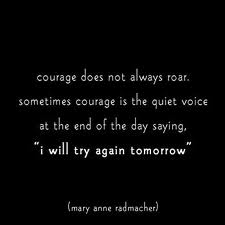
Sometimes? Courage is going to bed after a “bad day”, with resolve to try again tomorrow. Courage means you simply refuse to accept defeat.

The Lion now walked to the Throne Room and knocked at the door.

“Come in,” said Oz.

“I have come for my courage,” announced the Lion, entering the room.

“Very well,” answered the little man; “I will get it for you.”

He went to a cupboard and reaching up to a high shelf took down a square green bottle, the contents of which he poured into a green-gold dish, beautifully carved. Placing this before the Cowardly Lion, who sniffed at it as if he did not like it, the Wizard said:

“Drink.”

“What is it?” asked the Lion.

“Well,” answered Oz, “if it were inside of you, it would be courage. You know, of course, that courage is always inside one; so that this really cannot be called courage until you have swallowed it. Therefore I advise you to drink it as soon as possible.”

The Lion hesitated no longer, but drank till the dish was empty.

“How do you feel now?” asked Oz.

“Full of courage,” replied the Lion, who went joyfully back to his friends to tell them of his good fortune.

Swallow Courage

Ever get caught up in wishing things were different? Do you ever wish you were simply “normal”? (Who defines what is NORMAL, anyway?) I’m at various stages of accepting who I am today. Sometimes I have a clear vision of my “new normal” and seem to understand the “new me”. At other times though? I’ll be honest – I flounder. There is a part of me that wants to “fit in” and do things like “normal” people do.

Why do I have to find batteries so that I can continue hearing when my CI “dies”?

Why do I have to stand and sit slowly?

Why do I have to remove my hearing aid at times when the ear mold leaves a sore in my ear?

Why do I have to use my hands (or Chloe) on the stairs to safely navigate “UP”?

One must “swallow” courage – to believe!

My husband reminded me the other day that even people without disABILITIES struggle with acceptance. As a psychologist, he has seen folks from all walks of life struggle with accepting the way things are TODAY. Age may have made a change in your “normal”. An accident, illness or disABILITY may have changed your “normal”. He said, ““You have differences that make you uniquely you, but that also require some assistance. Without Chloe you’d fall more and miss more. Without your implant you are deaf. You need to accept who you are without apology and stop looking to be treated normally”.

Courage ≠ Never Being Afraid

“But how about my courage?” asked the Lion anxiously.

“You have plenty of courage, I am sure,” answered Oz. “All you need is confidence in yourself. There is no living thing that is not afraid when it faces danger. True courage is in facing danger when you are afraid, and that kind of courage you have in plenty.”

“Perhaps I have, but I’m scared just the same,” said the Lion. “I shall really be very unhappy unless you give me the sort of courage that makes one forget he is afraid.”

You can have courage and still feel fear. The unknown can be a scary thing. When an acquired disABILITY occurs in the life of a person, there are no guarantees things will not get worse. Many have progressive symptoms. Courage does give us the ability to deal with change, however. Few are born with courage. It is a learned skill, an acquired characteristic.

The Cowardly Lion has always been a favorite of mine in “The Wizard of Oz”. I loved both the movie and the books. I smile when he uses his tail to wipe his self-pitying tears away. I grin when he “shakes” in fear of the Wicked Witch and trembles at the sight of the flying monkeys. I know the end of the story. The Cowardly Lion shows courage time and again throughout the movie, putting himself at risk for others and to achieve his own ultimate goal… a gift bestowed from the Wizard – that of courage. Unbeknownst to the Cowardly Lion, courage lay dormant in his fearful heart. He only had to exercise what was already there.

I hope that YOU believe that courage is in your heart. You may not even recognize it. If you take risks and live life “in spite of”? You have courage!

Denise Portis

© Personal Hearing Loss Journal

http://globaldialoguecenter.blogs.com/disabilities/2011/05/courage-enabler-for-people-with-disabilities-or-perceived-differences.html

http://www.independentliving.org/docs5/Leone97.html
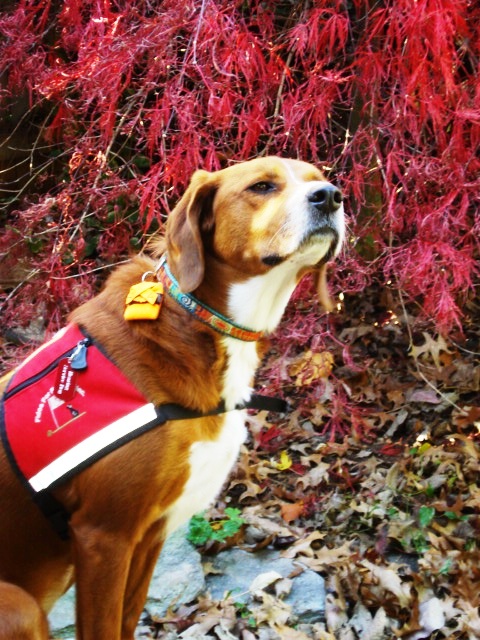


I Have Meniere’s Disease – Harsh Reminder

I have Meniere’s Disease. It is easy for folks to forget that as the disease is “invisible”. Amazingly, I sometimes forget I have it myself. So that is just embarrassing! GRIN. Meniere’s disease manifests itself in individuals in a variety of ways. The disease lacks specific symptoms and triggers that are true of everyone. The disease varies person to person. For myself, the weather tends to be a very specific trigger for me. If pressure systems come into the area that include heavy rains or even high humidity, I know that I will have a “bad balance day”. If that day is simply the beginning of a string of similar weather days, I can be so off-balance by day 3 or 4, that I practically have to CRAWL up and down steps. It’s rather embarrassing to crawl when you are 45 – believe me!

Here in Maryland, we have had a significant amount of sunny, low-humidity days. As a result, my balance has been pretty good. Yesterday, I did laundry and actually jogged up and down the steps WITH a laundry basket. Yet I forget sometimes that in spite of my having few visible symptoms, I still HAVE Meniere’s disease even on bright sunny days.

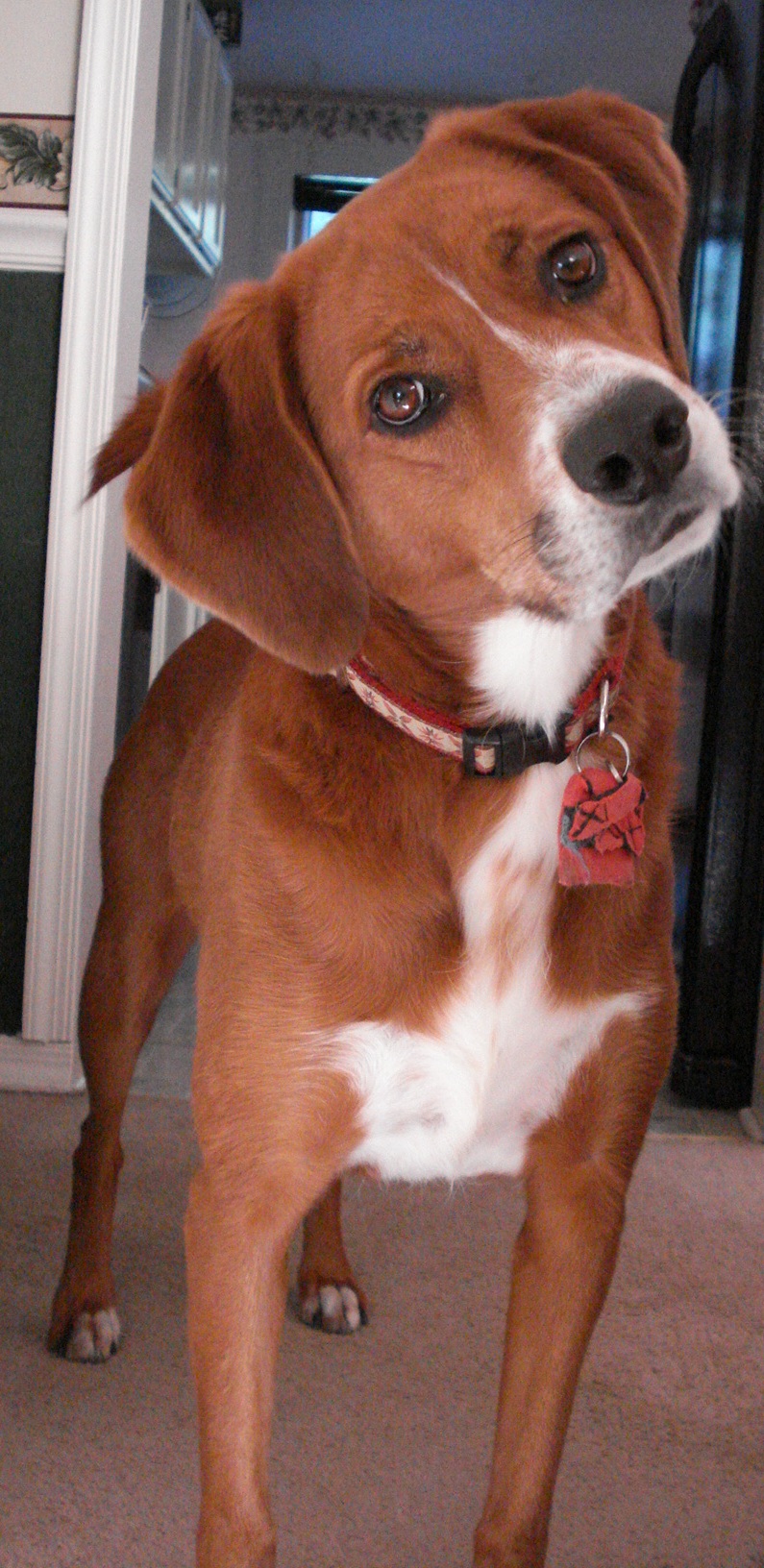
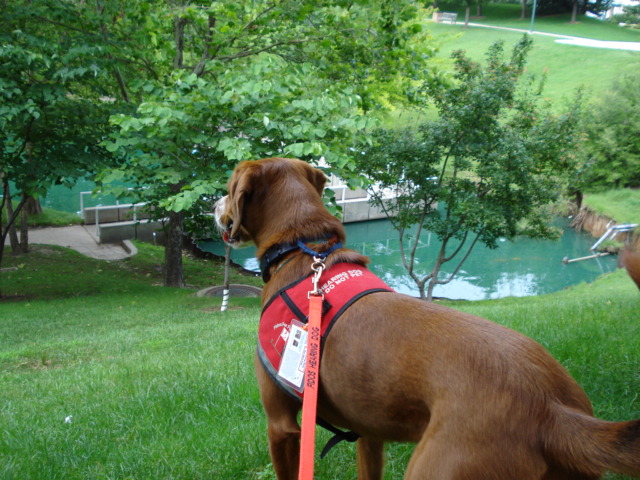
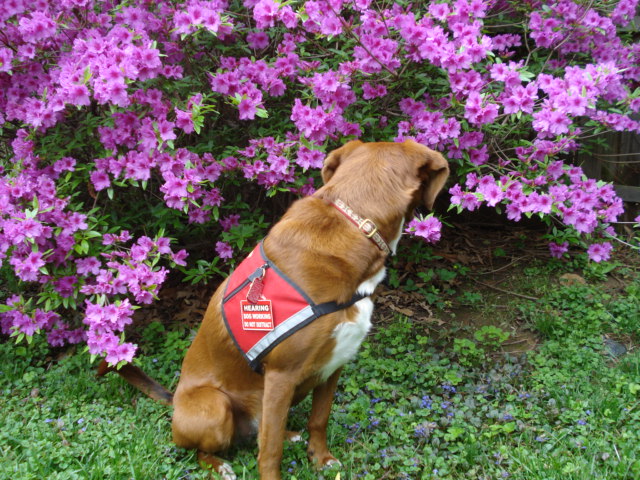
Chloe does a number of things for me, only some of which are hearing alerts (what she was originally trained for at Fidos For Freedom). Chloe has also been trained to help me with a number of “balance assist” tasks which are very helpful on days I am experiencing Meniere’s disease symptoms. As a matter of fact, there are weeks that Chloe actually does more balance work for me than she does hearing alerts. One thing we have taught her to do is to “roll” her own blanket. I carry a blanket that is HERS. The blanket goes to every place I teach. It smells like her and she knows it is her “safe place” to be unless I ask her to do something for me. I usually put it out of the way in the classroom, but where she can easily see me. The blanket and Chloe are usually within 4-5 feet of me at all times. Below is a video of Chloe “rolling” her blanket — she adjusts the carpet square to be high enough that I can easily reach it without having to bend past my limitations.

Harsh Reminders

I get aggravated at family and close friends sometimes when they make suggestions for me to do something or try something that they KNOW I cannot do. It’s easy to forget certain things I cannot do because I don’t walk around with a sign on my shirt that says, “Beware of fall when bending!” You know what? Sometimes the person who forgets what I can and cannot do is – ME. You’d think I’d always be aware of the fact that I cannot bend to get something off the floor without paying the price. For me… bending far enough to retrieve something off the floor means that I lose consciousness for just a few seconds. Everything goes “black” in my vision, and my “hearing” (even with a cochlear implant) turns off. As soon as I stand back up, everything snaps back into focus. If I bend quickly, (for example to try and catch something as it is falling), I usually “join” the item on the floor… only I am sprawled out looking ungainly and mystified as to how I got there.

We’ve had beautiful weather here in Maryland lately. I need to remind myself on days like these that I still HAVE Meniere’s disease. In class this morning, I began gathering my things up to pack into my bag and exit the room. I dropped my roll sheet, so Chloe went over to pick it up and bring it to me (an automatic retrieve). As I was standing next to her pink blanket, I decided to save myself time and reached down to pick up her blanket. I lost my balance and my forehead crashed into the podium. After connecting with a wicked CRACK, the impact popped me back on my caboose. Thankfully, I didn’t lose consciousness. Chloe trotted over to me with the roll sheet and dropped it into my lap. She wagged her tail at me, nose 3 inches from my face.

“Hey Denise! Umm… why are you on the floor?” (Yup. I can read my assistance dog’s mind. Scary, huh?)

“Guess I should have had you roll your blanket, huh Chloe?”

Upon hearing “roll blanket”, she calmly rolled the end of the blanket and then tugged it over closer to where I sat.

I heard a student over my shoulder ask, “Ummm. Mrs. Portis? Are you OK? Was that your HEAD?”

I tried to chirp out in a manner that was convincing, “Oh sure! I’m fine, no problem!”

As I used Chloe in a stand/stay to get off the floor… I thought to myself one word – over and over again.

stupid

Stupid

STUPID!

Harsh reminders are needed from time to time, if not for any other reason than to remind us of the consequences of forgetting our own limitations.

We need to remember our own limitations. As a person with hearing loss, it helps me to remember that I cannot hear well in really noisy, crowded areas. If I need to have a conversation with someone, it is better to ask them to step over to the side out of the “hub-bub” of noise if I need to talk to them. Failure to acknowledge what I cannot do well (hearing in noise) only results in that I will be frustrated and angry at my inability to understand the conversation. If I want to play with my dogs, I need to remember to sit on the floor in order to tug on toys, throw balls, and squeak stuffed animals at them. If I try to “play” standing, I am sure to take an unplanned nosedive.

Have you had some harsh reminders about your own invisible illness or disability? Some lessons are hard to learn!

Denise Portis

© 2011 Personal Hearing Loss Journal

Reflections on National Invisible Illness Awareness Week

According to the Invisible Illness Awareness website, the following statistics are true:

  • Over 100 million people in the U.S. have a chronic illness;
  • 20.6 percent of the population, about 54 million people, have some level of disability;
  • 9.9 percent or 26 million people had a severe disability
  • 1.8 million used a wheelchair
  • 5.2 million used a cane, crutches, or a walker
  • So that is less than 6% who have a visible illness.
  • There are many illnesses that start out being invisible and as the disease progresses it becomes more visible.

Also note that:

  • 26 million persons were considered to have a severe disability;
  • yet, only 7 million persons used a visible device for mobility.
  • Thus, 19 million of the people who were defined as severely disabled, did not use a wheelchair, cane, crutches or walkers.
  • In other words, 73% of Americans with severe disabilities do not use such devices.
  • Therefore, a disability cannot be determined solely on whether or not a person uses visible assistive equipment.

U.S. Department of Commerce (1994). Bureau of the Census, Statistical Brief: Americans With Disabilities. (Publication SB/94-1).U.S. Department of Commerce (1997). Bureau of the Census, Census Brief: Disabilities Affect One-Fifth of All Americans. (Publication CENBR/97-5).

Why Do I “Plug” Invisible Illness Awareness Week?

I have been trying to raise awareness about this week for three years now. This year, a friend noticed my “don’t miss” posting on Facebook and couldn’t resist teasing me about it. After all, I don’t exactly allow my challenges to be INVISIBLE. I wear a bright red ear mold on the hearing aid in my “deaf” ear. I wear sparkly “bling” on the cochlear implant on my “hearing again” ear. I go about my life accompanied by a hearing assistance/balance assist dog 24/7. I learned long ago that it was in my best interests to make an invisible disability – VISIBLE. It kept me from being knocked out of the way, and helped people realize that something about me is different. I can still work, shop, go to movies, hike, and dance… yeah. OK, maybe not that last part…

I just don’t hear well… especially in big, cavernous places, or busy, buzzing atmospheres. Once you get my attention and I know you are talking to me, I can actually hear you great! I may have to ask for a very occasional repeat, but for the most part I do really well. I’m proud of how far I’ve come in my hearing. Despite all my visible reminders and “kissing sidekick”, Chloe, people who know me well (friends, co-workers, and family members) will forget that I may have trouble if you don’t get my attention first and that I can’t move FASTever. Heck… sometimes even *I* forget that I cannot move fast. Nothing reminds me quicker than when I

fall

down

and

go

BOOM!

Through the years I’ve been able to meet some wonderful people. Some examples include:

1) Folks through the training center at Fidos For Freedom.

2) People at Hearing Loss Association of America conventions or conferences

3) “Hearing Again” recipients at Cochlear America conferences

4) Individuals in support groups for tinnitus, Meniere’s disease, hearing loss, and assistance dogs users (both face-to-face and in virtual environments online).

Not every disability can be made visible. Not every person chooses to even try and make something invisible – visible. They have their reasons and it is an individual’s choice how they want to disclose or keep hidden any disabilities they may have. It could influence their work environment, relationships, and even self-esteem. I choose to support ALL individuals who live with chronic illness, invisible illness, or disability. Recognizing these illnesses once a year in a push for national awareness, I hope will eventually dispel erroneous ideas and information about these very populations. This is one of the reasons I “blog”, and invite guest authors to write for “Hearing Elmo” as well. Raising awareness makes a difference… one person at a time.

I read some incredible stories of courage, faith, and perseverance this week at the national website for invisible illnesses. You can check out some of them here. I’m proud to be a part of a community of people who choose to live a victorious life  – “in spite of”.

Take some time this week if you can to recognize the courageous people that you know who live with invisible illness and the choices they have made in order to live life to its fullest!

Denise Portis

© Personal Hearing Loss Journal

30 Things

From Invisible Illness Week

30 Things About My Invisible Illness You May Not Know:

1. The illness I live with is:

Invisible if I want it to be, but I wear bling and use a service dog so that it is not.
2. I was diagnosed with it in the year:

1993
3. But I had symptoms since:
I was 6 years old after a car accident.

4. The biggest adjustment I’ve had to make is:
Learning to hear with a cochlear implant and learning how to adjust on days my Meniere’s disease symptoms have me wobbling around with poor balance.

5. Most people assume:
My cochlear implant has “fixed me”.

6. The hardest part about mornings are:
Not being able to hit “snooze” on my alarm clock since that happens to be my service dog, Chloe. When the alarm goes off, she kisses me awake and there is no going back to sleep. The dog is definitely a “morning dog”.

7. My favorite medical TV show is:
Not really a medical show but I do like Dr. Phil. He’s a “reality therapist” and I think everyone who has an invisible illness needs to have a healthy dose of reality!

8. A gadget I couldn’t live without is:
FM Clipboard for classes.

9. The hardest part about nights are:
Trying to ignore the tinnitus that comes roaring into play after removing my cochlear implant.

10. Each day I take __ pills & vitamins. (No comments, please)
1 prescription (blood pressure) and 9 different vitamins – one of which is Manganese. Studies have shown that people with Meniere’s disease may have a Manganese deficiency.

11. Regarding alternative treatments I:
Have tried numerous ones including acupuncture, chiropractor, and vitamins.

12. If I had to choose between an invisible illness or visible I would choose:
Visible – no question. This is why I try to make my invisible illness – VISIBLE.

13. Regarding working and career:
I am proud that I am able to work having made a number of adjustments and having chosen to be partnered with an assistance dog.

14. People would be surprised to know:
That I dread group activities because I don’t hear as well as they think I do.

15. The hardest thing to accept about my new reality has been:
That I must sometimes choose not to do things I once enjoyed because of my symptoms. For example: If there is a movie I wanted to see that is coming out, but the weather is bad and my Meniere’s disease has flared up, I cannot go and have to put it off.

16. Something I never thought I could do with my illness that I did was:
Go back to school and finish my MS.

17. The commercials about my illness:
There are none. I’ve never seen a late-deafened/cochlear implant commercial, nor a commercial about Meniere’s disease.

18. Something I really miss doing since I was diagnosed is:
Listening to music.

19. It was really hard to have to give up:
Friends who couldn’t cope with the new me accompanied by a service dog.

20. A new hobby I have taken up since my diagnosis is:
Blogging/writing

21. If I could have one day of feeling normal again I would:
Go to an amusement park and ride every roller coaster there!

22. My illness has taught me:
That the disability community is live and well and fully utilize the Internet to connect, support, share information and to be proactive.

23. Want to know a secret? One thing people say that gets under my skin is:
“Nevermind”. If you aren’t willing to repeat it for someone who hears differently are you not behaving as if it doesn’t matter to THEM?

24. But I love it when people:
Include me.

25. My favorite motto, scripture, quote that gets me through tough times is:
Helen Keller:  “Blindness separates us from things but deafness separates us from people. “

26. When someone is diagnosed I’d like to tell them:
Email me. Ask questions. I want to help!

27. Something that has surprised me about living with an illness is:
How family members who once knew you “when” are not willing to learn about the new you.

28. The nicest thing someone did for me when I wasn’t feeling well was:
Email me and ask how I was doing.

29. I’m involved with Invisible Illness Week because:
Many illnesses and disabilities are invisible. I want to raise awareness.

30. The fact that you read this list makes me feel:

Appreciative that you care enough to learn more!

Denise Portis

© 2011 Personal Hearing Loss Journal

Deep Breath – Start Fresh

Invisible Awareness Week is September 12th – 18th this year. I love the theme of this year’s promotion. How often do we take a DEEP BREATH and START FRESH? Perhaps the better question is how often do we NEED to do these two things?

Invisible illness or disability definitely takes adjustment. However, just when we may feel as if we have adjusted to a new lifestyle something will happen to take us back to “ground zero”. It may be that your disability or illness is progressive. Or perhaps, your life has simply changed in such a way that living with your challenges requires a new plan. For example, my children are now adults. Even though they still live at home at 21 and 20-years of age, both are working and going to college. This means that they may LIVE here, but I don’t see them as often as I did when they were younger. That means I don’t have the assistance of people who hear as often as I once did.

Part of the reason I decided to train and be matched with a canine partner, was so that I would be independent of my family’s help. Chloe has been a big blessing and I am grateful for her work of being my EARS and to help me with balance-related tasks. For all that she does, however, there are things she cannot do for me. A couple of weeks ago I needed to make a doctor’s appointment. The voice on the other end of the line had a heavy accent. Chloe obviously cannot assist me in understanding a voice with a heavy accent. However, I have found that because my life changes have been gradual, I already had a plan in place for when no one was home to help me with a call that had a heavily accented voice.

Are you a person living with a chronic or invisible illness? Do you have an invisible (or visible) disability? Do a quick assessment of your life, coping mechanisms, and skills. Do you need to take a deep breath and start fresh?

If you are a person living with invisible illness, I encourage you to check out the site for Invisible Awareness Week. Perhaps you can help to spread the word! There are a great number of resources available at the website.

Denise Portis

© 2011 Personal Hearing Loss Journal

Sometimes? There’s Not a Great Solution…

Chloe doesn't know Spanish...

Sometimes? There is not a great solution available for positive advocacy.

This past Friday, my 21-year-old daughter asked me to go shopping with her. I’m always thrilled when she CHOOSES to spend time with me, so I agreed so long as it was the morning so that we could “beat the heat”. She agreed. She wanted to shop for new “under things” and I knew JCPenny was having a sale on these items. Kyersten, Chloe and I headed for Annapolis Mall to shop.

The bad thing about shopping in the “intimates” department is that there is not much room to maneuver. I was having some difficulty with my balance as well so I was just being extra careful about how much moving I had to do. Chloe does great even in confined spaces with the exception of that tail. I talk to her a great deal while we are out because it helps to keep her attention on me. Kyersten was busy looking at different styles available.  My main job was to offer the occasional opinion and situate Chloe so that her tail didn’t knock things off with her loving “wag”. Chloe may not understand all that I say to her, but she does know her name and will wag as if she is paying attention to everything else I’m saying. Because my attention was on HER, and as we were in “tight quarters”, I was taken by surprise by two little girls who ran up and threw their arms around Chloe’s neck.

One little girl was about 4-years-old, and the other (obviously big sister) was probably 9 or 10-years-old. I stuttered out, “Oh! I’m sorry. She’s a working dog and cannot be petted right now”. The girls continued to squeeze and talk excitedly.

I tried to tune in a bit better and realized they were talking in Spanish. With my heart plummeting to my stomach, I held up my hand and shook my head NO saying, “Please don’t pet her. She is a working dog”.

The older girl stopped and tried to talk to me in English, and I understood “She’s a pretty dog”. At this point Chloe broke her sit/stay in order to break the choke hold. I was unprepared and went to my knees and caught myself on a rack.

With bras, panties, and tiny hangers attached to various body parts, I again held up my hand, shook my head no and said, “No please!” in a very firm voice. As I was still wobbling, I sat on my caboose to get my bearings.

The older girl said, “Oh … sorry” with some other words that I could not make out because of the accent. I did understand that she understood that Chloe was NOT to be petted. In Spanish she (I think) explained to her younger sister about Chloe. I think she realized something was amiss because I was now sitting on the floor with lingerie scattered around me. She left quickly with her little sister in tow.

I had Chloe brace so that I could get up, and asked my daughter to pick up some scattered articles. (Chloe could have, but I didn’t figure anyone else would want dog saliva on merchandise). Right as I was on one knee about to stand, the youngest came zooming around the corner with a squeal to squeeze Chloe again (who was now in a stand/stay and “brace”). I held up my hand and intercepted the young lady and my hand blocked her at the chest. Although I did not PUSH, it did stop her in her tracks. I said firmly with a head shake, “NO!” She turned and ran away.

I did NOT want to place my hands on someone else – let alone a child. I didn’t injure her, but I really felt out of options. I was “rattled” the remainder of the day. I was very upset with MYSELF that the resolution to this problem ended up playing out like it did.

When All Else Fails… Be Firm

I did look around for the youngster and never did see her or her older sister during the remainder of our shopping trip. When something doesn’t go according to plan I tend to beat myself up about it I’m afraid! I kept thinking about other options I may have had, and tried to think of what I might do should this happen again. (I’m open to suggestions – grin).

Sometimes we can try to advocate in a positive way – and the situation may just fall apart. Sometimes? You just have to be firm and resolute. We should always try to be positive and upbeat at the beginning…

“It would assist me in staff meetings if everyone would just pop a hand up before speaking so I can locate who is talking”.

“I can easily do my share of answering the phone if I had access to a captioned telephone that would provide understanding for when I don’t hear everything”.

“She’s not a pet. She’s a service dog and she can come into the store with me”.

Yet there are times we may have exhausted other options and have to stand firm.

“I need everyone to simply pop your hand up with a small wave before you speak. Thanks in advance”.

“I will require a captioned telephone so that I can do my job and share the task of answering the phone”.

“Here is a flier about what the ADA says about my rights. I’ll be over there shopping should you have any additional questions”.

I don’t think ANY of us welcome having to be firm and insistent, but there is a time and place for being firm. I try to always remember that there will be others who come after me that may also have accessibility issues. How I handle a situation may condition someone with normal hearing to respond to the next person they interact with who has a disability. There are times, however, when all pleasant and positive avenues have been closed to you. Even in your firmness… keep your cool. Keep it short and stick to the facts. My husband grins and tells me, “Denise! TMI. Keep it short! They don’t care about your background or care to hear your story”!

Accents, Foreign Languages, and Hearing Loss

The great thing about our country is the diversity. Because of where I live there are a large number of minority populations who speak English as their SECOND language. I do not speak an oral foreign language so I’m a little jealous of those who can! My mother taught high school Spanish for over twenty years, but her children never learned (much to her dismay). I have a lot of respect for people who speak English as their 2nd language. It is difficult, however, to understand language when an accent distorts the way a cochlear implant and/or hearing aid pick up the words. I have trouble understanding people with thick accents that may speak PERFECT English. I even have problems with American accents such as folks from Boston, Texas, etc. (I understand “Southern” as I lived there for so long!)

However, the fact that I have difficulty with accents, is MY problem. People with hearing loss should have patience with those who speak other languages as their primary language. I have heard late-deafened folks demean and criticize those who speak other languages. I always think to myself, “Really?” It is far more productive to explain that you have a hearing loss and have trouble understanding when an accent is present. Let them know that you are aware it is your problem, and pleasantly ask if they can perhaps speak slower and face you when they speak. I’ve overheard HoHearies blast people with heavy accents – as if it is THEIR fault! Always – ALWAYS – remember you are an advocate for others with hearing loss whether you signed up for it or not! If you are negative, critical and defensive, you are having a negative influence on how the rest of us are treated in the future. Yes, it can be frustrating and even embarrassing to have to ask someone with a heavy accent to repeat themselves again and again. But “own” the problem as yours – it isn’t their problem. It’s a big thing to be fluent in more than one language, so treat them with the respect they deserve.

Denise Portis

© 2011 Personal Hearing Loss Journal

Get Their Attention

I recently attended the annual national convention of the Hearing Loss Association of America because it was actually held in my area this year. At one point, I was in the crowded convention hall perusing the numerous hearing loss vendors and booths. At a distance, I saw an old acquaintance scoot by in their scooter. I tried to wave them down but I was not in their peripheral so they did not see me. After they quickly rolled out of my sight, it hit me! I could have raised my voice and said, “Hey Bob!” This friend did not have a hearing loss, but attended these conventions alongside of his wife who WAS deaf and hearing again with two cochlear implants. I had to smile at my mistake, because I forget that people with normal hearing do not have to have a visual cue in order to get their attention. (Thankfully we ran into each other later…)

I see this all the time in my kids. Kyersten and Chris (now 21 and 20-years-old) attend college but live at home. They really have no memories of my not having a hearing loss. Even though I had a progressive loss, it took twelve years before my hearing was completely gone. They have both told me that they don’t remember my ever hearing well. They are so accustomed to speaking with someone who has a hearing loss, they automatically do things that are more difficult for someone who isn’t in constant contact with someone who is deaf. They always come into the same room that I am in, and rarely try to have a conversation from another room with ANY family member… even those with normal hearing. Recently my son came all the way into the family room to ask my husband a question. It was a simple question that could have easily been asked from the kitchen. The television wasn’t on, and the area was fairly quiet. However, he is so accustomed to facing the person he is talking to, it is difficult to remember that he can do some communicating from another room when it comes to his dad. My daughter is often told that even as shy as she is, she has “uncanny eye contact” when communicating with someone.

Teaching Them Early

When my kids were about 2-3 years old, they were already “old hats” at communicating with a person who had hearing loss. They cannot remember watching television without captions. Even “Barney, the Dinosaur” had captions, as did “Sesame Street” and “Thomas the Tank Engine”. I believe it helped them learn to read as early as they did!

If I needed to tell my kids something, I would walk over to them and get down on their level. I would put my hands on each side of their face and say, “I’ve got my GUESS WHAT FACE ON!” I’d then (almost nose to nose) tell them what I wanted to tell them, or simply say “I love you”.

If they came to talk to me, I could hear that they were talking, but not understand what they were saying. So I’d lean down and put my palms on each side of their face and ask, “Wow! Do you have your GUESS WHAT FACE ON?” It didn’t take long for them to begin putting their own palms on the sides of my face when talking to me.  As they grew older, we dropped putting our hands on the face of the other, but they would come and tell me with direct eye contact…  “Mom, I’ve got my GUESS WHAT FACE ON…” and then tell me what they were going to say.

By the time my kids were 5 and 6-years-old, it had become habit. I was eventually able to afford a refurbished hearing aid that gave me some help in hearing for several years. I recall my daughter (from the next room) telling my son, “Wait a minute. Let me put my GUESS WHAT FACE ON and ask Mom!” As they continued to age and mature, what “stuck” was direct eye contact and face-to-face conversations. It was actually a wonderful gift to help nurture in them, for all of us do very well to give the other person the attention they need and deserve when communicating. No competing with electronic games, closed captioning on television, or computers when we talk. We put everything down and LOOK at the other person.

How to Get a Deaf Person’s Attention

Here are some great tips in how to get the attention of a person with hearing loss.

1. Wave your hand in their line of sight.

2. Touch their shoulder or hand before speaking.

3. Move into their line of sight with your body to gain their attention.

4. Turn the lights off and on (this is especially helpful in a room that may have more than one person with hearing loss and you need EVERY person’s attention).

5. If sitting at a table with the person, gently knock on the top to get their attention through vibrations.

Can you think of any others? I welcome your input!

How Service Dogs Get Attention

Hearing assistance dogs are taught to get their partner’s attention by gently bumping them with their nose or touching them with a paw. As I have a balance disorder, Chloe tries to garner my attention by standing and staring and WAGGING LIKE MAD. She only places a paw on me or bumps me with her nose if her 1st efforts have failed. Smaller assistance dogs, may get their partner’s attention by actually jumping up on them.

Even though hearing assistance dogs are trained how to get the attention of their partner to alert them to sounds, the human partner has to be responsible as well. Shortly after being matched with Chloe my trainer, Pat, took me to many different types of public places to train ME. Chloe was already trained. She drilled into me, two important things:

1. WATCH YOUR DOG

2. TRUST YOUR DOG

I quickly learned to pay attention to what has Chloe’s attention. Her hearing is not only much keener than my own, it is more sensitive than people with normal hearing. I can now even recognize when she hears something if she is standing in front of me (with my only seeing the back of her head). Chloe has a modified “heel”. “Heel” position is when the dog’s shoulders are parallel to their partner’s left leg. However, I do not have peripheral vision on my lower left. So we taught Chloe a modified “heel” that is slightly forward of a true “heel”. I had to learn how to observe the BACK of her head. Thankfully she has these wonderful hound ears that perk up and she “points with her nose” in the direction from which a sound is coming. She will even cock her head to the side to really tune in.

Look the neighbor came out...
Look at that family over there...
something is in the bushes...

If the sound is something she thinks I should hear, she’ll come and get me – phone ringing, door bell, someone calling my name, kitchen timer, etc. These are all trained alerts. However, I have been in situations where I could tell a sound had completely distracted her yet I could not hear or place what it was. When this happens, I ask “Chloe… what is it? Show me!”

Chloe will start to wag and TAKE me to what is making the sound. I have to be careful about this. I don’t want her to take me to every single sound she hears. She may hear the kid’s arguing and cock her head as she listens. I do NOT want her to take me to where they are arguing because they are old enough to work out their own problems! She seems to understand when it is a sound that I need to pay attention to – such as a cat locked in the laundry room, the low-battery sound on the phone in the bottom of my purse, or “Daddy” hollering from the bathroom because there isn’t any toilet paper!

A Word of Caution

I believe that individual’s with hearing loss should get the attention of every person they wish to speak to – even if that person has normal hearing. Do you know how many conversations I have interrupted because I walked up to someone and started talking without hearing that they were talking to someone else? I try to make it a habit (and still sometimes fail) to make sure I have the attention of someone before I begin speaking. This eliminates the likelihood of my talking over someone already talking.

I suspect all of us can improve our communication skills. If you have someone in your life who has a hearing loss, I encourage you to sit them down and ask them in what ways you may better communicate with them. If you have a hearing loss (whether a veteran of deafness or a “rookie” – new to coping with hearing loss), try to sit folks down and have a “heart to heart” about ways they might better communicate with you. This may include family members, co-workers, or even supervisors. Don’t think, however, that once you share with them how to better communicate with you that they will always do “right” from that point forward. I have learned that the people in my life need occasional (positive) reminders.

“Could you put your hand down please? You are covering your mouth”.

“Do you mind looking my direction when you speak?”

“Could you get my attention before you begin speaking? I’m afraid I missed all that you said prior to my looking up and seeing you standing there!”

Stay positive. Few people will put any genuine effort into communicating with you if you belly-ache and whine about it. If you get angry, it may cause resentment and defensiveness. Keep your cool! Smile… be positive! In the end, you are actually helping them better communicate with ALL!

Denise Portis

© 2011 Personal Hearing Loss Journal

“Family”

Approximately 1 in every 8 Americans experience some degree of hearing loss (Binder, 2011). This is approximately 36 million people – just in the United States. While to some, this number may seem overwhelming or unfortunate. For me? I have to admit to a small “thrill” – for you see… I’m a part of this “family”. I am one of those “1 in 8”.

What is “family”? The obvious definition includes those to whom you are related. I’m very grateful for my immediate family, for in many ways they fall into the “family” of which I am writing today as well. For the purpose of this post, “family” consists of individuals who understand by direct or indirect experience, a life that may be different as the result of disability – whether it be congenital or adventitious.

Hearing Loss Association of America

I recently had a couple of wonderful weekends that helped solidify this feeling of “family” for me. The first was when I went to one day of the 4 day national convention for the Hearing Loss Association of America. This year it was in my area, so I could not pass up trying to go at least one day. I was able to attend a number of workshops, all of which had CART. The rooms had terrific amplification, so I was able to hear the speakers of each workshop very well thanks to my cochlear implant. However, there were a number of people in each workshop who used the CART. On a large screen next to the speaker, every word spoken was also typed by a trained captionist. Those who had never experienced CART before, and therefore had never experienced workshops such as these that were truly accessible, hung on every typed word! As I looked around, nearly every ear had a hearing aid or cochlear implant – sometimes BOTH. I counted six hearing assistance dogs in attendance at the convention on Saturday. I was surrounded by “family”. Even those without hearing loss knew someone who did, were family members, or professionals that worked with our population. Between workshops old friends and new friends often crowded around talking. I couldn’t get over feeling like I knew these people. There were no snide comments or competition over who had the better cochlear implant or hearing aid. We were all “family” – with an intimate knowledge of what it means to live with hearing loss.

I attend a local chapter of HLAA, but being at a national event has no equal. The Internet has allowed people with similar disabilities to contact, share information, and get to know each other in a supportive environment. Some of the people I met I had only known online. However, these national conventions allow us to meet face-to-face! What a treat to literally hug the neck of some of my “family”!

This past weekend, I was able to hang out with a wonderful friend who has bilateral Nucleus Freedoms. She lives in North Carolina and since my husband and I were going down to visit his mom and dad, I took the opportunity to spend the morning with her. She took me to one of her favorite places – the North Carolina Zoo. I hadn’t seen the zoo in at least nine years – not since I had moved away from the area in 2002. We have so much in common in addition to hearing loss. No – we do not have similar backgrounds or childhood experiences. But we both are advocates and do all we can in our own small realm of influence to make a DIFFERENCE. She is a sensitive soul who sees much more than a normal set of eyes can see. It shows up in her photography and in the simple things she points out. A whispered, “L o o k“, usually yields a treat of catching LIFE in an unexpected way. I consider her “family” although we are not related.

Fidos For Freedom, Inc.

At Fidos For Freedom, clients include those with mobility issues caused by numerous types of disability or illness, and people with hearing loss. I cannot count the number of different types of disease, invisible illness, and disabilities present in our “family” at Fidos. The fact we are there for the same reason makes us “family”. Whether client, trainer, puppy raiser, volunteer, or DOG… we find a bond and sense of “family” that cannot be found in other groups in our lives.

I am thrilled to share information and get to know people all across the U.S. who are partnered with assistance dogs. Our disability or invisible illness may be different… but we are the same. Some have partners from organizations like Fidos and some are owner-trained teams. Regardless, we are “family” and I feel a loyalty towards these teams that defines the kind of “family” we are.

Sometimes FAMILY are not “Family”

My readers share with me sometimes that trying to get family to understand what it is like to live life in “their shoes” is quite difficult. For those who acquired disability or invisible illness later in life it may make more sense that family members such as parents and siblings seem incapable of grasping who you are now. However, there are others who have shared that even though their own challenges began at birth, family members are unable to fully understand (or perhaps cope?) what it is like to experience life with additional challenges. I truly believe that people with disability and invisible illness are more capable than those who are “normal”. Learning to adapt, and seeking support, information, and techniques create a malleable, strong individual. Oh sure! There are times we flounder. Change is never easy. But the end result yields a person who is extremely ABLE – not disabled. It is unfortunate that many people to whom we are related are unable to really connect with us once change takes place. Perhaps our peers often become “family” to us because they help us stay connected to life in a more positive way. They understand. Relatives often lose contact with us or only see us once in a great while. These individuals who offer daily support, information, and “family” literally evolve into a close knit community and family. I have had some readers share that they are closer to those in their peer group (disability group) than they are to siblings, parents, and other relatives. They have shared that not only do these “real” family members not understand – they don’t want to understand. I was recently reminded that my own siblings do not really know who I am anymore. After something rather tragic occurred in a relationship I find now broken, I wailed to my mother on the phone how terrible it all was. I shared some things with her that I had never shared before… and she responded, “You never shared these things with me when you were going through this”. So I am (painfully) aware that sometimes our family members are unaware and out of touch because we withdraw.

I am blessed to have family who are also “family”. My immediate family have been a safe haven of support throughout all of my adult life. My children have never known me without hearing loss. Mom’s favorite word growing up has always been “huh?” My husband held my hand both literally and figuratively throughout the process of losing my hearing over 12 years. When I became profoundly deaf, he was my biggest cheerleader in seeking other technology that would help me hear again. My family willingly sacrificed so that I could attend trainings and eventually receive an assistance dog so that I could be more independent. My immediate family members advocate for those who have any type of special challenge. They have participated in TBI (traumatic brain injury) camps, hearing loss conventions, local HLAA chapters, Walks for Hearing, cancer awareness walks, and much more. They know and realize that  disability or invisible illness does not define the person. They have always seen the PERSON first. Because they understand what it means to live with disability or invisible illness simply because they LOVE someone who does have challenges, they are “family” as well as family. I hope that many of you have family members that are also “family”. People who support you without hindering you. People who cheer you on and look forward to your eventual success.

Look for – and BE – “Family”

If you are currently adjusting to acquired disability or invisible illness – please know you are not alone. Find a computer and Internet access. It won’t take you long to discover you are not walking this road alone. As you reach out, look for ways to connect and be “family”. I promise you that there is no other feeling like finally… belonging.

Binder, M. (2011). Hearing. The Ear Man: Hearing Aid Service. Retrieved June 28, 2011, from http://www.theearman.com/hearing.html

Denise Portis

© 2011 Personal Hearing Loss Journal


“Tag” You’re IT

Chloe and I were recently in a Wal-mart shopping. In the household cleaning section, one doesn’t expect to run into a child. Among the 4 or 5 other shoppers and carts stood a 5 or 6-year-old little girl. I don’t know how she ditched mom, but she was obviously unsupervised. She was about 20 feet away when she first caught sight of us and slowly made her way down the isle towards us. Inwardly I cringed… for I didn’t really feel like asking her not to pet Chloe. Instead she got close enough and looked at Chloe’s vest (although I’m not sure she could even read), and then at the side of my head where my cochlear implant and BLING sparkle for all the world to see!

She smiled at me and said, “This is a WORKING DOG”.

I replied (with some surprise), “You are EXACTLY right! Chloe is a working dog”.

Unsure of what communication might follow that exchange, she smiled impishly up at me… reached over with her index finger an POKED me while exclaiming, “TAG! You’re IT”. With a squeal she was gone and around the corner with pony-tails flying behind her.

Service Dogs and Play

Chloe’s tail started wagging and she looked up at me with an expectant, “Yeah! Let’s go!”

I just grinned at her and caught sight of a lady about 3 yards from us just grinning from ear-to-ear, having seen the whole thing. I smiled back, calmly walked by her and just as I was passing her – reached out and poked her while saying, “Now YOU’RE it…”  She burst out laughing and we went on our way.

I am asked occasionally if Chloe is ever allowed to play. Most recently this came up at a DEMO we did for the Department of Disabilities for the state of Maryland. I think people love the idea of working dogs, but often wonder if the dog is ever allowed to be “just a dog”. We always assure people that our dogs have plenty of opportunities to rest, play, and just be a dog. They are frequently rewarded throughout the day with treats, praise, and physical touch. Walmart is not the BEST place to induce Chloe to play, so I opted out of the game of “tag”… but I can assure you that Chloe is allowed to play with our family dog, and with family members very often.

All Work and No Play

Just like people, dogs need down time. Especially working dogs IMHO. But we could learn a few things from our furry partners. Chloe often naps when waiting in line at a busy cash register, or if we are traveling by Metro, airplane, or even the family car. She knows when to rest and get some shut eye. She also knows when to play and enjoy a major tail-wagging romp! I try to remember to take “5” and rest when I can. I try to get 8 solid hours of sleep each night because I actually hear better, and walk more steady if I make sure a good night’s rest is priority.

Perhaps we should all play tag from time to time. Hey! It is good exercise, and I’ve not met anyone yet who didn’t smile after being tagged!

Denise Portis

© 2011 Personal Hearing Loss Journal