Sex and Hearing Loss

When preparing to write this post, I went back and forth about providing “hard and fast” FACTS about gender differences in hearing loss and writing about personal observations. Because I can easily provide links to documents, research and scholarly articles about the topic, I decided to write about personal observations. Before I do that, let me provide those links!

A wonderful article about gender and race differences can be accessed HERE.

How hormones can have a part in the way hearing loss manifests in individuals can be read about HERE.

An article about why men are more likely to experience hearing loss can be accessed HERE.

An article by ASHA and Cochlear Americas can be accessed HERE.

Personal Observations

I realize that personal observations are somewhat limited by the experiences of the individual themselves. However, as I have had the opportunity to be a part of a number of hearing loss organizations, and have had the privilege of speaking to groups of my peers and professionals across the United States, I have a lot of faith in my own personal observations about gender differences. Sometimes new information was gleaned as the result of attending workshops, conferences and meetings; listening to experts on hearing loss discuss gender differences was very informative. However, I also happen to be a terrific “listener” in spite of my own profound hearing loss. Corresponding with people from across the United States that I may have met in my travels, or are frequently visiting “Hearing Elmo”, I have drawn some conclusions about how hearing loss affects the different sexes. Please allow me to share my observations with you!

Men with Hearing Loss

1. Men are more apt to be pushed into getting help. Perhaps men stay in a stage of denial longer than women do, but men are usually encouraged to do something about their hearing loss as opposed to taking the initiative to doing it themselves. I don’t think it is because they are unable to make decisions about their hearing health; rather, men are more likely to “fake” their way through life pretending they don’t really have a hearing problem. This does not mean that women do not “fake it”, nor does it mean that women are not ever pestered to visit an audiologist. I just believe that men are more likely to be badgered into going to a hearing health professional than women are.

2. Men do not usually seek support from peers until hearing loss has reached a critical point. I believe that men are more likely to “go on about their life” and “making do” after getting that first hearing aid than women are. If assistive technology allows a man to continue working, interacting, and living life, they will be unlikely to join support groups or advocacy groups compared to women with hearing loss. If hearing loss is progressive, men will also begin to seek out information, support, and peers once hearing loss interferes with communication and relationships. On the positive side, men with a stable, mild to moderate level of hearing loss are more likely to not let hearing loss define who they are. Hearing aids and assistive devices are merely tools. I think men may equate support groups with “talking about your feelings”, and as a result miss opportunities such as learning more about advances in technology, discovering legislation that may have an effect on hearing loss populations, and learning valuable communication strategies.

3. At the severe to profound level, men are more likely to shut people out. I can’t tell you the number of times men have told me that they alienated everyone that cared about them when their hearing loss really began to affect their lives. Perhaps it is a coping mechanism? One man wrote to me and shared, “I filed for divorce from my wife of 11 years. I felt in a panic to do it before she filed for divorce from me because I wasn’t the man she married”. One man came up to me after a workshop and said, “It’s easier to be be cranky and belligerent than to discuss with my family how my hearing loss makes me feel”. Still another shared, “I’d rather be accused of being distant than to talk about my hearing loss with her”.

4. Men are less likely to use hearing assistance dogs. Of all the people I know who chose to be partnered with a hearing assistance dog… most are women. Yes – there are some men… but my experience is that they are the minority. I believe if you are partnered with a hearing assistance dog, you have shouldered the responsibility of knowing that by doing so you will be making a potentially invisible disability very visible. Perhaps men are less likely to place their safety and trust in a canine partner? That doesn’t mean they are less likely to like dogs. (On the contrary, I am asked by more men to pet Chloe or field questions about what she does for me). The budding psychology student in me believes that men are more likely to strive to be independent of help from any avenue compared to women. What I find ironic, is that my own hearing assistance dog actually PROVIDES independence to me rather than a new dependent relationship. I think men and women simply view this very visible “assistance” in different ways.

Men in the Supportive Role

I believe men are supportive of those they care about that may have hearing loss. Many husbands attend HLAA, ALDA or AGBell meetings, conferences and conventions in support of someone they care about. However, I have heard women make complaints such as:

“He gets so frustrated that I’m still so SAD about my hearing loss!”

“He is supportive of MY problem, but does not acknowledge it is OUR problem.”

“He doesn’t mind making phone calls for me, but I can tell it frustrates him sometimes”

Women usually welcome a “helping hand” with something as intensely personal as hearing loss. They normally welcome a shared role in learning to live with the acquired disability.

Women with Hearing Loss

1. Women are more likely to “grieve” hearing loss. I think both males and females go through stages of grief when they experience hearing loss. However, I think women tend to get bogged down in depression and experiencing feelings of grief than men do. Perhaps it is because women are usually living more with their “feeler” than men do? I just know that I have heard countless testimonies of women who experienced real grief about their hearing loss. Maybe women are more likely to admit they feel sad about their hearing loss in comparison to men.

2. Women seem to need peer support groups even early in hearing loss. Not all hearing loss is progressive. However, I have been a part of a number of hearing loss support groups and traveled to visit groups across the country. Many hearing loss support groups have women who attend that have a moderate to severe hearing loss. Most of the time, the men I meet who attend these groups have a more significant loss. I think women rely on communication more than men do as a part of what holds their relationships together. When women see a threat to their relationships, they are spurred to action to seek out assistance from their peers. Women tend to flood the workshops on communication tips and will be the attendees who are taking copious notes.

3. Women tend to care about how their hearing loss affects others more than men do. Yikes. I may get “grief” for this one. Fellas? Before you send a barrage of emails to my INBOX, please note that I am not saying men do not care about how hearing loss affects the “others” in their lives. It has been my experience that women seem to be more concerned about how their hearing loss affects others… to a fault. Women can actually become bogged down in worrying about how their hearing loss is changing the lives of those around them. They may worry more about being a burden and how others “feel about them now”. A positive reaction, however, is that women are more likely to actively discover how the “others” in their lives are doing, and in the process adopt or modify communication strategies.

Women in the Supportive Role

I think communication is so important to women, that they may become NAGS to the men in their lives who have hearing loss. It is important to learn “HOW” to encourage the male in your life to seek help. Women may resort to desperate and negative measures if they see that communication has been influenced by hearing loss.

Men may attend support groups with their significant other with hearing loss as an ongoing part of their “protective/provider” role. When the male is the one with hearing loss, however, women should understand that the men in their lives may not necessarily welcome a partnership view of hearing loss. Men (especially at first) may prefer attending support groups alone so that they may continue in what they view as being independent in their role. Women should carefully choose how to discuss that support groups provide them with important information and tools as well as peer support from others who love someone with hearing loss.

As always, I welcome your input and own experiences as they relate to sex and hearing loss!

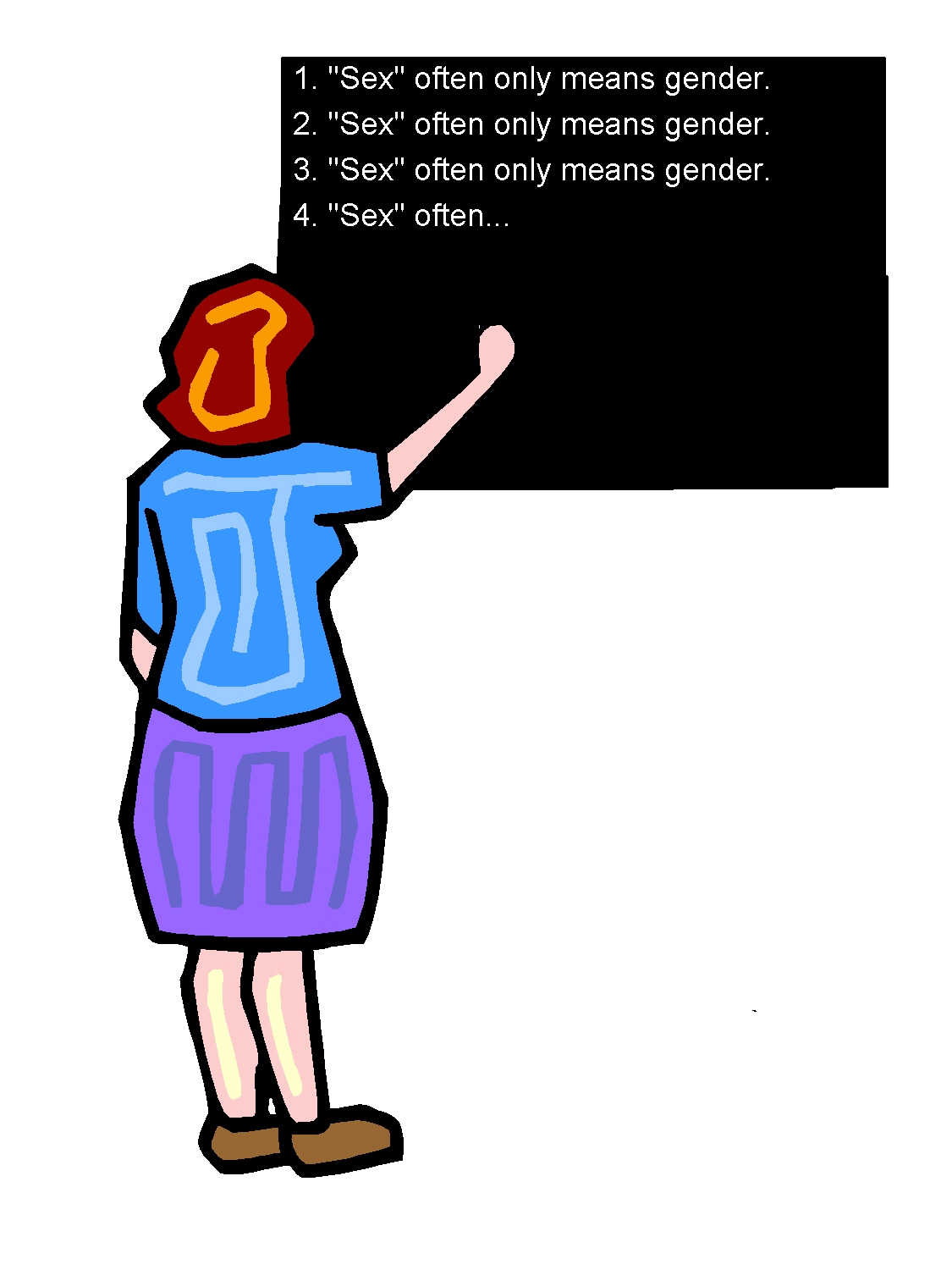
Now… for all those that saw the title of this post and thought I was going to write about something much different? You have an assignment:
Denise Portis

© 2010 Personal Hearing Loss Journal


Meniere’s Rant

I don’t usually go on and on about Meniere’s disease, but I’ve had a pretty bad week with the “little Rascal”. For one thing, I count myself extremely BLESSED as I seem to have only one major trigger. Rain. I know plenty of other folks who have other types of triggers that include flying, change in altitudes (vacations in the mountains!), alcohol, head cold or allergies, chocolate (oh my!), smoking, and even certain foods! So since I only have “rain” as a Meniere’s trigger, I really try not to complain very much.

A fellow Meniere’s patient pointed me to a terrific support group through Facebook today. I have already found a lot of great information. If you belong to Facebook… check it out here. There is a simple but helpful Meniere’s organization on the Internet which can be accessed here. A website providing basic information and clinical trials can be accessed here. My favorite website is the National Institute on Deafness and other Communication Disorders (NIDCD). They have a terrific Meniere’s Disease section that can be located here.  Thanks to the Meniere’s disease Facebook page, I was even directed to our very own Super Villain – Count Vertigo. Who knew?

Being a former farmer’s kid and because I still have numerous relatives that I love in a farming community in SE Colorado, I try to never belly-ache about the rain. Rain is necessary and in most cases a “shower of blessing” to farmers, ranchers, and those who get tired of moving their sprinklers around.

But this week? SIGH. I’ve had some bad experiences. On a rainy day, I fell in the laundry room this past week and happened to find the only exposed nail in the “unfinished room”. Thankfully, I hit it square and impaled myself through the fleshy part of my arm. I was able to pull it clean away and stop the bleeding very quickly. A quick verification that I had a tetanus shot recently, a severe pounding with the hammer on that (stupid) nail, and I escaped “nearly” unscathed.

This morning my alarm clock went off and my well-trained assistance dog was in my face immediately to “kiss me awake”. As soon as I sat up I knew it was raining outside. When the room spins the moment I become vertical, I rarely need to look outside to verify that it is raining. I didn’t fall until about 10 AM. Unfortunately, when I lost my balance I was on the stairs with my arms around a large load of laundry. Missing three steps means I have a pretty good chance of landing “gracefully” and still on my feet. Missing four however? Not a chance. I lay sprawled on the floor staring at the ceiling and a concerned hound dog with dirty laundry scattered all around me. I have a standard set of “OK, I’ve fallen – now what?” questions I ask myself.

1) Am I conscious? (duh)

2) Is anything broken?

3) Am I laying on anything important (like a dog or a cat)

4) Can I close my eyes and open them again and stay conscious?

5) Do I need to call a family member?

If I can answer No, No, No, YES, and NO… then I simply sit up and take my time to re-group. This time I didn’t hit anything other than my elbow on the way down. I may or may not be sporting a pretty blue spot tonight.

There is no cure for Meniere’s Disease. (Hope you aren’t new to the disease and I just depressed you for the remainder of the year!) There are some treatment options, but they only work for “some”, and all the options only serve to reduce the severity of symptoms or number of attacks. NIDCD lists several treatment options that include:

1. Medications – Prescriptions such as meclizine, diazepam, glycopyrrolate, and lorazepam can help relieve dizziness and shorten the attack.

2. Salt restriction and diuretics – I take a prescription diuretic and do restrict my salt. I’ve not seen any real difference, but continue to do these in case it has a cumulative effect.

3. Cognitive therapy – Doesn’t treat the Meniere’s but does help the patient deal with anxiety and coping with “future attacks”.

4. Injections

5. Pressure pulse treatment

6. Surgery

7. Alternative medicine. I take Manganese (5 mg) and a B complex vitamin. Researchers have found that Meniere’s disease patients have a Manganese deficiency. Manganese can be hard to find. (Magnesium is plentiful, but you’ll have to go to a specialty store or order online to find Manganese). Other treatments include acupuncture, acupressure, tai chi, and other supplements. Always tell your doctor if you are taking other supplements as many may interfere with prescription drugs.

This past year, Gene Pugnetti was surgically implanted with a special cochlear implant to treat his severe Meniere’s disease. You can read about the latest update here. The original story can be read here. I will be looking for updates about Gene and wish him the best!

Some things I have learned that help me with Meniere’s disease:

1. I take 5 mg of Manganese and a B-complex vitamin.

2. I limit my salt and take a prescription diuretic.

3. I take 50 mg. of Benedryl before bed.

4. I have inexpensive molding about 4 feet high along the hallway, kitchen, and bedroom. At night, if I have to get up in the dark, I only need to feel my way around the room to discourage getting disoriented. Without it, my eyes “play tricks on my brain” about how close the floor, walls, and doors are as I am struggling to see in the dark. The molding has allowed me to move about the house as needed in the dark without injury.

5. I never EVER go down the stairs without holding on to something. If I have something in my arms, I balance the “something” on one hip. On bad days, if it takes me 3 or 4 minutes to get down the stairs instead of 30 seconds, that’s OK. Patience is a virtue… and may prevent broken bones!

6. I avoid looking directly at ceiling fans or other contraptions that “spin”.

7. I do not ever ride roller coasters, or rides that spin in any way. If I am “spun” into an unconscious state, it is rather difficult to hold on! I made a promise to my family after “Space Mountain” in 2002 to avoid these rides for the remainder of my life. I’m finding it isn’t a difficult promise to keep.

8. I stand and sit with pre-meditation. To simply “pop up” or sit down quickly only means I will experience dizziness. Why bother when moving with a little more care will help to avoid it?

Hopefully this information may be of use to someone! I’m very thankful Meniere’s disease rarely necessitates I write about it!

Denise Portis

© 2010 Personal Hearing Loss Journal
Is INVISIBLE good?

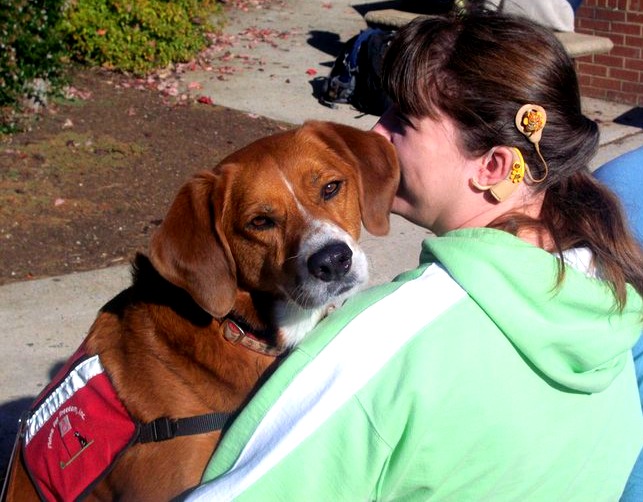
Chloe and Denise at 2010 Fall Family Weekend

A person that I know with invisible challenges (Fibromyalgia, IBS, and Chronic Fatigue) said to me recently, “Denise… you have mostly positive advocacy experiences because you make your invisible disability – visible. That isn’t always possible for other people with invisible problems!”

I thought about that statement for a week. Then I thought about it for another week. I actually thought about it for a third week, which for me? It’s nearly impossible for me to “simply think” on an issue without going ahead and blogging about it! I decided to do a “test”. I would dampen the visibility of my disability and see if I had any problems as a result. If you don’t want an invisible disability to ever become apparent – don’t get an assistance dog. Nothing shouts, “THERE’S SOMETHING DIFFERENT ABOUT YOU” more than having an assistance dog with you. Let’s face it… it’s not the norm to see a dog in a public place. Having a canine partner is not for the faint of heart, for you will have questions, be stopped constantly by admirers, skeptics and the occasional unattended child. Because of my balance problems, having an assistance dog has yielded far more benefits than any negatives. I wasn’t about to leave my assistance dog at home for the sake of a “test” so I had to think of other ways. Thankfully, those who know me well are so accustomed to seeing Chloe with me, she is almost invisible as well.

I have always worn my hair up since acquiring hearing loss. I made the decision early on to make sure my hearing aids could be seen. The decision came as the result of being knocked out of the way in a Sam’s warehouse in 2000. Someone had been trying to get by and I continued to look at the shelves since I couldn’t hear the “excuse me” in such a cavernous place. I think the woman who knocked me down was equally as startled as I, for she certainly had no intent of sending me to the floor. She said, “Why didn’t you move?”

I replied, “I’m deaf”, and watched the color drain out of her face. She helped me up and hurried away. That week I began to wear my hair up AND I opted to purchase brightly colored earmolds for my hearing aids. In 2005, I was implanted with the cochlear implant. It was very natural for me to continue to wear my hair up and to add the CI “bling”. Making an invisible disability – not – has helped me. The only time I’ve had a problem with my CI being so visible is when I would on very rare occasions run into a defensive, belligerent, culturally Deaf person who was vehemently against the technology.

So for my “test” I thought I’d wear my hair down and not have any visible assistive listening devices. I chose to do it on a “long” work day. Shortly after arriving at school I ran into one of my student’s parents. I couldn’t discern any difference in the way we interacted and communicated. I went to the office and made copies for my classes, and checked my folder for any notes from the administrator. My first class seemed to go OK. During discussion time, it can get pretty noisy. It seemed to me students addressed their desk instead of looking up when speaking, but I was very aware I could just be guessing at that. Another student helped me pull the overhead projector screen down and I could tell he was responding to a question with his back to me as he reached to pull it down. Again, I was very aware this was probably just my imagination and… after all what proof did I have that this doesn’t happen on a normal school day?

I was well into the afternoon classes and began to think that this was a poor test since all of my students know I have a hearing loss. I was already “plotting” to venture into a store or restaurant with my hair down for a more accurate test. That may actually BE a better way to test my theory, however I was surprised by a late afternoon comment.

After a requested “repeat”, a student said, “Oh sorry! I forget you have a hearing loss when your hair is down!”

Yes. I realize that my students interact with me quite a bit and are more likely to notice a change in my hair. This meant I needed a new test.

I went to Costco this weekend with my son. He’s 6’3″ and strong enough to assist with all those items we buy in BULK to save money. I deliberately wore my hair down. I hate going to Costco on a Saturday because it is always so much busier. However, I figured for this test… that would be a good thing. I pointed out items and my easy-going, “glad to be of help” son would load them up on the big cart. I had several people stop to admire Chloe and ask questions about her. It seemed pretty standard until my son pointed out…

“You know they only ask how long you’ve been training her because they can’t tell you have a hearing loss, right?”

Ta da! This was the proof I needed, right? Who knows. I did know that my friend with invisible challenges was right about one thing. I do try to make my disability visible and usually it is to my benefit.

I enjoy answering questions about my CI and my assistance dog. People ask great questions for the most part, and most are curious because they know someone who has hearing loss or someone that could use the assistance of a canine partner.

Should everyone with an invisible disability make it visible?

No.

Cochlear implant manufacturers produce the CI’s in a variety of colors… usually HAIR colors. Individuals choose a processor and magnetic coil based on their hair color in order to eliminate the visibility. The idea is to help you keep it “your business” if that is what you desire.

I’ve heard from others with invisible challenges or disabilities who have said:

1. I don’t want anyone feeling sorry for me. If I want someone to know about it, I’ll tell them at an opportune moment.

2. I don’t want my co-workers treating me any differently. It would be terrible if they thought any advancements or promotions I got were the result of special privileges.

3. I don’t want to appear weak. I have bad days but do my best to camouflage them.

4. I don’t want to draw a bull’s eye on my disability, putting me at risk for crime or making me a target.

5. I want people to know who I AM, and not judge me or define me by my disability.

These are legitimate and persuasive arguments. If you have an invisible disability or challenge, it is YOUR CHOICE how open you want to be about it. My heart goes out to those struggling with depression or mental illness. These challenges can be very difficult to disclose. Sometimes invisible challenges carry with them a stigma that can wound and demoralize an individual. Never forget that we are people first. We are NOT our disability or challenge. I chose to look at it as my disability is simply a part of who I am now… a new me. As we mature and/or age (as the two do not always coexist), all of us change. We may choose to color our hair, or take care of wrinkles through the help of a trusted plastic surgeon. Maybe we wear glasses or contact lenses now. Many choose to do what they must to avoid the stigma of an invisible challenge. Those who choose to keep their challenges hidden have the right to do so. I do not judge them and trust my personal choice is treated with the same respect.

Care to comment on why you do or do NOT make your own invisible challenges or disability more visible?

Denise Portis

© 2010 Personal Hearing Loss Journal

Exercising My Right to VOTE

Since my husband wasn’t going to get home until around 7:15 and the polls are crowded right before they close, I chose to walk to our polling place today. It was a beautiful, crisp, cold morning and required very little encouragement to get Chloe to make the long walk to go vote.

About a block from the school where we vote I stopped to get Chloe’s vest out of my bag and “got her dressed”. She looked at me sort of quizzically for I don’t usually “dress her for work” on a walk. She was immediately “all business” though and stayed in a proper “heel” instead of her “I’m on a walk meandering trot”. I entered the school cafeteria and stopped to remove gloves, scarf and unzip my coat. (Hey! I said it was CRISP!) While waiting in line a nice lady asked if she could pet Chloe. Chloe’s body always wags, “yes, please”, but I have to ask people not to pet her in vest in public places. Days my balance is “off” only requires her reaching for a friendly hand that I’m FLAT ON MY FACE. So I pleasantly explained why I couldn’t allow her to say hello, and continued waiting in line.

I didn’t have to wait long. Mr. “I really need a smoke” was sitting waiting for me and motioned me to come over. In this big cavernous, noisy room with hard floors, walls and high ceilings, I had to struggle to hear. Ever try to speech read someone who was chewing gum like a cow? This poor guy really needed his nicotine fix. I asked for a repeat on the birthday question 3 times. I finally pointed to my mouth and said, “I can’t understand you I’m afraid. Would you repeat that once again?”

I guess it was the hound dog head resting on the table top, bright bling on my CI and the fact that I asked for a repeat 3 times that he finally got that “light bulb” look on his face. He looked up, stared me square in the eye, moved his gum to his cheek, and clearly enunciated, “Birthday month and day?” Well WHEW.

Now I headed to a shorter line waiting for a poll volunteer to show me to a booth. The lady standing there waiting with me seemed friendly. She looked at Chloe, looked at me and said, “Oh wow! I saw you speaking to Earl! I can’t believe you are deaf because you speak so well!”

“Yes, most Americans with hearing loss actually speak very well and do not use sign” I explained.

We stood there waiting silently but I could see a funny look on her face like she was about to bust. The polling folks aren’t really suppose to have a conversation with you. Since I was ‘ready for it’ though I heard her whisper, “My husband can’t hear a thing even with hearing aids. It’s driving me bananas“.

Since she was trying to be unobtrusive I lowered my voice and said towards the floor, “Well I hear voices very well now that I have a cochlear implant. They require a very simple surgery and most folks I know do really well. You should have your husband look into it”.

She looked thoughtful and motioned to another worker to show someone BEHIND me to the next open booth. Again talking to the FLOOR she whispered, “Well I don’t know if he’d go for that”. (pause) “Does the dog come with the implant?”

I looked up to catch the wink so I just grinned and shook my head. “Sadly, but no!” I whispered back. I told the floor, “Well you should check into the Hearing Loss Association of America. They have a terrific website. You both could find out much more”.

Finally she could not delay any longer and showed me to an empty booth. “Push the card all the way in until you hear it click”, she said in a normal tone of voice. She turned to leave me to my voting and whispered, “Thank you!”

I took 15 minutes to vote and Chloe and I both got a sticker. (BIG GRIN)

On the walk home I couldn’t help but send up a quick prayer for this lady and her husband. Remembering how hearing loss once drove my own loved ones “bananas“, I really felt empathy for them. Hopefully she will follow through and find out more information about HLAA. I had to grin to myself as we headed up the last big hill towards my neighborhood. I went out to vote and ended up being pro-active about my hearing loss once again.

Funny how our own circumstances allow us to do that, isn’t it? I felt overwhelmed with gratitude to be able to have a whispered conversation to someone random that obviously had a “need”. It reminded me of one of my favorite “lists” that I periodically put around the house when needed.

Alice Gray‘s “Treasures of the Heart” seminar:

How to Put a Wow in Every Tomorrow:

1) Develop an attitude of gratitude: When you are experiencing tough times, remember the blessings in your life. It’s like sprinkling sunshine on a cloudy day.

2) Encourage others: When someone has a goal, most people point out the obstacles. You be the one to point out the possibilities.

3) Give sincere compliments: We all like to be remembered for our best moments.

4) Keep growing: Walk a different path. Take a class. Read something inspiring.

5) Give the gift of forgiveness: Forgiveness is a blessing for the one who forgives as well as for the one who is forgiven.

6) Take care of yourself: Exercise, eat a healthy diet, sing, and dance a little bit every day.

7) Do random acts of kindness: The most fun is when the other person doesn’t know who did it.

8.) Treasure relationships: Eat meals together, take walks, listen. Share laughter and tears. Make memories.

9) Share your faith: You can wish someone joy and peace and happy things, but when you share your faith–you’ve wished them everything.

Hope you went out to vote today!

Denise Portis

© 2010 Personal Hearing Loss Journal

We’ll Never Be the Same

“observe a leaf falling from on high…listen to the sounds it makes as it touches branches on the the way down…then the sound of landing. I didn’t realize until today that I can do that. I cried. Good thing no one was there. 🙂

A friend of mine penned the above words in her “status message” on Facebook, yesterday. Honestly? When I read the words, goosebumps erupted on my arms and neck and I felt an overwhelming emotion well up in my chest. I sat at my desk and “cried like a baby” if you must know. Deep, wrenching sobs that shook my entire body and caused my assistance dog to lay her head on my knee and look imploring up at me … asking to “help” as best she could.

Why?

Unless you’ve lost something and regained it through surgery, rehab, hard work, and perseverance you could never understand completely. When an individual chooses to be surgically implanted with cochlear bionics, they can only do so after their “natural hearing” has reached a point that other assistive devices provide little help. Many resign themselves to not ever hearing again “this side of Heaven”. To regain that and as an added benefit, the ability to interact and communicate with others, strengthening old relationships or forging new ones, repairing self-confidence and esteem, all “sweeten the deal” and make the decision even more lifechanging. For some, aural rehab goes very quickly, while for others that first year can be frustrating and challenging. In the end, we’ll never be the same. We will never take for granted our hearing and the ability to listen to the sounds around us. One becomes a part of a “family” of other folks who are “hearing again” as well. We get it. We understand. We’ll never be the same.

The Internet has changed our world, but there are some unheralded benefits of having the Internet. It has provided a connection for people with disabilities, health concerns, or chronic illness. Support groups and message boards exist for every type of health issue.

Those with the invisible illness/disability of fibromyalgia or chronic fatigue syndrome are connected to others who live with the knowledge that today things might be pretty good – but tomorrow you may be bedridden. Those with chronic, hard-to-explain pain disorders can communicate with others who live the same life and share the burdens and triumphs of living with a disease that WILL NOT squelch their inner spirit.

Those who have a loved one that has survived a traumatic brain injury can find others who “miss the person they once loved” and are “learning to love the person left behind”. They can share successes and set-backs, fashioning relationships with other parents, spouses and loved ones who understand because they LIVE IT.

Individuals who live with mental illness can connect with others who understand the stigma and prejudices. They can connect with others who are SURVIVORS.

People (finally) diagnosed with the new epidemic of Lyme disease can find a community of people who have learned how to talk to their doctors, discuss holistic practices that provide relief, discover medications and lifestyle changes that can make a difference in the number of recurring flares, and how to remain positive and proactive in living with the illness.

I have a cousin in the latter stages of treatment for breast cancer. Her “voice” has changed throughout this process and I can tell by reading her penned words that she has a new fascination, anticipation and appreciation for life. She will never be the same.

I think we are slow to recognize how hardship, tragedy, trials, and adversity can provide the surprising and unexpected benefit of a permanent change in hearts, minds, and bodies. For many of us our very foundation has been rocked and rebuilt. Life is different. Sweeter.

We’ll never be the same.

Denise Portis

© 2010 Personal Hearing Loss Journal

Walking in the Autumn

One thing I love about cooler temperatures, is that when “Chloe takes me for a walk” I can do so – HEARING. I’ll probably get “wrung out to dry” for this, but I do not usually exercise with my CI processor on my head. It’s not that I CANNOT, but more about a choice I made. I know people who run races with their cochlear implant! When I use to go to the gym, I would lift weights with my CI and my hearing “intact”. I don’t have a gym membership anymore, so my primary means of exercise is walking.

This summer I made the choice to walk in the cool of the evening without my cochlear implant. It is “wicked hot” here in Maryland on summer evenings, and I tend to perspire a lot. Oh gee… that’s stretching it a bit, because I honestly? I sweat! I walk “very fast”, much to the delight of my beloved assistance hound. It’s just short of a “jog” and because I move at a pretty good clip, I tend to perspire a great deal. I got tired of having to stick my CI in the “Dry ‘n Store” when I got home. After all, when I arrive back home I’m walking into a house full of people I care about. I want to hear them and interact with them. That doesn’t really happen if I have to go “deaf” upon my return from a walk!

However, it looks like cooler temperatures are here to stay for the season. (Hope I don’t jinx that!). One thing I love about the fall, winter, and early spring is being able to walk with my CI on and “working” since I do not perspire as much. It’s especially fun when walking for the first time in a long time WITH SOUND. I had forgotten that Chloe’s feet can actually be heard on the sidewalk. The sound of the breeze in the branches above the sidewalk sounds like music to these ears! Squirrels scamper about and “fuss at me” from lower branches of the trees as I pass. Those dogs we always see in fenced yards that either greet with a friendly bark and wag, or snarl/bark with a territorial warning, each have a unique sound, tone and “voice”!

I can hear the leaves skitter on the sidewalk in front of me as the breeze picks a few up and scatters them ahead. I can hear the distant traffic, occasional siren, or overhead jet… these peripheral sounds that make up the noisy world in which we live. Some of the “pressure is off” in walking with sound. I don’t have to concentrate so intently on the direction of Chloe’s attention, or worry about unheard traffic as I cross streets.

I think Chloe enjoys our walks more because I actually talk to her more. Isn’t that strange? I wonder why my voice tends to go SILENT when I cannot hear? I’m much more “chatty” as we walk along when I can hear the world around us. I realized I must talk infrequently when I took note that Chloe would turn her head to look at me. I realized she was startled to hear me talk! (I’ll have to make a better effort next summer of talking even when ‘deaf’)

In anticipation of winter, I look forward to hearing my boots on icy sidewalks and the sound of skeletal branches click-clacking in the cold wind!

Seasons of Life

Re-adjusting to hearing while walking at night brought a reminder of a parallel I’m currently experiencing. I’m at a “new place” in my life. At the age of 44, I have a child living on a college campus away from home. The “baby’ of our family is almost twenty and as a young man has really begun asserting some independence. (This is a good thing… though hard to adjust to not being needed like I was!) I’m in my last semester of school and feel the pressure of finding more part-time work come January!

It’s funny how different seasons in life we may “hear” differently. Specifically in hearing God, this often changes depending on the season of life one finds themselves living. At times, hearing Him is by choice… after all, He’s never the One who “leaves” or temporarily disconnects with us. Much like the choice to deliberately not wear my CI, I can choose to disconnect with God. It has happened in times of anger, depression, and even when everything was going “swell”.

It’s not that I’m coming back to the place of a LOUDER relationship with God. However, this season of my life I have found that I am having to lean more heavily on Him and on the power of our relationship. I guess you could say that right now, I really need God in my life… in an ever-present, constant sort of “coil connected to my head” kind of way! I have numerous little “worries” and concerns that seem to weigh heavily on my heart and mind. It’s just a season I’m going through. I’m thankful I’ve deliberately and consciously chosen to listen more carefully to God during this time.

Denise Portis

© 2010 Personal Hearing Loss Journal
Prepared For It?

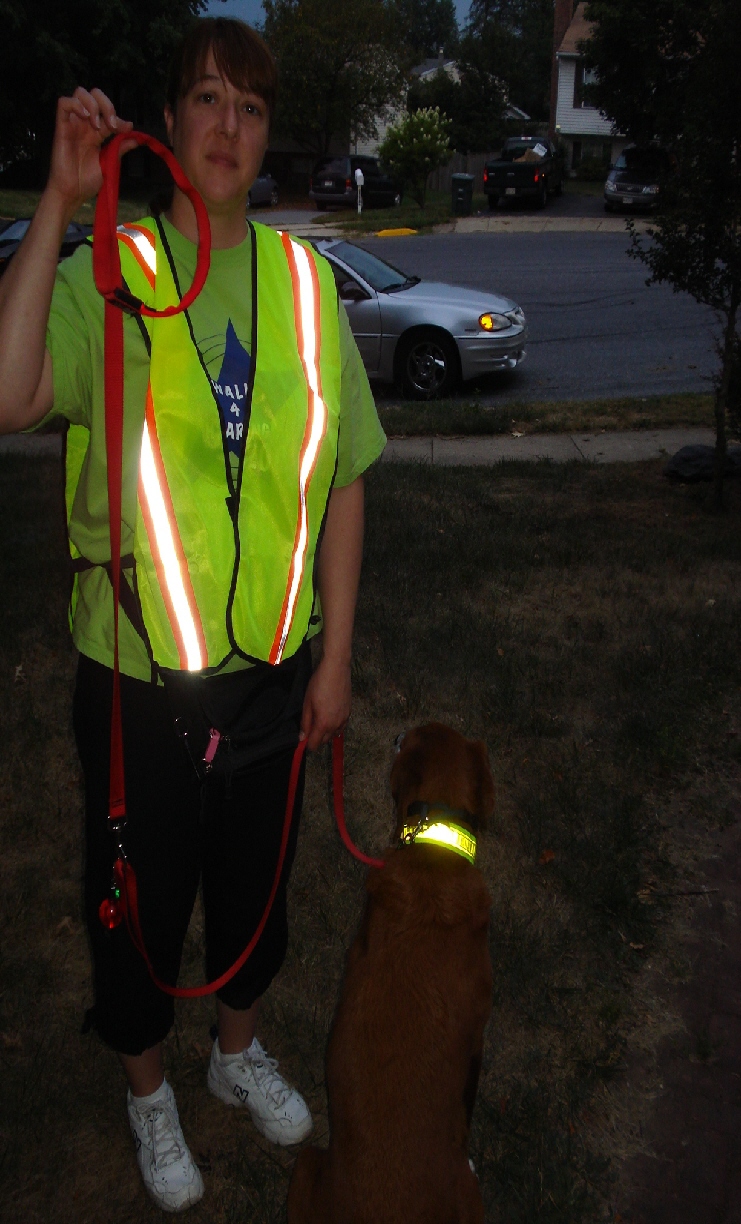
We simply do not take ANY chances

“The dog days of summer”… whew! Has it ever been hot here in my home state! I could take a repeat of last winter’s snows, believe me! I’ve always preferred 3 feet of snow to 3 weeks of 95 + temperatures! Because of the heat, Chloe and I have been forced to walk pretty late at night. At “twilight” it is dark enough that it isn’t safe to be walking. At least not in my neighborhood where people go 40 mph in a 15 mph zone.

To placate my husband, I make sure Chloe and I are decked out in a number of things that are reflective. I wear a reflective vest, and Chloe a reflective collar. The leash I carry actually lights up near the handle end, and it also sports “lighted bling” of various kinds. I’m sure from a distance we must look like Santa and his team of reindeer! Small price to pay … this GLOW IN THE DARK preparation — for a safe walk! I didn’t anticipate having to walk so late at night, yet preparation has made all the difference.

I’m safe.

It is cooler.

We walk faster.

No… really! Not sure why that is, but the big “loop” we walk is usually 7-8 minutes faster than if we walk when there is more light. Perhaps because we aren’t having to stop to get Chloe re-collected after startling a bunny? Either the bunnies have an early bedtime, or they simply are not seen as easily.

Just Because it Wasn’t Planned, Doesn’t Mean You Don’t PREPARE

I know of very few people who planned to acquire a disability or to be diagnosed with chronic illness. I have become acquainted with people who have progressive hearing loss or are deaf, people who have lost their eyesight due to Usher’s Syndrome, people with MS, Parkinson’s, Meniere’s disease, and Chronic Fatigue Syndrome, people with fibromyalgia and many others who find that they are living a life they didn’t exactly “sign up for”.

So what do you do?

Give up? Try to get a refund? Sue?

Well… most of the people I know “deal with it”. They do so in their own way, and for some it may mean working through it. Working through it for some people may mean that they have a pretty long period of time either denying the problem or grieving the problem. Each of us do this, but some spend more time on these steps than others. That’s OK. I get really aggravated when I hear someone tell a person learning to live with changes that affect their life that they need to “get over it” and “get on with life”. I guess I’m aggravated because the person saying that usually does not have the same diagnosis as the person they are preaching at! However, I do sometimes see someone who DOES share the diagnosis “preach” the same. Just because YOU did not grieve your hearing loss — or whatever it may be that you are dealing with — doesn’t mean that other people deal with the loss the same way.

Once you do work through that process, however, you can start to prepare. Preparation is key. For me preparation looks like this:

1. I always have #13 hearing aid/cochlear implant batteries. I carry some in Chloe’s vest, the car, my pocket book, and Chloe’s treat bag. I have them in my bedroom and my office.

2. My cane is right by the front door. If it is rainy or if there has been a pressure system come into the area, having my cane “handy” insures I actually take it with me out the door. No one “messes” with where I put my cane. If you move it, you risk life and limb (grin).

3. I leave early to arrive early. Let’s face it. It takes me longer to get to where I’m going. For one thing I travel with an assistance dog, and I have to spend a couple of minutes allowing her to “do her thing” before going into a public place. I have to load her up safely in the car. I have poor peripheral vision on one side so I drive the speed limit in a world where no one else does. I allow extra time to get to places ON TIME. Sure! I’m early sometimes, but I am rarely late.

4. I never walk out the door without my cell phone… and I am ZEALOUS about making sure my phone has a full charge. As a matter of fact… I have my cell phone on my person almost every waking moment. (Perhaps something to do with having a kid in college in another state now?)

5. I make it a PRIORITY to get eight hours of sleep. This is so important, I schedule myself to get at least eight hours. Heck! I’ll be honest… I actually do better with nine, so if I can schedule that I do! Having a cochlear implant is terrific! I love being able to communicate without having to actually be in the same room with someone. I’m fairly certain it’s not AGE… it simply takes a LOT of brain power to communicate now! Who’d have “thunk” that communicating with a hearing loss could be so exhausting. It doesn’t seem fair that no calories are burned! It is mentally (and sometimes emotionally) exhausting to communicate with hearing loss. If I get less than eight hours of sleep, it is very noticeable that I do not communicate as well. Fatigue will do that.

6. I make sure I travel with information about service/assistance dogs. You never know when you may have access issues. As a matter of act this has been a pretty prevalent part of our lives lately. (See the links here (with a video too!), here and here).

7. I avoid sodium, limit caffeine (something I find nearly impossible), and take Manganese! These three things I have found to be very helpful in limiting the effect Meniere’s disease has on my own life. Manganese is hard to find too! (Magnesium is plentiful… Manganese not so much). Remembering to make these “BIG 3” a priority, really makes a big difference in how severe my symptoms may be when an episode hits.

8. I memorize and use lines that best describe my communication issues and how I can solicit positive responses. These include:

A. You speak wonderful English! However, I have a hearing loss so I have trouble with accents. Could you repeat that a little slower please?

B. I have trouble understanding in background noise. If you would face me when you talk, I should be able to speech read and hear with my CI (point to it) and hear you much better!

C. I missed what you said. What I heard was (and I repeat the parts I heard). Could you repeat what I missed? (This way folks aren’t having to repeat EVERYTHING).

D. It’s so noisy in here that I am having trouble pulling your voice from “all this chaos”. Can we step over there (points) to a quieter spot? I really want to hear what you are saying.

E. Do you mind if we sit down? My balance is “off” today and if we sit it will give me one less thing I have to deal with!

F. Let’s step over here to talk so that I can put Chloe in a “safe place” so she won’t get stepped on.

There are many more… but it pays to rehearse and have specific examples to communicate to others your attempt at being proactive to help yourself. I have never… not even one time… had someone respond to these types of explanations in a negative way. Preparing explanations like this keep me from slipping and offending someone by spouting off:

A. Geesh, your accent is killing me! I can’t hardly understand what you are saying!

B. Would you quit mumbling and speak slower please? Gee whilackers!

C. HUH?

D. WHAT DID YOU SAY? (In a super loud voice trying to drown out all the noise. Now ever eye is on you and the person who was trying to talk to you).

E. (Denise is bumped and falls to the floor in a tangle of arms and legs… including doggie legs).

F. STOP STEPPING ON MY DOG!

Preparation = Ownership

In preparing and planning, a person with an acquired disability or chronic illness in essence choose to take ownership of their own life. It isn’t another person’s responsibility. It is ours. What ways do you prepare and “own” your life to better live with a disability or chronic illness?

Denise Portis

© 2010 Personal Hearing Loss Journal
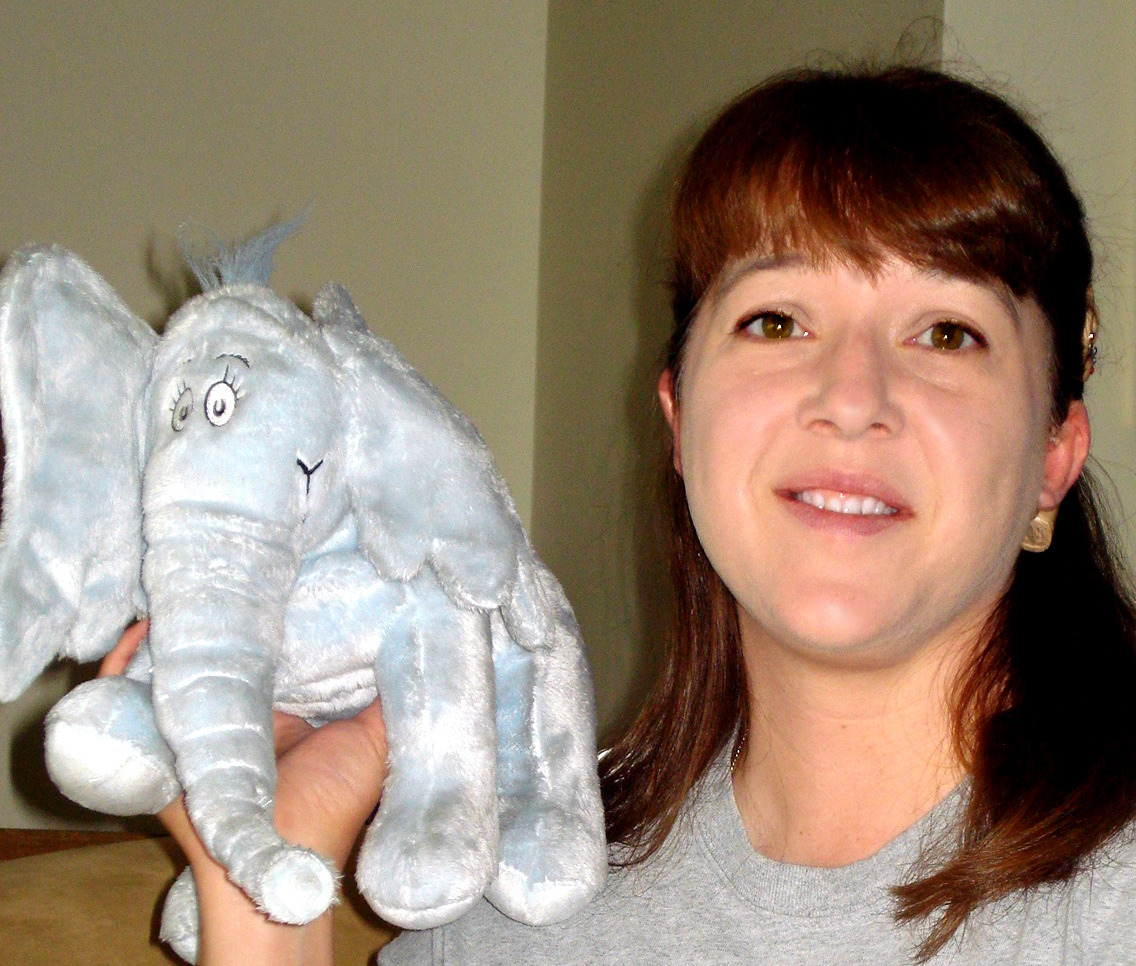

A Common Dust Speck

To others it was just a common dust speck. To Horton, it housed an entire world in need of assistance, with hundreds of lives at stake on the brink of being (gulp) boiled. “Common” is subjective, for what is commonplace and boring to one individual may be exactly opposite to another.

Losing to Learn to Appreciate

Having an acquired disability like hearing loss and a balance disorder often teaches me to be appreciative of things I once took for granted. Activated merely eight days before, what blended into the background as a normal, ordinary, and mediocre sound to my husband, was the astonishing, spine-tingling gurgle of sound to me! It took me 15 minutes to finally pinpoint the sound of the electric coffee-maker in his office.

“How could you not hear THAT! What a wonderful sound! It is so distracting! It fills the entire room!” I exclaimed.

“Honey, it is such a commonplace sound it doesn’t even register for me!” he replied.

I was stumped! This gurgle-burp, sigh of steam… commonplace? Doesn’t register? No way!

Subtle cues

If you’ve never had any experience with a hearing assistance/balance assist dog, there are cues that are subtle… even invisible to someone other than their partner. My husband is constantly amazed that I am able to scoot the cart out of the way of a “mother of two in a hurry” at a store when I only have one cochlear implant. Finding the direction of sound is quite a challenge. However, Terry isn’t watching what I’m paying attention to while we shop. If Chloe turns her head and pricks her ears up, I automatically look in the direction her nose is pointing. To me this subtle cue shouts, “Well! Would you look at THAT, Denise!”

When air pressure and bad weather create a vestibular nightmare for me, it is the subtle cues that Chloe and I communicate most effectively. On a “normal day”, I’ll drop something and can slowly bend to retrieve the object. However, on a “bad day”, I only need to look at the object I dropped and intercept Chloe’s gaze… for she has most certainly already noticed the dropped item too. Sometimes I only smile and she cheerfully retrieves the object! Other times I may point and ask her to specifically fetch something. (You don’t ALWAYS want your dog to retrieve dropped items. For example, my husband Terry dropped a large candle from the top of the closet this weekend. I did not want Chloe to retrieve any of the glass scattered over the carpet and had to “shoo” her away!)

Chloe may go through a day and only alert me to the kitchen timer a couple of times, my cell phone, and retrieve my garden gloves from the yard. Those tasks may seem very ordinary and commonplace. Yet without those alerts, my tea kettle would have boiled empty and the chicken defrosting in the microwave may have sat in there all day! I would have missed the call from my husband reminding me that he was working late. I would have had to retrieve those garden gloves myself in the middle of a yard with nothing nearby with which to pull myself back up! So common and subtle cues are subjective. They may be very important alerts that enable me to live more independently.

Just Help

I know people who do things to help others who are never noticed. They don’t want the attention. It can be something as simple as paying a military person’s meal for them when you see them in a restaurant.

Perhaps you help a mother get her stroller up on the curb, or take a shopping cart to the “cart corral” for a customer in a hurry.

Don’t ever underestimate any help you are prompted to give. We are called to serve… to make a difference. Even people with disabilities can help others. I know someone who is blind and deaf who emails “10 Blessings” a day to various people. As I’m the occasional recipient, I can tell you those blessings come on days I need them most.

You don’t have to have money to help. Most acts of service are free.

You don’t have to have a lot of time to help. Most opportunities take seconds.

Don’t ever look at a day as a “common” one. If you really set out to do so, you can make a difference in someone’s life.

If you listen really carefully, you may even hear…

“We are here, we are Here, we are HERE”

Denise Portis

© 2010 Personal Hearing Loss Journal
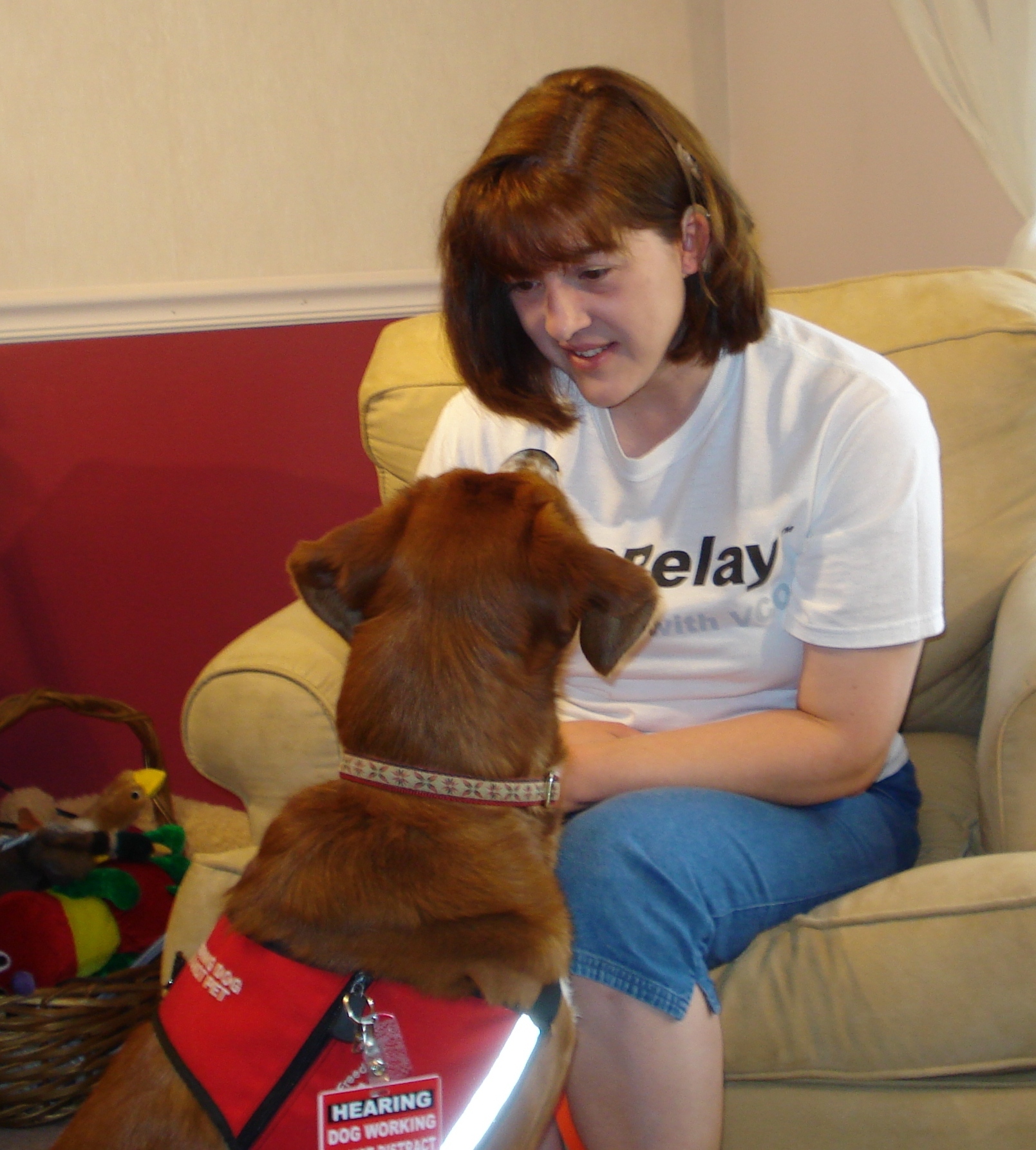

Community

I don't exactly blend into the background...

Recently Chloe and I were at our neighborhood grocery store. I rounded a corner and came face-to-face with a young boy approximately 6-years-old. His eyes grew wide as saucers and his mouth dropped open. Curious, I looked around quickly to make sure his astonishment was at my own appearance and not on someone in my vicinity. Since it was just Chloe and I… I surmised he was surprised at ME. He looked at Chloe carefully and read her vest. I could see his little mouth sounding out the words on her vest. I could “see the light bulb go on” for him about what Chloe does as her job. He took a step to the side and leaned so as to better see the side of my head. My smile let him know I was OK with that – I even turned my head so he could better see the cochlear implant. His answering smile seemed thrilled to understand as the result of his attentive perusal. I wasn’t prepared for what happened next. So unprepared was I, my own mouth dropped open in surprise!

A lady who looked like she’d lost a 7-year-old boy came around the corner in a near trot. She stopped dead in her tracks and looked with relief on the boy and waved at him to “get over here“. He shook his head “no” and signed, “Look (towards me)! Cochlear Implant receive me, able dog own can/able? yes?” His mother practically interrupted his sign and shook her head NO.

She signed back, “Dog want – cochlear implant want not. Appear normal important!” She took him by the hand and drug him away to the cereal isle. I stood there for a few minutes digesting what I had over – erm – HEARD. Obviously, she didn’t realize I am fluent in ASL. I stood there … in all my NOT NORMAL glory… not fitting in… while Chloe sat and stared at a box of Uncle Ben’s rice that happened to be nose-level.

I was speechless! For those of you who know me – well that is a RARE THING – THAT! I finished my shopping in a near-daze.

Not Normal

I wear “bling” on my cochlear implant and have a bright, red ear mold on the hearing aid in the opposite ear. I have an assistance dog who alerts me to direction, sounds I miss, and helps me with balance related tasks. You can look at me and guess pretty quickly there isn’t a lot NORMAL about me. But that isn’t because I have a hearing loss and balance problems. Plenty of people wear cochlear implants or hearing aids. Plenty of people have balance problems. I believe my not being “normal looking” lies in the fact that I make sure my invisible disabilities – AREN’T. There are numerous reasons for that… likely best left for another post. It is in my best interest to be visible. It keeps me from getting injured – although it doesn’t guarantee that.

Not everyone with hearing loss chooses to be as visible with bionics or assistive listening devices and technology. Not everyone with Meniere’s disease is partnered with an assistance dog. Yet this works FOR ME. I’m happy, confident and independent. Isn’t that what every adult wants, after all? Sure – like everyone I have things I am dependent upon. My faith – the love of my family – connections with others. However, what I choose to use in order to live my life independent of the help of others is my desire. I’ve taken steps that I felt were necessary to ensure that independence.

A “Brag” on the Hearing Loss Crowd

Can I just brag for a minute? Do you know that I believe people with hearing loss tend to be more accepting and understanding about differences than any other group? I am MOST at home in a crowd of people who all have hearing loss yet are extremely different.

Some have assistance dogs

some “sport” various CI’s represented by all three manufacturers of cochlear implants

some have vision loss as well

some have hearing aids

some wear neck loops and are using assistive devices

some use sign language

some carry notebooks and READ and WRITE messages…

Yet I am at home among this group. I was reminded of how at home I feel after enjoying the numerous pictures taken by friends who were able to attend the recent Hearing Loss Association of America convention in Milwaukee. Everyone “fits in” at these conventions. It’s much like a family reunion. I don’t agree with everything HLAA does, nor do I believe they always seek to fulfill their original mission. But one thing HLAA does very well is – COMMUNITY. Through forums, live chats, national conventions, state conferences, local support groups, and the Walk4Hearing, HLAA provides community to an every-growing population of people living with hearing loss. Being a part of this community encourages people to do more than live with hearing loss. This community encourages LIVING WELL with hearing loss. I think we all want an abundant life!

William Mather Lewis: The abundant life does not come to those who have had a lot of obstacles removed from their path by others. It develops from within and is rooted in strong mental and moral fiber.

Socrates: Living well and beautifully and justly are all one thing.

Latin proverb: While life lasts let us enjoy it.

Denise Portis

© 2010 Personal Hearing Loss Journal


Divine Deposits

~ All the blessings we enjoy are Divine deposits, committed to our trust on this condition, that they should be dispensed for the benefit of our neighbors ~  John Calvin

My young adult children enjoy going to the bank with numerous paychecks and depositing their money into both savings and checking accounts. I envy them sometimes, for my husband and I certainly cannot wait to deposit numerous checks. Instead we worry about looming car repair bills, vet expenses and other various “unexpectedness” that ensures every paycheck is automatically credited to our account.

This week I have been thinking about “divine deposits”, perhaps because I’m feeling DIRT POOR but more likely because I’ve experienced what it means to have someone deposit part of themselves into my life. No matter how hard things are in my life, I can always “count my blessings”. I’ve experienced financial crisis, loneliness, loss, fear, disability, heart break and depression; yet, I’ve never been completely bereft of blessings.

An old hymn once sung with some frequency before churches switched to more contemporary worship music, is entitled “Count Your Blessings” and written by Johnson Oatman, Jr. The first verse:

When upon life’s billows you are tempest-tossed,
When you are discouraged, thinking all is lost,
Count your many blessings, name them one by one,
And it will surprise you what the Lord hath done.

Bing Crosby use to sing a song entitled, “Count Your Blessings Instead of Sheep”. The first verse, crooned by this music legend, is:

When I’m worried and I can’t sleep
I count my blessings instead of sheep
And I fall asleep counting my blessings
When my bankroll is getting small
I think of when I had none at all
And I fall asleep counting my blessings

I’m certainly a believer in considering the “good” and recognizing the power of blessings perceived. However, I believe John Calvin best described the REASON for our blessings. Blessings aren’t actually blessings unless we turn around and do something with them. If we simply receive a blessing and let it “sit in our soul bank”, the value of that deposit plummets.

So HOW Do I Bless Others?

Oh sure! Some people use anonymous gifts of money to be a blessing to someone else. However, I believe that blessings are rarely monetary. The cash value of blessings may be low, but the eternal value is considered priceless!

I recently stood in the hospital room of a dear lady dying of cancer. She could no longer speak because of the difficulty in breathing. Yet even in her pain-wracked body, you could see the yearning in her eyes to “give back” to those visiting her crowded hospital room. Each person who entered was greeted with a small smile, warm pat on the hand and dazzled by the twinkle in the eyes of this “walking blessing”.

I know of people who have adjusted to a life-changing, unexpected hearing loss, who cheerfully participate in the Walk4Hearing so that others can benefit from the local and national support of the Hearing Loss Association. Cochlear implant recipients often become mentors to others who are thinking about being surgically implanted with these bionics, or are new to “hearing again”. An investment is made in the life of someone else… an investment of time, advice, friendship, and understanding.

The trainers at Fidos For Freedom are volunteers. Countless hours of dedicated training and expertise are poured into every match of client and canine. The trainers are not paid for their work… at least not on THIS side of Heaven. I believe these compassionate trainers do what they do because someone else invested in them… they are simply “paying it forward”.

Who Are Your “Neighbors”?

“All the blessings we enjoy are Divine deposits, committed to our trust on this condition, that they should be dispensed for the benefit our our neighbors.”

Sure, the neighbor that benefits from your own “dispensed blessings” may be someone who actually lives nearby. Yet a ‘neighbor’ is often someone you have never met. It is possible to even be a blessing without being consciously AWARE. This is the result of living a life in such a HABIT of kindness, that blessings just ooze from your pores and influence complete strangers!

“Pay it forward”. To whom, you may ask? Anyone you can! I’ll leave you with one of my favorite commercials:

Denise Portis

© 2010 Personal Hearing Loss Journal