Sometimes? All You Can do is LAUGH

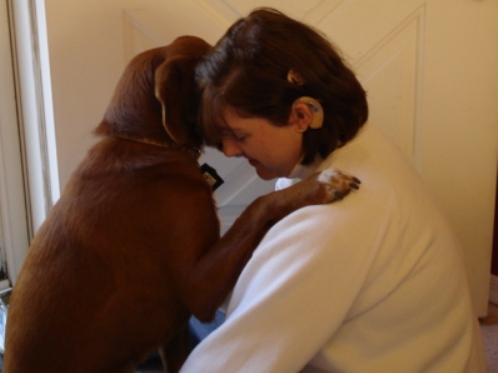
chloe hug

You’d think by now hound dog was accustomed to me bustin’ out into peals of laughter. I’ve done it often enough, after all! But I still take her by surprise sometimes!

I had a “Murphy’s Law” kind of day just recently. One of those days where if something COULD go wrong, it WOULD. Some interesting facts about Murphy’s Law and where it all began, visit this link. “Whatever can go wrong will go wrong”.

Chloe and I were walking one evening and the weather was DIVINE. Hardly any clouds, low humidity, and I had a “pep in my step”. For once, my Meniere’s disease was allowing me to walk at a pretty good clip with very little weaving. When I walk, I talk to my dog. Chloe would probably freak if I took a walk and was totally silent. It helps her pay attention to me, and I throw her name in there from time to time. However, sometimes I’m just…

Yackin’

Yup. Just talkin’ about anything and everything. It helps me to think out loud and I tend to go on and On and ON. I actually said out loud, “Wow, Chloe. Look at how easily I’m walking this evening! No wobbles! Moving along at a good rate! I’m smokin’!

Chloe gave me this LOOK. Almost as if she anticipated something going wrong after that lofty observation. Within 30 seconds (I kid you NOT), I stumbled on an ornery piece of elevated sidewalk and opened my mouth to shriek (for I do precious little QUIETLY) only to have a bee swoop in my open mouth as I began to fall into a nearby bush. So here I am choking on a bee, trying like crazy to spit it out while being impaled on various twigs and branches of a bush… a ROSE bush – wouldn’t ya know? So thorns grabbing me everywhere. Worse, it was damp earth under the bush thanks to recent rains so when I connected with the ground there was a obvious squishy sound and splat as my hip, knee and foot connected. So there I lay in the mud INSIDE a bush, choking on a bee, covered in thorns, desperately trying to hang on to my leash because Chloe was …

OUT THERE

SOMEWHERE

outside the BUSH.

I laid there a minute trying to go through my Meniere’s “play list” that automatically begins playing after I fall.

It’s a cute little jingle.

I’d share the wonderful lyrics with you so that you can sing along… but frankly I can’t carry a tune in a bucket and it’s one of those songs one whines and sings to oneself. So anyway… I run through the steps.

1. Am I dead?

2. Is anything broken?

3. Where is Chloe?

4. Can I move?

5. Do I need help?

So I was able to answer, No, No, *POINTS – somewhere outside the bush*, Barely, Yes.

I tried to turn to see if I could reach my bag. You know… the one with my cell phone in it that I carry in case of emergency? I can see it just out of reach out *there* near Chloe’s legs.

So… I asked Chloe to fetch the bag for me. She grabbed it up and ducked down to look under the bush at me. What she saw, made her drop her jaw and the bag tumbled back to the ground. Crap. Now my phone is laying outside the bag. So I tell Chloe to “fetch phone” – which is actually easier for her to do as it is something  she does several times a day. She grabs the phone, looks down under the branches again to where I lay and squirmed to reach my outstretched hand to give me the phone. Success!

Only… the phone is dead. That’s right, I carry around a phone with a dead battery on walks because it is SO helpful to do that. *rolls eyes*

So I decided that I needed to get out from under the bush. Easier said than done. I’m hung up, slightly injured, dizzy, muddy and on the verge of crying. Not a good combination. I thought, “Oh my gosh. I’m going to have to lay here until somebody walks by to help. How embarrassing! How will I explain this?” I didn’t have to lay there very long before I noticed that Chloe was now snuffling at my hung up hoodie sweatshirt.

TUG. YANK. R…I….P! Unbelievable! She tugged me free!

I rolled to one side to get out from under the bush and was wise enough to sit there a minute. Chloe plopped down and waited for me to “collect myself”. I fall SO OFTEN, if I am able to just go down without hitting my head I consider that a coup. So I checked out all my scratches and now torn clothing and thought that – heck. It could’ve been worse. It HAS been worse. So I started to laugh. Sometimes? All you can do is laugh. Chloe looked at me and just panted and “grinned”. It’s not the first time I’ve sat laughing covered in mud and trying to find the wherewithal to get up and keep going! (Likely won’t be the last time either!)

Can You Laugh at Yourself? Should You?

If you live with an invisible illness, have a disability, or a chronic condition, it can be helpful to learn to laugh at yourself. A great little article about the benefits of laughter can be found HERE.

But if you don’t believe in the power of endorphins or social connectedness, you still should learn to laugh at yourself. At least… that is my opinion. Here are some reasons I have learned to laugh at myself:

1. If I am laughing, it can reduce anxiety that others may feel when my disability pops up and causes me to do something like fall, mishear something, or other “Denise blooper”. Does it matter if someone else’s anxiety is lessened? Well… I don’t want people to feel uncomfortable around me. If I can laugh at myself, hopefully they will learn that I take who I am and my new “life parameters” in stride and am fine with it.

2. It reduces MY anxiety. Endorphins are real. It’s not some kind of borg nanotechnology that only re-routes and fixes sci-fy actresses. I FEEL BETTER after laughing.

3. If I laugh, it really helps me accept myself – just the way I am. You can’t change the unchangeable. I’m a klutz. I’m going to fall. As long as I’m in one piece and don’t have any odd bits of bone poking out anywhere, (Yeah, I know. Right?) laughing at myself helps me just accept what happened. It is MY WAY of embracing my flaws. This is who I am.

3. It helps me put things in perspective. While cackling like a hyena, I can take stock too. My little “jingle” may re-play. Some deep breaths – a mirthful hiccough or two, and I’m good as new!

4. Laughing helps me de-stress. Likely I’m laughing because I just did something that COULD cause me stress. (What if someone saw? Bet this mud will NOT come out of my jeans! Chloe tore my hoodie! I’m never walking again! As a matter of fact I’m just going to sit here on the sidewalk and feel sorry for myself! I’m going to stomp on my phone – when I finally get up. I hate my life! I want my mother… ) Laughing… de-stresses me. I can feel the tension roll off of my shoulders.

So I do believe “laughter is good medicine”. But…

There are perfectly good reasons to take the time to CRY too.

Or Scream.

… but those are best left for another writer to touch on! 😉

Denise Portis

© 2014 Personal Hearing Loss Journal
 

Watch Me

Chloe and Lewis

Want to get on my last nerve? Enjoy listening to me Sputter as I desperately try to spit out a response? Want to see this kitty’s claws?

this puppy’s teeth?

this chicky’s – erm – umm – BEAK?

Then tell me I can’t do something. Heck, I’m not even the “first born” in my family! The birth order norm fairy forgot to send the memo when I was born – “2 of 4”. I can be a stubborn behind. Sometimes this is very, very BAD. But sometimes? Sometimes this is very, very GOOD.

Do you know that I credit my “can do” attitude to my hound dog? The fact that I can say, “Watch me!” can be attributed to the fact that I am partnered with an assistance dog from Fidos For Freedom, Inc.

Yes. Perhaps I would have found my courage without her. I may have discovered I am resilient on my own. I may have responded to a “Hey! You can’t do that!” with the response of “Oh yeah? WATCH ME!” by simply growing and maturing. However, I can exactly pin point the moment in time when I grew self-esteem muscles.

Chloe jumped into my bubble bath with me when my phone rang. Her hearing alert was so ingrained, she was oblivious to the water and naked partner.

I was matched with Chloe in May of 2007. Shortly after that, Chloe came home to live with me and to do what she’d been trained to do. Alert me to sounds I could not hear. (Eventually she received additional training and skills to help me with my balance). I use to really enjoy bubble baths. This was before numerous concussions and worsening Meniere’s disease made the risk of drowning to real. Chloe was parked on the bath mat while I enjoyed that lazy bubble bath. I can’t tell you how startled I was to suddenly find my dog IN the bathtub with me and licking my face. My husband popped his head in the door and said, “Your phone was ring… ing. Ummm. Why is Chloe in the bathtub with you?

From that moment on, I knew I’d never miss a phone call.

… or alarm clock, or not be able to pick up something I’d dropped, or climb stairs safely, or know if someone was behind me in a store, and friends? The list goes on…

Watch Me

One of the early commands I learned was “Chloe – WATCH me“. Because I talk to my dog and would often say, “Chloe – look-it that squirrel, – or – look-it that bunny”, I learned NOT to say, “Chloe LOOK”. It would make her eagerly look around at whatever CRITTER I had seen before her! However, if I say, “WATCH me“, she looks right at me. She may cock her head and obviously listen for a command; much more than just meeting my brown eyes. However, she knows that “WATCH me” means “make eye contact – pay attention”.

Chloe actually tells me “WATCH me” as well. Chloe does it with her ears and head. When her head swings in a specific direction and her ears go up, I :  1) look at her and pin point where she is looking/listening, 2) turn to look myself. It may mean I need to step out of the way of something or someone.

Not LITERALLY

“WATCH me” doesn’t always mean literally, however. I was so cracked up at a meeting I attended recently. I was seated next to a person with low vision. We were in between speakers and were visiting while we waited for the next session to start. About 10 yards away, I noticed this man and lady plug up a power strip and run an extension cord over to their row in the auditorium. I interrupted my friend and said, “Hang on – they can’t do that! I’ll be right back. Watch me!

I stood up and walked over to the couple now fussin’ with how the cord should lay across the aisle. I put Chloe in a sit/stay and said, “Oh I’m sorry. You can’t put that cord there as there are a bunch of us in this area who cannot navigate safely with it stretched across the aisle“. They looked at me with a startled eyes and then around me to the section I was sitting in. I could tell by the dawning comprehension on their faces, that they spotted the service dogs, walkers, scooters, and canes.

Ooops. Sorry about that!” and they worked together to pick it up and roll it back into a nice handful of cords and plugs.

I casually walked back to my group and my friend said, “I saw that! Fist bump!” and she held up her fist for a “you go girl” moment.

Then it hit me. When I walked away I had told my friend with low vision, “WATCH me“. When I returned she said, “I saw that!” I started laughing. Not the kind of southern girl lady-like giggle. Oh no. I was hee-hawing. I managed to snicker out loud in between SNORTS what I had said – and what she had said. I nearly laughed myself into the floor. Yup. The kind of laugh where I had tears of mirth running down my cheeks and very unladylike hiccoughs to boot. My friend was laughing just as hard. She said, “We’re a pair, aren’t we?

You “see”, my friend? You don’t have to have 20/20 vision to be able to WATCH ME. You can pay attention with your eyes, your ears, or your hands. You can pay attention with your heart. You can pay attention – by PAYING ATTENTION.

It’s a focus.

It’s an attitude.

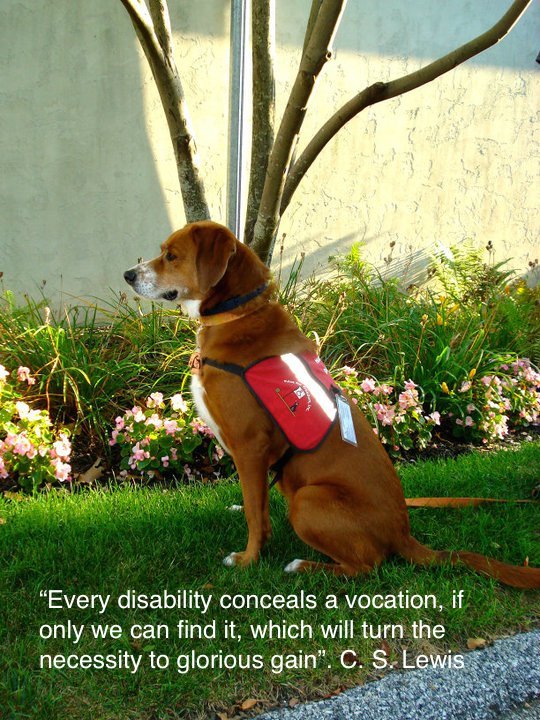
One of my favorite quotes (in the opening picture above) is by C.S. Lewis: “Every disability conceals a vocation, if only we can find it, which will turn the necessity to glorious gain”.

I recently had someone take me to task for self-identifying as a person with disABILITY. She argued that I was basically admitting I was unable to do something. I thought, “Well how wrong is THAT?”

Every person I know who lives with disability is actually someone who has learned how to do something IN SPITE OF challenges. You find a new way to do something. You learn how to do things safely even though it may not be the way a task is done by most folks. Perhaps you have assistance because of a device, service dog, or have simply learned to ask for help.

Yesterday while on campus, I needed to drop something off at the Disability Support Services office. My balance was “good” yesterday, so I exited a door that actually opened into a courtyard that had stairs bordering the perimeter. I felt confident to go up the 20 some odd stairs with Chloe. When I reached the top, an employee was standing there with big eyes, having seen me take a slow but steady climb to the top.

Hey!” I said cheerfully, and stepped around her. I looked up and was startled by a mass of people coming out of the gymnasium towards me on a very narrow sidewalk. I looked for an alternative path and spotted a way around through the mulch and picnic area.

Sensing what I was about to do, the lady beside me said, “Maybe you should wait“. I know she meant well. I felt no criticism, nor did I feel she was talking down to me. But… I was in a hurry, and I was having a good balance day. I had my service dog right beside me.

So I responded, “Oh, I’m ‘good’, no worries…” and proceeded to carefully pick my way around tree roots, pine cones, mulch and twigs. I didn’t retort, “WATCH me“, but if one could interpret the courage and attitude from my squared shoulders and confident stride, you would have “read that” in my departure.

Chloe and Fidos For Freedom were the “shot in the arm” I needed to become confident and independent. You may have found your own way to adapt. Having a disability does NOT mean you cannot do something. As a matter of fact, chances are if you tell someone who is differently-abled they cannot do something, you may discover by the set of their jaw, the determined look, and confident square of their shoulders that they most certainly CAN. Their body language screams,

WATCH me“.

Denise Portis

© 2014 Personal Hearing Loss Journal
Recurring Dreams… Life Goes On

1531649_10202502950992038_1907354485_o

One of my favorite chapters in “Introduction to Psychology” is the one where we study dreams, sleep, and the subconscious mind. Everyone dreams – though you may not always remember your dreams. If you have furry family members, you’ve learned that even pets dream. I’ve seen evidence of REM sleep in dogs, cats, hamsters, even cows!

Very likely, if you do remember a dream it is because it was a bad one. Or, you may remember it because it is a recurring dream. Interpreting dreams is tricky. Yes, yes, I know! Abraham, Jacob, Joseph, Daniel, and numerous others in the Bible made it look easy. It really is NOT that easy. If you have dreams that are bothering you, or have recurring dreams, don’t be afraid to talk about them with someone you trust. It can be a friend, counselor, or peer with a supportive role in your life. However, just remember, YOU are the expert on your dreams… they are YOUR dreams. Tartakovsky (2011) explains that there are indeed some universal symbols in dreams, however what those symbols mean to the DREAMER is what really matters. Someone else analyzing and interpreting the dream on your behalf is very likely inaccurate. In spite of knowing WE are the expert  when it comes to our dreams, recurring dreams usually end up making us “talk out loud” about what we are dreaming. Because you dream this dream OFTEN, you start thinking about it when you are awake. Most dream analysis experts agree that “recurring dreams reflect feelings and awareness that have not been successfully resolved in our waking lives” (Psychology Campus, 2004-2008, para. 4).

My Recurring Dream Had a Specific Trigger

I (like many of you) have a recurring dream and it always follows the same conscious scenario. Every time I fall and actually sustain an injury, I can guarantee I will have the same dream. I actually call it my “falling dream“.

Yes.

I do understand that by anticipating the dream, I am likely precipitating the dream itself. I get that. Now before you jump to conclusions, my dream isn’t about falling. Heck, I do enough of that in my conscious activity! I certainly don’t need it to happen in my subconscious mind – grin!

After a fall, I have a dream where I’m walking in a busy location with people everywhere, and all of sudden I’m frozen and cannot continue walking. Perhaps even more telling, my service dog, Chloe, is also frozen mid-step. Everyone around us continues to walk, talk, and move. Sometimes in the crowd I recognize people from my family, work, church, etc. Most of the time the faces are strangers, however. I can “hear” myself in the dream screaming (of course my mouth is not moving), “Help me! I can’t move! I can’t speak! Why aren’t you helping me? Can’t you see I’m frozen?”

So… yeah.  Please have fun with that and if you feel like commenting or emailing me what YOU think this probably means, go for it! I’m always interested in other’s opinions. Because the dream always follows a significant “Denise fall down – go boom” moment, I think I have this one figured out. I’ve had this same dream for over 12 years. The only thing that has changed in the dream is the addition of Chloe, my service dog. I was matched to Chloe in 2007. Goes to show the significant impact a service dog has on their person that she ended up in a recurring dream. <BIG GRIN>. Another change in the dream occasionally happens… but I’ll get to that later! <wink>

I believe this dream “for me”, means that I recognize that my “new normal” has an affect on ME, but not so much others. All the feelings, fears, bruises, even shame, is something I deal with in being differently-abled. However, it isn’t something that impacts others. Ever want to scream at the world to stop a moment and acknowledge that…

DARN IT. I’m dealing with this! Don’t you see? 

or

DARN IT. I suck at this! Don’t you see? HELP!

Life goes on. That’s hard, isn’t it? Isn’t it frustrating when you are sucker punched with a personal crisis of some kind and life just goes on as usual for everyone else? Worse? Life goes on for YOU!?

You lose someone close to you and crap. Life goes on.

You receive a diagnosis that will change your life. This sucks but life goes on.

Someone you trusted betrays you. It hurts but life goes on.

A progressive illness progresses. You adapt and life goes on.

You are sick and tired of being sick and tired. Life goes on.

Simple Acknowledgement

Most folks who live with invisible disability or a chronic illness will tell you that it is hard for them to share with others when they are struggling. This may be because they always seem to be struggling and figure everyone around them is sick and tired of hearing about it. We don’t want to be labeled as a “bellyacher”. Maybe you only rant to someone close to you. Perhaps you write. Maybe you pray. You may have some type of “release” that allows you to vent.

Sometimes my frustrations get the best of me and I bellyache out loud. However, most of the time I keep it quiet or at most confide in a trusted friend who “gets it” on a level that others cannot. I have a friend with MS who once told me, “Denise? I always feel like crap. I can’t respond to ‘How are you today?‘ with, ‘actually I feel like crap!‘. So I respond the way all of us respond, ‘I feel great, how are you today?‘. I can’t respond truthfully. People who do not have MS cannot understand what it is like to wake up tired, go to bed tired, and hurt all over each and every day. So I lie and say, ‘I’m great! How are you?‘ I don’t think this makes me a liar. This is how I convince myself I’m OK. I try to convince others I am.” 

You know? I don’t know very many people who live with significant challenges who want someone who will allow them to dump for hours each day. Griping for hours on end does not help physically, emotionally, or mentally. Most of us learn early on that perseverating on the negative only provides the ingredients for a significant meltdown. It is HUGE, however, to know we have a trusted peep or two that we can say, “Today is a bad day, but I’m going to be OK“.

Most of us simply long for a quick acknowledgment. Perhaps a short hug. I have a friend who has a seizure disorder and lives with chronic fatigue and pain whom I see about once a week. Like most folks, when we greet we say, “How are you doing?” I know this person well enough that both of us can say (on a day things aren’t going so well), “I’m not doing that great today, but things can only get better“. Or, “I’m not doing that great but I’m OK. Tomorrow will be better“. A pat on the shoulder and an understanding hug goes a long way. My friend doesn’t want me to grab her hand, drag her over to the side, and make a big production out of her “horrible, no good day”. If I say, “I’m thinking about ya“, or “How can I pray for you today?“, that is enough. You can see some of the tension roll off their shoulders. Simply acknowledging another’s pain or distress is A BIG DEAL. Salovey, Brackett, and Mayer (2004) call this empathy or emotional intelligence, and one can grow their EQ (emotional intelligence) simply by learning to acknowledge someone else’s feelings. It doesn’t have to be time-consuming. As a matter of fact, here are some great tips that will grow your EQ and help someone else:

1. Remember – and follow up.

Did someone tell you that they were having a rough day? The next time you see them ask them how they are doing NOW. By simply remembering they were going through a tough time and you care enough to follow up is HUGE.

2. Send a card.

My life has dramatically changed in that most of my correspondence is electronic. I buy one book of stamps each YEAR, when I use to buy that many stamps each month. However, I do shop for and keep inexpensive cards for “other” occasions (in other words, not birthday or anniversary), so that I can send a card off to someone who let it “slip” they are going through a tough time.

3. Follow up with a text.

It takes 10-15 seconds (depending on how many thumbs you have), to send a quick text. If you’ve limited time, don’t text an open-ended question. Just send off a quick, “Wanted you to know I’m thinking of you today and hope your day is better“. It doesn’t take much time and it likely means THE WORLD to that person.

A Significant Change in the Dream

Ok. I explained earlier that I do have one specific change that happens in my dream and over the years I think I have this figured out as well. Sometimes when I am “frozen”, a person or persons do come up to ICE CUBE Denise and Chloe, and try to help. Guess what? These are usually people I’m thinking about consciously, who are also going through something significant. For example…

I had this dream this past week after a fall on the deck. The injury was significant enough to warrant a doctor’s visit, x-rays, and a cancelled trip. I have been thinking about and praying for two specific people, both of whom showed up in my “falling dream”. One had surgery last week, the other is looking at surgery in her future. Both came and patted “frozen Denise and Chloe” and told my icy self that “everything would be OK”.

You know what? Having a support group MATTERS.

10538663_10204128535430633_9142153402343424683_n

It doesn’t mean that you need to join an organization (although there are benefits to doing so). It does not mean you need to find a group in which you stand up in a circle and say, “Hello. My name is Denise and I have invisible disabilities“. However, there is significant HELP in having a person or two who GET IT.

A tribe.

People who understand where you are coming from when you experience your life – your “normal”.

Thankfully, it is fairly easy to find those folks. The Internet has opened the door to really connecting with others who are like-minded, live what you live, and provide support simply because they truly GET IT. Maybe you have a friend or confidant who is that support for you, but they don’t actually share your diagnosis. But folks? Everyone has something. Life is hard. We all have difficult times. The two folks who showed up in my “falling dream” last week do not share my diagnosis. They do share living a difficult life but PERSEVERING. That’s why these folks show up in my dream. Support makes a difference.

You can be that kind of support. It will grow you. It may be time consuming at times. You may find a reciprocated “shoulder”. You may not. I don’t know about you, but at the end of my life I want to be the kind of person who patted a few ice cube people. I want to be that person who tells someone THEY matter. What they are GOING THROUGH matters. One of my dream goals is to eventually see a puddle under every person in my crowd.

Because we all deal with something.

We can help each other to thaw out by caring, listening, hugging.

Denise Portis

© 2014 Personal Hearing Loss Journal 
Psychology Campus (2004-2008). The possible meanings of dreams. Retrieved August 11, 2014 from http://www.psychologycampus.com/dream-psychology/

Salovey, P., Brackett, M. and Mayer, J. (2004). Emotional intelligence: Key readings on the Mayer and Salovey model. New York: Dude Publishing.

Tartakovsky, M. (2011). How to Analyze Your Dreams (And Why It’s Important). Psych Central. Retrieved on August 11, 2014, from http://psychcentral.com/lib/how-to-analyze-your-dreams-and-why-its-important/0005975

Folding Fitted Sheets and “Good ‘Nuff”

fitted sheet2

My newlywed daughter bragged to me recently that her husband can fold a fitted sheet. Pressing for details I found out that he evidently can fold them where they are laying flat.

… like they just came out of the package.

… making Martha Stewart proud.

I think I hate him (just kidding…)

I’ve seen various videos, blog posts, articles and pictures explaining how to fold a fitted sheet. I once saw a 5 step-by-step diagram of how to fold a fitted sheet on a beautifully laminated bookmark.

Because evidently we worry about that while reading…

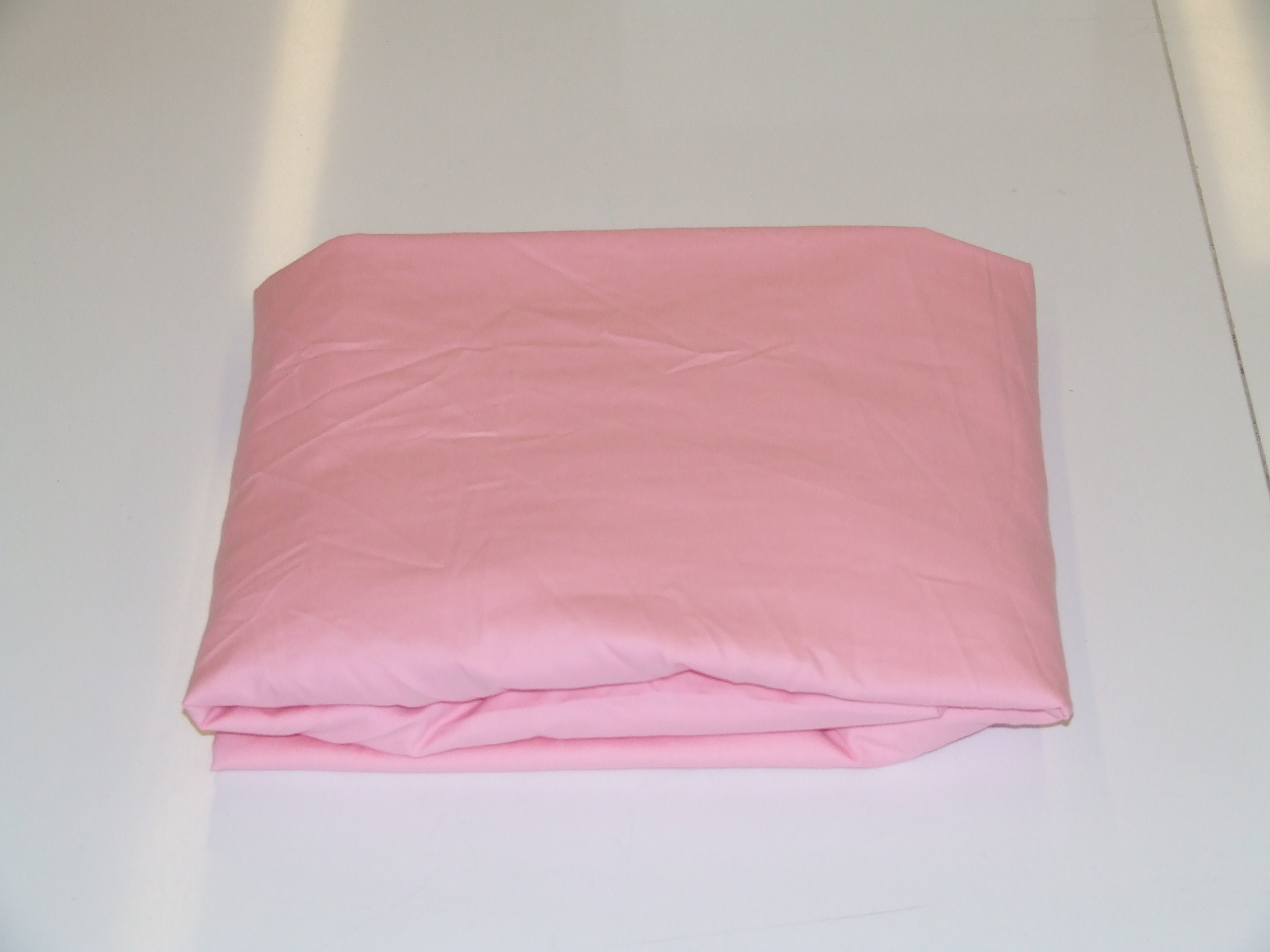
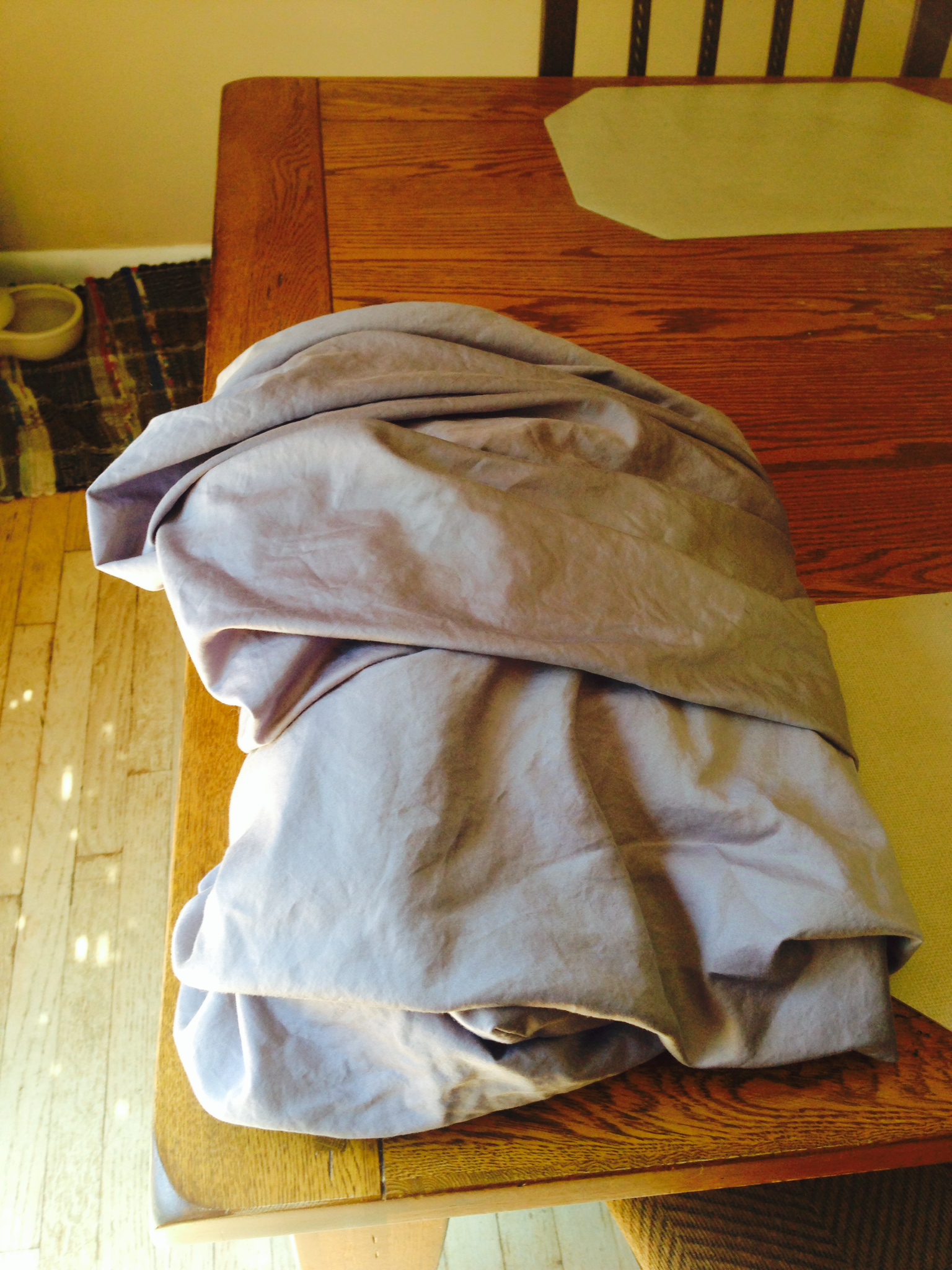
Evidently a newly laundered fitted sheet can look like this after folding...
Evidently a newly laundered fitted sheet can look like this after folding…

As a student and professor of psychology, it is fun to “look back”. Although I didn’t know it at the time, I definitely had OCD (Obsessive-Compulsive Disorder) as a kid. I’ve given some examples of things I would do to help me feel like I was coping and controlling in class before that made jaws drop. OCD can look different lived out in different people. For me, it meant ordering, organizing, labeling, etc. I had a full-size bed growing up with bright yellow “sunshiny” sheets. I’ve often wondered how that young, OCD Denise dealt with folding fitted sheets. Because you see? I can’t. 

Fold fitted sheets I mean. I must have gotten around that by only having one pair of sheets. When laundered, they went right back on the bed.

I’ve come a long way from that OCD Denise. Now some of you who know me WELL are saying to yourselves, “Honey? You’ve still got a long ways to go!”

But to give you an idea about how far I’ve come, look at the fitted sheet I folded this morning straight out of the dryer. As a matter of fact, I have my very own 5 step-by-step instruction guide:

photo-3


1. Remove from dryer and hold up high to avoid pet fur.

2. Shake to allow dryer sheets to fall to the floor.

3. While holding up high, match corner to corner.

4. Fold.

5. Admire work. It ain’t purty. But it’s GOOD ‘NUFF.

Stacked in a linen closet, it does not take up anymore space than one folded perfectly. At least… that’s what I tell myself. You see? I had to learn something. Sometimes you pat yourself on the back, murmur, “Good job!” and go on to something else. It’s “good ’nuff“. The sheets are clean, stacked neatly and await being put in use for the next time I change the sheets out.

Allowing a Fitted Sheet to Rock Your Boat

So when do you determine by reviewing your priorities, when to keep at that “fitted sheet” or when to determine it’s “good ’nuff”? Only YOU can decide.

I’m pursuing a Ph.D. in Psychology. I’m over half-way through and doing well. However, now I’ve reached the detailed statistics phase. And folks? I haven’t had statistics since the 80’s and long before the sophisticated analysis softwares were available. This past week I hit a wall. I mean that both literally and hypothetically. I have been staying up really late reviewing videos and media, reading, Reading and doing more READING, learning SPSS and writing like crazy. As a person who lives with invisible disabilities that include post-concusive syndrome, hearing loss, and Meniere’s disease, I require 8-10 hours of sleep each night just to live a “normal for me” day. I’ve not been getting that. I’m almost cross-eyed with fatigue. So this past week, falling more than usual as a result of that fatigue, I walked into my husband’s home office, showed him a new bruise from hugging a wall with ridiculous and unbridled passion, collapsed on the floor and bawled my eyes out. Do you know what my very wise husband reminded me? “You may not be understanding all of this. Just keep plugging away. By the time your dissertation is complete you will look back on this and realize you are very knowledgeable about your research and understand it well. For now you are doing ‘good enough’ and passing. You don’t need perfection at this stage“. Sometimes we have to “let go” of needing something to be perfect and accept that it is “good ’nuff”.

This past week a lady who has admired Chloe several times sat behind us in church. She leaned up and said something and honestly? I caught about 10% of what she was saying. (In case that doesn’t sink in, I was missing 90% of it <big grin>) I already had my cochlear implant on a special program to utilize the hearing loop in our auditorium. I’m one of the first people to tell folks new to hearing loss, “Don’t fake your way through a conversation“. However, it was obvious she was just saying something about Chloe again. She had a smile on her face, and I was set up to hear through the loop, not someone sitting on my “non CI” side and behind me. So I smiled and nodded my head and turned back to the front. Yup. Poor form on my part. But…

I have learned that if it is important and I responded with a smile inappropriately, someone will respond with a shocked or hurt look, confusion, etc., and I can hasten to explain I wasn’t hearing well. I didn’t see any of that on this lady’s face. She smiled, I smiled, and I determined then and there this “fitted sheet didn’t need to be folded perfectly”. For a few minutes I sat there thinking, “I have no idea what she just said!” I re-analyzed what I saw on her face, her indication of Chloe in a perfect down/stay and sleeping at my feet, a returned smile and decided, “You know? This fitted sheet (conversation) is not folded properly, but it is good ’nuff“! I brought my attention back to the service and felt OK about my decision.

This past Saturday, a fellow client from Fidos For Freedom rolled up to me in her scooter with service dog at her side. She has been with Fidos longer than I have and I consider her a friend and mentor. Another friend of mine and fellow client, Cara, is taking ASL (American Sign Language). She has been practicing her ASL with me during trainings. She is doing great (You rock, girl!). Cara noticed that I was talking to this other client who at times is hard to understand – especially when you have a hearing loss. Cara stopped behind the lady I was talking to and I know she was hesitating to see if she could interpret for me. I wanted this fitted sheet folded perfectly. I said, “I’m not catching what you are saying“. No faking nor presumptions on my part. This fitted sheet needed folded the right way because it was important to me. I love this lady and wanted to “hear” what she was saying. So she got out her little electronic board and began writing. It was what I needed to “hear” too. Cara waited long enough to see if I was “getting it” and then went on her way. I continued to communicate with this lady and left that conversation encouraged and with some great advice. I needed to hear her. I worked to hear her. She worked to communicate with me. Good ’nuff, wasn’t good enough. I needed to communicate 100% effectively with her. So… I did.

Living with invisible disabilities or chronic illness means that YOU have to decide what your priorities are and when to determine a task is “good ’nuff”. Only YOU can determine when you need to make sure something is accomplished to your satisfaction – to your personal standards. There are things you will decide to do that require work. It may mean you use up all of your reserves for the day. If you are into the “spoon theory“, you use every single one of your spoons. There are other things that happen during the day that result in the decision that, “this is good enough”. The worst thing you can do is stubbornly work at folding a fitted sheet that belongs to someone else. Worse, you allow someone else to bully you into re-folding one that you already decided was “good ’nuff”.

Are you one of those (annoying) people who can fold a fitted sheet perfectly? Well:

If-you-can-fold-a-fitted-sheet


Denise Portis

© 2014 Personal Hearing Loss Journal
False Coping Skills and Elephants

IMG_1238
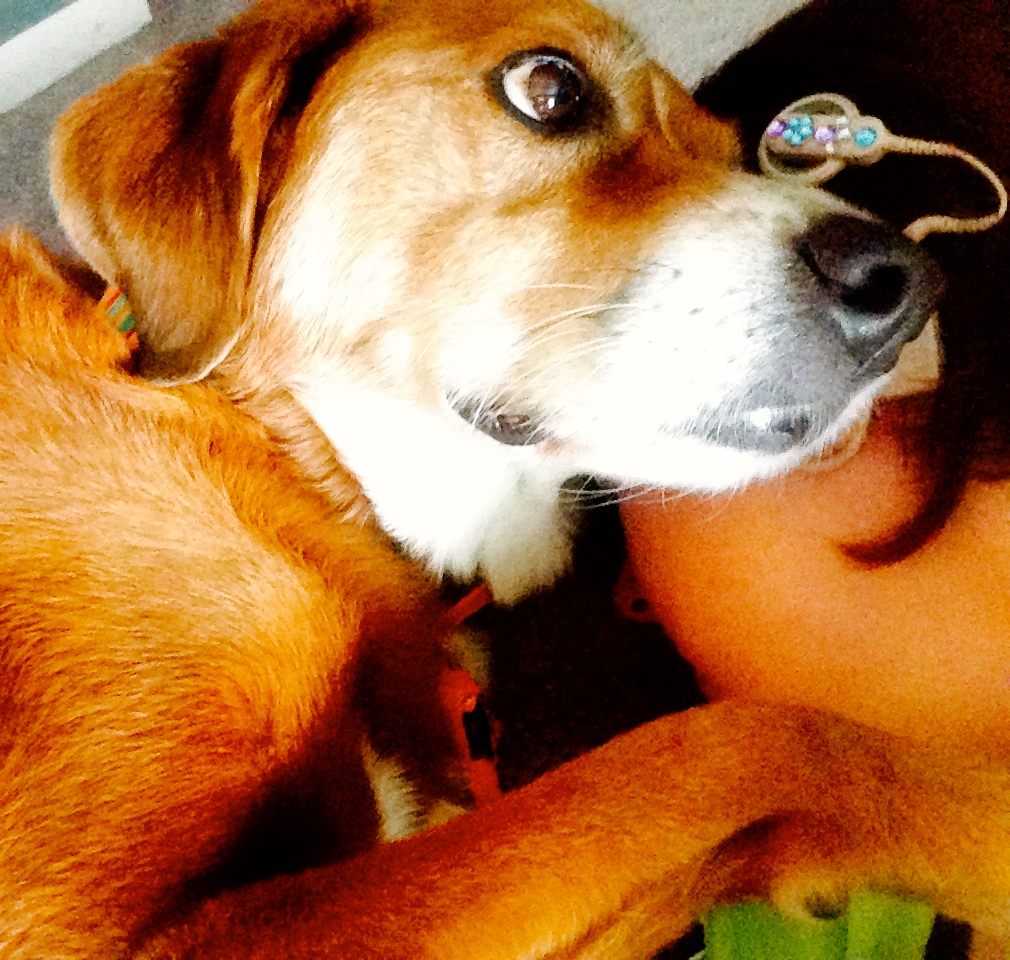
Hound dog knows when I’m “finished”

Ever wake up just feeling completely whipped?

I feel like I’ve developed GREAT coping skills. After all, you either learn to cope or you’re “done”. So the options are pretty clear cut IMHO. Two coping skills I learned early on in adjusting to my “new normal” as a person who is “differently abled”, include:

1. Start each day new. Yesterday is gone. Tomorrow will come without my worrying about it now. Handle today and today only.

2. Stay busy. Staying busy helps to keep your mind off your troubles and focus on the here and now. It can be busy-ness towards important things, or even the mundane.

The second one I use a great deal, but I’ll be honest. It isn’t exactly a HEALTHY coping mechanism. I don’t do well with a lot of down time. A perfect day for me is getting up (safely – believe me, it can be hard when you have a balance disorder and go VERTICAL for the first time that day), taking my dog for a walk while planning my day, re-enter the house in high gear without stopping until bedtime.

Yeah. Not always healthy. The problem with staying BUSY in order to cope is that it is a false kind of coping. This type of coping skill isn’t actually a coping skill at all. It is called avoidance. And friends? I do this really well. Some of you do too. (You know who you are…)

Staying Busy to Avoid

Do you “do busy” really well? It may be time to stop to discover WHY you stay so busy. Do you strive to remain busy to avoid unpleasant thoughts, actions, environments, even people? Don’t confuse healthy boundaries with avoidance. One is – well… HEALTHY. The other? Not so much. As a matter of fact, avoidance can lead to a number of physical and emotional problems. Psychologists have recognized avoidance for what it is for decades now. Yes, in the right context it can be healthy. But it is easy to AVOID to the point of harm. Spira, Zvolensky, Eifer, and Feldner (2004) explain that being busy to avoid our problems is actually a predictor of panic disorders. You see? The problem with staying busy to avoid something is that eventually you really will run out of things to do. Worse? Your body physically screams, “ENOUGH ALREADY!” and shuts down.

I am finishing up the last of numerous classes in my doctoral work and have already begun the very long process of dissertation study. This work keeps me really busy and it is work I actually enjoy because psychology is what I “do”. I work part-time as an adjunct professor and this helps to keep me busy. I love my work, love my students, and love to teach. The problem with working as part-time faculty at a community college is that it is impossible to predict how many courses you will be teaching semester to semester. For example, I taught the first summer school section, but not the second. I used the extra time in the beginning to catch up on some of my own school work and to do some “Spring cleaning” that had been long delayed… seeing as how it is SUMMER. These past few days though I’ve found I have had some down time. *grimace*

Forced Mindfulness

When I am forced to the point of literally running out of things to do… even for just a day or so, I find it debilitating.

Scan 3

Whoosh.

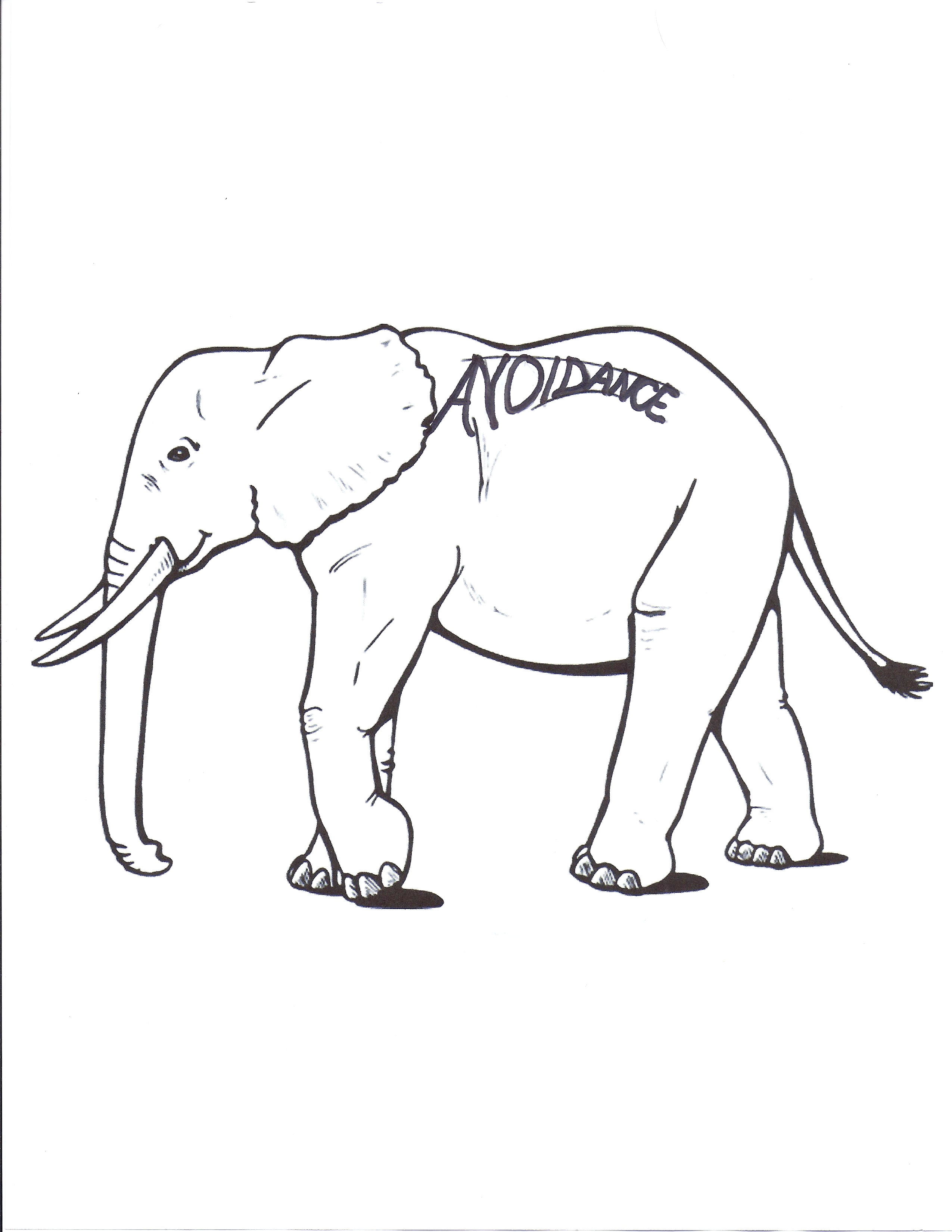
(Hear that? That was the air being sucked out of my lungs when the elephant in the room finally sat. On. My. Chest.)

I don’t do “mindfulness” well. I’m learning though.

Brown and Ryan (2003) explain mindfulness as being AWARE and ATTENTIVE. Let me explain on a more personal level and maybe you can “see” yourself somewhere in this:

Avoidance:

My new normal of hearing with a cochlear implant and living with a balance disorder is not easy. I’ve adjusted. Only to have to re-adjust. That’s OK. I’m flexible. Most of the time.

I work at a job I love and navigate life safely with a service dogMost of the time.

I am optimistic, cheerful, can poke fun at myself and enjoy busting my butt to help others. Most of the time.

I’m very busy and drop exhausted into bed each night and sleep well. Most of the time.

I have taken control of chronic depression and don’t let it control me. Most of the time.

I don’t feel sorry for myself. I like me. I recognize that I am doing well. Most of the time.

Truthfulness:

My new normal of hearing with a cochlear implant and living with a balance disorder is not easy. I’ve adjusted. Only to have to re-adjust. That’s OK. I’m flexible. Most of the time. 

Some days having a CI and Meniere’s disease sucks. I don’t hear perfectly. I feel left out. I’m tired of falling. I’m tired of running into things. I hate long-sleeves and high collars since they only hide bruises. I’m tired of adjusting. I’m going to cry. I’m going to scream. I may swear. 

I work at a job I love and navigate life safely with a service dog. Most of the time.

I love my job but it is really hard when the hallways are crowded. It can be overwhelming to have to rush from one side of campus to another. Crap. It’s raining? Really? *waves white flag*

I am optimistic, cheerful, can poke fun at myself and enjoy busting my butt to help others. Most of the time.

Sometimes I want to change my “… I’m fine, how are you?” to “I’m having a sucky day. And frankly? I don’t care how you are doing if you want to know the truth!!!!”. I’m going to have to ask for help. After all, Chloe cannot 1) retrieve a bag of dropped potatoes in the grocery store, 2) pick up that tiny paperclip without risk of swallowing it, 3) get the umbrella I dropped in a puddle without getting really muddy, 4) tell me EVERYTHING WILL BE OK.

I’m very busy and drop exhausted into bed each night and sleep well. Most of the time.

I can lay in bed and worry. 

I have taken control of chronic depression and don’t let it control me. Most of the time.

It’s hard when I have to “own” the knowledge that I will always “deal” with depression. 

I don’t feel sorry for myself. I like me. I recognize that I am doing well. Most of the time.

uh-huh. Ri -i -i -i -i -i…ght.

So yeah, sometimes I’m forced to pay attention and be aware. How is that helpful? Well, for starters attentive awareness facilitates choices of behaviors that are consistent with my needs, values, and interests (Brown & Ryan, 2003). It is healthy to really navigate personal feelings, thoughts, and even pain. David Cain wrote about mindfulness in a way that really “stuck” with me. It changed the way I view “forced attentive awareness”. Check out this great article, “How to Make Mindfulness a Habit With Only a Tiny Commitment“.

For me, mindfulness means being truthful with ME. I am learning to be mindful even when I am super busy. I do this because there will be days I am NOT busy and I want mindfulness to be an invited friend instead of unexpected guest. As a person of faith, it is also super helpful to be frank with God. In doing so, I am actually able to recognize false coping skills that in the long run are not healthy for me.

I’ve heard some folks say, “Oh golly. I can’t go there and allow myself to FEEL. You don’t know what I’ve been through“.

No. No I don’t. But I do know that pretending those feelings don’t exist do not change the fact that the elephant is THERE. At some point in time it’s gonna sit. On your chest. You won’t be able to breathe.

Be Mindful of Your Pachyderm

It is healthy to habitually and mindfully pay attention and be aware of what and who you really are. What are your struggles and successes? Where have you been, where are you now, and where are you going? Who is helping you get there?

What is really hard for you? What have you learned to do well? What do you need to change?

WHO ARE YOU? 

Don’t pretend that being mindful is the same thing as having your mind full. The latter is just another form of busy-ness on the cognitive level. Be attentive. Be aware. Do this with enough frequency that you can be mindful each and every day – for even just a few moments. I make it a priority to be mindful for a longer period of time – like a whole DAY, at least once a year.

But the elephant “sat” without invitation for me this past week. It took me by surprise. That is going to happen. However, if you’ve practiced mindfulness, you are going to discover…

YOU CAN BENCH PRESS AN ELEPHANT.

Denise Portis

© 2014 Personal Hearing Loss Journal

Brown, K., & Ryan, R. M. (2003). The benefits of being present: Mindfulness and its role in psychological well-being. Journal Of Personality And Social Psychology84(4), 822-848. doi:10.1037/0022-3514.84.4.822

Cain, D. (2013). How to make mindfulness a habit with only a tiny commitment. Rapitude.com. Retrieved July 20, 2014, from http://www.raptitude.com/2010/03/how-to-make-mindfulness-a-habit-with-only-a-tiny-commitment/

Spira, A. P., Zvolensky, M. J., Eifert, G. H., & Feldner, M. T. (2004). Avoidance-oriented coping as a predictor of panic-related distress. Journal of Anxiety Disorders, 18(3), 309-323. dii: 10.1016/S0887-6185(02)00249-9

Inclusion

back up1

A friend of mine from high school works for KIT (Kids Included Together) and I’ve enjoyed following her training schedule on FaceBook as it takes her literally all over the world. KIT, “… specializes in providing best practices training for community–based organizations committed to including children with and without disabilities into their recreational, child development and youth development programs” (KIT, 2014, para. 1). I touched base with her recently to ask if she and I could dialogue about what inclusion looks like on a community college campus. I want to be more involved at my workplace with the Student Services department and Disabilities office to help raise awareness about what disABILITY, chronic illness, and invisible conditions are (and are not), and to help train professors and staff to provide an atmosphere of inclusion, acceptance, and a place to grow for all who are differently-abled.

There seems to be such stigma attached with certain diagnosis or disABILITIES. I cannot stress to fellow professors how important it is to let students know at the very beginning of class:

1. You welcome transparency about any and all invisible illnesses, chronic conditions, or disabilities.

2. You provide assurance of confidentiality.

3. You provide a platform in which students can provide feedback about classroom procedures or policies that make it difficult in light of their diagnosis or condition.

4. You become a “safe person” to any who wish for a faculty advocate to coordinate with Disability Support Services and/or other faculty.

Some unfortunate stigmas attached to living with a disability or chronic condition, include:

1. You are looking for special favors because you are “special”.

2. You are not capable of doing well in class because you have to do things “different than the norm”.

3. You have a persecution complex.

4. You are a drama queen/king.

Some of the strongest people I know are people who live daily with an invisible illness/disability or chronic condition. They not only often have to find “new ways” to do something that to the normal person seems “easy” (for example, washing hair… pretty darn difficult if you have a balance disorder), but they also have to navigate a world that harshly criticizes, misunderstands, or labels folks who struggle with these issues. Some of the most difficult invisible illnesses to positively advocate for are those with mental illness or disorders. Good gravy, talk about your stigmas! They are often considered “crazies” or “fragile”, and people often avoid them after disclosure. This sucks IMHO. Some of my favorite people are those who happen to have mental illness or disorders. Talk about your resilient people! 🙂

Real Responses that HELP

As I have been thinking about inclusion from an adult perspective, I have found that in many arenas, peers, co-workers, and colleagues want to make their event fully accessible to you but do not know where to start. I have learned in the decades I’ve lived with invisible disABILITY, that we should strive to not only point out the problem – but also the solution. So here is where I need your help. I want to put together a document that can be downloaded by readers so that folks can use the collaborated effort of YOUR ideas to assist when they have problems of their own.  So email me your examples, and I will include them! denise.portis@gmail.com  – in the subject line please put: Hearing Elmo Problems and Solutions.

Here are some examples of my own to get your brain working on ideas yourself! Not all are “cut and dry” problems and solutions. Sometimes the solution is simply a candid response. Read on:

1. PROBLEM: It doesn’t help when you yell when I’ve indicated I can’t hear you as added volume distorts your words and draws attention to both of us.

SOLUTION: If I have indicated I didn’t hear you, please make sure you are facing me. It helps me to see your face. Speak in a normal tone and try not to over-enunciate words as this distorts the way it appears on your lips. If I still cannot make it out, consider writing it down, or re-phrasing it.

2. PROBLEM: It’s great to have accessible venues as long as the accessibility options are available.

SOLUTION: Are there elevators available for those who cannot take stairs? Please make sure these are not blocked. (At a recent workshop I attended, when the elevator opened, the registration desk was backed up to the opening, blocking the exit. They were horrified and quickly moved things, saying, “We didn’t know someone was attending who needed this“. It’s actually against the law to block accessible options from use. This includes handicapped parking, bathrooms, ramps, making sure hearing loops are actually switched on and working, and much more. (I once complained that the handicapped stall in the ladies room had been “out of order” for a couple of days and was encouraged to use the other available stalls until it got fixed. WHAT? *grimace*).

3. PROBLEM: People think if I just plan ahead and “rest up”, I will be able to participate in an event.

SOLUTION: When I have to bail even last minute on something I hoped to attend, I try to provide as much notice as possible. You may need to remind organizers or colleagues that how you feel “day to day” is often out of your control and that you regret the late cancellation. Something as uncontrollable as the WEATHER can wreck havoc with my plans. We aren’t trying to be butt-heads and we very likely really wanted to participate. Please do not make it worse by giving us a hard time or insinuating we planned poorly.

4. PROBLEM: The workshop has several small group activities but the room does not allow the groups to separate very far. This may cause difficulties for those with any degree of hearing loss with the “bee hive” effect.

SOLUTION: Go up to the workshop facilitator and request to allow your group to go out in the hallway, or a nearby room so that it is quieter so that you can participate. (If you know in advance the workshop may incorporate these kinds of activities, see if the conference/convention center has assistive listening devices, or invest in your own so that you can carry it with you always. Be a “hearing loop” advocate! http://www.loopamerica.com/?gclid=CjkKEQjwttWcBRCuhYjhouveusIBEiQAwjy8IG2XkFTiQkOxeExJVBKV8kaOwZxqjxKgqTGAMSh4Ktzw_wcB)

I look forward to receiving your own ideas and together presenting a form we can share!

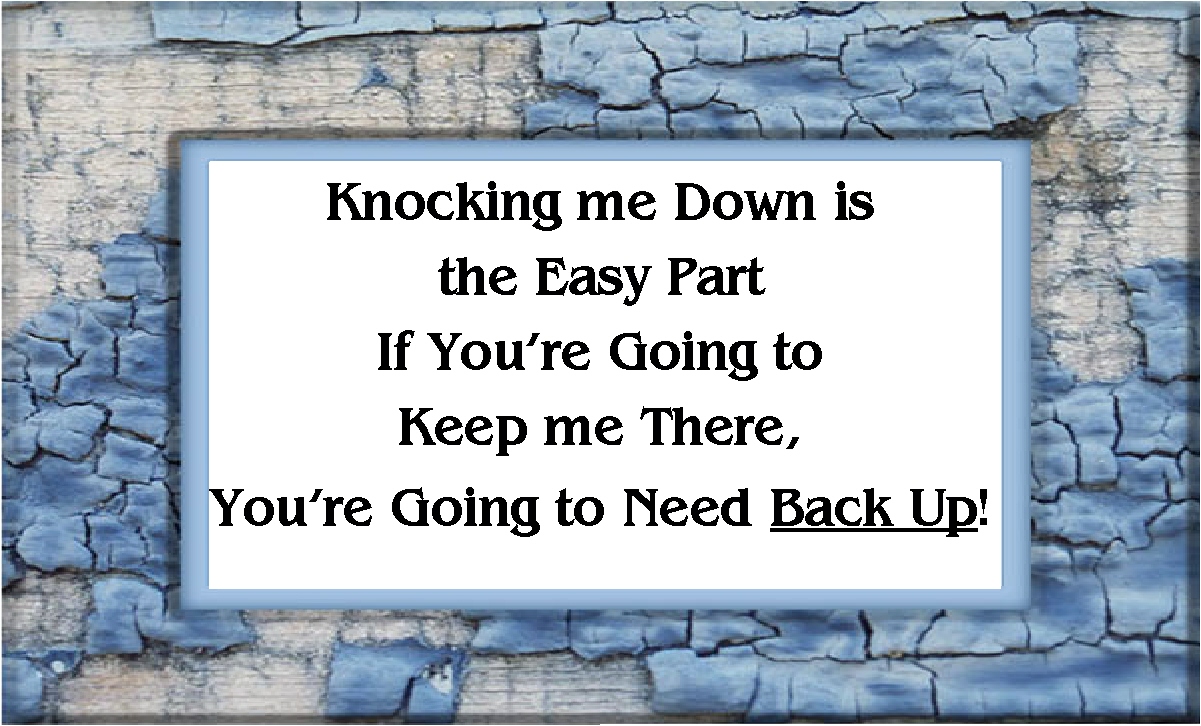
Finally, you may be wondering about the picture I chose for this week’s post. The truth of the matter is, we all have the power to wound or injure another person with words, actions, or lack of action. I want to remind my own community of folks who live with chronic illness, or invisible disability that you are not alone. Yes, people can and will hurt you. But there is strength in numbers and you are not alone. I get knocked down from time to time, but you seriously are going to need “back up” to keep me down. This community is very resilient. We bounce back because we’ve learned there aren’t a lot of other options.

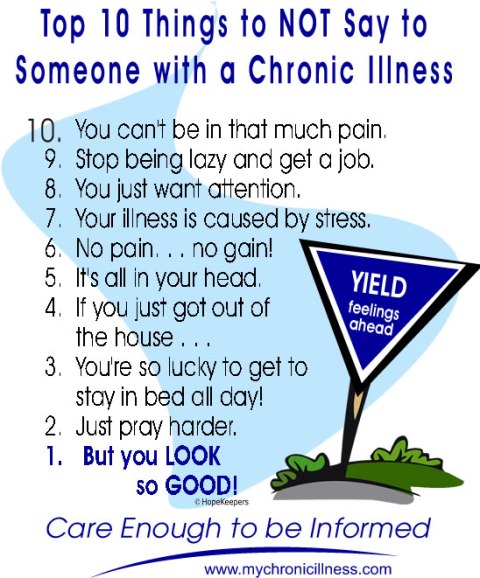
Send me your own ideas of problems and solutions to things that you have perhaps experienced yourself. I leave you with one of my favorite “list graphics”:

my chronic illness

Denise Portis

© 2014 Personal Hearing Loss Journal
Kids Included Together (2014). KIT: About us. Retrieved on June 8, 2014, from http://www.kitonline.org/html/about/kit.html

Beaver – Destructive or Discerning?

swimming-beaver-344367-m

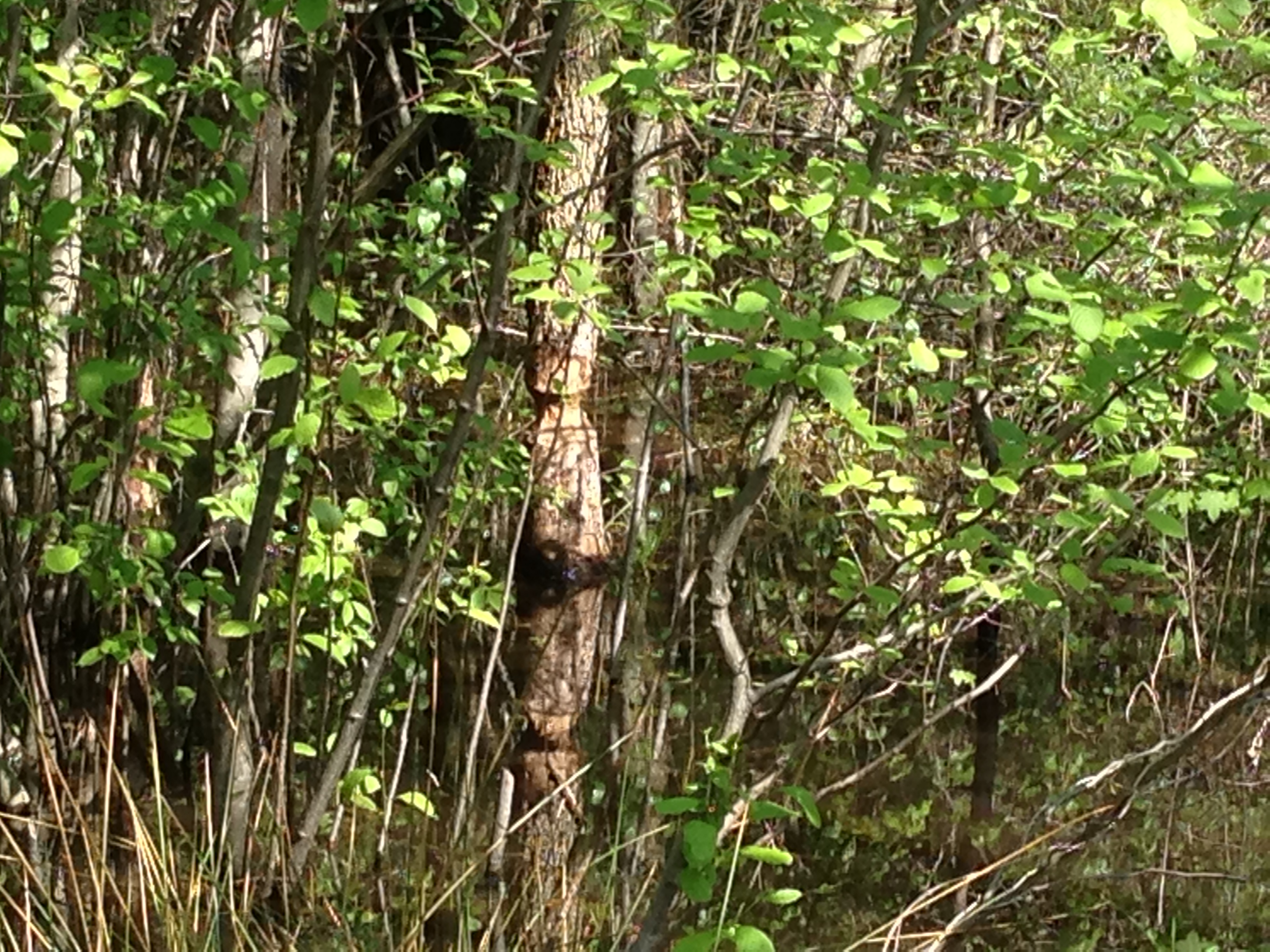
We have beaver. Actually, we’ve had beaver for about 16 months now, however this summer it is really evident WE HAVE BEAVER.

Our townhouse community sits up at the top of a hill. It is a closed cul-de-sac community, so it is great that “through traffic” is not an issue here. A brand-new walking path is now within footsteps of my front door. It will eventually connect to other walking paths, but for now it is about 1.5 miles round trip. At the bottom of our “hill” the path takes us by both a busy road, and what was once a small creek. In the Spring, I use to get a kick out of “hearing” the water sounds, especially after heavy rains. Last Spring those water sounds disappeared. However, I spotted this:

beaver10

… and then this:

beaver11

The creek quickly turned into a pond. And this year? Well let’s just say there is a new ecosystem near my house.

I came across a huddled group of homeowners about 3 weeks ago, whispering and gesturing towards the pond with banks now within 60 feet of our back doors. I stopped to see what was going on, and because it was early enough in the morning with few traffic sounds, I could actually hear their whispers.

“Will the water level rise much more?”

“What do you think they are up to?”

“Do they bite?”

Now my first thought was, “FOLKS. Beaver do not understand human language and to my knowledge they don’t have bionic hearing like I do. Why the HECK are you whispering?”

I didn’t voice those thoughts. Instead I said, “Ummm” (I’m ever so eloquent…)

Yeah, but have y’all been down to the pond area where the walking path is? Have y’all seen what has happened down there?

Blank looks. I discovered they don’t comprehend SOUTHERN. I tried to speak a little more cultured…

Yes, you should walk down there. There are 2 HUGE culverts about 8 feet in diameter. That water level will never get any higher unless those culverts become dammed up as well. If that happens, the city will just unplug them. After all, that road will flood before our homes will“.

Blank looks. See what a lack of exercise will do? Go walking folks, go walking. Check out what the beaver have done up close. Geesh. I think they were miffed I was talking in a normal tone of voice. After all… *sneaky whisper* … the beaver probably HEARD ME.

Beaver have made a comeback in Maryland. I pulled this from a neighboring county’s website:

“Beaver can be among the most beneficial of the county’s wildlife. They create favorable habitat for a variety of wildlife species including fish, birds, amphibians, reptiles, and mammals. This variety of wildlife is in turn valued for recreational, scientific, educational and aesthetic purposes. Beaver activity is also helpful in retaining storm water runoff and improves water quality by trapping sediment, nutrients, and pollutants. Beaver activity can also cause flooding of roads, trails, forest land. They also consume trees and shrubs. Their impacts often occur suddenly and dramatically.

These benefits and detriments often occur simultaneously at a single location. Because of the varying degrees of tolerance levels among people to beaver activity, there are bound to be disagreements on how best to “deal” with beaver conflicts.” (Howard County Parks and Recreation, 2014).

Living side-by-side with these amazing creatures is fairly simple. I’ve been thinking a lot about this family of beaver.

beaver3

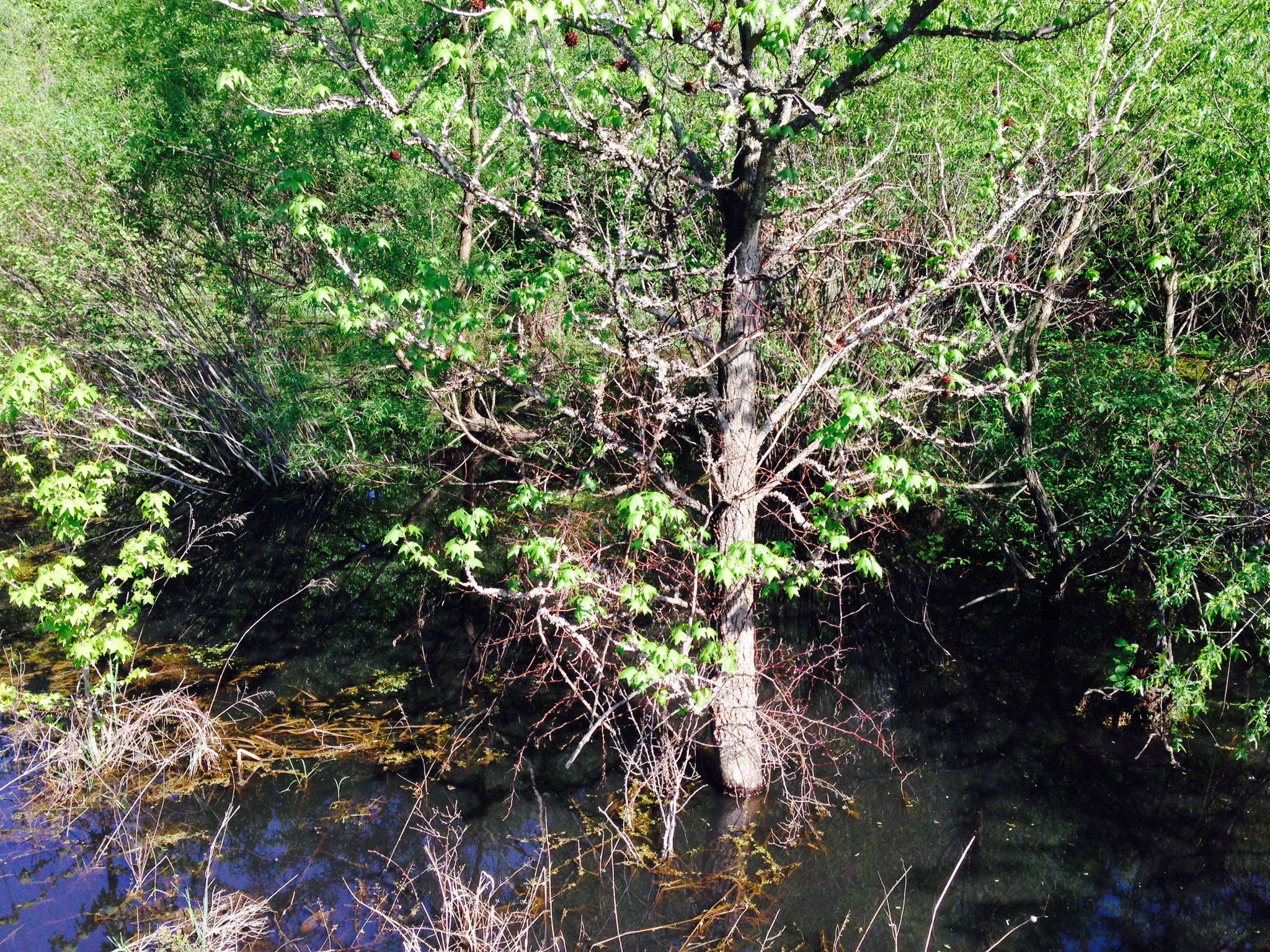
They migrated to this area near the bay bridge and did what came naturally to them. Not with destruction in mind… but cunning and incredibly discerning architects, this family of beaver have created a whole new ecosystem. We’ve always had tree frogs (although it took Chloe’s trainer to clue me in to what I was hearing each year). But now we have:

Beaver8

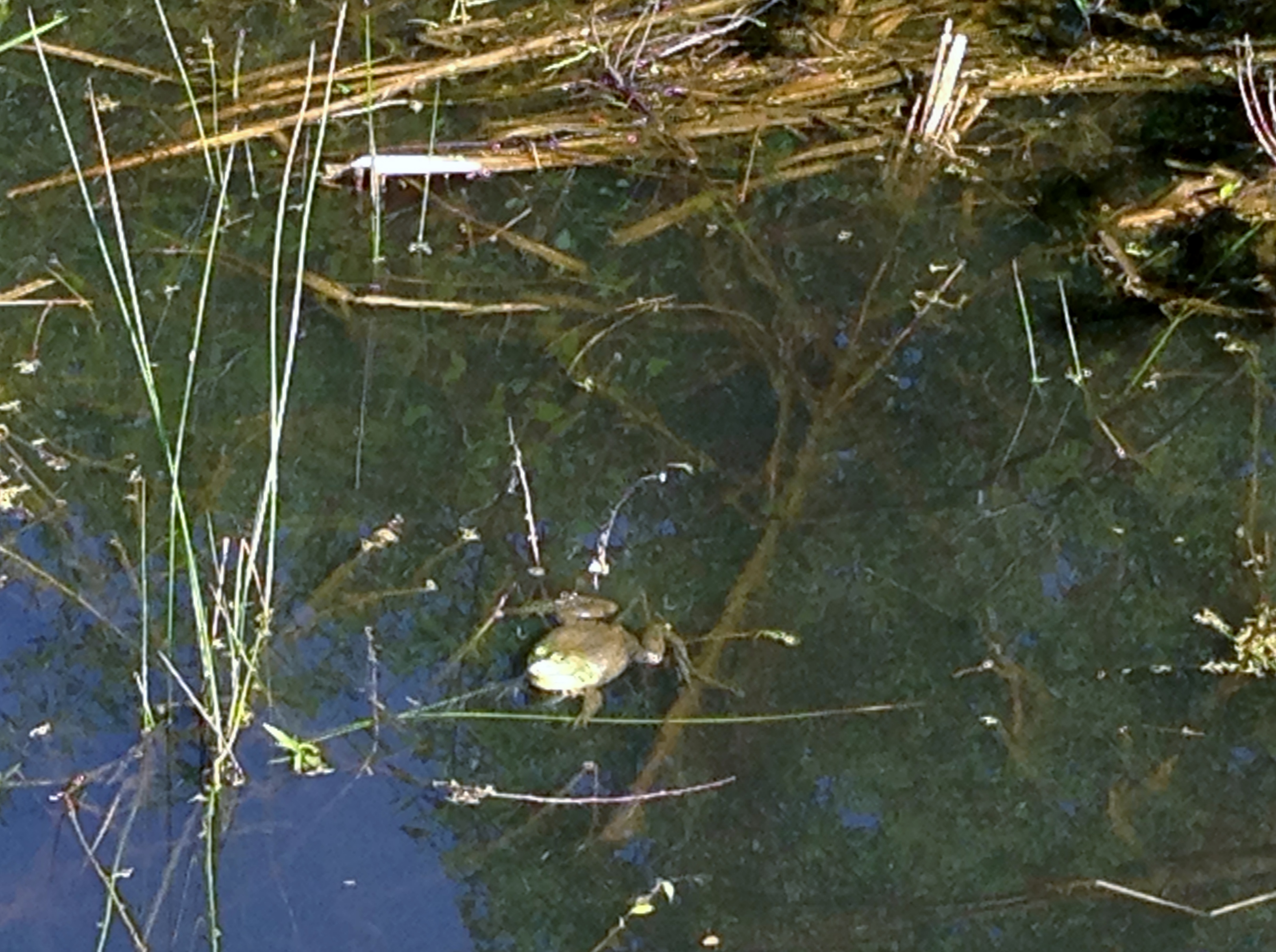
… bullfrogs. You should have seen Chloe’s head and ears the first time she heard THEM! These fellas stretch about two feet, nose to tip of hind legs. I know this, because I’m the crazy neighbor lady screeching to the neighborhood boys who have caught them and held them up to “Return them to the pond when you are done!”  There are also numerous plants I have never seen before in this area when all we once had was a creek…

Beaver7

and the trees are flourishing…

beaver1

I counted 4 different families of mallard duck one evening, with little ones thriving in this secluded and protected environment. Turtles are sunbathing on any log or rock that breaches the surface of the water. The fox are back (having been gone for at least two summers). There are enough deer in our area now to make my poor hound dogs hoarse for all the barking alerts they insist on for me.

I cannot help but be amazed. The beaver strengthened and created a home just right for them, and in the process created a place to thrive for other species. Folks? I want to be a beaver.

I didn’t ask for disabilities. I never once thought, “When I grow up… I want to be DEAF and have a significant BALANCE DISORDER”. However, in my own process of adapting and making my environment safe and liveable for ME (cochlear implant surgery, service dog from Fidos For Freedom, be-dazzled canes, no-slip shoes, discovering where all the elevators are on campus, practicing all I learned in vestibular rehab.), I have created a new ecosystem.

I want MY WORLD to intersect with the REAL WORLD and help folks recognize the importance of inclusion. I work to make sure that my new life, teaches and advocates in accepting differences. I want others to recognize abilities rather than disabilities. I want my invisible disabilities to be visible and “pond-like“. I want my life to inspire others to choose to live equally purposeful lives. In my own small way I do this by working with my campus disability office. I openly talk about being “differently-abled” in class. I “plug” what I know whenever I can to whomever will listen… cochlear implants and service dogs, depression and coping skills. I have discovered my environment changing. People are coming out of the woodwork… or umm… newly created POND, and sharing with me that they have a mental illness, invisible challenge or diagnosis such as fibromyalgia, chronic fatigue syndrome, or Lyme’s disease.

Yes. Having an attitude of gratitude and focus on education and advocacy, has me walking by concerned citizens from time to time, whispering about a beaver conspiracy. But just as I’ve learned that being transparent is contagious, these folks will eventually HEAR and go walking to discover other new ecosystems. At least… I hope they will.

Do you live with disability? Are you struggling with an invisible illness? Do you have a chronic condition that folks do not seem to understand, nor comprehend how it affects you? Hearing Elmo is not just a place to “hear”. My desire is that numerous authors, both named and anonymous, begin to disseminate the kind of information that changes our environments. In the end, the beaver aren’t the sole beneficiaries. We all benefit. Would you like to write for Hearing Elmo? Contact me at denise.portis@gmail.com and type “Hearing Elmo” in the subject line. Building dams is pretty fun. It is unexpected. It is worthwhile. We can all make a difference!

Denise Portis

©2014 Personal Hearing Loss Journal
Howard County Parks and Recreation. (2014). Beavers. Retrieved May 16, 2014, from http://howardcountymd.us/DisplayPrimary.aspx?id=2396

Fundamental Attribution Error

hershey park

I drive my family crazy sometimes. I have psychology on “the brain”. Things I’m studying, things I’m teaching, things I’m thinking about (the dreaded dissertation looms after all), I tend to talk about. I mean a lot. Even when you don’t want me to.

Spring is a busy month for Hearing Elmo. For some reason, lots of folks tune in and contact me. I love to write (even email responses) so I don’t mind at all. To me? This is what Hearing Elmo is all about. I’m glad to be a small part in helping to raise awareness about invisible disAbilities and chronic illnesses. I learn SO MUCH from so many of you who write. So thanks! 🙂

Lately, I’ve had a lot of conversations both email and face-to-face with folks who are struggling with bad thoughts. Thoughts about strangling someone.

Even though it’s deserved.

People with disAbilities or chronic illness are often judged. Sometimes it’s a first impression. Sometimes it is by someone who knows better. I want to cover both today. In psychology we call this the “Fundamental Attribution Error”. Lilienfeld, Lynn, Namy, and Woolf (2013), explain that the fundamental attribution error “refers to the tendency to overestimate the impact of dispositional influences on other’s behavior. By dispositional influences, we mean enduring characteristics, such as personality traits, attitudes and intelligence. Because of the fundamental attribution error, we also tend to underestimate the impact of situational influences on other’s behavior” (p. 501). It’s that last part I want to talk about in this post.

People with Disability or Chronic Illness are Misunderstood

If you are reading this post you likely have some connection to invisible illness or disAbility. Perhaps your condition is not invisible at all. You may live with personal challenges.

easter 2014

Easter Sunday I came home from church with husband and hound dog and went downstairs to work. After about 20 minutes I came to the realization many of you do each and every day. I was wiped out. I knew I would get far more work done if I went upstairs to take a nap. Some folks call these “power naps”. Me? I’m not going to sugarcoat it. I need naps sometimes because I have Meniere’s disease and hear with a cochlear implant. I’m 47-years-old. I get tired. I get tired a lot! So trudging upstairs I passed my husband in the family room and said, “I’m going upstairs to take a nap“. I stood there a second to see if that elicited any reaction.

Now Terry has been married to me long enough to know that if I actually say I need a nap, you better let me take a nap. No smart remarks. He only said, “Be sure to close the blinds or Chloe will bark at every little thing“. I’ve “trained him well“, yes?

But it isn’t easy being the significant other of someone who has a invisible illness or disAbility. When Terry first married me I was only unilaterally deaf and no balance disorder to speak of. Fast forward 28 years and I am now at a point where I can still do a lot. I have dreams, goals, work hard, am a wife, mother, mentor, teacher, student and writer… and I take naps.

I have been out and about before running errands or just shopping with my best friend – Terry Portis. I have out of the blue said, “Ok. You need to take me home.” The last time this happened we were going to a super Target. We had just parked in the parking garage and Terry started to get out. “Ok“, I said. “You need to take me home“.

He stopped and looked at me. After a long pause he asked incredulously, “You mean… now?

I looked at him eyeball to eyeball (which can be uncomfortable with the risk of losing your contacts – but I needed him to know I meant business). “Now” I responded.

So we went home. Sometimes when I “run out of gas” I do so very suddenly. There can be little warning. You could make me push it and we’ll both risk the reality of a major nosedive in “Lawn and Garden” with mild concussion and concerned gathered crowd to show for it. (Clean-up on aisle twelve…)

None of us ask to develop acquired disAbilities. No one prays for a chronic illness. People we know and love may get peeved at us that we require more rest than we use to need. Part of it may be that they miss doing things with you that they use to be able to do. My husband loves Target. But sometimes? Well sometimes you need to take me home and do it NOW. That can be hard.

So those of us who have the chronic illness or disAbility need to be understanding too. But… don’t be afraid to talk about it. One of my favorite “opening statements” for a heart-to-heart conversation begins like this:

“When you say (or do) _________________ it makes me feel like _______________.”

It lets the people I care about know that it DOES bother me when they say or do something – not seeing the whole picture. They don’t understand the situation well enough to get why I behaved a certain way or responded a certain way. So I need to remind them. That’s OK.

If you are the “significant other” – try to put yourself in the other person’s shoes. You don’t want to really know what they are going through for that would mean you’d have to share the disAbility or diagnosis to really get it. What they are going through is really… REALLY…

HARD.

But you know what? They can get through it because you are there to help them, encourage them, and cheer them on! (So don’t forget how influential you can be, OK?)

For Those Who Don’t Know me

Several times a year someone who doesn’t even know me will say something that I almost come unglued about. I have one of those moments where I want to strangle someone. But in most states that is still against the law…

Costco, October 2013: I was in the meat section trying to decide how many crock-pot size meals I wanted to make in the next couple of weeks when I heard a woman about 3 feet away say, “Oh MY GOD!!!!!!!!!!! A dog, in the meat section. I’m going to complain to the manager“.

I turned around and saw this woman standing there with hands on hips and an embarrassed husband standing next to her. Well my friends? Sometimes good sense just rushes right out of my head. I pointed my finger in her face and said, “This is a service dog. I am late-deafened and have a balance disorder. This dog has picked up dozens of things for me since I’ve been in this store for the last 20 minutes. You shouldn’t judge what you don’t know. I’d rather have disAbilities than be stupid. You can’t fix stupid“. And I walked away.

Amidst applause. For it seems we had drawn a crowd.

Yet I will be honest with you. More times than not I do NOT get to say something pithy and intelligent. Sometimes my heart is broken. Sometimes I walk away crushed. Sometimes I strangle people. (Ok, maybe not but I may FEEL like it).

It can be really hard when people judge what they don’t know. After stumbling into an end cap at a store I had a person jest, “Little early to be drinking, isn’t it?” I could get mad and “let it rip”. Or strangle. Cuz yeah I’m a little sidetracked by how satisfying that would be right now. But folks don’t know me. They don’t know my reality, or my day-to-day situational influences that have me moving, responding, and requesting naps. Then I have to make a decision.

A) Strangle them

B) Scream at them

C) Walk away. It isn’t worth it.

“C” is the best response most of the time.

———

Do you get tired easily? Does fatigue trigger headaches, body aches, and brain fog? Do you sometimes just need a NAP? People may not understand that. They may think you are being lazy. They may think you should try harder. They may need strangled…

… with the truth. So tell them!

Denise Portis

© 2014 Personal Hearing Loss Journal

Lilienfeld, S. O., Lynn, S. J., Namy, L. L., Woolf, N. J. (2013). Psychology: From inquiry to understanding (3rd ed.). Boston: Pearson Publishing.


Your Thinker and the Trickle Down Effect

squirrel-pin-tree-winter-snow-nature-hd-wallpaper-desktop-free-animals-picture-squirrel-hd-wallpaper

Wednesday, March 19th

I had a “pep in my step”. I had a whistle on my lips. My heart was glad. I was walking my service dog and most of the snow was gone from the ground.

“What beautiful weather for a walk!” I thought to myself.

But then a squirrel scampered down off a tree trunk merely inches in front of my well-trained service dog’s nose. It all happened so fast.

The first jerk on the leash put my body in motion. You can’t fight the laws of science. I was going to be in motion until something stopped my motion since my brain went on instant vacay. Let me tell you I stuck the landing. Nearby Olympic judges all held up “10” placards. Cheers all around (or at least in my imagination).

I lay there on the pine-needle strewn ground for a minute trying to determine if anything was broken. The world was still spinning. I closed my eyes for a minute and choked back the nausea. Flipping to my back I felt a hound dog kiss on my face.

“Whew. Chloe is still here”, I thought.

I forced my brain to verify the leash was actually still in my hand. YUP! I opened my eyes and focused for a second. Chloe went into a down/stay on her own and rested her head on my shoulder. The weight of my ding-a-ling service dog’s head was a comfort.

I heard something! Another good sign. My cochlear implant was still attached to my head. I focused on the sound and looked up – Up – UP into the tree boughs above me and spotted that rascal squirrel.

Oh.

My.

Gosh.

He had the impudence to sit up there fussing – at US. I couldn’t help but laugh. He was ticked! I laughed all the way up until he skipped away… jerking the branch he was on and dumping snow on my face and chest from twenty feet up. My laughter stopped immediately. I was choking after all…

I sat up and brushed the snow off and started to giggle again. Chloe wagged her tail in delight. It seems she wasn’t going to get a “Denise sermon” after all. Within 10-15 seconds though I was overcome with a different emotion. I sat there crying. Not just silent tears – nooooooo. This was unladylike, deep sobs with intermittent hiccups!

I sat there bawling my eyes out for five or six minutes, comforted by a hound dog most certainly sorry her instincts caused another “Timber…” moment for me.

Yes. I could see the funny. But fast on the heels of the laughter and positive attitude came an emotion near the surface most days. Self-pity. Sorrow. I hate my life.

Is Happiness a Choice?

One of my favorite books is “Happiness is a Choice” by Minirth and Meier. The premise of the book is that especially for those of us living with depression, happiness is a choice. The book’s number one principle is: “Change the way you talk to yourself”.

I’m on board with that. Really!

I am!

You can change some of the negative aspects of your thinking by challenging the irrational parts and replacing them with more reasonable thoughts” (Martin, 2010, para. 4). Whitbourne (2013) explained these, “inner monologues as “self-talk,” in which you provide opinions and evaluations on what you’re doing as you’re doing it. You can think of self-talk as the inner voice equivalent of sports announcers commenting on a player’s successes or failures on the playing field” (para. 1). I believe in the power of self-talk. I believe our “thinker” really can influence our behavior. My husband is a cognitive psychologist. He and I have a lot of discussions as I work on my own Ph.D. about the best ways to change behavior. He – and other professionals like him – believe that if you can simply change what your thinker is thinking, there will be a trickle down effect. It will influence and possibly change behaviors you wish to change. There is a lot of scholarly research and science to support this.

I believe this! I do! But I will be honest for a moment. There are times I want to just say…

SCREW SCIENCE

That’s right. Just in case you even needed MY – or ANYONE’s permission…

It is OK to be upset about the reality of your life.

Living with acquired disability sucks. Hearing loss sucks. Meniere’s disease sucks. How about you? Fill in the blank:

_____________________ SUCKS.

*Deep Cleansing Breath*

I’ve tried to explain to folks who ask, that living with a chronic condition or acquired disability is – on the best of days – HARD.

I still get the flu.

I have still lost people I love and miss them.

I have lost beloved pets.

I get headaches, body aches, and am growing older.

I get mad at my family sometimes.

I experience car problems.

I hate traffic.

I have unexpected bills.

I still have a period (hey! Jus’ layin’ it all out there! <BIG GRIN>)

All of these things happen to me just like they happen to you. Only folks with chronic illness or acquired disability have those things happen on top of what – for them, is the norm… living with challenges daily.

Yeah, yeah. I know!

I still get the flu   I can be thankful I have medicine to help and a hound dog to cuddle with. See? I can see the positive!

I have still lost people I love and miss them  I can be thankful I will see them again someday based on my personal faith beliefs and worldview.

I have lost beloved pets  I have other furry family members and that makes me happy.

I get headaches, body aches, and am growing older  Beats the alternative. Right? 

I get mad at my family sometimes   But I have a family…

I experience car problems.  But I have a car and this time we could afford the “fix”.

I hate traffic.  I have a job to go to.

I have unexpected bills.  But I’m smart enough to figure out how to pay that bill or arrange payments.

I still have a period Yeah. I got nuthin… (LOL)

So can my forced “change thinking” have a trickle down effect and influence my behavior, feelings, and perceptions? Yes.

And no.

Confused? I don’t mean to be the cause of a “What the heck you talkin’ about, Denise?” thoughts.

However, it is important – at least I think it is – to allow yourself to have moments of self-pity. Feel the sorrow. Rail at God. Write “My Life Can Suck” really big and pin it to a wall and throw darts at it. If it makes you feel better, do it. I think it is healthy to “own your feelings” about the reality of your life. It’s hard. You may feel alone. You may want to give up. It’s OK to feel that way.

But then? (Brace yourself…)

Change your thinker. Allow it to do what studies have shown actually works. The “Trickle Down Effect”. I’m here to tell you though that it isn’t a long-term fix. You may have to “adjust the knobs on your thinker” daily. Maybe on REEEEEALLY bad days – hourly!

Do you know what thoughts help me the most?

Keep on keeping on.

I can make a difference in the life of another.

Tomorrow is a new day.

Mean People Suck. (Sorry. That’s my favorite bumper sticker and I *had* to throw it in there).

Yup. They are platitudes. “Feel good self-talk”. But ya know something? It works for me because I also allow myself the freedom to sit in the pine-needles with snow covering my shoulders and bawl my eyes out.

So strive to improve your self-talk. But feel free to wail.

{{{{{{{{{CYBER HUG}}}}}}}}}}}} from me to you!

Denise Portis

©2014 Personal Hearing Loss Journal
Martin, B. (2010). Challenging Negative Self-Talk. Psych Central. Retrieved on March 21, 2014, from http://psychcentral.com/lib/challenging-negative-self-talk/0003196

Whitbourne, S. K. (2013). Make Your Self-Talk Work for You. Psychology Today. Retrieved on March 21, 2014, from http://www.psychologytoday.com/blog/fulfillment-any-age/201309/make-your-self-talk-work-you

Counseling. Only for the Weak and Needy?

terry and denise

I’m married to a psychologist. I’m 37 hours + dissertation away from my own Ph.D. in Psychology (I know, I know it is still a lot! But to count it down helps! 2016 seems like such a long ways away!). My daughter is getting her Master’s in Psychology. My son is working on his Bachelor’s in Cyber-criminology. Needless to say our family meals – the few we have since our kids are adults now – are very weird. Weird, as in we talk about strange things. “Psycho-babble”. We are psychology geeks. Or is that freaks?

For me, to seek counseling has zero stigma attached. But… some folks do think that seeing a counselor is something to be ashamed of and try to hide the fact they may be getting professional help.

Don’t misunderstand. I don’t think you should tell your life story to every single stranger you encounter who asks, “How are you, today?” But when is it OK to seek professional help and talk to someone about all the things you DO have trouble expressing to anyone else?

I Feel Like I’m not as Independent…

A friend of mine found out I was seeing a counselor. She knows me well enough that she can ask me nosy questions and I don’t even feel as if she is being – well, NOSY. With her permission, I’m copying the gist of the conversation here:

Her: “You are one of the most independent people I know! Why are you so open about seeing a counselor? Aren’t you afraid people will think you aren’t as strong as you let on? I think if I went to see one I wouldn’t be able to let anyone know!”

Me: “Well it doesn’t work that way. I need someone to listen and who will give me objective advice. If they were my bestie like you, they wouldn’t give it to me straight!”

Her: “Hey. I tell you like it is all the time!”

Me: “Giving me a ‘dose of reality’ is different than being objective from a trained, counselor’s point of view. How can something make me less strong when I walk out of there feeling ‘stronger’?”

Her: “I dunno. I thought you were ‘Ms. Independence’. It seems strange to hear YOU are going to see a licensed counselor!”

Me: “You are missing the point. I’m seeing a counselor so that I can continue to be independent about the right things, but am also learning to be dependent in a healthy way. Geesh this life is hard enough without trying to ‘go it alone’. We all need help from time to time!”

She remains unconvinced, but hey! I think she’s coming around.

So Should you see a Counselor?

So how DO you know if you should see a counselor?

Psychology Today has a great little “self test” that helps you determine if you should seek therapy. You can find it here: CLICK HERE

Another great little quiz to help you make this determination can be found here at Psych Central’s website: CLICK HERE

The Huffington Post put out a great article in February, “8 Signs You Should See a Therapist”. You can find that article here: CLICK HERE

Those 8 “signs” include:

1. Everything you feel is intense

2. You’ve suffered a trauma and you can’t seem to quit thinking about it

3. You have unexplained and recurrent headaches, stomach-aches or a rundown immune system

4. You’re using a substance to cope

5. You’re getting bad feedback at work

6. You feel disconnected from previously beloved activities

7. Your relationships are strained

8. Your friends have told you they’re concerned

People with disability or living with invisible, chronic illness can benefit from counseling. Whether you are struggling to cope, grieving “something lost”, feeling angry or depressed, or just feeling overwhelmed, seeking help can prove very beneficial. It doesn’t make you weak. If anything, it shows how proactive you are about your own mental and emotional health. Recognizing that “all parts” of who we are need to be strong is a sign you are being pretty darn good to yourself!

How do I find Help?

Where do I find help? My favorite “how to” article is several years old, but I still think it’s the best advice I’ve seen. You can check out the article by Dr. Aletta here: CLICK HERE

For me, I had to find someone that was “in network”. I can’t afford to pay for counseling other than a co-pay. Sometimes practices will have pro-rated charges based on your income. For most of us though, we have to go see who our insurance will pay for to help alleviate costs. Depending on your insurance, you can probably find a list of “in network” counselors, therapists, and psychologists. For me, finding someone who had similar faith practices was important. Doctrine wasn’t as important as finding someone who believes there is a God. So you may have to go to the web and search too, matching practices up with who your insurance says is “in network”. If you don’t have insurance, or insurance won’t cover counseling, there are still options. (The article I gave you *points up* gives some great tips).

Feel free to comment here or privately email me. I’m pretty open about my own “journey to a healthy mental/emotional, Denise”. If you live in an area where counselors are “few”, you may find assistance at area worship centers. If confidentiality is a MUST (meaning you don’t even want to be seen coming and going), a new trend includes cyber-counseling. A licensed and trained counselor sees you at a designated time through a web-cam, so it is still face-to-face (important for those of us that need to see a face to communicate well).

Denise Portis

© 2014 Personal Hearing Loss Journal