DisAbility Etiquette (part ONE)

DisAbility Etiquette (Part ONE)

You cannot know how long I struggled with what to TITLE this piece! Having recently left a nearly 3-decades-long career in teaching (Psychology and ASL), I know how preoccupied folks are with being “inclusive” and equitable. Some even fully embrace being <GASP> WOKE. Folks who do not identify with any marginalized person group have shared with me (at least in the field of education and higher learning) that workshops, required certifications, and mandatory inclusive components more and more feel like “hoops to jump through”. 

I can tell you that as a person with disabilities, the last thing I want abled people to feel about inclusive practices is relief at having a checkmark on their HR records. I love the way Emily Ladau (2021) simplifies best practices with an easy to incorporate “rule” in interacting with those who are differently-abled. “The Golden Rule” is simple and easy to live out with true authenticity. Treat others in the same way you would want to be treated. “You don’t need to start overthinking everything you say or do. That just makes things weird. Disability etiquette isn’t about tiptoeing around us and treating us like strange, delicate flowers (in fact, that’s pretty ableist in and of itself.) It’s about treating us like full and equal human beings” (Ladau, 2021, p. 89). 

I truly believe (most) people mean well. Sometimes well-meaning intentions go awry, however. Yesterday, my husband and I went out to eat at a restaurant. My husband knows not to linger and hover over me as my service dog, Finn, gets me from “point A” to “point B” safely. Besides, he needed to make a “pit stop” so I walked out alone. As I navigated the last section near the door, I passed a booth with a family who had young children in it. Having lived the majority of my life with profound hearing loss, I do speech read fairly well. I saw one of the dads say to those at the table, “there’s a dog coming with a disabled person… don’t look, don’t stare, DON’T STARE”. Two of the three children (with age-appropriate ability to fully comply), dived under the table with one screeching, “I’m not looking at the dog! I’m not looking at the woman!” 

I tell you what, I was so cracked up I had to stop and lean against my cane for a second before giggling my way to the door. As I passed the booth one dad was doing a classic “face palm” while the other mouthed, “SORRY” as I hobbled by. When I got outside, I had to do a “cane lean” again as I seriously nearly fell over laughing. Those dads didn’t need to warn the kids about my coming by. Finn is gorgeous, smart, and talented. I don’t mind the “look at the dog!” comments. I know the dad’s comments were meant in respect, but please… just treat me like a normal person. I have bling on my cane, cochlear implant, and hearing aid. My dog is an 85-pound, solid Golden Retriever. I’m not invisible nor do I care to be. If someone says, “What a pretty dog” as I walk by, I simply smile and say, “Thank you! He’s amazing”. I don’t consider noticing something that is VERY noticeable as being rude.
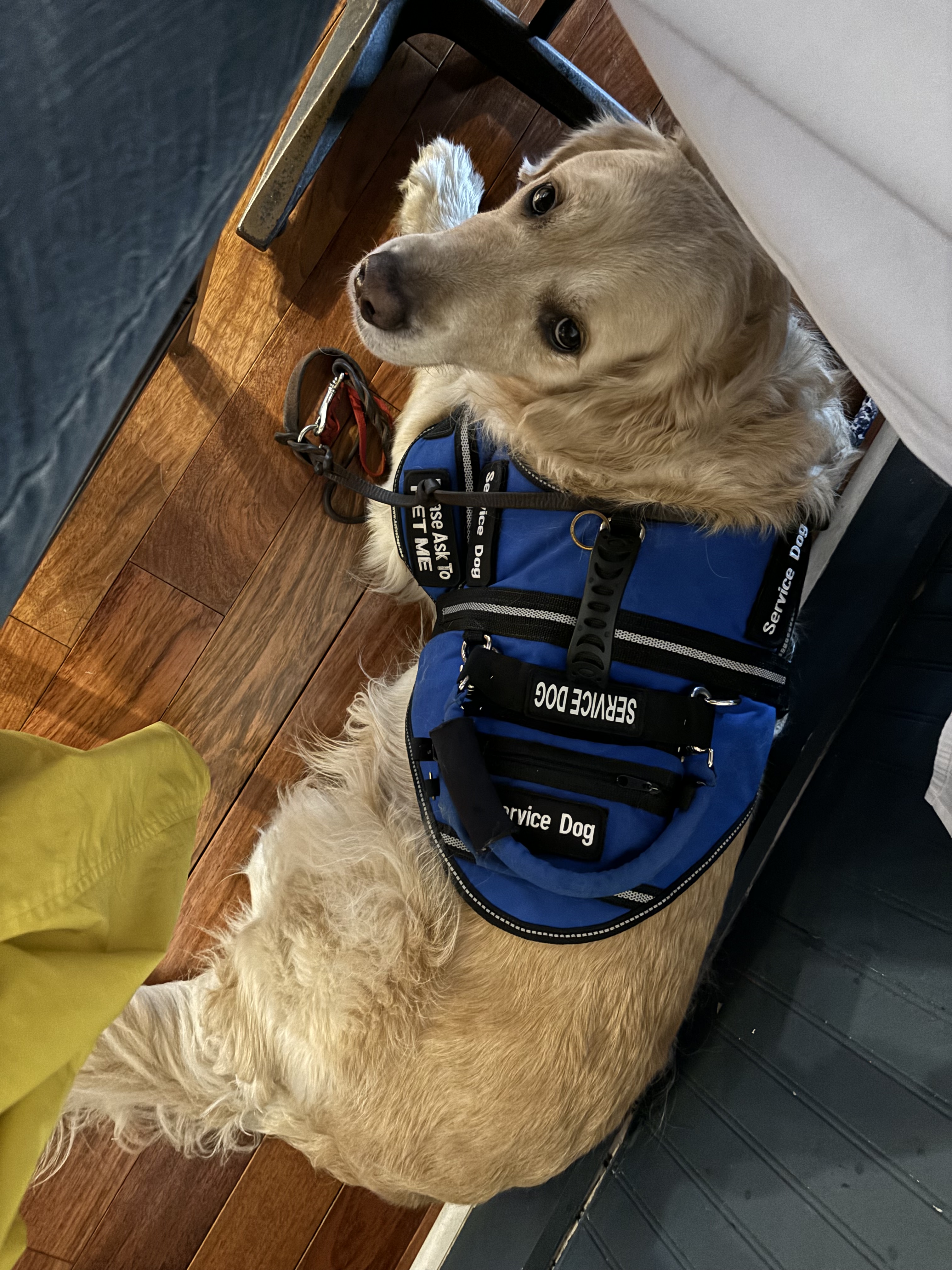
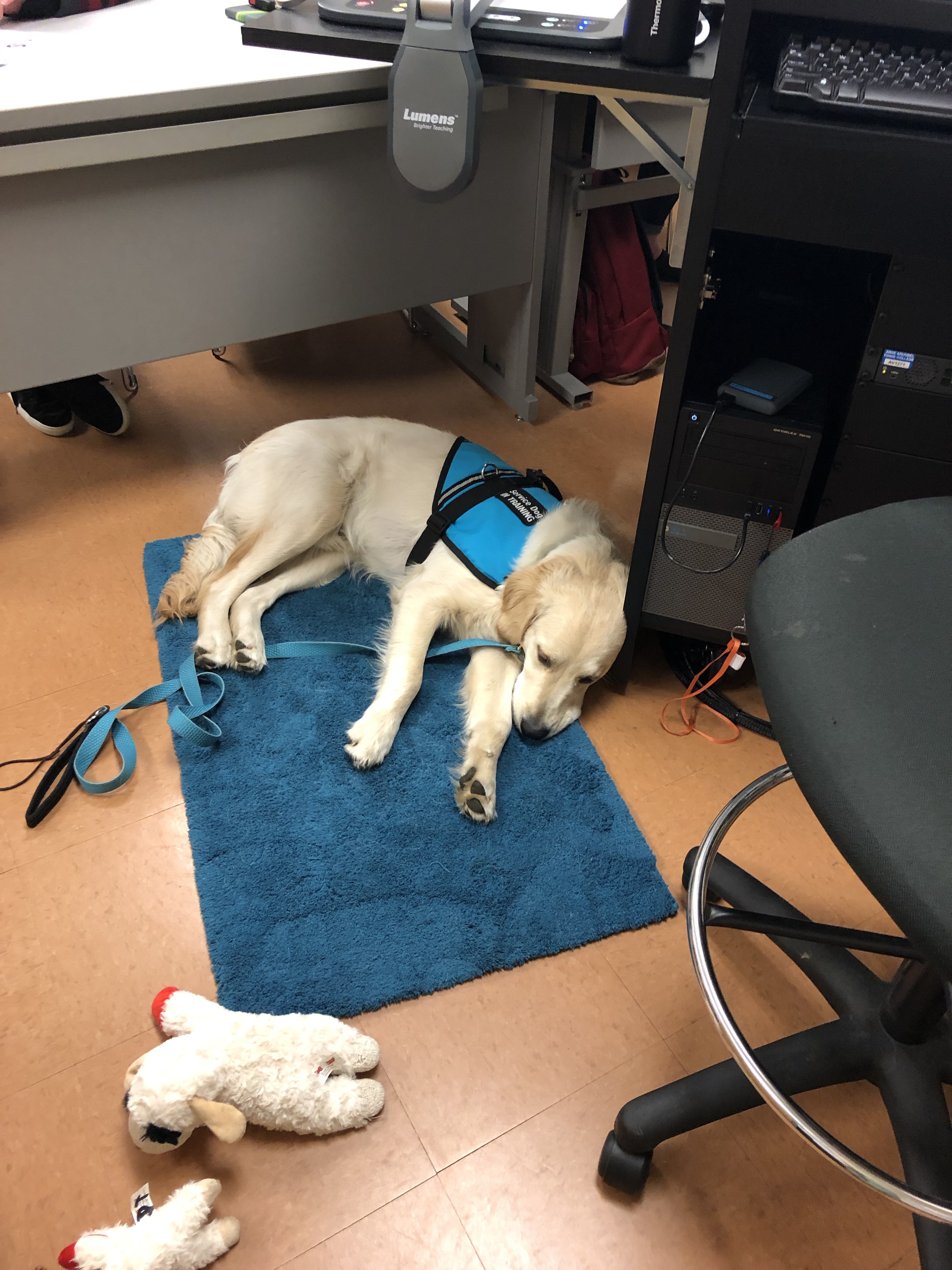
Photo description: Large Golden Retriever with royal blue service dog vest under a table at a restaurant. 

To close out this two-part series on “DisAbility Etiquette”, I wanted to share some do’s and don’ts of two disabilities I have. [CHALLENGE: If you have other disabilities and would like to write for “Hearing Elmo” and share your own “do’s and don’ts” please contact me at denise.portis@gmail.com. I love having guest writers!]

In part two, I want to discuss some do’s and don’ts for people who use canes and service dogs for mobility challenges. In part one, I’d like to share some tips for interacting with people who have hearing loss. NOTE: I do “hear again” with a cochlear implant but these tips work for anyone with any degree of hearing loss, even those who are culturally Deaf.

DO:

  1. The Golden Rule (I won’t reiterate it again – smile)
  2. If you know someone has a hearing loss and you are hosting a workshop, meeting, or get-together, send an email or text to the person and ask what you could do to make the venue more accessible.
  3. Follow-up (especially work-related) meetings with an email to ask if they have any questions or missed any topics. (Careful with this one… don’t be condescending).
  4. If possible, secure captioning (transcription) for the meeting. Transcripts can be emailed to EVERYONE which only helps all present.
  5. Avoid small group activities where everyone is talking in small groups at the same time.
  6. If a person uses ASL, please provide an interpreter.
  7. Flicker the lights to bring the meeting to order. Yelling or wildly gesturing is rude.
  8. If there is a microphone present, USE IT. Don’t say, “my voice carries” or “I think everyone can hear me”. 
  9. Insist others use a microphone from the audience, or repeat any questions asked. 
  10. Write out on a white board or include a slide in a presentation if you are going to do any type of ice-breaker question, detailing what is being asked of participants. 

DON’T

  1. Announce or otherwise bring attention to any one individual who may have trouble hearing.
  2. Raise your voice to a near shout. 
  3. Turn your back to the audience to point to or gesture towards a screen or whiteboard.
  4. Talk to the interpreter of a culturally Deaf person, instead of talking to the person themselves. 
  5. Play music or “theme songs” in between speakers.
  6. Use videos without captioning turned on
  7. Talk at the same time someone else is.
  8. Over enunciate speech
  9. Chew gum or have other items in your mouth when speaking.
  10. Hesitate to ask the person with disabilities if you are not sure how to proceed.

Ladau, E. (2021). Demystifying disability: What to know, what to say, and how to be an ally. New York: Ten Speed Press

L. Denise Portis, Ph.D.

© 2023 Personal Hearing Loss Journal
Kindness Can Be Complicated

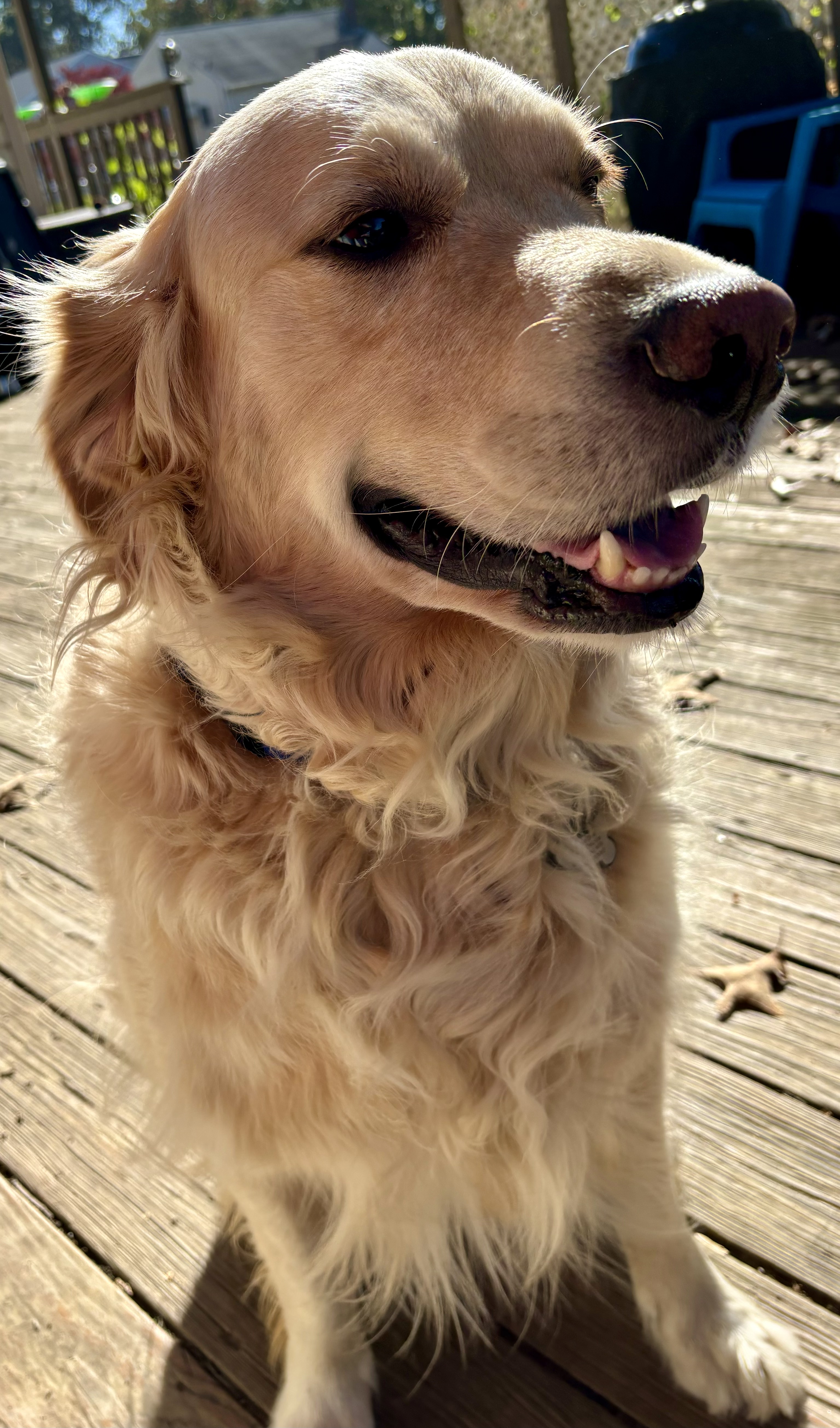
Photo description: Finn, Golden Retriever, 5-yrs-old, off duty and relaxing on a wood porch.

YAWN. 

I get it, Finn. I’m nervous too. Stay calm. (I fidget with my cane)

Finn YAWNS again and sidles closer. 

I know! Should I be rude and curt? Condescending in hopes of shaming? Teacher/educator mode? I just want to shop without notice like every other person in this store!

Finn YAWNS and does a slight eye roll. With him as my shopping buddy I can’t very well go unnoticed.

Finn is my 3rd service dog. Like anything I take on, when I chose to be partnered with a service dog to help mitigate my disabilities, I learned all I could about dog behavior, training, and service-dog work. A dog yawning is a very specific kind of “dog language”. Turid Rugaas (2013) explains that when a dog yawns, the dog is signaling that it is nervous, anxious, or excited. Finn and I were silently communicating unease at having been stopped and engaged even though all of MY body language said, “stay clear, I’m doing fine on my own”. 

“Dogs yawn when they are slightly stressed by something in the environment. It can be something very simple, such as a dog or person passing by a little too closely. Dogs often yawn when they are feeling like they have to “perform” in some way. Dogs yawn often when they feel confused or frustrated by the current situation” (Aloff, 2007, p. 90). Finn was not comfortable because I wasn’t comfortable. Being my partner for five years, he knew that I was not happy this person had stopped me in Costco to talk about my disabilities and service dog. With only one hand on the cart (the other holding Finn’s leash), I automatically wobble more than I would if both hands were on the cart. Because of my wobbles, my cane, hooked for easy access on the cart handle, is banging against the side of the cart. I’m sure my voice is tense. I’m unhappy. Finn YAWNS.

I’m unhappy because someone is trying to be nice. 

You read that right.

Out of the kindness of their own heart, a total stranger asked if they could help me in the store. My cart has 7 or 8 items in it already. It’s obvious I didn’t need their help to shop thus far. I assure them I am fine and “thank them for asking”. They ask about Finn, who is now on his 5th YAWN. His vest says, “Please ask to pet me” on the side. 

This very KIND person asks, “May I pet him? What’s his name?” I reply (with kindness) my rehearsed response:

“I don’t mind if people pet him if I’m seated. Since I am not, it would be better for you just to ignore him.”

The kind person looked around and even stepped to the side to look down a long aisle with cooking utensils. “I don’t see any chairs”.

Oh because everything about me tells you I want to sit so you can pet my service dog and take even more of my time?

Instead I say, “Well I am shopping right now and we need to keep going. I tend to run out of energy fairly quickly so we need to finish up”. 

The kind person looks slightly affronted and says, “OK. I was only trying to help!” 

AND… There lies the conundrum.

Kindness is complicated. I truly believe people mean well. Perhaps if I were not differently-abled, I would make the same mistakes. Good hearted people want to help someone, especially if it looks like they are struggling. (By the way, I was doing great before being stopped and actually struggled more after having to engage – hence Finn’s YAWN.) 

As a former teacher, I’m all about advocating through education and information. However, there is a time and place for everything. Like most people with disabilities, if I need help I will ask for it. This is something you learn to do if you’ve lived with disabilities for some time. My service dog, cochlear implant, and cane can help me do most things independently. There are times, however, where I need some assistance. I will ask for it. I’ve never been turned down and I’m 57 y’all! That’s a lot of years of having to occasionally ask for assistance! Sometimes automatic doors will not work. Sometimes a dropped item is too big or too heavy for Finn to pick up. I will ask for help. I appreciate all the kind people but enough already. Rebekah Taussig (2020) said it best:

I am a magnet for kindness. Like the center of a black hole, my body attracts every good deed from across the expanse of the universe to the foot of my wheelchair. I move through parking lots and malls, farmers’ markets and airports, bookstores and buffets, and people scramble to my aid. They open doors and reach out their arms to help, they offer prayers, grab my handlebars for a push, watch over me, and hold out wads of cash (p. 167).

People trying to be kind can be authentic. They noticed me and really do want to help. It can also be someone who is curious and wants to learn more. Maybe they know someone with a mobility challenge and want to learn how they can best help? As Rebekah states, folk’s attempts at being kind can “be anything from healing to humiliating, helpful to traumatic. It’s complicated” (Taussig (2020, p. 169).

I’ve come home from Costco trips determined to be an online shopper. I’ve also come home and thought about what a positive shopping trip that was after asking a stranger for help when Finn’s leash snagged on a pallet at a Target we were at and I could not yank it free. I tried to free it myself for a few minutes and then caught the eye of someone nearby and said, “Would you mind freeing Finn’s leash for me?” A dozen or so people bumped heads trying to be first in line to free that leash! (Yeah, that was a slight exaggeration). After freeing us up, I went on about my business as did the kind “helper”. 

Kindness is complicated. Please don’t misunderstand. Kindness is wonderful. We NEED MORE KIND PEOPLE. The world NEEDS MORE KIND PEOPLE. Just use “intelligent kindness”. Does the person you want to help look as if they need it, as if they want it?

If you are person with a disability? Don’t struggle with something you cannot do on your own and then beret everyone around for not helping. If you need help, ASK.

L. Denise Portis, Ph.D.

© 2023 Personal Hearing Loss Journal
Aloff, B. (2007). Canine body language: A photographic guide. Interpreting the native language of the domestic dog. Dogwise Publishing. 

Rugaas, T. (2013). Calming signals—The art of survival. Turid Rugaas—International Dog Trainer: International Dog Trainer Education. Retrieved October 26, 2023 from http://en.turid-rugaas.no/calming-signals—the-art-of-survival.html

Taussig, R. (2020). Sitting pretty: The view from my ordinary resilient disabled body. Harper Collins Publisher.

Brain Injury Awareness – A Survivor’s story 50 Years Later

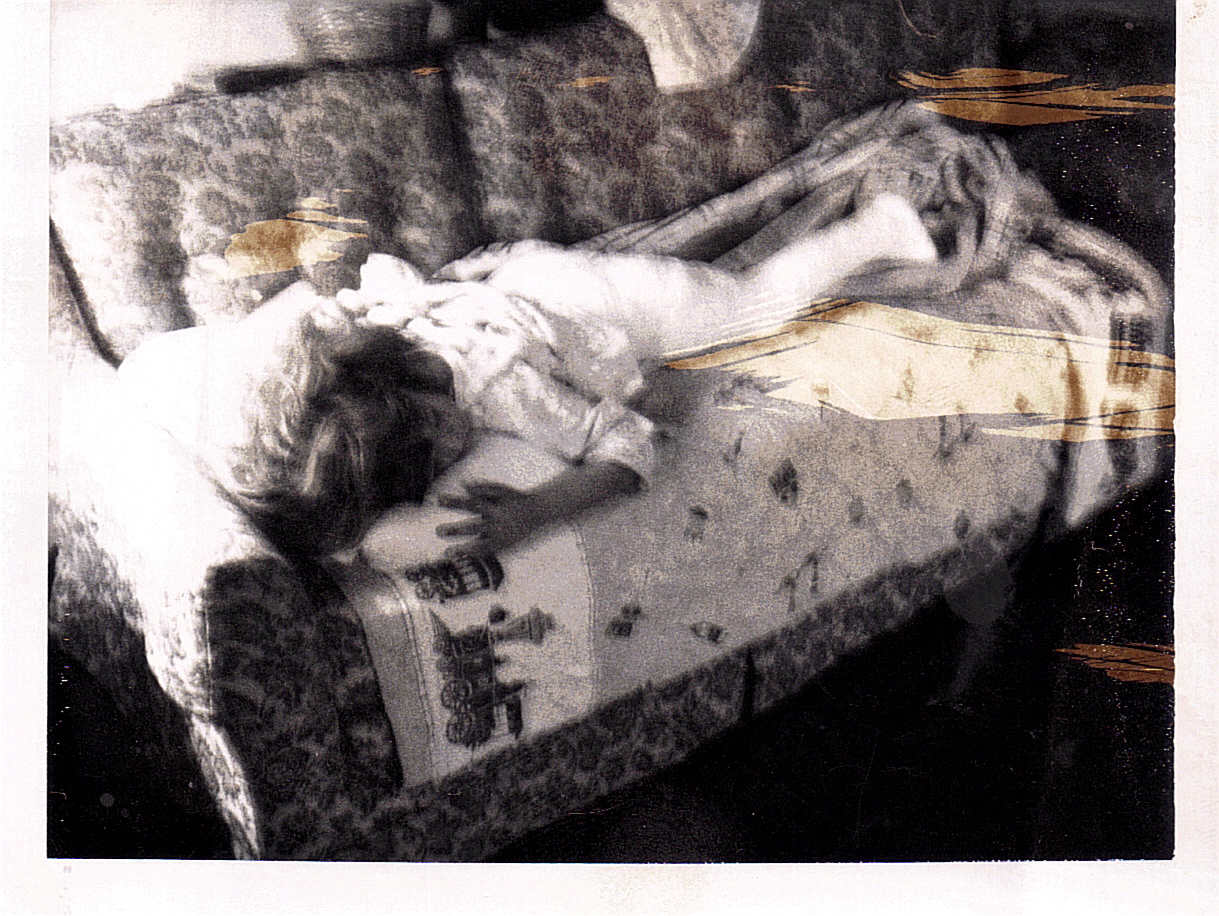
Wow! This photo is from 1972. I was in a body cast from the chest down and had to sleep a lot. Prior to the TBI, I slept on the top bunk in a room I shared with a sibling. There was no lifting me that high so I spent much of my recovery on the couch. Mom slept in a nearby recliner. Traumatic Brain Injury as a child meant that my saying “I don’t remember my early childhood” wasn’t at all unusual to declare. Even abled folks in their 50s say, “I can’t remember back that far”. My parents worked hard in my rehab and by third grade I was back in school. I would eventually become deaf and acquire a vestibular disorder, but I had a terrific childhood living on a farm in rural Colorado.

Fast forward 50 years. TBI, like many traumatic injuries, is “the gift that keeps on giving”. I don’t even mean that in a particularly snarky way, as my disabilities have opened up so many opportunities for me during me life. The downside, however, is that when the brain is injured in a significant way a survivor will always have repercussions. For me, it meant 11 concussions, broken fingers, hands, toes and numerous hospital visits. It has meant learning disabilities and cognitive challenges. It meant that it took me 16 years to finish all my degrees. It has meant a very real struggle to stay on top of serious depression and anxiety.

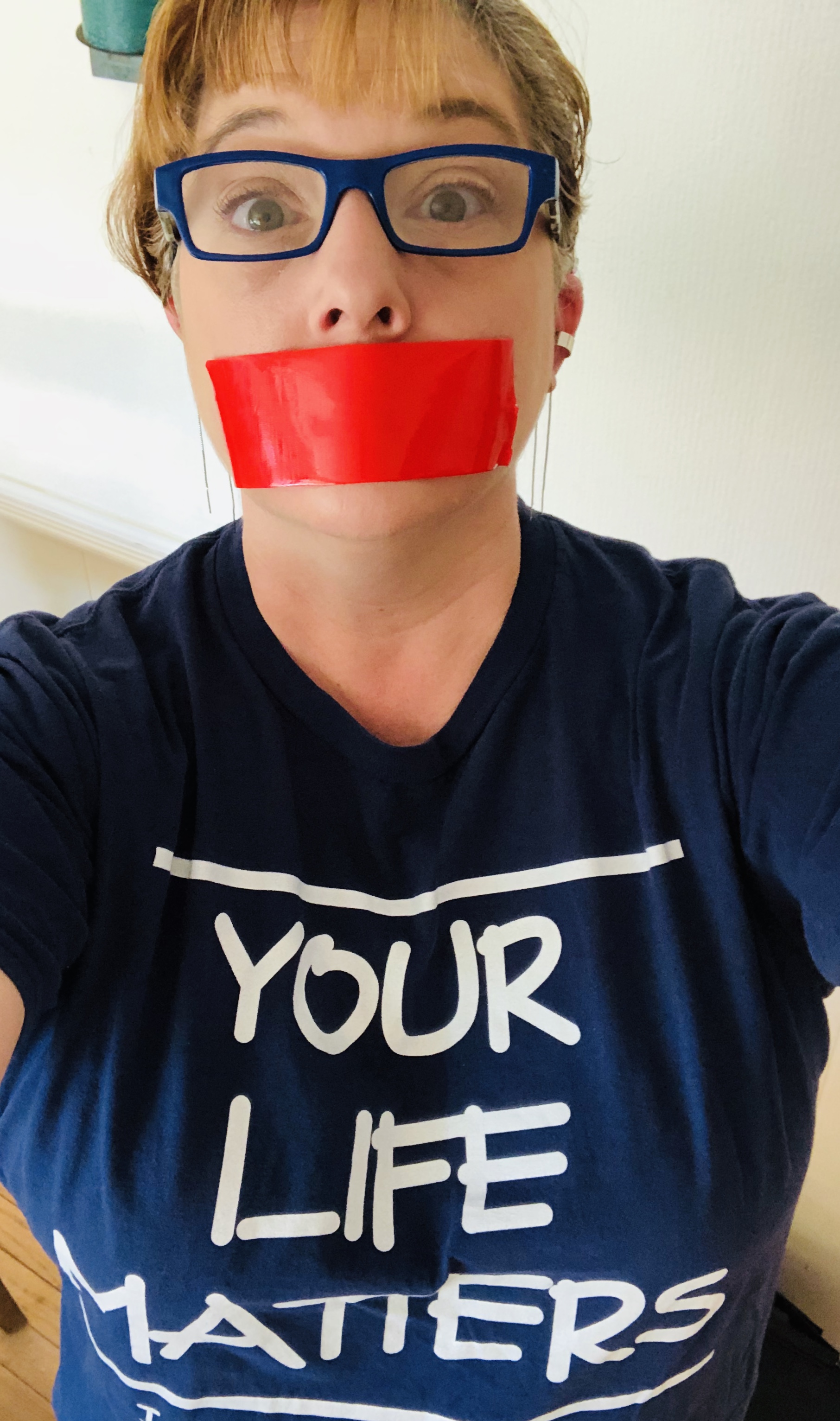
Having fought, struggled, and persevered, having cried, grieved, and given up SO MANY TIMES, on this side of having survived 50 years, I can say “My Life Matters“. For over 3 decades, I have used something “bad” for something very, very GOOD. I am an advocate, a teacher, a passionate voice for those who often have no voice. My TBI gifted me with my “calling”, and became the impetus to fight the fight for those with disabilities.

I am one of the lucky ones, however. Are you a parent? Research and gear up with all the knowledge that you can about how to keep your child’s head safe in play, team sports, and recreational activities. Treat concussions seriously, even mild ones. Don’t hesitate to enjoy life, but enjoy it safely. Enjoy it while protecting that wonderful brain of yours. You cannot put a cast on a brain and hope it heals straight. Preventative measures are all we can do.

Happy Brain Injury Awareness Month!

L. Denise Portis, Ph.D.

You can do ANYTHING!  Well… MOST THINGS!

I anticipate that what I write this week will upset some folks who live with disABILITY or chronic conditions. If you would, “hear me out” until the end of the post. If you still disagree, I can easily “agree to disagree” and even concede that the power of optimism is often the key to overcoming real obstacles.

My main point? Do not tell a person with disABILITY that: YOU CAN DO ANYTHING!

This standard platform statement is normally accompanied by volume and higher pitch, with a pom-pom smacked to the face of anyone not paying attention. Educators like myself sometimes misuse this encouraging statement. Administrators may assume the statement is standard for any mandatory attendance meeting, certain to help liberate the doubtful and unify the group, lighting them on fire with enthusiasm. 

Last semester I sat and cried with a student having to drop my class. Like me, she is a TBI survivor. Her dream job was to work in a big hospital and oversee support groups for individuals and families who are experiencing life with traumatic brain injury. She wants the “shingle”, the Ph.D., the training to really make a difference. I believe she will reach her goal. She will reach her goal after a longer road than most. There will be setbacks. There will be obstacles. I shared with her that it took me 16 years and a lot of outright stubbornness to finish school. Accommodations made the attempt more equitable but honestly, I shared, “it took not giving up and recognizing my pathway to goal was a longer one”. 

I have had short-term mentors tell me YOU CAN DO ANYTHING! (My long-term mentors had a more realistic approach). However, pom-poms, enthusiasm, and genuine hopefulness will never:

… allow me to hear normally.

… walk without a limp.

… have vertigo-free days.

… help me be as sharp at the end of the day as I am at the first.

… keep me from needing more sleep than others.

… prevent me from ever falling again.

… alleviate my communication challenges.

… prevent me from feeling isolated and left out occasionally.

… stop the loss of vision in my right eye brought about by 11 concussions.

… interrupt every single panic attack.

… defeat persistent depressive disorder.

… keep me from missing my Mom, the primary REALIST in my life.

Frankly, there are some things I CANNOT do. Any successes or “wins” are the result of stubborn persistence. Any recognitions or awards are from finding a different way to accomplish the same tasks. Many “end results” were not something originally targeted. There are things I CANNOT do and tasks I will NEVER be able to do. Instead, I have learned to set my sights on something obtainable. I have learned to align my goals with things that are possible. I have even learned to dream and “pin my hopes on” goals that are doable for even one such as I. In the end, most of us aspire to make a difference. If you find yourself looking around at the place your training, hard work, and experience have landed you thinking, “Well gee. This was a major detour but gosh darn it! I’m happy and I’m making a difference!” 

Perhaps the big DIFFERENCE we make was something outside our imagination originally. Reality redirected our purpose with an unexpected detour. Yet here you are, thriving…influencing… and KILLIN’ IT! Having a sense of real purpose looks good on EVERYONE. 

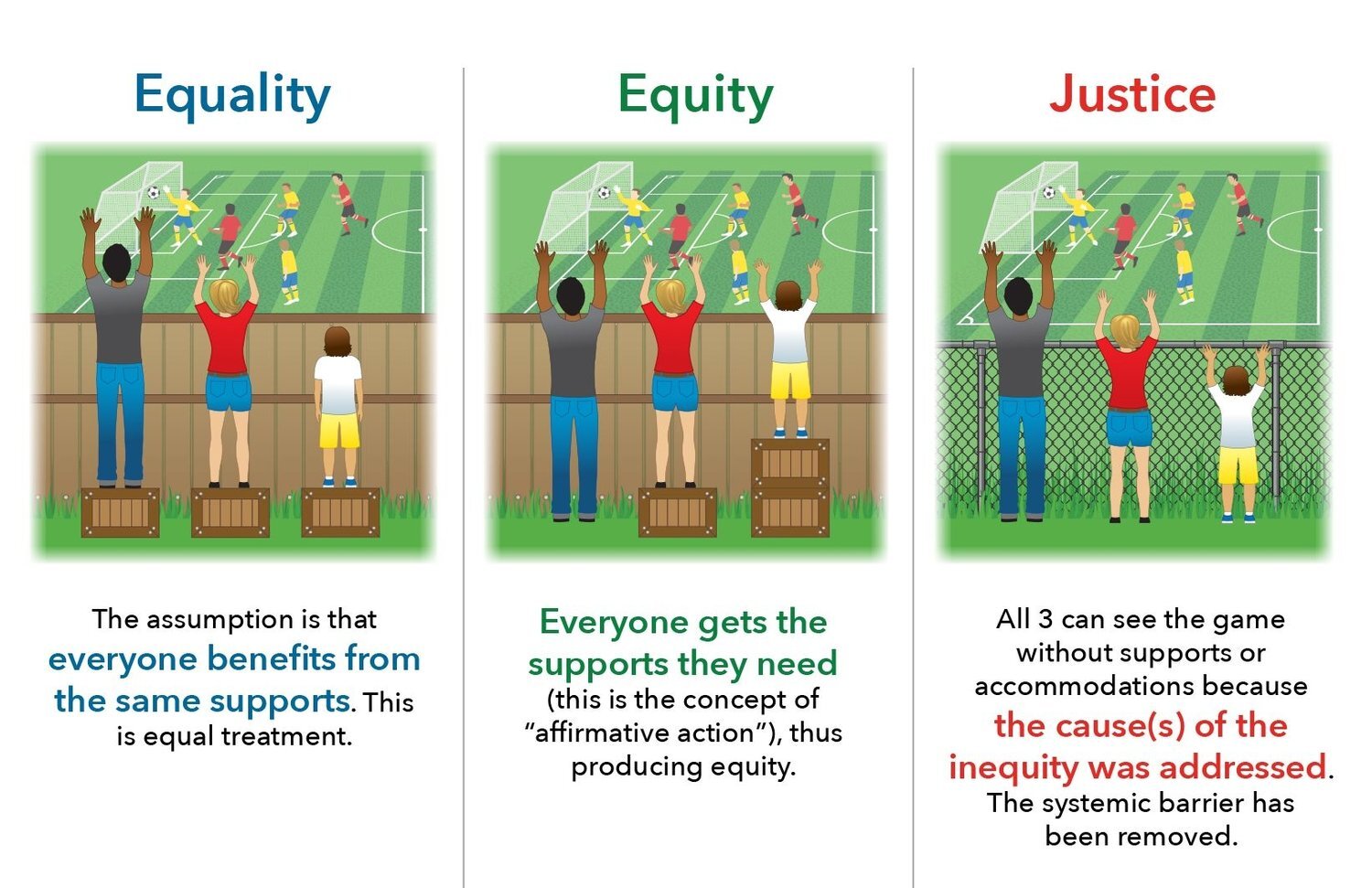
I have talked with students and colleagues hesitant to ask for some extra time or an equitable accommodation because they fear being judged that their performance is only possible through props others do not need. Y’all? There is a heck of a lot of difference between equitable accommodations and “hand holding”. This photo says it all:

I received an email from a follower of Hearing Elmo around Christmas. They are on disability, with limited transportation and even more limited opportunities. They shared that at times they are discouraged because they feel limited in what they can do. But folks? The opportunities this reader has are golden, the lives they touch are valuable. They consider their purpose and mission to advocate, educate, and touch just one life at a time. They support and encourage LGBTQ+ young adults with disability and act as a sounding board, a shoulder to cry on, and are a stout champion to a truly marginalized group. 

Are you an abled administrator, director, co-worker, or friend? I encourage you to use realistic encouragement and language as you lovingly support the folks in your life who have special challenges to overcome. Having YOU helps them overcome. Be careful not to balk at a seemingly unrealistic goal. If people with disability are anything y’all, they are realists! If you are blessed with an invitation to chart a path alongside someone who is determined, then LISTEN, research, encourage, and advocate on their behalf. 

A well-meaning friend and I had our behinds parked on a bench on campus catching up with each other. Some geese flew overhead, flying in a perfect “V” and heading South for the winter. My friend said, “Wow, what a racket!”

I grinned at her and said, “Well I don’t hear anything!”

Abashed, she said, “Well at least you can see them, right?”

I said, “Sure! And I do LISTEN with my EYES sometimes!”

However, unless a big ol’ goose comes waddling up to my side and honks right in the direction of my cochlear implant, I’m not gonna hear it’s unique sound y’all. This doesn’t mean that I do not have a purpose since I cannot hear a goose honk from high above while flying in formation. My disAbilities make me uniquely qualified and effective to make a difference in the lives of those in Denise Portis’ sphere of influence. Y’all have a sphere too. Manage it. Own it. Thrive. Because all of us are pretty…

FABULOUS.

L. Denise Portis, Ph.D.

2023 Hearing Loss Journal

When Overcoming Makes You Really Tired

Photo by Alina Levkovich 

There’s nothing easy about finding your way through a world loaded with obstacles that others can’t or don’t see. When you are different, you can feel as if you’re operating with a different map, a different set of navigational challenges, than those around you. Sometimes, you feel like you have no map at all. Your differentness will often precede you into a room; people see it before they see you. Which leaves you with the task of overcoming. And overcoming is, almost by definition, draining. — Michelle Obama (Obama, 2022, p. 7).

I have said this time and again at Hearing Elmo. People with disability, challenges, and invisible or visible issues are the strongest people I know. It’s as if working hard to carry on and adapt, cope, and do your hardest to thrive, develops physical, mental, and spiritual muscles. The comparison to muscles stops there, however. Yes, our “differentness” can make us stronger, but it rarely produces true strength, muscles that are bulked up and fit. We may be strong but we are also very tired. We may often FEEL weak.

“Individuals with disabilities are at a greater risk of experiencing fatigue than the general population, and this risk increases with age” (University of Washington, 2013, para. 1). I am in my 50s now and can certainly attest to finding myself fatigued earlier in the day because of my disabilities. Even though I have a service dog to help me with gait, balance, and directed retrieves, even though I have a cane and hear with a cochlear implant, hearing and walking are physically and mentally draining. It sucks we don’t burn calories navigating life with a disability! I even make it a top priority to take naps when I can, eat healthy foods, exercise 3-4 times a week, go to bed at a decent hour and even practice mindfulness to the point it is seamlessly woven into the fabric of my life now.

Many are confused about what mindfulness really is. I think they picture someone in a yoga pose with a very zen expression. Mindfulness is actually a very active and participatory state of being. In other words, taking a long nap is not mindfulness. Unless your subconscious mind produces better results than mine does, you cannot be asleep and practice mindfulness. “To live mindfully is to live in the moment and reawaken oneself to the present, rather than dwelling on the past or anticipating the future. To be mindful is to observe and label thoughts, feelings, sensations in the body in an objective manner. Mindfulness can therefore be a tool to avoid self-criticism and judgment while identifying and managing difficult emotions” (Psychology Today, n.d.).

This “practicing mindfulness” is especially helpful after a “terrible, horrible, no good, very bad day” (Viorst, 1987). When my disabilities or rather, working, living, and loving others with my numerous disabilities KICKS MY BUTT, mindfulness helps me keep it in perspective and center myself in the present rather than focusing on my “terrible, horrible, no good, very bad day”. Something I actually tell myself after these kind of days? TODAY HAD SOME HICCOUGHS BUT TOMORROW WILL BE BETTER. I WILL TAKE CARE THAT I TAKE CARE TO AVOID BEING IN THIS SAME PLACE TOMORROW.

We can, and have, and will continue to overcome. We will also be tired, perhaps even always tired. This journey is worth it, my friend. Even if our journey includes constantly coping, adapting and persevering. It’s worth it. And by being worth it, we are a living, breathing, testimony that people with disabilities believe life is worthwhile; that WE are worthwhile.

L. Denise Portis, Ph.D.

2022 Personal Hearing Loss Journal
Obama, M. (2022). The light we carry. (1st edition). Crown Publishing.

Psychology Today (n.d.). Mindfulness. https://www.psychologytoday.com/us/basics/mindfulness

University of Washington (2013). How to do a Lot with a Little: Managing Your Energy [Factsheet]. Aging and Physical Disability Rehabilitation Research and Training Center. http://agerrtc.washington.edu/

Viorst, J. (1987). Alexander and the terrible, horrible, no good, very bad day. Simon & Schuster.

Use the Freaking Microphone

Gotta say, I’m so grateful for being late-deafened in 2019.

I realize much of the reason I am grateful is that I have access to a great number of “first world technology”. I “hear again” with a cochlear implant. I have apps that caption speakers if they are within 6-10 feet of me. My hearing aid and cochlear implant are bluetooth compatible so (for example) using the GPS in my car, Siri tells me where to go (ahem) in my own head and it doesn’t bother anyone else in the car.

I have super cool devices to clean, dry, and care for all my hearing assistive technology. I have volume controls, fire alarms with strobes, and captioning on my television. I speech read at about 45-47% accuracy (which is actually pretty high but I credit it to teaching others how to do so in workshops, etc.). I can make doctor appointments online, and my home phone (Google voice) sends me an email transcription of every message left. I text like a pro and rarely have to knuckle down and actually phone anyone. My calendar and alerts sinc with my Apple Watch so my whole wrist vibrates when I need a reminder. I can order online, bank online, and renew my service dog’s insurance online. I definitely live in the right day and time, in a first world country, where even “middle class” I enjoy a host of perks that make being late-deafened, not so very bad.

Do you know the #1 pet peeve that happens to be very low tech and low cost, is the fact that no one wants to use a microphone?

I do pretty well in groups of 10-15 or less, sitting around a table so that I can see everyone, and everyone is polite and speaks one at a time. Put me in a room with more people than that, or people sitting in rows and spread out, and I really struggle. I may get 50% of what is said. You might be thinking “what does that mean?”. Please allow me to clue you in.

  1. 50% doesn’t mean in a 40 minute presentation or workshop that I received and understood the first 20 minutes.

This means that I get very little take-away. If I’m hearing 50% of what is being said while it is being presented and spoken, I am actually missing much more than that because of lost comprehension. Think about it this way.

If I read aloud a paragraph to you and dropped 50% of the words randomly, would you understand ANY of the paragraph at all? Even if you are hearing 50% of the words, you’ve lost the context and have very little understanding of what I just read.

2. 50% means my frustration level is high and my fatigue has ruined me for the rest of the day.

If I could burn calories by struggling to hear, comprehend, and communicate effectively, I could eat whatever I want, whenever I want, and never work out for the rest of my life. When you tack on the fact that my primary issue is a balance disorder and not the hearing loss, when the latter contributes to fatigue this increases my chances for wobbles and for falls. I have left meetings where people refuse a microphone and seriously put myself in jeopardy the remainder of the day because my brain became mush.

3. 50% means more work for other people.

I work at a college and am a valued member of the psychology department in spite of my adjunct status. After meetings or workshops where I get my 50%, I have never EVER been turned down by colleagues after requesting a follow-up email with a copy of the PowerPoint they used, a summary of their talk with major points highlighted, and any pertinent questions asked by others (that I didn’t hear at all) and responses given. I work with good people. People who care, who are inclusive, and frankly are all about social justice issues like accessibility.

So… if people were simply using the freaking microphone:

  1. My comprehension goes to 80-90%
  2. I expend the same amount of energy a hearing-abled person expends to attend a meeting or workshop.
  3. No one feels compelled to send me copious notes about what they just covered.
  4. I am included… not just in the meeting, but because I will be hearing questions and responses from the floor. I will feel comfortable speaking myself because I know what is going on in the meeting.
  5. Other people with “normal” hearing, actually hear better. Speakers who use microphones are more likely to face the room/audience, speak more clearly, and not cover their mouth or faces with hands, fliers, etc. (Tidwell, 2004).

Having experienced good hearing/comprehension environments, imagine my frustration when I cannot hear and there is a microphone available that someone refuses to use. I have had workshop speakers decline microphone use, college presidents and vice-presidents, and TFO constituents. I have experienced county executives, politicians, pastors, graduate and residency doctor/teachers refuse to use the microphone. From the perspective of someone with hearing loss, this hurts y’all. It also pisses me off. (Jus’ sayin’)

“My voice carries, so I’m not going to use this” (points to microphone).

“I walk around a lot so I’m not going to use the microphone. I have a loud voice” (Note: most microphones are mobile).

“Can everyone hear me? I have a big voice. I’m not going to use the microphone… because everyone can hear me, right?” (while ignoring my wildly gestured hand-waving negating their statement).

Folks, volume ≠ communicating well. Raising your voice (your volume level) distorts your voice (Ardon, 2019). If you use a microphone and use a normal tone and volume because the microphone is doing the work, your words are understood by more people. The quality of your speech improves when using a microphone. You aren’t having to remind yourself to “speak up” so the people in the back of the room can hear you.

This post isn’t about any frustration about not hearing well when a microphone is NOT present. (Although as I continue positive advocacy, I work to have more and more microphones available in meeting and workshop venues). I simply want to remind folks to use the microphone when it IS THERE and IS AVAILABLE. Not using it tells me that I don’t matter… that anyone with any level of hearing loss doesn’t matter. (NIDCD reports that 15% of all Americans over the age of 18 have hearing loss. That number goes way up if your audience is 40 years old and up) (NIDCD, 2019). Even in small meetings, the number of people who benefit from a microphone in use goes way up. Present are people with hearing loss, auditory processing issues, ADHD, and folks who do not speak English as their first language. Please… use the microphone.

For all of us who want to be included, thank you in advance.

L. Denise Portis, Ph.D.

©2019 Personal Hearing Loss Journal
Ardon, F. (2019). Your voice carries… use the mic anyway. Neuroamazing. Retrieved

December 15, 2019, from https://neuroamazing.wordpress.com/2019/10/09/your-

voice-carries-use-the-mic-anyway/

National Institute on Deafness and other Communication Disorders (2019). Quick statistics

     about hearing. Retrieved December 15, 2019, from

https://www.nidcd.nih.gov/health/statistics/quick-statistics-hearing

Tidwell, R. (2004). The ‘invisible’ faculty member: The university professor with a hearing

disability. Higher Education 47(2) 197-210. doi: 10.1023/B:HIGH.0000016421.25286.e8

“H A L P”

I’ve…

got this…

Halp! HALP Geegay!

Say what?

My granddaughter Samantha Jean just turned two-years-old. Samantha is at the stage where she has opinions and expresses those opinions. These opinions vary from what she wants to wear today, to what she wants to eat, to what she wants to DO, and what she wants you to do. She is just full of opinions. She also is very independent already.

“I do it!” After caring for her a couple of weeks while mama was in the hospital having her baby brother (rather early), this phrase quickly made its way to “Samantha’s Favorite Words” list.

I had to learn to let her do it, even if I wasn’t happy with the results when she was finished. Thankfully, since she is only 2, I was able to distract her to “fix it” or wait until she moved on to another activity and straighten, organize, or re-do the activity to my satisfaction.

(Yeah. I’m a little OCD and a bit of a control freak!)

What I love about Samantha, is that unlike many two-year-olds, if she was NOT able to do something she rarely had a meltdown about it. I was amazed at the first time she asked me for “halp”, and graciously stepped aside to let me do it.

I heard these requests for “halp” for numerous things:

When trying to stick her head through an arm hole instead of the one designated for her – ahem – HEAD,

When trying to get blueberries to stay on her spoon,

When trying to safely navigate the steps on the back porch which were a bit too much for such short legs,

When her train rolled to where she couldn’t reach it underneath the buffet,

When trying to read a book,

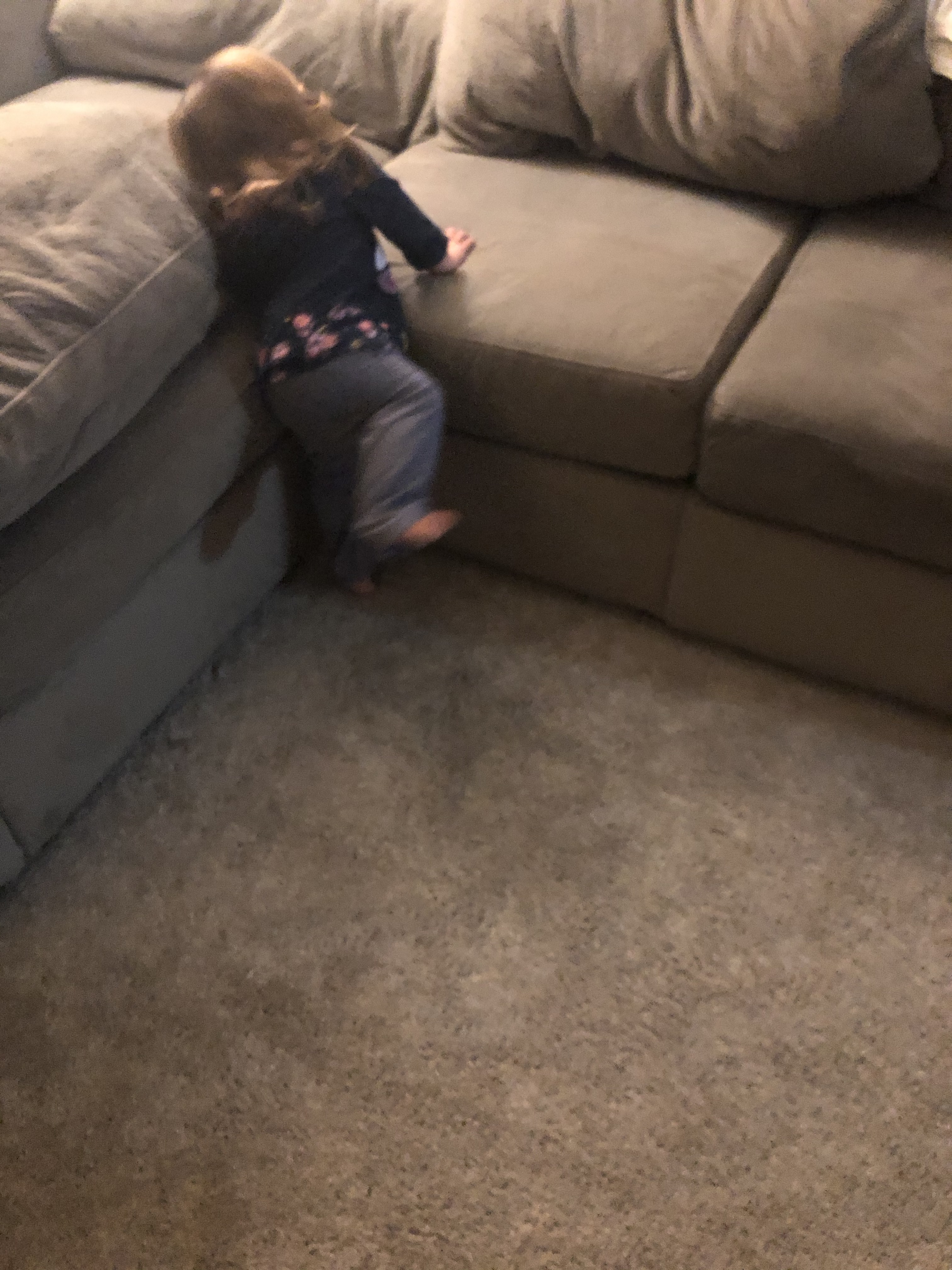
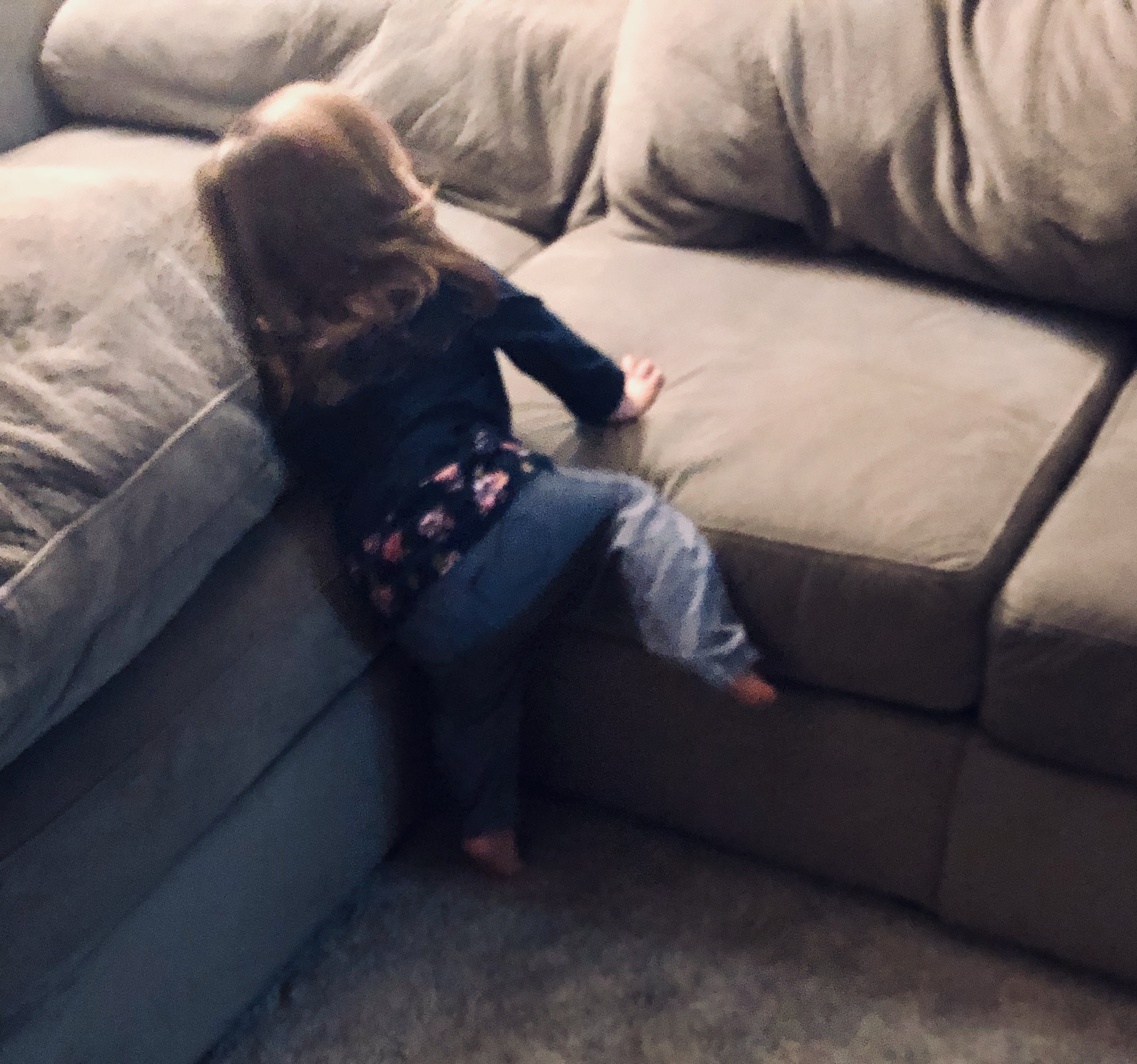
When trying to get up on some of the furniture, (see photos)

Sometimes Samantha would ingeniously choose a way to do something differently so that she could stay independent in the activity. For example, if there was something for her nearby she could use as a means of boosting herself up on tall furniture, she might drag that toy or bench close to use it to navigate her destination without “halp”.

She cannot manage “Grandma” yet so she calls me “Geegay”. I figure she will get there so I think the latter is awfully darn CUTE. I loved hearing Samantha say, “HALP, Geegay!” throughout the day. She more often did things without assistance, but never hesitated to ask for help should she:

  1. Figure out she really did need it to accomplish what she wanted to do.
  2. Was too tired to find an accessible means to accomplish it on her own, or the effort wasn’t worth the “gain”.

I had to admit while living with her, I saw the lesson to be learned again and again.

Stubborn People with disABILITY

I realized the other day that I have lived with disABILITY longer than I have lived without. The feeling was strange since I had simply shouldered new challenges and practiced “keep on keepin’ on” while aging. People with disABILITY (congenital or acquired) often find that as they age, accommodations that were once enough to give them access to an activity or opportunity, no longer are enough. Perhaps even accessibility tools, electronics, devices, etc., may have once allowed you to be independent in a task but as you age you find those things are not enough to be completely independent.

My life with a disABILITY started at the age of 6 with a traumatic brain injury, broken bones, and destroyed hearing in the left ear. After a long recovery, I never felt like a person with a disABILITY until about the age of 18 when my hearing loss became bilaterally progressive. I eventually acquired Meniere’s disease (a vestibular disorder) and really began identifying as a person with a disABILITY at the age of 26 or 27.

I have a good friend who describes herself as “bilaterally hearing-impaired”. Because we are both currently training our third service dog and work at the same place, we often train together. One thing I love about hanging out with Jessica is that she always asks if she can do something for me. Whether it is to get the door for me, pick up something I’ve dropped, carry something for me, etc., she always asks first. She doesn’t assume I want her help, she thinks to ask first in the event her assumption I need it is unwanted or not needed.

Sometimes I say, “actually Finn has been working on door buttons, let us see if he will get this door open for us”. Perhaps the item I dropped is something my Golden puppy can safely work on his retrieve and get for me, so I will let her know that Finn and I have “got it handled” and no “halp” is needed. After training together for some time, Jessica once replied to my “no thanks we’ve got this” with a very thoughtful reminder.

“No problem. However, we know each other well enough now that I trust you to let me know when you need help and that you will ask for that help”.

The first time she interjected this reminder, I found myself thinking about it the rest of the day. Can you guess why? It is simple really. People with disABILITY can be pretty stubborn, and never ask for “halp” when they really need it. We can even earn the reputation of being ornery about our refusal; ungracious in both word and attitude.

In my early adult years of learning to live with deafness and balance issues, I adopted a rather unattractive and even dangerous attitude of “I am woman. Hear me roar!” This could be interpreted as, “I don’t need help. Leave me be. I’ve got this. Don’t you dare pity me!”

The only reason I can think of that I acted with such vehement, even arrogant refusal is that I didn’t want people to pity me. I also did not want them to think that I was UNable rather than differently-abled. I think that all changed for me when I realized how it made ME FEEL when I asked to assist someone who needed my “halp” and they refused. After realizing I felt “robbed” and even hurt when denied the opportunity to help someone that I cared about who obviously needed my “halp”, I started re-thinking my own stubborn refusals.

I have lived with the assistance of 3 service dogs now. Even so, there are things my canine partner cannot do for me, or cannot do SAFELY on my behalf. I have learned to ask for “halp”.

I have never, EVER been turned down. Even should I ask the most cantankerous-looking  curmudgeon in the aisle at the grocery store to get the 32-ounce can of turnip greens on the bottom shelf because a) I can’t bend down and get it, and b) the circumference is to large for my Golden’s mouth, I have never been told NO when asking for “halp”. (Hey we love our turnip greens in this house! I lived in the South a loooooong time).

Solutions to World Problems

Surely a solution to the world’s problems is to simply be kind to others. We all know that isn’t going to be the norm, however. Still, individually we can do our part and hope (even pray) for a ripple effect.

In every way that YOU can, make a difference.

If someone needs it, “HALP” them. Do it with a smile and without conditions. Do so easily, readily, and without any need for acknowledgement. Be the kind of person who so naturally sees a need and meets that need that it becomes who you are and not what you do.

But…

It is always good to ask. Never assume that someone who appears to need help, wants your help. Maybe they have some assistive device that will allow them to pick up that item without “halp”. They want to be independent.

BUT…

Don’t be a stubborn jackass. If you need “halp”, ASK. If someone asks if they can “halp” and you simply need a few minutes to do it yourself, explain that graciously. Don’t become haughty and retaliate with angry words and threats about where you are gonna hit them with your cane. Don’t tell them what to do with their request to “halp”. (Ahem)

Necessary Reminder

May I share something with you that you already know?

Even able-bodied people need “halp” sometimes. Whether it is assistance with a task, or a needed hug at a low moment, all of us need each other. The next time you need assistance for “halp”, just ASK already!

Even my two-year-old granddaughter will ask for my help when she knows she needs it. She even does so when she recognizes that she can do the task, but that it will get done quicker and with less effort if she simply asked for HALP.

Pogosyan (2018) provides multiple reasons why we should be willing to help and accept help from others. “Research has found many examples of how doing good, in ways big or small, not only feels good, but also does us good” (para. 2). So in closing, I would like to remind you (and yes myself as well) that disallowing someone to assist actually robs them of the benefit gained from that help.

Pogosyan goes on to explain that, “One reason behind the positive feelings associated with helping others is that being pro-social reinforces our sense of relatedness to others, thus helping us meet our most basic psychological needs” (Pogosyan, 2018, para. 1). In a very powerful way, it supports our need for EACH OTHER.

I’m starting to think this world is just a place for us to learn that we need each other more than we want to admit. – Richelle E. Goodrich
Our greatness has always come from people who expect nothing and take nothing for granted – folks who work hard for what they have, then reach back and help others after them. – Michelle Obama

L. Denise Portis, Ph.D.

©2019 Personal Hearing Loss Journal
Pogosyan, M. (2018). In helping others, you help yourself. Psychology Today. Retrieved December 7, 2019, from https://www.psychologytoday.com/us/blog/between-cultures/201805/in-helping-others-you-help-yourself


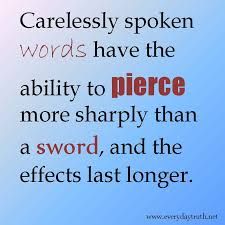
Careless Words

As a person with disABILITY, like any within a diversity group, I have experienced harm from words. Before you stop reading and think I’m going to blast the abled population, let me just say that people with disABILITY are often the worst offenders.

If I asked every person in the world to throw up their hand if they have experienced words that have…

hurt them

demoralized them

made them wince (inwardly and outwardly)

caused a “hitch” in your breath because of the unexpectedness

made you cry

made you SWEAR

caused you to “shut down”

forced you into isolation

triggered you to “fight back”

or scarred you for life…

… the sudden uplift of hands worldwide would cause a major shift in wind currents and likely tilt earth off its axis. Seriously. We’ve ALL experienced this.

I use the phrase “experienced words that have…” intentionally. Not all of us HEAR well and many who do hear well don’t listen well. The damage of careless and mean words is not something simply heard or speech read on the lips of fellow human beings. The words are EXPERIENCED. This experience is why damage is done. We take it in. We stew on it. We watch those words ping-pong back and forth in our brains and hearts like a pinball machine, drawing blood and causing wounds from every “hit”. We are scarred.

When my children were younger I would remind them that human beings can FORGIVE but we cannot FORGET. Our words have such power – it’s just freakin’ scary! I am an impulsive speaker. I say things without thinking through and that impulsivity causes regret more times than I can count.

People have told me things before that I needed.

Perhaps I was being a butt-head and careless with my own words. They put me in my place. Maybe it hurt but it was a disciplinary kind of hurt and I walked away wiser and un-scarred. (By the way, all of us have people in our lives whose very positional relationship with us allows them this power).

People have given me true (heartfelt) constructive criticism. This means the intent was clear, precise, and helpful. I am sensitive enough that even this at times can be hurtful, but it doesn’t WOUND.

Those types of experiences can hurt… but they aren’t spirit-murdering (a new word I learned at an Anne Arundel Community College workshop this week). I would like to argue that CARELESS words are never EVER helpful.

The word itself means, “not giving sufficient attention or thought to avoiding harm or errors”. Careless words can be both intentional and direct. They can also be unintentional and “oopsie” moments. Either way they hurt. They wound. They leave scars.

At the end of the semester a handful of students were sticking around to chat after the final. They were lovin’ on Finn, my 3rd service dog in training (SDiT),

… and just “messing around”, hangin’ out, and talking. One of my students muttered something and *I* (emphasis on that I, for I am deaf – grin) heard the collective indrawn breaths. So…

I nosily asked, “what just happened”?

The student said, “Good God, did you hear what I said?“, acting both horrified and astonished.

“Well, no,” I replied, “but I heard y’all’s REACTION”.

Her eyes filled with tears and she admitted, “I said something contradictory and stupid and then said, ‘GAWD that was bipolar of me'” She then slapped her hand over her mouth and looked around at the group with big eyes. The group all immediately patted her back and assured her that “we ALL say stupid things”, and “we knew what you meant”. She vehemently waved all their support aside and said MUCH louder…

“No, NO. You don’t understand! I AM BIPOLAR. I just slammed myself!”

At this point, the floodgates opened and she was sobbing hysterically. It was contagious… of the 8 students standing there, five of them were in tears within minutes!

Do you know they stuck around for another 20 minutes and discussed the power of words and stereotypes? I just stood there in awe watching what I hoped was a little bit of my teaching rubbing off as they expertly dissected and dialogued about intent, carelessness, and harm.

OWN It

You are gonna spew careless words. Whether you speak with your voice or your hands, you are going to speak before thinking. Or… maybe you speak AFTER thinking but you simply don’t care about the damage you are unleashing.

Own it. If you care, if you want to minimize the damage, if you want to do better, if you are the kind of human being that understands the power of words, OWN IT.

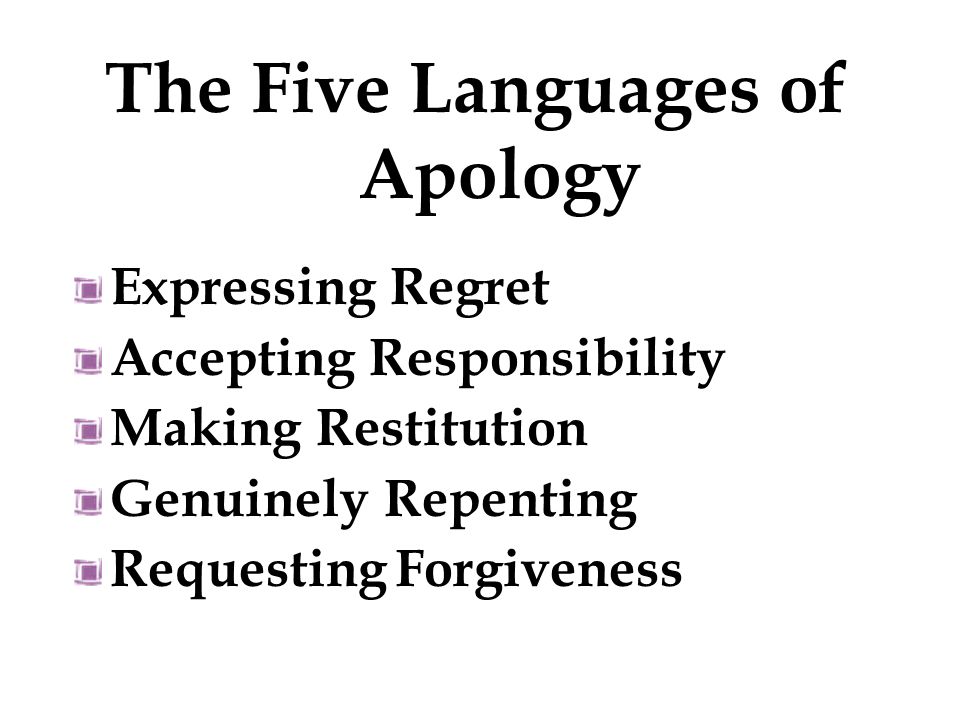
Apologize if needed (and mean it)

Make amends

Strive to do better. Vow it!

Practice

Call it (when appropriate) when you see others do it

Follow up and use all five apology languages IN WRITING.

This last one I have learned the power of this conscious decision to OWN it by following up with a note. Whether it is a handwritten note, an email or text, etc., writing down a follow up with a person I threw careless words at is so important.

It becomes this tangible, concrete evidence of my regret and promise to do better. The injured party can re-visit it if they want. It may act as a future means of measurement to them about how far I’ve come in using words as weapons. For me, it acts as a literal pivot point from which I can measure my own growth, my own practice of intentional, encouraging communication.

Next week, I want to discuss how one goes about admitting and voicing that “ouch! that hurt”. If careless words can injure, we are all wounded warriors. What do you do or say if someone hurts you?

Have a great week y’all!

L. Denise Portis, Ph.D.

© 2019 Personal Hearing Loss Journal


Overcoming It

A hero is just someone who is brave a little bit longer

For a former “farm girl”, I recognize it goes against the grain to say I HATE RAIN.

Besides… I don’t HATE rain, I hate the consequence of rain.

Not the consequence of providing necessary water to growing plants.

Not the consequence of washing the world clean.

I hate the consequence of navigating a rainy day. It promises bruises, headaches, falls, and sudden yelps and “CRAP, woah!” exclamations.

The irony is not lost on me that although I am profoundly deaf (when not wearing my cochlear implant),

although I have post concussive syndrome from numerous falls,

although I have a bum ankle that I badly sprained 4 years ago and wish to God I had broken instead,

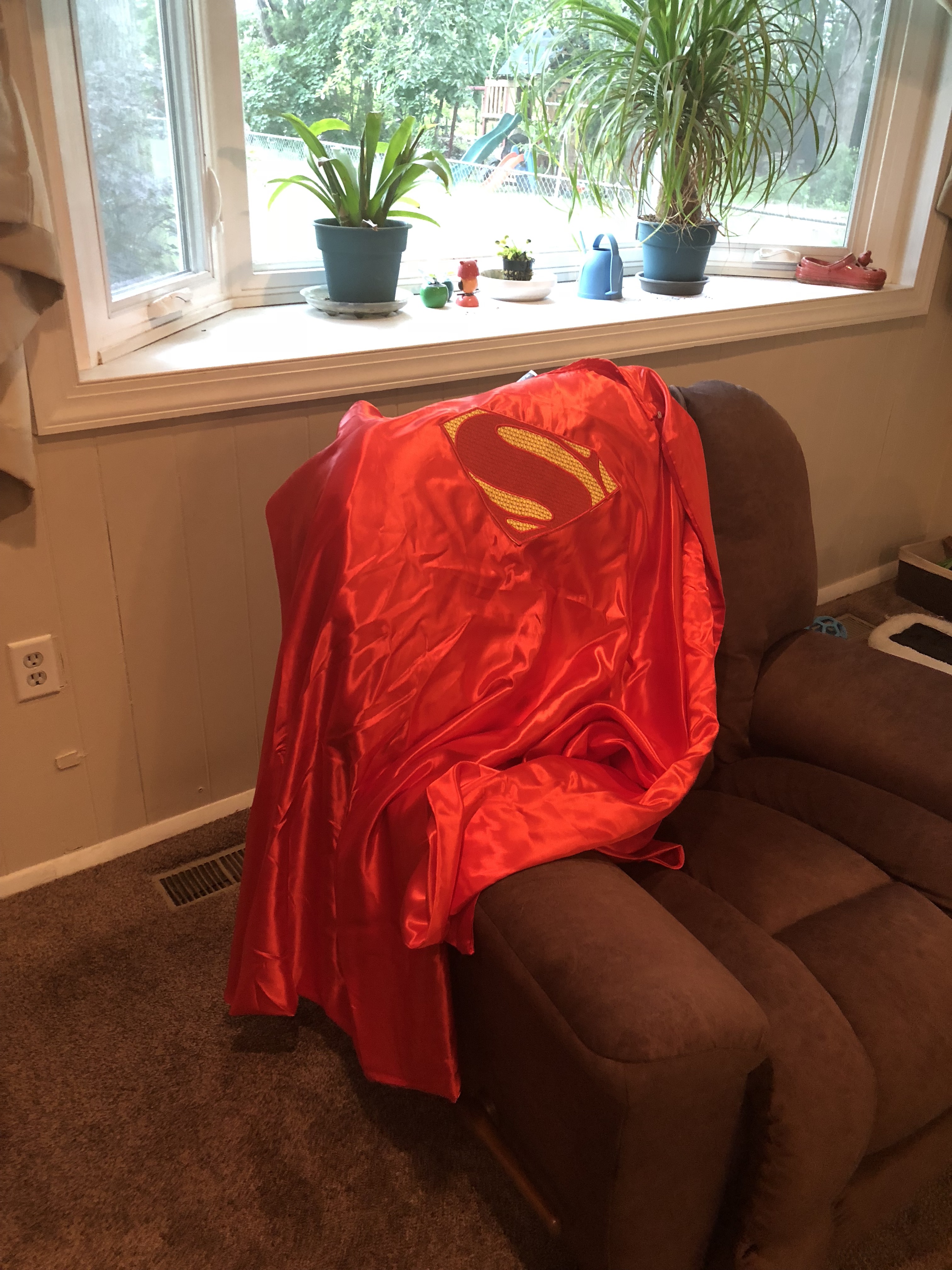
… Meniere’s disease is the battle for which I must “don the cape”. Something that falls into the “invisible illness” category. A disease/disorder with no cure and few agreed upon symptom smashers.

Meniere’s and weather changes are incompatible. On bad weather days I sometimes have to psych myself up and recognize that I cannot change the weather today and I cannot cure my Meniere’s. What I can do is “don the cape” and make the best of it.

Today I had my heart set on going to training at Fidos For Freedom, Inc., the organization from which I received both of my service dogs. My current service dog, Milo, loves going and the extra practice does us both good. I usually don’t wave the white flag on a day until I actually get up and go look at the sky. Lord knows, our weather forecasters are not very accurate about a “3 day” or “5 day” outlook. (Super strange that it seems the m0re technology available to us, the more meteorologists miss the forecast). I usually know it’s raining outside as soon as my feet hit the floor. I certainly cannot hear it <grin> as I don’t “have my ears in yet”. This morning I knew as soon as I swung my feet out of bed that it was raining. It’s fairly easy to guess when the entire room is spinning and the floor seems to be missing under my feet.

I always start out strong. I CAN DO THIS. I let the dogs out and start my coffee. Something I do each and every morning. No matter that I am doing it while hugging the nearest wall or counter.

I didn’t sink to the floor this morning, sobbing, after letting the dogs in for breakfast. I hung on to the chair rail molding on the wall and shook, said a few choice words, immediately asked for forgiveness and pled in genuine prayer to help me let go and walk to the kitchen. I’ve learned that caving to the despair only exacerbates my symptoms.

So I’m not going to Fidos For Freedom, Inc. today even though Milo-bear is looking forlornly out the window wishing we weren’t at home.

Please do not misunderstand this post. I’m not looking for sympathy. I am not inviting you to my pity party. I simply want to share what it is like to live with a chronic, invisible illness. It might also surprise you that I am glad

happy

untroubled

delighted

pleased 

… at peace with having this disease. If I did not have Meniere’s disease, I know that I would not have the heart and passion for people who live with invisible illness. When I am the one tagged to produce a post for “Hearing Elmo”, I do not do so from the keyboard of an expert. I don’t have the answers. I don’t have anything profound to share today.

NOTE: Like to write? Want to share your journey? Hearing Elmo welcomes guest writers!

Instead I can salute and encourage all who must “don the cape” and simply make it through today. Overcoming one hour at a time and making the best of it. Shauna Niequist said, “… what I can do is offer myself, wholehearted and present, to walk with the people I love through the fear and the mess. That’s all any of us can do. That’s what we’re here for.” 

We are super heroes because simply “overcoming it” is our default and salvation. It’s not always pretty and I don’t always “rock my cape” with grace, drive, and power. Sometimes I just feel pissed. But…

I’m overcoming it. I’ve had practice. I’ve got this.

And friend? So do you.

Nope. It ain’t easy. You can overcome it. You have before. You will today. “Don the cape” and get through today.

L. Denise Portis, Ph.D.

© 2018 Personal Hearing Loss Journal
New Twist on an Old Fable

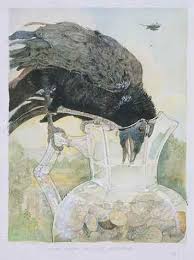
Townsend version of Aesop’s Fable: The Crow and the Pitcher

A crow perishing with thirst saw a pitcher, and hoping to find water, flew to it with delight. When he reached it, he discovered to his grief that it contained so little water that he could not possibly get at it. He tried everything he could think of to reach the water, but all his efforts were in vain. At last he collected as many stones as he could carry and dropped them one by one with his beak into the pitcher, until he brought the water within his reach and thus saved his life.

Moral: Necessity is the mother of invention.


I have the privilege of hanging out with numerous people with disability. Some are students, some are colleagues I work with at Anne Arundel Community College, and some are individuals I know from various community advocacy groups. One thing I have learned about people with disabilities,

“Where there’s a will… there’s a way”

This “will” is what this Aesop’s fable of the Crow and the Pitcher reminds me of as I have seen time and time again, people with disabilities finding a way to accomplish what they need to do with whatever means available to them and within their own power.

I was walking towards an “accessible” bathroom with a young woman who self-identified as a “little person”. I normally have a rolling briefcase trailing from my right hand and a service dog in heel with the leash in my left-hand. As we approached the bathroom, I readied myself to  disengage myself from my rolling briefcase and pull the bathroom door open. Before I could do so, the student yanked one of her textbooks out of her book bag, stepped up on it, and pulled the door open. She held it open for me and never missed a beat… continuing to talk about what we were discussing on the way to the women’s bathroom.

I, myself, do things that I have simply learned which allow me to be independent. However, this example stuck with me a long time. The young woman was accustomed to doing this and obviously had practice. The young woman’s “normal” reaction was an expectation to do something NEW and NECESSARY to accommodate her need.

Another example: One day on campus as I was preparing for class, a student whom I have met only in the hallway a few times after exchanging a cheerful greeting, poked her head in the door and waved at me. This student uses a wheelchair. I walked over and realized the issue before she even opened her mouth. Right outside this classroom is a CRAZY women’s bathroom that has an entrance that is impossible for any person with mobility issues to get in and out of without assistance.

Need me to get the door?” I asked.

Yup!” – “Thanks!” she whispered with a knowing grin.

Later that week I saw her in the hallway again. This time instead of only a cheerful greeting in passing, she stopped me and told me thank you again. Even though the other bathroom on the third floor where we were was more accessible, it was much further from her class and she lacked the time necessary to go down that far to avoid being late for class. I explained to her that I had to have help with this particular door too if I had my service dog with me. We both giggled at how ridiculous it was that we required assistance for that bathroom. (Do you know I still don’t know her name? Comrade in arms, but clueless as to who she is – smile). The day I got the door for HER, my service dog was waiting patiently behind me in the classroom so I was able to assist without any hoopla or drama.

Just in case you are not a long-time reader of Hearing Elmo, I have Meniere’s disease (a vestibular disorder) and “hear again” with a cochlear implant. I also have post-concussive syndrome. I have made numerous adjustments and changes within my home, car, and office to eliminate my need for assistance. Since I can’t raise my hands over my head without swooning, everything I need in the kitchen is on a shelf I can reach safely. My shower has everything I need eye level instead of up higher on the rock-faced shower wall. I have chair-rail molding all over the house so that I can grab it with my fingers if I am walking and get wobbly. All my appliances and drawers that “stick” have a tug on them so that Milo (my service dog) can open them for me. I could go on and on, but I don’t want you to miss that the reality of ANYONE with disability or chronic illnesses, is that they are accustomed to doing whatever it takes to be as independent as possible.

Please Keep in Mind

Will you do your best to remember one thing? If a person with disability, chronic illness, or invisible condition asks you for assistance, you are their LAST resort. They have thought of and planned for everything that they can to be as independent as possible. However, there are times that we just need help.

Don’t make a big deal about helping, just do it calmly and with grace.

Don’t discuss the details or “unfairness” of the person needing your assistance unless THEY want to discuss it.

Don’t feel sorry for us.

Don’t be super dramatic and bring attention to the issue.

Where There’s a Will, There’s a Way

Earlier I stated, “where there’s a will, there’s a way”. If you live with disability, chronic illness, or visible/invisible conditions, I understand when WILL disintegrates. I work as hard as the next person with disability to be independent and strong. Yet… there are times I just throw up my hands and yell, “SCREW this! I give up!

I cannot speak for others because we are all SO different. Even people who share the same diagnosis may:

  1. Have different symptoms
  2. Take different medications
  3. Have different responses/side effects to those medications
  4. Have more support than you do
  5. Have less support than you do
  6. Have a different personality style and traits
  7. Have a different developmental history than you do
  8. Have different faith practices than you
  9. Have different co-morbid diagnoses (Other conditions in addition to their primary challenge)
  10. Have cognitive issues as well that impact problem-solving

I can say that for ME, the best thing I can do after having a “Screw this” kind of day, is to go to bed. And yup… I mean I do so even if it is only 5 PM! I always feel better, have a clearer head, and a renewed WILL after getting some rest.

I am really tired of being TIRED after having to find and produce my own accommodations for various activities. However, a fresh perspective (after a good night’s rest) nearly always renews my inner warrior and allows me to face a new day willing to do whatever I need to in order to be a thriving, surviving disability advocate.

In the comments, I welcome other examples of how you have learned to make things accessible for you.

Warm hugs and virtual “high 5’s” to my fellow differently-abled people!

© Personal Hearing Loss Journal

Denise Portis, Ph.D.