Accepting Help ≠ Dependence

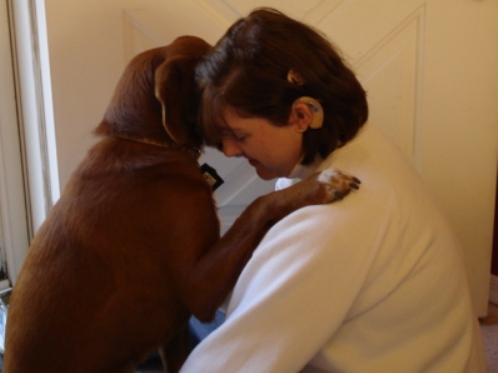
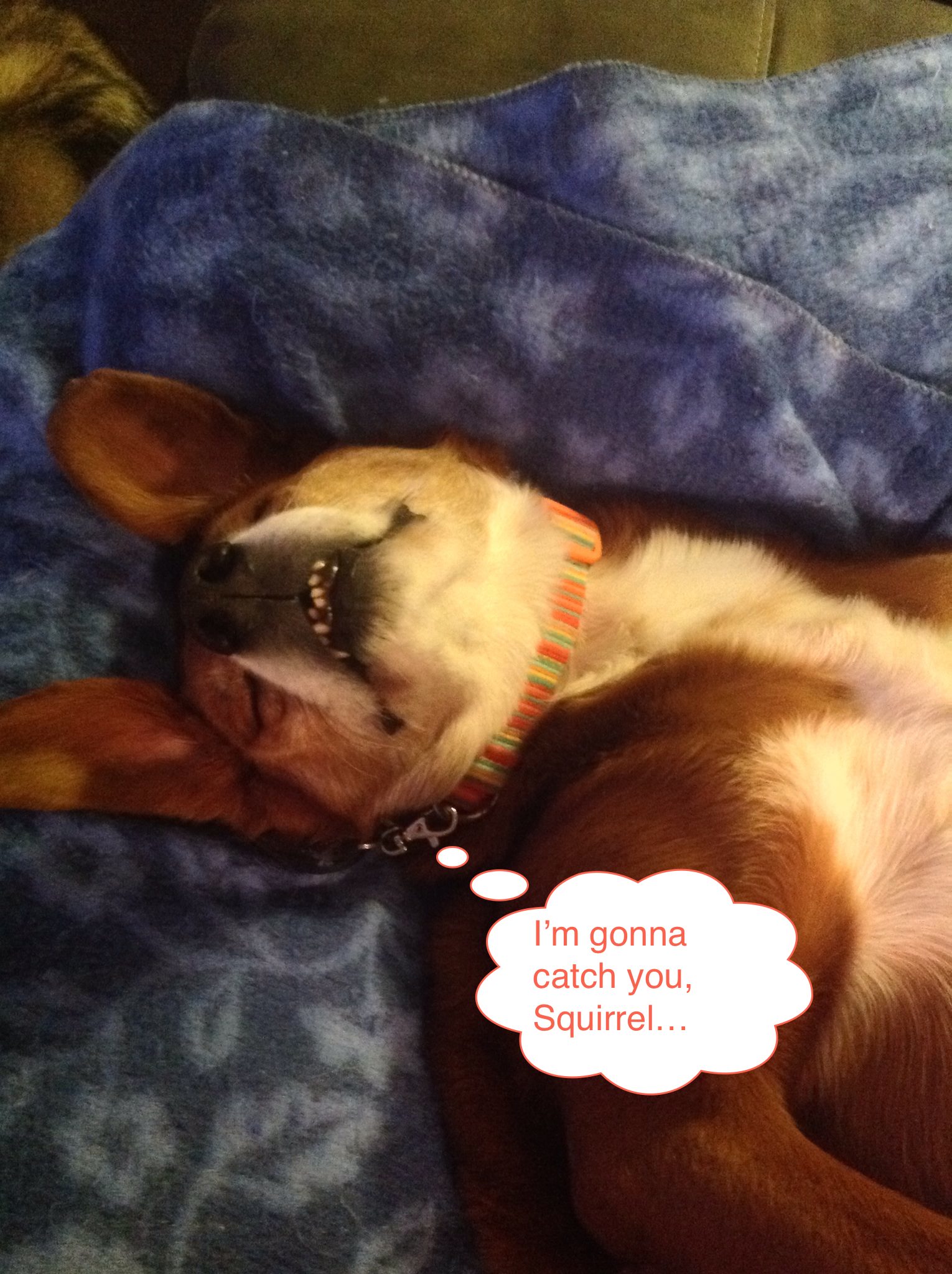
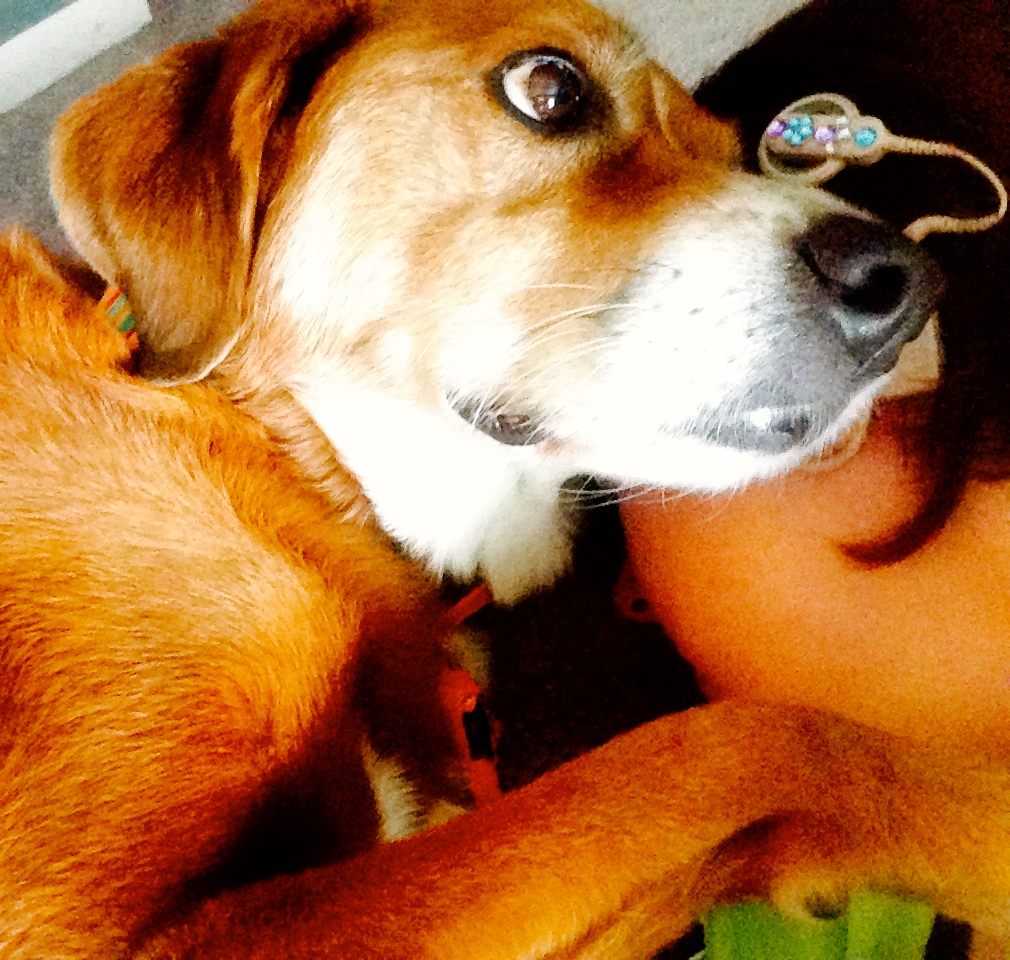
This service dog took full advantage of a holiday vacation in Florida.

My Christmas holiday was a blur. They can be that way sometimes. I flew to Florida with my husband to be with my parents for Christmas, but I had a TON of homework. Chloe, faithful service dog, at least got the opportunity to really chill out. When I got home, I headed to an academic residency for 4 days.

Even being super busy, I still learned a few things. I learned some things about myself, about other people, and about acceptance. I began to lose my hearing and balance at the age of 25. Now that I am 48-years-old, you would think I have learned all that one can learn after living with hearing loss and a vestibular disorder for 2+ decades!

Ungracious Acceptance

Acceptance of my life as it is, seems to be an ever-evolving concept. Sometimes I take things in stride. Progression of the toll my diagnoses have, a new “timber – down goes Denise – fall”, having to switch out cochlear implant batteries mid-conversation, taking the elevator instead of escalator or stairs, and having to wait for an empty handicap stall in public bathrooms so that my dog and I BOTH fit, is really second nature for me now.

But sometimes? Sometimes I am WITCHY about it. (Feel free to put another first letter there as it probably fits from time to time). Maybe it’s hormones? Perhaps it is a lack of sleep? It may be I just had an unpleasant encounter with someone who was condescending towards me when my being differently-abled became apparent. For whatever reason, at times when someone asks if they can assist I must look…

S c A r Y

I assume this because their eyes get big, they throw up their hands in an “I surrender!” pose, and they take two full steps back. I don’t MEAN to put off that vibe, but I know there are times I must do so. I work SO hard at being independent. I love the color purple, but that isn’t why I carry a bright purple cane. I love dogs, but that isn’t why my 24/7 partner is a service dog from Fidos For Freedom, Inc. I love dangly earrings, but I don’t wear “bling-bling” on my cochlear implant because I’m a drama queen.

(OK, OKAY! I’m a drama queen, but in THIS instance it is not why I have bling-bling on my cochlear implant! Yeesh!)

I do all of these things to be independent. I yearn for independence and inner strength. I forget sometimes that the latter is the result of a “thinker” and “feeler” in sync in the body of a person who is differently-abled. Part of it, I actually HAVE caught the exasperated looks on faces when I do ask for help with something. It can be fleeting, but it’s there. I’m deaf, not blind. (We can debate if differently-abled people are far too sensitive about this and see things that are not there later).

Yeah, so? Let’s Go!

While in Florida, amidst homework and research, I did insist on going out to eat every day. I did a little bit of shopping at a place we don’t have in Maryland. Bealls was a very cool place! We also do not have a Belk. So yup. I did a little shopping.

When we went out on the town to do these things, we had to borrow my parent’s car. It is a big ol’ SUV and Chloe had to sit in the back compartment. It gave her plenty of room to stretch out and seemed like a great option for four people plus one service dog. The problem was that my parent’s SUV sits very high. Chloe is 10+ years old. She is retiring in May of 2015 (unless she lets me know it needs to be before then). The first couple of times I gave the “Chloe… OUT” command, she jumped from the back, only to have her front legs collapse and do a hound face plant in the parking lot. The first time it happened, I gasped. The second time it happened, I’m pretty sure I yelled. OK, yeah. I don’t yell. I have a hearing loss. I SCREECH. Ask me to demonstrate sometime, but bring the ear plugs.

Because my husband, Terry, didn’t want to see what a third time would trigger, he suggested, “Let me lift her out of the back and set her on the ground!

I said, “Ok, but do it in a way you don’t embarrass her. Make it quick and don’t make a big deal about it.

Perhaps I should explain that I disagree with those who say that dogs don’t exhibit or feel some of the same things humans do. I have seen dogs excited. I have seen them pissed. I have seen dogs pouting (do I have some stories about my grand-dog, Pegasus, or what?). I have seen dogs embarrassed. Point & laugh and dogs will duck their heads in shame/embarrassment.

Chloe’s weight ranges from 59-62 pounds. Needless to say, we don’t carry her around. I wasn’t sure how she would respond to being lifted from the back and set on all fours on the pavement; nor, did I know how she would respond to being lifted up into the back of the SUV.

The first time we opted to lift the service hound out, I held my breath. Terry reached into the back, hooked his arms under her and locked his hands over her spine, and carefully picked her up and set her on all fours.

PUH.

I exhaled rather noisily, and watched as she wagged her tail and moved to heel position, looking up at me as if, “Yeah, so? Let’s go!

I was stunned. I had a treat in my hand to cajole her back into a good mood. Instead I went into the store as if nothing out of the ordinary had happened. I watched Chloe from the corner of my eye. (Ummm… explain to me how oval shaped things like eyeballs have corners?) I digress…

I fully expected Chloe to act, I don’t know… WEIRD for awhile. However, she took it all in stride. She needed the help, being rather fond of her own face, and didn’t even miss a step in going on about her job after accepting assistance.

Do you know where I’m going with this?

WHY???????

Why do we act so weird when we need help? Maybe it is just a little help.

… like picking up the dropped blue tooth device I spotted in a hallway that I could not bend to get, and didn’t want Chloe to destroy by enthusiastic fetching.

Maybe it was a lot of help.

… like helping me dislodge my wedged rolling briefcase from the elevator door as it was stuck solid. I struggled with my butt holding the door, cane braced, and dog freaking out as I tugged on a very STUCK wheel.

Sometimes? Sometimes, we just need a little help to continue doing our thing. We need a helping hand. We aren’t signing an I.O.U. If we truly want the world to be a kinder place, then why are we prickly when someone asks if they can help? By accepting help we are not sticking a “I’m WEAK” note on our forehead. We can accept help and still be independent. We aren’t waving all rights to an independent life should we accept help once in awhile. For most people, helping another is done so with no strings attached. They don’t even think twice about it. They may never think about it again, while WE sit there perseverating on it and making a huge deal about it. Why can’t we just say, “thank you!” and our attitude be, “Yeah, so? Let’s go!

PRIDE.

Pride can be a good thing. There are good types of pride, and crippling types of pride. Learn the difference. Learn to accept help. It doesn’t mean you are signing on to a life of dependence. It means that you are SMART. You know your limitations and are making wise choices to do what is best for YOU. Face plants on the pavement aren’t fun. All you will have for that type of stubbornness is a skinned chin. (Ask Chloe…)

Denise Portis

© 2015 Personal Hearing Loss Journal



It Can Be Small Things…

Deborah Marcus, friend and photographer, explains, "I love to hear how what I capture and share gets people to notice stuff they'd probably overlook". I have learned much through seeing what she sees through her camera lens.
Deborah Marcus, friend and photographer, explains, “I love to hear how what I capture and share gets people to notice stuff they’d probably overlook”. I have learned much through seeing what she sees through her camera lens.

A dear friend and fellow “hearing again with a CI” friend, Deborah Marcus, has a knack for capturing the kind of photos that has me sucking in my breath and having to pinch myself to remember to continue breathing. She finds the smallest detail and creates a visual memory by “pointing and clicking”. It’s a talent, and one I don’t have. So I enjoy seeing the small things through her camera lens that I would normally miss. Why do I miss them? I’m not looking…

The Problem With Health Challenges

One of the biggest problems with health challenges isn’t pain. It’s not fatigue. It’s not the stigma. It isn’t depression, anxiety, or any other comorbid diagnosis. In the years I’ve lived as a disability advocate, writer, and mentor, the biggest danger of living with chronic health conditions and challenges is that it can make a person extremely self-centered.

It’s easy to do. No one understands except perhaps others we’ve connected with who “live the same”. The people we love may be supportive or stumbling blocks. They may be our biggest advocates, or the pain in our… erm… behind.

Take Deborah’s photo above. Now me? I love daisies and any type of flora that is yellow and white. But ya know? I’d walk right by this flower and only think, “what a pretty flower!” I don’t stop, grow quiet, get down on my knees, and really open my eyes. If I did that more often, I’d see the gorgeous wee bug. (Entomologist, I’m not…)

It can be the small things that make an ordinary moment in time, something to be celebrated. When we become self-focused, it is impossible to see those small things and we miss celebrations.

Pity Parties are still Celebrations

Don’t get me wrong. I believe it is healthy to have a good ol’ pity party from time to time. After all, a party is a celebration … of sorts. ♪♫ It’s my party, and I’ll cry if I want too…♫♪

Learning to adjust to new challenges can be exhausting. Some folks with chronic illness or invisible disabilities may find it very therapeutic and healing to bawl their eyes out (Borchard, 2014). In “7 Good Reasons to Cry Your Eyes Out”, Borchard (2014), explains all the GOOD that can come from a good ol’ pity party.

But self-pity is dangerous and different than an occasional pity party. Self-pity begins and ends with self-focus. When we are entirely focused on ourselves and our own problems and difficulties, we cannot see the small things and miss the celebration. “We are bombarded with opportunities to feel sorry for ourselves” (Smith, 2004, para. 2) and if we become self-focused our camera not only fails to capture the beautiful bug, but we miss the flower as well. As a matter of fact, we may only see the dusty road in front of us as we trudge along feeling sorry for ourselves.

My Life is Hard. Can I Learn to “Really Look” Again?

Life is hard. I have heard from many readers who live with chronic conditions and invisible illness who know that they will wake up with pain and fatigue, stress and anxiety, and go to bed holding hands with the same bed fellows. However, many of these same people have learned that in spite of their circumstances, they can make a difference.

They have set short and long term goals… and are seeing them fulfilled.

They have reached out to mentor and volunteer… forever changing the life of another.

They have learned to adjust and evolve, rolling with the “punches”… teaching others by example and living with courage and perseverance.

They have learned to stop focusing on self… and can see the small things. They are celebrating.

I’m still learning how to do this myself. Believe me, when I reflect on “things we should do”, I’m sitting in the front row of my own classroom. And sometimes, it isn’t fun. Last week we had StRaNgE weather. It was in the mid-70’s one day, and in the low 30’s the next. Sunshine to snowflakes. For folks with Meniere’s disease this means you walk as if strolling on the deck of a ship – IN THE MIDDLE OF A FREAKING HURRICANE.

Rushing from my car to my 11 o’clock class, I was trying to hurry Chloe out of the wind and drizzle and hustle 100 yards into the building. One thing folks with Meniere’s disease do not do well is hustle. Not even with blinged-out cane and service dog. So I slipped on some leaves plastered to the sidewalk and fell on my hip and rolled to my caboose. I sat there a second with Chloe, wagging her tail beside me, perfectly content for a spontaneous pit stop. Since I was already SITTING, I let her go leash length to do her thang. As I moved to get up, my “no slip” (*rolls eyes*) boots slid some leaves out of the way as I struggled to rise. I noticed that the leaves had left perfect “leaf footprints” on the white sidewalk in a beautiful display of “peek-a-boo” gone right. I stood there and said, “well celebrate THAT!” I’m learning to look, and it only took 10 seconds. I remembered that leaf pattern long after my britches dried out. It was worth remembering; worth celebrating.

I hope each of us who live with significant challenges can learn to see the small things. We can only do it if we learn to look and if we take the time to do so. We can only do it if we stop with what is natural – self-focus and self-pity. I believe no human is stronger than those who live with invisible illness and disability. I’m a wimp with little to no ability to see what is right in front of me. If I can learn, you can as well.

Denise Portis

© 2014 Personal Hearing Loss Journal
Borchard, T. J. (2014). 7 good reasons to cry your eyes out. Retrieved November 28, 2014, from http://psychcentral.com/blog/archives/2009/06/06/7-good-reasons-to-cry-your-eyes-out/

Smith, R. (2004). Self-pity will destroy you. Retrieved November 28, 2014, from http://www.ncbi.nlm.nih.gov/pmc/articles/PMC437127/


But, Butt, Buttocks and Butte

Isn’t the English language crazy sometimes? Did you know that it is actually one of the hardest languages to learn? (Oxford Royal Academy, 2014). Since most who are reading this likely know and use English as their first language, that may come as a surprise to you. We bellyache about how difficult it is to learn Spanish, French, German, etc., because most of us were born into English speaking households. Yet, many scholars argue that English is quite difficult to learn.

Take homophones for example. “Butt” can mean to “be adjacent to” or it can be your hiney, your buttocks, your butt, your behind, your gluteus maximus, your CABOOSE. Talk about confusing! You have to look at words in context to figure out the meaning. Then… we have acceptable shortened versions of words. For example BUTT is an acceptable, widely used word in the place of BUTTOCKS. However, BUT is not short for BUTocks. As a matter of fact, that isn’t a word! Add an “e” to BUTT and it even changes the pronunciation of the word. Now it is BUTTE (pronounced \ˈbyüt\). However, you don’t ever add an “e” to BUT. The word BUTE is not a word (unless you mean the derivative of the medical word phenylbutazone). You just ran screaming from the room, didn’t you?

Get it Right

But ya know something? Sometimes we use words and think we know what they mean when we do not. It is my opinion, that those of us who live with disability, chronic illness, or invisible diagnosis, should know our own SELF very well. I have Meniere’s disease and am late-deafened. I sought to learn everything I could about both conditions. When I later developed extremity peripheral neuropathy, I learned all I could about this condition as well. However…

I cannot expect everyone I meet to be experts on what is wrong with ME.

Aren’t we guilty of that sometimes? Heck, even with our loved ones we really can expect too much from them. So we have to be careful about our expectations. If I tell a colleague that I’m late-deafened and they respond with, “Oh… OH! I know some sign language!” (and they start to slowly and painfully finger spell their name)… don’t have a COW. (Besides… that is just MESSY!) Not everyone knows that the vast majority of people with hearing loss are late-deafened and do not use ASL. Try gently educating instead.

I told a student who was walking down the hallway and then into an elevator with me, all the things Chloe does for me. She asked about my condition, so I tried to explain Meniere’s disease in layman’s terms. When we exited the elevator, she helpfully took my elbow, and said, “Here… let me help you“. I stopped (after making sure hound dog and my bags were on the right side of the closing elevator door) and dug in my heels. I looked at her in astonishment. I had just walked down a hallway with her, wheeling my bags behind me and juggling leash of faithful service dog not five minutes before! After helpfully disclosing and explaining Meniere’s disease now I’m incapable of walking on my own? Because I knew she meant well, I didn’t scream, spit, or throw a hissy fit (*pats self on back for rhyming so nicely right there*).

I said, “I can walk on my own. Chloe helps me“. She stared and then said, “But… But you are WOBBLING“.

I cheerfully retorted, “Yup. Welcome to my life!” and walked off.

Everyone’s an Expert!

Another problem you may encounter if you have a long-term or permanent diagnosis, is that helpful folks sometimes act “the expert”. I’ve tried to explain that I am late-deafened and hear again with a cochlear implant, only to be interrupted by the person exclaiming, “Oh yeah. I have to turn the volume up now that I’m in my 40’s!” (I’m like… whaaaaaa…?)

I told an employee of my favorite grocery store a little bit about Meniere’s disease. Chloe and I always meet him stocking bread in the same aisle almost every week. After hearing my brief explanation of Meniere’s, he said, “Oh yeah, I walk into things after I’ve been drinking even just one beer!” I stood there trying to determine if my brain heard what I thought it heard. Ever been taken by surprise before and your mouth just blurted out what you were thinking before you had a chance to filter it through your state-of-the-art “Maturity Meter”?

I said, “That’s the dumbest thing I have ever heard“. He stared and then stomped off. We only see the tail end of him leaving the bread aisle when we go to the store now.

All my buddies who are late-deafened joke about this response after telling someone that they are late-deafened: “Oh yeah, I have an aunt who is death“.

Rest in peace, auntie.

Cut ‘EM Some Slack

Just as our English language can be confusing, so can your explanations of who you are to others. Even invisible conditions such as mental illness are so misunderstood. Many folks who try to explain a mental illness diagnosis are then treated like:

1. Fragile porcelain that may break under pressure

2. They are suddenly contagious

3. They are more dangerous than Freddy Krueger

All we can do, is do our BEST. In the end, we need to work hard at trying to understand that others – even those who may care about us the most – may not completely understand your new normal. That’s OK. A healthy acceptance and ability to BE GOOD TO OURSELVES is not dependent on the understanding of others.

Denise Portis

©2014 Personal Hearing Loss Journal
Oxford Royale Academy (2014). Why is English so hard to learn? Retrieved on October 27, 2014, from http://www.oxford-royale.co.uk/articles/learning-english-hard.html

Sometimes? All You Can do is LAUGH

chloe hug

You’d think by now hound dog was accustomed to me bustin’ out into peals of laughter. I’ve done it often enough, after all! But I still take her by surprise sometimes!

I had a “Murphy’s Law” kind of day just recently. One of those days where if something COULD go wrong, it WOULD. Some interesting facts about Murphy’s Law and where it all began, visit this link. “Whatever can go wrong will go wrong”.

Chloe and I were walking one evening and the weather was DIVINE. Hardly any clouds, low humidity, and I had a “pep in my step”. For once, my Meniere’s disease was allowing me to walk at a pretty good clip with very little weaving. When I walk, I talk to my dog. Chloe would probably freak if I took a walk and was totally silent. It helps her pay attention to me, and I throw her name in there from time to time. However, sometimes I’m just…

Yackin’

Yup. Just talkin’ about anything and everything. It helps me to think out loud and I tend to go on and On and ON. I actually said out loud, “Wow, Chloe. Look at how easily I’m walking this evening! No wobbles! Moving along at a good rate! I’m smokin’!

Chloe gave me this LOOK. Almost as if she anticipated something going wrong after that lofty observation. Within 30 seconds (I kid you NOT), I stumbled on an ornery piece of elevated sidewalk and opened my mouth to shriek (for I do precious little QUIETLY) only to have a bee swoop in my open mouth as I began to fall into a nearby bush. So here I am choking on a bee, trying like crazy to spit it out while being impaled on various twigs and branches of a bush… a ROSE bush – wouldn’t ya know? So thorns grabbing me everywhere. Worse, it was damp earth under the bush thanks to recent rains so when I connected with the ground there was a obvious squishy sound and splat as my hip, knee and foot connected. So there I lay in the mud INSIDE a bush, choking on a bee, covered in thorns, desperately trying to hang on to my leash because Chloe was …

OUT THERE

SOMEWHERE

outside the BUSH.

I laid there a minute trying to go through my Meniere’s “play list” that automatically begins playing after I fall.

It’s a cute little jingle.

I’d share the wonderful lyrics with you so that you can sing along… but frankly I can’t carry a tune in a bucket and it’s one of those songs one whines and sings to oneself. So anyway… I run through the steps.

1. Am I dead?

2. Is anything broken?

3. Where is Chloe?

4. Can I move?

5. Do I need help?

So I was able to answer, No, No, *POINTS – somewhere outside the bush*, Barely, Yes.

I tried to turn to see if I could reach my bag. You know… the one with my cell phone in it that I carry in case of emergency? I can see it just out of reach out *there* near Chloe’s legs.

So… I asked Chloe to fetch the bag for me. She grabbed it up and ducked down to look under the bush at me. What she saw, made her drop her jaw and the bag tumbled back to the ground. Crap. Now my phone is laying outside the bag. So I tell Chloe to “fetch phone” – which is actually easier for her to do as it is something  she does several times a day. She grabs the phone, looks down under the branches again to where I lay and squirmed to reach my outstretched hand to give me the phone. Success!

Only… the phone is dead. That’s right, I carry around a phone with a dead battery on walks because it is SO helpful to do that. *rolls eyes*

So I decided that I needed to get out from under the bush. Easier said than done. I’m hung up, slightly injured, dizzy, muddy and on the verge of crying. Not a good combination. I thought, “Oh my gosh. I’m going to have to lay here until somebody walks by to help. How embarrassing! How will I explain this?” I didn’t have to lay there very long before I noticed that Chloe was now snuffling at my hung up hoodie sweatshirt.

TUG. YANK. R…I….P! Unbelievable! She tugged me free!

I rolled to one side to get out from under the bush and was wise enough to sit there a minute. Chloe plopped down and waited for me to “collect myself”. I fall SO OFTEN, if I am able to just go down without hitting my head I consider that a coup. So I checked out all my scratches and now torn clothing and thought that – heck. It could’ve been worse. It HAS been worse. So I started to laugh. Sometimes? All you can do is laugh. Chloe looked at me and just panted and “grinned”. It’s not the first time I’ve sat laughing covered in mud and trying to find the wherewithal to get up and keep going! (Likely won’t be the last time either!)

Can You Laugh at Yourself? Should You?

If you live with an invisible illness, have a disability, or a chronic condition, it can be helpful to learn to laugh at yourself. A great little article about the benefits of laughter can be found HERE.

But if you don’t believe in the power of endorphins or social connectedness, you still should learn to laugh at yourself. At least… that is my opinion. Here are some reasons I have learned to laugh at myself:

1. If I am laughing, it can reduce anxiety that others may feel when my disability pops up and causes me to do something like fall, mishear something, or other “Denise blooper”. Does it matter if someone else’s anxiety is lessened? Well… I don’t want people to feel uncomfortable around me. If I can laugh at myself, hopefully they will learn that I take who I am and my new “life parameters” in stride and am fine with it.

2. It reduces MY anxiety. Endorphins are real. It’s not some kind of borg nanotechnology that only re-routes and fixes sci-fy actresses. I FEEL BETTER after laughing.

3. If I laugh, it really helps me accept myself – just the way I am. You can’t change the unchangeable. I’m a klutz. I’m going to fall. As long as I’m in one piece and don’t have any odd bits of bone poking out anywhere, (Yeah, I know. Right?) laughing at myself helps me just accept what happened. It is MY WAY of embracing my flaws. This is who I am.

3. It helps me put things in perspective. While cackling like a hyena, I can take stock too. My little “jingle” may re-play. Some deep breaths – a mirthful hiccough or two, and I’m good as new!

4. Laughing helps me de-stress. Likely I’m laughing because I just did something that COULD cause me stress. (What if someone saw? Bet this mud will NOT come out of my jeans! Chloe tore my hoodie! I’m never walking again! As a matter of fact I’m just going to sit here on the sidewalk and feel sorry for myself! I’m going to stomp on my phone – when I finally get up. I hate my life! I want my mother… ) Laughing… de-stresses me. I can feel the tension roll off of my shoulders.

So I do believe “laughter is good medicine”. But…

There are perfectly good reasons to take the time to CRY too.

Or Scream.

… but those are best left for another writer to touch on! 😉

Denise Portis

© 2014 Personal Hearing Loss Journal
 

By Association…

by association

You’re gonna think this is off topic. Hang with me, I promise this is a “typical Hearing Elmo” post.

I’m turning in my “Christian” card. 

I’ve been so aggravated with “Christians” over the past month, that I decided to shred my “card”. Being a “card carrying Christian” doesn’t mean anything anyway.

It matters how you live and Who you put your faith in… at least that is what I believe. Sometimes I get extremely annoyed on FaceBook. But…

I stay because the disABILITY community is alive and well, thriving and connecting on FaceBook. In the last month, however, I have seen folks post a couple of things in the name of God, that made me shred my card. Carrying a card doesn’t mean squat. I’m going to live what I believe and ignore some folks that choose to make the “real deal” look bad.

1. The suicide/death of Robin Williams

Some things I actually saw posted:

“Shame on Robin Williams for causing such grief and forcing his family to shoulder this for the rest of their lives. No way is he in Heaven”.

“A Christian cannot commit suicide. It keeps them from Heaven. Guess we know where Robin Williams is”

“It’s is so sad he (Robin Williams) didn’t get help for his depression. Had he known God, that would have helped”

“Disgusts me! Suck it up and be a man. Seriously, the coward’s way out”.

All these from folks who regularly post things making it clear their faith-based beliefs. Yet this erases all of that in my opinion. They only show their stupidity (I mean… try doing some real research on what clinical depression is, would ya?) and judgmental attitudes. Yeah. That will win others to Christ.

2. The ALS Ice Bucket Challenge

Some people who have made it clear what “card” they carry when it comes to personal beliefs and faith, reported that they could not accept the challenge because ALS research conducts stem-cell research. It doesn’t seem to matter that stem-cells can be harvested from a number of different procedures – only one that is from embryos. Couples with frozen embryos can:

  • simply discard the embryos
  • can store the embryos indefinitely at their own expense
  • can give the embryos to other infertile couples. (More information about that option is available through the RESOLVE: The National Infertility Association)
  • can donate the embryos to general research or stem cell research (CIRM, 2014).

Stem cells can also come from adults, however, and umbilical cords of newborns. Scientists and researchers have even learned to induce pluripotent stem cells – alter adult stem cells to have the properties of embryonic stem cells (Mayo, 2014). But wait, let me guess. You have issues with genetic research, too?

Let’s say stem cell research goes against your personal beliefs and world views. So you do not support infertile couples seeking help in order to conceive? So if stem cell research is done and embryos are used… and a cure or viable treatment is found for diagnosis such as: spinal cord injuries, type 1 diabetes, Parkinson’s disease, Alzheimer’s disease, heart disease, stroke, burns, cancer, osteoarthritis, and ALS (Mayo, 2014), you would not participate in this treatment or cure if diagnosed with one of these, right? Or, if someone you love is diagnosed with one of these debilitating diseases you will let them suffer? Do you know how many relatives I have that would not be alive if not for diabetes/insulin research?

OKAY!

Ok.

ok… I will calm down. After all, you are allowed your opinions and biases. This IS (still) a free country. But I don’t have to buy into that, nor drink your proffered kool-aid. I read some posts about rejecting the ALS Ice Bucket challenge that made me weep.

I mean I cried buckets (though not ice buckets).

Because people who have this disease or love someone who does may have seen your post. And heard your excuses.

Hey. Most of us have limited incomes and must choose what we do with our discretionary monies. There are only a handful of places I give to each year because they are causes and non-profits that I am passionate and convicted about. If you choose not to accept the “challenge” that is your choice. Maybe say, “sorry, I give to other foundations/charities but I salute those of you who are giving to ALS”. Just please don’t make excuses about why you aren’t going to give to the ALS foundation and say it is because of the “card” you carry. Worse… explain that you are going to give your donation directly to a patient with ALS instead of the evil foundation. Because that person wants your money and not a cure.

Who Am I – by Association?

So all of this has made me think. (Can ya tell? LOL) Some of my associations I am very proud of and gain physical, emotional, psychological, and spiritual benefit from participating. Others make me keep my distance though. I may even shred my “card”. It doesn’t change who I am – merely my associations. I am a person of faith, but I want to be transparent, compassionate, and a friend who makes a difference.

What are your associations? (Other than those that are faith-based)

I am associated with groups who have bionic hearing. I have a cochlear implant. Sometimes we disagree on “best company” or hearing health strategies, but we don’t judge or behave holier-than-thou. We agree to disagree when needed.

I am associated with groups with vestibular disorders. There are SO MANY different specific diagnosis that are vestibular disorders. Meniere’s disease is a fickle pickle. Few have exactly the same symptoms and triggers, and what program works for one may not do anything for another. However, we work hard to accept that “whatever works” for each sufferer.

I am associated with groups who advocate for the rights of those with service animals. Fidos For Freedom, Inc., radically changed the course of my life. I don’t agree with all training practices and at times am rubbed wrong by certain personalities. However, I proudly wear the mantle of service dog “mom”.

Yet at some point in my life I had to dis-associate with the culturally Deaf. My reasons are a long story, but it is my story and I shoulder the responsibility of that choice.

I chose to dis-associate with my undergrad alumni. Again a long story, but one I stand by.

I chose to dis-associate with people who don’t like Greek yogurt. They can’t be trusted.

These are my choices, and YES. I “get” that you have the choice to “dis” Robin Williams, individuals who took their own life, and depressed people who have lost hope. I respect your choice. Doesn’t mean I can and will choose to associate with you. I understand that your conscious will not let you give (one time or regularly) or support (by posting a video and challenging others) the ALS Foundation. But if you choose to voice that opinion and choice in such a way that it harms others, I don’t have to associate with you.

There are numerous organizations in our great country that I do NOT support because of ethical concerns and personal choice. But you will never see me posting things in a public venue something that may cause harm to someone else – even peripherally. I have the freedom to express my opinion one-on-one to close friends and my husband. Believe me… I do this regularly when my ability to cope with those who hate Greek yogurt overwhelms me.

Y’all? Go be nice to others. 🙂

Denise Portis

© 2014 Personal Hearing Loss Journal

CIRM. (2014). Myths and misconceptions about stem cell research. Retrieved September 2, 2014, from http://www.cirm.ca.gov/our-progress/myths-and-misconceptions-about-stem-cell-research

Mayo Clinic. (2014). Stem cells: What they are and what they do. Retrieved September 2, 2014, from http://www.mayoclinic.org/tests-procedures/stem-cell-transplant/in-depth/stem-cells/art-20048117


Recurring Dreams… Life Goes On

1531649_10202502950992038_1907354485_o

One of my favorite chapters in “Introduction to Psychology” is the one where we study dreams, sleep, and the subconscious mind. Everyone dreams – though you may not always remember your dreams. If you have furry family members, you’ve learned that even pets dream. I’ve seen evidence of REM sleep in dogs, cats, hamsters, even cows!

Very likely, if you do remember a dream it is because it was a bad one. Or, you may remember it because it is a recurring dream. Interpreting dreams is tricky. Yes, yes, I know! Abraham, Jacob, Joseph, Daniel, and numerous others in the Bible made it look easy. It really is NOT that easy. If you have dreams that are bothering you, or have recurring dreams, don’t be afraid to talk about them with someone you trust. It can be a friend, counselor, or peer with a supportive role in your life. However, just remember, YOU are the expert on your dreams… they are YOUR dreams. Tartakovsky (2011) explains that there are indeed some universal symbols in dreams, however what those symbols mean to the DREAMER is what really matters. Someone else analyzing and interpreting the dream on your behalf is very likely inaccurate. In spite of knowing WE are the expert  when it comes to our dreams, recurring dreams usually end up making us “talk out loud” about what we are dreaming. Because you dream this dream OFTEN, you start thinking about it when you are awake. Most dream analysis experts agree that “recurring dreams reflect feelings and awareness that have not been successfully resolved in our waking lives” (Psychology Campus, 2004-2008, para. 4).

My Recurring Dream Had a Specific Trigger

I (like many of you) have a recurring dream and it always follows the same conscious scenario. Every time I fall and actually sustain an injury, I can guarantee I will have the same dream. I actually call it my “falling dream“.

Yes.

I do understand that by anticipating the dream, I am likely precipitating the dream itself. I get that. Now before you jump to conclusions, my dream isn’t about falling. Heck, I do enough of that in my conscious activity! I certainly don’t need it to happen in my subconscious mind – grin!

After a fall, I have a dream where I’m walking in a busy location with people everywhere, and all of sudden I’m frozen and cannot continue walking. Perhaps even more telling, my service dog, Chloe, is also frozen mid-step. Everyone around us continues to walk, talk, and move. Sometimes in the crowd I recognize people from my family, work, church, etc. Most of the time the faces are strangers, however. I can “hear” myself in the dream screaming (of course my mouth is not moving), “Help me! I can’t move! I can’t speak! Why aren’t you helping me? Can’t you see I’m frozen?”

So… yeah.  Please have fun with that and if you feel like commenting or emailing me what YOU think this probably means, go for it! I’m always interested in other’s opinions. Because the dream always follows a significant “Denise fall down – go boom” moment, I think I have this one figured out. I’ve had this same dream for over 12 years. The only thing that has changed in the dream is the addition of Chloe, my service dog. I was matched to Chloe in 2007. Goes to show the significant impact a service dog has on their person that she ended up in a recurring dream. <BIG GRIN>. Another change in the dream occasionally happens… but I’ll get to that later! <wink>

I believe this dream “for me”, means that I recognize that my “new normal” has an affect on ME, but not so much others. All the feelings, fears, bruises, even shame, is something I deal with in being differently-abled. However, it isn’t something that impacts others. Ever want to scream at the world to stop a moment and acknowledge that…

DARN IT. I’m dealing with this! Don’t you see? 

or

DARN IT. I suck at this! Don’t you see? HELP!

Life goes on. That’s hard, isn’t it? Isn’t it frustrating when you are sucker punched with a personal crisis of some kind and life just goes on as usual for everyone else? Worse? Life goes on for YOU!?

You lose someone close to you and crap. Life goes on.

You receive a diagnosis that will change your life. This sucks but life goes on.

Someone you trusted betrays you. It hurts but life goes on.

A progressive illness progresses. You adapt and life goes on.

You are sick and tired of being sick and tired. Life goes on.

Simple Acknowledgement

Most folks who live with invisible disability or a chronic illness will tell you that it is hard for them to share with others when they are struggling. This may be because they always seem to be struggling and figure everyone around them is sick and tired of hearing about it. We don’t want to be labeled as a “bellyacher”. Maybe you only rant to someone close to you. Perhaps you write. Maybe you pray. You may have some type of “release” that allows you to vent.

Sometimes my frustrations get the best of me and I bellyache out loud. However, most of the time I keep it quiet or at most confide in a trusted friend who “gets it” on a level that others cannot. I have a friend with MS who once told me, “Denise? I always feel like crap. I can’t respond to ‘How are you today?‘ with, ‘actually I feel like crap!‘. So I respond the way all of us respond, ‘I feel great, how are you today?‘. I can’t respond truthfully. People who do not have MS cannot understand what it is like to wake up tired, go to bed tired, and hurt all over each and every day. So I lie and say, ‘I’m great! How are you?‘ I don’t think this makes me a liar. This is how I convince myself I’m OK. I try to convince others I am.” 

You know? I don’t know very many people who live with significant challenges who want someone who will allow them to dump for hours each day. Griping for hours on end does not help physically, emotionally, or mentally. Most of us learn early on that perseverating on the negative only provides the ingredients for a significant meltdown. It is HUGE, however, to know we have a trusted peep or two that we can say, “Today is a bad day, but I’m going to be OK“.

Most of us simply long for a quick acknowledgment. Perhaps a short hug. I have a friend who has a seizure disorder and lives with chronic fatigue and pain whom I see about once a week. Like most folks, when we greet we say, “How are you doing?” I know this person well enough that both of us can say (on a day things aren’t going so well), “I’m not doing that great today, but things can only get better“. Or, “I’m not doing that great but I’m OK. Tomorrow will be better“. A pat on the shoulder and an understanding hug goes a long way. My friend doesn’t want me to grab her hand, drag her over to the side, and make a big production out of her “horrible, no good day”. If I say, “I’m thinking about ya“, or “How can I pray for you today?“, that is enough. You can see some of the tension roll off their shoulders. Simply acknowledging another’s pain or distress is A BIG DEAL. Salovey, Brackett, and Mayer (2004) call this empathy or emotional intelligence, and one can grow their EQ (emotional intelligence) simply by learning to acknowledge someone else’s feelings. It doesn’t have to be time-consuming. As a matter of fact, here are some great tips that will grow your EQ and help someone else:

1. Remember – and follow up.

Did someone tell you that they were having a rough day? The next time you see them ask them how they are doing NOW. By simply remembering they were going through a tough time and you care enough to follow up is HUGE.

2. Send a card.

My life has dramatically changed in that most of my correspondence is electronic. I buy one book of stamps each YEAR, when I use to buy that many stamps each month. However, I do shop for and keep inexpensive cards for “other” occasions (in other words, not birthday or anniversary), so that I can send a card off to someone who let it “slip” they are going through a tough time.

3. Follow up with a text.

It takes 10-15 seconds (depending on how many thumbs you have), to send a quick text. If you’ve limited time, don’t text an open-ended question. Just send off a quick, “Wanted you to know I’m thinking of you today and hope your day is better“. It doesn’t take much time and it likely means THE WORLD to that person.

A Significant Change in the Dream

Ok. I explained earlier that I do have one specific change that happens in my dream and over the years I think I have this figured out as well. Sometimes when I am “frozen”, a person or persons do come up to ICE CUBE Denise and Chloe, and try to help. Guess what? These are usually people I’m thinking about consciously, who are also going through something significant. For example…

I had this dream this past week after a fall on the deck. The injury was significant enough to warrant a doctor’s visit, x-rays, and a cancelled trip. I have been thinking about and praying for two specific people, both of whom showed up in my “falling dream”. One had surgery last week, the other is looking at surgery in her future. Both came and patted “frozen Denise and Chloe” and told my icy self that “everything would be OK”.

You know what? Having a support group MATTERS.

10538663_10204128535430633_9142153402343424683_n

It doesn’t mean that you need to join an organization (although there are benefits to doing so). It does not mean you need to find a group in which you stand up in a circle and say, “Hello. My name is Denise and I have invisible disabilities“. However, there is significant HELP in having a person or two who GET IT.

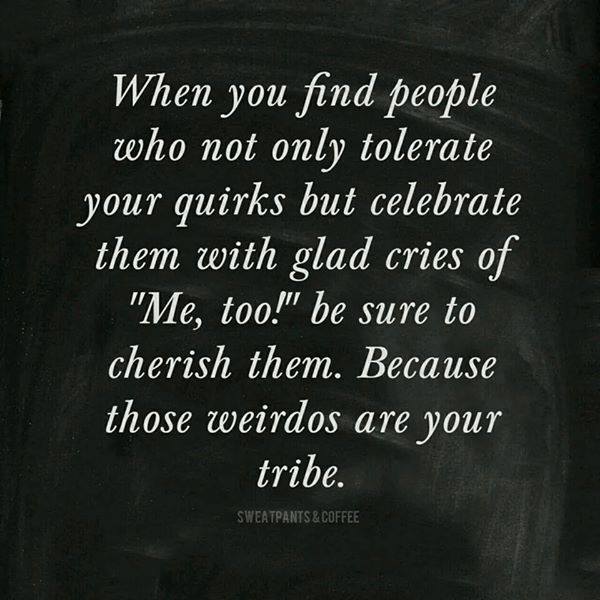
A tribe.

People who understand where you are coming from when you experience your life – your “normal”.

Thankfully, it is fairly easy to find those folks. The Internet has opened the door to really connecting with others who are like-minded, live what you live, and provide support simply because they truly GET IT. Maybe you have a friend or confidant who is that support for you, but they don’t actually share your diagnosis. But folks? Everyone has something. Life is hard. We all have difficult times. The two folks who showed up in my “falling dream” last week do not share my diagnosis. They do share living a difficult life but PERSEVERING. That’s why these folks show up in my dream. Support makes a difference.

You can be that kind of support. It will grow you. It may be time consuming at times. You may find a reciprocated “shoulder”. You may not. I don’t know about you, but at the end of my life I want to be the kind of person who patted a few ice cube people. I want to be that person who tells someone THEY matter. What they are GOING THROUGH matters. One of my dream goals is to eventually see a puddle under every person in my crowd.

Because we all deal with something.

We can help each other to thaw out by caring, listening, hugging.

Denise Portis

© 2014 Personal Hearing Loss Journal 

Psychology Campus (2004-2008). The possible meanings of dreams. Retrieved August 11, 2014 from http://www.psychologycampus.com/dream-psychology/

Salovey, P., Brackett, M. and Mayer, J. (2004). Emotional intelligence: Key readings on the Mayer and Salovey model. New York: Dude Publishing.

Tartakovsky, M. (2011). How to Analyze Your Dreams (And Why It’s Important). Psych Central. Retrieved on August 11, 2014, from http://psychcentral.com/lib/how-to-analyze-your-dreams-and-why-its-important/0005975

Turn On Date

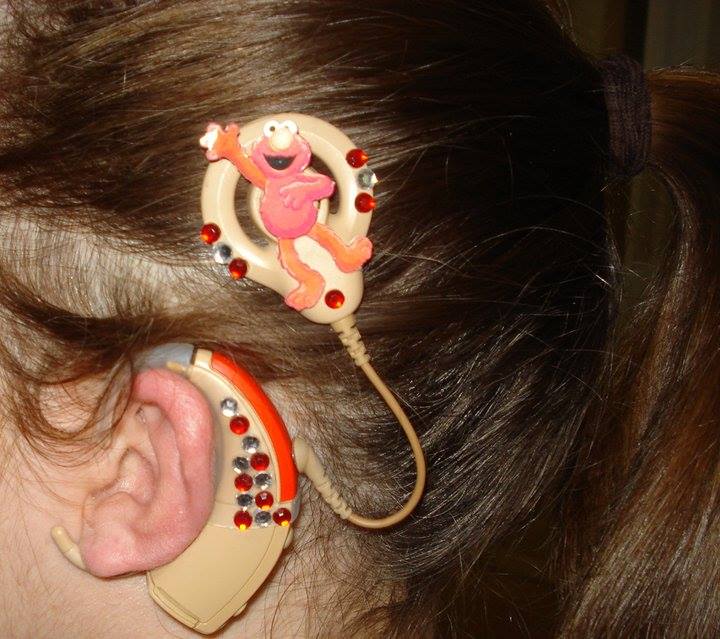
Elmo bling

One of my favorite discussions to have with people who have chronic illness, invisible or visible disabilities, or living a “new normal”, is sharing stories of how their adopted vernacular throws others they communicate with for a loop. We probably all have stories to tell. If your life is different because of a surgery, technology, or diagnosis, you may be using words and phrases that confuse and irritate folks who don’t live a similar life. I try to be careful and take a quick look around at WHO I’m talking to when having a conversation, but that is after really screwing up a lot in the early years. Here are some of my more memorable screw ups:

Your Turn On Date

Johns Hopkins sends folks my way when they are considering a cochlear implant, especially if they have Meniere’s disease as well. I have learned that when talking to someone new to the idea of cochlear implants, you cannot talk to them like someone who has already had the surgery. Cochlear implant peeps throw around terms that make perfect sense to US, but not so much to others. Case in point: I met with a lady with Meniere’s at a library who was investigating cochlear implants. At some point in the conversation I said, “Now the date you are turned on, you need to have a designated driver if possible. Everything will be so strange and you may not be able to drive safely if you don’t have someone to drive for you after you are turned on“.

Her eyes got big and she paled. She stuttered out, “Wha…wha… WHAT!?!?” I’m savvy enough to figure out by the way she answered that she didn’t understand my terminology. I thought I’d clear it up but succeeded in only making it worse…

Yes, when you go to the audiologist and they turn you on…” I stopped. Seeing her dropped jaw will silence me. I backed up and tried again, using “activation date” instead of “turn on date”. Do you know something? Unlike others who meet with me, she never followed up with post-surgery emails or meetings! <BIG GRIN>

I Lost My Ears

I had only been activated 8 months when I lost my ears. Now for CI folks, they get that when we talk about our “ears” we are talking about the external technology… not about our “listening appendages”. I was in a super Walmart, looking for a very specific jar of dill pickles (because yes… I’m that picky), when my cochlear implant – which has a magnetic coil to keep it on my head – flew off my ear and into the pickles.

Had I stayed still and searched the immediate jars I would have found it right off. As it was, being new to “hearing again”, I immediately stood up and screeched because my world had suddenly and completely gone SILENT. An older lady shopping amongst the same shelved pickles looked at me strange. I nervously picked up jars of pickles looking for my “ear”. The lady came closer and joked, “Are you pregnant?“. I turned to her with big tears in my eyes which made her come closer and immediately quit teasing me.

Are you OK?” she asked kindly. I looked at her and wailed, “I lost my ear! I can’t find it!

She looked at me bug-eyed and walked away. Quickly.

Thankfully I found my CI attached to the metal lid of some nearby olives. No wonder I couldn’t find it amongst the pickles.

I’m Not Turned On

When we lived in another part of Maryland, we use to have to drive a long way to go to church on Sunday. We actually went into another county to do so. Normally my family doesn’t listen to the car radio because they know that I’m totally incapable of tuning out the radio and hearing just the conversation. However, on longer trips, I often say, “I’m turning my ears off” so that they can listen to the radio and they know if they need me they only need to tap my shoulder. In truth, it is nice being able to sit in “total silence” from time to time. It is certainly conducive to “deep thinking”.

So one Sunday on our way to church, I gave the family heads up that I was going silent on purpose. I must have moved from “deep thinking” to day dreaming. We got to church, got our stuff out of the car, and Terry and I waved goodbye to the kids as we headed over to the building where we had small group Bible study. I’m still deaf at this point and I couldn’t tell ya if Terry was talking to me. I know my mind was somewhere else – that’s for sure! We went into the classroom and sat down at the big table. Some other couples were already there. One of the ladies leaned up so that she could see around Terry and said something. It was then I realized I still hadn’t turned my cochlear implant back on. “Oh! Wait, I’m not turned on!

I reached up and punched the correct button and looked around at a bunch of stunned faces. Terry was actually embarrassed. (If you know Terry, you know he rarely gets flustered). A few who caught on a little late began to snicker. Me? Well I thought it was just HYSTERICAL. So I managed to get out in between laughs, “Oooops. I need to find a better way to say I don’t have my CI on“. Terry quickly said, “Yes Denise. Yes you do!“. It took a number of months for me to live that one down.

Remember Your Audience

Do you live with a chronic condition or acquired disability? Have you become an expert in navigating your “new normal”? Can you “talk shop” with the rest of your population?

It’s hard to remember that just because WE understand what we mean, others may not. We tend to use words and phrases that become a part of our vocabulary. Try to pay attention to your audience. A good advocate learns to do that. You may have to deliberately choose to use a different word or phrase if no one really connects with it but you. For example, I had to stop referring to my bright purple cane as “my third leg”. I’m fairly naive and had no idea the shocked looks were from folks who had heard that phrase in a completely different context.

In order to really educate and advocate, you need to use terminology that the general public will understand. You may think a word or phrase is very obvious, but others may not ever hear that word in conversation. I was trained at Fidos For Freedom, Inc., to know how to advocate for accessibility with my service dog. The trainers didn’t tell us, however, that not everyone in the general public knows what the ADA is! (Thankfully, they also equipped us with great little brochures and handouts with the law explained on them).

Fibro fog” may only mean something to other folks with fibromyalgia. “CFS zombie” may only be a phrase others with chronic fatigue syndrome use. HoHearies can be figured out by most of the population, but is only self-identified by those who are hard of hearing. The general public may even make incorrect associations just because they don’t understand your chosen words. I had no idea anyone would ever think “tinnitus” was something caused by a cut from a dirty tin can.

You are a more effective advocate when you “consider your audience” and appropriately explain symptoms, treatment, and diagnosis. The goal is to educate after all. If you only succeed in confusing those around you, you haven’t really helped to educate.

What’s REALLY fun is when those closest to you start to confuse others as well. Terry often asks if I “have my ears on” now.

Denise Portis

© 2014 Personal Hearing Loss Journal

False Coping Skills and Elephants

IMG_1238
Hound dog knows when I’m “finished”

Ever wake up just feeling completely whipped?

I feel like I’ve developed GREAT coping skills. After all, you either learn to cope or you’re “done”. So the options are pretty clear cut IMHO. Two coping skills I learned early on in adjusting to my “new normal” as a person who is “differently abled”, include:

1. Start each day new. Yesterday is gone. Tomorrow will come without my worrying about it now. Handle today and today only.

2. Stay busy. Staying busy helps to keep your mind off your troubles and focus on the here and now. It can be busy-ness towards important things, or even the mundane.

The second one I use a great deal, but I’ll be honest. It isn’t exactly a HEALTHY coping mechanism. I don’t do well with a lot of down time. A perfect day for me is getting up (safely – believe me, it can be hard when you have a balance disorder and go VERTICAL for the first time that day), taking my dog for a walk while planning my day, re-enter the house in high gear without stopping until bedtime.

Yeah. Not always healthy. The problem with staying BUSY in order to cope is that it is a false kind of coping. This type of coping skill isn’t actually a coping skill at all. It is called avoidance. And friends? I do this really well. Some of you do too. (You know who you are…)

Staying Busy to Avoid

Do you “do busy” really well? It may be time to stop to discover WHY you stay so busy. Do you strive to remain busy to avoid unpleasant thoughts, actions, environments, even people? Don’t confuse healthy boundaries with avoidance. One is – well… HEALTHY. The other? Not so much. As a matter of fact, avoidance can lead to a number of physical and emotional problems. Psychologists have recognized avoidance for what it is for decades now. Yes, in the right context it can be healthy. But it is easy to AVOID to the point of harm. Spira, Zvolensky, Eifer, and Feldner (2004) explain that being busy to avoid our problems is actually a predictor of panic disorders. You see? The problem with staying busy to avoid something is that eventually you really will run out of things to do. Worse? Your body physically screams, “ENOUGH ALREADY!” and shuts down.

I am finishing up the last of numerous classes in my doctoral work and have already begun the very long process of dissertation study. This work keeps me really busy and it is work I actually enjoy because psychology is what I “do”. I work part-time as an adjunct professor and this helps to keep me busy. I love my work, love my students, and love to teach. The problem with working as part-time faculty at a community college is that it is impossible to predict how many courses you will be teaching semester to semester. For example, I taught the first summer school section, but not the second. I used the extra time in the beginning to catch up on some of my own school work and to do some “Spring cleaning” that had been long delayed… seeing as how it is SUMMER. These past few days though I’ve found I have had some down time. *grimace*

Forced Mindfulness

When I am forced to the point of literally running out of things to do… even for just a day or so, I find it debilitating.

Scan 3

Whoosh.

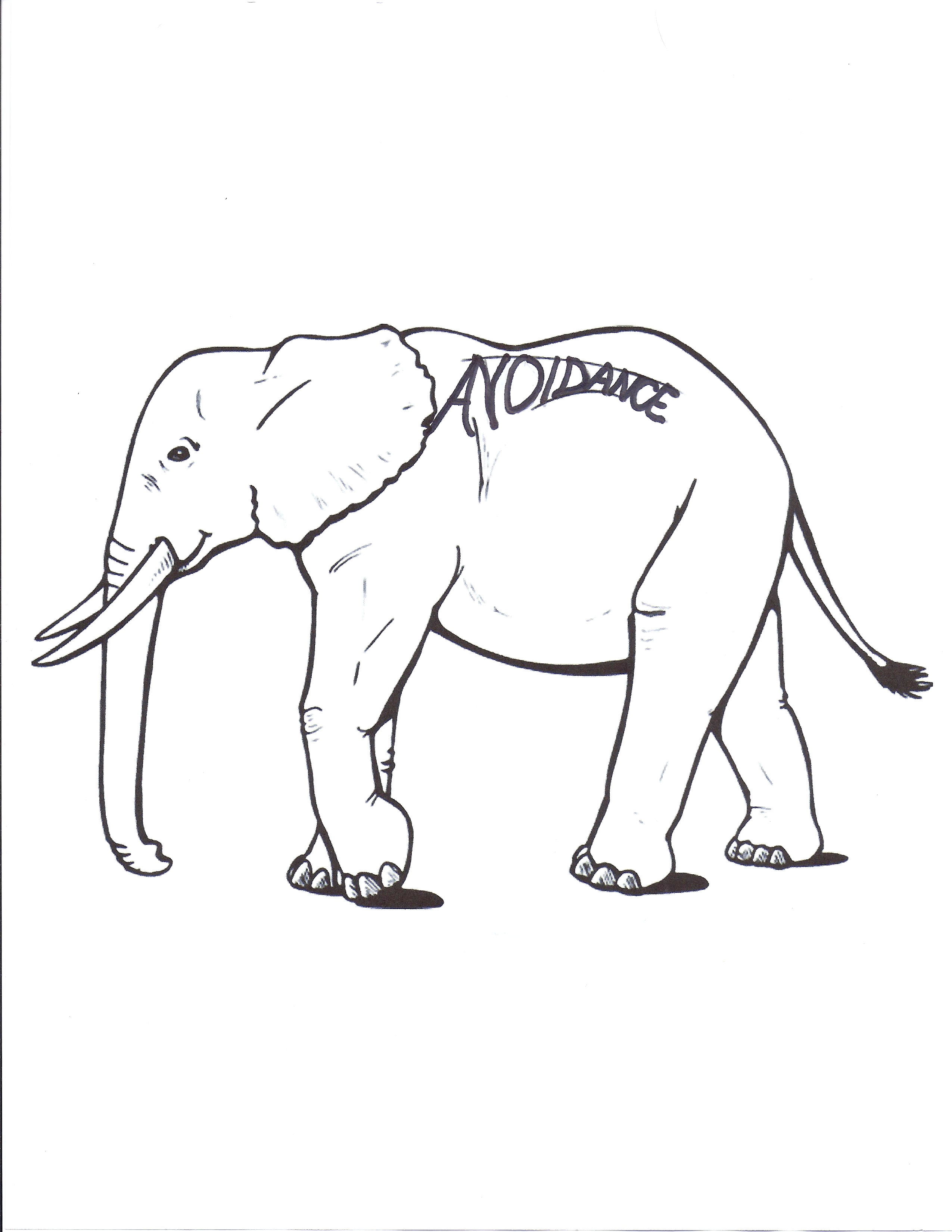
(Hear that? That was the air being sucked out of my lungs when the elephant in the room finally sat. On. My. Chest.)

I don’t do “mindfulness” well. I’m learning though.

Brown and Ryan (2003) explain mindfulness as being AWARE and ATTENTIVE. Let me explain on a more personal level and maybe you can “see” yourself somewhere in this:

Avoidance:

My new normal of hearing with a cochlear implant and living with a balance disorder is not easy. I’ve adjusted. Only to have to re-adjust. That’s OK. I’m flexible. Most of the time.

I work at a job I love and navigate life safely with a service dogMost of the time.

I am optimistic, cheerful, can poke fun at myself and enjoy busting my butt to help others. Most of the time.

I’m very busy and drop exhausted into bed each night and sleep well. Most of the time.

I have taken control of chronic depression and don’t let it control me. Most of the time.

I don’t feel sorry for myself. I like me. I recognize that I am doing well. Most of the time.

Truthfulness:

My new normal of hearing with a cochlear implant and living with a balance disorder is not easy. I’ve adjusted. Only to have to re-adjust. That’s OK. I’m flexible. Most of the time. 

Some days having a CI and Meniere’s disease sucks. I don’t hear perfectly. I feel left out. I’m tired of falling. I’m tired of running into things. I hate long-sleeves and high collars since they only hide bruises. I’m tired of adjusting. I’m going to cry. I’m going to scream. I may swear. 

I work at a job I love and navigate life safely with a service dog. Most of the time.

I love my job but it is really hard when the hallways are crowded. It can be overwhelming to have to rush from one side of campus to another. Crap. It’s raining? Really? *waves white flag*

I am optimistic, cheerful, can poke fun at myself and enjoy busting my butt to help others. Most of the time.

Sometimes I want to change my “… I’m fine, how are you?” to “I’m having a sucky day. And frankly? I don’t care how you are doing if you want to know the truth!!!!”. I’m going to have to ask for help. After all, Chloe cannot 1) retrieve a bag of dropped potatoes in the grocery store, 2) pick up that tiny paperclip without risk of swallowing it, 3) get the umbrella I dropped in a puddle without getting really muddy, 4) tell me EVERYTHING WILL BE OK.

I’m very busy and drop exhausted into bed each night and sleep well. Most of the time.

I can lay in bed and worry. 

I have taken control of chronic depression and don’t let it control me. Most of the time.

It’s hard when I have to “own” the knowledge that I will always “deal” with depression. 

I don’t feel sorry for myself. I like me. I recognize that I am doing well. Most of the time.

uh-huh. Ri -i -i -i -i -i…ght.

So yeah, sometimes I’m forced to pay attention and be aware. How is that helpful? Well, for starters attentive awareness facilitates choices of behaviors that are consistent with my needs, values, and interests (Brown & Ryan, 2003). It is healthy to really navigate personal feelings, thoughts, and even pain. David Cain wrote about mindfulness in a way that really “stuck” with me. It changed the way I view “forced attentive awareness”. Check out this great article, “How to Make Mindfulness a Habit With Only a Tiny Commitment“.

For me, mindfulness means being truthful with ME. I am learning to be mindful even when I am super busy. I do this because there will be days I am NOT busy and I want mindfulness to be an invited friend instead of unexpected guest. As a person of faith, it is also super helpful to be frank with God. In doing so, I am actually able to recognize false coping skills that in the long run are not healthy for me.

I’ve heard some folks say, “Oh golly. I can’t go there and allow myself to FEEL. You don’t know what I’ve been through“.

No. No I don’t. But I do know that pretending those feelings don’t exist do not change the fact that the elephant is THERE. At some point in time it’s gonna sit. On your chest. You won’t be able to breathe.

Be Mindful of Your Pachyderm

It is healthy to habitually and mindfully pay attention and be aware of what and who you really are. What are your struggles and successes? Where have you been, where are you now, and where are you going? Who is helping you get there?

What is really hard for you? What have you learned to do well? What do you need to change?

WHO ARE YOU? 

Don’t pretend that being mindful is the same thing as having your mind full. The latter is just another form of busy-ness on the cognitive level. Be attentive. Be aware. Do this with enough frequency that you can be mindful each and every day – for even just a few moments. I make it a priority to be mindful for a longer period of time – like a whole DAY, at least once a year.

But the elephant “sat” without invitation for me this past week. It took me by surprise. That is going to happen. However, if you’ve practiced mindfulness, you are going to discover…

YOU CAN BENCH PRESS AN ELEPHANT.

Denise Portis

© 2014 Personal Hearing Loss Journal

Brown, K., & Ryan, R. M. (2003). The benefits of being present: Mindfulness and its role in psychological well-being. Journal Of Personality And Social Psychology84(4), 822-848. doi:10.1037/0022-3514.84.4.822

Cain, D. (2013). How to make mindfulness a habit with only a tiny commitment. Rapitude.com. Retrieved July 20, 2014, from http://www.raptitude.com/2010/03/how-to-make-mindfulness-a-habit-with-only-a-tiny-commitment/

Spira, A. P., Zvolensky, M. J., Eifert, G. H., & Feldner, M. T. (2004). Avoidance-oriented coping as a predictor of panic-related distress. Journal of Anxiety Disorders, 18(3), 309-323. dii: 10.1016/S0887-6185(02)00249-9

TONS of Demerits = Life Turning Point

demerit

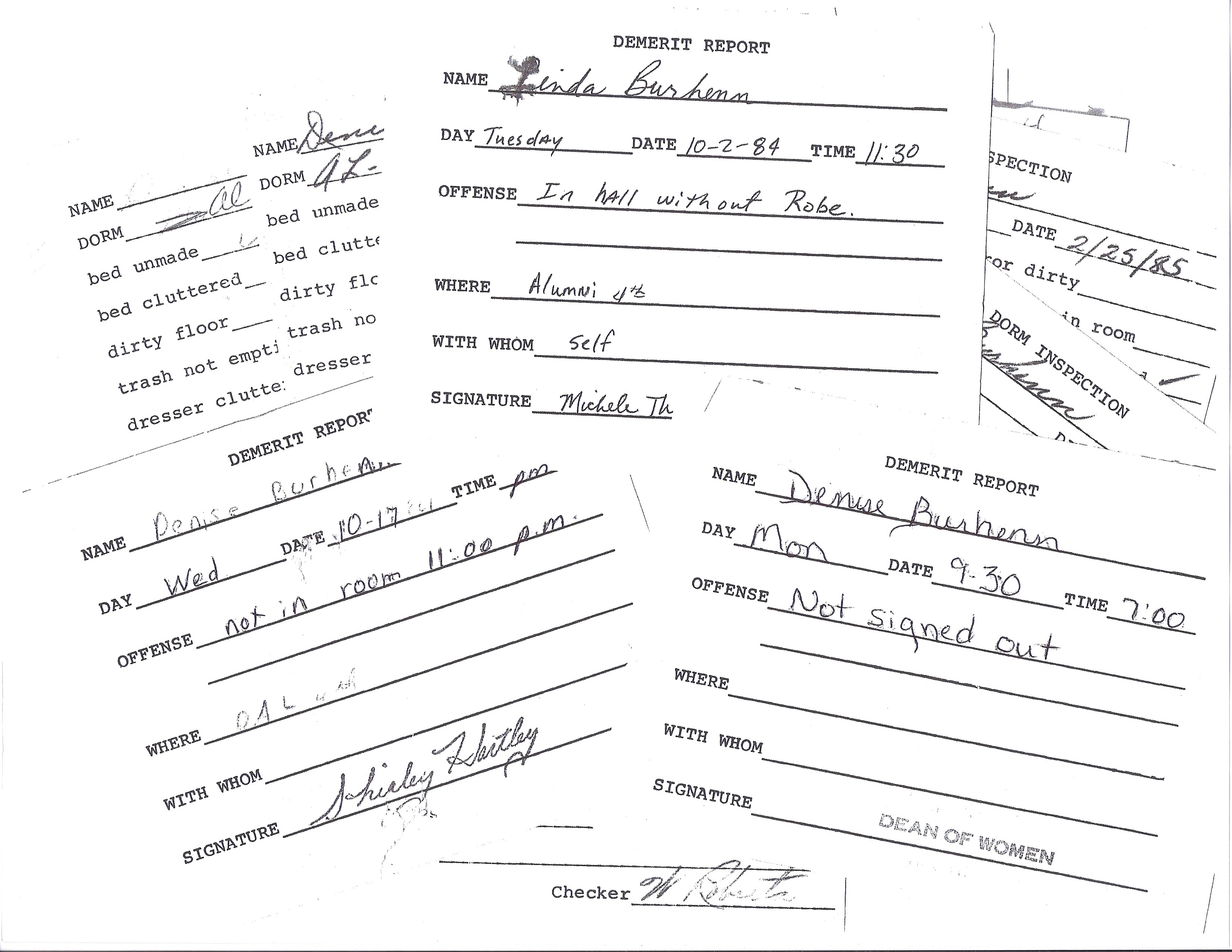
I went to a Christian University right out of high school. I lived in a small rural farming community with no Christian colleges nearby so I thought that I may as well go to the one my parents attended … 5 states away. What I didn’t realize, is that little had changed in the 25 years since my parents went there. Rules, regulations, and unequal criteria for males/females were still early 1960’s. If I had it to do over again, I would have transferred out after I met my husband-to-be my Freshman year. He was smart and he did that. I’m stubborn though and wanted to finish where I started. I remember the first week when I received my first demerit. I still have every demerit I ever received. Back to that in a minute…

Some Background

You see? In high school I was “the weird one”. I had some close friends, which coupled with my dream of “leaving forever”, was part of the reason I survived high school. I grew up in a legalistic, religious background. It was a loving home… and most of what I experienced I wouldn’t change because I’m sure it is a part of who I am today (and I happen to like who I am today). However, in high school I was not allowed to do anything OUTSIDE OF SCHOOL. No “dragging main” on Friday and Saturday nights. I wasn’t allowed to date until I was 16 years old, and by the time I hit that milestone everyone thought I was “weird”. I didn’t get to go to movies or dances. I got really tired of people thinking I felt as if I was better than everyone else, when the boundaries put in place were not of my choosing. I was bullied. I’ve never really talked about it to many people. Classmates would probably be shocked if they knew some of the things that happened to me when I was caught in the gym alone, or in the hallway on the way to Study Hall. One of my bullies (a second cousin one year older) would actually follow me into the bathroom (he was male) and shove me around just for kicks. Another bully, also one year older, not only shoved me around and called me names, but he pinched private parts, threatened me with horrible death threats, and basically made my life hell. I would just see him coming and start to have a panic attack. I learned to duck into safe places like the office, or favorite teacher’s rooms “just to say hi” to escape an encounter with him. One of the things he constantly pounded (quite literally) into me was that I thought I was better than everyone else because I was so “holy”. This is the baggage I took into college with me <smile>!

Yay! A Demerit!

By the time I was 18 and started getting written up (for really ridiculous things), I began to really excel at breaking stupid rules. Sure, I got a LOT of demerits but I did plenty of things I never got caught for either. I don’t say that in a bragging way. My point is that I really was proud of having proof on paper what a “rebel” I was. I even sat through some “sermons” from hall monitors and dorm mothers because of what my last name was. My family name was known at this university and they couldn’t believe I wasn’t behaving “perfectly”. I got married young and tease my husband that it was “just to get out of the dorm”. I even received some demerits after I said “I do“… for sitting to close to my husband in chapel. *rolls eyes* But ya know something? I hung on to every single one of those demerits because they were important to me. They represented a turning point in my life. I finally realized as a young adult that I could make decisions about what I would – and wouldn’t do – by myself. I really filled my lungs deeply with the freedom of that feeling! Demerits were received for not meeting someone else’s expectations. Now I could determine what my own boundaries were, what my expectations were for my own life.

I’m a person of faith (and haven’t tried to hide that on here), but I like to think I really live my faith and am a REAL person. Life isn’t about rules and regulations. Nothing wrong with some of those as they keep us on track, help us reach goals, and provide security. However, these rules and boundaries are only good when they set us free, not when they cripple us. Trying to follow someone else’s rules will only get you a box full of demerits. You have to believe what you live and live what you believe.

Life Turning Point

My college experiences and changes set the stage for how I handle life today. It was a turning point for me. I stopped apologizing for who I was, and felt comfortable in my own skin because *I* had made decisions and set standards for myself that I approved of and felt comfortable with as well. If someone didn’t like what I did, I gently (OK, sometimes it wasn’t gentle) argued that I respected their choices, so they should respect mine. I learned to be responsible for ME. I wanted to live a transparent, REAL kind of life, and wanted to make a difference because of that “realness”.

I had single-sided deafness from a car accident at the age of 6-years-old. I had my last ear surgery at the age of 18. I STILL think it took us all by surprise when I developed rather rapid, bi-lateral,  progressive, sensorineural hearing loss after the birth of my kiddos. At the same time, I developed Meniere’s disease (although I didn’t know what it was at the time). I determined early on what kind of “person with disabilities” I wanted to be. I would be responsible for who I am and how I cope. My top TEN decisions that turned my life around:

1. It is OK to grieve. It is OK to scream.

I learned how important it is to give yourself permission to FEEL. Bottling up those feelings only leads to physical and emotional problems.

2. Discover your “safe people”.

I’ve blogged about this before. However, find who is “safe”; cherish and nurture these relationships. (Some of those posts are HERE, HERE, and HERE.)

3. I can “be deaf and have a balance disorder” however I want!

Disability and invisible illnesses are often unique and you may not share exactly the same symptoms as another. Own who you are. Do what makes you comfortable with your “new normal”. For me this means bling-bling on the cochlear implant, bright canes and assistance dog. I am far better served to make the invisible, visible.

4. When necessary, get professional help.

There is no shame in seeking help. Finding a trusted, objective professional can be very beneficial for a variety of reasons. If you aren’t happy with who you are seeing, find someone else.

5. When necessary, ASK for help from others.

There is no shame in asking for help when you need assistance. I have never had anyone turn me down if I ask for help getting to my car, or to help me identify what sound Chloe is zeroed in on. In spite of the negative headlines, most people are nice. Most are glad to help when asked and feel good about offering assistance. (There is a trick to this though – you DO have to ASK. If you are an independent peep like me, folks have learned to wait to see if I ask for help).

6. Believe you can make a difference.

I don’t care what your limitations are. I have never met ANYONE that didn’t have a way to make a difference – to be a catalyst for positive change. Our disabilities don’t limit us – WE limit ourselves.

7. Avoid negative people.

We all have these folks in our lives. But you can limit your interaction. Set boundaries. Protect yourself.

8. Dream big. Have goals.

Just because special challenges “rocked your world” doesn’t mean you can’t have short-term and long-term goals. Your attitude is the only barrier to achieving these.

9. Write. Share. Take photos. 

Thinking is great. I recommend THINKING. However, the single most powerful tool I have is my writing. I know others who draw, take pictures, or attend support groups and share. Make sure your “new normal” is something tangible, something you can look back on and identify and recognize change.

10. Don’t work at meeting someone else’s expectations.

If you haven’t learned this already, here’s a news flash. You can’t please everyone. It is healthy to have expectations for yourself, but those alone are all you should work towards.

Have you ever received “grief” for not following someone else’s directions about how to live your life? As a kid, this is OK because we need older (and sometimes wiser) folks to give us direction and instill good habits. But as an adult, you are responsible for you. Don’t apologize for choices you have made. If you deal with your challenges a certain way and it works for you, pat yourself on the back. Be careful though. Like ALL people, we can become focused on self. That isn’t what I’m trying to encourage here. We need other people. Don’t isolate yourself and say, “to heck with the rest of the world”.

Denise Portis

© 2014 Personal Hearing Loss Journal


Inclusion

back up1

A friend of mine from high school works for KIT (Kids Included Together) and I’ve enjoyed following her training schedule on FaceBook as it takes her literally all over the world. KIT, “… specializes in providing best practices training for community–based organizations committed to including children with and without disabilities into their recreational, child development and youth development programs” (KIT, 2014, para. 1). I touched base with her recently to ask if she and I could dialogue about what inclusion looks like on a community college campus. I want to be more involved at my workplace with the Student Services department and Disabilities office to help raise awareness about what disABILITY, chronic illness, and invisible conditions are (and are not), and to help train professors and staff to provide an atmosphere of inclusion, acceptance, and a place to grow for all who are differently-abled.

There seems to be such stigma attached with certain diagnosis or disABILITIES. I cannot stress to fellow professors how important it is to let students know at the very beginning of class:

1. You welcome transparency about any and all invisible illnesses, chronic conditions, or disabilities.

2. You provide assurance of confidentiality.

3. You provide a platform in which students can provide feedback about classroom procedures or policies that make it difficult in light of their diagnosis or condition.

4. You become a “safe person” to any who wish for a faculty advocate to coordinate with Disability Support Services and/or other faculty.

Some unfortunate stigmas attached to living with a disability or chronic condition, include:

1. You are looking for special favors because you are “special”.

2. You are not capable of doing well in class because you have to do things “different than the norm”.

3. You have a persecution complex.

4. You are a drama queen/king.

Some of the strongest people I know are people who live daily with an invisible illness/disability or chronic condition. They not only often have to find “new ways” to do something that to the normal person seems “easy” (for example, washing hair… pretty darn difficult if you have a balance disorder), but they also have to navigate a world that harshly criticizes, misunderstands, or labels folks who struggle with these issues. Some of the most difficult invisible illnesses to positively advocate for are those with mental illness or disorders. Good gravy, talk about your stigmas! They are often considered “crazies” or “fragile”, and people often avoid them after disclosure. This sucks IMHO. Some of my favorite people are those who happen to have mental illness or disorders. Talk about your resilient people! 🙂

Real Responses that HELP

As I have been thinking about inclusion from an adult perspective, I have found that in many arenas, peers, co-workers, and colleagues want to make their event fully accessible to you but do not know where to start. I have learned in the decades I’ve lived with invisible disABILITY, that we should strive to not only point out the problem – but also the solution. So here is where I need your help. I want to put together a document that can be downloaded by readers so that folks can use the collaborated effort of YOUR ideas to assist when they have problems of their own.  So email me your examples, and I will include them! denise.portis@gmail.com  – in the subject line please put: Hearing Elmo Problems and Solutions.

Here are some examples of my own to get your brain working on ideas yourself! Not all are “cut and dry” problems and solutions. Sometimes the solution is simply a candid response. Read on:

1. PROBLEM: It doesn’t help when you yell when I’ve indicated I can’t hear you as added volume distorts your words and draws attention to both of us.

SOLUTION: If I have indicated I didn’t hear you, please make sure you are facing me. It helps me to see your face. Speak in a normal tone and try not to over-enunciate words as this distorts the way it appears on your lips. If I still cannot make it out, consider writing it down, or re-phrasing it.

2. PROBLEM: It’s great to have accessible venues as long as the accessibility options are available.

SOLUTION: Are there elevators available for those who cannot take stairs? Please make sure these are not blocked. (At a recent workshop I attended, when the elevator opened, the registration desk was backed up to the opening, blocking the exit. They were horrified and quickly moved things, saying, “We didn’t know someone was attending who needed this“. It’s actually against the law to block accessible options from use. This includes handicapped parking, bathrooms, ramps, making sure hearing loops are actually switched on and working, and much more. (I once complained that the handicapped stall in the ladies room had been “out of order” for a couple of days and was encouraged to use the other available stalls until it got fixed. WHAT? *grimace*).

3. PROBLEM: People think if I just plan ahead and “rest up”, I will be able to participate in an event.

SOLUTION: When I have to bail even last minute on something I hoped to attend, I try to provide as much notice as possible. You may need to remind organizers or colleagues that how you feel “day to day” is often out of your control and that you regret the late cancellation. Something as uncontrollable as the WEATHER can wreck havoc with my plans. We aren’t trying to be butt-heads and we very likely really wanted to participate. Please do not make it worse by giving us a hard time or insinuating we planned poorly.

4. PROBLEM: The workshop has several small group activities but the room does not allow the groups to separate very far. This may cause difficulties for those with any degree of hearing loss with the “bee hive” effect.

SOLUTION: Go up to the workshop facilitator and request to allow your group to go out in the hallway, or a nearby room so that it is quieter so that you can participate. (If you know in advance the workshop may incorporate these kinds of activities, see if the conference/convention center has assistive listening devices, or invest in your own so that you can carry it with you always. Be a “hearing loop” advocate! http://www.loopamerica.com/?gclid=CjkKEQjwttWcBRCuhYjhouveusIBEiQAwjy8IG2XkFTiQkOxeExJVBKV8kaOwZxqjxKgqTGAMSh4Ktzw_wcB)

I look forward to receiving your own ideas and together presenting a form we can share!

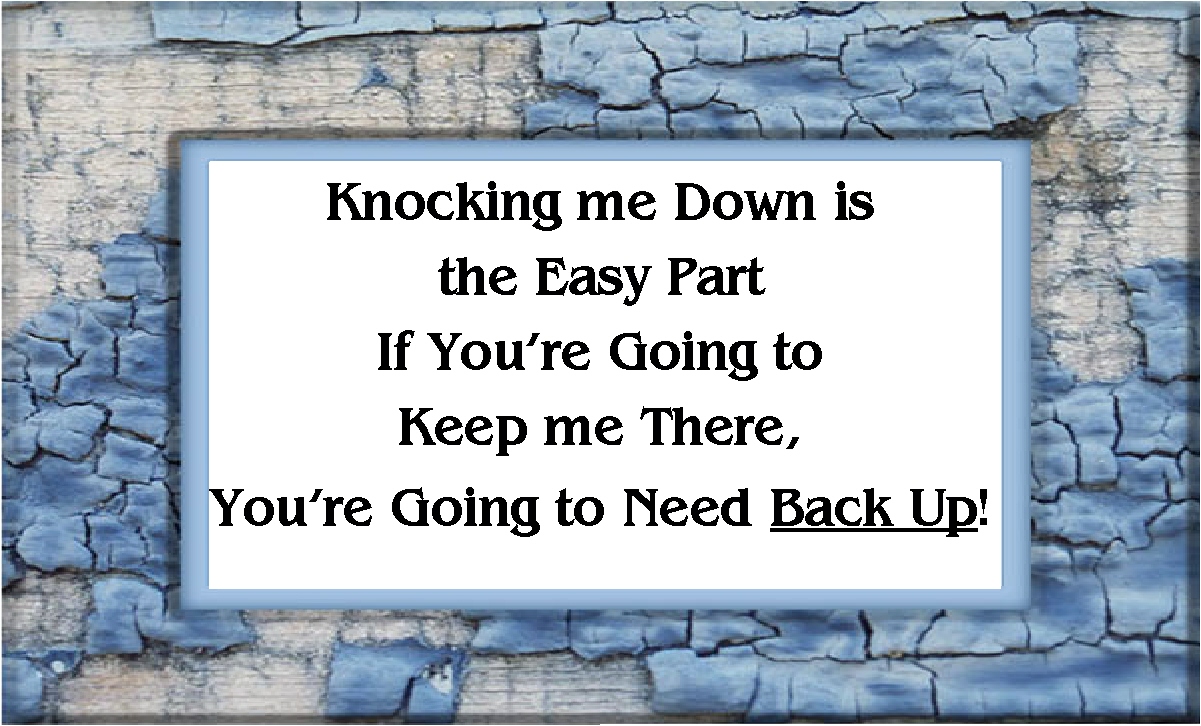
Finally, you may be wondering about the picture I chose for this week’s post. The truth of the matter is, we all have the power to wound or injure another person with words, actions, or lack of action. I want to remind my own community of folks who live with chronic illness, or invisible disability that you are not alone. Yes, people can and will hurt you. But there is strength in numbers and you are not alone. I get knocked down from time to time, but you seriously are going to need “back up” to keep me down. This community is very resilient. We bounce back because we’ve learned there aren’t a lot of other options.

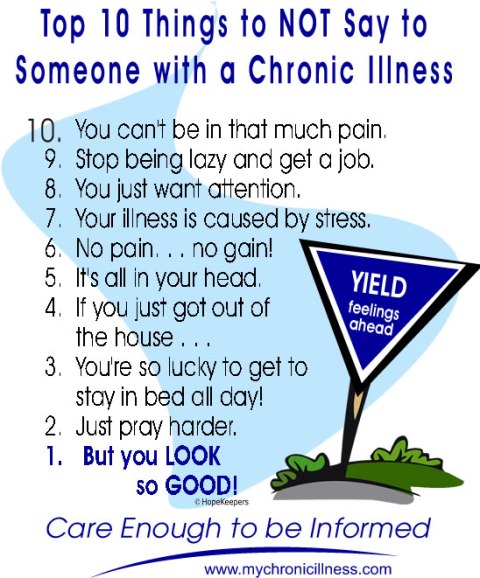
Send me your own ideas of problems and solutions to things that you have perhaps experienced yourself. I leave you with one of my favorite “list graphics”:

my chronic illness

Denise Portis

© 2014 Personal Hearing Loss Journal

Kids Included Together (2014). KIT: About us. Retrieved on June 8, 2014, from http://www.kitonline.org/html/about/kit.html