Braille Menus

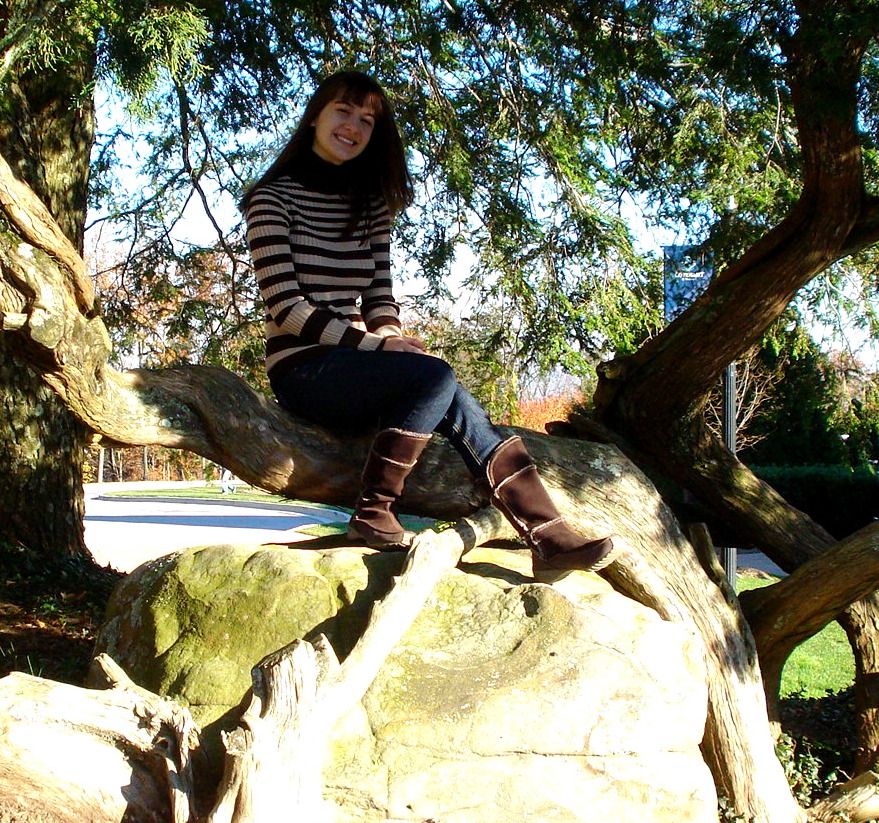
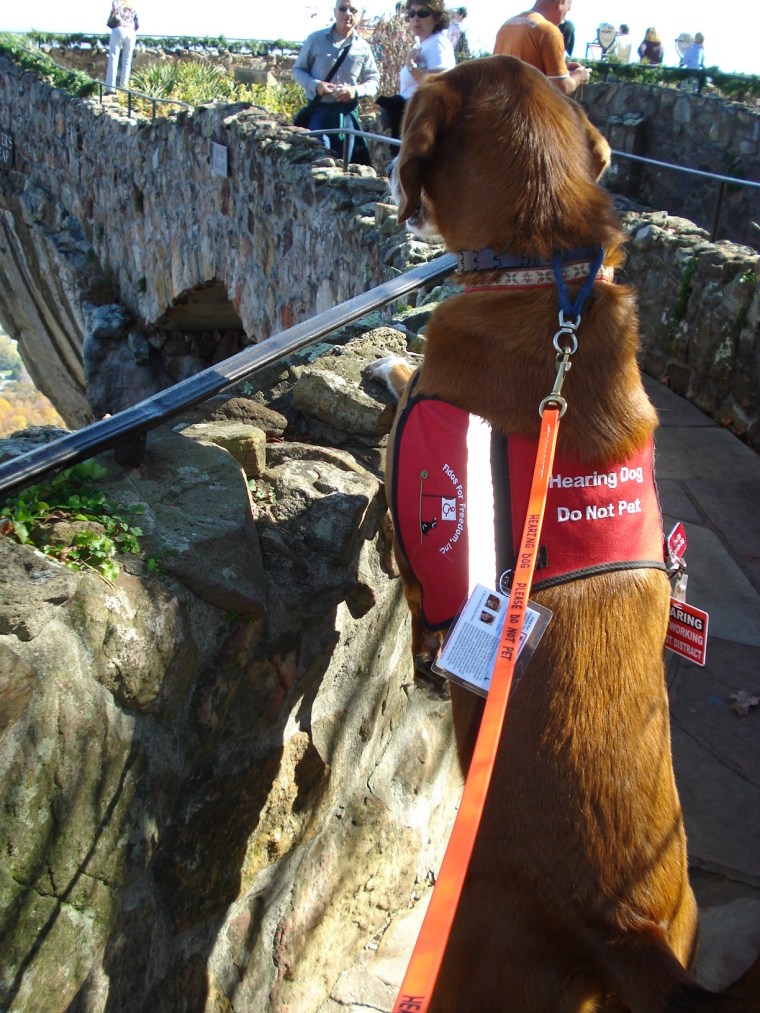
Kyersten has always loved the outdoors... here she is on Lookout Mtn. in Georgia.

Kyersten, my “going on 20” daughter and I, went to Baltimore yesterday. She had a field trip she had to complete in order to earn some extra credit in her 200 level zoology class that she is taking. This has been a TOUGH class for her and she earnestly reasoned with me why she so desperately needed the car to go the National Aquarium. She can be pretty convincing. I had not been in awhile, so invited myself along so that I could spend some one-on-one time with her. Perhaps since we’ve recently visited some colleges on her “short list” that she will be transferring to next Fall, it was still keenly evident to me how precious little time I have left with her before life really changes! She was very willing to endure my company and cheerfully agreed (even before I promised lunch out!).

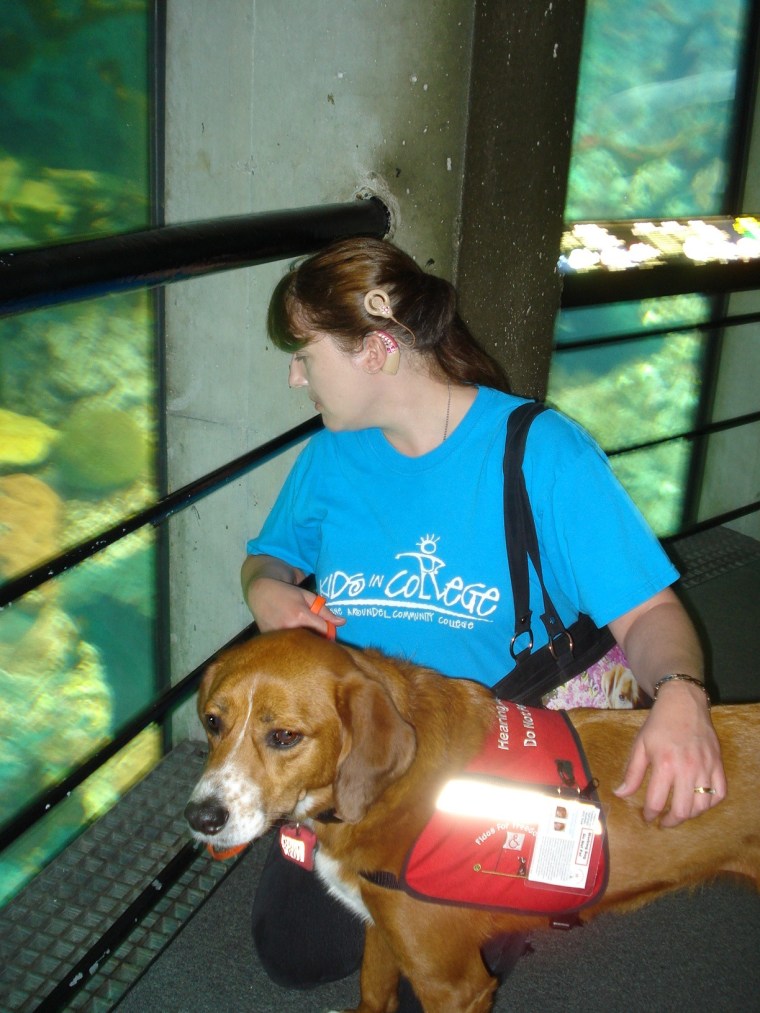
The aquarium is a great place to be with a CI and working dog. There is SO much to hear, and it can be a great place to practice using some of my special programs like “BEAM” to hear just Kyersten in a din of NOISE. It is good for Chloe, for we do not frequent really noisy places out of habit. It is good practice for her to stay calm and focused amidst all the “merry mayhem”. Towards the end she was wagging her tail at every squealing group of school children, and even met another service dog. Butch was a HUGE black lab that was built like a tank. He was very “lab-like” and friendly. He and Chloe said a brief hello and went on accompanying their partners. Chloe was much more relaxed after that – smile. A harmless moment of flirtation is enough to put the wag in the tail of my hound dog!
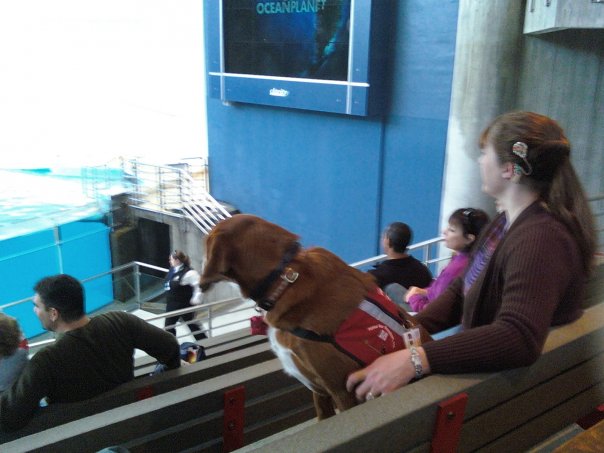
A Dolphin Show can be really noisy and tough to hear at with all the echo! Doesn't keep it from being REALLY FUN!

Lunch at the Cheesecake Factory

I gave Kyersten the option of several places to eat there in the Inner Harbor. She gave me one of those “duh” looks that 19-year-old’s are so good at… She loves cheesecake, so I really didn’t need to ask her! She eats a pretty light lunch there in order to save room for what is important. CHEESECAKE. Smart kid, yes?

Even though it was 12:30, we didn’t have to wait in line at all. Perhaps because it was a weekday? The young man asked us to follow him back through the restaurant. The area he led us to looked out over the promenade and one wall was all glass. I made the mistake of glancing around too much and caught site of the ceiling fans in my peripheral. I sort of “toppled” with a decided lack of GRACE into my chair. Kyersten just grinned at me, as she guessed my problem. I situated Chloe under the table, and turned to look at the young man who seated us.

“May I bring you a Braille menu, ma-am?” he asked politely.

I could see Kyersten’s eyes widen across the table.

Without missing a beat, I pointed to my CI and said, “Oh no thank you! I’m fine with this one” (and then pointed down to the regular novel-length menu on the table).

When the young man walked away, Kyersten rolled her eyes and said, “OH BRUUUTHER!”

I just grinned and said, “Hey! He was polite, and I do have a service dog with me. I toppled into the chair… for all he knows I don’t see well!”

Kyersten just looked at me, and looked at the cochlear implant on my head decorated in gold, red and green jewels for Christmas. She then looked at the opposite ear with the prominent BTE hearing aide and bright red ear mold.

She didn’t say another word, but that 2nd eye roll said it all.

Not the first, won’t be the last!

This was not the first time I’ve ever been offered a Braille menu before. I have friends with low-vision or are legally blind. I appreciate the fact that many restaurants have Braille menus!

I also appreciate it when restaurants train their employees “enough” that they have learned to recognize someone with a special need. Oh sure! They might not identify the need correctly, but I truly believe it is the thought that counts! When I have students in my ASL classes do projects like “go to the mall” without your voice and only sign, (“Deaf for a Day“), many come back to class and tell me that they were offered a Braille menu at the food court at various places. We discuss how they handled this and what this may mean.

Hearing Loss is Unique to Each Individual

Hearing loss itself is unique to every individual. The disability is not a “cookie cutter” change in hearing. I get some responses from people sometimes that do not like that I use the “disability” word. I’m OK with that, and respect their opinion and choice to not identify with that word. Personally, I am OK with admitting that I have a disability. I believe it does not strip away any power, self-esteem or pride to admit that. I am NOT, however, disabled. Yet, my disability may not be anything like that another person with hearing loss experiences.

I have Meniere’s disease. I do not meet many people with hearing loss who have Meniere’s. I am bi-modal (one CI, one hearing aid). I am more likely to meet bi-lateral people if I meet someone with a cochlear implant now! (Which I think is JUST TERRIFIC!) What they experience in their hearing loss is different than what I experience. Some people use a “bit of sign”, while others are culturally Deaf and do not use their voice at all. Some people have hearing aids that they do very well with, while others put their own in a drawer and “fake it” through life. I hear very well in quiet to “medium-noise” environments. I don’t even have to speech read anymore thanks to the wonderful technology of my Nucleus Freedom! However, in really noisy environments I do have to speech read even when using special programs. Other people with cochlear implants may do better in noisy situations.

I have had the privilege of participating in various forums, workshops, conferences and conventions. I have seen people with hearing loss really become defensive with other people with hearing loss. You know? (scratching head and really ponderin’ on that) I just don’t get that! So what if someone hands you a Braille menu! Were they genuinely trying to help? Does it matter that they don’t realize your hearing loss is different than their own? Perhaps they do not understand that what works for them may not work for you. Why come unglued and act defensive?

Here are a few real-life examples I have observed:

1. A person with hearing loss walked up to another person with hearing loss and pointed to their wires connected to their body-worn processor for their cochlear implant. “Why on earth would you wear something like that with all those wires showing?” Oh yeah… that produced a positive response!

2. “Bling” on cochlear implants and hearing aids are often disdained by other people with hearing loss.

3. “Why would you go with THAT company for your CI? The one I went with is so much better and their success rate is much higher!” (Should we just be happy someone is HEARING AGAIN?)

4. “I’m sorry, I didn’t catch the last part of what you said”. “What? You have a cochlear implant now, shouldn’t you be hearing better than I am with two hearing aids?” (Yeah… as long as you aren’t talking while crunching raw broccoli, bozo…)

Let’s face it! We will likely meet someone else with hearing loss who has chosen different techniques, coping mechanisms and technology in order to live life to its fullest. They may hand us a Braille menu. Our response should be positive… and let them know we genuinely appreciate their attempt to be helpful. An angry retort, thrown “menu”, defensive attitude and “hearing loss sermon” will not bring anything positive out of their mistake. Relax. Smile. Educate in a positive way.

Denise Portis

© 2009 Hearing Loss Journal
 

On the Road Again…

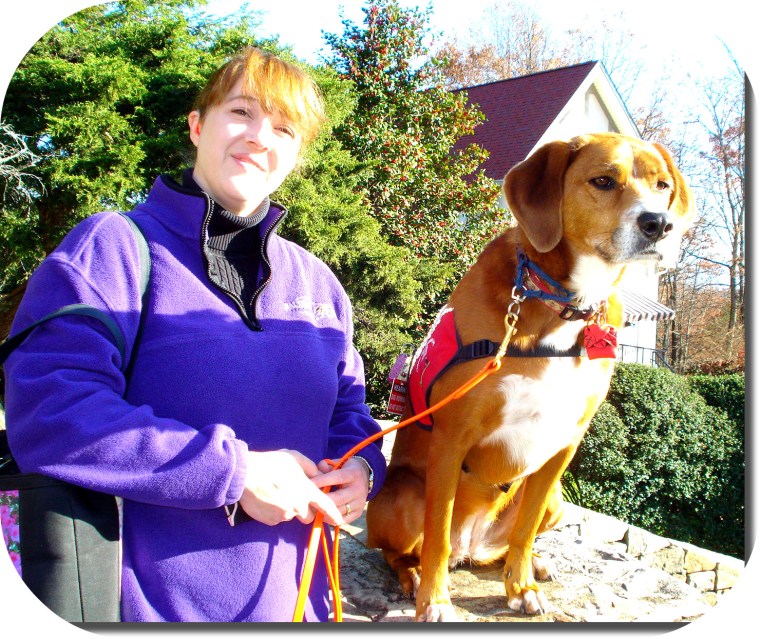
Denise and Chloe at Covenant College
Chloe enjoyed visiting these colleges, and "tolerated" the long drive.

This past Thursday, my daughter and I headed out on a road trip to visit two colleges on her “short” list. Bryan College is in Dayton, TN, and Covenant College is on Lookout Mtn, just over the TN border in Georgia.

Traveling with a hearing loss can be intimidating, but honestly I’m not new to this! Not to hearing loss, and not to traveling with one. In the past, knowing I had to travel would keep me up nights and worrying about the details weeks in advance. Hearing loss is such a part of my life, I do not really remember life with normal hearing.

Things that Help

I think one of the more obvious things that help me when traveling with a hearing loss is that I make my invisible disability – visible. From wearing bright “bling” on my cochlear implant (currently sporting Christmas “bling”), to wearing a bright red ear mold on the hearing aid in my other ear, I really try to make my hearing loss noticeable. I wear my hair up, and I pay attention. I hear really well with my CI, but I’m also wise enough to understand that late at night after I’ve become fatigued and am standing in a large cavernous, echo-producing foyer of a motel, I may have difficulty hearing! So the reliable, noticeable reminder of my disability only comes to my aid when checking in and reserving a room. Almost instantly, front desk employees “change tactics” and are careful to point out where to sign, wait for me to look up to continue speaking (although I actually hear well when not looking now), and are careful to point for directions instead of simply telling me where to go next.

People must travel with assistance dogs regularly enough now that I never am asked what Chloe does or why she is with me. She is less trouble than “some people’s” kids, so she is only help to me when traveling! Thankfully, at Fidos For Freedom, puppies travel with their trainers quite a bit to expose the dogs to motels, airplanes, etc.

hug
Kyersten and Chloe at Rock City for a short "break" to visit a tourist attraction

When stopping for gas, thankfully one can easily pay at the pump. The few times I had to go inside to grab a bottle of water for Kyersten or Chloe, the “visible reminders” served the same purpose at these places as well.

Why do I Believe Visible is Better?

I know plenty of people who choose to keep their invisible disability hidden. That is certainly their choice, and I am very supportive of “whatever works” for each individual. It is my personal opinion, however, that being up front about your hearing loss is only in your best interests. I have heard some folks say that they keep their cochlear implant or hearing aid hidden because they do not want to be treated differently. However, it seems these same individuals are very vocal in their criticism of people who continue to forget to get their attention before speaking, failures to set up assistive listening devices in conferences or meetings, or in disdain rebuke those who have accents, are gum chewers, mumble, or are soft spoken. I believe that in keeping a visible reminder that you do not hear the same way others do (with amplification, speech reading, or cochlear implant technology), others are reminded to communicate more clearly and with better speaking skills than they might otherwise employ.

chloe1
Chloe at Covenant College waiting for the Admissions Office to open.

I believe that by being visible, I have in many ways become more approachable to others and are more accepting of who I now personally. The moment I decided to become transparent about my hearing loss, my blood pressure numbers began to come down and I became more relaxed and at peace with who I am. Think about it this way… what is your demeanor, attitude, and feelings when in the process of trying to hide something?

loved the wildlife
Lots of critters in the mountains of Tennessee! I had to keep Chloe "tight leashed" to keep her from forgetting her job when on a trail!

Hoping mom doesn’t notice a missing cookie from the cookie sheet that just came out of the oven and are desperately trying to lick the last bit of chocolate chip from your fingers?

Have you ever lied and hoped no one would ever discover the truth? One often has to cover one lie with another… and then another.

Have you ever played hide-and-seek? Your heart accelerates as the person who is “it” draws closer to your place of hiding. You may even hold your breath in an attempt at keeping your hiding place from being discovered!

I believe that deliberately trying to hide something like an invisible disability eventually produces anxiety, unease, and produces a fear of discovery. These are all negative feelings! They do not provoke positive change and influence.

In spite of my bling and wearing my hair up, I still take some folks by surprise. Let’s face it… not everyone pays attention to detail. My husband is one of those people who I can greet at the door when he gets home from work and he will never notice I cut my hair 5 inches or am wearing a new outfit. (I don’t buy new clothes very often either!). Terry just doesn’t pay attention to visual detail. It always gives me a bit of a thrill to see the look on someone’s face who did NOT notice my visible reminders, when I’ve finally had to point to my mouth and say,

“I’m sorry. I missed the last part of what you said because of all the noise in here. I’m deaf and hear with a cochlear implant and just could not make out what you said. Could you repeat that please?”

The person’s mouth drops open and they totally FORGET what they said. Instead they exclaim, “Wow! I would have never known you were death! (Intentional mis-spell here in loving attention of all the times I’ve heard this instead of the correct identification). You are so… So… NORMAL!”

Another reason why I do not want to try to hide my invisible disability, is because I tried “the other way”. Do you know what I felt when something I tried to keep hidden became known to someone? Shame. That shame and embarrassment led to poor self-esteem and anger.

Again, I’m not “preaching” at others to adopt what I have done in order to bring awareness to their hearing loss. I really do believe that each individual must do what work best for them.

This is Who I Am

I am comfortable in my own skin. I don’t believe God reached down and caused me to become deaf. I also don’t believe God is “hands off” and set the world in motion just to sit back and watch everything happen. My life is not God’s Youtube. I believe everything has a purpose. Every good thing, and every bad thing happens in order to grow me. I really believe that! I make choices every single day. Sometimes the choices are small and may only involve what kind of tea bag to grab in the morning. However, many choices involve shaping and molding our character to produce a unique individual equipped to make a difference where I happen to be planted. My choices affect my attitudes and future decisions.

Sometimes our decisions are processes. For example, I did not “wake up” a secure and confident late-deafened adult. I “messed up”, acted out, hid, grieved, griped and smacked people. This was a process God allowed me to experience. The process grew me. I don’t regret the process even though I shed a lot of tears.

I’m still a work in progress! Just because I’m 43 and have been an “adult” more years than I was not, I continue to grow, mature and evolve. I don’t care how old you are, you still have a great deal to learn! We are ALL works in progress. Heck. If I was a “finished product”, God would just take me home!

Denise Portis

© 2009 Hearing Loss Journal

chloe2

P.S. If you do NOT like attention being drawn to your disability, I do not recommend being matched with a hearing assistance dog! People notice the dog as if it were a flashing neon sign!

It Takes Just One Voice

DSC031201

My “morning chore” this morning included cleaning up the porch and putting patio furniture up for the season. Each Autumn I accomplish this task, I’m reminded how desperately our deck needs replaced. I haven’t been out on the deck in about a week and was startled to find more Zinnias in full bloom. Don’t they know it’s late October? Most had died and I thought part of my morning chore for this designated “deck clean-up” morning was going to be to shut the flower pots down for the year. I just couldn’t do it… not with brand new Zinnias raising their beautiful colorful heads to celebrate this Fall Fashion Show going on in mid-Maryland right now!

I explained to Chloe how surprised I was to see brand new blooms on the Zinnias. Patient dog that she is she listened attentively, but I could tell she didn’t really understand what all the excitement was about! But you see? The Zinnias were not finished…

Disabled and finished?

This week I received a tearful email from a fellow HLAA (Hearing Loss Association of America) member. She was upset about the state of her local chapter. It seems they are having trouble attracting new members and the old members are rarely participating. They are SPECTATORS, but not PARTICIPATORS. A peer mentor at one of the local hospitals that performs cochlear implants for people in our area, she explained to me that she cannot even generate any interest in those relatively new to hearing loss.

“You can see that the word ‘disability’ has sunk into their very soul, impacting the way they choose to live their lives,” she explained. “I try to explain to them that hearing again through a cochlear implant is something to be celebrated! It is not normal, perfect hearing, but it is hearing and choosing to stay involved in the hearing world in which they were a part! If you talk to them you can tell they are depressed, defeated, and ACTING disabled. It’s as if all the color has gone out of their lives.”

I thought about my own support group and local chapter of HLAA. There are a handful of people who volunteer for everything, work hard at making sure the chapter is well run, make it a priority to attend each month, and reach out to other members who are on the ‘roll’.

DSC03113

These folks stand out. They smile, are involved in numerous OTHER community endeavors, love people, make a difference… they are colorful. In spite of their hearing loss, deafness, communication needs and problems, they are noticeable because of their focus on ABILITY instead of DISABILITY.

dAp

Fidos For Freedom participates in dAp programs throughout Maryland. Chloe and I have been to two of these early on in our training together. The disABILITY Awareness Program was started in the late 1970’s. The intent of dAp is to educate children and their teachers about disabilities, what it’s like to be a person with a disability, and to increase acceptance of people who may be ‘different’. I’m given the opportunity to talk about what I CAN do. Fidos For Freedom has been instrumental in helping me to be independent again. I have learned so much about what it means to live “in spite of” a disability. There are so many different disabilities represented in our client family. For many, being partnered with a canine partner helps them focus on the “can do” instead of what they cannot. Many enter the training program at Fidos pretty much beaten down by the fact that their life is now completely different because of a disability. They finish their training in full bloom. They stand out and make a difference. Their independence grants them the courage to re-take their life.

One Voice

I love people with disabilities. Near and dear to my heart are populations with hearing loss, deafness, Meniere’s disease and brain injury. I belong to these populations. I wrote back to my friend this week and tried to encourage her. Many small chapters of organizations like HLAA have to make the decision to perhaps only meet quarterly instead of monthly. What you can’t do is “close shop”. If you make a difference in ONE person each year, is that not important?

Do you feel alone? Ever feel as if you are carrying the load alone and GEE HAS IT BECOME HEAVY? You may be one voice. Are you caring for an elderly parent who has Alzheimer’s? Are you a stay-at-home mom with three little ones under 5-years-old and no one at home SPEAKS ADULT? Do you work with people with addictions, and feel your heart breaking every time someone returns to their drugs or alcohol? Do you love someone with TBI who will never be the same person they were prior to their accident? Do you or a loved one live with a terminal illness?

You can remain in FULL BLOOM … in spite of it being late October. You can be ONE VOICE that makes a difference. An amazing thing can happen to ONE VOICE that remains in full bloom in spite of the season. It may take time and a lot of effort. It may not even happen in your lifetime. But one voice is usually joined by another… and then Another… and ANOTHER. You may never discover your own influence this side of Heaven. Be influential anyway. Stay in full bloom. Be one voice… one that makes a difference. If your life is all that is changed, is that a bad thing?

Some of you may cringe. I love Barry Manilow. (Sue me!) My older brother got me hooked on him in the late 70’s. This is a short song, but I ask you to listen to it and think about it from the point of view of making a difference.

Denise Portis

© 2009 Hearing Loss Journal

Not an Exact Science…

Just because I can zero in and concentrate, doesn't mean I'll always get it right!

Having a hearing assistance dog has its advantages when I do not hear “surround sound”. I have trouble with directionality as I only have one cochlear implant (and due to my balance problems very likely will not ever have a second). I have learned to pay attention to where Chloe is looking in order to figure out from what direction a sound is coming. The only problem is… sometimes I don’t pay attention.

Today our sweet cat, Kiki, found herself stuck due to my inability to hear and failure to take note of WHY Chloe was parked on the stairs instead of next to me. Kiki decided to squeeze between the door and the glass storm door in order to better partake of the sunlight and “view”. I did not know she was there, and closed the door because of the draft as I walked by. Thankfully, my husband came home about 10 minutes later and saw “cat on glass” as Kiki was smushed like a sardine between the storm door and metal door. We retrieved her amongst a chorus of “poor kitty”, and “I can’t believe I did that” while Kiki just purred and basked in all the attention. yellowchairkiki Having a hearing assistance dog is not an exact science when it comes to utilizing her amazing ears if I don’t pay attention to where she is fixated! I really have to pay attention to why she is parked and pointedly looking in one direction!

Reading Lips/Speech Reading

Some people believe that everyone with hearing loss read lips well. Actually, they call it speech reading now, as really you are trying to discern what someone says solely by what you see on their mouth as they speak. Speech reading is not an exact science. As a matter of fact, mistakes are often made by even the best of speech readers. Now that I hear as well as I do with my cochlear implant, I have lost the ability to speech read to some degree as I may once again rely on what I am hearing to understand in many situations. I do still rely on speech reading in noisy environments, and I will always be a big fan of closed captions. Several friends (God bless ’em) have started posting video links in Facebook that have the lyrics attached as well. This only enables me to hear BEST, so I am always thankful for what I see in addition to what I hear.

A couple of nights ago, my daughter was talking to her boyfriend on Skype. They go to separate colleges and during the school year have a “long-distance” relationship. My husband and I graduated from different colleges as well, but our only hope of contact was through a weekly letter (through good ol’ fashioned snail mail) and the occasional phone call. I was still able to use the phone well at the time, and waited by the pay phone at the end of the hall every Friday night. Technology has changed “long distance relationships”. My daughter actually has “candlelight dinner dates” with her boyfriend via Skype. They talk almost daily either “face-to-face” with Skype and webcam, or a minimum of numerous texts sent immediately through the easy access of cell phones. I popped my head in the other night and found them “talking”. My daughter “muted” the long-distance boyfriend so that she could ask me what I wanted. (Another interpretation, “Can’t you see I’m busy? Hurry up!”) Her boyfriend was still talking, so I told her what he was saying. She quickly typed (as you can both speak and type thru Skype) and asked him if what I said he asked was what was actually said. I was right on the button! She unmuted BK (the boyfriend) and both were amazed at my ability. I immediately chalked it up to “luck” and reminded them both that it isn’t a cheap parlor trick! It takes work and concentration to really be good at speech reading. I simply got lucky!

Think About What Looks Alike

I picked up a good HoH (hard of hearing) habit from a friend in California in 2006. She coached me to learn to repeat to people what I thought I heard even if I knew it could not be right. By doing so it did several positive things:

1. It allowed the person with normal hearing to only have to repeat what I got wrong, saving them the time and possible exasperration of repeating everything verbatim.

2. It allows the person with normal hearing to begin to understand what things sound like to ME… a person who hears with a cochlear implant. They learn to be experts at rephrasing things and finding synonyms to explain the same comment.

3. It allows both parties to see the “funny” in trying to make sense of what I hear. I both SEE in speech reading and hear with a cochlear implant.

4. It allows the HoH person to learn to extend grace and to accept that mistakes are made and most people are eager to help clear up the confusion. It creates a positive communication environment.

Stop for a moment and think about what looks the same on the mouth when words are enunciated. Some mistakes I’ve made:

1. I thought someone walked towards me with an admiring glance and said… “Sweeeeet…. heart”!

Really they were looking beyond me and saw a red corvette… they were saying “Sweeeeet Car!

2. The words six and set look the same as SEX. (yikes!)

3. Mom I’m knitting hard!

Which was really, “Mom, I need the car!”

4. Mrs. Portis, I forgot my paper. Canons get formica? (I was really scratching my head in confusion on this one)

Mrs. Portis I forgot my paper, can I run get it from my car?

Learning to speech read more accurately, can however, help a HoH person communicate better. My local chapter of HLAA has plans to do a 2 hour “speech reading tips” class in the next couple of months. Some great resources that we will be utilizing, come from CHHA (Canadian Hard of Hearing Association), and include:

“Sound Ideas: Managing your Hearing Loss” manual and video

“Lip Reading Naturally” by Frances Mezei and Shirlee Smith

Think It Looks Easy?

I have a challenge for you. Mute your television and see if you can figure out what is being said. You might be surprised at how well… or how poorly you do!

Some additional resources:

1. http://www.agbell.org/docs/speechreading.pdf

2. http://www.lipread.com.au/Products.html

3. http://www.amazon.com/Lessons-Lip-Reading-Self-Instruction-Edward-Nitchie/dp/1428638008

4. http://www.lipreading.com/

Denise Portis

© 2009 Hearing Loss Journal


Happy Birthday Chloe!

birthday Chloe turned five-years-old on Thursday, October 1st. According to one source, that makes Chloe about 36-years-old in human years. No wonder she is perfectly fine with a Sunday afternoon nap now!

History in a Nutshell

Chloe came to Fidos For Freedom in January of 2005 as a three month old puppy. PC310044 Chloe was puppy raised by Linda O., who is a long-time Puppy Raiser for Fidos For Freedom. Chloe has an anonymous sponsor, however we have been blessed to get to know her as well over the years. Chloe’s sponsor has acted as such on behalf of numerous Fidos For Freedom dogs.

Chloe had two fantastic trainers. First she trained with Jolanthe W., and later with Pat J. Both were instrumental in helping Chloe to learn basic obedience, public deportment, and hearing alerts.

In January of 2007, I was matched with Chloe at a Wednesday night training. I’m not sure who had the happiest tail wag!

Chloe and I graduated from Fidos For Freedom at the Tux & Tails Gala in May of 2009.

I cannot imagine life without Chloe! Whether it is doing her job alerting me to sounds I do not hear, or retrieving dropped items so that I do not topple from the Meniere’s, Chloe is simply glad to be with me. She doesn’t even consider her job, “work”.

In honor of all those canine partners who assist their human with various tasks, I want to wish Chloe a very Happy Birthday!

Denise Portis

© 2009 Hearing Loss Journal
Random Contemplations

istock_woman_thinking.70184934 I was trying to fall asleep last night and decided to brainstorm about what I could write about this week. It’s been an “uneventful” week, which is really a good thing! I don’t mind uneventful weeks.

As I tried to think of something that might interest YOU, I realized that my brain was busy with random contemplations. Some were serious. Some were… erm –

NOT.

1. Why is it that now I am over 40 I get these stray hairs on my CHIN? And why must these hairs have roots that stretch all the way to your big toe? It’s the only reason I can think of that when you pull one with the tweezers your big toe curls as you scream.

2. Why is it that I enjoy hearing with my cochlear implant so much, and yet there is a certain relief to remove it at night before bed? Perhaps it is just the knowledge that I always know I’ll sleep well (unless I’m brainstorming). Perhaps it’s because there is a difference between hearing and hearing WELL? It takes work in the form of attentiveness, concentration and perseverance to communicate in this noisy world. I’m not complaining… I’m just sayin’! Relief!

3. Why do dogs turn around three times before they lay down? Why do three of our dogs turn in “one direction” before they lay down, and one of the dogs always turns in the other? Is he “left-handed”?

4. Why is it so difficult to find plain sweettarts in a roll? Who carries those now? I can’t find them anywhere!

5. Why does my cochlear implant always give me a warning “beep” that the batteries are low when I’m driving in the car? Why can’t it happen at home before I leave? How DOES IT KNOW? Sigh.

6. Why do young adult kids in college sigh and roll their eyes if you knock on their door to bother them while they are doing homework, yet will pop into my office to bother me while I’m doing homework of my own now? Why doesn’t it matter to me? I drop everything and give them my undivided attention and sit and contemplate how special they are after they leave. I’m pretty sure they don’t do that when I leave THEIR room!

7. Why am I the only one that can close the bread properly? I don’t even eat a lot of bread! How hard is it to twist the excess plastic at the end, and twist a “twistie-tie” around it? It apparently requires a college degree.

8. Why does God always send me “something” just when I need it most? Whether it be a verse, or an email/post from a friend who cares, or a song? I had forgotten how much a song can do for the soul, and try to “tune in” now that I can hear again. Sometimes? I don’t even realize how much I need something from God until He sends something my way.

9. How did I let blackberry season come and go and not get out somewhere to pick some? What will I do this winter without blackberries to eat? I’m going to have to corner friends next year and beg them to go with me.

10. Why does it seem like we don’t have time to send someone a “real” card (not an e-card)? It isn’t until I get one in the mail myself that reminds me why it is so nice to see the real hand-writing from someone who cares.

11. Why does Chloe bark at horses if she’s in the car, causing my cochlear implant to stop (ADRO program) because her bark is too loud, but when she sees a horse face-to-face and outside the car she tries to hide behind my legs?

12. Why do people say men are from Mars and women are from Venus? Cripes, people… we are all living on EARTH. Get over it! Yeah we act different, but that makes life interesting.

13. How does Chloe know when I turn my alarm off the night before I know I can sleep in? She must have an internal alarm clock, because she gets me up at the same time regardless. If my alarm is SET and goes off, the licks my arm or hand and bumps my face. If my alarm is NOT set, she jumps on the bed and tackles me?

14. Why do I love bananas, but cannot stand banana pudding, popsicles, taffy or moon pies? Sorry… can’t add much to this one.

15. Why is that I felt like my mom was a know-it-all growing up, and now that I don’t live with her I realize she really did? I miss my mom…

16. Why can’t the Denver Broncos have a winning team? I mean… I miss the Orange Crush. I even (gulp) miss Elway. Somebody shoot me…

17. How hard can it be to find the LOTR trilogy in DVD? I can’t find it ANYWHERE because they are coming out with Blue Ray soon. What about those of us who still use regular ol’ DVD players?

18. Why is it that I have a college degree and am in grad school and can’t work a remote? I can’t even turn ON our television. There is one remote that turns it on, one that runs the TIVO, and one that runs the volume. My kids can do it, and I cannot.

19. Why are solitary walks (with perhaps just a dog by your side) one of the most peaceful things a person can do? Why don’t I deliberately and habitually make time to do something that brings me so much peace?

20. What’s not to love about Facebook? I love to look at … faces.

Denise Portis

© 2009 Hearing Loss Journal

Disappointed and it’s ALL MY FAULT

This is one of my all time favorite paintings by Ron DiCianni

Last night our church had a special prayer meeting. I’m always “in” for prayer meetings! I wish we could have them more often than we do. I’ve been a big fan of prayer since about 1993. That was the year I began losing my hearing. Nothing like slowly losing the ability to communicate well with other people, to drive you to your knees to learn to communicate with God. I suppose in many ways, prayer is one of the reasons I do not regret being late-deafened. I’d never want to go back and undo all that I’ve learned about prayer.

My Own Fault

I’ve learned plenty about prayer, but I must not have learned much about asking for assistance in advance! You would think I would learn to ask for help in the right way, and in time to allow folks in charge to be able to assist me! I mean? How hard is it to shoot an email to the pastor to remind him that I’ll need everyone to use the microphone if they speak from the floor?

There were around 20 people there last night. Small groups are something I look forward too. As soon as the pastor saw me he made eye contact and let me know he was going to use the microphone. Whenever possible, he asked folks to come up to the microphone. When he asked questions that required “popcorn answers”, he repeated what they said into the microphone as it would not reach to the back of the group. Sometimes, however, a person answered much longer than what may have been anticipated. The pastor was forced to “interpret” and condense what they said. At certain points, he could tell someone was going to speak longer, or perhaps someone volunteered to pray for a specific need. He asked them to come up to the microphone. (whew). Had I let him know in advance I was going to be there, I’m sure they would have had a cordless microphone ready!

As a person with hearing loss, it is YOUR responsibility to make sure that the people at a meeting you are going to attend know in advance that you will need some assistance in order to hear well. People with normal hearing in a group of twenty very likely do not need a microphone at all. As a matter of fact, I don’t think our pastor had planned in advance to use one because he had to “borrow” one off the musician at the keyboard!

I love my cochlear implant! LOVE IT! It doesn’t make me a person with normal hearing, however! So when I know I’m going to attend something in which I may have trouble hearing, it is my responsibility to give someone in charge a “heads up” that I’ll be there.

Sometimes you may need to attend something in which there is no easy way to offer assistance so that you hear better. (Birthday parties, baby showers, picnics, etc.) We as late-deafened people still have a responsibility to have the right attitude about the activity. Let’s face it! There will be times you simply will not hear well. It’s not anyone’s FAULT… it’s just a fact of life for a late-deafened person. Your responding in a gracious way is the right way to go. Learn to ask people to repeat things the right way. Perhaps that means repeating for them what you DID hear, so that they only have to repeat what you did NOT. It may mean asking to step over to the side so that you are not quite so much in the middle of a lot of noise. It may mean that you are willing to bring a neck loop and/or assistive listening device. Relax, and learn to have fun even if you are not able to hear everything. Chances are the people you are with really care about you. They cannot ever fully understand what you live. Don’t punish them for that!

After prayer meeting last night, I was crying before I could even get out the door. And let me tell you Chloe was having to jog to keep up! I was just so ticked off at myself for having poorly planned, and so disappointed about not hearing very well… I hate crying in public, but gee was I mad at myself! I know better! I’ll do better! GRIN

How to Handle It?

So? What does a late-deafened person do when you’ve alerted a group that can assist in ways such as a cordless microphone being ready, and the group “forgets” or overlooks your need?

A. Continue to remind them, but don’t mention how you weren’t able to participate this time.

B. Express sincere regret at not being able to fully participate and ask if there is anything you can do to make sure assistance is available next time.

C. Knock some heads together.

D. Whine and complain and never return.

E. Pout and embarass anyone in charge with a loud verbal rebuke after the meeting.

Hmm. You know? There may be more than one right answer here and it may depend on your own personality. (Answers C, D, and E are really not great choices folks!) The key is to remember that what you say and how you react may affect how another person with hearing loss is assisted by this group in the future! Lay the groundwork for good relations! Another person with hearing loss may reap the benefits of you having handled things the right way!

Denise Portis

© 2009 Hearing Loss Journal

Thorns

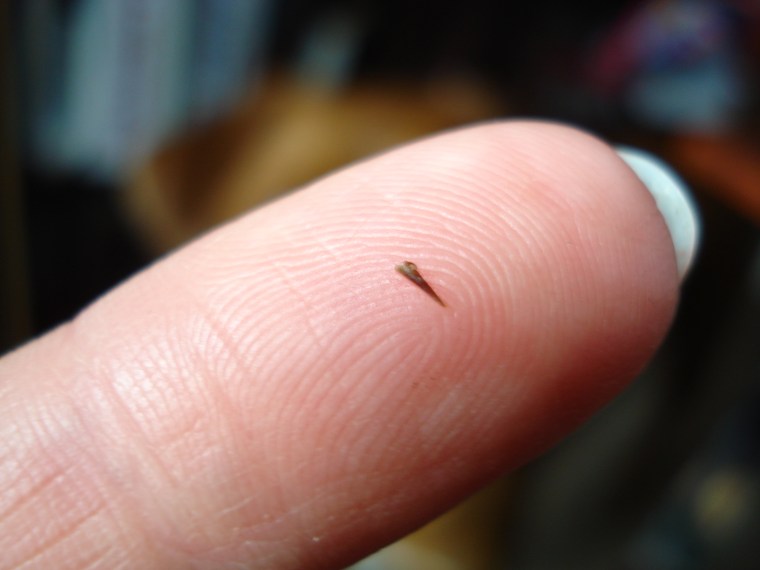
What may look small, can cause BIG trouble!

About 10 days ago I decided to be industrious and trim the rosebush in the back yard. This rose bush is about 15 years old and HUGE. Our backyard is pretty much the “playground of the canines”, so I do little more to it than mow really! However, this rosebush is truly a monster! I’ll have to get a picture of it in full bloom sometime. By the end of the summer, the branches are hanging low to the ground and some pruning is necessary. I decided to do it on impulse, which is never a good start to any project.

Instead of wearing gloves and long sleeves, I simply ran inside to fetch the clippers. It shouldn’t surprise you that by the time I was finished I was covered in scratches and even a rash! (I must be allergic to multiple rosebush thorn scratches). One particular thorn ended up causing a lot of problems.

Somehow, it broke off under the skin of my right index finger. I’m not sure why I’m saying “somehow”, because we’ve already established I was doing this without gloves (sigh).

Anyway… I couldn’t get it out! Today, it had finally healed enough that I decided to try again. I found a needle, disinfected it, and found a bright sunny spot in my office to plop down and “dig”. I was amazed that I got it out after 3 or 4 minutes!

How could such a tiny thing, cause so much pain and distress for 10 days?

Thorns are nasty little things. I suppose for the rosebush, it serves a purpose. But thorns are definitely one of those things that ended up in existence after “the Fall”. What good are they really to anything other than the plant?

Thorns make great analogies, however. For example, plants that produce thorns (which includes many weeds) are easy to grow. They require very little maintenance. Within a short period of time, they can choke out plants that you sowed on purpose!

Choking out the Important

Chloe is a wonderful assistance dog. I really count on her, and I cannot imagine life without her! However, Chloe isn’t perfect. Many of her “faults” are common hound tendencies. Hounds are hunters and should Chloe spy a bunny in the front yard, the house could be burning down and she’d only sit and perseverate on that bunny. I acknowledge one time what she’s barking at, and then work hard to re-direct her. Sometimes I have to get firm, and sternly tell her to “settle”. Infrequently, I have to go a little farther. If she simply will not leave the very thought of that bunny alone, I command her to go in a “down/stay” in her bed by my desk. (This is where she usually plants herself anyway as she’s rarely far from my side sans a bunny in the front yard). When she is commanded to go there, however, to her it is punishment. To let me know how she felt, she decided to pout.

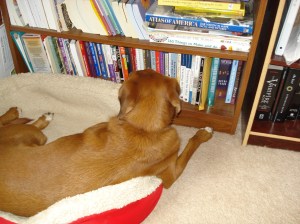
DSC03072 Chloe may decide to let all her training and every good thought to be choked out by thorns if she allows it. She can be decidedly narrow-minded once a bunny enters the picture. Thankfully, she is eager to please as well, and so her pouts are normally short-lived.

Don’t we all allow one thing to crowd out everything else sometimes?

Accentuate the Positive

There is an old song about accentuating the positive. Many times we choose to do the opposite. One or two things can be going wrong in our life, and suddenly our lives are “horrible”. I get frustrated with people who have a bad day, and then announce that they “hate their life”.

For some reason, we will let thorns choke out every good thing in our lives. The Bible is full of verses about thorns, and they often have to do with choking out good things. Another anaology the Bible uses is that of a “thorn in the side”. Ouch! We should strive to be a blessing to others, not a thorn in their side!

Is Hearing Loss a Thorn, or a Blessing

Isn’t it hard to try and be thankful for a life-changing disability? I don’t know that we ever have to quit TRYING. It doesn’t naturally “compute”, and it is a daily decision we have to make. The alternative however, is to allow our disability to be a thorn. It can grow and fester and choke out all the good things in our lives. If you have a hearing loss and it affects your communication with others, do you allow the negatives to choke out all the numerous positives in your life? It’s easy to do; easy to allow…

You may need to get out your clippers and do some pruning. Take my word for it; don’t do it on impulse. Plan, prepare, pray, and make sure you dispose of all the clippings.

I’ll leave you with the lyrics of this great old song, Accentuate the Positive:

Gather ’round me, everybody
Gather ’round me while I’m preachin’
Feel a sermon comin’ on me
The topic will be sin and that’s what I’m ag’in’
If you wanna hear my story
The settle back and just sit tight
While I start reviewin’
The attitude of doin’ right

You’ve got to accentuate the positive
Eliminate the negative
And latch on to the affirmative
Don’t mess with Mister In-Between

You’ve got to spread joy up to the maximum
Bring gloom down to the minimum
Have faith or pandemonium’s
Liable to walk upon the scene

To illustrate my last remark
Jonah in the whale, Noah in the ark
What did they do just when everything looked so dark?

(Man, they said “We’d better accentuate the positive”)
(“Eliminate the negative”)
(“And latch on to the affirmative”)
Don’t mess with Mister In-Between (No!)
Don’t mess with Mister In-Between

(Ya got to spread joy up to the maximum)
(Bring gloom down to the minimum)
(Have faith or pandemonium’s)
(Liable to walk upon the scene)

You got to ac (yes, yes) -cent-tchu-ate the positive
Eliminate (yes, yes) the negative
And latch (yes, yes) on to the affirmative
Don’t mess with Mister In-Between
No, don’t mess with Mister In-Between

Denise Portis

© 2009 Hearing Loss Journal
Get My Attention First

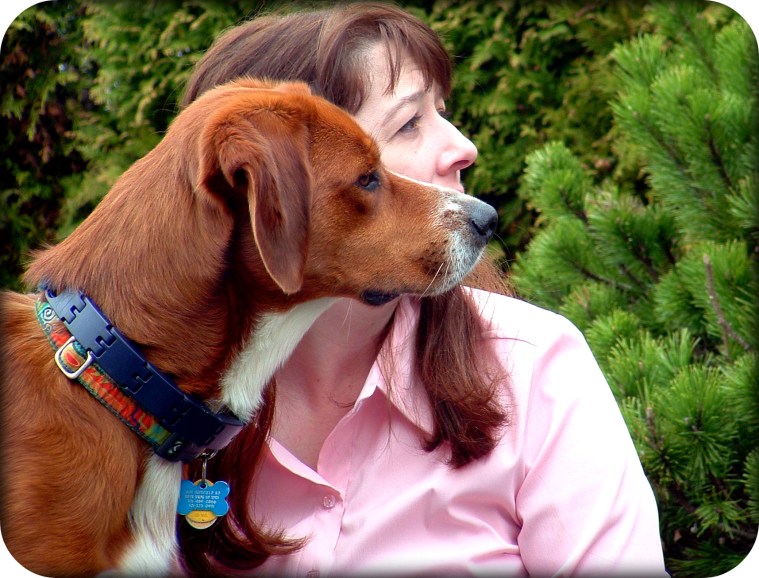
Denise and Chloe at the Aquarium in Baltimore Aug. 23, 2009

Dog Training 101

When I first began training at Fidos For Freedom in Laurel, Maryland, I learned from trainer Tracy B. that it is very important to use your dog’s name. This was especially important on the training floor where there were numerous dogs present all of which were being given obedience commands by their human partner. Calling the dog’s name gets their attention first. Follow that with a command about what you what them to do, and then lavish praise.

Even though I only attend the trainings on average twice a month now, I still make it a habit to use Chloe‘s name first. We have another dog that is never far from Chloe when she is home. Tyco is our family dog and is a two-year-old Norwegian Elkhound. He’s a “dog’s dog”. Oh sure… he loves us, but he idolizes Chloe. So where Chloe is, Tyco is there as well.

My husband was running into a road block on the stairs when he first arrived home from work. Both dogs would park on the stairs – entire bodies all “a-wag” waiting for him to acknowledge them.

I have finally taught Terry actual obedience commands (you CAN teach an old dog new tricks) so instead of saying, “Would you please MOVE?” he will say “move” with some authority in his voice instead of a question. The only problem was that he failed to use either dog’s name. I had to remind my “old dog” that he needed to use their name first. Now when he arrives home he will say, “Chloe move” (and she does), and “Tyco move” (and he does only because he follows Chloe – GRIN).

When he gets to the top of the stairs, he can put his things down and greet the dogs “proper-like”.

Hearing with a CI

When you have a hearing loss for twelve years and then receive a cochlear implant, you still do not hear perfectly. In spite of the fact that CI’s are bionics, you will also discover that you are not Jamie Sommers who can hear BETTER than folks with normal hearing. As a matter of fact, hearing takes WORK. Don’t get me wrong… I LOVE what I’m hearing and am so thankful for this technology! In a quiet room with few distractions, I can usually carry on a conversation without even having to look at you!

Let’s face it… the world is not a quiet place and the times I find that I’m trying to have a conversation in a quiet room are few and far between. Instead there is normally background noise. It can be noises like the television, stereo, pets, restaurant noise, crowd noise, etc. So the majority of the time I am trying to hear ONLY your voice amidst all the sounds my CI picks up for me. I have special programs (Smartsound NOISE or FOCUS) that allow me to pull only what I’m looking at closer; a type of directional microphone really! However, it is NOT a perfect solution. The background noise never stays at a constant level. It can get louder or softer. Hearing will never again be something that just “happens” for me.

It takes work.

I must concentrate.

It’s a shame I don’t burn calories!

Is it any wonder why late-deafened folks are so exhausted at the end of the day? I require 8-9 hours of sleep each night. If I don’t get it, I do not function at 100% the next day. I’ve had days where a sick teen or ill service dog have kept me up most of the night. I rarely even attempt wearing my “ears” (cochlear implant and hearing aid) the next day as I know I will hear little since I cannot concentrate.

Use My Name Please

It is very helpful to first use the name of someone you are conversing with that has a hearing loss. Hearing with a CI, I learned pretty quickly that in a crowd of noise it is in my best interest to work at tuning out all the sound. I recognize my name very easily, even among the buzz of voices around me. I’ve always been very thankful my name starts with a harsh consonant! Hearing my name first allows me to identify who is addressing me. I can turn and face them and begin concentrating in earnest.

Unless we are having a face-to-face conversation, I may look away from you after we have visited a bit to see if Chloe is doing as I asked (normally a down/stay or stand/stay). Or, I may smile at people across the room, wave, etc. If I am not looking at you, it is VERY helpful to say my name again to let me know you are talking to me again. It gets my attention. My CI zeros in on the voice. I’ve even been able to discern my name coming from the mouth of someone across the room! I think the most difficult listening situation is to be in a small group of people who are talking in a larger room with other small groups talking. You find that you are “part of the group” and attempt following the conversation as different speakers say different things. It can be exhausting!

Look at Me Please

I find it amusing that people with hearing loss are often the worst communicators. At my local HLAA (Hearing Loss Assoc. of America) meeting recently, I attempted to have a conversation with someone after the meeting. People were talking and standing around; some were busy tearing things down. There was a LOT of noise. The person I was trying to talk to spoke to their feet. Granted… they had the nicest brown sandals I have seen in awhile. Out of habit I looked to see what they were looking at while they spoke. I had to apologize several times and ask them to repeat something. At one point, this person’s attention was snagged by the activity of another member who was cleaning up the snacks. The person I was talking to turned to see what this other member was doing. I could tell they were still talking, but it became a buzz of sound as soon as they turned their back to me.

I said, “Pardon me? I missed that part after you said what you did about the recent rains”.

They looked at me exasperated and said, “Even though you have a cochlear implant now you don’t hear any better than I do!”

I decided to walk away (as I didn’t think I could speak “kindly”). They were on their way to grab a snack before they all disappeared anyway.

You’ve Come a Long Way, Baby!

I have learned a few things in the four years I have been “hearing again”. It is OK to stand next to someone who WAS talking to you and wait until you are spoken to again. A touch on my arm, or using my name alerts me to the fact that you wish to speak to me again. When I was first activated, I would attempt to not look as if I were ESCAPING after someone finished talking to me. I’d go and find a quiet place and look with wide eyes at the different groups of people standing around talking. If someone waved and then started toward me, I would “brace myself” for the difficulty in conversing with them.

Now I can stand in a crowd of people and wait to be acknowledged. If no one gets my attention, I am at ease. I find that I am even brave enough to start a conversation on my own. After all, I pursued a cochlear implant so that I could continue talking to the people in my life.

This week my schoolwork was interrupted by an “incoming IM” from my daughter. She was in between classes and wrote, “Hey mom! Do you have your ears in? Can I call you?”

Seconds later I was talking to her on the phone. Perhaps this isn’t a big deal to those of you who hear normally. But I haven’t been using the phone for very long. Even after receiving a cochlear implant, it took a lot of practice and courage to start using the phone.

… and here I was in the middle of the day

… talking to my daughter

… on the phone.

I cried.

But they were happy tears!

Denise Portis

© 2009 Hearing Loss Journal
Turning Off An Alert

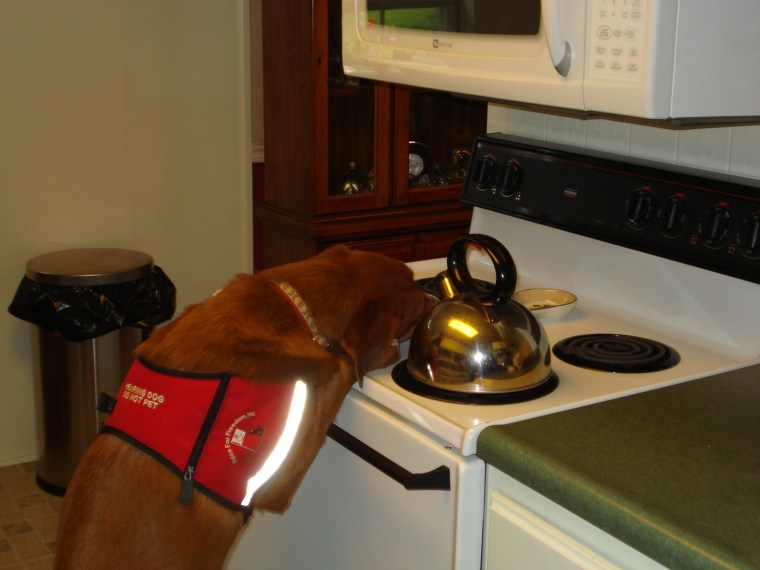
No worries... this is a staged picture. The tea kettle is cold, and a treat is on the stove to award a "Paws up" command.

One of the things I really love about Fidos For Freedom, is that even when you have completed your training you receive follow-up support “for life”. I see Chloe’s trainer about 3 times a month and so when I decided I wanted Chloe to learn a new alert, I contacted Pat.

I was putting the tea kettle on the stove to boil and walking away to check my email in the mornings. It would “whistle” like crazy after I obviously forgot about it after walking away. (You’d think I could wait patiently for all of 2 minutes!) My kids are sleeping in this summer on days they don’t work… at least, they are if the tea kettle doesn’t whistle them awake after it has been boiling for ten minutes or so! They BEGGED me to stop leaving the tea kettle without watching it. Well, I knew one other hearing assistance dog at Fidos who alerted to the tea kettle for her partner. I asked Pat how this was done, and she gave me a step-by-step plan of how to train this alert.

It worked like a charm! In a matter of a week, Chloe was alerting to the whistling tea kettle. The only problem is that I found I now had to turn that alert OFF.

Chloe bumps things with her nose to let me know what is making the sound. If a kitchen timer goes off or my cell phone rings, Chloe bumps them with her nose. When I taught her to alert to the tea kettle, I was finally able to “just forget about it” because she understood that this was now a part of her job. She’d race to get me and then make sure I was following her into the kitchen. Before I could stop her she tried bumping the hot tea kettle with her nose. I screeched and scared her to death ‘mid-bump’!

I thought, “well maybe it is all in the timing…” I attempted to follow her much more closely when she came to get me to let me know the tea kettle was whistling. That worked on days my balance wasn’t giving me fits. However on rainy days when Meniere’s disease caused me to have difficulty walking fast, she would beat me to the kitchen every time! I had to screech at her again!

She started being really anxious to alert to the tea kettle! (Wouldn’t you?) Everytime she did her job, I ended up having to screech at her. For now, I am hanging out in the kitchen for the 2 minutes or so it takes for the tea kettle to whistle. I think I’ll time how long it takes to be “almost whistling” and set the kitchen timer instead. The tea kettle would be an important alert (especially if you ask my sleepyhead kids), but it isn’t worth a burn on Chloe’s nose or paw. It is time to re-think how I want to do this. For now, the alert needs turned off.

Conditioning

When I first began losing my hearing, a subtle yet negative pattern began to take place in the way I interacted with others. If there was a communication blunder, faux pas or misunderstanding, it was always the hearing person’s fault. They not only didn’t understand what I was going through, but they didn’t care! Or so I had convinced myself…

The reality is that my disability is MY problem. It’s not YOUR problem! I had to learn to be proactive – not REactive. It can be very frustrating to tell someone to please face me when they talk – AGAIN. But the truth of the matter is, I make as many or MORE mistakes than the hearing people in my life. I start conversations with someone in my family from another room almost on a daily basis. I can hear them responding, and have to quickly hustle into the other room to at least catch the tail end of what they said. If I cannot understand, I sheepishly have to ask for a repeat (Baa – BAAA)

After I joined HLAA and began to learn from my peers a better way to communicate and advocate, I realized I desperately needed to be re-conditioned. Through the beginning years of my hearing loss I had conditioned myself to believe and react in such a way that hearing people were out to get me and that I needed to harshly and sternly educate in bullheaded opposition in order to gain their cooperation. I desperately needed to turn off this “alert”.

As the result of having established a bad habit in the way I choose to handle conflict regarding communication, I had begun alienating people round me. Worse… my behaving in such a way only insured that the next hard-of-hearing or late-deafened person this “idiot hearing person” dealt with would receive a defensive response. Not only was I hurting myself, but others with hearing loss as well.

Once in awhile I meet someone “new” that has hearing loss and a chip on their shoulder. I want to take them aside and explain my own history and need to turn off an “alert” It’s not always the right time or place, but I have had the opportunity to do so a few times. Sharing my own story seems to mean more than fussing at them about what they are doing. Explaining how to communicate with me best is an important “alert” or task. But to do so the wrong way is not worth “burning” someone else. I was taught and encouraged to re-think how I wanted to convey this information. I had to turn off an old “alert”.

It is very likely that all of us have something we should change… a bad reaction we have towards others. Maybe it’s one person that really gets under your skin. You hear their name and your blood pressure goes up! It may be time to recondition a negative response. You may not even realize it, but you may be hurting your reputation by the way you choose to respond to even the mistakes of others. Your own reputation or testimony may not be all that is at stake. Perhaps you are making all Democrats or Republicans look bad. Maybe you are making all Christians appear holier-than-thou or judgemental. Maybe the way you behave affects the way others look at all people with hearing loss. If you recognize this, you can turn the alert off and recondition the way you respond. If I can do it, anyone can!

Denise Portis

© 2009 Hearing Loss Journal