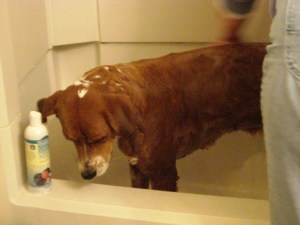
Chloe was having a pretty good week. At least she was until I told her to get in the bathtub. NOT her favorite thing. If “hound dog” could do forlorn, then honey? She’s gonna do FORLORN in the bathtub covered in suds.
While I scrubbed her and told her what an awesome dog she was, intervening during those “I’m gonna shake” moments, I thought about how quickly things can change.
Chloe was happy and excited to get home from class today. She was rough-housing with her buddy, Tyco, when she heard me call her upstairs. She came running with her tail all a-wag. I told her to get in the tub and proceeded to break her ever-lovin’ heart. She is drying and pouting over in the sun as we speak. If I’m lucky, she’ll have forgiven me by suppertime.
Spring has “sprung”, I’m getting a handle on my new schedule, Terry and I just took 2 days away to re-group ALONE (grin), I’m feeling very connected and supported at my primary “free time” activity (Fidos For Freedom Inc., in Laurel, MD), and then it happens. When you can see change coming you can run like mad… or at least brace for it. But sometimes? Well sometimes change smacks you up side the head like Gibbs smacks DiNozzo. It’s completely by surprise. You lay on the floor, dazed and confused, staring up at the ceiling fan thinking, “What just hit me?”
I’ve even let this unexpected negative “change” suck me into an old habit of depression. I could feel it creepin’ up on me. I’m blessed to have a live-in psychologist and I made sure I changed my “8 hours of sleep a night” to 10 hours immediately. That seemed to help. That in addition to some time since the SMACK DOWN, I’m feeling like I can do this thing called life again, despite the newest challenge. Change can be hard and can create a lot of stress. Heck. I was having such a meltdown (as were other members of the family), hubby announced “Let’s go out to eat for supper!” I begged and pleaded and implored him to allow me to fix supper (yeah, right!), but he insisted we go out to eat. We walked out the door discussing these serious issues that “done smacked me up ‘side the head” and half way to the car my husband stopped dead in his tracks and interrupted me saying, “Um Denise? Where’s Chloe?”
You know the service dog who is with me 24/7? The one on the other end of the leash every waking moment of my life? Poor forgotten Chloe stood inside the locked house door whining and whimpering. So yeah. I am THAT distracted by my smack.
There are various proverbs that remind us that life is not easy. Everything is not always going to go well. Sometimes bad things happen. It doesn’t matter if you have disabilities or not. Life can be very, very good. Yet any of us who have lived enough of it know that it can also be hard. I survive because of my 3 “F’s”: Faith, Family, and Friends who care. Surviving is sometimes one day at a time, one week at a time. This is why people with disabilities should take care not to isolate themselves. It’s so easy to do. Isolation is even easier than having to face interacting with others while learning to live successfully with a disability. But isolation is dangerous. We need others. Others help us do that “surviving” thing!
I for one and very glad to see Monday this week.
Chloe, on the other hand, is just glad her monthly bath can be chalked off.
Recently, I read a blog that mentioned kidney disease and hearing loss. You can read the post HERE.
My husband, Terry, and I have been married almost 26 years. He was born with only one kidney, and the one he has doesn’t work ideally. Because he has always lived an “alcohol/drug” free life, he is in good health considering!
I have noticed, however, that he has started showing signs of hearing loss. It started with the television. We “TIVO” everything so that we can watch favorite shows when we have time to sit down and watch them together. In recent months, I have noticed that HE is asking me to turn the volume up. I’ll let that sink in for a minute (grin). I’m deaf. Sure I “hear again” with a cochlear implant, but HE is asking ME to turn up the television. He usually has the remote that fast-forwards through the commercials (as I seem incapable due to vertigo in watching the screen and trying to hit buttons). I have the remote that controls the volume.
He is also saying “huh” more. I’ve noticed it at the dinner table and also in restaurants. Granted, both places can be noisy environments, but it has been a bit of an eye-opener for me to be on the other side of that “huh?”
So as we’ve aged, my hearing has gotten better and his – not so much. I can’t say at this point he will need hearing aids, but I’m thinking the probability in the next 10 years is very high.
I want to be the kind of spouse he has been. Terry has been my biggest cheerleader, support, and source of encouragement. It can’t be easy to be married to someone who is late-deafened when you fell in love with someone who could hear. He has shown me that what happens after “I do” doesn’t impact love, commitment, or a shared life. He hasn’t let it phase him that I have a balance disorder. He picks me up if I fall, brushes me off and helps me see the “funny” in it (as long there isn’t any blood). He encouraged and supports my having a hearing assistance/balance assist dog from Fidos For Freedom. He now actually serves on their board.
So if my husband with kidney disease DOES lose his hearing? I’ll be there for him too. In the meantime, I am helping him navigate living with some adjustments regarding VOLUME.
This past Sunday, my pastor spoke on discipleship. In discussion of what discipleship actually is (growth), he discussed how some people may get confused that at the end of twelve years of high school they graduate and participate in commencement. Commencement is not the end of something; rather, commencement is the beginning of the rest of your life. However, for some that may be the defining moment of their life – the culmination of all they will accomplish.
According to dictionary.com, commencement is a beginning, or a start. Merriam-Webster defines it as a point in time in which one “enters upon the next”. In just a few months, commencement will take place at a number of schools. At the community college where I work, reminders are going out to students reminding them to petition to graduate by a certain date. At Fidos For Freedom, a service dog and therapy dog organization, commencement takes place at the banquet that takes place each May. Clients who are “graduating” this year are already gearing up for speeches, festivities, and recognition of a completion of training.
Yet these exercises are not an ending to anything. Rather, they are a beginning. For college students they may be transferring to a four year college to obtain a higher degree. It may mean looking for that ideal career. For clients at Fidos For Freedom, it is the start of a new life of independence – with trainers and “family” in the wings should any further assistance be needed.
Safe People
The topic of my favorite book, “Safe People”, has been a recurring theme in many of my discussions with family and friends lately. I actually dug my copy out to read it again, because I found myself recommending it to several different people. Learning to identify and avoid unsafe people and relationships can be a hard-learned lesson. I think the truths that have permanently etched themselves on my heart and mind from this book, are how to be a safe person MYSELF. For me, it was reaching a point in time when I could turn my back on the past and boldly face my future. Sure! I took lessons learned from the past – in my relationships, problems, and successes – but armed myself with those lessons to be better equipped for my future.
It has been a commencement for me. Like Merriam-Webster explains… it is a period of time where I chose to “enter upon the next” chapter of my life.
Progressive Illness/Disability
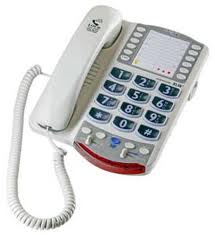
I think one of the frustrating things about having progressive hearing loss, or chronic illness/disability, is that one may commence living life with a new charge for life , equipped to be as independent as possible, only for changes in our health to take us back to square one. Prior to my cochlear implant, I remember learning to cope with the telephone, conversations in crowded places, and learning to speak with people with poor communication habits. However, in a matter of months my hearing would take a dive and I would discover that what worked last month, didn’t work at all now! Like most families with small children at home, we lived paycheck to paycheck. We pinched pennies and scrimped and saved to purchase an amplified telephone for me. For five or six months I was in telephone heaven! I used the phone every single day with confidence and enthusiasm. It didn’t take long, however, before I was struggling to even use that new gadget. I earned a little extra time by using it when the kids were outside and the house was relatively quiet. What was once easy became increasingly difficult. Eventually, the frustration of what I wasn’t hearing, despite hearing aids set to t-coil and begging people on the other end to speak clearly into the phone, had the phone collecting dust from lack of use. I’d talk to other HoHearies and get some new ideas. At some point though? The phone became a thing of my past. I had to come up with ways to contact people other than the phone. For the late-deafened community, the emergence of email, texting, and even FaceBook became very real “life-savers” in terms of being able to freely communicate with others. Although I hear well enough on the phone now that I have a cochlear implant, these other forms of communication are still my own first choice.
Resilience is a Special Kind of Strength
Many readers of Hearing Elmo have various disabilities, invisible illnesses or chronic health problems. For some, those difficulties are progressive and force them into a constant state of evolution. This can actually be healthy. (I see some of you grimacing out there!) Yet progressive illness can produce resilience – the likes of which create a strong and capable individual who can face life’s problems with the confidence earned through experience. Resilience is a special kind of strength. These individuals know that living successfully with progressive health problems is simply adopting an attitude of commencement.
Some people never graduate. They never enter that next stage of life. Even though the past may be painful, they cling to it with a tenacity that may stun family and friends. If they have progressive health problems, they may be stuck in the grief process. The grief process is a PROCESS. In a healthy situation, one moves from one stage to the next, eventually reaching acceptance and a new normal. Even psychologically we can get stuck in the past. Everyone else has moved on, but we have super-glued ourselves to unresolved situations instead of letting go and moving on with our lives (like everyone else has). Living this way yields toxicity to both ourselves and to others. We become “unsafe people”. It can have a negative influence on our relationships, self-esteem, and emotional/mental health. Dr. Seavey addresses how to face the future in a terrific article that can be accessed HERE.
Can you look back and see different points in your own life where commencement took place? Using all you learned in a specific period of your life, you chose to begin the next chapter of your life. May we all view commencement as springboard to usher in a successful, victorious future and not as a monument that designates an END!
The woods near our home without their usual foliage…
(PART ONE OF FOUR)
Chloe and I took a walk after lunch today. I had to smile as I saw the snowflakes falling softly around us even though it wasn’t cold enough to “stick”. I just love winter. I love actually getting out IN the cold weather as well. I love bundling up and walking briskly – something I can do even with Meniere’s as my symptoms are usually much more mild in the winter. I love being able to see my breath in the air and being able to smell various fireplaces in use in homes as I pass. However, one of the biggest reasons I love winter might surprise you. As a person with hearing loss, one doesn’t expect to enjoy QUIET.
Winter Can Be So Quiet
When walking, many people are inside where it is warm. So in the wintertime, my walks are often much more quiet than when I go during other seasons. I love the quiet. Don’t get me wrong! I love being able to hear, but I hear best when it is quiet. Am I contradicting myself? (BIG GRIN). Eh… maybe.
Hearing with a cochlear implant is a mind-boggling thing. I hadn’t expected to hear this well again this side of Heaven. When my husband and I realized that my progressive hearing loss would ultimately mean I would not hear at all, we were concerned. Thankfully, through the support and relationships of the Hearing Loss Association of America, we learned that being late-deafened does not necessarily mean the end to hearing. We learned about cochlear implants and I took almost three years researching and “talking the much needed ears off” numerous cochlear implant recipients. As thankful as I am for my cochlear implant, it does not mean that I now hear perfectly. As a matter of fact, I become a little aggravated when people act as if my cochlear implant “fixed” my hearing. Yes, I can hear. But it’s a different kind of hearing, and one made more difficult when trying to understand speech in the midst of noise.
So I love the quiet. I hear better. When walking, as the world around me is more quiet compared to other times of the year, sounds that are present are crisp and clear. If it is quiet on our walks, I can actually hear much of what Chloe is hearing.
Chloe can HEAR the squirrels even though she hasn’t yet spotted them…
I love listening to nature. I pick up many more sounds in the winter because of the quiet. The lack of foliage also assists in allowing sound to carry. In some spots of our neighborhood I can even enjoy an “echo-like” effect in the world around me.
We Need the Quiet
I have had numerous late-deafened folks tell me that they too, go “deaf” on purpose. For those of us who are thrifty, it saves on battery life. However, for many it is simply a matter of being mentally fatigued. It takes a lot of effort to understand and communicate using technology and speech reading. People with hearing loss must employ a number of senses to communicate. Those with normal hearing are not required to use much more than their sense of hearing to communicate. I believe this is part of the reason I need 8-10 hours of sleep a night. (Yes… you read that right!) I am mentally exhausted at the end of every day just because I’m communicating with family, friends, and co-workers. It takes work to hear! Listening requires active participation for those of us with hearing loss.
The forest is sleeping during the winter…
When there is a great deal of background noise, I don’t hear well. As a matter of fact? There are times I don’t even try. Case in point… my church:
Want to know the noisiest part of every church service? I think it is before and immediately after the actual service. Or, how about when the pastor or minister of worship says, “Everyone take a few minutes to meet and greet those around you!” ? AAAARGH! I try to make myself invisible if you must know. I am petrified someone will come and talk to me because I know I won’t hear them. I’m getting better though when someone approaches with their hand out and a big smile. I’m taking a risk but “betting on” that they are saying, “Hello, how are you today?” I have learned to smile, shake their hand and say a simple “Hello!” My preference in communicating is definitely one-on-one. I do really well – IF – it is in a quiet atmosphere.
But you know something? My exposure to multiple disabilities at Fidos For Freedom has taught me one very important lesson. We could ALL do with more “quiet” in our lives. Quiet can foster introspection – and friends? I’m big on reflection, meditation, and soul-searching! For many of us, we face many physical battles on a daily basis. We really NEED quiet time. Contemplation may provide us with resolve, a new “plan of attack”, time to absorb new information about our disease/disability, and the ability to recuperate emotionally and mentally. As a person of faith, it is my quiet moments that I can humbly ask for guidance or assistance… or scream for help!
It is often when we are quiet that we can plan and “gear up” for the journey ahead. Victor Hugo said, “One is not idle because one is absorbed. There is both visible and invisible labor. To contemplate is to toil, to think is to do. The crossed arms work, the clasped hands act. The eyes upturned to Heaven are an act of creation.” For some of you, life’s journey requires a little planning. I have a friend who cannot do anything spontaneously. Errands are planned, cleaning specific rooms of the house are planned a whole day in advance. Errands rely on the goodwill of family and friends who are willing to cart her “here and there” as her eyesight has deteriorated. Cleaning is done when the body isn’t on “strike”. Lyme’s and Chronic Fatigue insist that she double-up on recipes when she has enough energy to cook. That way she can freeze things so that she doesn’t go hungry on days she cannot cook meals. She requires a lot of quiet time. For her… it’s not a communication issue. She needs time to plan and to take strategic steps in organizing as best she can her journey. She even needs quiet time to COPE with her disease.
Winter allows me more quiet time. Outside – fewer people are out and about. Inside – family members at home tend to curl up and do quiet things on their computers or may catch up on reading. Like hibernating bears they tend to sleep more. Co-workers are quieter during the winter. Hubby says it is because of S.A.D. Who knows? I do think winter generates a feeling of “quiet” in many people.
I encourage you to find more quiet time. Winter, spring, summer, or fall – the season isn’t important. Finding time to be QUIET and use the time wisely is important to all. Even if you use the time for a power nap…
At City Dock in downtown Annapolis near the U.S. Naval Academy
I find it a little hard to believe it is 2012. Normally, the New Year doesn’t sneak up on me. However, this year it certainly did just that. In the past, I’m almost obsessive-compulsive about planning and organizing my resolutions for the New Year. I suppose that I haven’t allowed myself to obsess about it this year, points to the fact that I continue to change and evolve as I age. I think change is important and hope that I will always grow, mature, and change from one year to the next.
Sometimes though? Sometimes I see things in myself that I need to change because they are negative. In my reflection of 2011, I discovered a real negative that I really want to work on in 2012. Introspection did not really help me discover WHY I have developed this bad habit, but I can make some educated guesses.
I apologize. I apologize a great deal. I apologize for things that are not my fault. Some reasons I may do this?
1. I feel as if it will keep others from feeling the blame or reacting in a defensive way.
2. I default to shouldering the blame for most things.
3. I hope to diffuse any uncomfortable thoughts or reactions by others.
4. I hope to garner apologies and acceptance of responsibility by others by my own example.
5. HABIT
Please don’t misunderstand me. I believe that people should accept responsibility and offer apologies when they are warranted. However, I have developed a habit of apologizing for things that are not my responsibility. Sometimes when I say “I’m sorry”, it is simply a matter of miscommunication. I need to say something… but do so in a way it more accurately communicates my real meaning.
An example: “I’m sorry you misunderstood me”.
A better response would be, “I believe I have been misunderstood. May I clarify my meaning and intent?”
As a person with hearing loss I even respond with a “sorry” when I missed something. Example: “I’m sorry. I didn’t catch that”. It may very well be that it is no one’s FAULT that I missed it. After all… I am a late-deafened adult. Yes, sometimes folks may cover their mouth with their hand, or mumble. When that happens it is better to say, “I didn’t catch that. Could you repeat it please?” – or – “You were covering your mouth and I didn’t catch that. Will you repeat it please?” I’m going to try to stop myself before I respond with a habitual “I’m sorry. I didn’t catch that”.
It’s My Choice to Mitigate My Disabilities with a Service Dog
Recently, I “replied all” to an email in which a group of employees were nailing down details about when to meet for a book group. We are reading “Storm” by George R. Stewart. I actually typed out, “I apologize in advance that I will have my service dog with me as she is with me 24/7”. I sat and looked at that sentence for a minute and thought to myself, “WHAT IN THE WORLD?”
I deleted that sentence and re-typed, “Just a heads up so that no one is startled, I will have my service dog with me as she is with me 24/7”. I re-read and re-thought that sentence for several minutes. I like to give people I’ve never met before heads-up about Chloe, but it isn’t required. However, some people ARE afraid of dogs or have allergies. I like to let people know in advance when I can.
When I interviewed at the local community college, before hanging up the phone I let the person know that I would have my service dog with me at the interview. When I arrived to meet with the panel of people interviewing that day, the director let me know that he was glad I told him about Chloe. He normally has his dog with him at work during the summer, and he didn’t want his dog to interfere with my working dog.
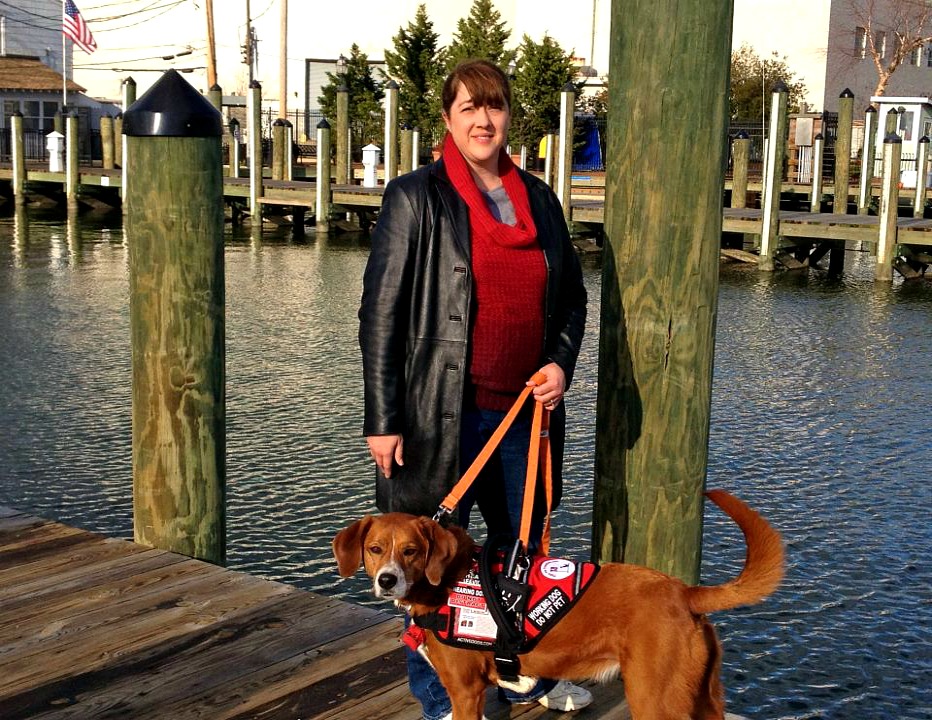
Sometimes it cannot be helped. I arrive and people are surprised (or dismayed) that I have a service dog with me. In the past, I have intercepted looks and stepped forward to apologize that I have Chloe with me. I’m not sure why I felt compelled to do this. I’m NOT sorry I have Chloe. She has given me the independence and confidence I needed to follow my dreams! Yet, I often felt as if I needed to apologize for her presence.
When someone asks if they can pet Chloe, I would automatically say, “I’m sorry. She’s a working dog and cannot be pet while she is in vest”. A better response that I’m trying to remember to say is, “She’s a working dog and cannot be distracted right now. Thank you for asking permission though!”
I realize that many people use the “I’m sorry” phrase without thinking about the ramifications of the meaning. To many it is simply a way to break the ice, or begin communicating a difficult idea. For me, I believe that the overuse of the phrase has only served to weaken my own self-esteem and even development as a confident adult with a disability. Please understand that I am talking about ME – and how being overly zealous with apologizing has inadvertently affected ME in a negative way. You will never hear me correct YOU if you choose to use this phrase.
I believe in giving heartfelt apologies when they are needed. In the right circumstances, it conveys the desire to make right a wrong and to restore a good relationship with another person. One of my favorite books is “The Five Languages of Apology” by Chapman and Thomas. I believe in caring about our fellow man and to learn to apologize in such a way it restores good communication and healthy relationships.
It’s no one’s fault I do not hear well. There is no one to blame that I stumble around on rainy days nor am able to retrieve things from the floor. You may be surprised to learn that I wouldn’t change anything about me. Sure… it’s taken a long time for me to accept who I am and to “like me” just the way I am! I do want to correctly communicate my heart, mind, and intent to others. I believe I apologize in far too many circumstances. I want to accurately relay information without demeaning or demoralizing myself.
You may be thinking “poTAtoes” – “po-TAH-toes”. What is the difference? For me… this is something I choose to work on this year. I want to better communicate with others without taking the blame for things that cannot be helped.
In October I was at a training class at Fidos For Freedom in Laurel, Maryland. One of my least favorite exercises is the “Meet and Greet”. I hate it, yet know it is one of those necessary (evil) tasks that I must learn to accomplish with an assistance dog along side of me. Reality check? I will have to communicate with others in a group when there is background noise. It is very difficult for those of us with hearing loss to do this exercise. I have to remember to turn my t-coil off on both cochlear implant and hearing aid. Thankfully, our training room is looped and I hear the trainer very well when commands are given. However, I have to turn these OFF in order to hear a group of people in the “Meet and Greet”. We introduce ourselves and give a little information about our dogs to new people. To folks we know well we simply “catch up”. Our dogs are suppose to remain in a safe place (sit or stay) and we learn to communicate while also keeping an eye on our partners. When you also speech read, it can be very difficult to watch faces while also keeping an eye on your dog. At this particular training, Chloe was in a down/stay for the inevitable “Meet and Greet”. Some of these dogs Chloe has known for a long time. Some of them are newer puppies recently introduced to the training floor to eventually be matched with a client. I spotted Chloe stretching in her down/stay with tail all a-wag and kisses galore for another dog in a down/stay. I corrected her and then realized I missed what the fellow client said.
“I’m sorry. I missed that”, I said with exasperation.
The other client didn’t hesitate and said, “Don’t be sorry. I don’t apologize for weaving around with both a cane and a dog!”
It hit me that I was implying my inability to hear well in this environment could be changed. It is what it is. I do NOT hear well in “Meet and Greets”. It is not anyone’s fault that I do not. No apologies are necessary. I’m learning to ask for repeats without apologizing.
I wish you success in planning your own New Year’s resolutions and goals. I’m keeping it simple this year. Happy New Year and welcome 2012!
I recently “re-read” a terrific article by Arlene Romoff, fellow blogger and Hearing Loss Association of America member/leader. She detailed how to navigate the holidays with a hearing loss. (Her article can be viewed here).
I was reminded that these tips work well for most holiday situations, but not ALL. Are you ever invited to holiday gatherings that are not “family” or close friend centered activities? It can be quite difficult to navigate holiday gatherings that you are not in control of – or – that are attended by folks you may not know so well. My husband and I have been attending a terrific church for the past two months and are involved in a small group with similar aged people. A holiday gathering was discussed and planned. Sign-up for the activity began a couple of weeks ago. And you know? For the first time in my life with hearing loss, I explained when asked if I was coming that I’m would not be. I did not feel crushed by the guilt of being so anti-social afterwards!
Perhaps it is because I have learned in recent years that it is OK to be alone “on purpose” on occasion. Now don’t get me wrong! I’m all for relationships, communication, and forging/cementing friendships! I believe in “play time” and in working hard to participate in family and friend activities during the holiday so as to celebrate the season in all its glitter, glory, and historical significance.
I knew from paying attention in this small group at church that “sign up” would begin soon. So I embraced an opportune moment at home with my best friend and husband, Terry, to discuss the issue. I explained that I fully supported his going to “represent us” and that I know from understanding the dynamics and participators in this group… that not all attend with spouse or “significant other” for various reasons. I explained to him that I have chosen to not put myself in extremely unsettling and difficult situations. Sure… sometimes I have no choice. But in this? I did. I explained that the effort was almost debilitating and between fears of being jostled and trying to navigate and hear in an unfamiliar place – in a PARTY no less – well… I was just choosing literally NOT “to go there”. I could see him thinking about my comments and as he is very expressive, I could tell he was thinking back to various activities I had attempted in the past. He was very understanding. He agreed that should things like this come up and he desired to go, he would do so even without me. He knew I’d hound him for details later and appreciate participating vicariously.
It has been a couple of weeks now since that sign-up sheet went around in class. I still don’t feel guilty, but must be so use to that feeling I keep waiting for it to hit me! (GRIN) As it is, I simply think am finally OK with being alone “on purpose”.
Solitary Activities
I love to walk and hike. Thankfully my assistance dog, Chloe, never argues about being a walking buddy so I can depend on her ears and alerts to stay safe while doing something I enjoy. My preference is to walk alone… but I never say “no” to walking with my young adult daughter, Kyersten. However, when walking alone I actually hear better. No one to talk to you see, unless you count a very attentive hound dog. Because of this “lack of people” noise, I’m able to tune into what sounds are going on around me. I’m constantly amazed at what my cochlear implant will pick up – when no one is talking. The sound of crunching leaves, fussing squirrels, the wind blowing the now skeletal branches of the trees around me… autumn is noisy! I can hear traffic sounds both near and far, children on the playground, dogs barking at doors as we traverse the neighborhood, and cats glaring from windows in homes. OK, yeah… that last one was a bit over the top, but I certainly have “holes drilled into my back” by the glares of imperial felines who watch us pass their kingdom’s boundaries!
I love when my house empties out with various family members going to activities, movies, or different shifts at work. I work better in a quiet house. No one interrupts me and I get a lot of work done! When I don’t have work to do, I have learned to not only embrace solitary “down time”, I look forward to it! A hot cup of tea and a good book + turning off my ears “on purpose” = a type of sweet surrender to all that is good in being alone.
I participate in holiday activities and feel close to family and friends. Thanksgiving was at my house (but of course!) and we had company as well… but on my terms. No holiday music, activities were quieter ones, and I heard very well. The experience was not at all stressful. I’m learning, you see…
I DO get to know new people – but usually one-on-one. In large or even small group settings, my focus and concentration are on staying at a place I’m not “lost” in the conversation. That makes it pretty difficult to get to know others! But one-on-one meetings, lunches, or walks allow me to really discover new people. I’m quick to invite and accept the invitations for such outings!
Thankful for… the Internet
Perhaps a bit “off topic”, but as Thanksgiving was this past week, I don’t feel as if I can close this post without mentioning how thankful I am for the Internet. I know people think that you cannot have “real” friends through the Internet. However hearing loss can at times be almost isolating… and not by choice. I have discovered a network of very special friends – all who have hearing loss. I have peeled back layers of “them” to see reveal people who I am proud to call FRIEND. I have met them face-to-face in various locales… usually hearing loss related activities. I never hesitate to participate in groups – even large ones – with my peers. There is no frustration in asking for repeats at these conferences, conventions, and gatherings. I don’t mind folks invading my personal space, for it is always good EAR first. In super noisy environments, paper is always handy and darn if we don’t abbreviate and jot quick notes as good as the younger texting generation! If your batteries go dead, one need simply to remove their implant… scowl at it, and several people nearby will hand you batteries. It isn’t strange to ask hostess or waiters to turn the background music “off”, because no one in the group wants it on anyway. We finish each others sentences and clarify for each other when one voice, timbre, or pitch may not be heard as easily as another. We are comfortable with each other because we live the same kind of life. The Internet allows us to stay in touch “in between times”. For that I am grateful and mindful to acknowledge the power of connecting through this tool – the Internet.
If you are a person with hearing loss and have not yet learned it is fine to be alone “on purpose”, perhaps it is because you have not yet discovered solitary activities that you enjoy. I hope that you will learn to embrace these times. Take up a new activity that is done well as the result of your being alone. I know dynamite photographers, writers, and artists whose skills improved when they learned to embrace their own alone time. What hidden talents and skills have you not yet honed but could do so should you choose to be alone “on purpose”?
When you think of “entitlement”, do you picture someone with their arms crossed and a demanding attitude? Do you associate negative thoughts with the word? I have heard the word “entitlement” discussed at length in various groups lately. Parents may bemoan the fact that “kids today have a sense of entitlement that promotes a feeling of justification for all they do and all they DESERVE“. My husband and I even “shake our heads” at our own kids from time to time. Don’t get me wrong… our kids are TERRIFIC. They are well-adjusted, do not use drugs or drink alcohol, their language is acceptable, they make good grades, they are responsible and willingly reach out to others. But sometimes? Sometimes they act as if they deserve certain things even before earning the right to have that luxury, trust, or understanding. Thankfully, we can simply remind them about the blessings they have and use a comparison or two between their own lives and the lives of some of their peers and they are quick to apologize for their previous attitude.
Teachers confess that students in classrooms across the country are morphing into groups of individuals who demand respect and favors they have not earned. Elayne Clift (2011) said, “Whether it’s rude behavior, lack of intellectual rigor, or both, we are all struggling with the same frightening decline in student performance and academic standards at institutions of higher learning (para. 6)… when teachers refuse to lower standards, those students seem to resort to a new code of conduct that includes acted-out rage, lack of respect, and blame”(para. 8). From what I understand, this attitude is reaching epidemic proportions in classrooms. Thankfully, I have not experienced this in my own classrooms yet. I do, however, believe it CAN be a problem and is certainly happening in many schools. Parents and caregivers may unintentionally (or with very real intent) foster and promote this attitude in their children.
What about “Occupy… ” a city near you movement? I’ve listened to some of my peers argue that those camping out and “occupying” locations in cities across America, are individuals trying to make a point about those in power and wealth, yet harbor a sense of entitlement.
I’m not here to debate any of these issues. Instead, I wanted to point out that a sense of entitlement is alive and well in the disABILITY community. I support being a positive advocate and for educating individuals as to what their rights are under the ADA. I’m not here to debate these issues, however, and recognize that there are plenty of examples of people with disabilities being misrepresented, mistreated, and unfairly judged.
What is ENTITLEMENT?
Webster’s defines “entitlement” as:
1. a: the state or condition of being entitled : right b: a right to benefits specified especially by law or contract
2.: a government program providing benefits to members of a specified group; also: funds supporting or distributed by such a program
3.: belief that one is deserving of or entitled to certain privileges
When I first began losing my hearing at the age of 25-years-old, I knew next to nothing about hearing loss and how it can impact a life. I spent the first decade of progressive hearing loss learning about hearing loss in general. I sought support and information about how to better communicate and how to deal with the emotional consequences of an acquired disABILITY. When I developed Meniere’s disease as well, I challenged myself to learn all there is to know about a disease with no cure. As a result, I’ve learned what my own triggers are, what steps I can take to lesson the symptoms experienced, and reduce the severity of flare-ups. I’ve become an advocate for those with hearing loss… especially those who are late-deafened. I support and advocate on behalf of those who use service dogs to mitigate their disABILITY.
I’ve met PLENTY of folks who do the same. This does not mean, however, that I have not met people with hearing loss, Meniere’s disease (or other balance disorder), and people with service dogs who exhibit an attitude of entitlement. Many have taken laws that protect their rights and use them as a weapon of mass destruction. Instead of resting on the assurances these laws were meant to produce in the lives of individuals with disABILITIES, these laws are used to insist on more than what is deserved and intended. Don’t get me wrong! Companies and local and federal government should be compliant with specific criteria the ADA outlines and determines as provisions for equal access. A person with disability should be given any available means and technology at work so as to do their job in such a way they are on equal footing with another who does not have a disABILITY for promotions, raises, and opportunities. My “beef” with people with disABILITIES begins where folks insist everyone else in their life adjust their attitudes to satisfy their fragile egos.
Respect is earned…
Whether you have a disABILITY or NOT… respect is earned. We are not entitled to respect by our fellow man. Let’s face it. There are mean people out there… and mean people SUCK. But we as individuals who live with disABILITIES are going to get a whole lot further if we treat even mean people with – respect.
In the service dog industry mean people can “bring out the mean” in others. I’ve seen it happen time and again, and frankly? It’s happened to ME. Some wise-guy person in “charge” will barrel up into my personal space, put out a hand to physically stop me from entering an establishment with chest puffed out, hand on a hip and a look on their face as if to say, “over my DEAD, lifeless body“. My first reaction? “That can be arranged…”
Nothing gets my back up quicker than a cocky, insolent ignoramus who chooses to invade my personal space as well! Especially since the latter may mean I over-compensate and “fall down go boom“. I know my rights. I have copies of the law. I’ve been trained (thanks to Fidos For Freedom). But I have learned that fighting “fire with fire” only leaves me with singed body parts. Sure, I may gain access, but at what cost?
One of my favorite Bible verses is Proverbs 15:1. I just love Proverbs! You could read one verse a day… strive to learn and apply something from it and be busy a very long time… or close to three years since there are 915 verses to be exact, but I digress (grin). Proverbs 15:1 (ESV) says, “A soft answer turns away wrath, but a harsh word stirs up anger.” Pardon my grammar… but AIN’T THAT THE TRUTH? Nothing takes the “wind out of the sails” of an angry store associate quicker than to be gently confronted with the truth of the law. The law is on our side, after all. Some folks are “deaf” to the truth though and because of preconceived ideas will thumb their nose at the law and insist persons with service dogs STAY OUT. Even if you need to call the police to file a report and insist on your right of entry and service, staying poised and in control should be paramount. When we lose control, it only exacerbates the situation. Worse? It sets up the next person with a service dog to encounter this same store associate with an even BIGGER chip on their shoulder.
Tired of paying the same ticket price as person’s with normal hearing at a theater, only to hear VERY LITTLE? If you want to promote open captioning or rear-window captioning… do so with a positive attitude armed with information about who uses it, what the law says, etc. Marching up to a theater manager with both guns a-blazing… accomplishes very little. When theaters do provide these services and use this available technology, be sure to thank the management. I’ve heard some HoHearies say, “why should I? Folks with normal hearing don’t have to thank the management for being able to hear a movie they paid for!” But is that the point? We are trying to raise awareness and help companies like movie theaters to provide these things so that we all benefit. (Hearing Loop.org has a great article here). We need to earn their respect. Thanking management does a number of things:
1) it reminds them who we are… real people who enjoy attending things like movies.
2) it helps them keep the numbers in perspective… many people use and enjoy captions. These “thank you’s” equal number of tickets sold and helps them remember the big picture…
3) it helps them see we ARE appreciative… not demanding snobs or spoiled people with a sense of entitlement.
A great blog post by Shanna Bartlett Groves on this issue can be viewed here and here.
Are you trying to get your church on board with providing an induction loop for people who use hearing aids and cochlear implants? Is the task difficult because there are not very many this would effect… or perhaps there is ONLY you? You will have an attentive audience and lay the groundwork for actually achieving this freedom to hear in church if you handle it the right way. Do not march up to the deacon board with a self-righteous sense of entitlement. Should they care that ALL may hear and participate in church? Well duh – of course they should! But we need to ask in the right way… with the right attitude. Non-profits have more freedom to say “no”. However, we can help them understand what this may mean for those who utilize t-coils in a way that our churches are eager to spend that little bit of money necessary to put in a virtually hassle-free technology that allows us to hear. If you hurl accusations about their lack of “Christian love” and belittle and chastise them… you will only insure they begin to believe that people with disabilities are demanding folks with a sense of entitlement. You may even need to show them how much you care about this issue. Offer to head up fund-raising for this technology. For many smaller churches, funds may be very limited in what they can provide even if they WANT to do so. (Hearing Loop.org addresses this issue here). I have a friend in another part of the country that finally talked her church into purchasing an induction loop system. She then went straight to the local newspapers and pushed for a story to be done on what this small church was doing to provide equal access for those with hearing loss. Her church ended up getting a great deal of positive publicity… reminding all in the community what churches are suppose to be doing in the first place. (A great blog post by fellow HoHearie, Shanna Bartlett Groves can be viewed here).
Yes. I think knowing our rights and standing up for equality is important. It is the “how” that concerns me. Heaven forbid that the way I handle something negatively influence the NEXT person who has a specific life challenge! We influence the thinking of those in the general public as well…
Several weeks ago I was at Costco picking up bulk items that we insist on purchasing in case the world should end. The carts there are ginormous (hey… it’s a word!), if only to hold the huge packages of paper towels, toilet paper, and bottled water we purchase to save a little money. In the pharmacy section I was busy searching for generic antihistamine. An older couple noticed me, first by spotting Chloe and then by noticing the cochlear implant (after reading her vest). They sidled closer with genuine interest on their faces. The lady said, “That’s one of those bionic things that people use to hear better with, right?”
“Yes,” I replied with no small amusement. Noticing the hearing aids in the ears of the gentleman I added, “I have no regrets about getting one either!” I had to repeat this actually, for he didn’t hear me very well the first time! I started to share a little information about my own hearing loss when the man piped up and said, “Well if God wanted me to hear better than I do now, He wouldn’t have allowed me to lose my hearing.”
Now I could have gotten all feisty about someone questioning my own acceptance of what God has allowed in my life. I felt a little “twinge” even – to set this man straight. But I knew this would help very little where as a gentle response would accomplish much more in the long run. “Really? I look at my cochlear implant as using technology available that HE allowed as a blessing in this day and age in which we live!” The man looked confused as he had not heard me very well, but the woman said, “Honey never mind him. He can’t HEAR. You hear so much better than he does! Where did you get your implant?” … and with that I had the opportunity to plant a seed of hope and to share information that may one day provide better hearing for this (ornery) man. It is, after all, all in the attitude!
What is your attitude as a person with disABILITY? Do you at times behave as if you are entitled? Learn to gauge the reactions of those around you as you share what could be done to help you communicate more effectively. Ask for evaluations of how you handle these situations from people who are close to you. Respect is earned. May I never behave or respond in such a way that another person with disABILITY is judged at the onset to be a person with a sense of entitlement.
Cowardly Lion: Courage! What makes a king out of a slave? Courage! What makes the flag on the mast to wave? Courage! What makes the elephant charge his tusk in the misty mist, or the dusky dusk? What makes the muskrat guard his musk? Courage! What makes the sphinx the seventh wonder? Courage! What makes the dawn come up like thunder? Courage! What makes the Hottentot so hot? What puts the “ape” in apricot? What have they got that I ain’t got? Dorothy, Scarecrow, Tin Woodsman: Courage! Cowardly Lion: You can say that again!
the quality of mind or spirit that enables a person to face difficulty, danger, pain, etc., without fear; bravery.
What Kind of People Have Courage?
Exactly what kind of people have courage? In my opinion, courage is not found in a specific “kind” of person, personality, gender, or culture. Courage can be found in the heart of any individual. Facing life develops courage in our hearts. I began thinking about courage this past week. I was waiting outside a classroom as I had arrived a bit early. I have no idea what kind of class was being held in room 406, but I heard the professor say, “When you think of someone who is courageous, who comes to mind?”
I couldn’t hear all the responses, but some that I did hear included:
men and women in the armed forces
parents
law enforcement officers
and firefighters.
As I sat leaning against the wall eavesdropping on the class discussion, I thought about how I would answer that question should anyone ever ask me.
“People with disABILITIES have courage”
Part of the reason I love Fidos For Freedom so much is that the clients, trainers, and volunteers have become like family to me. There are a number of disABILITIES present in people who are “family” at this organization. People who are “differently-abled”. Some of the clients are deaf (or Deaf), some have balance problems, chronic fatigue syndrome, fibromyalgia, chronic pain (from accidents or illness), CRPS, MS, and the list goes on. No matter the background or current health status of any one individual, one thing I see in the face of ALL is – COURAGE.
How can we be SO different and struggle with such a wide variety of challenges, and yet all have courage? Bill Tipton said, “Increasing your courage to take calculated risks can improve your general well-being and attitude in life. Learning to transform the negative reaction of fear of failure to a positive sensation of opportunity can enhance your chances for success. I believe people with disabilities, or perceived differences, get more opportunities to demonstrate and practice courageousness” (Global Dialogue Center, 2011)
I believe when a person takes a “calculated” risk and strives to improve their life, courage results. I have seen people work very hard to train assistance dogs. I have seen people work very hard to train to be matched with an assistance dog. Different people have different obstacles, but all push on… reaching for that goal of more independence. I’ve seen clients training who are in obvious pain. I have seen people work hard at taking risks and learning new ways of doing things so that they may safely and confidently handle a dog partner. This is courage.
How Does One Find Courage?
Jayne Leone said, “Related to the word courage are the words encourage and discourage. (In fact within the word courage is the word rage.) Think of the times we have encouraged ourselves or encouraged others. Now think of the times we have discouraged ourselves and discouraged others. There are many buzz words being used today — such as empowerment, challenged, support — used by many professionals, when in reality the operative word is courage, encourage or discourage. As we well know, many social institutions can encourage us or discourage us as disabled persons. They can help us be empowered, help us to maintain self-control, help us be self confident, help us gain courage. By discouraging us they can do the opposite” (Independent Living Institute, 1997).
I believe that courage isn’t an attribute one learns and then “ya got it“. I do believe that courage, though hard-earned and a difficult teacher, is practiced by choice on a daily basis. This is why we have “good days” and “bad days”. I think the key to having an abundant life is to have more “good days” than “bad days”, but allow “bad days” to act as a learning experience as well. Let’s face it. We are going to have bad days. Don’t you think the key is in how one RESPONDS to a bad day? Courage doesn’t disappear on bad days. Courage doesn’t guarantee success.
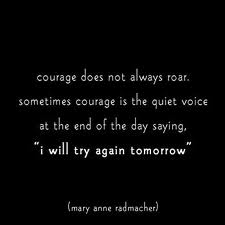
Sometimes? Courage is going to bed after a “bad day”, with resolve to try again tomorrow. Courage means you simply refuse to accept defeat.
The Lion now walked to the Throne Room and knocked at the door.
“Come in,” said Oz.
“I have come for my courage,” announced the Lion, entering the room.
“Very well,” answered the little man; “I will get it for you.”
He went to a cupboard and reaching up to a high shelf took down a square green bottle, the contents of which he poured into a green-gold dish, beautifully carved. Placing this before the Cowardly Lion, who sniffed at it as if he did not like it, the Wizard said:
“Drink.”
“What is it?” asked the Lion.
“Well,” answered Oz, “if it were inside of you, it would be courage. You know, of course, that courage is always inside one; so that this really cannot be called courage until you have swallowed it. Therefore I advise you to drink it as soon as possible.”
The Lion hesitated no longer, but drank till the dish was empty.
“How do you feel now?” asked Oz.
“Full of courage,” replied the Lion, who went joyfully back to his friends to tell them of his good fortune.
Swallow Courage
Ever get caught up in wishing things were different? Do you ever wish you were simply “normal”? (Who defines what is NORMAL, anyway?) I’m at various stages of accepting who I am today. Sometimes I have a clear vision of my “new normal” and seem to understand the “new me”. At other times though? I’ll be honest – I flounder. There is a part of me that wants to “fit in” and do things like “normal” people do.
Why do I have to find batteries so that I can continue hearing when my CI “dies”?
Why do I have to stand and sit slowly?
Why do I have to remove my hearing aid at times when the ear mold leaves a sore in my ear?
Why do I have to use my hands (or Chloe) on the stairs to safely navigate “UP”?
One must “swallow” courage – to believe!
My husband reminded me the other day that even people without disABILITIES struggle with acceptance. As a psychologist, he has seen folks from all walks of life struggle with accepting the way things are TODAY. Age may have made a change in your “normal”. An accident, illness or disABILITY may have changed your “normal”. He said, ““You have differences that make you uniquely you, but that also require some assistance. Without Chloe you’d fall more and miss more. Without your implant you are deaf. You need to accept who you are without apology and stop looking to be treated normally”.
Courage ≠ Never Being Afraid
“But how about my courage?” asked the Lion anxiously.
“You have plenty of courage, I am sure,” answered Oz. “All you need is confidence in yourself. There is no living thing that is not afraid when it faces danger. True courage is in facing danger when you are afraid, and that kind of courage you have in plenty.”
“Perhaps I have, but I’m scared just the same,” said the Lion. “I shall really be very unhappy unless you give me the sort of courage that makes one forget he is afraid.”
You can have courage and still feel fear. The unknown can be a scary thing. When an acquired disABILITY occurs in the life of a person, there are no guarantees things will not get worse. Many have progressive symptoms. Courage does give us the ability to deal with change, however. Few are born with courage. It is a learned skill, an acquired characteristic.
The Cowardly Lion has always been a favorite of mine in “The Wizard of Oz”. I loved both the movie and the books. I smile when he uses his tail to wipe his self-pitying tears away. I grin when he “shakes” in fear of the Wicked Witch and trembles at the sight of the flying monkeys. I know the end of the story. The Cowardly Lion shows courage time and again throughout the movie, putting himself at risk for others and to achieve his own ultimate goal… a gift bestowed from the Wizard – that of courage. Unbeknownst to the Cowardly Lion, courage lay dormant in his fearful heart. He only had to exercise what was already there.
I hope that YOU believe that courage is in your heart. You may not even recognize it. If you take risks and live life “in spite of”? You have courage!
I have Meniere’s Disease. It is easy for folks to forget that as the disease is “invisible”. Amazingly, I sometimes forget I have it myself. So that is just embarrassing! GRIN. Meniere’s disease manifests itself in individuals in a variety of ways. The disease lacks specific symptoms and triggers that are true of everyone. The disease varies person to person. For myself, the weather tends to be a very specific trigger for me. If pressure systems come into the area that include heavy rains or even high humidity, I know that I will have a “bad balance day”. If that day is simply the beginning of a string of similar weather days, I can be so off-balance by day 3 or 4, that I practically have to CRAWL up and down steps. It’s rather embarrassing to crawl when you are 45 – believe me!
Here in Maryland, we have had a significant amount of sunny, low-humidity days. As a result, my balance has been pretty good. Yesterday, I did laundry and actually jogged up and down the steps WITH a laundry basket. Yet I forget sometimes that in spite of my having few visible symptoms, I still HAVE Meniere’s disease even on bright sunny days.
Chloe does a number of things for me, only some of which are hearing alerts (what she was originally trained for at Fidos For Freedom). Chloe has also been trained to help me with a number of “balance assist” tasks which are very helpful on days I am experiencing Meniere’s disease symptoms. As a matter of fact, there are weeks that Chloe actually does more balance work for me than she does hearing alerts. One thing we have taught her to do is to “roll” her own blanket. I carry a blanket that is HERS. The blanket goes to every place I teach. It smells like her and she knows it is her “safe place” to be unless I ask her to do something for me. I usually put it out of the way in the classroom, but where she can easily see me. The blanket and Chloe are usually within 4-5 feet of me at all times. Below is a video of Chloe “rolling” her blanket — she adjusts the carpet square to be high enough that I can easily reach it without having to bend past my limitations.
Harsh Reminders
I get aggravated at family and close friends sometimes when they make suggestions for me to do something or try something that they KNOW I cannot do. It’s easy to forget certain things I cannot do because I don’t walk around with a sign on my shirt that says, “Beware of fall when bending!” You know what? Sometimes the person who forgets what I can and cannot do is – ME. You’d think I’d always be aware of the fact that I cannot bend to get something off the floor without paying the price. For me… bending far enough to retrieve something off the floor means that I lose consciousness for just a few seconds. Everything goes “black” in my vision, and my “hearing” (even with a cochlear implant) turns off. As soon as I stand back up, everything snaps back into focus. If I bend quickly, (for example to try and catch something as it is falling), I usually “join” the item on the floor… only I am sprawled out looking ungainly and mystified as to how I got there.
We’ve had beautiful weather here in Maryland lately. I need to remind myself on days like these that I still HAVE Meniere’s disease. In class this morning, I began gathering my things up to pack into my bag and exit the room. I dropped my roll sheet, so Chloe went over to pick it up and bring it to me (an automatic retrieve). As I was standing next to her pink blanket, I decided to save myself time and reached down to pick up her blanket. I lost my balance and my forehead crashed into the podium. After connecting with a wicked CRACK, the impact popped me back on my caboose. Thankfully, I didn’t lose consciousness. Chloe trotted over to me with the roll sheet and dropped it into my lap. She wagged her tail at me, nose 3 inches from my face.
“Hey Denise! Umm… why are you on the floor?” (Yup. I can read my assistance dog’s mind. Scary, huh?)
“Guess I should have had you roll your blanket, huh Chloe?”
Upon hearing “roll blanket”, she calmly rolled the end of the blanket and then tugged it over closer to where I sat.
I heard a student over my shoulder ask, “Ummm. Mrs. Portis? Are you OK? Was that your HEAD?”
I tried to chirp out in a manner that was convincing, “Oh sure! I’m fine, no problem!”
As I used Chloe in a stand/stay to get off the floor… I thought to myself one word – over and over again.
stupid
Stupid
STUPID!
Harsh reminders are needed from time to time, if not for any other reason than to remind us of the consequences of forgetting our own limitations.
We need to remember our own limitations. As a person with hearing loss, it helps me to remember that I cannot hear well in really noisy, crowded areas. If I need to have a conversation with someone, it is better to ask them to step over to the side out of the “hub-bub” of noise if I need to talk to them. Failure to acknowledge what I cannot do well (hearing in noise) only results in that I will be frustrated and angry at my inability to understand the conversation. If I want to play with my dogs, I need to remember to sit on the floor in order to tug on toys, throw balls, and squeak stuffed animals at them. If I try to “play” standing, I am sure to take an unplanned nosedive.
Have you had some harsh reminders about your own invisible illness or disability? Some lessons are hard to learn!
According to the Invisible Illness Awareness website, the following statistics are true:
Over 100 million people in the U.S. have a chronic illness;
20.6 percent of the population, about 54 million people, have some level of disability;
9.9 percent or 26 million people had a severe disability
1.8 million used a wheelchair
5.2 million used a cane, crutches, or a walker
So that is less than 6% who have a visible illness.
There are many illnesses that start out being invisible and as the disease progresses it becomes more visible.
Also note that:
26 million persons were considered to have a severe disability;
yet, only 7 million persons used a visible device for mobility.
Thus, 19 million of the people who were defined as severely disabled, did not use a wheelchair, cane, crutches or walkers.
In other words, 73% of Americans with severe disabilities do not use such devices.
Therefore, a disability cannot be determined solely on whether or not a person uses visible assistive equipment.
U.S. Department of Commerce (1994). Bureau of the Census, Statistical Brief: Americans With Disabilities. (Publication SB/94-1).U.S. Department of Commerce (1997). Bureau of the Census, Census Brief: Disabilities Affect One-Fifth of All Americans. (Publication CENBR/97-5).
Why Do I “Plug” Invisible Illness Awareness Week?
I have been trying to raise awareness about this week for three years now. This year, a friend noticed my “don’t miss” posting on Facebook and couldn’t resist teasing me about it. After all, I don’t exactly allow my challenges to be INVISIBLE. I wear a bright red ear mold on the hearing aid in my “deaf” ear. I wear sparkly “bling” on the cochlear implant on my “hearing again” ear. I go about my life accompanied by a hearing assistance/balance assist dog 24/7. I learned long ago that it was in my best interests to make an invisible disability – VISIBLE. It kept me from being knocked out of the way, and helped people realize that something about me is different. I can still work, shop, go to movies, hike, and dance… yeah. OK, maybe not that last part…
I just don’t hear well… especially in big, cavernous places, or busy, buzzing atmospheres. Once you get my attention and I know you are talking to me, I can actually hear you great! I may have to ask for a very occasional repeat, but for the most part I do really well. I’m proud of how far I’ve come in my hearing. Despite all my visible reminders and “kissing sidekick”, Chloe, people who know me well (friends, co-workers, and family members) will forget that I may have trouble if you don’t get my attention first and that I can’t move FAST – ever. Heck… sometimes even *I* forget that I cannot move fast. Nothing reminds me quicker than when I
fall
down
and
go
BOOM!
Through the years I’ve been able to meet some wonderful people. Some examples include:
4) Individuals in support groups for tinnitus, Meniere’s disease, hearing loss, and assistance dogs users (both face-to-face and in virtual environments online).
Not every disability can be made visible. Not every person chooses to even try and make something invisible – visible. They have their reasons and it is an individual’s choice how they want to disclose or keep hidden any disabilities they may have. It could influence their work environment, relationships, and even self-esteem. I choose to support ALL individuals who live with chronic illness, invisible illness, or disability. Recognizing these illnesses once a year in a push for national awareness, I hope will eventually dispel erroneous ideas and information about these very populations. This is one of the reasons I “blog”, and invite guest authors to write for “Hearing Elmo” as well. Raising awareness makes a difference… one person at a time.
I read some incredible stories of courage, faith, and perseverance this week at the national website for invisible illnesses. You can check out some of them here. I’m proud to be a part of a community of people who choose to live a victorious life – “in spite of”.
Take some time this week if you can to recognize the courageous people that you know who live with invisible illness and the choices they have made in order to live life to its fullest!

 Chloe was having a pretty good week. At least she was until I told her to get in the bathtub. NOT her favorite thing. If “hound dog” could do forlorn, then honey? She’s gonna do FORLORN in the bathtub covered in suds.












 Hearing Elmo