Get My Attention First

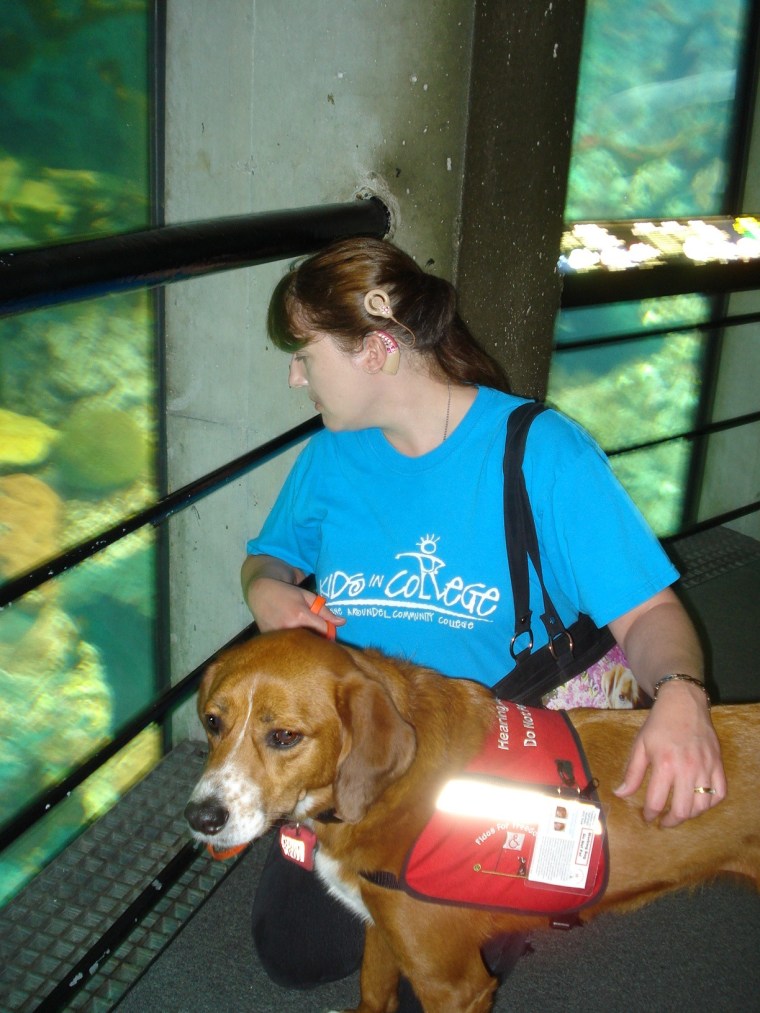
Denise and Chloe at the Aquarium in Baltimore Aug. 23, 2009

Dog Training 101

When I first began training at Fidos For Freedom in Laurel, Maryland, I learned from trainer Tracy B. that it is very important to use your dog’s name. This was especially important on the training floor where there were numerous dogs present all of which were being given obedience commands by their human partner. Calling the dog’s name gets their attention first. Follow that with a command about what you what them to do, and then lavish praise.

Even though I only attend the trainings on average twice a month now, I still make it a habit to use Chloe‘s name first. We have another dog that is never far from Chloe when she is home. Tyco is our family dog and is a two-year-old Norwegian Elkhound. He’s a “dog’s dog”. Oh sure… he loves us, but he idolizes Chloe. So where Chloe is, Tyco is there as well.

My husband was running into a road block on the stairs when he first arrived home from work. Both dogs would park on the stairs – entire bodies all “a-wag” waiting for him to acknowledge them.

I have finally taught Terry actual obedience commands (you CAN teach an old dog new tricks) so instead of saying, “Would you please MOVE?” he will say “move” with some authority in his voice instead of a question. The only problem was that he failed to use either dog’s name. I had to remind my “old dog” that he needed to use their name first. Now when he arrives home he will say, “Chloe move” (and she does), and “Tyco move” (and he does only because he follows Chloe – GRIN).

When he gets to the top of the stairs, he can put his things down and greet the dogs “proper-like”.

Hearing with a CI

When you have a hearing loss for twelve years and then receive a cochlear implant, you still do not hear perfectly. In spite of the fact that CI’s are bionics, you will also discover that you are not Jamie Sommers who can hear BETTER than folks with normal hearing. As a matter of fact, hearing takes WORK. Don’t get me wrong… I LOVE what I’m hearing and am so thankful for this technology! In a quiet room with few distractions, I can usually carry on a conversation without even having to look at you!

Let’s face it… the world is not a quiet place and the times I find that I’m trying to have a conversation in a quiet room are few and far between. Instead there is normally background noise. It can be noises like the television, stereo, pets, restaurant noise, crowd noise, etc. So the majority of the time I am trying to hear ONLY your voice amidst all the sounds my CI picks up for me. I have special programs (Smartsound NOISE or FOCUS) that allow me to pull only what I’m looking at closer; a type of directional microphone really! However, it is NOT a perfect solution. The background noise never stays at a constant level. It can get louder or softer. Hearing will never again be something that just “happens” for me.

It takes work.

I must concentrate.

It’s a shame I don’t burn calories!

Is it any wonder why late-deafened folks are so exhausted at the end of the day? I require 8-9 hours of sleep each night. If I don’t get it, I do not function at 100% the next day. I’ve had days where a sick teen or ill service dog have kept me up most of the night. I rarely even attempt wearing my “ears” (cochlear implant and hearing aid) the next day as I know I will hear little since I cannot concentrate.

Use My Name Please

It is very helpful to first use the name of someone you are conversing with that has a hearing loss. Hearing with a CI, I learned pretty quickly that in a crowd of noise it is in my best interest to work at tuning out all the sound. I recognize my name very easily, even among the buzz of voices around me. I’ve always been very thankful my name starts with a harsh consonant! Hearing my name first allows me to identify who is addressing me. I can turn and face them and begin concentrating in earnest.

Unless we are having a face-to-face conversation, I may look away from you after we have visited a bit to see if Chloe is doing as I asked (normally a down/stay or stand/stay). Or, I may smile at people across the room, wave, etc. If I am not looking at you, it is VERY helpful to say my name again to let me know you are talking to me again. It gets my attention. My CI zeros in on the voice. I’ve even been able to discern my name coming from the mouth of someone across the room! I think the most difficult listening situation is to be in a small group of people who are talking in a larger room with other small groups talking. You find that you are “part of the group” and attempt following the conversation as different speakers say different things. It can be exhausting!

Look at Me Please

I find it amusing that people with hearing loss are often the worst communicators. At my local HLAA (Hearing Loss Assoc. of America) meeting recently, I attempted to have a conversation with someone after the meeting. People were talking and standing around; some were busy tearing things down. There was a LOT of noise. The person I was trying to talk to spoke to their feet. Granted… they had the nicest brown sandals I have seen in awhile. Out of habit I looked to see what they were looking at while they spoke. I had to apologize several times and ask them to repeat something. At one point, this person’s attention was snagged by the activity of another member who was cleaning up the snacks. The person I was talking to turned to see what this other member was doing. I could tell they were still talking, but it became a buzz of sound as soon as they turned their back to me.

I said, “Pardon me? I missed that part after you said what you did about the recent rains”.

They looked at me exasperated and said, “Even though you have a cochlear implant now you don’t hear any better than I do!”

I decided to walk away (as I didn’t think I could speak “kindly”). They were on their way to grab a snack before they all disappeared anyway.

You’ve Come a Long Way, Baby!

I have learned a few things in the four years I have been “hearing again”. It is OK to stand next to someone who WAS talking to you and wait until you are spoken to again. A touch on my arm, or using my name alerts me to the fact that you wish to speak to me again. When I was first activated, I would attempt to not look as if I were ESCAPING after someone finished talking to me. I’d go and find a quiet place and look with wide eyes at the different groups of people standing around talking. If someone waved and then started toward me, I would “brace myself” for the difficulty in conversing with them.

Now I can stand in a crowd of people and wait to be acknowledged. If no one gets my attention, I am at ease. I find that I am even brave enough to start a conversation on my own. After all, I pursued a cochlear implant so that I could continue talking to the people in my life.

This week my schoolwork was interrupted by an “incoming IM” from my daughter. She was in between classes and wrote, “Hey mom! Do you have your ears in? Can I call you?”

Seconds later I was talking to her on the phone. Perhaps this isn’t a big deal to those of you who hear normally. But I haven’t been using the phone for very long. Even after receiving a cochlear implant, it took a lot of practice and courage to start using the phone.

… and here I was in the middle of the day

… talking to my daughter

… on the phone.

I cried.

But they were happy tears!

Denise Portis

© 2009 Hearing Loss Journal
Turning Off An Alert

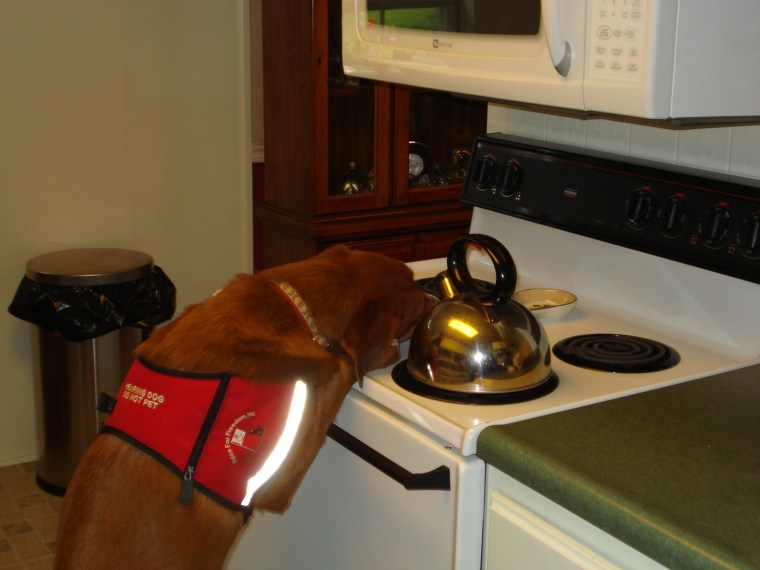
No worries... this is a staged picture. The tea kettle is cold, and a treat is on the stove to award a "Paws up" command.

One of the things I really love about Fidos For Freedom, is that even when you have completed your training you receive follow-up support “for life”. I see Chloe’s trainer about 3 times a month and so when I decided I wanted Chloe to learn a new alert, I contacted Pat.

I was putting the tea kettle on the stove to boil and walking away to check my email in the mornings. It would “whistle” like crazy after I obviously forgot about it after walking away. (You’d think I could wait patiently for all of 2 minutes!) My kids are sleeping in this summer on days they don’t work… at least, they are if the tea kettle doesn’t whistle them awake after it has been boiling for ten minutes or so! They BEGGED me to stop leaving the tea kettle without watching it. Well, I knew one other hearing assistance dog at Fidos who alerted to the tea kettle for her partner. I asked Pat how this was done, and she gave me a step-by-step plan of how to train this alert.

It worked like a charm! In a matter of a week, Chloe was alerting to the whistling tea kettle. The only problem is that I found I now had to turn that alert OFF.

Chloe bumps things with her nose to let me know what is making the sound. If a kitchen timer goes off or my cell phone rings, Chloe bumps them with her nose. When I taught her to alert to the tea kettle, I was finally able to “just forget about it” because she understood that this was now a part of her job. She’d race to get me and then make sure I was following her into the kitchen. Before I could stop her she tried bumping the hot tea kettle with her nose. I screeched and scared her to death ‘mid-bump’!

I thought, “well maybe it is all in the timing…” I attempted to follow her much more closely when she came to get me to let me know the tea kettle was whistling. That worked on days my balance wasn’t giving me fits. However on rainy days when Meniere’s disease caused me to have difficulty walking fast, she would beat me to the kitchen every time! I had to screech at her again!

She started being really anxious to alert to the tea kettle! (Wouldn’t you?) Everytime she did her job, I ended up having to screech at her. For now, I am hanging out in the kitchen for the 2 minutes or so it takes for the tea kettle to whistle. I think I’ll time how long it takes to be “almost whistling” and set the kitchen timer instead. The tea kettle would be an important alert (especially if you ask my sleepyhead kids), but it isn’t worth a burn on Chloe’s nose or paw. It is time to re-think how I want to do this. For now, the alert needs turned off.

Conditioning

When I first began losing my hearing, a subtle yet negative pattern began to take place in the way I interacted with others. If there was a communication blunder, faux pas or misunderstanding, it was always the hearing person’s fault. They not only didn’t understand what I was going through, but they didn’t care! Or so I had convinced myself…

The reality is that my disability is MY problem. It’s not YOUR problem! I had to learn to be proactive – not REactive. It can be very frustrating to tell someone to please face me when they talk – AGAIN. But the truth of the matter is, I make as many or MORE mistakes than the hearing people in my life. I start conversations with someone in my family from another room almost on a daily basis. I can hear them responding, and have to quickly hustle into the other room to at least catch the tail end of what they said. If I cannot understand, I sheepishly have to ask for a repeat (Baa – BAAA)

After I joined HLAA and began to learn from my peers a better way to communicate and advocate, I realized I desperately needed to be re-conditioned. Through the beginning years of my hearing loss I had conditioned myself to believe and react in such a way that hearing people were out to get me and that I needed to harshly and sternly educate in bullheaded opposition in order to gain their cooperation. I desperately needed to turn off this “alert”.

As the result of having established a bad habit in the way I choose to handle conflict regarding communication, I had begun alienating people round me. Worse… my behaving in such a way only insured that the next hard-of-hearing or late-deafened person this “idiot hearing person” dealt with would receive a defensive response. Not only was I hurting myself, but others with hearing loss as well.

Once in awhile I meet someone “new” that has hearing loss and a chip on their shoulder. I want to take them aside and explain my own history and need to turn off an “alert” It’s not always the right time or place, but I have had the opportunity to do so a few times. Sharing my own story seems to mean more than fussing at them about what they are doing. Explaining how to communicate with me best is an important “alert” or task. But to do so the wrong way is not worth “burning” someone else. I was taught and encouraged to re-think how I wanted to convey this information. I had to turn off an old “alert”.

It is very likely that all of us have something we should change… a bad reaction we have towards others. Maybe it’s one person that really gets under your skin. You hear their name and your blood pressure goes up! It may be time to recondition a negative response. You may not even realize it, but you may be hurting your reputation by the way you choose to respond to even the mistakes of others. Your own reputation or testimony may not be all that is at stake. Perhaps you are making all Democrats or Republicans look bad. Maybe you are making all Christians appear holier-than-thou or judgemental. Maybe the way you behave affects the way others look at all people with hearing loss. If you recognize this, you can turn the alert off and recondition the way you respond. If I can do it, anyone can!

Denise Portis

© 2009 Hearing Loss Journal

What does a “Drum Brush” Sound Like?

drum brush At church on Sunday I watched as the final seconds counted down to designate the start of our services. A timer displayed on the wall allowed everyone to see when the services were expected to begin at Daybreak Community Church. The band members rushed to thier spots and as the last second disappeared, the music director said “Good morning” to everyone present.

The drummer sat down at a single drum and microphone with a tool resembling the one you see pictured here. I had never seen this before as the “norm” for our drummer includes the entire drum set, cymbals, etc. I craned my neck to watch as he used what looked like a “whisk”, on a rectangular drum placed between his knees. I did my best to see if I could hear what sound he was making over there! Unfortunately, I could only hear the keyboard, base guitar and voices around me lifted in praise. It’s NOT that this is usually an unfortunate thing – smile! On the contrary, I am usually extremely pleased to be able to tell where we are as I look at the lyrics displayed on the wall behind the band! But today… I wanted to hear what this “whisk” sounded like!

Drum Brush

Immediately following the final “Amen” and parting song, I rushed up to the drummer with Chloe in “heel”. Because I didn’t even know what it was called, I reached over to his music stand and touched the “whisk”,

“Bobby… what IS that?”

“I call it a drum brush,” he explained while picking it up so that I could see it closer.

“A drum brush? What does it sound like?”

Bobby bent to his drum and “played it” again. I got down on one knee and moved my CI closer to the drum. I strained to listen… and could just barely make out a sound. It was a tiny, fluttery, BRUSH of sound. I smiled and looked up…

“Cool!”

Bobby asked, “What does it sound like to YOU?”

Hmmm… I had to ponder that for a brief yet “ponderous” second or two.

“I think it sounds like rustling leaves,” I replied.

“Hmm. I have always thought it sounds much like Jiffy-Pop popcorn,” Bobby grinned in response.

“Yeah! Yes, it does!”

I knew that agreeing also meant that I had instantly aged myself. For “Jiffy Pop” was something that was long before microwave popcorn. (Since Bobby and I are close to the same age, I knew he dared not make a crack about my age… besides you can STILL buy Jiffy Pop!)

Crackling Leaves and Jiffy Pop

If you click on the videos below, those of you with normal hearing or those who “hear again” with the miracle of a cochlear implant, you should be able to hear the sounds.


Memory Makers

Since I have been hearing again for four years now, many times when I re-discover a new sound I equate it to a sound that I still have “stored in my memory banks“. The brain is unique that way. If I am hearing a cat purr, I have a memory of cats purring prior to my becoming deaf. I grew up on a farm in southeastern Colorado. We had many cats and I had stored away what a cat’s purr sounds like. However, if what I am hearing is new to me, I am unable to compare it to the same sound that I was able to hear in my past. The best I can do is compare it to another sound in hopes of being able to describe it and make sense of it as I listen with my cochlear implant.

To me… a drum brush sounds much like the combination of crackling leaves and “Jiffy Pop” popcorn! It is the best comparison that I can think of in my attempts to place a new sound from a new “noise maker”.

Adaptation

Having an acquired disability can “make” or “break” you. I remember when my husband and I first realized that my hearing loss was progressive. I was going to the audiologist about every six months as my hearing was noticeably worse. Holding an audiogram with visible, charted proof that you are losing your hearing is very sobering. It seemed as soon as I adapted to communicating at the current level of loss, I would again lose some more of my hearing. Eventually, I could hear very little in spite of two new BTE hearing aids.

Each time I learned to re-adjust I would try to remember what had worked well for me in the past. Having never been deaf before, I had no comparison. I could only remind myself that I needed to continue to be active and proactive in communication. It worked in my best interest to make my invisible disability – visible. I wore my hair up so that my colorful ear molds could be easily seen. I pointed to my mouth and asked for a repeat if I was having trouble hearing. If I could only make sense of PART of what was said, I would repeat that PART and ask for clarification of what I did not get. If the background noise was extreme, I would ask if we could move to a quieter location to finish the conversation. I tried desperately to remain upbeat and positive. The alternative was scary.

Desperation and Despair

At one point in the process of my becoming a deaf person, I had really lost all hope. I had just moved from North Carolina and was trying hard to not only adjust to a new job, a new level of hearing loss, and a new community, but I had lost every friend that had meant so much to me! My North Carolina friends found excuses not to visit and emails were many times lost in cyber space. I had a great deal of difficulty connecting with people at work and church in my new home. I felt alienated and alone. Couple this with a progressive hearing loss that eventually began to even effect how well I could communicate with my family, and you were looking at one WHIPPED puppy!

Instead of adapting and reaching out for help, I isolated myself and became very depressed. Early in 2003, I found that I was actually contemplating how to end my life. How did I get to this point? At what point had I “given up”? When had I decided to no longer attempt living in spite of a disability? I’m not 100% sure of when it all went wrong, but I suspect I knowingly or unintentionally stopped remembering how wonderful life is! My brain had so many wonderful memories of living a successful and abundant life, and yet I seemed incapable of accessing those memories! I’m very glad that God intervened through people in my life who recognized I had given up.

No Alternatives

There are not any alternatives to adaptation. Life can be… and many times IS hard. We must continue to adapt and “roll with the punches”. There are plenty of blessings and wonderful memories as well. Adapting means we deliberately adjust to change. It is a mindset and a choice.

Lose your job?

Work hard at enlisting the help of friends and acquaintances to help you network to find a new position. You will find your friendships strengthened and you may make a friend or two you didn’t know before. Often times God moves us to a new place to live and serve which ends up providing a great deal more happiness than what we enjoyed before. Most people find that they grow and mature as they re-work that old resume, touch base with contacts and put themselves out there to obtain interviews in their seeking employment.My husband recently went through this and even I noticed the growth in his life at the end of the journey. He is now much happier than he was prior to losing his job.

Lose a loved one?

It can be so hard to say goodbye to someone we care about. I cannot write much about this topic, for truthfully I have yet to experience the loss of someone very close to me. I have seen plenty of people in my life go through this even recently, however. Their lives are a testimony to ME whether they realize it or not. It isn’t a matter of “if” I will experience the loss of someone I love. It WILL happen. I am learning how it can affect a person, and observing God’s grace poured out on the lives of those who desperately need it!

I could go on and on about different things that can happen to a person that requires we adapt. However, I would be writing all day if I did that for in truth, life insists we all learn to adapt. There is no healthy alternative!

Denise Portis

© 2009 Hearing Loss Journal

I’m sorry… 5 Different Ways

DSC02941

I’ve always been a big fan of “The 5 Love Languages”, written by Gary Chapman and along with other combinations of co-authors like Ross Campbell, and Jennifer Thomas. In collecting some background information for this post, I see that there are now 7 titles total. I’m behind! I only have 4 of the books! My favorite of the “lot”, is “The Five Languages of Apology: How to Experience Healing in All Your Relationships”. Every person has a preference in how they apologize. This is a good indicator of how they prefer to be apologized to by others!

Doggedly Different

chloe sorry Chloe and I have been working together for a little over two years now. In the beginning, I had to really get to know her and learn what some of her calming signals, body language and other cues meant. Sometimes as clients-in-training, we pick up things from our trainers just by paying attention. The trainers work with more than one dog more often than not. They simply cannot relay every single tidbit of information about your dog to you. When I’ve asked specific questions, they may think a second about MY dog and then answer as best they know. Something I picked up by listening to Pat was the word “phoeey”. It isn’t even said in a harsh way, or with an elevated tone.

We were at a gas station filling up Pat’s car. Chloe wasn’t  staying overnight with me yet, and so the fact that Pat was OUTSIDE the car filling up had Chloe concerned. I could just barely hear Chloe’s high pitch whine. When Pat got back in the car, Chloe hopped up to give Pat’s ear a kiss, and Pat calmly said, “Chloe phoeey”. Chloe immediately went back to her place “happy as a clam” and seemed assured that all was right in the world again.(Is a clam ever happy, folks? Where do we get some of our phrases? EYES ROLL).

By LISTENING, I learned that if I say “phoeey” to Chloe she understands to stop what she is doing. If it is something she knows she should NOT have been doing, she attempts to apologize as well. For Chloe, an apology is a sweet sit, eyes connect with a tiny sheepish duck of the head. She will many times put a paw on my knee if I’m sitting as if to say, “Sorry… we ok?” A pat on the head is all that is required for her to know the apology is accepted.

My Elkhound pup turned two this month, and believe me he is still a pup! tyco1 Tyco is very sensitive, and if I ask him to stop doing something (a louder WRONG for he ignores a “Tyco phoeey”), he belly crawls to me and licks my feet! The poor guy! I scratch his ears and “love talk” him for 10 seconds to let him know there are no bad feelings.(Longer periods of time just rewards his behavior… I want him to know all is well and GET ON WITH LIFE).

naked Peg 003 Pegasus is a nervous little guy. If he is corrected by person or other dog, Pegasus will TWIRL to apologize. He twirls. Constantly. In one direction. Opposite what my world spins due to Meniere’s. Needless to say, I intervene before I fall on my caboose. I reach down and pick him up mid-twirl, smooch him a kiss loudly and confidently, and set him back down. WHEW. Apology accepted.  ebony Ebony? Well she is our senior citizen. If she is corrected, (usually Ebony – NO) she ignores us. After all… she’s deaf (and partially blind, and arthritic, collapsing trachea, enlarged heart, liver disease, rotating patellas, alopecia and MORE).
5 Different Apologies

I think every person should read this book! I have learned so much about how each of my own family members have a different apology language. I’m learning how to do the same with other family members and friends. The apology languages are as follows:

1. Expressing Regret (“I am sorry”)

2. Accepting Responsibility (“I was wrong”)

3. Making Restitution (“What can I do to make it right?”)

4. Genuinely repenting (“I’ll try not to do that again”)

5. Requesting Forgiveness (“Will you please forgive me?”)

In a perfect world there would be no need for apologies. Since we live in a world that is far from perfect, it would be wise to learn to apologize. Let’s face it! We all blow it!

On Purpose

Sometimes we intentionally purpose to make someone mad or hurt them. I wish it weren’t true, but I can be honest with myself. There are times I know that what I’m going to say or do will either make another angry or hurt. Perhaps I justify it because it is done with vengeance. Maybe I’m just in a rotten mood and desire to “share the feeling”. It may be that I’m tired, not feeling well, and should go to bed instead of trying to communicate with someone. The damage is done! I believe when we are willful and premeditated about our wounding, our apology should reflect the seriousness of situation. I believe we should not only SAY we are sorry, but SHOW we are sorry. If I ever find that I am deliberate about being unkind, I attempt to make restitution. Shame on me!

Oops… did I do that?

Sometimes we hurt someone unintentionally. Apologies are given because of how another received what we said or did, not because it was our intent to hurt them. Have you ever discovered you hurt someone and that disclosure took YOU by surprise? If you hurt someone accidentally, you should apologize. Depending on the circumstances, you may try to explain what you were attempting to do. Don’t justify your actions WITHOUT an apology. It doesn’t really matter what you MEANT. If it hurt someone, we should try to make that right. We shouldn’t be so proud that we cannot say, “I’m sorry! I did not mean it that way, and I’m really sorry that what I said ended up hurting you!”

Having said all of that, we need to be careful about our own sensitivity. At certain times in my life, I remember being in the frame of mind where I EXPECTED people to say or do hateful things. Guess what? I was never disappointed. It seemed that every day I was owed an apology for something. What a terrible way to live! If someone says something a bit “off”, try not to jump to the conclusion that is was meant maliciously or callously. Expect the best from people… not their worst.

Recently my son and I were working together to change the cat litter out in the litter boxes. The kids have 3 cats between the two of them and so we have 3 litter boxes. (Ever tried to ask a cat to wait in line with her legs crossed?). We buy cat litter in huge 40 pound bags. I simply cannot lift it and “aim” at the same time. My 6′ almost 3″ son has no problem hefting big awkward bags… unless any dust happens to aggravate his allergies that is! In the middle of hefting, tilting and aiming the bag, he gave a tremendous house-rattling SNEEZE. Yup. You guessed it! When the dust cleared, he and I both looked down at the pile of litter that now completely covered my bare FEET.

“Um… gee mom. Sorry about that!”

I wiggled my toes. They didn’t appear because the pile was THAT DEEP. He didn’t MEAN to bury my feet. It wasn’t his intention to set up an accident to where it would necessitate my cleaning litter out from between my toes. I couldn’t help it… I started to giggle, then I began to crack up… and finally my son and I were both in stitches just dying laughing! We cleaned up the mess, and finished the job… but just barely! Chris gets the hiccups when he laughs THAT hard, which is just about as dangerous as a sneeze!

Heck! Even DOGS understand when it wasn’t on purpose! Sometimes my two big dogs will be playing and one of them may inadvertently nibble/pinch too hard. If Tyco did the “oops”, he drops and crawls to Chloe and licks her feet with his ears flattened. His apology language doesn’t change species to species it seems! If Chloe does the “ouchie”, she will come and sit next to Tyco and give him a soft cuff and lean against him. She looks up under her eyelashes at him with a look that says, “Did I do that? Um, sorry – oops!”

Chip on Their Shoulder

Have you ever met someone who is ultra-sensitive? It seems like every time you are with them you say or do something that hurts their feelings or wounds their fragile ego. Do we owe them an apology every single time? Wouldn’t our conversations with them end up being apologies alone? In the course of my lifetime I have been in contact with people like this. You may have to sit them down and say:

“You know? It seems like whenever we are together I say or do something that makes you mad or hurts your feelings. I’m really not intentionally doing these things! It may be that you have this expectation of me. Can we discuss this?”

Perhaps you should agree to just limit your contact with this person. Maybe you don’t have a choice! This may mean that you have to change your own behavior and carefully, methodically respond when with this person. You may be in a situation where it is impossible to tip-toe around the other person’s feelings. Your one-on-one conversation may include something like:

“It seems I cannot say or do anything to keep you from being upset. If you watch my interactions with others, I love to laugh, tease and interact with others in a positive way. I understand you do not like this and I have never intended to cause you pain. It may mean that we work together as best we can, and just acknowledge that our personalities do not mesh well. That’s OK! We don’t have to be friends to work together with mutual respect.”

clam If you are obsessing over where “happy as a clam” came from, feel free to click the clam to see what “Wise Geeks” says. Yeah… I was obsessing!

Denise Portis

© 2009 Hearing Loss Journal


B.L.I.N.G and Invisible Disabilities

B asically L iving I nvisible is N ot G ood

My 19-year-old daughter came up with the witty acronym of B.L.I.N.G. (B asically L iving I nvisible is N ot G ood). It can be tied to a variety of life lessons.

Cochlear implant “bling” and Assistance Dogs

I am a late-deafened adult and I also have Meniere’s disease. Being “late-deafened” is a fancy way of saying that I lost my hearing after I learned oral language. Hearing loss can be mild, moderate, severe or profound. Although all levels of hearing loss affect the way in which a person freely communicates, a person obviously has more serious problems the more severe their hearing loss is. I think part of the reason that HLAA (Hearing Loss Association of America), ALDA (Association of Late-Deafened Adults), and other non-profit organizations for people with hearing loss have trouble attracting new members is that for most people, hearing loss is a nuisance and not a life-changing disability.

According to NCHS (National Center for Health Statistics), there are 37 million Americans who have trouble hearing (NCHS, 2006). A study done by Gallaudet in 2001 reveals that 8 million Americans have difficulty hearing even with the use of a hearing aid (Gallaudet Research Institute, 2007). This leaves approximately 29 million Americans who communicate effectively in spite of a hearing loss. This vast majority of people with hearing loss enjoy the invisibility of their disability as they function well “in spite of”. They “look” like everyone else. They do not have a need for support groups, advocacy or a connection to a non-profit organization because they have no need to identify with the hearing loss group. (I discussed why some people choose to not seek help when they DO have a significant loss here.)

When it became obvious that my own hearing loss was progressive, I began to realize how difficult it is to have an invisible disability. Prior to my cochlear implant in 2005, you would never know I had a disability unless I opened my mouth to speak to you. My speech was beginning to deteriorate just a little bit due to the fact I had not heard my own voice in a number of years. I may have interrupted conversations, not realizing someone else was speaking. I had trouble balancing the volume of my voice and more often spoke to softly than to loudly! Meniere’s disease kindly bestows noticeable symptoms for me when it’s a rainy or overcast day. You would never know it, however, unless I tried to walk a straight line or go up or down steps!

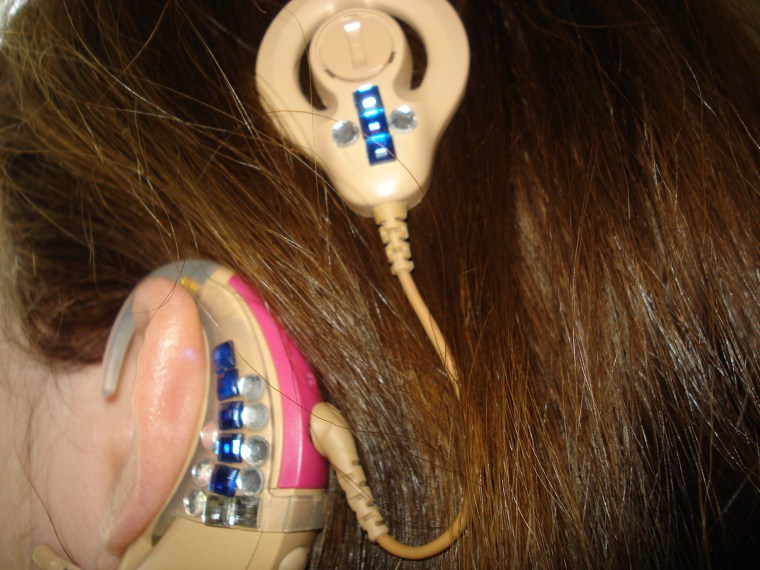
Being surgically implanted with a cochlear implant felt a little bit like a miracle. I could hear my own voice again in most environments and my speech improved dramatically over the period of only a couple of months! Having a cochlear implant does not mean I hear perfectly, however. There are some situations with a lot of background noise or poor acoustical environments that I may have to ask for a “repeat”. I may have trouble following conversations if I’m extremely fatigued. Prior to my implant, I had already adopted bright colored ear molds for my hearing aids and wore my hair up. I found out through a great deal of “trial and error” that it was in my best interests for people to know that I have difficulty hearing. After I received a cochlear implant, I didn’t see the need to change my adopted visibility. I wear “bling” on my CI, and it does draw attention to the fact that I hear but not in a normal way. It allows people to quickly identify that they may need to be sure to face me when they talk, or be aware that if I ask for a repeat it is not because I’m not paying attention. I really believe my “bling” helps other people as much as it helps me.

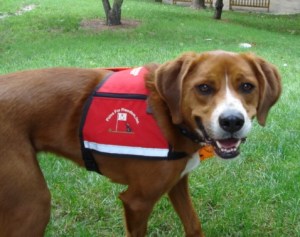
Having a hearing assistance dog who also does balance related tasks for me, brings attention to my disability as well. If you’ve ever thought about having an assistance dog, but do not like to field questions or have people notice you, then you may want to reconsider. Chloe comes from Fidos For Freedom in Laurel, Maryland. It’s not her bright red vest that gets attention. What makes people notice is simply the fact that she is a DOG! It’s not very often you see a dog in a store, restaurant or even church!

B asically L iving I nvisible is N ot G ood

Recently, God allowed a very mean person to be a part of my life for a short time. I say that GOD allowed this person, because it actually served to remind me that there are bigoted mean people who not only do not understand disabilities, but choose not to understand. Through FaceBook, I ended up “accepting a friend invite” because they were involved with someone I trusted. It didn’t take very long for this person’s true colors to be revealed. Comments left on my uploaded photos or “Notes” and eventually conversations between this person and myself and my husband through “instant messaging”, all revealed how there are still people who don’t “get it”. We received over 45 comments and messages from people astonished that there were still people like this out there! Some people do not realize that disabilities are often invisible. They do not understand that there are good reasons to make an invisible disability… visible! Some people do not understand that disabilities are not chosen. There are some that do not understand that disabilities may not only be life changing, they can be terminal. Many diseases and disabilities are those that shorten a life. God used this person in my life to remind me that some people are not only uneducated about disabilities, but they may willfully choose to believe the worst about those who have them. (It’s a great relief to not have to put up with this person anymore, but I do thank God that it was used to open my eyes!)

For me… basically living invisible is not good. There may be other people with Meniere’s disease or deafness who choose to live another way. I respect that! “Bling” works for me. It reminds even those I know well that in spite of my speaking perfect English (with the exception of a southern accent), I do not hear normally. It reminds them that if I repeat part of what I heard and wait for a repeat of what I didn’t… that it isn’t because I chose to stop paying attention. If I say, “whoa” under my breath and touch the wall in order to snap my visual field back into focus, they are reminded why I have a dog who picks up things for me and “braces”.

“Bling” and an assistance dog both serve to allow me to live with some independence. I don’t have to have family members with me now just to go to the post office or a store.

Invisible Awareness Week   0e1c199b505195ca9883a3faad5994b4

There are others who know what it is like to have an invisible illness or disability. September 14-20 is “Invisible Awareness Week“. If you or someone you know have an invisible illness, I encourage you to check out this site!

If you do not have an invisible disability, chances are you know someone who does. Do you know some of the strongest advocates for people with disabilities are those who do not have one? Think about it… who will get further with a person who misunderstands the needs, reactions, or communications from a person with an invisible illness or disability? Certainly people who live with invisible illnesses or disabilities should learn to advocate in a positive way. Their ability to do so helps us all! However, if you take a person aside and teach them… explain to them a little bit about another person’s disability or illness, it may mean even more! Every person can be a strong advocate for others.

Denise Portis

© 2009 Hearing Loss Journal

Falling on STEP 2

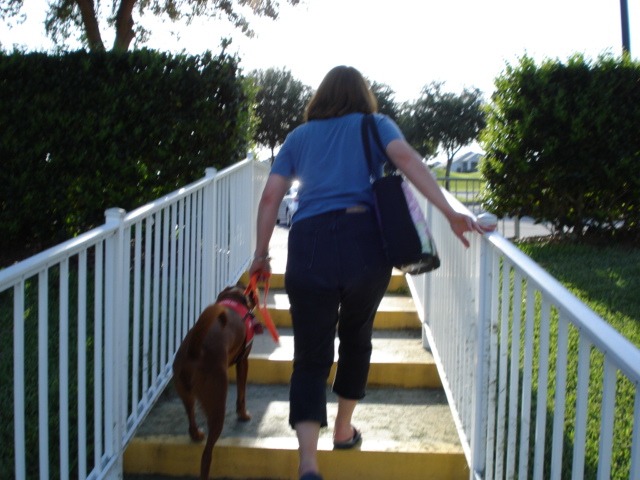
Chloe on stairs in Leesburg, Florida

Not All Stairs Are Created Equal

Sunday, my kids were scheduled to help clean up after the service. In an effort to save time, Kyersten handed us her library books that she had planned to return through the book drop. C. Burr Artz Library is only about 1 block from where our church currently meets. Books are often returned on Sunday since we are in the right vicinity. As it was Father’s Day, I was anxious to “shave off minutes” where I could and so agreed to drop them off for her. We were in separate cars, and the plan was that Terry and I would drop off the books and then reserve a table at Outback. Outback normally opens at 4 PM, but on Father’s Day they were opening earlier – a fact Terry was very excited about since the choice was his given the special day. Terry and I left the kids cleaning up the foyer and coffee corner, and hurried to stop by the library before proceeding to Outback.

C. Burr Artz Library in downtown Frederick

It may be difficult to see from this aerial shot of the library, but the book drop is to the left as you face the main doors. There is a set of stairs you cannot see, and a handicap accessible ramp leading right up to the book drop. Terry pulled into the circular drive in front of the library and the plan was for me to hop out, drop the books in, and hop back into the van. Sounds deceptively simple, correct?

I hopped out after telling Chloe “quiet” and “stay”. She tends to have a cow when I leave the vehicle without her. It rarely happens and only when someone else is in the car. Even so, she behaves as if I’ve left her in a foreign country! In order to keep Terry from having to listen to her belly-ache, I had high hopes my “quiet” would keep her calm for the several minutes it would take to drop the books into the slot. After all, she would be able to see me the whole time, and I would be no more than ten feet away.

There were only 4 big books, and easy to carry under my left arm. I approached the stairs and considered my options. Funny how having a balance disorder forces you to look at something as simple as a short staircase in a new light. The day was sunny and I am less apt to be dizzy on clear days. I was momentarily distracted by the appearance of a young man I go to church with as it seems he walked to the book drop and beat us there! He made a comment about that fact, and I grinned and waved goodbye.

My world tends to rotate counterclockwise. This is actually a huge boon in my humble opinion, as most people walk to the right on sidewalks, stairwells, etc. This means my strongest side… my right side… is closest to the handrail and “checks” my skewed impression of things moving towards the left. I confidently stepped up to the staircase.

Decisions to Make on Step 2

Within one step I found myself sprawled out in the stairwell. I grimaced and pulled myself back up and took inventory of the various scrapes, abrasions and new bruises. I felt an immense relief that I fell on STEP 2! At least I fell “forward” instead of “backwards” and didn’t have very far to fall. If I had been on step 5, it may have been worse as the fall would have been farther. If you fall IN the staircase, your fall is cut short by the slant of the stairs. (Are you grinning? Hey these things matter, believe me!)

“OUCH”, I muttered.

Now as falling is as much a part of my day as breathing, I really do not tend to sit around contemplating the fact that I’ve just fallen… again. I could hear Chloe “losing it” in the idling van behind me. A dog’s bark comes in loud and clear with a cochlear implant. I gathered up the strewn books, made it up the final stairs and dropped them into the book drop. Every time I use the book drop, I’m reminded of the time my son told me that it “talked to you” when you fed it books. I believed this for a number of years until he overheard me talking about our book drop one day and figured he’d better set me straight that he had been pulling my leg. Ornery little booger… anyway, I digress:

I returned to the van, hopped in and buckled up. Before I could say anything, Terry said,

“Good night, Chloe was NOT quiet while you did that. She cried the whole time!”

I sat there contemplating that comment a moment, perhaps hoping he’d notice my bloody knuckles and disheveled appearance. I’m not a patient person and so blurted out,

“Well gee it could be because I dropped out of sight when I fell on the stairs!”

I can only imagine what poor Chloe saw from her perspective inside the van. Wisely, Terry cluck-clucked like a good little mother hen and was appropriately conciliatory about my new “fall down and go boom” scratches.

Stairs are not all the same. A new discovery for me has been the realization that the width of the stairwell, angle of the slope, width of the stair itself, and whether or not the stairwell is “open” or “closed”  has an effect on perception when you have a balance disorder. You can learn the “feel” of a familiar stairwell; for example, I traverse the stairs at home at a pretty good pace and rarely fall even on a rainy day. (I might clarify that I rarely fall on the STAIRS at home… grin!). When I come to a “new” staircase, it is wise to take some time and check out the “lay of the land” so to speak!

We made it to Outback and reserved a table for four. Chloe went under the table and rested her head on my foot. She draped a heavy paw over my opposite foot… yeah I got the impression she wasn’t going to let me get very far without her again!

The Decision is Ours

Sometimes I wish life’s decisions were just made FOR me so that I could get on with living life. However, we all know that making decisions is part of a growing process. I don’t for a moment believe that God forces decisions on us. His word makes it pretty clear that we have a free will. We make the decisions even though He has the power and wisdom to make them for us. God is not a dictator, and much like a loving parent He allows us to make choices that may ultimately cause us pain. Even when it is clear we have made a “poor choice”, we still are able to learn from our mistakes.

I believe we can ask God for wisdom when we make decisions, and that it is wise to seek the counsel of others. In the end, we are left with a choice. Some decisions my family and friends have been faced with in recent days include:

“Do I take this job opportunity, or wait for something better?”

“Do I apply to this college, or another even if it is farther away?”

“What will I major in?”

“Do I buy this used car and clean out my savings account?”

“Do we remove my brother from life support?”

“The company is closing… should I work until the doors close or immediately start to seek a new position?”

“Do I go for a consultation for a bilateral cochlear implant?”

Granted, many of our decisions are not life-altering. I inwardly shake my head in exasperation when I hear people piously declare that they need to “think and pray about” whether or not to make a simple decision. I believe God gave us discernment to make decisions on whether or not to buy Kraft or the ingredients for homemade mac & cheese. Do we take the long way to Walmart or the short-cut and risk heavy traffic? I have heard people who have the time, means and talent try to determine if God wants them to serve in some capacity or another. For goodness sake… just serve! We can’t all be ushers, greeters, or nursery workers, but every individual can be “used” in some fashion. Don’t dare to call something God gives you to do “small” or “unimportant”.

I have made decisions about important things before only to discover rather quickly I have made a mistake. When I make a decision, I try to keep my head up and eyes focused for further direction and confirmation. By staying in a state of awareness, I can more quickly discern if I’m on the right path. If I’m not, I should come to that conclusion fairly quickly. Instead of being bummed about having wasted time, I make necessary adjustments and continue with a new plan of action. I feel an immense relief that I fell on STEP 2!

What is far more difficult is when you discover a mistake after a greater period of time has gone by… perhaps even years! You may feel incredibly “bummed” that you wasted so much time on the wrong path. Perhaps the wrong decision has you bearing new consequences even after adjusting and finding the right path. It’s hard to fall on STEP 5. Taking a fall late in the game, is still a fall “forward”. We can learn from our mistakes. Experience can be a great teacher.

As a parent of an 18 and 19-year-old, I offer advice WHEN ASKED but then allow my children to make decisions on their own. I think we should ask God for advice, for discernment, and for clarity. After I make a decision, my Heavenly Father sits back and watches far more attentively than a hound dog in an idling van. He may “bark” a warning, or alert others that care for me that I am in trouble. He may see me make adjustments and then fine tune my own decision so that I can continue on life’s path. May we all learn to make decisions with more confidence!

Denise Portis

© 2009 Hearing Loss Journal

Hearing at the GYN

chloe at door

Chloe is so accustomed to going everywhere with me, imagine her shock when I put her in her crate this morning to head to an early morning doctor visit! She goes to all my doctor visits with me, but as I’m still recovering from a sinus/respiratory infection I chose to leave her home for this particular visit as it is harder to keep track of her at the GYN’s office. Wouldn’t you know when I get there they all want to know where Chloe is? (I brought her last year).

Hearing at the Front Desk

The women’s medical plaza that I go to for my GYN visit is a big beautiful place. As you walk in the door, you enter a huge atrium and are completely surrounded by glass. It’s a huge, cavernous place and the echo off the rock, tile and marble is frustrating if you hear with a cochlear implant. I normally do pretty good. However, if you factor in that this is a OB/GYN office, there are various newborn babies crying in the waiting room as “mom” awaits a post-natal appointment with her doctor. There is a wonderful medical television service that discusses various “hot” topics among patients and provides nifty “quizzes” while you wait. They aren’t captioned, but I do really well if I’m sitting within 15 feet or so. However, if your goal while standing at the check-in desk is to communicate with the ladies behind the desk, that added background noise is not really “welcome“.

I asked for a couple of repeats as the friendly ladies at the desk … TALK to their desk as I’m checking in and providing responses to various questions. I happened to spy my chart open and so at one point after the lady again asked something of her DESK, I quickly reached down and tapped the card stapled to the front of my chart. I made the card myself and so easily recognized it. It has a picture of my smiling face and my cochlear implant with sparkly BLING above a paragraph explaining that I hear with a cochlear implant. It is very helpful if you face me when you speak so that I can pick up any visual cues and/or read lips if I miss what you are saying. The receptionist read where my finger was still pointed, looked up and beamed a big smile at me.

“Sorry about that!” she grinned.

“Not a problem”, I grinned back.

(They are the grinning’est office I’ve ever been in… )

Calling my Name and the Nurse’s Station

Because I’m concentrating and paying attention, I don’t have any problem hearing my name called. Sometimes I see other people in waiting rooms and they are deeply engrossed in a magazine, book, or their cell phone (grimace). I’m amazed that their name being called can bring them out of their “fog”, and to the realization that it is now their turn. I guess I’ve had a hearing loss so long, I don’t completely understand how people “hear without trying”.

So back to the nurse’s station I go and I get to go pee in a cup! That’s always such a joy (rolls eyes). Next… on to a room and the nurse asks me questions about my paperwork and takes my blood pressure. 128/76 which is VERY good for me when I’m in the doctor’s office. I monitor it at home as well since hypertension runs in my family, but normally when I go to the doctor my pressure is UP. I guess that means that although I’m smiling it’s not my favorite place to be? The nurse then tells me to “undress” and to remember the robe opens in the front and hands me a paper “drape”. (OH JOY). I repeat everything in order to make sure I understood correctly. I mean… who wants to get THIS wrong?

LOVE MY NEW DOCTOR

I have a new doctor because my old doctor of six years left the practice. Her name is Denise, so ya know… she must be pretty good! (smile). Seriously, though she was very thorough and was great about facing me and talking in a normal tone of voice. She asked me about my CI, and was pretty fascinated by the technology. She was very “game” for my request of “how to do this” as I’ve discovered a tried and true practice of how to talk to a doctor when your feet are in stirrups and you have a hearing loss.

I left my email at the check out counter so that that they can email the results to me. The receptionist at the check out desk said “no problem”. I explained that I hadn’t put my email address on anything, and could I write it down for her? Again… no problem, but hey! I’ve walked away before and then they never contact me!

As I was leaving, I felt what I’m sure ladies with normal hearing felt. Thank GOODNESS this only happens once a year.

Denise Portis

© 2009 Hearing Loss Journal

A Strong Bond

Tethered together helps to create that bond...

You Want Me to WHAT?

When I first started working with Chloe over two years ago, one of the first things my trainer told me was, “Chloe is to remain tethered to you at all times. Where you go, she goes… for 30 days”.  She was to be at the end of my leash and if I needed my hands free, she had to be tethered to me. No one could pet her, feed her or interact with her but me for 30 days. (It almost killed my family!)

If I did laundry, Chloe did laundry. If I fixed supper, Chloe (on a longer leash and out of harm’s way from the stove) fixed supper. If I went to the bathroom, Chloe came to the bathroom in a stand/stay. (You don’t want a service dog laying or sitting on public bathroom floors – EWWW!). Needless to say, it was probably harder on me than it was her. She was trained to be with someone 24/7. I had to learn to be responsible for this canine at the end of a four foot leash.

It’s amazing how someone could overlook a dog the size of Chloe, but it does happen. People look over her head and come close to tromping on her at times. A friend of mine is training her Great Dane pup as a service dog. I would like to think that Kenai could not be overlooked even in a down/stay!

Now Over Two Years Later

Chloe is rarely out of sight. At home she doesn’t wear her vest, but I still rely on her “working”… her hearing alerts throughout the day. On a day like today (pouring down rain), I need her to retrieve things when I drop them too. I am almost to the point of believing Chloe actually knows to stay a little closer on a rainy day. You wouldn’t think a dog would pick up on that but you never know!

If Chloe loses track of me, for example a squirrel caught her attention outside so she stands to stare while I head downstairs to get a load of laundry in the dryer, she races to find me as soon as she realizes I’m gone. If a gate is up, or door closed she’ll howl her anxiety of the fact. It’s created a rather unique bond between she and I. Honestly, on the days she is in her crate and not at the end of a leash has me feeling like I’ve left my right foot at home by mistake. There are infrequent times that Chloe isn’t feeling well and if I find I have to leave home, she remains in her crate. There have been a few times that she had to stay at home when we were going someplace she could not go safely. (For example, a zoo!) When we are reunited, you would think it had been a month since she saw me last and not a couple of hours! The bond we share serves its purpose, for a service dog and partner should have a close bond in order to establish a healthy working relationship.

It wouldn’t work with people!

Perish the thought should a person have to be leashed to another person for a “30 day bonding period”! I’ve been married for 23 wonderful years to the same man. I wouldn’t dream of attaching myself to him and staying in his vicinity indefintely. We’d strangle each other! (grin) Dogs who have been trained to assist a partner in some fashion do not seem to mind the constant companionship. They thrive in this atmosphere. Perhaps this is why dogs make such terrific service animals… they love to be with their partners.

Two great organizations that you can find more information about assistance/service dogs are:

Assistance Dogs International: Click here

International Association of Assistance Dog Partners: Click here

What the ADA says about service dogs: Click here

Denise Portis

© 2009 Hearing Loss Journal

If I’m Part of a Majority, Then What is Our Identity?

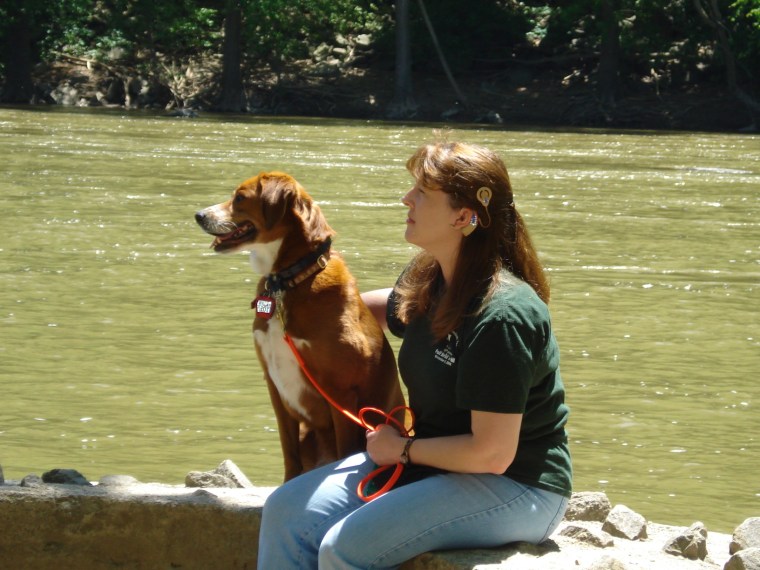
Denise and Chloe sit next to the Potomac at Harper's Ferry, WV

According to data provided by the National Center for Health Statistics (NCHS, 2006)), 37 million adults in the United States have a hearing loss. This is approximately 14.9% (2007) of persons over the age of 18 living in the United States. Gallaudet Research Institute (2007) states that anywhere from 2 to 4 adults out of every 1000, is “functionally deaf”, but of that number more than half became deaf after the age of 18-years-old. (NOTE: this would be after the acquisition of oral language). As many as 22 out of every 1000 adults in the U.S. consider that they have a “severe hearing impairment”. (Their hearing loss affects their lives and impacts the way that they communicate).

Who am I?

I began losing my hearing when I started having children. At the age of 25-years-old when my daughter was born, I have a very vague and fuzzy memory of thinking I may have a cold as speech sounded muffled to me. At the age of 27-years-old, my son had come along as well and at that point my husband and I both knew that something was up with my hearing. I went to an audiologist and was diagnosed with a moderate hearing loss… “did I want to buy a hearing aid for my ‘worse’ ear?”

Although I am deaf (with a small “d” as opposed to the capital “D” for culturally Deaf folks), I don’t consider myself deaf. I don’t think it’s a matter of denial either. I speak with my voice, and use a cochlear implant and hearing aid to maximize what I hear. For me… this is “normal hearing”. My “new normal”. I’m comfortable and happy with what I hear.

I know sign language, but it is highly unusual that I do. I learned ASL in college because I had two friends in my dorm who were culturally Deaf. I’ve been learning sign and taking classes ever since. I don’t use sign language with other hard-of-hearing people because the vast majority of them do not use sign language. Think about it for a moment. If like most people who lose their hearing, you do so after having learned oral language… won’t you try to continue to communicate in a way that more closely resembles the way that you did before your hearing loss? On top of trying to live with a newly acquired disability, would you want to learn a new language including it’s syntax and grammar, only to accomplish being able to sign to other people who happen to know sign? Doesn’t make sense does it? That is why the vast majority of people who lose their hearing turn to technology, surgery and/or reading lips.

Is ASL a bad thing if you are an oral deaf adult?

I’ve been to numerous hearing loss conventions where the attendance was anywhere from 500-800 hard-of-hearing people. These conventions often hire interpreters for the twenty or so people who use ASL as their primary means of communication. CART (Communication Access Real-time Translation using a court reporter) is also usually being paid for and the many workshops and sessions are also looped or have infra-red technology so that people with t-coils on their hearing aids and cochlear implants can hear more clearly. The small nucleus of folks who use primarily ASL tend to “hang out” together at these conventions. I have seen some very strong bonds and friendships develop. However, they are also isolated at times because they cannot speak to the hard-of-hearing majority who do not use sign. Sure! You can write notes, but I’ve rarely seen the effort made.

So should a HoH (hard-of-hearing) person learn ASL? My personal opinion is that learning a little bit of ASL is a good tool to use at home when you happen to have your hearing aids or cochlear implant out… or should your batteries die. Actually, HoH folks tend to learn Pidgin sign language, or exact signed English. They tend to sign exactly as they would speak in English (which isn’t ASL). I’ve been trying to talk my HLAA (Hearing Loss Association of America) chapter into doing one meeting on “often used phrases in ASL”. I believe knowing these phrases at home will facilitate communication in the situations I mentioned above. It can also be fun to learn a “hand full” of sign. However, most HoH people do not try to use sign language outside the home when they are at work, church or in public. They normally read lips, try to set up ideal listening environments, use technologies available, and often have hearing aids and/or cochlear implants.

I get a little aggravated when I make a doctor’s appointment and they offer to set up “Deaf Talk” for me since my chart is flagged with “deaf”. First of all, I’m on the PHONE making an appointment with them! I explain that I use a cochlear implant to communicate and that I speak English and prefer oral language. I suppose my preference is unusual in that I actually teach ASL as an alternative foreign language part-time. However, I do not associate myself with the Deaf (note the capital D) as I use my voice to talk in public. When I had jury duty this last year, the Frederick County court system had a CART reporter for me to use during that time. It was a very positive experience for both Chloe and I, as the courthouse doesn’t get a lot of service dogs either.

Having a CI and meeting a Deaf person

For lack of a better way to explain it, I have been “mistreated” far more often by the culturally Deaf than I ever have been by people with normal hearing. I’m not sure if it is distinctive to our area of the country, or if the attitude is nationwide now. However, it seems the culturally Deaf as a whole tend to feel pretty threatened by cochlear implants. I suppose I make it worse in that I wear “bling” on my CI, and my hearing aid has a bright red ear mold. I wear my hair up in part, because I really am NOT ashamed of my disability, but also because it helps me in the long run should I miss something someone says. They can immediately see that I “hear differently”. Many culturally Deaf are afraid that if those born deaf are implanted between the ages of 10 months and 2 years (indicative of the current trend) that their very culture is being threatened. Nine out of every 10 infants identified with hearing loss are born to hearing parents. These parents are often choosing the safe, non-invasive surgery of a cochlear implant to give their child the best opportunity at oral language. I don’t believe ASL is in any danger of becoming extinct, however,  because there will always be Deaf children born to Deaf parents who chose ASL. The Deaf have worked long and hard for equal access and equal rights and have a rich history and long-term success at being identified as a culture.

I have been stopped in stores and handed notes by the Deaf asking why I would choose a cochlear implant. “What is wrong with Deaf?” I put the notes down and sign to them (making their eyes pop open wide), and explain that I was born with normal hearing and that my choice allowed me to continue to participate in the same way that I was born. Some get angry and stomp away, and some try to argue. Only one or two have ever said that I had a right to my choice and that they respect that. The vast majority of encounters were not “pretty”. Most encounters involve the middle finger! (from them… not me!) I’ll never forget waiting for my daughter at Pet Smart, and a Deaf couple stopped and pointed to me and began signing to their son (who was hearing I believe) that “sad, not right. people embrace ‘who they are’, God finish create – appreciate, accept”. I signed to the parents and little boy, that the only “shame” was when people could not make individual choices that they feel is in their own best interests and that choice be respected by others. (At least they had the grace to turn red).

Don’t get me wrong. I love ASL, and use it far more than many HoH people do. However ASL is not my native language. It is not the language of the group of Americans with hearing loss that I have chosen to identify myself with since losing my hearing.

Why are the oral deaf not as visible as the culturally Deaf?

The culturally Deaf have learned to stand up for their rights and have learned to be proud of who they are and accept it without reservation. The HoH crowd, however, tend to buy the hearing aid, and then refuse to even acknowledge they have a hearing loss. They often try to keep it hidden and rarely admit to someone that they may be struggling to hear in a poor listening environment. They may rarely disclose that they have a hearing loss at work, church, etc. They often do not identify with even having a disability. Why is this I wonder? HLAA and AGBell are wonderful organizations for those with hearing loss. Yet, the vast majority of members are those whose hearing loss has become so poor, that it has really begun to affect their lives. In desperation they reach out for the support and information that they need. I often wonder why those who have a mild to moderate loss never seek out organizations like this? I suppose it is because they “get by” just fine. If their hearing loss is not progressive, they choose to live life without the added help and membership of organizations like this. I cannot cast stones, for I did not seek out help until my hearing loss had reached the point that I needed help.

I was pleasantly surprised a couple of weeks ago, to attend an open-captioned Star Trek movie at our local theater. The room was packed, and I only saw a handful of people signing. I saw plenty of hearing aids and cochlear implants. I think it is so important to support showings of feature films with open-captioning. I always thank the theater manager in person or via email. Many in attendance were the hearing spouses, family or friends. My children have grown up with closed captioning, and actually have trouble watching television without it. I never have to twist arms to get my hearing family to attend an open-captioned movie. When you’ve distinct Russian accents and alien tongues in a movie like Star Trek, you can bet that those with normal hearing got more out of the movie thanks to open-captioning!

Many of the organizations who serve those who have a hearing loss and are oral are in financial difficulty. They’ve been that way for over a decade and with the current economy they aren’t due for a major influx of cash or membership. They often have difficulty obtaining grants. My personal opinion is that they should do a major overhaul in the way they reach out to those with hearing loss. They need to change the way they try to raise an interest in order to gain membership. The majority of people with hearing loss do not have a significant loss. These organizations certainly shouldn’t turn their backs on those with significant hearing loss, but new programs and ideas should center around how to raise awareness among those with a mild to moderate loss. Things like the hearing aid tax credit are a step in the right direction as everyone will appreciate some financial help for the expense of hearing aids. The only problem with this tax credit, is that it will be years before it is available to all age groups regardless of their health coverage. I believe more effort should be in providing information to this largely untapped group. What can be done to provide helpful information to this group? What programs can be developed to help them at work, church, and in public? I think if the struggling non-profits who are membership based reach out to this group, it will help to raise awareness. How could it not? The majority of those with hearing loss (those who are oral), will be finally identified as a cohesive group of individuals striving for equal access, and recognition. How do you help a group of people who want to remain invisible, to see the value in becoming a visible and active group? I don’t know the answers to these questions.

I sign when I misunderstand

Although I identify with the oral hearing loss community, I have something rather humorous to share. If I am trying to communicate with someone who has a heavy foreign accent, or with someone in a very poor listening environment (like a mall or restaurant), I tend to sign while I’m talking. It really tickles my kids, for I have tried to communicate with someone who only speaks Spanish and found that I started to sign and voice when I discovered I couldn’t understand them. My daughter has told me that she can tell it is totally unconscious, that she can see me just naturally start to sign when I cannot hear well or understand someone’s speech. My family has actually learned to step up to help when they see me signing as they know that I read their lips and “hear their voices” better. They know if I start signing, that I’m not hearing very well. Sometimes I sign when I’m really tired… fatigue causes me to not hear as well. I asked my husband (who has devoted six years of his life to the hearing loss community in the past) why he thinks it is that I sign when I’m not hearing well. He’s a psychologist and likes to be asked “what do you think?” He believes that it is not that I am switching identities or loyalties by starting to sign in a “pinch”. He thinks it’s a subconsious decision and acknowledgement that I’m not hearing well. He said that other HoH people who don’t hear well stop and say “huh?” or “fake it”. He said that because I know ASL, I start to sign. He’s stepped up to wide-eyed friends with normal hearing and simply said, “perhaps you should find a quieter place to talk… Denise is having trouble. See? She’s signing!”

I do wish the oral hearing loss community could erase the stigma associated with hearing loss. Would it be that we could develop a positive internal locus of control and believe that we are valuable and viable adults in spite of hearing loss. I wish… I wish we could REALLY find our voice.

Denise Portis

© 2009 Hearing Loss Journal

Rain, Little Debbies, Saving a Turtle and Home & School Connection

Rain. Sigh... what's a dog to do?

Rain

The farm girl from rural Colorado would never complain about the rain. I don’t mind days like today as it saved me from having to water my flowers, and sweep the deck. I do get a bit whiney when it rains day after day, for I’m usually crawling around the house by Day 3. As it is suppose to be sunny this weekend, I find I’m in a good enough mood to write about the rain in a positive way! I “met” another person with Meniere‘s online through our blogs about 2 weeks ago who fears weather systems as much as I do. It seems very little is “the same” about symptoms of Meniere’s.

What to do with a dog when you can’t go outside and chuck balls for them to chase? Our poor Elkhound, Tyco, really looks forward to his daily scrambles after the ball. He and Chloe have been looking forlornly out at the deck.

Little Debbies

I had to make a quick run to the grocery store this morning to tide us over until my bigger grocery shopping trip on Monday. You know how you need one more trip to get the things you forgot? And I shop with a LIST! How does that happen?

A member of my family is going on a picnic Saturday, so I had written down Little Debbies. My dad worked at the factory in Chatanooga that made the creme that goes in the oatmeal cakes when he was in college! How is that for a random tidbit of Intel? Anywho… I bent down to grab the box, and had a major head rush. Everything went black for a second, so I did what any person with Meniere’s would do… I dropped everything and sat. Chloe sat next to me in the aisle and we both looked at that box. She was wagging her tail, I think in part because she knew I was going to need her help. She is always so eager to help out, it is almost comical! I used the cart to stand, and then pointed to the box and said,

“Chloe… fetch box”. She checked to make sure that I was pointing to the box, and went to retrieve it. Little Debbie boxes are kind of heavy (all that CREME ya know?) and the cardboard is cheap so it gives… it isn’t stiff. It took her a couple of tries, but she finally got it up off the ground and into my hand. Her tail wag indicated she knew she had really accomplished something. When I got home, I tried to take a picture of her retrieving the box, but Tyco got in the way. Oh well… you get the idea…

Chloe retrieves the Little Debbies

Saving a Turtle

I’ve always called Chris, “Eagle Eyes”, because he has always had a knack for spotting things the rest of us seem to overlook. Last night he went out to the front to bring the trashcan back around back. He saw some birds swooping down on something in the grass. He went to investigate and found this turtle. He was covered in thick mud and hightailed it across the cul-de-sac. Have you ever seen a turtle “high tailing it”? Me either! This one could MOVE. Anyway, we carried it two blocks south of us to the creek and set it free. Thank goodness for Chris’s “Eagle Eyes”, for this guy looked in bad shape as he was so far from water!  DSC02869

Home & School Connection

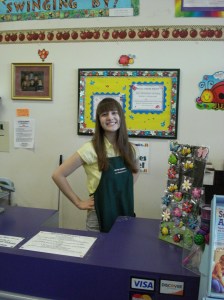
Kyersten has worked at the Home & School Connection for three years. She looks so cute in her little apron! She doesn’t really like to be called “cute” at 19-years-old though. At least… not by her mother. It’s a very cool store. There is one in Hagerstown as well. If you’ve never been, you’ll have to drop by… and at the very least bug Kyersten! They sell some pretty cool things. I almost bought a praying mantis set. They send you some praying mantis eggs and everything! I decided against it when I saw what they ate. How in the heck do you catch aphids for a praying mantis?

Kyersten looking cute in her apron


Denise Portis

© 2009 Hearing Loss Journal