with a positive attitude. Shoulders squared, chin lifted slightly, smile on my face, and oozing one LOUD and focused mantra
BRING IT.
I do this most mornings and have for 32 years. I need my morning pep talks, prayers and inner warrior rehearsal. In 1988, it was done to face the battle and acknowledge I was going Deaf. In 1994, I drank my super hero juice to face being fitted for my first hearing aid. In 1995, it was to gear up to go to the neurologist the day I was told I have Meniere’s disease. In 2005, it was the morning of my cochlear implant surgery, and in 2010 to spend the day in vestibular therapy to learn how to “fall safely” (after concussion #4).
It is August of 2021 and I still wake up each morning and square my shoulders, lift my chin, grin and ooze a “BRING IT” attitude. However, is is 10 AM and I have already cried twice as I struggle to assist and support my mom who was diagnosed with a terminal illness last week. Normally I still have spoons by 8 or 9 PM. (See “The Spoon Theory“). This week I’m spoon-less around 11 AM.
So I woke up this morning…
and reminded myself that sometimes you have to square off, lift your chin, and dig deep even if it is the middle of the day. At 11 AM I haven’t had a renewal of energy after a night’s rest. My spoons haven’t magically reappeared. Instead, of oozing “BRING IT” I’m hoping I can MAKE IT.
Deal with it and move on.
Like many of you, those who are going through things that seem
SO hard
Impossible
Too challenging for any “normal” human being,
just remember that we are resilient creatures. It may be 11 AM and I’m “spoon-less”, but I have siblings who are in this battle to support and fight for mom too. I have children who love me and text me during the day to remind me to take care of myself. I have a peer network at work with people messaging me or texting me several times a week to just remind me that I am thought of and valued. I have my faith to remind me that life is more than the 24 hours I breathe in and breathe out each day.
So I woke up this morning…
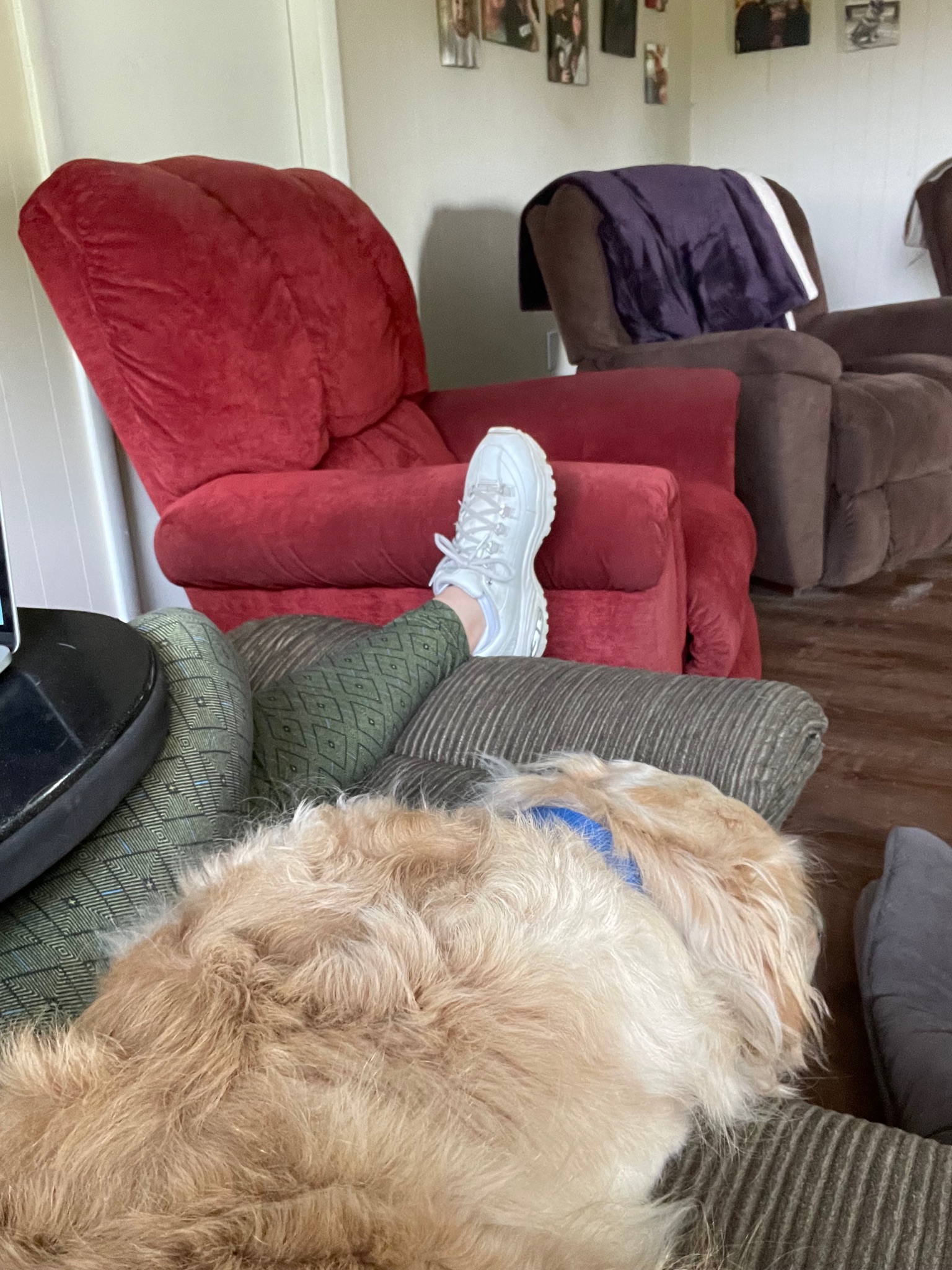
and I am not afraid that this day is already hard. For you see? I’ve had a day implode before and I survived. You can too. For all those who face seemingly insurmountable obstacles, please remember one thing. I may be sitting 5 feet from you like with my precious mother (currently seated at my 10 o’clock with her Shih Tzu, Toby), or 324 miles from the student who emailed me this morning and included a picture she took last night with her older sister in hospice counting down the final hours of kicking Multiple Sclerosis’ ass, (her words), and 3 time zones from my friend in Greece who is battling cancer AGAIN, but we are in this thing called LIFE together.
It isn’t always easy. It isn’t always pretty. It is, however, WORTH IT.
I’m grown-up enough in mind and body to know that today I started my day the same and petered out early. But you see? I know that I will go to bed tonight and sleep well (or poorly), doing so and knowing that my Apple Watch alarm and Golden Retriever, Finn, will wake me at 6 AM. My eyes will pop open and my feet will hit the floor. My first thought will be,
One thing that I try to remind my fellow spoonies is that everything your able-bodied peers experience simply because it is part of living life, they, too, will experience. Just because you have disabilities or chronic conditions, you are not exempt from normal life experiences. Wouldn’t it be great if, as a person with disAbility, you were excused from having routine life crises and problems? It would be great if we could be “off the hook” for things such as:
flu/colds
Covid-19
allergies
caring for aging parents
routine doctor visits
tight finances
broken washing machines
I mean, the list can go on and On and ON! All the stress and busy-ness that abled middle-aged folks experience, we are going to experience as well.
I’ve been under a great deal of stress. I have never handled stress well, though I have certainly found healthier ways to manage it now that I am older. I would go into detail about the types and levels of stress I have been experiencing, but I want to stick with the purpose of this post.
My #3 service dog, Finn, has been a bothersome mammalian velcro doggo. This happens when your stressed partner is taken away by ambulance and is absent for 2 days. Please allow me to provide the embarrassing details:
Wear Your Medic Alert ID
I have four Medic alert bracelets and one Medic alert necklace. On July 15th I was not wearing any of them.
I was experiencing very low energy all day and dealing with typical Meniere’s disease symptoms such as vertigo and dizziness. These are fairly typical symptoms of my disease, especially if you add in stress. I was packing up my bags to spend about 10-14 days with my mom in North Carolina to attend some doctor visits with her. I was also preparing for a face-to-face meeting that evening with my campus Active Minds chapter and had been baking like a fiend all day. I love baking and had planned to bring goodies for everyone to enjoy. Overall, my stress level was “off the charts” from my schedule and from family members experiencing some life-changing crises lately. Bottom line, my stress has been very high for far too long.
I had just zipped my suitcase closed and was getting ready to put make-up on in the bathroom. I had about 15 minutes before I had to leave for my meeting. I realize this is likely TMI for some folks, but if you follow “Hearing Elmo” you know I just tell it like it is and believe in transparency and writing about REAL experiences. I had to pee.
As soon as my bladder was empty my vision went black and within about 30 seconds I couldn’t speak. The right side of my face was in a spasm, my hands were useless and my heart was racing. My first thought was “stroke”. I stood up and screamed as best I could (as I couldn’t speak, remember?). My husband poked his head in the door and after a head-to-toe look, he realized I was experiencing a medical emergency. I managed to push out a garbled “st-ooooke” and he immediately palmed his phone from his pocket and dialed 9-1-1.
I didn’t have my cochlear implant on yet, but I could speech read that he was telling the dispatcher that I was having a probable stroke. At this point, I was still upright but could only shuffle my feet. I was unable to move my hands and arms. My husband stood in the door of the bathroom looking properly scared to death and my only thought was, MY FREAKING PANTS WERE DOWN AROUND MY ANKLES.
I knew I couldn’t articulate that and my terrified husband was distracted with giving particulars to the dispatcher. I kept looking down at my pants while my husband was oblivious to what I thought, was very obvious.
PULL UP MY FREAKING PANTS.
He took my elbow to take me to the living area and I dug my feet in and swung my head in a HARD NOOOOO. He gave me this look like, “What the heck, Denise? Come with me!” With a little bit of SNARK and right back at the sweet, “missing the obvious”, freaked-out male, I ducked my head again to my britches.
PULL UP MY FREAKING PANTS.
Terry finally figured out I wasn’t going to move with my pants around my ankles. (Whew)
After he hitched up my pants, I shuffled to the nearest chair and collapsed. The paramedics arrived within 5 minutes. Pretty impressive if you ask me! The fire department arrived a short time later. Finn was completely freaking out at this point, so Terry locked the dogs in our bedroom and called our son who lives nearby to come and take care of them.
I didn’t have my cochlear implant on my head. I usually put this on last after getting ready to leave. I couldn’t hear any questions being asked (for obvious reasons) and Terry finally figured out my CI was not on my head. He went to the office to dig that out for me. I knew with probable stroke, the medical peeps were going to want to do an MRI. I cannot have MRI’s as I have a magnet in my head. I kept flailing my arm up as best I could and was giving poor Terry the evil eye again. Any blood that was still in his face drained away when he noticed that I didn’t have my medic alert ID on my wrist. He immediately began explaining to the paramedics the issue and making sure everyone knew that I could not have an MRI. As I was being loaded up into the ambulance, internally I kept fussing at myself for being caught without my medic ID. I mean, I preach the importance of this simple yet life-saving piece of jewelry all the time! Here I was having a “come to Jesus” moment about my own hypocrisy in not having my ID on my person. Gah!
Later in the ER and while waiting to be admitted to the hospital, my husband, who prides himself on his corny puns, told me that I literally got caught with my pants down and figuratively did by not having my medic ID on my person. I gave him a wobbly smile but really didn’t find that funny until much later.
I was able to speak and move fairly normally after a few hours, but I was admitted for probable TIA and also had dangerously low potassium. I also had 2 major panic attacks which is never any fun if you have experienced them before. I am a long-time patient with depression and panic disorder, but these two attacks were the worst I have ever experienced.
I’m home now and getting stronger every day. I have a slew of doctor appointments in the next 2 weeks. I guarantee that I will not be caught without my medical ID again. I had never anticipated being completely unable to communicate. If you have disabilities or chronic conditions, wear medic alert ID. In addition to various types of jewelry, there are also QR code options and smart watch technology that will allow medical personnel to immediately access your history during an emergency.
It is always such a joy to provide this platform to guest writers who want to share stories and information about their own life journey as a person with disability and/or chronic conditions. First-person stories are powerful reminders that we are NOT ALONE. There are people all over this country who are working hard to be a positive advocate and world-changer on behalf of people with disability. Today I welcome a long-time friend whom I first met in 2002 at a national conference for people with hearing loss. We shared same age children and parenting with hearing loss.
Debbie Mohney was born with bilateral high frequency hearing loss. She became involved with Hearing Loss Association of America (HLAA) in 1993, and has served as President of the HLAA Boulder Chapter, and currently serves as the Colorado State Chapter Coordinator.
I think you all know that hearing loss is a part of my life and it affects me daily. I fully own my hearing loss, and I do everything I can to work on hearing better. I have overcome obstacles throughout my life, including pushing myself out of my comfort zone so that I can participate in a “normal” life. I also personally try to educate people around me if I can’t “hear or understand” instead of withdrawing. Believe me, this is not always easy to do, I was lucky, I grew up with my hearing loss. Most people suddenly experience hearing loss and don’t have the faintest idea of where to start.
Sometimes, society intentionally throws up roadblocks, by not providing accommodations such as insurance for medically necessary hearing devices, rehabilitation, or outright putting communication responsibility on the person with the hearing loss.
Recently, Zoom became a necessary thing in our society, and many people with hearing loss were left out. Because of advocacy efforts, Zoom added captions to paid accounts, and after advocates cried foul, they have agreed to add captions to all zoom accounts by September 2021. During the pandemic and beyond in our new world, without captions online, many people with hearing loss cannot participate equally in their jobs or join in on webinars, online classes, and other types of online classes.
In my case, I participate in dance classes, and luckily, I have a fair amount of experience and I have bluetooth in my hearing aids that serves me very well, but if I didn’t have these two things already, I would be lost in participating in these classes.
When you have a disability, or your child or family member has a disability, it becomes your personal responsibility to deal with your disability.
What responsibility should society have in dealing with the disabilities of others?
What if it means that someone can have a little bit closer to a normal life, or if accommodating the disability means that someone can support themselves instead of society?
What if accommodating someone with their disability means that they can join in and support others trying to make a living, instead of staying home and not participating at all?
What if the majority of people feel that their daily lives are too complicated to consider accommodating even just one person with a disability?
On February 17-19 I received 2 messages from people I only know through social media. One sent a message through FaceBook, and one sent an email. I thought the short messages were strange but began to piece it all together when I received second messages from both individuals a few days later. I also received a brand new message from someone that I also only knew in a round-about way.
Somewhere, a number of someones, have Lent messed up in their heads and hearts. The third actually only knew me through “Hearing Elmo”. We have probably only communicated three or four times in the eighteen years since I have been blogging. It seems some sort of challenge went out to strive to make a difference in the lives of under-represented, and diverse populations. Notes of encouragement, secret gifts, and words of affirmation were supposedly the goal in brightening the life of a person different than you.
I may be different than you, but y’all? I am plenty BRIGHT. There is just so much wrong with this way of thinking. Let me start with the obvious.
What is Lent?
Lent begins on Ash Wednesday and ends before Easter Sunday. Lent is all about doing WITHOUT. In choosing a sacrifice of some sort, an individual may concentrate on other things that they do not normally spend time doing. Things like meditation, prayer, self-examination, and much more. One can choose to observe Lent by doing without food like Jesus did in His own 40 day fast detailed in three of the gospels (Mark 1:13; Matthew 4:1–11; Luke 4:1–13). In today’s world Lent has become a sacrifice of perhaps “unhealthy foods”, things high in sugar, starches, or choosing to go “alcohol free”. One can also choose to examine what you spend a lot of your life doing and “fasting” from that during Lent. Perhaps that is watching television, or spending time on FaceBook or YouTube. You do not simply “do without”, you replace it with these life-changing new habits. At the end of Lent you may go back to some of things you choose to “do without”, only perhaps with a new mindset and new appreciation for quiet, reflective, purposeful thinking.
What Lent is NOT
Lent is not:
Revealing the underlying and unacknowledged level of PRIVILEGE you have.
Choosing someone to “bless” – someone with whom you never interact with at any other time of year.
Dehumanizing another by making them your project. (A project denotes something that needs work or fixed)
Assuming that your “new focus” is welcomed or necessary for a person you have determined is “in need”.
The fact that one individual who set out to “bless someone who is disabled” (revealed in a flurry of Q&A emails with me trying to determine WHAT THE HECK?) did so by finding me and my email address through this blog. I would love to put it out there for anyone who needs the message that…
I’m OK exactly the way I am.
Oh sure! Like anyone, people with disability, invisible conditions, or other challenges, may certainly appreciate genuine, heartfelt encouragement and affirmation from individuals who have a RELATIONSHIP with us. However, that boost is not given because we have a disability. It’s given because someone loves us and cares about us. It is provided by way of a positive relationship being lived out. Just as unsolicited advice is not welcome from someone you hardly know, unsolicited “feel good messages” are also not welcome.
Please understand that I am not saying you should not do nice things for other people. I simply ask that you be genuine about it. Please don’t make them a project.
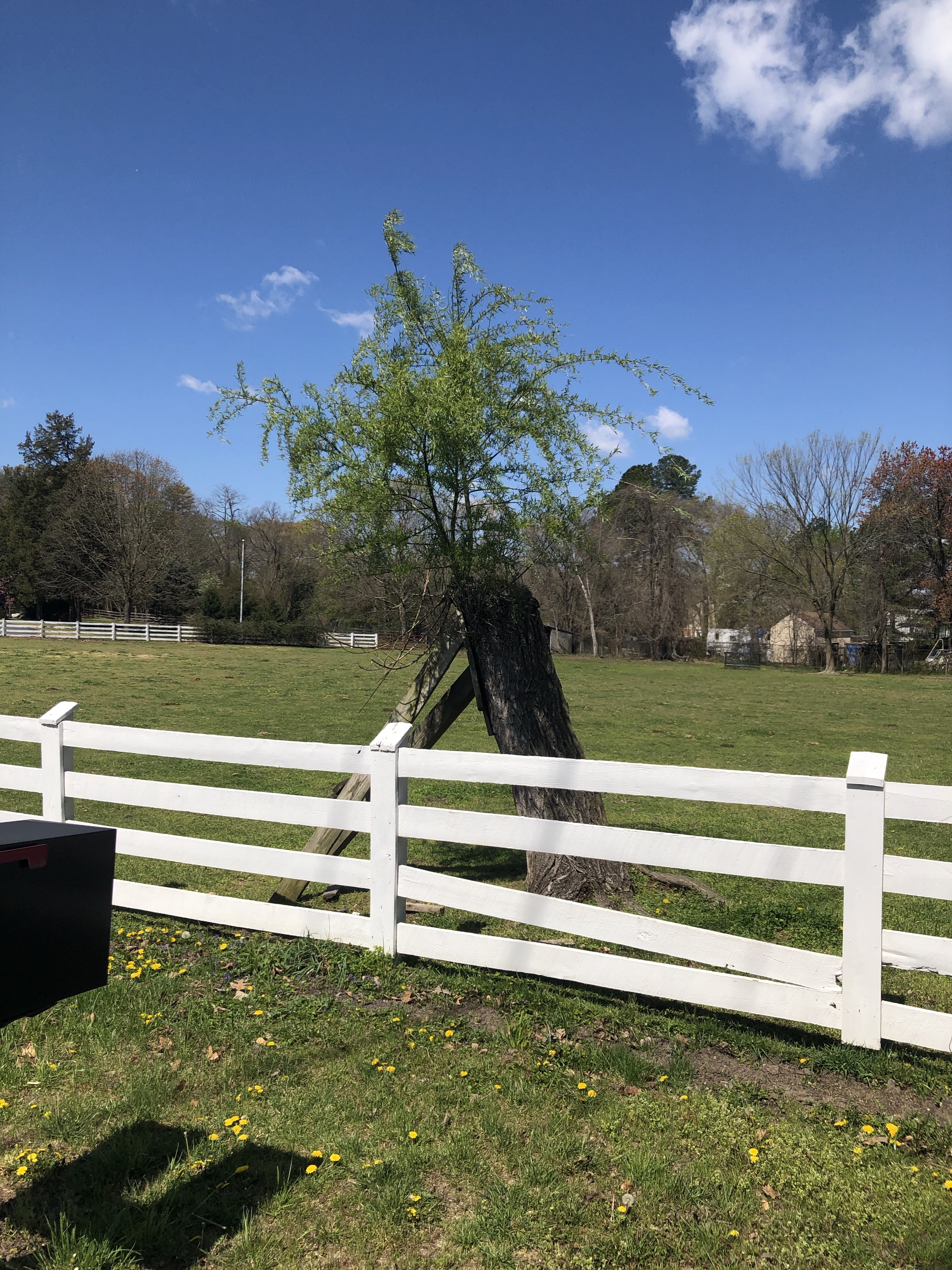
I first saw this Willow tree in “all its glory” when we first moved here in 2015
I really love living in Anne Arundel County. When we first moved to our “forever home” in 2015 (worthy of this auspicious title because we finally found an affordable and accessible home), this Willow tree was huge! Located on a nearby farm that I drove by every single day, this tree shaded a large area of pasture that 10-15 cows called home. You can tell by the size of the original trunk how massive this tree was in its prime.
I do not know if my admiration and affection stemmed from the fact the tree was simply beautiful, or that it bordered this idyllic version of a small farm reminding me of my childhood. Regardless, I became really attached to this tree. I passed it on the way to work and on the way home from work. It was hard not to get distracted by which cow or calf was scratching its bovine butt or shoulder on the trunk of this tree as I drove by each day.
One day I noticed that the owners had added some wooden supports on one side. I had noticed the tree had a slight “lean” to it all along and was curious about the farmer’s attempt to provide assistance against the “lean”. After twenty minutes of “googling” Weeping Willow trees, I discovered that their shallow root system can mean a tree can be at risk in high wind areas or areas with high water tables. I was actually surprised the farmer chose to do this as the effort provided support, but certainly was not aesthetically pleasing. It was the only provisional shade in the pasture, so perhaps the owners sought to prevent a problem before it happened. In this way, the farmer insured necessary relief from the heat of the day for the small herd.
Wouldn’t ya know, last Fall “something” happened to this tree. I didn’t see it happen so could only guess as the trunk was split and the vast majority of the tree lay in pieces on the ground. It made me very sad. Don’t ask me why, but I was a little weepy about the broken Weeping Willow! Over the next week I noticed branches being cut and hauled away. I was surprised to see the core trunk of this once stately giant with graceful crown of “weeping” branches still intact. In fact, it continued to be supported.
I like to think this survivor tree held some kind of sentimental value to the farmers. Perhaps it was a more pragmatic reason such as Willows grow quickly and it provided necessary shade to protect the cattle on a day with unforgiving heat and humidity. Still, I prefer thinking it was for heartfelt reasons they chose to do what they could for this “little engine that could” tree.
I watched all winter. Each day I drove by and thought this tree is DEAD and DONE. Much to my surprise, this Spring the tree began to grow again. It looks a little awkward and perhaps even unsightly with the obvious man-made supports in place. Yet it sprouted new branches with blooms and then leaves. I have a feeling this tree is going to surprise us all.
Anne Arundel Community College, like other schools nationwide, was forced to move all instructions online this Spring. Is it because I’m late-deafened that I really prefer interacting with my students face-to-face? Maybe. I know plenty of instructors with normal hearing that were dismayed by the daunting task of providing an engaging learning environment.
Many teachers provide a little blurb in their syllabus and perhaps a “3 minute mention” about accessible options, assistance and supports, and disAbility services. I realize it is likely because my heart beats within the chest of someone who lives with disAbilities and chronic conditions, but to me the issue should not be mentioned once and then never again. For one thing, there are numerous conditions that do not classify as a disability yet students still benefit from support. There are mental health diagnosis and physical chronic conditions that may make it difficult for a student to be “all in” during classes.
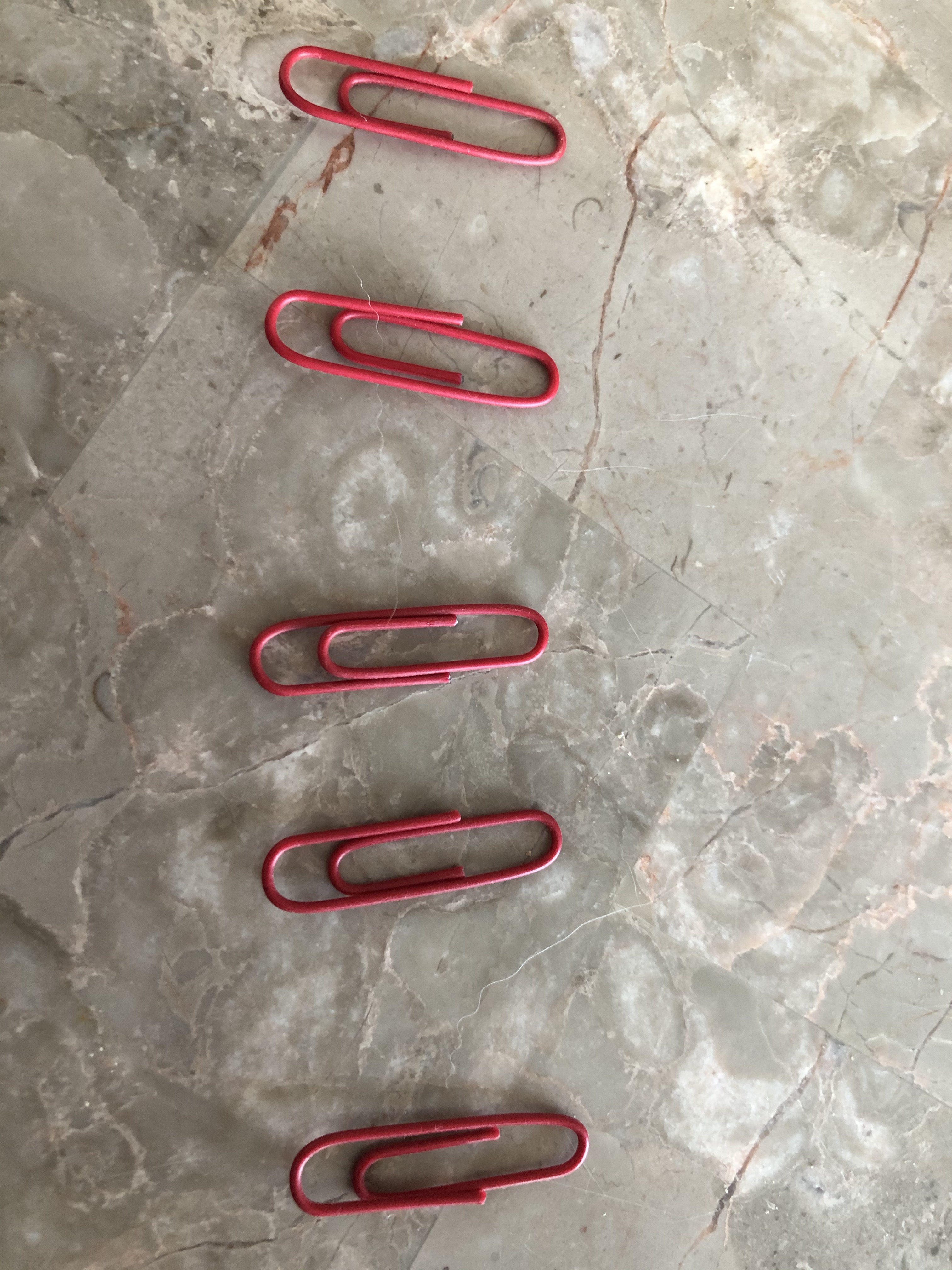
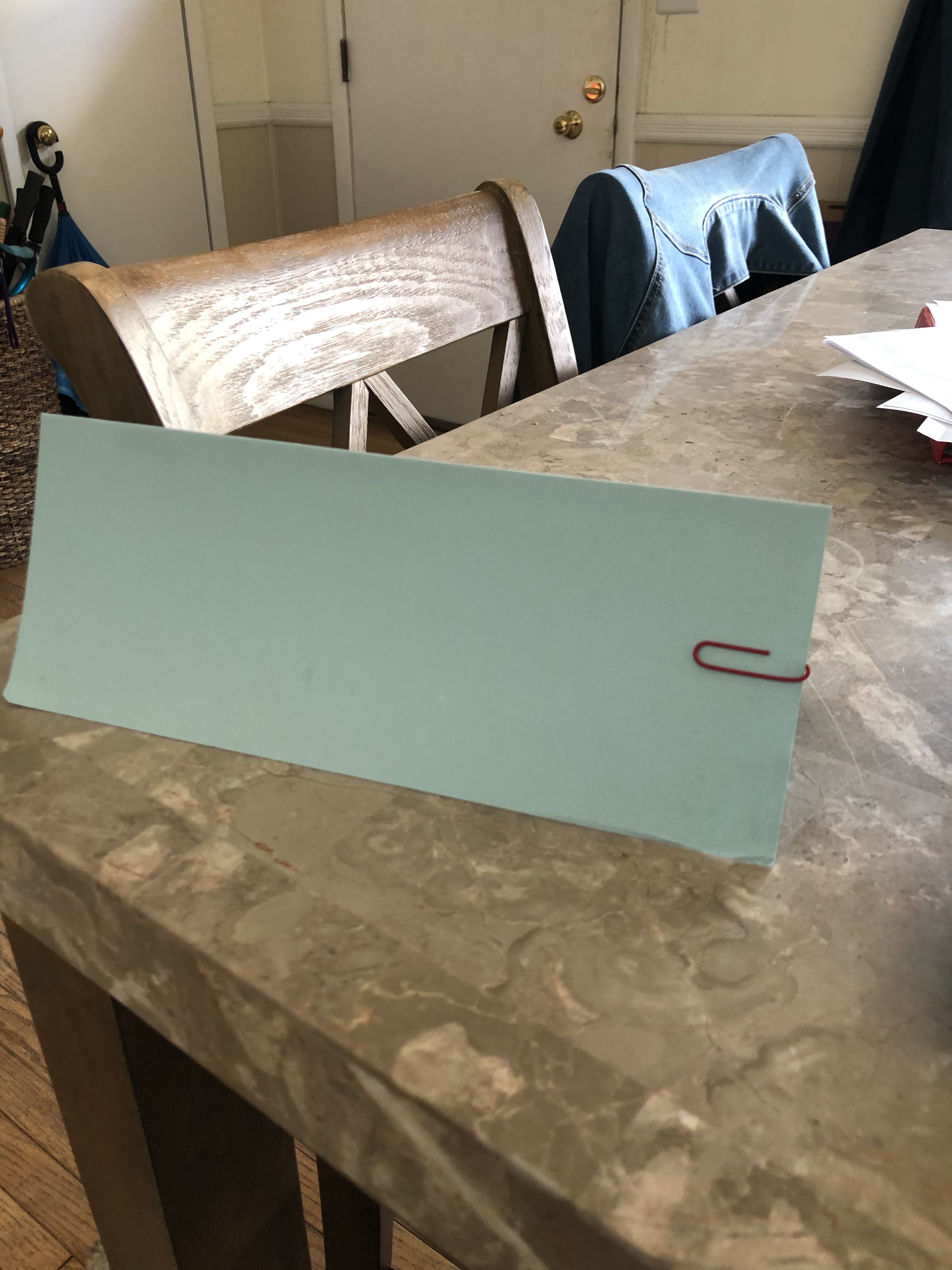
This is why I talk about it… WEEKLY. I remind students to come to me if they need support. Perhaps they need a face-to-face meet in my office. After quarantine, it may mean they needed a Zoom call so that they could talk. Prior to the social isolation restrictions in place, I used the ‘RED PAPERCLIP‘ system. My students have nameplates that they toss in a folder at the end of class. If the red paper clip on the back of their name plate was moved to the top, I contacted them via email and we set up a “text meet”, office hours conference, or FaceTime call.
After Spring break turned into a 3-week long, panic-filled transition period for instructors, I thought long and hard about what to do in place of my “RED PAPERCLIP‘ system so that students could still let me know they needed my support for something. These “somethings” included things like:
A 2-3 day extension on a due date
A pep-talk
A listening ear
Further information about the details of a project if the written instructions alone were not enough
Resources and/or connections to virtual mental health practitioners (I’m a teaching psychologist and not a counseling psychologist).
Resources for food, shelter, etc.
Advice and discussion about transfer decisions
Extra credit opportunities
AND MUCH MORE
So what to do if I didn’t have nameplates turned in after class and a visual check of red paperclips? Mid-semester I could only come up with staying in close contact (every couple of days) via email, reminding them of my availability and desire to assist. Do you know during the last 8 weeks of the semester, I received a half dozen texts from students who only sent a picture of a red paperclip? I received OVER a dozen emails from students with “red paperclip” in the subject line of their email. It made me smile. Well… it was a weepy smile, but a smile nonetheless.
For whatever reason, the farmer down the road from me, decided to support this willow tree. Will it ever be self-supporting again? I can’t answer that. Yet with support, this weeping willow provides something needed and necessary to a small herd of cattle. It is growing back quickly. Who knows what it will look like next year? Perhaps it provides some sentimental value to the owner as well. What I can tell you is that without the man-made supports in place, this tree wouldn’t have had a chance at a comeback.
My students know that I get “having a bad day”. I don’t allow them to abuse it but they know they can email me for some additional supports or “course grace”. I am also very transparent about my own good days, bad days, and having to push through ON a bad day. You see? I want to model good self-care. I also want to model the strength required to ask for assistance. Heck, I am “fiercely independent” using cochlear implant, captioning apps, service dog, and cane. However, I have learned there is no shame in asking for assistance. In fact, there is strength in asking for assistance and support.
Do you have people in your life right now who need support? If you don’t, you aren’t looking. We all need some support at different times in our lives. It may be a small “help”, but it can mean the world to someone at a time in their life when they just “need a little something”. I also encourage you to learn to ask for support. I assume many of you who are long-time readers of “Hearing Elmo” have disabilities or chronic conditions. Having extra challenges doesn’t mean you aren’t capable of helping others. It also means that you may need a little support from time to time. Learning to ask in a cheerful, matter-of-fact way goes a long way in positive advocacy. I have learned that many friends, colleagues and even total strangers do not know HOW I need support unless I inform them. It may sound like:
“Excuse me, could you pick up that credit card that I dropped? My service dog has trouble with that unless it is on carpet”.
“The automatic door button doesn’t seem to be working. Could you open and hold the door for me?”
“My fingers are particularly numb today. Do you mind picking up the papers at the end of each row?”
“The elevator in this building is not working today. Can you walk a few steps in front of me as I descend?” (Finn, my service dog, does all the work. However, I need a visual peripheral block to keep from feeling wobbly).
“Can you talk into my phone so my app can caption your voice? There is so much background noise in here I cannot hear you”
“Do you mind carrying my tray from the register to a table? With leash and rolling bag in hand, I cannot manage carrying that safely”.
I have never NOT had someone willing to help.
So keep an eye out for leaning willow trees. Pay attention to any “red paperclips” on the face of or in the body language of someone you meet. In small (and sometimes large) ways, we can make a difference.
Along with the rest of the country (and even the world), my family and I, co-workers, support groups, and community committees are living in the midst of a pandemic. This will be recorded and documented in history books written in the near and distant future. As a 53 yo, I thought Columbine and 9-11 were my life’s quota of “history making” events. I kinda hate that I’m wrong.
As an introvert, staying, working and living at home was not hard for me… in the beginning. As a woman with disAbilities, I also had a solid connection to virtual and online support groups and communities. I am blessed to have access to various technologies and WiFi, plus a husband and adult son at home that are as nerdy as a techie-illiterate could hope for.
I like to read, write, and engage in other creative activities. I have two puppies and four dogs total at home, so lots of fur family members to love on and cuddle. Imagine my surprise that I’m feeling isolated and alone. Imagine my surprise when making a quick trip to the grocery store yesterday, with mask on and service dog in heel, to be almost knocked on my butt by the change in – well, EVERYONE and EVERYTHING.
First there was very little traffic. It was surreal. Second, the store was not very crowded and everyone I met had a mask, bandana or scarf over their face. Everyone was very nice in almost, exaggerated, “OMG I haven’t seen another adult-speaking person in six days” kind of way. Several people commented on Finn and his calm ability to pick up my dropped items (yours truly averaging 2-3 an aisle as I was particularly clumsy yesterday). I saw a lot of reminders on computer-generated signs that purchases were limited to 2 per “kind”. I found toilet paper and was super thrilled with my off-brand purchase as I was down to a couple of rolls.
Third, I felt a little anxious and motivated to move quickly and not dawdle. It was disconcerting the anxiety of “rushing” that I felt. I kept thinking “I need to get home and disinfect everything”.
Even though I got out of the house for about 30 minutes, this introvert was still hurting for human contact and connection. Since this is really out of character for me, having loved my “me time” so much in the past, I had to contemplate this lack of peace I felt for being in my favorite place. After all, I’m not isolated completely, with plenty of daily contact with co-workers, friends, and family. I think my unease is that this forced isolation and limited contact is for such a serious reason. People are dying. The numbers are just staggering, both those we have already lost to the numbers the infectious disease models are predicting.
One thing I thought about that encouraged me was how capable we in the disAbility community are for such a time as this. Think about it! We are experts at adapting and coping. We have already learned to invest ourselves in the plethora of virtual and online supports which are accessible to us when many face-to-face venues are NOT.
Folks? We, the disAbility community, should be leading the charge in encouraging others, promoting positivity, prioritizing connection. and spreading a CAN DO attitude like a contagion. If ever there was a time for us to shine, it is now.
I hope you are well. I hope you are staying connected. I hope that you know that #YourLifeMatters and that you can lead during such a time as this. Go make a difference! I believe in you!
Words matter. As I have aged (and hopefully matured) the discovery of what we say and how we say it has evolved as I have learned to communicate with focused intent.
As a person with hearing loss, a typical response for me after you first say something ranges from:
Sorry? (or I’m sorry)
Pardon?
HUH?
My mama raised me to be polite I suppose. However, I have lived with acquired disability nearly twice as long as I did with “normal” hearing and “normal” balance. Even people with a normal range of hearing for their age may respond with an “I’m sorry? What was that?” if they miss something in an overly noisy room. Because I am more likely to miss what was said or miss the context and fully understand what was said, I am more likely to use these phrases.
After some length of time living with these ingrained habitual responses, I realized how it was actually making me FEEL. I’m all about good manners. I noticed that I was having to say, “I’m sorry?” so much that I was a really, REALLY sorry individual. I also realized that I had nothing to apologize for when I said it. More importantly, it served no purpose. Heck, I give workshops on how to convey to someone you didn’t hear what they were saying.
It is best to educate and advocate. Don’t complain or apologize. I am best served by responding in one of the following ways:
“I did not hear most of that because of the background noise in here. Would you repeat that please?” (Maybe even suggest a quieter location)
“I heard you say, “ya-da yada”, but missed the last part”. (Obviously we can fill in the yada with what you actually heard).
Beware of your volume. Be careful not to “guess”. After all, you are trying to educate folks that pieces of their sentence was lost but not EVERYTHING they said was.
My husband once said to me in a crowded room, “I will see you later. Plan on dinner at six?”
I heard, “… see… later. Dinner and sex?”
YES PLEASE.
When you become more proactive about what you heard and did not hear, you can also suggest synonyms. When my kids were in elementary school, they would joke that they knew more synonyms than anyone else. Having been to all of those hearing loss conferences (thanks HLAA) they learned that if your loved one was having trouble understanding all you said, throw out some different key words. It may end up being a consonant blend they have no trouble hearing at all!
“Grandma called this morning and asked you to call back when you can”.
“What?”
“I spoke to Grandma this morning. Be sure to call her back tonight!”
I hope you do not misunderstand the purpose of this post. There is nothing wrong with being polite. There is everything right about letting someone know you did not hear them.
– – – – – – – – –
Let me quickly chase a rabbit here and insert that faking that you can hear is much different than faking you are listening. The latter may result in hurt feelings or a punch in the arm. To fake that you heard someone has heftier consequences.
– – – – – – – – – –
What matters is letting them know you did not hear them in the right way. Our age-old habits of apologizing do not fix the problem. You are more likely to encounter people who are tired of repeating something, or start to do so LOUDLY. This only distorts the words making it even harder to understand.
By suggesting a quieter place to go, explaining you may do better with a different choice of words that can be understood in context better, or repeating the part you DID hear so that they don’t have to repeat everything can go a long way to better communication.
Depending on the environment, some other great options to take the place of constantly apologizing are:
If in the car, suggest turning the radio and/or music off so that your ears do not have to compete with their voice.
Ask to step into a building so the acoustics assist you in catching more of what they said to you. Outside, voices can D r… i f… t… a way…
If you know them well enough, ask them to ditch the gum 🙂
Make sure by word and deed that the problem is not something you should apologize for as no one did anything wrong. They didn’t either – so work on making sure they do not think you are criticizing them.
Do not let others say, I will tell you later. They won’t. If you hear this, let them know you will be following up by email to discover what they said because it is important to you.
If you see a conversation going sideways and frustration is evident on the face on the person you are speaking to, ask for an email. Explain you simply cannot hear them in this environment and that you ask they follow-up with a text or an email. Assure them you want to respond as needed.
Gotta say, I’m so grateful for being late-deafened in 2019.
I realize much of the reason I am grateful is that I have access to a great number of “first world technology”. I “hear again” with a cochlear implant. I have apps that caption speakers if they are within 6-10 feet of me. My hearing aid and cochlear implant are bluetooth compatible so (for example) using the GPS in my car, Siri tells me where to go (ahem) in my own head and it doesn’t bother anyone else in the car.
I have super cool devices to clean, dry, and care for all my hearing assistive technology. I have volume controls, fire alarms with strobes, and captioning on my television. I speech read at about 45-47% accuracy (which is actually pretty high but I credit it to teaching others how to do so in workshops, etc.). I can make doctor appointments online, and my home phone (Google voice) sends me an email transcription of every message left. I text like a pro and rarely have to knuckle down and actually phone anyone. My calendar and alerts sinc with my Apple Watch so my whole wrist vibrates when I need a reminder. I can order online, bank online, and renew my service dog’s insurance online. I definitely live in the right day and time, in a first world country, where even “middle class” I enjoy a host of perks that make being late-deafened, not so very bad.
Do you know the #1 pet peeve that happens to be very low tech and low cost, is the fact that no one wants to use a microphone?
I do pretty well in groups of 10-15 or less, sitting around a table so that I can see everyone, and everyone is polite and speaks one at a time. Put me in a room with more people than that, or people sitting in rows and spread out, and I really struggle. I may get 50% of what is said. You might be thinking “what does that mean?”. Please allow me to clue you in.
50% doesn’t mean in a 40 minute presentation or workshop that I received and understood the first 20 minutes.
This means that I get very little take-away. If I’m hearing 50% of what is being said while it is being presented and spoken, I am actually missing much more than that because of lost comprehension. Think about it this way.
If I read aloud a paragraph to you and dropped 50% of the words randomly, would you understand ANY of the paragraph at all? Even if you are hearing 50% of the words, you’ve lost the context and have very little understanding of what I just read.
2. 50% means my frustration level is high and my fatigue has ruined me for the rest of the day.
If I could burn calories by struggling to hear, comprehend, and communicate effectively, I could eat whatever I want, whenever I want, and never work out for the rest of my life. When you tack on the fact that my primary issue is a balance disorder and not the hearing loss, when the latter contributes to fatigue this increases my chances for wobbles and for falls. I have left meetings where people refuse a microphone and seriously put myself in jeopardy the remainder of the day because my brain became mush.
3. 50% means more work for other people.
I work at a college and am a valued member of the psychology department in spite of my adjunct status. After meetings or workshops where I get my 50%, I have never EVER been turned down by colleagues after requesting a follow-up email with a copy of the PowerPoint they used, a summary of their talk with major points highlighted, and any pertinent questions asked by others (that I didn’t hear at all) and responses given. I work with good people. People who care, who are inclusive, and frankly are all about social justice issues like accessibility.
So… if people were simply using the freaking microphone:
My comprehension goes to 80-90%
I expend the same amount of energy a hearing-abled person expends to attend a meeting or workshop.
No one feels compelled to send me copious notes about what they just covered.
I am included… not just in the meeting, but because I will be hearing questions and responses from the floor. I will feel comfortable speaking myself because I know what is going on in the meeting.
Other people with “normal” hearing, actually hear better. Speakers who use microphones are more likely to face the room/audience, speak more clearly, and not cover their mouth or faces with hands, fliers, etc. (Tidwell, 2004).
Having experienced good hearing/comprehension environments, imagine my frustration when I cannot hear and there is a microphone available that someone refuses to use. I have had workshop speakers decline microphone use, college presidents and vice-presidents, and TFO constituents. I have experienced county executives, politicians, pastors, graduate and residency doctor/teachers refuse to use the microphone. From the perspective of someone with hearing loss, this hurts y’all. It also pisses me off. (Jus’ sayin’)
“My voice carries, so I’m not going to use this” (points to microphone).
“I walk around a lot so I’m not going to use the microphone. I have a loud voice” (Note: most microphones are mobile).
“Can everyone hear me? I have a big voice. I’m not going to use the microphone… because everyone can hear me, right?” (while ignoring my wildly gestured hand-waving negating their statement).
Folks, volume ≠ communicating well. Raising your voice (your volume level) distorts your voice (Ardon, 2019). If you use a microphone and use a normal tone and volume because the microphone is doing the work, your words are understood by more people. The quality of your speech improves when using a microphone. You aren’t having to remind yourself to “speak up” so the people in the back of the room can hear you.
This post isn’t about any frustration about not hearing well when a microphone is NOT present. (Although as I continue positive advocacy, I work to have more and more microphones available in meeting and workshop venues). I simply want to remind folks to use the microphone when it IS THERE and IS AVAILABLE. Not using it tells me that I don’t matter… that anyone with any level of hearing loss doesn’t matter. (NIDCD reports that 15% of all Americans over the age of 18 have hearing loss. That number goes way up if your audience is 40 years old and up) (NIDCD, 2019). Even in small meetings, the number of people who benefit from a microphone in use goes way up. Present are people with hearing loss, auditory processing issues, ADHD, and folks who do not speak English as their first language. Please… use the microphone.
For all of us who want to be included, thank you in advance.
My granddaughter Samantha Jean just turned two-years-old. Samantha is at the stage where she has opinions and expresses those opinions. These opinions vary from what she wants to wear today, to what she wants to eat, to what she wants to DO, and what she wants you to do. She is just full of opinions. She also is very independent already.
“I do it!” After caring for her a couple of weeks while mama was in the hospital having her baby brother (rather early), this phrase quickly made its way to “Samantha’s Favorite Words” list.
I had to learn to let her do it, even if I wasn’t happy with the results when she was finished. Thankfully, since she is only 2, I was able to distract her to “fix it” or wait until she moved on to another activity and straighten, organize, or re-do the activity to my satisfaction.
(Yeah. I’m a little OCD and a bit of a control freak!)
What I love about Samantha, is that unlike many two-year-olds, if she was NOT able to do something she rarely had a meltdown about it. I was amazed at the first time she asked me for “halp”, and graciously stepped aside to let me do it.
I heard these requests for “halp” for numerous things:
When trying to stick her head through an arm hole instead of the one designated for her – ahem – HEAD,
When trying to get blueberries to stay on her spoon,
When trying to safely navigate the steps on the back porch which were a bit too much for such short legs,
When her train rolled to where she couldn’t reach it underneath the buffet,
When trying to read a book,
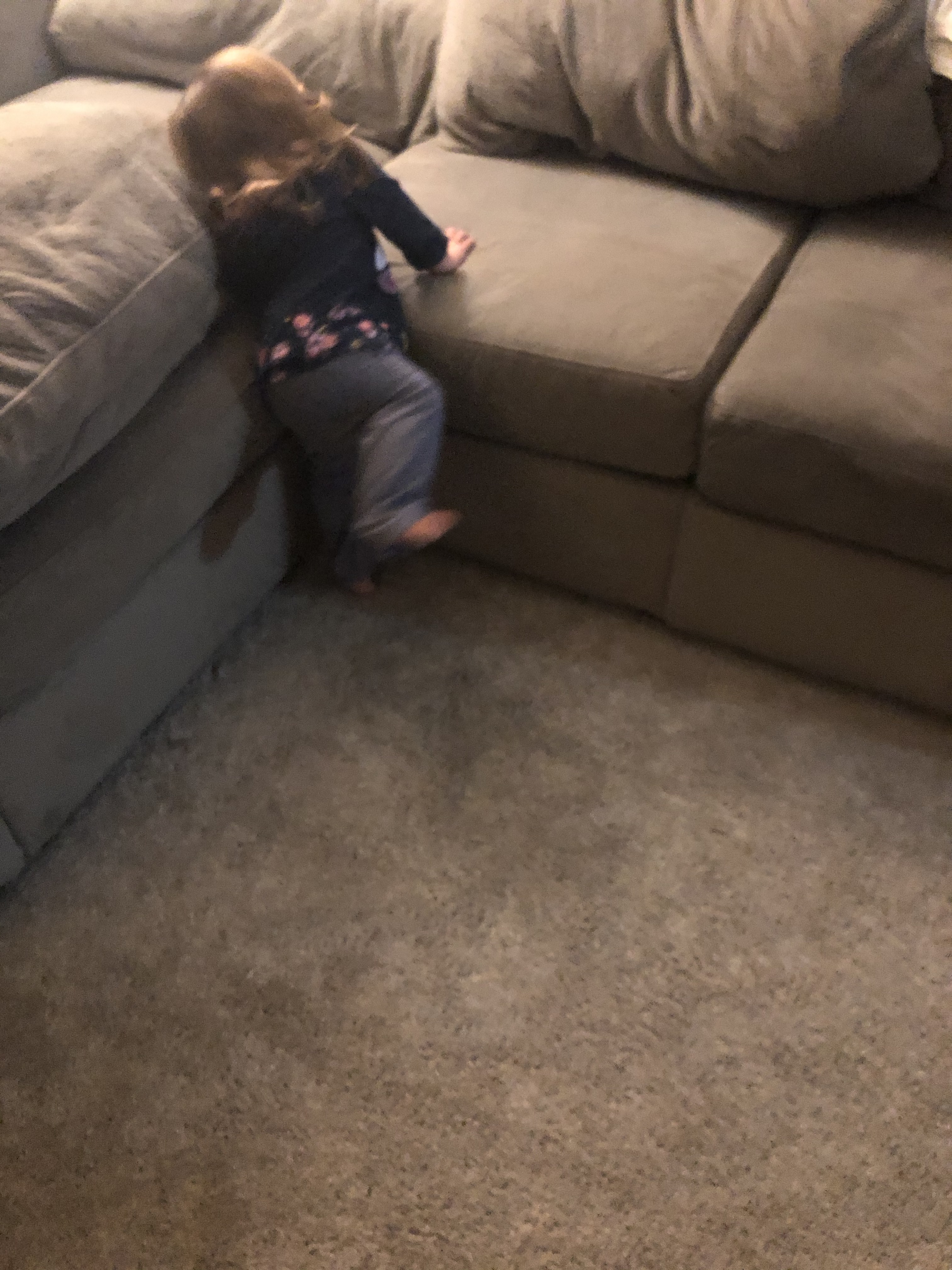
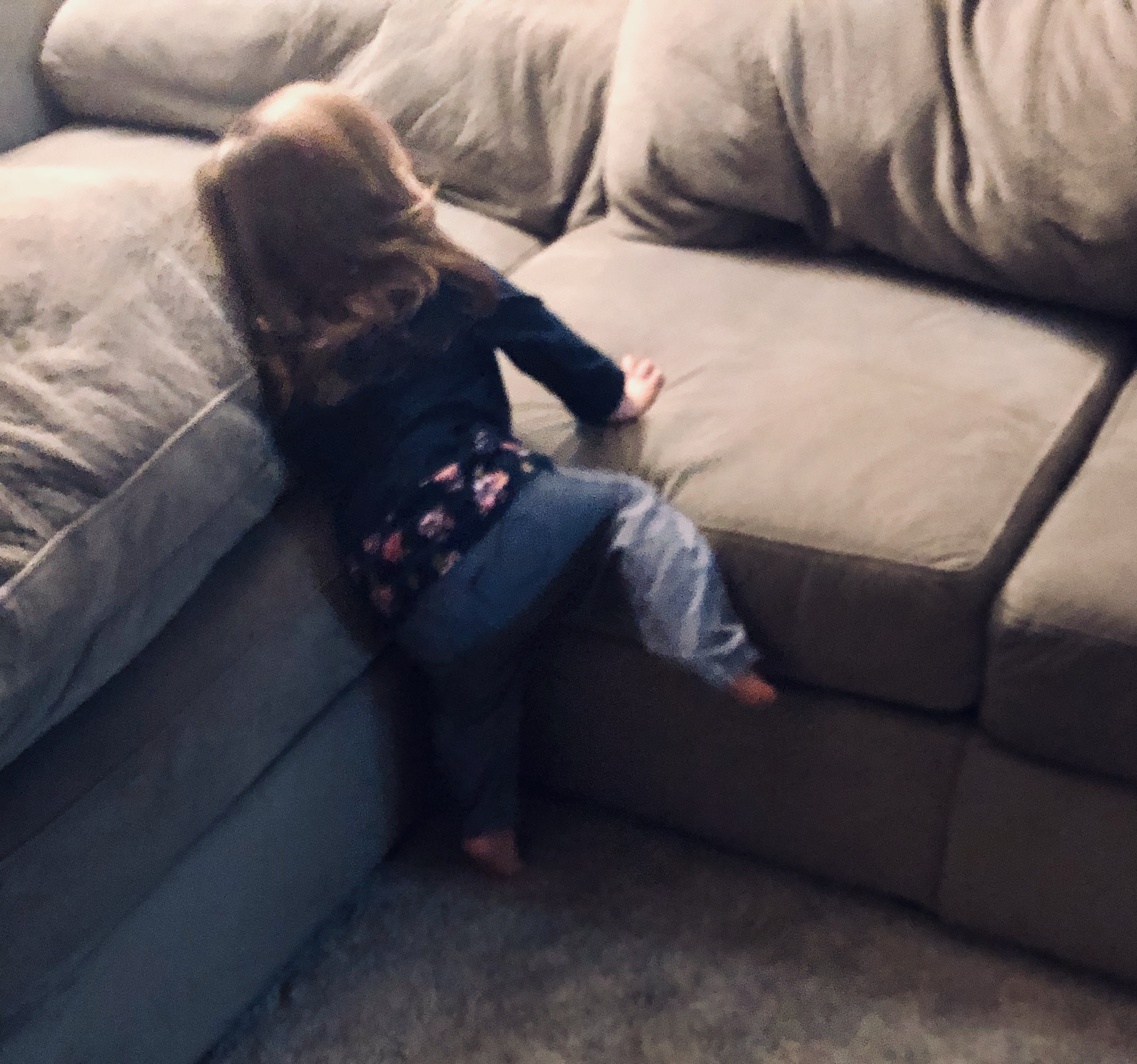
When trying to get up on some of the furniture, (see photos)
Sometimes Samantha would ingeniously choose a way to do something differently so that she could stay independent in the activity. For example, if there was something for her nearby she could use as a means of boosting herself up on tall furniture, she might drag that toy or bench close to use it to navigate her destination without “halp”.
She cannot manage “Grandma” yet so she calls me “Geegay”. I figure she will get there so I think the latter is awfully darn CUTE. I loved hearing Samantha say, “HALP, Geegay!” throughout the day. She more often did things without assistance, but never hesitated to ask for help should she:
Figure out she really did need it to accomplish what she wanted to do.
Was too tired to find an accessible means to accomplish it on her own, or the effort wasn’t worth the “gain”.
I had to admit while living with her, I saw the lesson to be learned again and again.
Stubborn People with disABILITY
I realized the other day that I have lived with disABILITY longer than I have lived without. The feeling was strange since I had simply shouldered new challenges and practiced “keep on keepin’ on” while aging. People with disABILITY (congenital or acquired) often find that as they age, accommodations that were once enough to give them access to an activity or opportunity, no longer are enough. Perhaps even accessibility tools, electronics, devices, etc., may have once allowed you to be independent in a task but as you age you find those things are not enough to be completely independent.
My life with a disABILITY started at the age of 6 with a traumatic brain injury, broken bones, and destroyed hearing in the left ear. After a long recovery, I never felt like a person with a disABILITY until about the age of 18 when my hearing loss became bilaterally progressive. I eventually acquired Meniere’s disease (a vestibular disorder) and really began identifying as a person with a disABILITY at the age of 26 or 27.
I have a good friend who describes herself as “bilaterally hearing-impaired”. Because we are both currently training our third service dog and work at the same place, we often train together. One thing I love about hanging out with Jessica is that she always asks if she can do something for me. Whether it is to get the door for me, pick up something I’ve dropped, carry something for me, etc., she always asks first. She doesn’t assume I want her help, she thinks to ask first in the event her assumption I need it is unwanted or not needed.
Sometimes I say, “actually Finn has been working on door buttons, let us see if he will get this door open for us”. Perhaps the item I dropped is something my Golden puppy can safely work on his retrieve and get for me, so I will let her know that Finn and I have “got it handled” and no “halp” is needed. After training together for some time, Jessica once replied to my “no thanks we’ve got this” with a very thoughtful reminder.
“No problem. However, we know each other well enough now that I trust you to let me know when you need help and that you will ask for that help”.
The first time she interjected this reminder, I found myself thinking about it the rest of the day. Can you guess why? It is simple really. People with disABILITY can be pretty stubborn, and never ask for “halp” when they really need it. We can even earn the reputation of being ornery about our refusal; ungracious in both word and attitude.
In my early adult years of learning to live with deafness and balance issues, I adopted a rather unattractive and even dangerous attitude of “I am woman. Hear me roar!” This could be interpreted as, “I don’t need help. Leave me be. I’ve got this. Don’t you dare pity me!”
The only reason I can think of that I acted with such vehement, even arrogant refusal is that I didn’t want people to pity me. I also did not want them to think that I was UNable rather than differently-abled. I think that all changed for me when I realized how it made ME FEEL when I asked to assist someone who needed my “halp” and they refused. After realizing I felt “robbed” and even hurt when denied the opportunity to help someone that I cared about who obviously needed my “halp”, I started re-thinking my own stubborn refusals.
I have lived with the assistance of 3 service dogs now. Even so, there are things my canine partner cannot do for me, or cannot do SAFELY on my behalf. I have learned to ask for “halp”.
I have never, EVER been turned down. Even should I ask the most cantankerous-looking curmudgeon in the aisle at the grocery store to get the 32-ounce can of turnip greens on the bottom shelf because a) I can’t bend down and get it, and b) the circumference is to large for my Golden’s mouth, I have never been told NO when asking for “halp”. (Hey we love our turnip greens in this house! I lived in the South a loooooong time).
Solutions to World Problems
Surely a solution to the world’s problems is to simply be kind to others. We all know that isn’t going to be the norm, however. Still, individually we can do our part and hope (even pray) for a ripple effect.
In every way that YOU can, make a difference.
If someone needs it, “HALP” them. Do it with a smile and without conditions. Do so easily, readily, and without any need for acknowledgement. Be the kind of person who so naturally sees a need and meets that need that it becomes who you are and not what you do.
But…
It is always good to ask. Never assume that someone who appears to need help, wants your help. Maybe they have some assistive device that will allow them to pick up that item without “halp”. They want to be independent.
BUT…
Don’t be a stubborn jackass. If you need “halp”, ASK. If someone asks if they can “halp” and you simply need a few minutes to do it yourself, explain that graciously. Don’t become haughty and retaliate with angry words and threats about where you are gonna hit them with your cane. Don’t tell them what to do with their request to “halp”. (Ahem)
Necessary Reminder
May I share something with you that you already know?
Even able-bodied people need “halp” sometimes. Whether it is assistance with a task, or a needed hug at a low moment, all of us need each other. The next time you need assistance for “halp”, just ASK already!
Even my two-year-old granddaughter will ask for my help when she knows she needs it. She even does so when she recognizes that she can do the task, but that it will get done quicker and with less effort if she simply asked for HALP.
Pogosyan (2018) provides multiple reasons why we should be willing to help and accept help from others. “Research has found many examples of how doing good, in ways big or small, not only feels good, but also does us good” (para. 2). So in closing, I would like to remind you (and yes myself as well) that disallowing someone to assist actually robs them of the benefit gained from that help.
Pogosyan goes on to explain that, “One reason behind the positive feelings associated with helping others is that being pro-social reinforces our sense of relatedness to others, thus helping us meet our most basic psychological needs” (Pogosyan, 2018, para. 1). In a very powerful way, it supports our need for EACH OTHER.
I’m starting to think this world is just a place for us to learn that we need each other more than we want to admit. – Richelle E. Goodrich
Our greatness has always come from people who expect nothing and take nothing for granted – folks who work hard for what they have, then reach back and help others after them. – Michelle Obama
I love teaching at Anne Arundel Community College! As much as I DO love it, I also enjoy investing myself in students by advising two student clubs. You get to know students on another level when you are getting to know them through a club or organization that they are passionate about. One, Active Minds, is not only a student club but also a chapter of the national organization. If any place should support suicide prevention and help to erase the stigma of mental health issues, it should be a college campus.
I know many of Hearing Elmo’s readers do NOT attend college. Yet within the disability community, we still need to remind folks that YOUR VOICE MATTERS.
So many times people with disability or chronic illnesses think they are without purpose or feel they have any real avenue in which they can make a difference. Many with disability have transportation issues and are often locked within boundaries that feel pretty darn oppressive.
This population is actually at greater risk for suicidal ideation (Disabled world, 2017) compared to the US population as a whole.
Quality of life certainly plays a role in the danger of suicide in those living with disability. However, it is more than the symptoms we struggle to manage. Isolation, stigma, finances (e.g. fighting for SSDI), fatigue, hopelessness and co-morbid mental health diagnosis all contribute.
Y’all? I’ve been there. Please… don’t give up. The fight is worth the cost of “keeping on” simply because YOU are worthwhile. You may feel as if you have no voice. You do! The internet has actually made it easier than ever to find and use your voice. Sometimes finding a place to plug in and BE HEARD, makes all the difference. Here are just a few ways:
1. Start an online or face-to-face support group.
See what your county has already available and get involved.
Use one of the numerous website and virtual group options and connect. FaceBook has a user friendly way of starting online groups.
Hang posters, ask your doctor to let other patients know, see your library personnel to find both meeting places and avenues of advertising.
2. Start a blog or vlog.
The disAbility community is alive and well on the Internet. You will be surprised how quickly you will have followers, and it is easy to find other bloggers who share many of your challenges.
3. Create.
Are you an artist? Musician? Writer? Love crafts? Use your talents to spread awareness about living with disability.
4. Volunteer.
You would be surprised how many volunteer opportunities are available where you live. Put Google to work for you, and discover what the options are. Sometimes a reason for living, is simply doing something that makes a difference in others.
As a deaf person, I count myself lucky and blessed to “hear again” with cochlear implant technology. Yet the silence is LOUD, even deafening, when someone makes the choice to stop fighting and checks out.
I get it. This life is hard. However, your voice matters… likely to more people than you think. At the very least it matters to me.
Journal: <i>Disabled World</i>. Language: English. Author: Thomas C. Weiss. Electronic Publication Date: 2015/06/14. Last Revised Date: 2017/02/13. Reference Title: “<i>People with Disabilities and Suicide Awareness</i>”, Source: <a href=”https://www.disabled-world.com/disability/awareness/suicide.php”>People with Disabilities and Suicide Awareness</a>. Abstract: Disability in relation to suicide is something that is very hard to find statistics on and it is not a new phenomenon. Retrieved 2019-08-27, from https://www.disabled-world.com/disability/awareness/suicide.php – Reference Category Number: DW#118-11443.




 Hearing Elmo