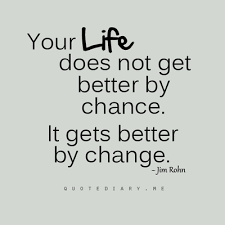
Polygamy and Practice

polygamy and practice

Do you know how many times polygamy has cropped up in my conversations? It’s super easy for me to hazard a guess because I have NEVER had a conversation about polygamy. I don’t watch “Sister Wives”, and know very few Mormons (and those I do – do not practice polygamy). So why… WHY would I bring the word up in a chance encounter? *shaking my head at myself*

I’m a creature of habit. I go to the same stores and the same restaurants. I’m super scheduled and my electronic calendar is near and dear to my heart. I’m color-coded. I’m organized.

Therefore, it’s no surprise that I tend to run into the same people at the places I frequent. I have shopped at the same grocery store for almost four years. You tend to run into some of the same people when you frequent a store. When you go everyplace with a service dog, it makes you rather unforgettable, especially with children. It’s no surprise that I see some of the same children in stores who have been curious about and thrilled with Chloe as I shop.

It shouldn’t have surprised me that a little boy I have seen a half a dozen times or more stopped me to ask about my dog. My new partner is Milo, a black shepherd/lab whose appearance is completely different than that of Chloe. Here is a recent photo of both Chloe (retired) and Milo (current). The picture isn’t that great which reminds me I need to work on getting some more “3 musketeers” shots!
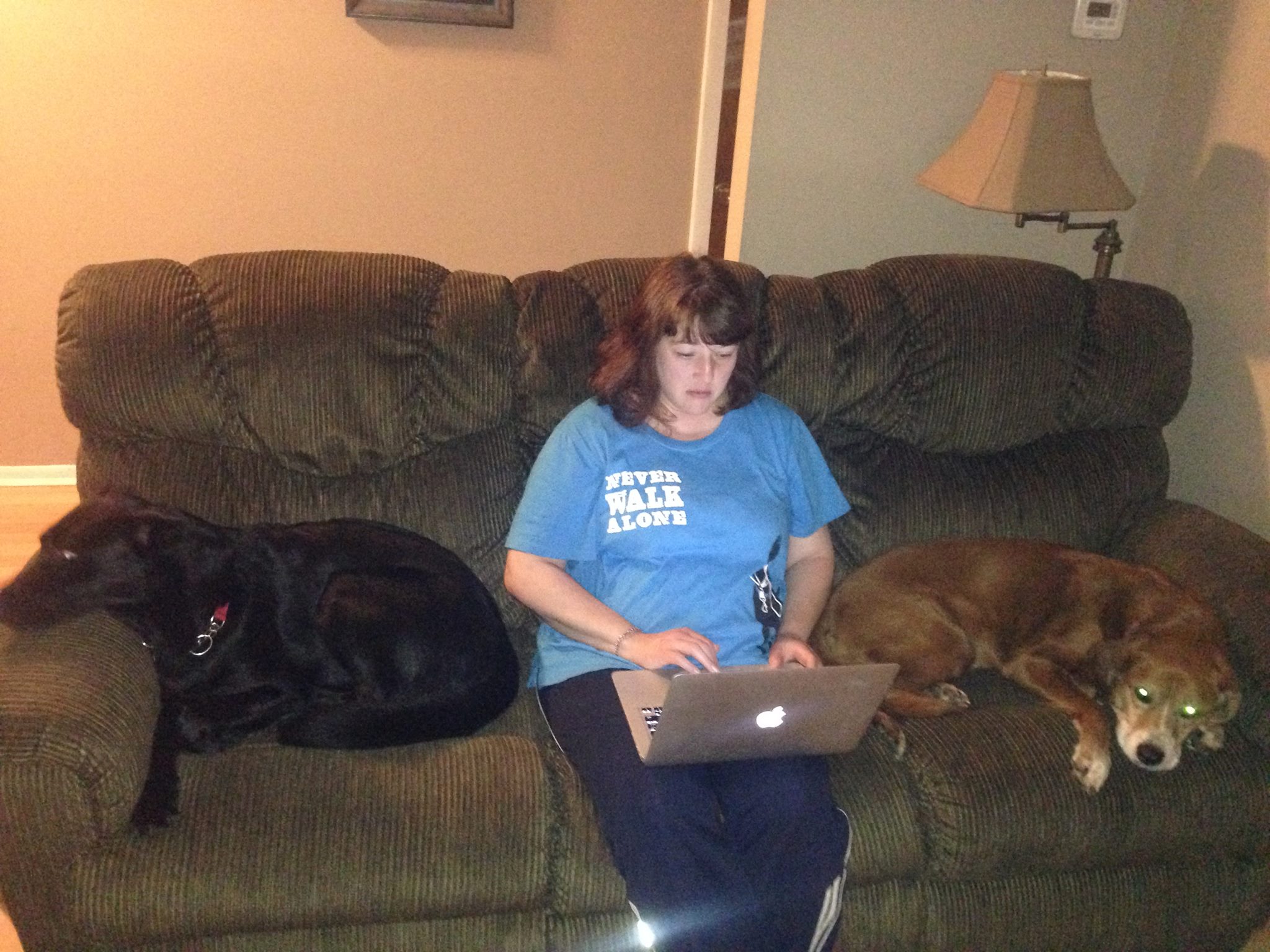
Service Dog Bookends

This little boy that I see occasionally (whose name I DO NOT know – which embarrasses me as he knows my service dog’s name), looked at me with big eyes and said, “Where is Chloe and WHO IS THAT?” (Ya gotta love kids)

I replied, “Oh, this is my new service dog, Milo. Chloe is retired now and is at home sleeping on the couch”.

He looked very solemn and said, “So she still lives with you?

Oh yes“, I said. “She will always live with me. It’s just that Milo is my new partner!

He was quiet for a second or two and said, “So it’s like you are divorced and Milo is your new service dog?

I was so astonished by the seemingly change in topic I stuttered out, “Well… ummm…. no, not at all. Chloe and I aren’t divorced. I guess it’s more like polygamy and both dogs live with me now!

The little guy look TOTALLY CONFUSED, and I glanced up to see the HORRIFIED LOOK on his mother’s face. Ever want to just slap your hand over your mouth? I knew as soon as I said it that it was 1) totally inappropriate, 2) would take the mother all day to explain to her son, and 3) completely “off the wall”.

I made a mess of trying to back peddle (for people with balance disorders can do precious little BACKWARDS), and hurriedly made my way down the next aisle.

I stood in the international food section fussin’ at myself and nearly in tears for using such a poor analogy around a 6-year-old. I determined then and there I needed to PrAcTiCe PrAcTiCe PRACTICE what to say in response to “where’s Chloe and who is THIS?

Part of Good Advocacy is Practiced Responses

Being a good advocate and representative of “whatever ails ya” means you have good responses when someone asks questions. I have learned the HARD WAY, that these responses need to be rehearsed. When you are taken by surprise by either well-meaning, curious people or rude, snarky trouble-makers, you want to have a measured, helpful reply so that you advocate in a positive and helpful manner. I have found that if I don’t have a “canned response”, I tend to match the tone and demeanor of the person asking. This means that sometimes I am pleasant and in “teacher mode”, with great responses that educate and advocate on behalf of the disability community. However, other times I’m waving my cane in a curmudgeon’s face and informing them in no-uncertain terms how horrible they are.

At Fidos For Freedom, Inc., (where I trained for now – TWO – service dogs), we practice how to respond when encountering access issues. If you have a service dog, it is not a matter of IF you have access issues, rather WHEN you have access issues. It is easy to get flustered. It is easy to get mad. It is easy to say the wrong thing. Practice makes it much easier to respond with something that will actually help you and others like yourself.

Doesn’t it Suck that Many of the Rude Ones are “Kin”?

What is even harder is when the person acting incredulous and skeptical is someone you know well or are even family. I’m lucky that I have a very supportive spouse and adult children. Even so… it is hard to love someone with a chronic condition. Once in awhile, my husband (or kids) do not filter what they are saying, because they, too, are sick and tired of Meniere’s disease. I’m 100% certain my husband has rehearsed responses to commiserate appropriately so that he doesn’t spend the night on the couch.

(Holding an ice pack on my cheek, or head), “I’m so tired of falling and staggering around! What I wouldn’t give for just one day of no vertigo!

It must suck, honey!” is the rehearsed response so that “Yeah, I’m getting tired of taking off work to take you to the E.R.” doesn’t slip out.

It can really hurt when someone who knows you better than others “opens their mouth and inserts foot”. I recommend that even support people practice and learn how to deliver sympathy and encouragement.

You Will Still Blow It

Even if you practice measured, helpful responses to personal questions, you are still going to blow it from time to time. A couple of Sundays ago I was ticked off at myself for not responding kindly to someone and was thinking, “Denise! You’ve had this diagnosis for 2 decades! Exactly WHEN is it gonna become HABIT?

I sit during the worship service. It isn’t because I cannot stand. Folks are surprised when they learn that at work, I stay standing for very long periods of time. I actually MOVE very easily and with very little wobble. It’s standing still that is the problem. My world turns… counter-clockwise when I’m standing still. I love my church. They are very supportive of people who are differently-abled. We have a loop system in the auditorium for people with hearing loss. We have fully accessible bathrooms and classrooms. We have an elevator and a lift for people with mobility issues. In spite of this, I’m forced to sit during the worship service. My church puts the words to the songs on the wall using a projector. We have a beautiful stage and lights as well. The song lyrics are in a multi-media slide show with patterns, colors, movement and lights. Everything is color-coordinated and changes song to song. The freaky OCD person in me is in awe every Sunday. It’s gorgeous! But… I can’t stand. If I do, I’m fighting consciousness. It isn’t a problem, for I don’t mind sitting. I’m comfortable and SAFE. I learned that not everyone understands why I’m sitting, however.

An elderly person came up to me at the beginning of the service and asked me how to access the hearing loop in the auditorium. I removed my cochlear implant and hearing aid and demonstrated how to switch to t-coil. I get this question about once a month and I’m always glad to educate. I love the hearing loop and it has dramatically transformed church for me. I love answering questions to help others access this wonderful technology. So wasn’t I surprised by the encounter, but totally floored by the follow-up question:

So why are you seated during the music? I’m way older than you and even I can stand!

I don’t know if it was the environment, the timing, or the unexpectedness of the question, but can I tell you … I really took it wrong? I could FEEL the tension creep up my spine and I was mentally counting to ten and trying to diffuse the explosion about to spew out of my mouth. THIS ONE I hadn’t practiced for. I hadn’t run any scenarios through my head and out through my heart filter to answer a question like this appropriately. So I didn’t.

Wow. That was really, really mean. We’re done,” I said. The person looked startled, then uncomfortable and walked away. I think the last action was because I’m certain my look was murderous. I mean… I was MAD. (I later apologized).

Folks are gonna take you by surprise once in awhile. You will hear an insensitive comment from someone you weren’t expecting it from and it will just shock you into silence (if you are lucky) or cause you to say something you regret. It is best to be prepared.

Ummm… WHY SHOULD I?

Maybe you are thinking that if people are going to be insensitive and inconsiderate, that “why should I temper what I say in response?

Since we are on the subject… here are some “canned responses”:

1. You don’t want to sink to their level.

2. You need to be the mature one.

3. Kill ’em with kindness.

4. In the end, you advocate for all of us.

5. Honey attracts more bees than vinegar.

Well.

I happen to love vinegar. I mean… don’t get me started on pickles. There are few things I love more. Let’s be honest though… from someone who is differently-abled to someone who may also live with acquired disability, chronic illness, or invisible issues, “WHY should we be careful in our response?

(sigh)

Because it’s the RIGHT thing to do. Sucks, don’t it? I can tell you from experience though that it is much better to answer correctly and watch someone else squirm, than to have to apologize for “going off” on someone. Go practice, my friends! You’ll be glad you did!

Denise Portis

© 2015 Personal Hearing Loss Journal
How the Church Can Welcome the Differently-Abled

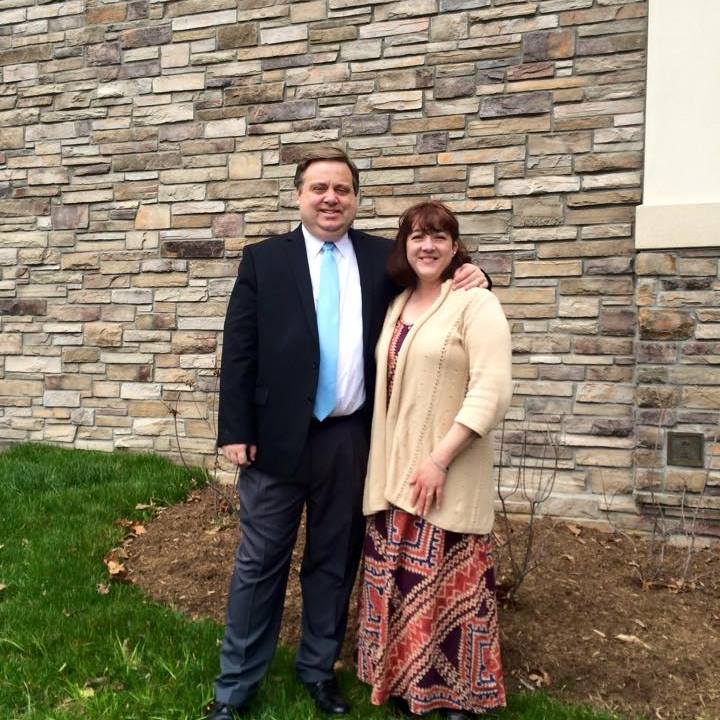
My husband, Terry and I, standing outside our church on Easter 2015.

After a great deal of thought and preparation, I decided to reach out and ask for help.

Ok. Really I’m BEGGING.

(Well that sounds sappy and depressing).

I’ll pay you MONEY. I’ll have your BABY. I’ll CLEAN your house. I’ll OWE YOU. I’ll toot YOUR HORN (but I warn you… I’m deaf). I’ll GIVE YOU PROPS. 

Hmmm. None of those are doing it for me.

I’m asking you to HELP. You CAN MAKE A DIFFERENCE.

Asking For Guest Authors

As a person of faith, and a person who is differently-abled, being able to attend my home church is important to me. My church does a lot of things right. My church could do some things better. I have learned to accept that some things are just HARD when you put everything that encapsulates ME in the place I have CHOSEN to worship.

However, I am a person with hearing loss, hearing again through the bionics of a cochlear implant. That’s pretty specific.

I am a person with Meniere’s disease, a balance disorder that the “experts” have not completely figured out yet. The triggers, symptoms, and treatments vary. How it affects me is very specific.

I have major depressive disorder. Many people do.

I have a service dog. Not everyone who is “differently-abled” has chosen to partner with one. You may have other assistive devices or options.

I know, however, that there are many, MANY people out there who struggle in their own PLACE of worship. There are people who struggle worshiping along side of the PEOPLE with whom they have chosen to worship. These people are different than “my church family people”. There are people out there who have passion for Purple. (Sorry… I got carried away with having a third point that started with P. Did I mention I also have OCD tendencies?)

I would like to ask for YOUR help. You see? I need your stories and your words. Together, the compilation of our experiences (I believe) can make a difference in our churches. I am launching an initiative that I hope will take MONTHS to complete. There is no hurry. The posts do not have to be consecutive.

You can write anonymously.

You can write unedited.

I need you. I believe those trying to improve accommodations and accessibility in places of worship need to hear your story. Would you be willing to participate?

Some ground rules:

1. Email me at denise.portis@gmail for suggestions as far as photographs, word count, etc.

– OR – Click this link: <ThIs HeRe LiNk>  (When you are a transplanted Southerner, it shows up even in your hyperlinks).

2. The story needs to be YOUR story. In other words, you live a life as a differently-abled person. Or, you LOVE a differently-abled person and because of your relationship have an important voice about this topic.

3. My assumption is the posts will trickle in over the course of months (maybe a year! I can HOPE!). I will tag them with “Churches and Disabilities”.

Do you have an invisible illness and struggle with accessibility, acceptance, and inclusion?

Are you differently-abled, and wish some minor (or major) changes could be made to make it easier for you to attend your church?

Do you have a mental illness or diagnosis that is misunderstood and has the kind of stigma that a church pretends doesn’t exist?

Do you long for support groups hosted by area churches for:

Grief Support

Addictions

disAbility Awareness

Parents of Differently-abled Children

“Single Again” Care

Why not consider writing about it?

It doesn’t matter if you have never written for a blog before. You don’t have to consider yourself a “writer”. Hearing Elmo needs YOUR STORIES. I truly believe it will make a difference.

Denise Portis

©2015 Personal Hearing Loss Journal

Through the Eyes of a Newbie

Milo Cade - Fidos For Freedom, Inc., Service Dog.
Milo Cade – Fidos For Freedom, Inc., Service Dog.

Many of Hearing Elmo’s readers know that I retired my service dog, Chloe, this year. Since May 1st, she is enjoying retirement and still does some hearing alerts at home. She is happy, spoiled, and we believe well-deserving of all the naps and belly rubs she is currently receiving. I was recently matched with Milo, from Fidos For Freedom, Inc. Milo is a shepherd/lab mix and I am enjoying the process of being partnered with a mobility/balance service dog versus a hearing/balance assistance dog. We determined my primary needs are mitigating issues with Meniere’s disease and not hearing alerts. I love my cochlear implant, and feel like I have adjusted to the world of “hearing again” very well. My balance is, and will continue to be, a major issue. I suppose in a way, this is an introduction of my new partner, Milo.

One thing I have enjoyed is experiencing MY world (work, church, walks, etc.) through the eyes of a newbie. For Milo, everything in MY world is new. He looks at everything in awe. If he isn’t looking in awe, he is sometimes in “investigation mode”.

Is it scary?

Is it freaky?

Is it edible?

Is it alive?

What does Denise think?

At a training session with my trainer a week or so ago, I brought Milo to one of my classes. I had allowed enough time to exit the service dog safely from my car. I had allowed time for a short potty break. (Honestly, Chloe hasn’t been at home long enough for me to get out of the habit of some of these things. I found myself at a potty area recently and realized I didn’t have a dog by my side!). I allowed enough time. Not.

I did not allow time for all the new things my newbie partner was seeing. The grassy area was new. The trees and picnic bench were new. The ramp into the building was new. The automatic door push-button was new. At least… it was new to MILO. For just a brief second, I was mildly annoyed. I had not allowed time for appraising all of these new environments. That was MY bad, not Milo’s. I want my dog to be confident and aware of his surroundings. I was almost late to class, but the time I took “extra” was time worth taking. Newbies need some extra patience from those of us who are veterans to the schedule and environment. We owe it to them. But you know something?

Blowing It BIG!

I really know how to blow it. I mean, I don’t do anything half-way. This isn’t always a good thing. I recently became extremely exasperated with someone relatively new to “hearing again”. I try hard to be a positive advocate for people with disabilities, and chronic and/or invisible illnesses. This blog is, in part, a way that I try to raise awareness and encourage people to talk about tough subjects.

I see this lady about 3 times a month at the grocery store. Over a year ago she saw my CI, asked about it, and eventually had surgery herself. This individual was relatively new to hearing loss. She was still struggling to help the people important to her understand that the CI did not “FIX” her hearing. Instead it was restored to a type of hearing (bionically) and  she would still be in environments occasionally where she would need others to understand that she needed to 1) see their face, 2) slow them down, and 3) find a quieter spot. After listening to her for about ten minutes – really distraught about not feeling accepted –  I felt myself becoming impatient. We had this conversation before and I felt as if we were “beating a dead horse”. Remorse and shame immediately washed over me. I stuck my finger in my own face and preached, “Really, Denise? Really?” (Y’all are trying to figure out how you stick your own finger in your face, aren’t you?)

As I had (thankfully) kept my mouth shut, I continued to listen and realized she was now apologizing… “I’m sorry I keep bringing this up. I just can’t seem to help them understand that the CI was not a CURE. I’m so frustrated!”

I realized then and there that I needed to put myself in newbie shoes more often and remember how difficult those early years were. Advocating and educating take time. Families and friends do not just wake up overnight and suddenly “get it”.

I told her that I often forget how hard those early years were, and that she had to keep at it… eventually some of it would start to sink in for her family members.

As a person of faith, I believe everything happens for a reason. We may not always like the purpose behind God allowing something to happen, but there is always a reason. I’m also (gulp) old enough now to know that we may not EVER completely understand why something happened this side of Heaven. I have ALWAYS felt like that the acquired disabilities I have were allowed so that I could help others… or at least try to do so. I blow it. I blow it BIG. However, I think those of us that have lived the life a few years, owe it to the newbies in our lives, to lovingly coach, encourage, cheerlead, advise, and HUG often.

You are going to have newbies in YOUR life. Unless you are isolating yourself, you will have folks new to whatever “ails ya”. People will look to you for understanding and advice. You will be able to empathize much better than their doctor, their families, and their co-workers. Of all people – YOU get it.

Are you looking for a way to invest your life in someone with similar challenges? There are opportunities everywhere. You simply need to know where to look. Urban areas often have face-to-face support groups for various illnesses and disabilities. There are numerous online support networks, discussion forums, and peer supports. Many doctor’s offices and rehabilitation specialists have contacts to support personnel. Invest yourself in the life of a newbie. Remind yourself while investing how difficult those first years were! It shouldn’t surprise you to discover, sometimes by accident, the student becomes the teacher. Always, always be teachable.

Denise Portis

© 2015 Personal Hearing Loss Journal
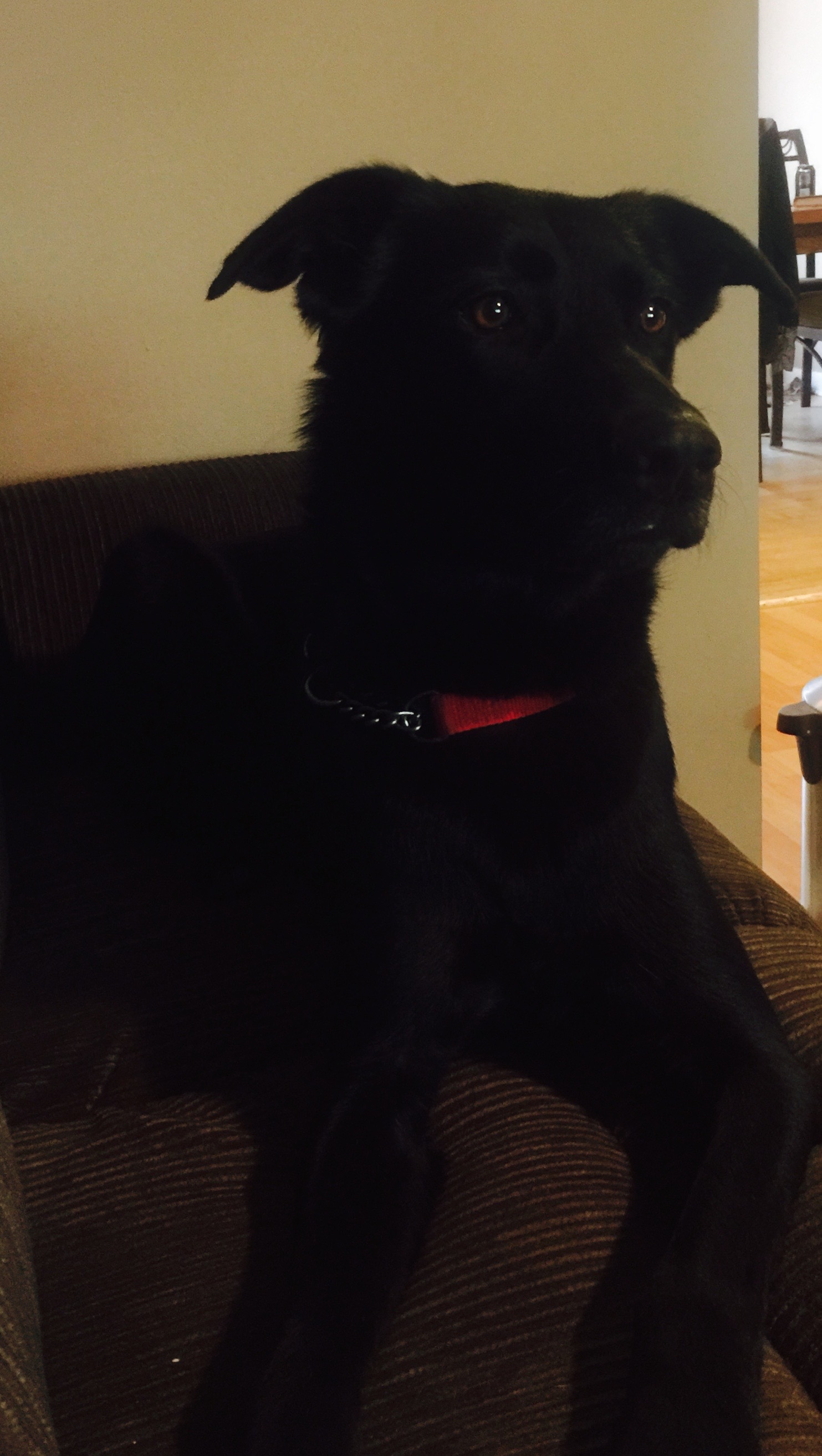
Self-Talk

positivethinkingimage11

Self-talk. Chances are you have been using self-talk since you were a child. As a matter of fact, developmental psychologists tells us that self-talk begins in middle childhood, ages 6 to 11-years-old (Arnett, 2013). Perhaps that is why many folks think that simply “talking to yourself” out loud is the same thing as self-talk. Children often “play out loud”, adding sound effects, conversations, and even lengthy monologue within imaginary play. This is not self-talk. Self-talk is really just your inner voice. It often reflects your conscious and unconscious thoughts, beliefs, and assumptions (Psych Central, 2015).

Self-talk CAN be out loud… don’t get me wrong. One of my favorite things to practically shout when I use self-talk, is “Girl? I REJECT THAT!” This is said out loud, with southern accent, hand on hip, and oozing with attitude.  (Are you picturing it? If you know me, you likely have even heard me say it).

Self-talk is also studied in Sport Psychology. As a matter of fact, if you do some searching online, many athletes have often used quotes that incorporate the use of self-talk. We ALL use self-talk, however. Whitbourne (2013), explained “Psychologists have identified one important type of these inner monologues as “self-talk,” in which you provide opinions and evaluations on what you’re doing as you’re doing it. You can think of self-talk as the inner voice equivalent of sports announcers commenting on a player’s successes or failures on the playing field” (para. 1).

This is why sometimes internally and oft-times out loud, we say, “Well. That was stupid”. As a matter of fact, much of our self-talk as adults is negative. Some of us may be parroting things we actually hear others say. However, most of the negative self-talk comes from the heart of pessimism and self-deprecation. Why? Why are we so hard on ourselves?

People who live with chronic illness, or invisible (or visible) disabilities often have negative self-talk. Statistics tell us we don’t really engage in negative self-talk more than adults who do not struggle with these issues, but perhaps the source is different. Frustration tends to be a significant source of negative self-talk for the differently-abled.

self-talk-2

Perhaps you are trying to discover how to do something independently. Maybe your are coming to terms with having to do something differently. Here are some things I have found helpful when I find frustration is spawning negative self-talk:

1. Identify it. Perhaps this is why the first phrase out of mouth is often “Girl? I REJECT THAT”. I identify that I am engaging in negative self-talk. See it (or hear it). Call it what it is. Now that you recognize it:

2. Change your spin on it. See if you can’t put a positive spin on it. Perhaps your self-talk has recognized something that you need to pay attention to but you need to say it like you are talking to your best friend. Be your own best friend. We wouldn’t say, “Geesh, that was dumb”. Try re-phrasing it. “Well I’m smarter than this. How can I make sure this doesn’t happen again?”

A great example of this happened to me just last week. I took a really hard fall between my front door and the grass to “potty the dogs”. It was late, and pretty dark outside. I was in a hurry. My pillow was calling out to me and I wanted to reply face-to-face. I left the house without my cane. I was only walking 10 yards. What could happen?

I have 6 bruises and a small cut on my arm to show how wonderfully intelligent that choice was. So laying there in the grass with “mother earth” in my mouth, ear, and eyes, my first thought was:

“Dang. You are so graceful”.

Yeah. I speak fluent sarcasm.

My second thought was, “Geesh, that was stupid”. I’m a bit of a motor-mouth so I’m pretty sure the conversation went on a little longer, discussing how many brain cells I have, could I be any lazier for not taking 10 seconds to grab the cane?, and competing very hard to convince all living things listening that I deserve my title of Accident Prone Queen.

Because I’ve had so much practice at this, I immediately identified what was happening. Putting a new spin on it meant I could say, “Well this is why you should take 10 seconds to grab the cane!” Folks, I was WRONG to leave the house without my cane. But finding a middle-ground and re-phrasing the self-talk helped me be just a little more kind to myself. We need to take the time to be kind to ourselves.

3. Flexible expectations. No one knows you like YOU know you. If you have lived with invisible illness or disability for any length of time at all, you know what your own limitations are.

Unlike some of my cochlear implant friends, I still do not hear music very well, nor enjoy what I hear. My iTunes account could be deactivated. Does this mean music isn’t a part of my life? Absolutely not. I sing 80’s tunes at the top of my lungs when home alone.

Because of positional vertigo, I cannot use exercise equipment like the cross trainer (my husband’s favorite), stair-climber, or anything that moves my position vertically. Does this mean I cannot exercise? No. I can use a treadmill and I can walk. The latter I do twice a day.

The doctoral program I am in is designed to push you through in two years. I will be done in 3.5 years. And you know what? That is OK. This is the pace I can do successfully and complete my schooling. I can be flexible in my expectations!

a622e70b25c04c3989562d851625641a

When all else fails, tell yourself to shut up. You may not say, “Girl? I REJECT THAT!”, but don’t be afraid to tell yourself to zip it. It may even be helpful to say it out loud. It works for me! In the end, you can actually work self-talk to your advantage. Learn to cheerlead yourself. Most of us look great with poms-poms.

Arnett, J. (2013). Developmental Psychology: A cultural approach (1st ed.). Upper Saddle River, NJ: Pearson Education, Inc.

Psych Central (2015). Challenging negative self-talk. Retrieved June 15, 2015, from http://psychcentral.com/lib/challenging-negative-self-talk/

Whitbourne, S. K. (2013). Make your self-talk work for you. Psychology Today. Retrieved June 15, 2015, from https://www.psychologytoday.com/blog/fulfillment-any-age/201309/make-your-self-talk-work-you

Denise Portis

© 2015 Personal Hearing Loss Journal
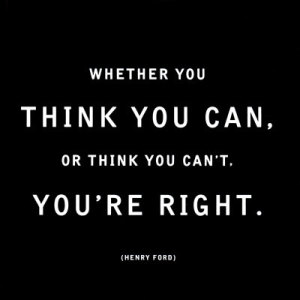
Tree Hugger

2015-04-11 19.08.33

The weather is finally feeling “Spring like”. The trees are all budding out and blooms galore, decorate my neighborhood. It ain’t all good. *achoooo* – but allergies seem a small price to pay for such pretty walking weather.

A couple of days ago, I ventured out of my immediate neighborhood and down a nearby walking trail. I’ve posted about beavers and bullfrogs in other posts as the path stretches along the perimeter of a small pond. At “the bend in the path” where the trail takes a sharp right turn, a huge tree was cut down. This was supposedly done to insure the path remained semi-straight. When I first saw it last year after this section of the trail was finished, I grieved a little seeing that this huge tree was chopped down and for the apparent reason it was hauled away. I haven’t been down this path in months and months. When I got closer to the remains of this giant, I looked for the scarred stump. I was surprised at what I saw. Every which way, new growth and small branches, sprouted from the stump.

I almost became a “tree hugger“. Not in the traditional “activist” sense, but I was so excited to see that it had persevered! I even took a few steps off the path to see how to approach for a hug. Seeing no great way to latch on and SQUEEZE, I instead reached out and calmly high five’d a small branch closest to me. I stood and silently celebrated the fact that this tree was still alive, determined to continue in spite of being chopped down!

Have You Felt the Woodsman’s Axe?

I turn 49 this year. Honestly, growing older doesn’t bother me in the least. Yet, because I have acquired disabilities, I have to admit that where I am is NOT where I thought I’d be. Don’t get wrong.

I feel good about me. I still have goals. I strive to make a difference. I love what I do. I have good days and bad days. There have been days I have really felt cut down.

AXED.

For many with acquired disability, chronic illness or invisible (or visible) conditions, much energy and focus is geared towards being independent. We don’t want to be a “bother” or put people out. I stopped trying to “fit in” a long time ago. I don’t hear normally. I don’t walk or stand normally. As I have become comfortable in my own skin, others have learned to accept me just the way I am as well.

But sometimes? Well, sometimes someone comes by with a wicked, sharp axe and hacks away at me, chipping away at who I am. Do you know what sucks? Sometimes the woodsman is someone I know well. Do you have people in your life who tell you “for your own good” to suck it up? “If you didn’t go around making a big deal about your disabilities, you would fit in better!” “Well aren’t you the DRAMA QUEEN?” “I’d never know something was wrong with you if you didn’t go around with a service dog!” (As if it never occurred to them I’m independent BECAUSE of the service dog).

There will be times we feel “cut down” because it is JUST ONE THING AFTER ANOTHER. I have some friends (those I call family, really) who have significant challenges. A few of them have really had a tough year. One took a significant fall in a store and is STILL recovering as the injury fall out was compounded by her MS. I have another friend with MS who is a stroke survivor. Her husband is now dealing with significant health issues. A young woman I got to know through Fidos For Freedom (who also writes) has a terminal illness and things seemed to go from bad to worse for her this year. These warriors have been chopped away.

Yet people with disabilities and chronic illness are stubborn. We persevere. If anyone “keeps on keeping’ on” it’s us! There is not any person with ANY challenge that cannot explode with new growth in the Spring. Winter is harsh. Axes are sharp. Bad stuff happens. But friends? Life isn’t over. Good can come from this.

Spring is here. Have you had a tough Winter? Did someone take an axe to you? You still matter. You can still make a difference. You are important. It’s Spring. Time to bust out in blooms or branch out in new growth. Don’t make me come fertilize you. 🙂

You meant evil against me, but God meant it for good in order to bring about this present result. Genesis 50:20 (NASB)

Denise Portis

©2015 Personal Hearing Loss Journal

Embracing It!

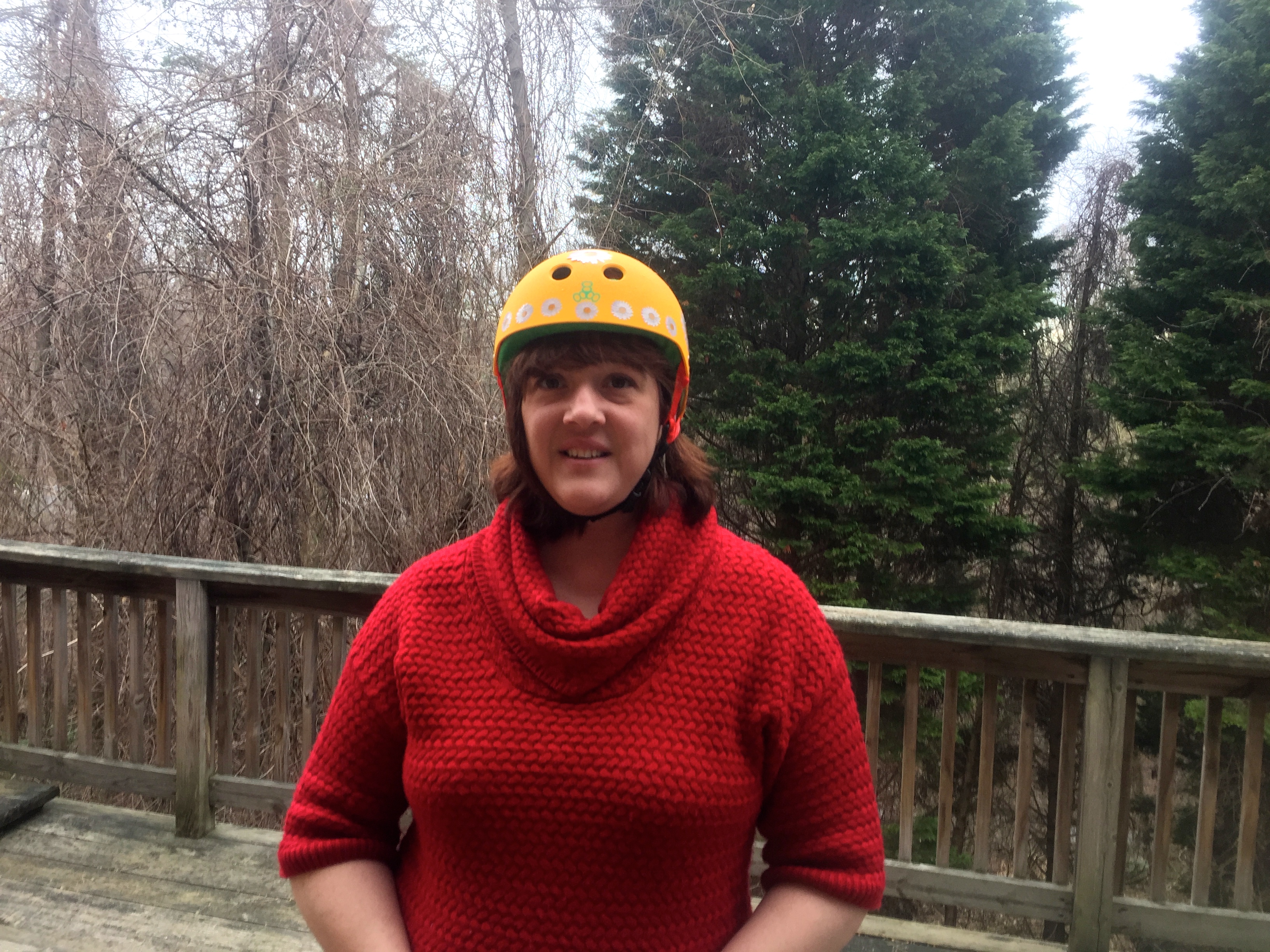
"So... tell me the truth. How does this look?" (Terry) "Baby? You are rockin' that helmet!"
“So… tell me the truth. How does this look?” (Terry) “Baby? You are rockin’ that helmet!”

I believe that there are very legitimate reasons for people who choose to keep invisible disabilities invisible. I respect their choice and their reasons for doing so. In many circumstances, it makes “good sense” and isn’t at all about vanity or shame.

I am “all out there” for lack of a better way to put it. In my profession, in my life, in the community service arenas I’m involved in, and for personal safety reasons, making my invisible disabilities – visible is the right thing to do.

I wear bling on my implant. I think it is fun. It puts a smile on my face. I’m so SO thrilled to be hearing again. The progression of my hearing loss took 12 painful years. I was completely deaf for almost two, silently researching and investigating cochlear implants. I’m so proud to be hearing again. Some say I’m flaunting it. Ummm…

YEAH.

If you do not want to bring attention to disabilities, do not ever choose to be partnered with a service dog. Even though our dogs are taught to be nearly invisible (and don’t you know folks are always startled when I get up to leave restaurants because they had no clue my dog was there?), when you walk through a store or into a doctor’s office, your service dog will bring attention to the fact that “something is different about you”. It has been a very long time since working dogs were only trained to be guide dogs. There are diabetic alert dogs, seizure alert dogs, autism dogs, PTSD service dogs, mobility assist dogs, balance assist dogs, alzheimer assist dogs, hearing assistance dogs, and the list goes on! My service dog makes me more independent. I don’t have to ask for help nearly as often. I don’t miss things (sounds my CI won’t pick up), and I’m confident and more safe. But choosing to have a service dog will bring attention to you.

When my Meniere’s disease worsened, I finally realized that 3-5 falls a week were too many. When I have my cane, I stumble maybe 3-4 times a week, but rarely go all the way down. I average only 2-3 falls a month now. I have three canes. They are bright, bold, and beautiful. I don’t try to hide that I carry a cane with me.

I love to be outside. Perhaps it’s the “farm girl” in me, but I love to be outside and love to walk. Just because I have a balance disorder does not mean that I am going to stop walking. Yet… I seemed to have trouble doing it safely. Even with cane and service dog, I was still taking tumbles when the roads or sidewalks were bad. Winter is my favorite season. I love snow, love ice, love “visible breath” in the air… but I have had some bad winters, 3 years in a row. As a matter of fact, when perusing my medical records with my neurologist, I was averaging 2 concussions each year, usually in Winter months. My last mild concussion was March 8th. I have a follow up with my neuro the first week of May. At the last appointment, he said, “You know. You need a helmet for when you walk!”

I laughed and said, “all my friends tell me I need to be wrapped in bubble wrap or need to wear a helmet.”

He looked at me eye-ball to eye-ball and said, “You don’t understand. I’m being serious. You CANNOT continue having concussions”.

Oh.

OH.

NO FREAKING WAY!

I sat there a little stunned for a minute but then began to consider the possibilities. I’m not afraid of what people think. I don’t care about what is fashionable – heck I consider myself a “disability-advocate fashion expert”. But could I embrace a helmet for walking when road and sidewalk conditions were bad?

I decided that yes… Yes, I could!

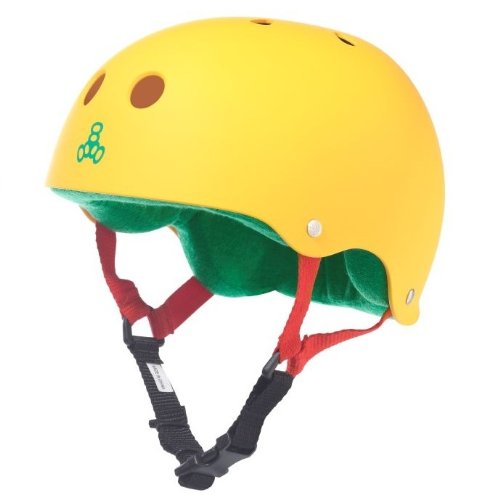
So I started researching, (cuz, yeah, that’s what I do) and found the helmet I wanted. I was crazy ecstatic that it is called a … “Brainsaver“! Ain’t it great? *BEAMS*

Triple 8 Brainsaver Rubber helmet with Liner in Rasta Yellow

I blinged up the helmet with some of my favorite stickers, (I’m a nut for daisies), and now I’m all set for walking. I even fixed the liner where my cochlear implant magnet had a little place to “rest” inside so it would not get pushed off.

I realize my approach to MY LIFE may not work for you. However, I love embracing who I am and holding my head high. I want to be an example to others, but I certainly know and understand that it is “different strokes for different folks”.

I hope I can report this time next year that I haven’t sustained any new concussions. Yay for me, and yay for neurologists who push to get their patients to take their brains seriously.

Denise Portis

© 2015 Personal Hearing Loss Journal
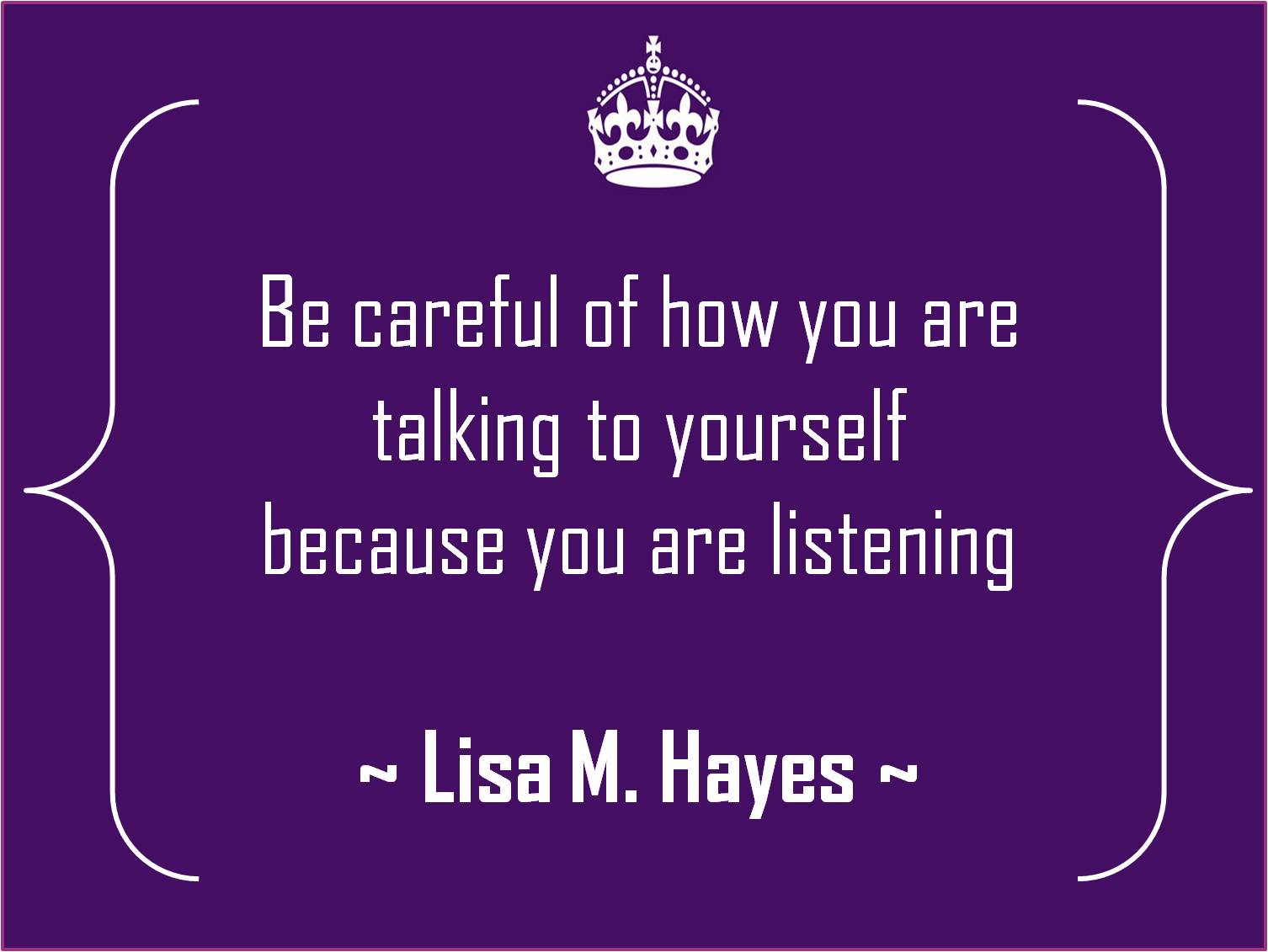
How Can I Redefine Me?

redefine

I stopped looking at myself as “disabled” a long time ago. I am, however, quite comfortable with being a person with disabilities. A friend, fellow-client at Fidos For Freedom, Inc., and blogger, was the first person I ever heard use the words, “differently abled”.

I have to tell you that sometimes I’m really feeling my disabilities. It can make me discouraged and frustrated. So many of us who live with disabilities or chronic illnesses often gripe, “I’d like just ONE DAY of feeling normal”. 

I’ve become very comfortable with being a “hearing again”, cochlear implant recipient and “late-deafened” (without my technology). I’ve even grown accustomed to having a vestibular disorder (Meniere’s disease). I use a cane, have a service dog, and bedazzle my cochlear implant with some amount of pride and transparency.

One thing I’m not OK with is concussions. I’ve had a lot. I was even told I had “post-concussive syndrome” after a moderate concussion in 2013. “You know… like football players have.” But…

I don’t play football.

My neurologist had me do ten weeks of vestibular rehab. This was actually a fantastic experience and I learned all kinds of tricks, most importantly how to fall safely – cuz I’m going to fall. Sure, I learned all the great things to minimize the possibility of falling, but I will take some tumbles. So I learned how to unlock my knees and SIT (albeit without any grace) to avoid falls. In spite of this, stuff just happens. And you know what? I get mad.

March 8

Take March 8th for example. There was some ice and lingering snow everywhere. I prepared to walk – which means I had my no-slip boots on, my tripod cane, and service dog (who is off vest but heels like the pro she is). I bundled up and made sure my charged cell phone is in a buttoned down pocket. I don’t use my cell phone while walking. No ear buds or attachments either – No listening to music. I pay attention when I walk. (Well, I also talk to my dog but that was the topic of another post).

So when I crossed a street and fell backwards on the ice I actually felt MAD on the way down. I had taken all these precautions! The back of my head actually BOUNCED on the road. Right before I blacked out I thought…

THIS SUCKS. 

I wasn’t out very long (I rarely am). I suffered with a headache for 4 days and made an appointment with my neurologist. (Follow up in May)

I remember thinking after texting my husband and making my way the rest of the way home, that I do not like being this person. I don’t like being the fall guy (get it?). By the time I walked the 2 blocks towards home, Terry met me and I sat on the porch for a good cry. After eliminating some of that tension (and freaking my husband out), I sat there to think (and yes, hold ice on my head). I kept thinking, “This isn’t who I am. I am not the walking, talking concussion waiting to happen. I have GOT to get a handle on this.” I needed to redefine myself. I’m NOT a fall guy. I’m a very careful person who sometimes sits quickly. I sit when I’m lucky… and when I’m not that’s OK. I have plan for that, too. I’m thinking a hockey helmet when the roads and walks are bad. Imagine how I can bedazzle THAT.

Your Thoughts Matter

Two hours before my fall, the pastor of my church (Weem’s Creek) spoke about courageous faith. Do you know that people with disabilities and chronic illness are some of the most courageous people I know? Here are some of his main points. If you aren’t a person of faith, read on anyway. This can easily pertain to anyone. If you are a person of faith you may be like me and think, “Well why have I never seen this before?”

1. To live a courageous faith, we must cultivate a habit of thinking thoughts that are from God. Instead of focusing on not thinking wrong thoughts, we need to focus on thinking right thoughts.

2. We can’t always control the thoughts we have, but we can control the thoughts we hold. We need to learn to hold the thoughts that are true, noble and excellent… those from God.

3. Meditate on God’s Word, not on our misery.

I think ATTITUDE is the real disability. If you can change your attitude, you will never feel disabled. Change your attitude – and that new attitude will CHANGE YOU.

I think of it as redefining me – redefining what having a disability means. My focus is on what I can do. I pour energy into discovering how to do things that I want to do – perhaps differently (using canine, technology, or assistance). This keeps our disabilities from defining US.

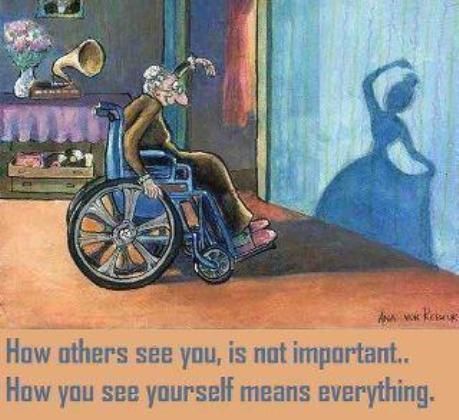
Be careful to acknowledge that everyone has a personal “definition”. Just because you may have a hearing loss too, doesn’t mean we define who we are the same. Being in control of our own definition (even if we need a necessary “redefine”), also helps others see us how we see ourselves.

It may take some work. I have a colleague at work who constantly tries to “help”. I finally told her one day, “watch how I do things WITHOUT your assistance”. That shut her up, made her watch… and don’t you know she learned so much? She told me later she just assumed I needed help. Having a disability does not mean you are “not able”. Most of us find very unique ways to be VERY abled.

Are you at a point in your life where you need a little redefining? Perhaps you have believed some of the “hype” about what you cannot do because of your diagnosis. Redefine yourself and hopefully change both your attitude and how others see you.

redefine4


L. Denise Portis

© 2015 Personal Hearing Loss Journal


When They SHOULD… but they DON’T

support

Do you know the #1 topic of emails to Hearing Elmo (or face-to-face for those of you who know me personally) is support or the lack thereof? I have not met a single person with acquired disability, chronic illness, or invisible condition that took on their “new normal” by choice. We need support.

People need other people. I don’t care if you are an introvert and “loner”, or a gregarious, extrovert. All of us need human connections to some degree. I hypothesize that those of us who live with acquired disability, chronic illness, or other invisible condition may need solid, supportive relationships even more than those who do not face daily challenges. Coping is TOUGH stuff, and geesh… don’t I hate we don’t burn calories for all the work we put into COPING? In psychology,  we have a special term for how important our relationships are to adjustment – psychosocial adaptation. Bishop (2005) explains this better than I could: Psychosocial adaptation “may be conceived as a process of responding to the functional, psychological, and social changes that occur with the onset and experience of living with a disability, chronic illness, or associated treatments” (p. 6). There is a ridiculous amount of research on how important relationships are to an individual’s psychosocial adaptation. Intimate relationships are imperative to the quality of life for individuals who are differently-abled. All very interesting STUFF, in my humble opinion, but not at all the goal of or intended topic of this post.

Intimate Relationships

When we hear the word “intimate” we may think of sexual expression. Maybe we think of fancy-smancy underwear. (So aren’t “we” the weird ones?). Intimate relationships are interpersonal relationships that are physically OR emotionally intimate. This means that we can have close friends or family members who have an intimate personal relationship with us in that they know us very well. We have let down our guards at some point and shared things with them that others have no clue about nor care. Yes, intimacy is often physical as well, and those of us who have a physically intimate partner in a spouse or significant other, count it a major blessing to also be a friend to this individual.

Our expectation of our intimate relationships is “through thick and thin” (and I don’t mean WEIGHT). We expect these folks to love us on our good days and our bad days. We know we can belly-ache to them and they won’t think less of us. For those of us who took traditional vows, we put a lot of faith in “till death do us part”. These folks know us – and love us anyway.

When acquired disability or chronic illness enters a life unexpectedly, we rest in the knowledge that our spouse or significant other, and intimate connections with friends and family members will strengthen us and help us adapt. We have this HOPE and expectation, yet so many share with me that they were let down by someone they had counted on to BE THERE for them. Some of you have even had to deal with broken relationships. Others may have partners and friendships that have stuck like super-glue, but you cannot help but feel as if you are a burden and that these folks feel “stuck” with you.

Perhaps someone shared with you that they get tired of how tired you are. Maybe they shared or insinuated that life with you sure is HARD. As if things weren’t hard enough, someone you depend on is tired of your diagnosis too? Thanks so much for that…

I know. Not a single person reading this post hasn’t at some point wished they could have just ONE day of normalcy. “If I could just have 24 hours of normal, it would re-set my gripe-o-meter box”, shared a long-time reader. Yup. I get that! So for someone in our intimate circle to complain that they are tired of all that WE are tired of? It’s enough to make you want to spit. Or hit someone. Or SPIT while HITTING someone…

So what do you do when you realize that those who support you are having trouble supporting you? I have three tidbits to share.

1. If the Shoe Were On the Other Foot

Please don’t lash out and tell your significant bozos (cuz at the point you are mad at them for their lack of support means they have morphed from close relationships to close BOZOS), that if things were “the other way around” you would TOTALLY be there for them – ALWAYS.

This, my friends, is impossible to prove. YOU are the one dealing with a significant, life-changing diagnosis. We don’t know how we would react to “the shoe being on the other foot”. Criticizing and attacking another by insisting we would support and behave differently is not fair, nor is it justified. There are numerous studies that support that stress and anxiety can be vicarious experiences by those who support people who are struggling.

I believe one of the very best things we can do for those who support us is to acknowledge up front that WE KNOW THIS IS HARD ON THEM TOO.

2. Engage in Active Listening

All relationships benefit from active listening. Active listening was made popular by psychologist, Carl Rogers, in the 50’s. Many different counseling approaches now incorporate active listening to engage in good communication. One of the best descriptions of active listening that I’ve read can be found HERE. It is five WONDERFUL pages of all that is Active Listening. So I’m not going to take the time to explain it here and instead am giving you a “homework assignment” <wink>.

3. Yes, They Should. But… They Don’t

I cannot boast of 100% supportive relationships, nor brag that I’ve handled my own acquired disabilities with grace and diplomacy. Even though I’m in a “good place” right now with numerous supportive relationships, I have been disappointed by some of my relationships, and have even lost some folks along the way.

It hurts.

The biggest mistake one can make in shouldering all that encompasses living with significant challenges, is trying to do it alone. You are not alone.

For one thing, you are reading THIS. I care.

The Internet insures that we are NOT alone. The Internet is accessible to even those with significant challenges. If your intimate relationships and friendships have let you down, please know that you need others. Find them.

Places you can find support:

1. The newspaper: Many list various support groups and networks available for numerous types of challenges and health issues.

2. Churches: Many have support groups and networks available to both members and non-members.

3. Libraries: Many have community services bulletin boards (both physical and on-site, as well as electronic) that list numerous support groups.

4. Online forums: One only has to “Google” their diagnosis to find numerous avenues of support online. One great searchable database can be found HERE.

5. National non-profit and for-profit organizations: Most diagnosis also have organizations that provide education, advocacy, and support at the local, state, and national levels. Search the Internet for organizations that provide resources for your specific population. Many have support networks as well.

6. FaceBook and other Social Media Outlets: You’d be surprised what support resources are available on FaceBook. Many are closed groups as well as have confidentiality tenants of membership.

7. Start your own: I’m not a big fan of “wiki” anything (I suppose it is the teacher in me), but I have to admit, WikiHow did this up right. Check it out HERE.

Cut ‘Em Some Slack

Finally, I’d be a poor advocate if I didn’t give you heads up that people are going to disappoint you. Forgive them.

You are going to have a really bad day and need all kinds of support, practically draining those around you DRY. Dehydrated people can lash out. Forgive them.

You will struggle with having to live your life yet another day – so very tired of it all. Someone will point this out. Mock you. Complain about you. Forgive them.

Someone will try really hard to support you and come up short. Their personality or own needs simply do not allow them to be exactly what you need them to be. Forgive them – and support THEM.

You are going to have the kind of day where you are just done with EVERYONE. You burn your bridges, isolate yourself, and find yourself very, very alone. Forgive yourself. And rebuild.

Denise Portis

©2015 Personal Hearing Loss Journal
Bishop, M. (2005). Quality of Life and Psychosocial Adaptation to Chronic Illness and Acquired Disability: A Conceptual and Theoretical Synthesis. Journal Of Rehabilitation71(2), 5-13.

Rogers, C. R., & Farson, R. E. (1957). Active listening. Lexington, Massachusetts: D.C. Heath and Company.

Change and Control

change for the better

I’m not a big fan of change. So when faced with a year that is sure to be chock-full of change, I can feel a little overwhelmed. Ok. That’s actually not true.

I can feel freaking terrified, sick to my stomach, near panic attack, bite my nails to the quick, SOMEONE LET ME OFF THIS MERRY-GO-ROUND called life screaming, “abandon ship! abandon ship!”

I’m not even a spontaneous person. My family knows not to ever throw me a “surprise” party. To me ordinary is extraordinary. I just hate change. For me, it’s all about control. That’s right. I’m a bit of a control freak. There is an upside to being a control freak. I am very organized. I’m punctual and responsible. There are, however, all kinds of negative things that come from being a control freak and refusing to accept change too.

I had fairly significant OCD tendencies throughout my childhood and into my early 20’s. As a teen, I developed bulimia nervosa after facing my first big change moving away from home to go to college. Emotionally, I drove some people bananas with my need to control and drove some people AWAY as a young adult.

If you believe everything happens for a REASON and that there is a life lesson to be learned in everything that occurs, one could hypothesize that my developing acquired disabilities was the best (worst) thing to ever happen to me! My hearing loss began at the age of 25 and was a progressive loss. I wasn’t completely deaf until the age of 32 so I had a long time to adjust and cope. Meniere’s disease was diagnosed at the age of 35, though I suspect I had it from my early 20’s. It, too, became progressively worse over time; in part, because of multiple mild concussions. My health issues forced me to change. To remain independent (something I discovered was extremely important to me), I found that I had to work hard at adapting. I had to embrace change instead of shy away from it or pretend it wasn’t happening.

Living with acquired disabilities means something CHANGED. You have to adjust. You have to make choices about how you will cope and how you will treat the diagnosis or disorder. You have to determine how you enlist others to assist – if at all. What adaptive equipment or technologies are available to mitigate the disability? How are you going to mentally and emotionally adjust? (For acquired disability or illness never occurs without having an impact in other areas of WHO you are…)

At the age of 48, I have lived more of my life adjusting to my new limitations than I did to living in a relatively “worry free” life. Here are some things about change that I have learned.

1. Take notice of changes.

This means you have to really get to know yourself. Habitually take your own “pulse” and see how you are doing. Make note of the readings on your “tension thermometer”. How are you sleeping? How are your relationships?

You don’t want change to take you by surprise. One must deliberately brace and expect changes. Be on the look out. Identify health (or mental health) changes.

2. Accept change with a positive attitude.

You cannot stop change, nor control it, but you can change how you react to change. We’ve all see the serenity prayer before. For those of us with acquired disability or illness, however, following these words of wisdom can be very freeing.

God … grant me the serenity
to accept the things I cannot change,
courage to change the things I can,
and wisdom to know the difference.

3. Learn to relax. 

Even up-tight control freaks can learn to relax. One of the most important things I learned in vestibular rehab was how to relax when falling. We naturally stiffen up and become tense when we are “on our way down”. I learned to relax my leg muscles so that I immediately dropped to my caboose instead of falling like a tree cut off at the base.

I have also learned to take “me time” every single day and refuse to feel guilty for taking the time to do so. It may be something as simple as looking through a friend’s collection of photographs. It may mean some personal journal time. I might choose to read a good book – that has nothing to do with psychology or my dissertation. I may burn my favorite candle while cuddling with my assistance dog on the floor in the dark.

4. Ask for help.

It took me so long to learn that it didn’t make me weak to ask for help. I chose to be partnered with an assistance dog so that I didn’t have to ask for as MUCH help from other people. In spite of this life-changing decision, I still occasionally have to ask for help. When I do, I don’t apologize first.

“I’m sorry to have to ask you this, but could you help me? I’m so sorry. I hate asking for help, but do need your assistance. I’m sorry I’m bothering you!”

Please don’t ask for help like this. It’s rather pathetic, isn’t it? Yet, we tend to react to even THINKING about help as if asking is something to apologize for when doing the asking. Honestly, most people are glad to help.

If you really have problems asking for assistance, at least learn to ask others “how can I do this task independently?” Brain storm with OTHERS what you can do to remain independent. I have run completely out of ideas about how to do something safely, only to discover through someone ELSE a “brilliant” work-around.

5. You are changing, but you are still You.

Frankly, all of us change as we grow older. The changes may occur physically, emotionally, or mentally. Yes, change may seem more difficult when it occurs as the result of acquired disability or chronic illness, but ya know something? You are actually stronger for it. You had to adjust and perhaps been forced to make changes. The core of who you are does not change. We tend to fear that being “disabled” becomes our new identity. No one signs up for that, and it is never chosen. So when it happens… know that who you are hasn’t changed. If anything you become a better version of you.

One of my favorite quotes about change was written by John Eliot. “As soon as anyone starts telling you to be “realistic,” cross that person off your invitation list.” We can’t avoid negative people. They will cross our path. They will see our being differently-abled as license to give-up and quit. They’ll tell us to be realistic and stop aspiring for “more”. You may not be able to avoid these morons people, but you don’t have to hang out with them on purpose.

So I gear up for a big year of changes for me. I’ll be finishing up my coursework in school, retiring my assistance dog, and face some possible surgery. Those all seem so darn negative, but there’s always two sides to every “coin”. My dissertation awaits – and geesh, but do I love to write or don’t I? I’m retiring Chloe, but I have my close-knit Fidos For Freedom family and friends supporting me with a successor dog eventually entering my life. I hate surgery, but really look forward to getting to the bottom of some of the neurological issues I’ve been having. I can identify and sense these impending changes with a weird sort of relief. I have discovered that change can be good. Relinquishing control can be freeing.

Denise Portis

© 2015 Personal Hearing Loss Journal
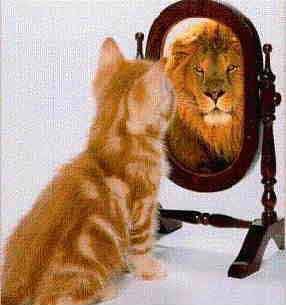
Cats Get a Bad Rap

CatAndMirror

I love dogs. However, I do love cats, too! I don’t currently own a cat which is just weird for me. Cats have a bad reputation though, don’t they? Think of the phrases we use about cats:

1. Tom-cattin’ around.

Males (or even females) slinking around at night looking to get some-some. (Jus’ tellin’ it like it is, folks). Apparently the name of said feline is also Tom.

2. Caterwauling

This is usually a female cat screeching and yowling around while in heat. It is used to describe humans at great risk to the idiot males who determine it would be funny to do so.

3. Like herding cats

This is impossible. They don’t run in herds so aren’t we the stupid ones?

4. Let the Cat out of the Bag

This means to tell a secret. Frankly if my cat was ever in a bag it would not be a secret. The whole house would know. If you don’t understand, you’ve never owned a cat. They are either playing in it by choice, or stuck in it due to HUMAN error.

5. Cattin’ around

Similar to “tom-cattin’ around”. To wander aimlessly looking for entertainment – usually resulting in feline delinquent behavior.

6. Fat cat

Evidently this means loaded, or very rich. I do NOT use this phrase this way.  At the time I was talking to an overweight cat.

7. Curiosity killed the cat

Cuz evidently even though it 1) looked dangerous, 2) smelled dangerous, 3) sounded dangerous, they couldn’t help but investigate anyway. Which leads to #8

8. Cats have nine lives

They get killed a lot. Or, at least do really stupid things that almost result in their demise.

9. Cat got your tongue

Ewww. Just ewww. Yet, it means speechless. This happens to me a lot. *rolls eyes*

10. Cat walk

To walk with splendid balance and grace with a sexy little swing of the hips. Evidently models walk on this. Perhaps cat calls came from this practice.

Cats can be pretty special critters though, and even better fur-babies. They sure get a bad rap, however. People seem to either love ’em or hate ’em. I find few who are indifferent. I’ve met some pretty special cats that behaved very un-cat like at times. And frankly? I’ve had some cats climb up in my lap and allow me to pet them while they purred my cares away more than once. They can be extremely intuitive.

People with Disabilities Get a Bad Rap

I don’t like identifying as a person with a disability. It is the language used by the laws that protect my rights as a person with unique challenges, however, so I accept the “label”. Folks with disabilities get a bad rap though.

Here are just a few of the things I have heard:

1. We complain. A lot.

Evidently about anything and everything; but mostly about our disability. I mean… it’s as if we live with it 24/7 or something. Pretty lame, aren’t we?

2. We are lazy.

In the decades I have mentored and worked as an advocate for persons with disabilities, I believe one of the toughest diagnosis is that of CFS (Chronic Fatigue Syndrome). There are some other diagnoses that are closely related in which the primary symptom is extreme and debilitating fatigue and/or pain. It hurts to do anything. So sometimes, complaints just slip out of the mouths of these brave people. Maybe curse words too, but STUFF SLIPS OUT. It is very, very difficult to live with one of these diagnoses and I admire these folks. I do.

3. We are extremely dependent.

Most of the people I know who are differently abled – work very hard at learning to do things DIFFERENTLY so that they can remain as independent as possible. If you knew how hard it is to ask for help you’d never roll your eyes at a request from someone living with chronic illness or disability.

4. We will never contribute to society.

Geesh. This is so, SO wrong. Most of those I know living with a chronic illness or disability are super busy working in their community. They “give back” at times to the point of going to far and doing to much. Everyone has a desire to be needed – to matter. This includes people with disabilities.

5. We are drama queens/kings.

I’m a bit of a drama llama. I prefer this term because I am crown-less yet recognize I, at times, spit for attention. But seriously… most of us HATE attention. We are trying to just “be normal”. We haven’t created our own song and dance in expectation of applause.

6. We are hypochondriacs.

The thing about long-term disability or chronic conditions, is that you become an expert on your diagnosis. As a matter of fact, at times, you know more than your doctor does. You have researched and investigated everything about your diagnosis and in so doing have learned about similar diagnosis or co-morbid diagnosis. We seek to understand it because we are trying to survive.

7. It’s all about us.

There are selfish people with disabilities and selfish people without disability. Many of us (just like you) work hard at making a difference for others. We actually hate the attention and don’t want it to be about us. We love being able to do even small things to help someone else.

8. We will die young.

Many people with disabilities live an average life span. But folks? They do so never ditching the diagnosis. This makes them WARRIORS. This makes them courageous. This means we could take some lessons from these people.

There are also those whose diagnosis mean their life span will be cut short. These people are still warriors. They simply have less time to prove it to you. So make it a little easier for them and stop judging and embrace their uniqueness. None of us are promised tomorrow. Even those without serious and permanent diagnosis could be gone tomorrow. Shouldn’t we all work to make a difference TODAY instead of write people off as if they have no future?

9. We don’t care about our health.

Yes. Some diagnosis make it really difficult to move, to exercise, and to live a healthy lifestyle. Sometimes people who are differently abled gain weight. But added pounds does not mean they don’t care about their health. As a matter of fact, most of us have learned that dietary changes, moderate (doable) exercise, and holistic approaches can improve the quality of our life. Don’t preach at us to become “juicers” or vegan, or organic shoppers. Don’t tell us to just get out and MOVE. Folks who live with a long-term illness or disability are often avid health nuts. They may not look it, but they work to keep things such as blood sugar, cholesterol, and blood pressure in control. Please don’t judge.

10. We are disabled.

Being disabled does not mean not being able. We are very able. We likely just do things differently. We are still more LIKE you, than not like you. We feel. We love. We get pissed. We yearn to connect. We throw our dog’s ball and scratch our purring fur-balls. We are very able. If in doubt, get to know us and discover it for yourself.

Denise Portis

© 2015 Personal Hearing Loss Journal