Polygamy and Practice

polygamy and practice

Do you know how many times polygamy has cropped up in my conversations? It’s super easy for me to hazard a guess because I have NEVER had a conversation about polygamy. I don’t watch “Sister Wives”, and know very few Mormons (and those I do – do not practice polygamy). So why… WHY would I bring the word up in a chance encounter? *shaking my head at myself*

I’m a creature of habit. I go to the same stores and the same restaurants. I’m super scheduled and my electronic calendar is near and dear to my heart. I’m color-coded. I’m organized.

Therefore, it’s no surprise that I tend to run into the same people at the places I frequent. I have shopped at the same grocery store for almost four years. You tend to run into some of the same people when you frequent a store. When you go everyplace with a service dog, it makes you rather unforgettable, especially with children. It’s no surprise that I see some of the same children in stores who have been curious about and thrilled with Chloe as I shop.

It shouldn’t have surprised me that a little boy I have seen a half a dozen times or more stopped me to ask about my dog. My new partner is Milo, a black shepherd/lab whose appearance is completely different than that of Chloe. Here is a recent photo of both Chloe (retired) and Milo (current). The picture isn’t that great which reminds me I need to work on getting some more “3 musketeers” shots!
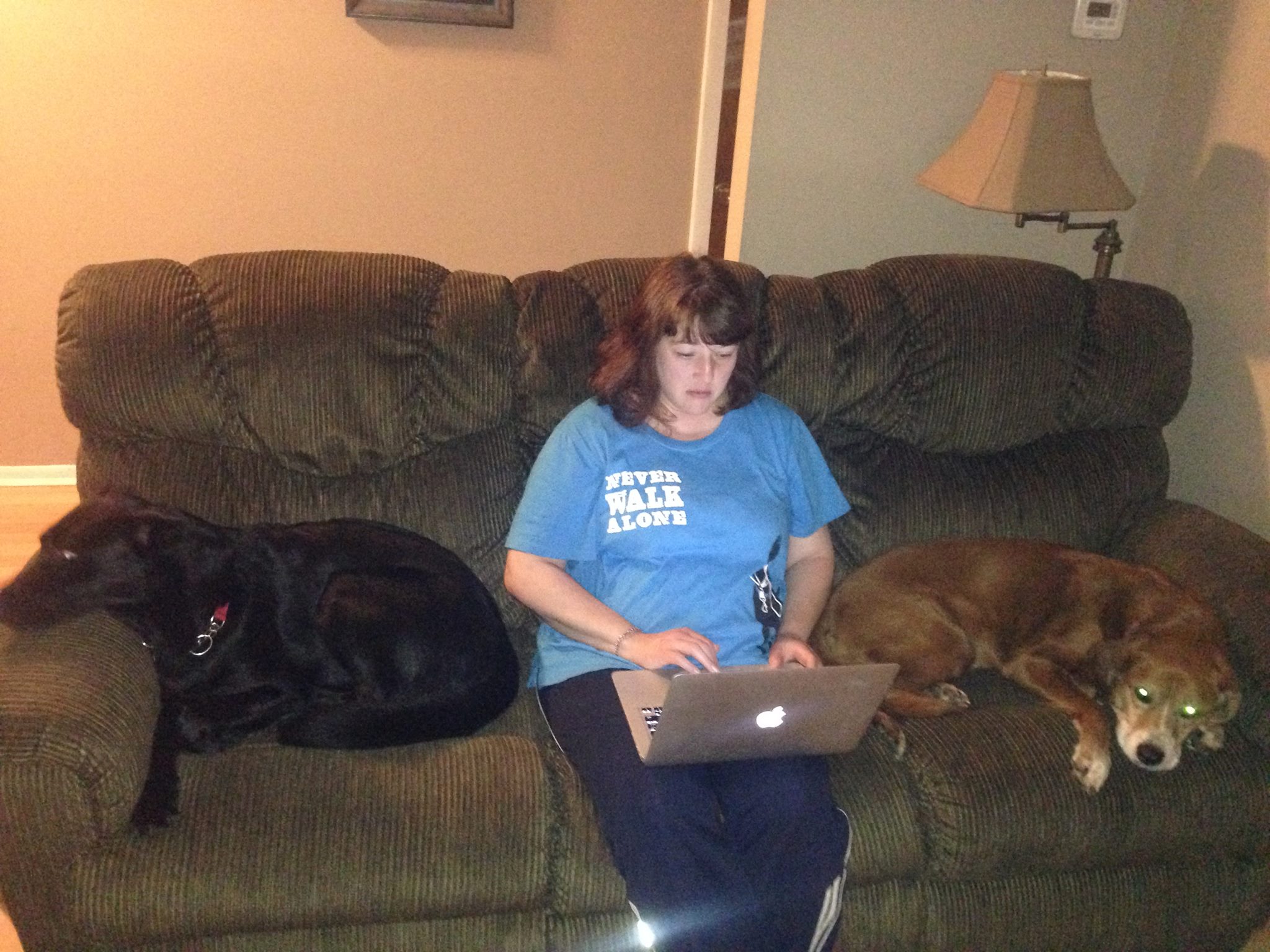
Service Dog Bookends

This little boy that I see occasionally (whose name I DO NOT know – which embarrasses me as he knows my service dog’s name), looked at me with big eyes and said, “Where is Chloe and WHO IS THAT?” (Ya gotta love kids)

I replied, “Oh, this is my new service dog, Milo. Chloe is retired now and is at home sleeping on the couch”.

He looked very solemn and said, “So she still lives with you?

Oh yes“, I said. “She will always live with me. It’s just that Milo is my new partner!

He was quiet for a second or two and said, “So it’s like you are divorced and Milo is your new service dog?

I was so astonished by the seemingly change in topic I stuttered out, “Well… ummm…. no, not at all. Chloe and I aren’t divorced. I guess it’s more like polygamy and both dogs live with me now!

The little guy look TOTALLY CONFUSED, and I glanced up to see the HORRIFIED LOOK on his mother’s face. Ever want to just slap your hand over your mouth? I knew as soon as I said it that it was 1) totally inappropriate, 2) would take the mother all day to explain to her son, and 3) completely “off the wall”.

I made a mess of trying to back peddle (for people with balance disorders can do precious little BACKWARDS), and hurriedly made my way down the next aisle.

I stood in the international food section fussin’ at myself and nearly in tears for using such a poor analogy around a 6-year-old. I determined then and there I needed to PrAcTiCe PrAcTiCe PRACTICE what to say in response to “where’s Chloe and who is THIS?

Part of Good Advocacy is Practiced Responses

Being a good advocate and representative of “whatever ails ya” means you have good responses when someone asks questions. I have learned the HARD WAY, that these responses need to be rehearsed. When you are taken by surprise by either well-meaning, curious people or rude, snarky trouble-makers, you want to have a measured, helpful reply so that you advocate in a positive and helpful manner. I have found that if I don’t have a “canned response”, I tend to match the tone and demeanor of the person asking. This means that sometimes I am pleasant and in “teacher mode”, with great responses that educate and advocate on behalf of the disability community. However, other times I’m waving my cane in a curmudgeon’s face and informing them in no-uncertain terms how horrible they are.

At Fidos For Freedom, Inc., (where I trained for now – TWO – service dogs), we practice how to respond when encountering access issues. If you have a service dog, it is not a matter of IF you have access issues, rather WHEN you have access issues. It is easy to get flustered. It is easy to get mad. It is easy to say the wrong thing. Practice makes it much easier to respond with something that will actually help you and others like yourself.

Doesn’t it Suck that Many of the Rude Ones are “Kin”?

What is even harder is when the person acting incredulous and skeptical is someone you know well or are even family. I’m lucky that I have a very supportive spouse and adult children. Even so… it is hard to love someone with a chronic condition. Once in awhile, my husband (or kids) do not filter what they are saying, because they, too, are sick and tired of Meniere’s disease. I’m 100% certain my husband has rehearsed responses to commiserate appropriately so that he doesn’t spend the night on the couch.

(Holding an ice pack on my cheek, or head), “I’m so tired of falling and staggering around! What I wouldn’t give for just one day of no vertigo!

It must suck, honey!” is the rehearsed response so that “Yeah, I’m getting tired of taking off work to take you to the E.R.” doesn’t slip out.

It can really hurt when someone who knows you better than others “opens their mouth and inserts foot”. I recommend that even support people practice and learn how to deliver sympathy and encouragement.

You Will Still Blow It

Even if you practice measured, helpful responses to personal questions, you are still going to blow it from time to time. A couple of Sundays ago I was ticked off at myself for not responding kindly to someone and was thinking, “Denise! You’ve had this diagnosis for 2 decades! Exactly WHEN is it gonna become HABIT?

I sit during the worship service. It isn’t because I cannot stand. Folks are surprised when they learn that at work, I stay standing for very long periods of time. I actually MOVE very easily and with very little wobble. It’s standing still that is the problem. My world turns… counter-clockwise when I’m standing still. I love my church. They are very supportive of people who are differently-abled. We have a loop system in the auditorium for people with hearing loss. We have fully accessible bathrooms and classrooms. We have an elevator and a lift for people with mobility issues. In spite of this, I’m forced to sit during the worship service. My church puts the words to the songs on the wall using a projector. We have a beautiful stage and lights as well. The song lyrics are in a multi-media slide show with patterns, colors, movement and lights. Everything is color-coordinated and changes song to song. The freaky OCD person in me is in awe every Sunday. It’s gorgeous! But… I can’t stand. If I do, I’m fighting consciousness. It isn’t a problem, for I don’t mind sitting. I’m comfortable and SAFE. I learned that not everyone understands why I’m sitting, however.

An elderly person came up to me at the beginning of the service and asked me how to access the hearing loop in the auditorium. I removed my cochlear implant and hearing aid and demonstrated how to switch to t-coil. I get this question about once a month and I’m always glad to educate. I love the hearing loop and it has dramatically transformed church for me. I love answering questions to help others access this wonderful technology. So wasn’t I surprised by the encounter, but totally floored by the follow-up question:

So why are you seated during the music? I’m way older than you and even I can stand!

I don’t know if it was the environment, the timing, or the unexpectedness of the question, but can I tell you … I really took it wrong? I could FEEL the tension creep up my spine and I was mentally counting to ten and trying to diffuse the explosion about to spew out of my mouth. THIS ONE I hadn’t practiced for. I hadn’t run any scenarios through my head and out through my heart filter to answer a question like this appropriately. So I didn’t.

Wow. That was really, really mean. We’re done,” I said. The person looked startled, then uncomfortable and walked away. I think the last action was because I’m certain my look was murderous. I mean… I was MAD. (I later apologized).

Folks are gonna take you by surprise once in awhile. You will hear an insensitive comment from someone you weren’t expecting it from and it will just shock you into silence (if you are lucky) or cause you to say something you regret. It is best to be prepared.

Ummm… WHY SHOULD I?

Maybe you are thinking that if people are going to be insensitive and inconsiderate, that “why should I temper what I say in response?

Since we are on the subject… here are some “canned responses”:

1. You don’t want to sink to their level.

2. You need to be the mature one.

3. Kill ’em with kindness.

4. In the end, you advocate for all of us.

5. Honey attracts more bees than vinegar.

Well.

I happen to love vinegar. I mean… don’t get me started on pickles. There are few things I love more. Let’s be honest though… from someone who is differently-abled to someone who may also live with acquired disability, chronic illness, or invisible issues, “WHY should we be careful in our response?

(sigh)

Because it’s the RIGHT thing to do. Sucks, don’t it? I can tell you from experience though that it is much better to answer correctly and watch someone else squirm, than to have to apologize for “going off” on someone. Go practice, my friends! You’ll be glad you did!

Denise Portis

© 2015 Personal Hearing Loss Journal
NOT “The End” – Turning the Page on a New Chapter

"Hanging it Up"
“Hanging it Up”

I’m a reader. Perhaps it has something to do with having a mother who was an English teacher. Maybe it is because both my parents are readers. All I know, is that I can’t remember not having books. I lived in a rural, farming community and as it was before the “age of the Internet”, much of what we did in our free time was reading. Thanks to my mom, I have read all the “great classics”. I also grew up reading series such as “Trixie Belden”, “The Bobbsey Twins”, “Nancy Drew”, “Hardy Boys”, “Sugar-Creek Gang”, “Agatha Christie”, and “Little House on the Prairie”. I remember being SO BORED one summer that I started reading my dad’s favorite series, “Louis L’Amour” and discovered they were actually OK too!

I always felt a little melancholy when coming to the end of a good book. If it was a series, I fretfully waited for the sequel to come out. It was especially hard when the author ended a book with a “cliff-hanger”. I think that is when I started biting my nails.

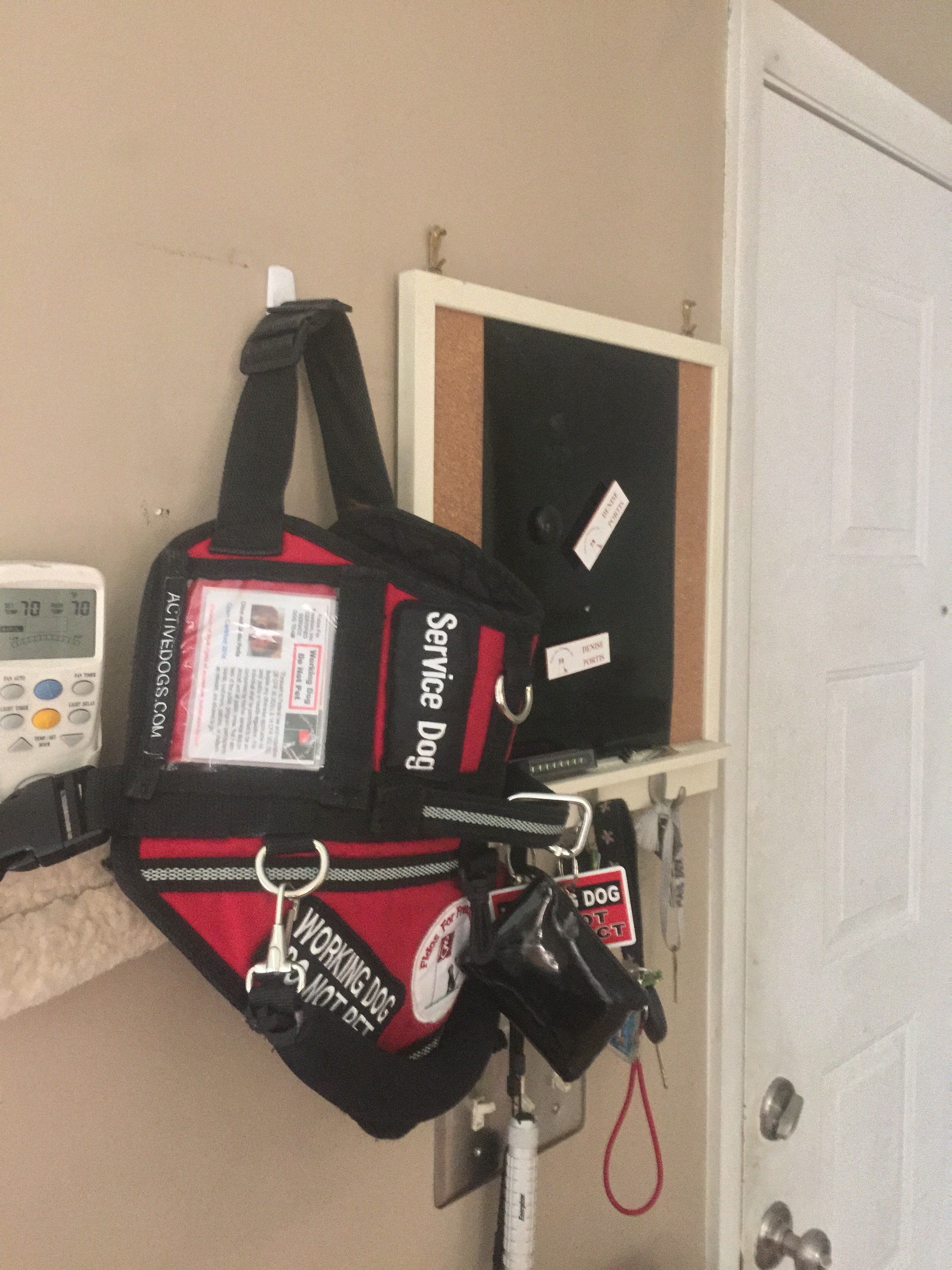
I’ve had an emotional roller-coaster kind of 2015. I have been slowly easing my service dog, Chloe, into part-time work. I have already started training for a successor dog at Fidos For Freedom, Inc. In the past week, Chloe has gone from part-time working dog to “when hound dog feels like it”. I always ask her if she wants to “get dressed” and more often than not she flops her tail at me and gives me a sweet hound-dog look. “See you later, mom! I’ll be here when you get back!” 

Her vest is more often hanging on its hook, than it is being worn by faithful service dog. It has been a harder transition on me than it has been on her, and frankly? That’s the way I want it.

People notice that Chloe isn’t with me now. I suppose when you are thought of as a team, when the “cute red head” is missing, people notice. I’ve answered these questions dozens of times:

“You get to keep her, don’t you?”

“What will she do all day?”

“How will a new partner and Chloe get along?”

At first, it made me really sad to see her vest hanging on it’s hook as I walked out the door. I had an overwhelming feeling of finality. I know I’m making the right decision, but for awhile I felt like I was facing the end of a book–“The End“.

However, I realized that just like in OUR lives, finishing one chapter in life doesn’t mean the book is over. We plan to ease Chloe into therapy dog work if it is something both my husband and I can work into our schedules. If she doesn’t transition that direction, she will continue to be a beloved furry member of our family.

When the Life You Had Is Over…

One of the most disconcerting things about acquired disabilities or invisible, chronic illnesses, is that at some point you may not be able to do everything that you once were able to do. I’ve heard some people say, “Don’t ever say you CAN’T. Just find a new way of doing it!” But friends? That isn’t always realistic.

Take roller-skating for example. I love to roller-skate. I was actually pretty good at it, too. I could skate backwards, do a single axle, speed race, limbo on skates, and much more. Post balance/vestibular disorder, I can no longer skate. Sure, I could probably find various devices to prop myself up, or skate with a walker on wheels. But, I won’t be skating like I was. This doesn’t mean that I stop doing ALL extra-curricular activities. There ARE some things I can still do and do so safely. I simply started a new chapter in my book, “This is My Life“.

Some people find that after acquired disability or diagnosis, they can no longer work. Their “new normal” includes chronic pain, debilitating fatigue, or other symptoms that make it impossible for them to work “9 to 5”. However, they may find they there are some things they can do to continue earning a paycheck. There are a variety of things one can do to earn money while working at home.

Some people become volunteers and do a number of things that yield personal satisfaction and allow them to “give back”; however, the activities are not dependent on a set schedule. I know some people who no longer work due to a diagnosis, and likely do TOO MUCH as volunteers. There are so many opportunities! There are so many ways people of various abilities can do to benefit others.

If your life took an unexpected turn after a diagnosis or acquired disability, your book isn’t finished. You are just starting a new chapter.

BUT… YOU DON’T UNDERSTAND. Everything in my life has changed! I cannot successfully reach goals I made a long time ago before this diagnosis. My friends have changed. My relationship status has changed. My book really is approaching “The End”. 

Perhaps your life really did experience a 180 change in direction. Some of my favorite books are part of a SERIES. The book may have ended, but there is a sequel. Set new goals. Make new friends. Do new things. I have found that some of the most rewarding experiences I have had were the direct result of my embracing my own “new normal”. I stopped trying to be the Denise I was before hearing loss and Meniere’s disease. The people I have met, the job that I have, and the organizations in which I am involved would have never been a part of my life if I hadn’t been forced to start a new chapter, or even a new book in a part of a series.

Hanging your vest up? Have major changes happened in your life? Your story isn’t finished. The chapter may be done. The book may even be finished. Your story is NOT complete.

Writer’s block? Network with others who have similar diagnosis as you do. See what they do to volunteer, serve, or even jobs and careers they may have. It’s never too late to go back to school! Many older adults sit in my classrooms taking classes to earn a degree and prepare them for something new. Gone are the days where all my students were 18 and 19 years old.

From an editorial review of “The Story of My Life” by Helen Keller: “Many of her later works were largely autobiographical, but there was always an emphasis on the inherent power of the individual to journey through life with hope. The Story of My Life is the first chapter in such a journey.”

If your life has significantly changed, it is simply the end of a chapter. Your story – your journey continues.

Denise Portis

© 2015 Personal Hearing Loss Journal
Time Lapse

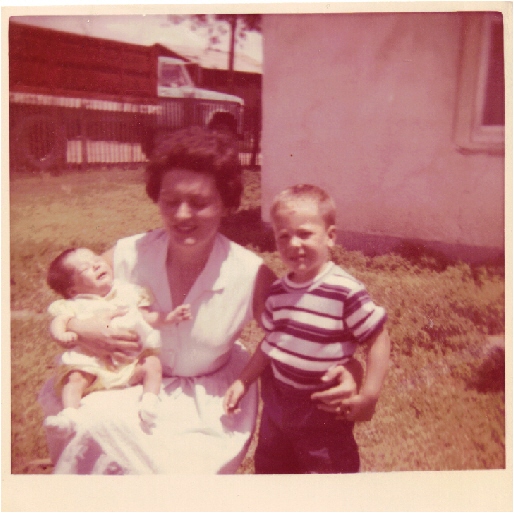
One of my first photos, 1966 with my mother and older brother, Lee.
My life today...
My life today…

Oh to be able to see a time lapse of your life! Recently, someone I knew from “my old hometown”, posted a video of a rose blooming in a time-lapse segment. Just a little over a minute long, I sat spell-bound as I watched. Here… lemme share a little spell-binding:

So consider yourself bound by a spell!

Erm…

Moving on…

When I think back over my life, I know that at no point did I foresee who I would be in 2014. I had no plans for a traumatic brain injury at the age of 6. I didn’t put down “late-deafened adult at 25” as a life goal. I never had a hint that I would deal with Meniere’s disease on a daily basis.

There are few things I desire in life. I feel blessed in what I have. However, if I had to explain a “main theme” on my “Bucket List”, I would have to say my heart’s desire is a slow build to real beauty. Just like the rose bush above in that my imagination could not capture what was to come AFTER TIME.

What I think is beautiful today is not at all what I thought was beautiful at 6 years old, 16 years old, or 46 years old. Outer beauty is fleeting and temporary. Outer beauty needs a number of “props” just to pass as beautiful. Things like make-up, proper lighting, staging, and other “props” that are not really a part of the person. Now that I’m 48, beauty is truly an inner kind of spark.

A friend of mine, Deborah, celebrates a birthday today. She is one of those “slow build to beauty” kind of people. The longer I know her, the more her beauty is revealed to me. She has a heart for people and a passion for making a difference.

Just Because You have Broken Parts, Doesn’t Mean You are BROKEN

Years ago when I decided to embrace who I was, life became easier. I stopped trying to hide how I dealt with challenges and decided that being REAL was much more nurturing for my inner Denise.

My ears don’t work without the aid of bionics. My balance causes me to fall – a lot. My most “frequent” view is staring at the sky while I “get a grip”. (Hey! At least this means I get outside a great deal!). I may have broken parts as a person with disabilities, but I am not broken.

Neither are you. Do you live with disability, chronic illness, or life-changing diagnosis? You may have broken parts but you are not broken. Some of the most courageous people I know are folks who live with challenges. If we could look at a time lapse of your life, what would it show?

Sure. We would get some indication of dealing with tough times. We would see wounds. We would also see numerous victories. I’m fairly certain we would see a slow build to beauty, however. It helps to take a step back and look at the big picture from time to time. After all, living with challenges can cause a person to get bogged down in “today” and just surviving. May each of us remember to review our time-lapse life and celebrate the beauty.

Denise Portis

© 2014 Personal Hearing Loss Journal

Your Thinker and the Trickle Down Effect

squirrel-pin-tree-winter-snow-nature-hd-wallpaper-desktop-free-animals-picture-squirrel-hd-wallpaper

Wednesday, March 19th

I had a “pep in my step”. I had a whistle on my lips. My heart was glad. I was walking my service dog and most of the snow was gone from the ground.

“What beautiful weather for a walk!” I thought to myself.

But then a squirrel scampered down off a tree trunk merely inches in front of my well-trained service dog’s nose. It all happened so fast.

The first jerk on the leash put my body in motion. You can’t fight the laws of science. I was going to be in motion until something stopped my motion since my brain went on instant vacay. Let me tell you I stuck the landing. Nearby Olympic judges all held up “10” placards. Cheers all around (or at least in my imagination).

I lay there on the pine-needle strewn ground for a minute trying to determine if anything was broken. The world was still spinning. I closed my eyes for a minute and choked back the nausea. Flipping to my back I felt a hound dog kiss on my face.

“Whew. Chloe is still here”, I thought.

I forced my brain to verify the leash was actually still in my hand. YUP! I opened my eyes and focused for a second. Chloe went into a down/stay on her own and rested her head on my shoulder. The weight of my ding-a-ling service dog’s head was a comfort.

I heard something! Another good sign. My cochlear implant was still attached to my head. I focused on the sound and looked up – Up – UP into the tree boughs above me and spotted that rascal squirrel.

Oh.

My.

Gosh.

He had the impudence to sit up there fussing – at US. I couldn’t help but laugh. He was ticked! I laughed all the way up until he skipped away… jerking the branch he was on and dumping snow on my face and chest from twenty feet up. My laughter stopped immediately. I was choking after all…

I sat up and brushed the snow off and started to giggle again. Chloe wagged her tail in delight. It seems she wasn’t going to get a “Denise sermon” after all. Within 10-15 seconds though I was overcome with a different emotion. I sat there crying. Not just silent tears – nooooooo. This was unladylike, deep sobs with intermittent hiccups!

I sat there bawling my eyes out for five or six minutes, comforted by a hound dog most certainly sorry her instincts caused another “Timber…” moment for me.

Yes. I could see the funny. But fast on the heels of the laughter and positive attitude came an emotion near the surface most days. Self-pity. Sorrow. I hate my life.

Is Happiness a Choice?

One of my favorite books is “Happiness is a Choice” by Minirth and Meier. The premise of the book is that especially for those of us living with depression, happiness is a choice. The book’s number one principle is: “Change the way you talk to yourself”.

I’m on board with that. Really!

I am!

You can change some of the negative aspects of your thinking by challenging the irrational parts and replacing them with more reasonable thoughts” (Martin, 2010, para. 4). Whitbourne (2013) explained these, “inner monologues as “self-talk,” in which you provide opinions and evaluations on what you’re doing as you’re doing it. You can think of self-talk as the inner voice equivalent of sports announcers commenting on a player’s successes or failures on the playing field” (para. 1). I believe in the power of self-talk. I believe our “thinker” really can influence our behavior. My husband is a cognitive psychologist. He and I have a lot of discussions as I work on my own Ph.D. about the best ways to change behavior. He – and other professionals like him – believe that if you can simply change what your thinker is thinking, there will be a trickle down effect. It will influence and possibly change behaviors you wish to change. There is a lot of scholarly research and science to support this.

I believe this! I do! But I will be honest for a moment. There are times I want to just say…

SCREW SCIENCE

That’s right. Just in case you even needed MY – or ANYONE’s permission…

It is OK to be upset about the reality of your life.

Living with acquired disability sucks. Hearing loss sucks. Meniere’s disease sucks. How about you? Fill in the blank:

_____________________ SUCKS.

*Deep Cleansing Breath*

I’ve tried to explain to folks who ask, that living with a chronic condition or acquired disability is – on the best of days – HARD.

I still get the flu.

I have still lost people I love and miss them.

I have lost beloved pets.

I get headaches, body aches, and am growing older.

I get mad at my family sometimes.

I experience car problems.

I hate traffic.

I have unexpected bills.

I still have a period (hey! Jus’ layin’ it all out there! <BIG GRIN>)

All of these things happen to me just like they happen to you. Only folks with chronic illness or acquired disability have those things happen on top of what – for them, is the norm… living with challenges daily.

Yeah, yeah. I know!

I still get the flu   I can be thankful I have medicine to help and a hound dog to cuddle with. See? I can see the positive!

I have still lost people I love and miss them  I can be thankful I will see them again someday based on my personal faith beliefs and worldview.

I have lost beloved pets  I have other furry family members and that makes me happy.

I get headaches, body aches, and am growing older  Beats the alternative. Right? 

I get mad at my family sometimes   But I have a family…

I experience car problems.  But I have a car and this time we could afford the “fix”.

I hate traffic.  I have a job to go to.

I have unexpected bills.  But I’m smart enough to figure out how to pay that bill or arrange payments.

I still have a period Yeah. I got nuthin… (LOL)

So can my forced “change thinking” have a trickle down effect and influence my behavior, feelings, and perceptions? Yes.

And no.

Confused? I don’t mean to be the cause of a “What the heck you talkin’ about, Denise?” thoughts.

However, it is important – at least I think it is – to allow yourself to have moments of self-pity. Feel the sorrow. Rail at God. Write “My Life Can Suck” really big and pin it to a wall and throw darts at it. If it makes you feel better, do it. I think it is healthy to “own your feelings” about the reality of your life. It’s hard. You may feel alone. You may want to give up. It’s OK to feel that way.

But then? (Brace yourself…)

Change your thinker. Allow it to do what studies have shown actually works. The “Trickle Down Effect”. I’m here to tell you though that it isn’t a long-term fix. You may have to “adjust the knobs on your thinker” daily. Maybe on REEEEEALLY bad days – hourly!

Do you know what thoughts help me the most?

Keep on keeping on.

I can make a difference in the life of another.

Tomorrow is a new day.

Mean People Suck. (Sorry. That’s my favorite bumper sticker and I *had* to throw it in there).

Yup. They are platitudes. “Feel good self-talk”. But ya know something? It works for me because I also allow myself the freedom to sit in the pine-needles with snow covering my shoulders and bawl my eyes out.

So strive to improve your self-talk. But feel free to wail.

{{{{{{{{{CYBER HUG}}}}}}}}}}}} from me to you!

Denise Portis

©2014 Personal Hearing Loss Journal
Martin, B. (2010). Challenging Negative Self-Talk. Psych Central. Retrieved on March 21, 2014, from http://psychcentral.com/lib/challenging-negative-self-talk/0003196

Whitbourne, S. K. (2013). Make Your Self-Talk Work for You. Psychology Today. Retrieved on March 21, 2014, from http://www.psychologytoday.com/blog/fulfillment-any-age/201309/make-your-self-talk-work-you

Courage!


The Cowardly Lion from "The Wizard of Oz"

Cowardly Lion: Courage! What makes a king out of a slave? Courage! What makes the flag on the mast to wave? Courage! What makes the elephant charge his tusk in the misty mist, or the dusky dusk? What makes the muskrat guard his musk? Courage! What makes the sphinx the seventh wonder? Courage! What makes the dawn come up like thunder? Courage! What makes the Hottentot so hot? What puts the “ape” in apricot? What have they got that I ain’t got?
Dorothy, Scarecrow, Tin Woodsman: Courage!
Cowardly Lion: You can say that again!

cour·age

[kur-ij, kuhr-]

noun

the quality of mind or spirit that enables a person to face difficulty, danger, pain, etc., without fear; bravery.

What Kind of People Have Courage?

Exactly what kind of people have courage? In my opinion, courage is not found in a specific “kind” of person, personality, gender, or culture. Courage can be found in the heart of any individual. Facing life develops courage in our hearts. I began thinking about courage this past week. I was waiting outside a classroom as I had arrived a bit early. I have no idea what kind of class was being held in room 406, but I heard the professor say, “When you think of someone who is courageous, who comes to mind?

I couldn’t hear all the responses, but some that I did hear included:

men and women in the armed forces

parents

law enforcement officers

and firefighters.

As I sat leaning against the wall eavesdropping on the class discussion, I thought about how I would answer that question should anyone ever ask me.

“People with disABILITIES have courage”

Part of the reason I love Fidos For Freedom so much is that the clients, trainers, and volunteers have become like family to me. There are a number of disABILITIES present in people who are “family” at this organization. People who are “differently-abled”. Some of the clients are deaf (or Deaf), some have balance problems, chronic fatigue syndrome, fibromyalgia, chronic pain (from accidents or illness), CRPS, MS, and the list goes on. No matter the background or current health status of any one individual, one thing I see in the face of ALL is – COURAGE.

How can we be SO different and struggle with such a wide variety of challenges, and yet all have courage? Bill Tipton said, “Increasing your courage to take calculated risks can improve your general well-being and attitude in life. Learning to transform the negative reaction of fear of failure to a positive sensation of opportunity can enhance your chances for success. I believe people with disabilities, or perceived differences, get more opportunities to demonstrate and practice courageousness” (Global Dialogue Center, 2011)

I believe when a person takes a “calculated” risk and strives to improve their life, courage results. I have seen people work very hard to train assistance dogs. I have seen people work very hard to train to be matched with an assistance dog. Different people have different obstacles, but all push on… reaching for that goal of more independence. I’ve seen clients training who are in obvious pain. I have seen people work hard at taking risks and learning new ways of doing things so that they may safely and confidently handle a dog partner. This is courage.

How Does One Find Courage?

Jayne Leone said, “Related to the word courage are the words encourage and discourage. (In fact within the word courage is the word rage.) Think of the times we have encouraged ourselves or encouraged others. Now think of the times we have discouraged ourselves and discouraged others. There are many buzz words being used today — such as empowerment, challenged, support — used by many professionals, when in reality the operative word is courage, encourage or discourage. As we well know, many social institutions can encourage us or discourage us as disabled persons. They can help us be empowered, help us to maintain self-control, help us be self confident, help us gain courage. By discouraging us they can do the opposite” (Independent Living Institute, 1997).

I believe that courage isn’t an attribute one learns and then “ya got it“. I do believe that courage, though hard-earned and a difficult teacher, is practiced by choice on a daily basis. This is why we have “good days” and “bad days”. I think the key to having an abundant life is to have more “good days” than “bad days”, but allow “bad days” to act as a learning experience as well. Let’s face it. We are going to have bad days. Don’t you think the key is in how one RESPONDS to a bad day? Courage doesn’t disappear on bad days. Courage doesn’t guarantee success.

Sometimes? Courage is going to bed after a “bad day”, with resolve to try again tomorrow. Courage means you simply refuse to accept defeat.

The Lion now walked to the Throne Room and knocked at the door.

“Come in,” said Oz.

“I have come for my courage,” announced the Lion, entering the room.

“Very well,” answered the little man; “I will get it for you.”

He went to a cupboard and reaching up to a high shelf took down a square green bottle, the contents of which he poured into a green-gold dish, beautifully carved. Placing this before the Cowardly Lion, who sniffed at it as if he did not like it, the Wizard said:

“Drink.”

“What is it?” asked the Lion.

“Well,” answered Oz, “if it were inside of you, it would be courage. You know, of course, that courage is always inside one; so that this really cannot be called courage until you have swallowed it. Therefore I advise you to drink it as soon as possible.”

The Lion hesitated no longer, but drank till the dish was empty.

“How do you feel now?” asked Oz.

“Full of courage,” replied the Lion, who went joyfully back to his friends to tell them of his good fortune.

Swallow Courage

Ever get caught up in wishing things were different? Do you ever wish you were simply “normal”? (Who defines what is NORMAL, anyway?) I’m at various stages of accepting who I am today. Sometimes I have a clear vision of my “new normal” and seem to understand the “new me”. At other times though? I’ll be honest – I flounder. There is a part of me that wants to “fit in” and do things like “normal” people do.

Why do I have to find batteries so that I can continue hearing when my CI “dies”?

Why do I have to stand and sit slowly?

Why do I have to remove my hearing aid at times when the ear mold leaves a sore in my ear?

Why do I have to use my hands (or Chloe) on the stairs to safely navigate “UP”?

One must “swallow” courage – to believe!

My husband reminded me the other day that even people without disABILITIES struggle with acceptance. As a psychologist, he has seen folks from all walks of life struggle with accepting the way things are TODAY. Age may have made a change in your “normal”. An accident, illness or disABILITY may have changed your “normal”. He said, ““You have differences that make you uniquely you, but that also require some assistance. Without Chloe you’d fall more and miss more. Without your implant you are deaf. You need to accept who you are without apology and stop looking to be treated normally”.

Courage ≠ Never Being Afraid

“But how about my courage?” asked the Lion anxiously.

“You have plenty of courage, I am sure,” answered Oz. “All you need is confidence in yourself. There is no living thing that is not afraid when it faces danger. True courage is in facing danger when you are afraid, and that kind of courage you have in plenty.”

“Perhaps I have, but I’m scared just the same,” said the Lion. “I shall really be very unhappy unless you give me the sort of courage that makes one forget he is afraid.”

You can have courage and still feel fear. The unknown can be a scary thing. When an acquired disABILITY occurs in the life of a person, there are no guarantees things will not get worse. Many have progressive symptoms. Courage does give us the ability to deal with change, however. Few are born with courage. It is a learned skill, an acquired characteristic.

The Cowardly Lion has always been a favorite of mine in “The Wizard of Oz”. I loved both the movie and the books. I smile when he uses his tail to wipe his self-pitying tears away. I grin when he “shakes” in fear of the Wicked Witch and trembles at the sight of the flying monkeys. I know the end of the story. The Cowardly Lion shows courage time and again throughout the movie, putting himself at risk for others and to achieve his own ultimate goal… a gift bestowed from the Wizard – that of courage. Unbeknownst to the Cowardly Lion, courage lay dormant in his fearful heart. He only had to exercise what was already there.

I hope that YOU believe that courage is in your heart. You may not even recognize it. If you take risks and live life “in spite of”? You have courage!

Denise Portis

© Personal Hearing Loss Journal

http://globaldialoguecenter.blogs.com/disabilities/2011/05/courage-enabler-for-people-with-disabilities-or-perceived-differences.html

http://www.independentliving.org/docs5/Leone97.html


Imagine!

Emmanuel Kelly The X Factor 2011 Auditions.

Click on above link for short performance!

I’m not a huge YouTube fan, because captions on music and video are not “perfect”. It’s better than it use to be, but it isn’t good enough that I could say I really enjoy it.

However, this past year I discovered “The X Factor”. It is now in the U.S. and the FOX network is underway on season one. I still like watching the shows in other countries as well. I came across this very special one this past week.

I was so impressed with Emmanuel Kelly’s performance. I think he and his brother’s adoption story and courage can teach so much. Bravery, courage, and “spunk” are not narrowly defined by a body that wields these attributes. Imagine what our world would be like if everyone saw with filtered eyes what Emmanuel’s mother did. Imagine what it would be like if everyone had someone in their corner during developmental years to mold and shape phenomenal human beings. Imagine if every individual with bodies that are broken, damaged, disABLED, or diseased learned to refine and use their gifts.

Learning to live with an acquired disability can be hard. There are always harsh lessons. Yet… acquired disability is not the end of life. We all have talents, skills, and gifts that are not affected by any changes you may find that define “the new me”. Sure… you may lose a few opportunities. I use to sing in choirs. (SMILE). Yet, I still choose to discover, refine, and eventually use the gifts that I DO have. You can do the same. May we all learn to look past first impressions and appearances… learning to IMAGINE.

Imagine there’s no Heaven
It’s easy if you try
No hell below us
Above us only sky
Imagine all the people
Living for today

Imagine there’s no countries
It isn’t hard to do
Nothing to kill or die for
And no religion too
Imagine all the people
Living life in peace

You may say that I’m a dreamer
But I’m not the only one
I hope someday you’ll join us
And the world will be as one

Imagine no possessions
I wonder if you can
No need for greed or hunger
A brotherhood of man
Imagine all the people
Sharing all the world

You may say that I’m a dreamer
But I’m not the only one
I hope someday you’ll join us
And the world will live as one

Denise Portis

© 2011 Personal Hearing Loss Journal

“Family”

Approximately 1 in every 8 Americans experience some degree of hearing loss (Binder, 2011). This is approximately 36 million people – just in the United States. While to some, this number may seem overwhelming or unfortunate. For me? I have to admit to a small “thrill” – for you see… I’m a part of this “family”. I am one of those “1 in 8”.

What is “family”? The obvious definition includes those to whom you are related. I’m very grateful for my immediate family, for in many ways they fall into the “family” of which I am writing today as well. For the purpose of this post, “family” consists of individuals who understand by direct or indirect experience, a life that may be different as the result of disability – whether it be congenital or adventitious.

Hearing Loss Association of America

I recently had a couple of wonderful weekends that helped solidify this feeling of “family” for me. The first was when I went to one day of the 4 day national convention for the Hearing Loss Association of America. This year it was in my area, so I could not pass up trying to go at least one day. I was able to attend a number of workshops, all of which had CART. The rooms had terrific amplification, so I was able to hear the speakers of each workshop very well thanks to my cochlear implant. However, there were a number of people in each workshop who used the CART. On a large screen next to the speaker, every word spoken was also typed by a trained captionist. Those who had never experienced CART before, and therefore had never experienced workshops such as these that were truly accessible, hung on every typed word! As I looked around, nearly every ear had a hearing aid or cochlear implant – sometimes BOTH. I counted six hearing assistance dogs in attendance at the convention on Saturday. I was surrounded by “family”. Even those without hearing loss knew someone who did, were family members, or professionals that worked with our population. Between workshops old friends and new friends often crowded around talking. I couldn’t get over feeling like I knew these people. There were no snide comments or competition over who had the better cochlear implant or hearing aid. We were all “family” – with an intimate knowledge of what it means to live with hearing loss.

I attend a local chapter of HLAA, but being at a national event has no equal. The Internet has allowed people with similar disabilities to contact, share information, and get to know each other in a supportive environment. Some of the people I met I had only known online. However, these national conventions allow us to meet face-to-face! What a treat to literally hug the neck of some of my “family”!

This past weekend, I was able to hang out with a wonderful friend who has bilateral Nucleus Freedoms. She lives in North Carolina and since my husband and I were going down to visit his mom and dad, I took the opportunity to spend the morning with her. She took me to one of her favorite places – the North Carolina Zoo. I hadn’t seen the zoo in at least nine years – not since I had moved away from the area in 2002. We have so much in common in addition to hearing loss. No – we do not have similar backgrounds or childhood experiences. But we both are advocates and do all we can in our own small realm of influence to make a DIFFERENCE. She is a sensitive soul who sees much more than a normal set of eyes can see. It shows up in her photography and in the simple things she points out. A whispered, “L o o k“, usually yields a treat of catching LIFE in an unexpected way. I consider her “family” although we are not related.

Fidos For Freedom, Inc.

At Fidos For Freedom, clients include those with mobility issues caused by numerous types of disability or illness, and people with hearing loss. I cannot count the number of different types of disease, invisible illness, and disabilities present in our “family” at Fidos. The fact we are there for the same reason makes us “family”. Whether client, trainer, puppy raiser, volunteer, or DOG… we find a bond and sense of “family” that cannot be found in other groups in our lives.

I am thrilled to share information and get to know people all across the U.S. who are partnered with assistance dogs. Our disability or invisible illness may be different… but we are the same. Some have partners from organizations like Fidos and some are owner-trained teams. Regardless, we are “family” and I feel a loyalty towards these teams that defines the kind of “family” we are.

Sometimes FAMILY are not “Family”

My readers share with me sometimes that trying to get family to understand what it is like to live life in “their shoes” is quite difficult. For those who acquired disability or invisible illness later in life it may make more sense that family members such as parents and siblings seem incapable of grasping who you are now. However, there are others who have shared that even though their own challenges began at birth, family members are unable to fully understand (or perhaps cope?) what it is like to experience life with additional challenges. I truly believe that people with disability and invisible illness are more capable than those who are “normal”. Learning to adapt, and seeking support, information, and techniques create a malleable, strong individual. Oh sure! There are times we flounder. Change is never easy. But the end result yields a person who is extremely ABLE – not disabled. It is unfortunate that many people to whom we are related are unable to really connect with us once change takes place. Perhaps our peers often become “family” to us because they help us stay connected to life in a more positive way. They understand. Relatives often lose contact with us or only see us once in a great while. These individuals who offer daily support, information, and “family” literally evolve into a close knit community and family. I have had some readers share that they are closer to those in their peer group (disability group) than they are to siblings, parents, and other relatives. They have shared that not only do these “real” family members not understand – they don’t want to understand. I was recently reminded that my own siblings do not really know who I am anymore. After something rather tragic occurred in a relationship I find now broken, I wailed to my mother on the phone how terrible it all was. I shared some things with her that I had never shared before… and she responded, “You never shared these things with me when you were going through this”. So I am (painfully) aware that sometimes our family members are unaware and out of touch because we withdraw.

I am blessed to have family who are also “family”. My immediate family have been a safe haven of support throughout all of my adult life. My children have never known me without hearing loss. Mom’s favorite word growing up has always been “huh?” My husband held my hand both literally and figuratively throughout the process of losing my hearing over 12 years. When I became profoundly deaf, he was my biggest cheerleader in seeking other technology that would help me hear again. My family willingly sacrificed so that I could attend trainings and eventually receive an assistance dog so that I could be more independent. My immediate family members advocate for those who have any type of special challenge. They have participated in TBI (traumatic brain injury) camps, hearing loss conventions, local HLAA chapters, Walks for Hearing, cancer awareness walks, and much more. They know and realize that  disability or invisible illness does not define the person. They have always seen the PERSON first. Because they understand what it means to live with disability or invisible illness simply because they LOVE someone who does have challenges, they are “family” as well as family. I hope that many of you have family members that are also “family”. People who support you without hindering you. People who cheer you on and look forward to your eventual success.

Look for – and BE – “Family”

If you are currently adjusting to acquired disability or invisible illness – please know you are not alone. Find a computer and Internet access. It won’t take you long to discover you are not walking this road alone. As you reach out, look for ways to connect and be “family”. I promise you that there is no other feeling like finally… belonging.

Binder, M. (2011). Hearing. The Ear Man: Hearing Aid Service. Retrieved June 28, 2011, from http://www.theearman.com/hearing.html

Denise Portis

© 2011 Personal Hearing Loss Journal
 

When Family Can’t Forget

For the sake of this post, I’m brave enough to admit my age. I’m 45-years-old. I remember thinking that 45 seemed really old when I saw my parents celebrate that birthday. Now that I’m 45 myself, it doesn’t seem very old at all. As a matter of fact, I spend a lot of my time wondering when I will grow up.

Are you who you were at 10-years-old? (Can you remember back that far?)

Are you who you were at 16-years-old?

How about 20-years-old? Are you the same person you were then?

I think about who I was at these *mile stone* birthdays and realize how much I’ve changed over the years. Oh sure, our personalities, quirks, and even some habits remained ingrained in our make-up even decades later. But something happens to an individual growing older.

Life.

And you know what? Life can be hard. Oh yes – I know! Life can be very good. However, in my own life the more positive changes in who I am, occurred as the result of crisis and difficulties. One of the more frustrating things about “growing up”, however, is that our families won’t let go of who we were.

Think about it for a second. I left home at the age of 18-years-old. Many of you did the same, or perhaps even younger. Our parents, siblings, and close relatives who sat in the same pew as we did at church and attended the same high school football games, very likely have had very little participation in your growing up since that time. That’s what leaving home is all about. We make our own lives, invest ourselves in our own families, make mistakes, and grow. All this happens with very little influence of the people that were ONCE a major influence!

It’s very frustrating to me, however, to not be seen as who I AM around my family as they think I’m still who I WAS. I wasn’t the best big sister in the world. Having dealt with a number of emotional issues in my late teens, I can admit I wasn’t the best daughter in the world either. Now that I’m 45-years-old I don’t get to see my family nearly as often as I prefer. I have seen my sister 5 times since 1986. I have seen my brothers one time in the last 9 years. We all live in different states – spread out all across the U.S. I am able to see my parents at least once a year. However, I haven’t seen my grandparents since 1999 – which grieves me to no end bein’ they had such a major influence on my life in my developmental years. (Colorado is a long way off from Maryland). I was getting a bit aggravated when family members would make comments about me – even in a teasing fashion -as if I’m still the same person that I was. But then it hit me! How could they know who I AM, since they have not been involved in my life on a daily basis for the last 2 decades? The answer to that is that – they cannot!

As a result of this “middle of the night” epiphany, I began to ease out of feeling frustrated at not being able to leave my past – in the past – around my family. Worse? Try evolving into a person with an acquired disability when your family can only remember you “disability free”. I feel for them! It can be very hard to understand exactly what it may mean for you to live life on a daily basis – different now- solely because of an invisible disability or acquired chronic illness. For my immediate family members the process was gradual and progressive. They would be unable to pinpoint a point in time when I began to be who I AM. But for other friends and family members it can be very difficult to understand who you are now that acquired disability or invisible illness has changed you.

A young woman with fibromyalgia said: “I guess, where i’m very frustrated today, is, i’m having a fibro flareup, no doubt due to stress, i work at a bank, and we’re getting audited tomorrow, so checking, double checking, to make sure everything is just right, and i am so tight, and sore today, and NO ONE gets it, to look at me,i might look tired, but they just assume i’m ok, well, i’m NOT. It’s one of those diseases that no one can see that you have it, they have no idea how much pain we’re in, and they just assume everything is ok, and they don’t understand why I’m being so quiet, and they think i’m mad, and it is not that, i just feel like dirt” (Dannape, 2011).

Invisible illness with invisible symptoms are difficult to explain or even complain about. You LOOK fine.

On a hearing loss forum, 16-year-old Xatego explained:  “How do I deal with my family who claim they completely understand my hearing loss? I appreciate the fact that they were supportive and gave some of their time to look after me. But it annoys me when they like to think that they understand my hearing loss and the implications it has on my day to day life. I basically have a 90% loss of hearing. For example, my parents question my need to have subtitles when I’m watching TV. They say if only I watch TV without subtitles, it would reduce my need for it. I explained to them why, they didn’t listen. My cousin and I are basically the odd ones out of our whole family. He has severe autism and behind his back he is labeled by other relatives as the “crazy” one. I wonder what they call me since they treat me like an idiot. One of them even asked me if I was ‘still’ deaf. My sister and my mother gets irritated when I ask them to repeat their words. I get so frustrated; it’s not like I like having to ask them to repeat what they’re saying continually. When they say they understand.. They don’t. If you don’t have a hearing loss you don’t understand the way it cuts you off from people” (Xatego, 2011).

It can be really hard to explain what life is like for you when you are only beginning to understand it yourself.

Trying to Leave your Past – in the Past

Have you ever lived with someone who was losing weight? Someone with a great deal of weight to lose has learned that in order to keep it off, weight loss should be gradual with numerous lifestyle changes. The people who live with you may not SEE a lot of weight dropping off of you. But if a friend or family member came to visit who has not seen you in a long time, they are astonished at how different you look! I think it is the same for family members who spend time with me that have not seen me in a really long time. They are taken aback by the cochlear implant, hearing aid, and assistance dog. They remember who I WAS.

Earlier I asked if you were the same person you were when you were 10, 16, and 20-years-old. As for me? I didn’t really like who I was at any of those ages. Did you make stupid mistakes when you were younger? Did you ever make a decision that left long-term consequences? Ever feel as if you are wearing “scars” as the result of some past experience? I think some of the most crucial, vulnerable moments are in the weeks, months and years immediately following a firm decision to be DIFFERENT. An alcoholic may remember the day and time of their last drink – even if it was decades ago. But they will be the first to tell you that family and friends hurt by their alcoholism had a hard time believing “this time” was for real.

The ex-con will tell you that when they made 180 degree turn and CHANGED, their skeptical family and friends had a hard time believing it was for real!

The drug addict who is now free from the poisons they once put into their body will tell you that family and friends who had “seen it all” – wait around waiting for the other shoe to drop! For a significant amount of time everyone’s expectation is that the person will go back to being who they WERE.

Why do we long for people we love to break bad habits, yet make it hard for them to really do so? Why do we believe they will only fail again? In spite of testimonies of people who have gone on to serve in their communities and churches, raise families of their own, and be contributing, POSITIVE influences in their homes and workplaces, we who knew them “when” expect more of the same. Shame on us! I have seen God use people who were once drug addicts, alcoholics, and criminals in ways He could never use people who look perfect.

At some point in time these changed people made a choice.

and they never turned back.

Victor Frankl said, “When we are no longer able to change a situation, we are challenged to change ourselves”. God uses hardship to change us. But our biggest skeptics may be those who love us best. We may be misunderstood and even spurned. You may feel as if your family cannot let go of who you were. But I’ll never be that needy, selfish, emotional basket-case of young womanhood again. My trials have made me strong. Angela Barron McBride once said, “Full maturity is achieved by realizing that you have choices to make”. I made choices. You’ve made choices. Hopefully we are ALL continuing to reach towards what being mature is all about! For the Christian, it is becoming more like Christ. We’ll never “get there” – but our goal should be to become more like Him day by day.

Because I’m not who I was 2 decades ago, I long to be the kind of person who believes that people who hurt me years ago are not who they were either. That sister-in-law you couldn’t stand? Twenty years may have changed her into someone you can now not only like – but love. That brother who was in and out of rehab and managed to drag the family through the disaster of three failed marriages may not be who he was. At what point do we believe the BEST of people? If God can change ME, He can change anyone. I’m not perfect… and I have not “arrived”. But I do like who I am. I wouldn’t change a thing. The process was (and IS) painful, but worth who I see in the mirror each day.

Try not to be aggravated when family members have trouble letting go of who you were. Time will tell – and if you are lucky? You may live to hear one of them say, “You aren’t who you were… you’ve changed!”

Dannape (2011, April 27). Fibromyalgia General Discussion. Message posted to “The Pain No One Sees”. Retrieved May 25, 2011, from http://www.fibromyalgia-symptoms.org/forums/Fibromyalgia_General_Discussion/The_pain_no_one_sees/
Xatego (2011, April). Yahoo Answers: People with disabilities. Message posted to “How do I deal with my family who claim they completely understand my hearing loss?” Retrieved May 25, 2011, from http://answers.yahoo.com/question/index?qid=20110424135942AA52fMB

Denise Portis

© 2011 Personal Hearing Loss Journal

Soul Surfer

My daughter was home for Easter weekend so the family enjoyed a rare night out to the movies. The movie “Soul Surfer” had been recommended to us so we chose to attend on Sunday afternoon. I was in a bit of a huff when I arrived due to some family conflict, missing the first part of the movie while I sat and fumed. (Yup… I definitely need to learn to fume a little quicker).

Once I started paying attention, however, I really enjoyed the movie. When you “hear again” with a cochlear implant, you really do have to make the concentrated effort to PAY ATTENTION as listening is no longer a passive exercise – rather an active effort. On occasion, I’m lucky to snag a movie we are attending that is open captioned. I do not have to focus with nearly the same concentrated effort when the movie is open captioned. As it was, I finally TUNED IN and really enjoyed the movie. I won’t spoil it for you in case you haven’t seen it, but basically a teenager learns to live life differently due to circumstances that were neither predicted nor expected. She learned that “in spite of” she can continue to make a difference in the lives of others… to touch souls.

Individuals with acquired disabilities of any kind have to do the same, don’t they? I mean the alternative is isolating yourself and giving up. That isn’t a life I’d wish on anyone. (Believe me I know, because I tried it for a short time!) It takes a lot of courage to persevere and learn to do some things differently when life throws you a curve ball. I’ve always been a lousy “catch”, so wouldn’t you know when my own disabilities took hold and changed my life that I was totally unprepared?

I was at a Fidos For Freedom training with my assistance dog one Saturday and a fellow client that I have come to know quite well wasn’t at all surprised by a blunt question. We had learned to be “straight” with each other early on because we discovered that by doing so we could learn from each other. She is a client who has been matched with a service dog trained to assist her with mobility tasks. Having experienced a recent “wet week” due to spring showers in our area, I asked her how she found the wherewithal to come to trainings after having a “bad week”. She has had to learn to do things differently because of her disability and must prepare well in advance when attending trainings that other people may be able to spontaneously decide to attend! She said, “I simply remember that by coming I have opportunities to encourage someone else. I don’t want to miss those opportunities so I get my butt out of bed!”

I’ve never met anyone that was not able to MAKE A DIFFERENCE in the life of another. I don’t care who you are or what your circumstances are. The only necessary ingredient to successfully touching the life of another is BEING WILLING. If you aren’t willing, it will never happen. People with acquired disabilities have learned to maximize technology. We have learned to perhaps do something DIFFERENTLY in order to accomplish a task. We have also learned when to cut ourselves some slack. People with acquired disabilities have learned to ask for help at times. We are malleable, persistent, and BRAVE. No worries. I’m not “tooting my own horn” here, I’m simply pointing out the obvious having met numerous people with acquired disabilities.

Surfing for Souls

There are numerous ways individuals can make a difference. My “short list” is below. Feel free to leave comments and add to this!

1. Join online support groups and be active in the group. Reach out to others who are perhaps struggling with a new acquired disability.

2. If possible, participate in local support groups or chapters that meet physically each month. Go prepared to learn, but look for opportunities to serve.

3. Be open and honest. Don’t hide the fact on your Facebook. Don’t make your disability invisible. Visibility allows others to see you active in your community, doing things others do without thought. Shopping, church, or GOING TO THE MOVIES are all activities we can still accomplish. Welcome questions and be prepared to be a positive advocate.

4. Have business-card sized cards available to give to people who stop to ask questions about the: Cochlear implant bling, service animal, hearing aids, wheel chair, walker or bright purple cane! In this way they can contact you at a later date and ask questions in a more controlled, confidential way. They may need the information for themselves, or for someone they care about who struggles with their own acquired disability.

5. Don’t apologize for being different. Celebrate it!

6. Advocate, advocate, advocate! When the support groups and organizations to which you belong do annual fundraisers, DEMOS, or community service appearances, do not hesitate to get involved and advocate! At times you will be called upon to write local or state government officials. Take the time to do this!

I remind myself as I encourage you to do the same. I need to be be aware on a DAILY basis. I can surf for souls to touch. I can make a difference!

Denise Portis

© 2011 Personal Hearing Loss Journal

Sex and Hearing Loss

When preparing to write this post, I went back and forth about providing “hard and fast” FACTS about gender differences in hearing loss and writing about personal observations. Because I can easily provide links to documents, research and scholarly articles about the topic, I decided to write about personal observations. Before I do that, let me provide those links!

A wonderful article about gender and race differences can be accessed HERE.

How hormones can have a part in the way hearing loss manifests in individuals can be read about HERE.

An article about why men are more likely to experience hearing loss can be accessed HERE.

An article by ASHA and Cochlear Americas can be accessed HERE.

Personal Observations

I realize that personal observations are somewhat limited by the experiences of the individual themselves. However, as I have had the opportunity to be a part of a number of hearing loss organizations, and have had the privilege of speaking to groups of my peers and professionals across the United States, I have a lot of faith in my own personal observations about gender differences. Sometimes new information was gleaned as the result of attending workshops, conferences and meetings; listening to experts on hearing loss discuss gender differences was very informative. However, I also happen to be a terrific “listener” in spite of my own profound hearing loss. Corresponding with people from across the United States that I may have met in my travels, or are frequently visiting “Hearing Elmo”, I have drawn some conclusions about how hearing loss affects the different sexes. Please allow me to share my observations with you!

Men with Hearing Loss

1. Men are more apt to be pushed into getting help. Perhaps men stay in a stage of denial longer than women do, but men are usually encouraged to do something about their hearing loss as opposed to taking the initiative to doing it themselves. I don’t think it is because they are unable to make decisions about their hearing health; rather, men are more likely to “fake” their way through life pretending they don’t really have a hearing problem. This does not mean that women do not “fake it”, nor does it mean that women are not ever pestered to visit an audiologist. I just believe that men are more likely to be badgered into going to a hearing health professional than women are.

2. Men do not usually seek support from peers until hearing loss has reached a critical point. I believe that men are more likely to “go on about their life” and “making do” after getting that first hearing aid than women are. If assistive technology allows a man to continue working, interacting, and living life, they will be unlikely to join support groups or advocacy groups compared to women with hearing loss. If hearing loss is progressive, men will also begin to seek out information, support, and peers once hearing loss interferes with communication and relationships. On the positive side, men with a stable, mild to moderate level of hearing loss are more likely to not let hearing loss define who they are. Hearing aids and assistive devices are merely tools. I think men may equate support groups with “talking about your feelings”, and as a result miss opportunities such as learning more about advances in technology, discovering legislation that may have an effect on hearing loss populations, and learning valuable communication strategies.

3. At the severe to profound level, men are more likely to shut people out. I can’t tell you the number of times men have told me that they alienated everyone that cared about them when their hearing loss really began to affect their lives. Perhaps it is a coping mechanism? One man wrote to me and shared, “I filed for divorce from my wife of 11 years. I felt in a panic to do it before she filed for divorce from me because I wasn’t the man she married”. One man came up to me after a workshop and said, “It’s easier to be be cranky and belligerent than to discuss with my family how my hearing loss makes me feel”. Still another shared, “I’d rather be accused of being distant than to talk about my hearing loss with her”.

4. Men are less likely to use hearing assistance dogs. Of all the people I know who chose to be partnered with a hearing assistance dog… most are women. Yes – there are some men… but my experience is that they are the minority. I believe if you are partnered with a hearing assistance dog, you have shouldered the responsibility of knowing that by doing so you will be making a potentially invisible disability very visible. Perhaps men are less likely to place their safety and trust in a canine partner? That doesn’t mean they are less likely to like dogs. (On the contrary, I am asked by more men to pet Chloe or field questions about what she does for me). The budding psychology student in me believes that men are more likely to strive to be independent of help from any avenue compared to women. What I find ironic, is that my own hearing assistance dog actually PROVIDES independence to me rather than a new dependent relationship. I think men and women simply view this very visible “assistance” in different ways.

Men in the Supportive Role

I believe men are supportive of those they care about that may have hearing loss. Many husbands attend HLAA, ALDA or AGBell meetings, conferences and conventions in support of someone they care about. However, I have heard women make complaints such as:

“He gets so frustrated that I’m still so SAD about my hearing loss!”

“He is supportive of MY problem, but does not acknowledge it is OUR problem.”

“He doesn’t mind making phone calls for me, but I can tell it frustrates him sometimes”

Women usually welcome a “helping hand” with something as intensely personal as hearing loss. They normally welcome a shared role in learning to live with the acquired disability.

Women with Hearing Loss

1. Women are more likely to “grieve” hearing loss. I think both males and females go through stages of grief when they experience hearing loss. However, I think women tend to get bogged down in depression and experiencing feelings of grief than men do. Perhaps it is because women are usually living more with their “feeler” than men do? I just know that I have heard countless testimonies of women who experienced real grief about their hearing loss. Maybe women are more likely to admit they feel sad about their hearing loss in comparison to men.

2. Women seem to need peer support groups even early in hearing loss. Not all hearing loss is progressive. However, I have been a part of a number of hearing loss support groups and traveled to visit groups across the country. Many hearing loss support groups have women who attend that have a moderate to severe hearing loss. Most of the time, the men I meet who attend these groups have a more significant loss. I think women rely on communication more than men do as a part of what holds their relationships together. When women see a threat to their relationships, they are spurred to action to seek out assistance from their peers. Women tend to flood the workshops on communication tips and will be the attendees who are taking copious notes.

3. Women tend to care about how their hearing loss affects others more than men do. Yikes. I may get “grief” for this one. Fellas? Before you send a barrage of emails to my INBOX, please note that I am not saying men do not care about how hearing loss affects the “others” in their lives. It has been my experience that women seem to be more concerned about how their hearing loss affects others… to a fault. Women can actually become bogged down in worrying about how their hearing loss is changing the lives of those around them. They may worry more about being a burden and how others “feel about them now”. A positive reaction, however, is that women are more likely to actively discover how the “others” in their lives are doing, and in the process adopt or modify communication strategies.

Women in the Supportive Role

I think communication is so important to women, that they may become NAGS to the men in their lives who have hearing loss. It is important to learn “HOW” to encourage the male in your life to seek help. Women may resort to desperate and negative measures if they see that communication has been influenced by hearing loss.

Men may attend support groups with their significant other with hearing loss as an ongoing part of their “protective/provider” role. When the male is the one with hearing loss, however, women should understand that the men in their lives may not necessarily welcome a partnership view of hearing loss. Men (especially at first) may prefer attending support groups alone so that they may continue in what they view as being independent in their role. Women should carefully choose how to discuss that support groups provide them with important information and tools as well as peer support from others who love someone with hearing loss.

As always, I welcome your input and own experiences as they relate to sex and hearing loss!

Now… for all those that saw the title of this post and thought I was going to write about something much different? You have an assignment:

Denise Portis

© 2010 Personal Hearing Loss Journal