Random Contemplations

istock_woman_thinking.70184934 I was trying to fall asleep last night and decided to brainstorm about what I could write about this week. It’s been an “uneventful” week, which is really a good thing! I don’t mind uneventful weeks.

As I tried to think of something that might interest YOU, I realized that my brain was busy with random contemplations. Some were serious. Some were… erm –

NOT.

1. Why is it that now I am over 40 I get these stray hairs on my CHIN? And why must these hairs have roots that stretch all the way to your big toe? It’s the only reason I can think of that when you pull one with the tweezers your big toe curls as you scream.

2. Why is it that I enjoy hearing with my cochlear implant so much, and yet there is a certain relief to remove it at night before bed? Perhaps it is just the knowledge that I always know I’ll sleep well (unless I’m brainstorming). Perhaps it’s because there is a difference between hearing and hearing WELL? It takes work in the form of attentiveness, concentration and perseverance to communicate in this noisy world. I’m not complaining… I’m just sayin’! Relief!

3. Why do dogs turn around three times before they lay down? Why do three of our dogs turn in “one direction” before they lay down, and one of the dogs always turns in the other? Is he “left-handed”?

4. Why is it so difficult to find plain sweettarts in a roll? Who carries those now? I can’t find them anywhere!

5. Why does my cochlear implant always give me a warning “beep” that the batteries are low when I’m driving in the car? Why can’t it happen at home before I leave? How DOES IT KNOW? Sigh.

6. Why do young adult kids in college sigh and roll their eyes if you knock on their door to bother them while they are doing homework, yet will pop into my office to bother me while I’m doing homework of my own now? Why doesn’t it matter to me? I drop everything and give them my undivided attention and sit and contemplate how special they are after they leave. I’m pretty sure they don’t do that when I leave THEIR room!

7. Why am I the only one that can close the bread properly? I don’t even eat a lot of bread! How hard is it to twist the excess plastic at the end, and twist a “twistie-tie” around it? It apparently requires a college degree.

8. Why does God always send me “something” just when I need it most? Whether it be a verse, or an email/post from a friend who cares, or a song? I had forgotten how much a song can do for the soul, and try to “tune in” now that I can hear again. Sometimes? I don’t even realize how much I need something from God until He sends something my way.

9. How did I let blackberry season come and go and not get out somewhere to pick some? What will I do this winter without blackberries to eat? I’m going to have to corner friends next year and beg them to go with me.

10. Why does it seem like we don’t have time to send someone a “real” card (not an e-card)? It isn’t until I get one in the mail myself that reminds me why it is so nice to see the real hand-writing from someone who cares.

11. Why does Chloe bark at horses if she’s in the car, causing my cochlear implant to stop (ADRO program) because her bark is too loud, but when she sees a horse face-to-face and outside the car she tries to hide behind my legs?

12. Why do people say men are from Mars and women are from Venus? Cripes, people… we are all living on EARTH. Get over it! Yeah we act different, but that makes life interesting.

13. How does Chloe know when I turn my alarm off the night before I know I can sleep in? She must have an internal alarm clock, because she gets me up at the same time regardless. If my alarm is SET and goes off, the licks my arm or hand and bumps my face. If my alarm is NOT set, she jumps on the bed and tackles me?

14. Why do I love bananas, but cannot stand banana pudding, popsicles, taffy or moon pies? Sorry… can’t add much to this one.

15. Why is that I felt like my mom was a know-it-all growing up, and now that I don’t live with her I realize she really did? I miss my mom…

16. Why can’t the Denver Broncos have a winning team? I mean… I miss the Orange Crush. I even (gulp) miss Elway. Somebody shoot me…

17. How hard can it be to find the LOTR trilogy in DVD? I can’t find it ANYWHERE because they are coming out with Blue Ray soon. What about those of us who still use regular ol’ DVD players?

18. Why is it that I have a college degree and am in grad school and can’t work a remote? I can’t even turn ON our television. There is one remote that turns it on, one that runs the TIVO, and one that runs the volume. My kids can do it, and I cannot.

19. Why are solitary walks (with perhaps just a dog by your side) one of the most peaceful things a person can do? Why don’t I deliberately and habitually make time to do something that brings me so much peace?

20. What’s not to love about Facebook? I love to look at … faces.

Denise Portis

© 2009 Hearing Loss Journal
Very thankful for…

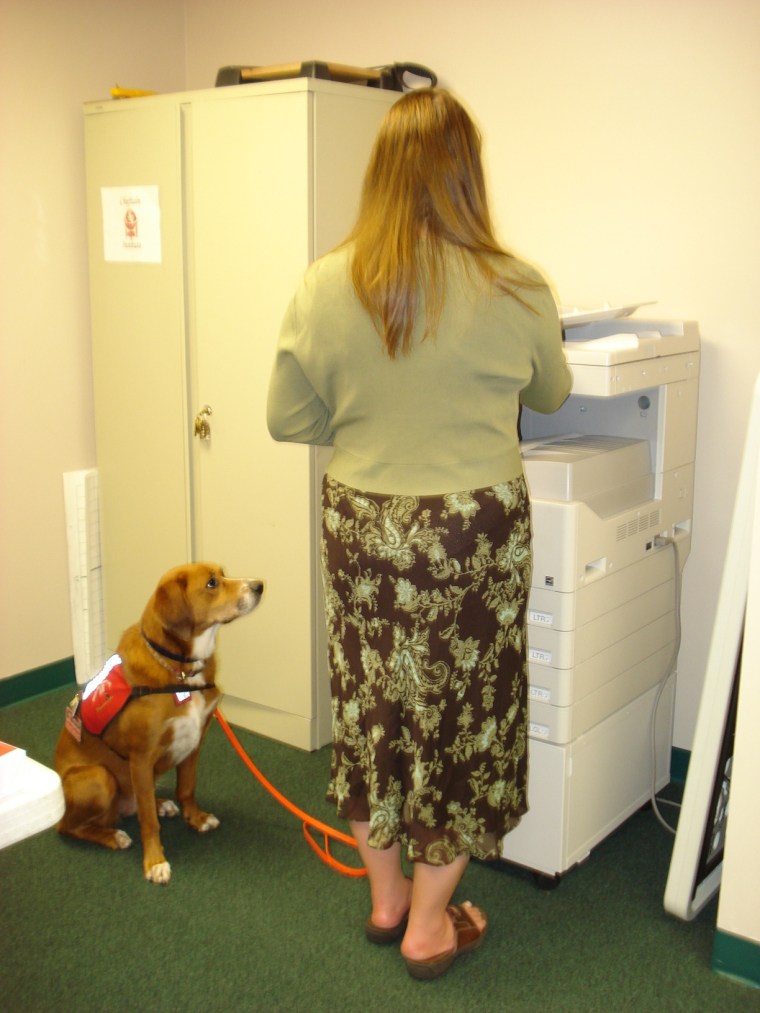
Making copies in the office

… copiers who “spit out” the copies high up instead of down low. See the look of disappointment on Chloe’s face? One of her favorite things to do is to “collect” the copies if they come out low.

School is starting! “Back to School Night” is tomorrow night and classes officially start 9/10! I only filled two classes this year so will only be teaching in the afternoon. As I’m in school myself, this will actually be a welcome break.

(pssst… hey Chloe? Ready to be my school bell again?)

Denise Portis

© 2009 Hearing Loss Journal
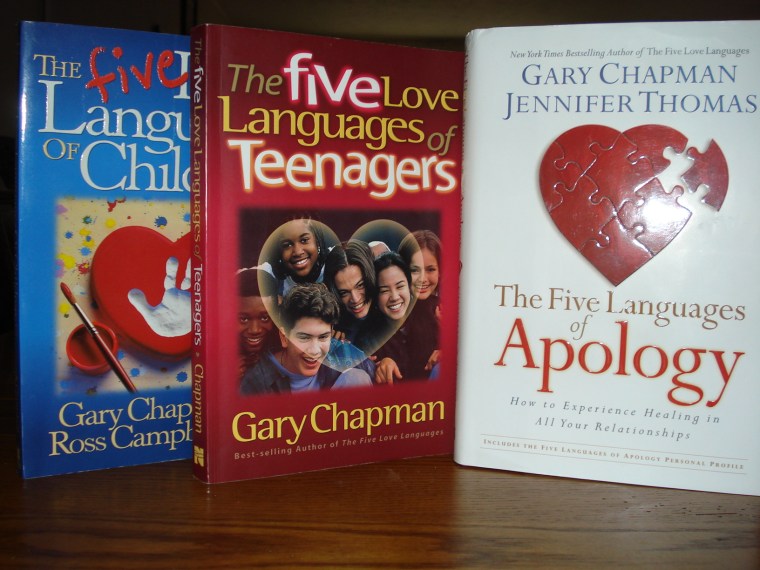
I’m sorry… 5 Different Ways

DSC02941

I’ve always been a big fan of “The 5 Love Languages”, written by Gary Chapman and along with other combinations of co-authors like Ross Campbell, and Jennifer Thomas. In collecting some background information for this post, I see that there are now 7 titles total. I’m behind! I only have 4 of the books! My favorite of the “lot”, is “The Five Languages of Apology: How to Experience Healing in All Your Relationships”. Every person has a preference in how they apologize. This is a good indicator of how they prefer to be apologized to by others!

Doggedly Different

chloe sorry Chloe and I have been working together for a little over two years now. In the beginning, I had to really get to know her and learn what some of her calming signals, body language and other cues meant. Sometimes as clients-in-training, we pick up things from our trainers just by paying attention. The trainers work with more than one dog more often than not. They simply cannot relay every single tidbit of information about your dog to you. When I’ve asked specific questions, they may think a second about MY dog and then answer as best they know. Something I picked up by listening to Pat was the word “phoeey”. It isn’t even said in a harsh way, or with an elevated tone.

We were at a gas station filling up Pat’s car. Chloe wasn’t  staying overnight with me yet, and so the fact that Pat was OUTSIDE the car filling up had Chloe concerned. I could just barely hear Chloe’s high pitch whine. When Pat got back in the car, Chloe hopped up to give Pat’s ear a kiss, and Pat calmly said, “Chloe phoeey”. Chloe immediately went back to her place “happy as a clam” and seemed assured that all was right in the world again.(Is a clam ever happy, folks? Where do we get some of our phrases? EYES ROLL).

By LISTENING, I learned that if I say “phoeey” to Chloe she understands to stop what she is doing. If it is something she knows she should NOT have been doing, she attempts to apologize as well. For Chloe, an apology is a sweet sit, eyes connect with a tiny sheepish duck of the head. She will many times put a paw on my knee if I’m sitting as if to say, “Sorry… we ok?” A pat on the head is all that is required for her to know the apology is accepted.

My Elkhound pup turned two this month, and believe me he is still a pup! tyco1 Tyco is very sensitive, and if I ask him to stop doing something (a louder WRONG for he ignores a “Tyco phoeey”), he belly crawls to me and licks my feet! The poor guy! I scratch his ears and “love talk” him for 10 seconds to let him know there are no bad feelings.(Longer periods of time just rewards his behavior… I want him to know all is well and GET ON WITH LIFE).

naked Peg 003 Pegasus is a nervous little guy. If he is corrected by person or other dog, Pegasus will TWIRL to apologize. He twirls. Constantly. In one direction. Opposite what my world spins due to Meniere’s. Needless to say, I intervene before I fall on my caboose. I reach down and pick him up mid-twirl, smooch him a kiss loudly and confidently, and set him back down. WHEW. Apology accepted.  ebony Ebony? Well she is our senior citizen. If she is corrected, (usually Ebony – NO) she ignores us. After all… she’s deaf (and partially blind, and arthritic, collapsing trachea, enlarged heart, liver disease, rotating patellas, alopecia and MORE).

5 Different Apologies

I think every person should read this book! I have learned so much about how each of my own family members have a different apology language. I’m learning how to do the same with other family members and friends. The apology languages are as follows:

1. Expressing Regret (“I am sorry”)

2. Accepting Responsibility (“I was wrong”)

3. Making Restitution (“What can I do to make it right?”)

4. Genuinely repenting (“I’ll try not to do that again”)

5. Requesting Forgiveness (“Will you please forgive me?”)

In a perfect world there would be no need for apologies. Since we live in a world that is far from perfect, it would be wise to learn to apologize. Let’s face it! We all blow it!

On Purpose

Sometimes we intentionally purpose to make someone mad or hurt them. I wish it weren’t true, but I can be honest with myself. There are times I know that what I’m going to say or do will either make another angry or hurt. Perhaps I justify it because it is done with vengeance. Maybe I’m just in a rotten mood and desire to “share the feeling”. It may be that I’m tired, not feeling well, and should go to bed instead of trying to communicate with someone. The damage is done! I believe when we are willful and premeditated about our wounding, our apology should reflect the seriousness of situation. I believe we should not only SAY we are sorry, but SHOW we are sorry. If I ever find that I am deliberate about being unkind, I attempt to make restitution. Shame on me!

Oops… did I do that?

Sometimes we hurt someone unintentionally. Apologies are given because of how another received what we said or did, not because it was our intent to hurt them. Have you ever discovered you hurt someone and that disclosure took YOU by surprise? If you hurt someone accidentally, you should apologize. Depending on the circumstances, you may try to explain what you were attempting to do. Don’t justify your actions WITHOUT an apology. It doesn’t really matter what you MEANT. If it hurt someone, we should try to make that right. We shouldn’t be so proud that we cannot say, “I’m sorry! I did not mean it that way, and I’m really sorry that what I said ended up hurting you!”

Having said all of that, we need to be careful about our own sensitivity. At certain times in my life, I remember being in the frame of mind where I EXPECTED people to say or do hateful things. Guess what? I was never disappointed. It seemed that every day I was owed an apology for something. What a terrible way to live! If someone says something a bit “off”, try not to jump to the conclusion that is was meant maliciously or callously. Expect the best from people… not their worst.

Recently my son and I were working together to change the cat litter out in the litter boxes. The kids have 3 cats between the two of them and so we have 3 litter boxes. (Ever tried to ask a cat to wait in line with her legs crossed?). We buy cat litter in huge 40 pound bags. I simply cannot lift it and “aim” at the same time. My 6′ almost 3″ son has no problem hefting big awkward bags… unless any dust happens to aggravate his allergies that is! In the middle of hefting, tilting and aiming the bag, he gave a tremendous house-rattling SNEEZE. Yup. You guessed it! When the dust cleared, he and I both looked down at the pile of litter that now completely covered my bare FEET.

“Um… gee mom. Sorry about that!”

I wiggled my toes. They didn’t appear because the pile was THAT DEEP. He didn’t MEAN to bury my feet. It wasn’t his intention to set up an accident to where it would necessitate my cleaning litter out from between my toes. I couldn’t help it… I started to giggle, then I began to crack up… and finally my son and I were both in stitches just dying laughing! We cleaned up the mess, and finished the job… but just barely! Chris gets the hiccups when he laughs THAT hard, which is just about as dangerous as a sneeze!

Heck! Even DOGS understand when it wasn’t on purpose! Sometimes my two big dogs will be playing and one of them may inadvertently nibble/pinch too hard. If Tyco did the “oops”, he drops and crawls to Chloe and licks her feet with his ears flattened. His apology language doesn’t change species to species it seems! If Chloe does the “ouchie”, she will come and sit next to Tyco and give him a soft cuff and lean against him. She looks up under her eyelashes at him with a look that says, “Did I do that? Um, sorry – oops!”

Chip on Their Shoulder

Have you ever met someone who is ultra-sensitive? It seems like every time you are with them you say or do something that hurts their feelings or wounds their fragile ego. Do we owe them an apology every single time? Wouldn’t our conversations with them end up being apologies alone? In the course of my lifetime I have been in contact with people like this. You may have to sit them down and say:

“You know? It seems like whenever we are together I say or do something that makes you mad or hurts your feelings. I’m really not intentionally doing these things! It may be that you have this expectation of me. Can we discuss this?”

Perhaps you should agree to just limit your contact with this person. Maybe you don’t have a choice! This may mean that you have to change your own behavior and carefully, methodically respond when with this person. You may be in a situation where it is impossible to tip-toe around the other person’s feelings. Your one-on-one conversation may include something like:

“It seems I cannot say or do anything to keep you from being upset. If you watch my interactions with others, I love to laugh, tease and interact with others in a positive way. I understand you do not like this and I have never intended to cause you pain. It may mean that we work together as best we can, and just acknowledge that our personalities do not mesh well. That’s OK! We don’t have to be friends to work together with mutual respect.”

clam If you are obsessing over where “happy as a clam” came from, feel free to click the clam to see what “Wise Geeks” says. Yeah… I was obsessing!

Denise Portis

© 2009 Hearing Loss Journal

B.L.I.N.G and Invisible Disabilities

B asically L iving I nvisible is N ot G ood

My 19-year-old daughter came up with the witty acronym of B.L.I.N.G. (B asically L iving I nvisible is N ot G ood). It can be tied to a variety of life lessons.

Cochlear implant “bling” and Assistance Dogs

I am a late-deafened adult and I also have Meniere’s disease. Being “late-deafened” is a fancy way of saying that I lost my hearing after I learned oral language. Hearing loss can be mild, moderate, severe or profound. Although all levels of hearing loss affect the way in which a person freely communicates, a person obviously has more serious problems the more severe their hearing loss is. I think part of the reason that HLAA (Hearing Loss Association of America), ALDA (Association of Late-Deafened Adults), and other non-profit organizations for people with hearing loss have trouble attracting new members is that for most people, hearing loss is a nuisance and not a life-changing disability.

According to NCHS (National Center for Health Statistics), there are 37 million Americans who have trouble hearing (NCHS, 2006). A study done by Gallaudet in 2001 reveals that 8 million Americans have difficulty hearing even with the use of a hearing aid (Gallaudet Research Institute, 2007). This leaves approximately 29 million Americans who communicate effectively in spite of a hearing loss. This vast majority of people with hearing loss enjoy the invisibility of their disability as they function well “in spite of”. They “look” like everyone else. They do not have a need for support groups, advocacy or a connection to a non-profit organization because they have no need to identify with the hearing loss group. (I discussed why some people choose to not seek help when they DO have a significant loss here.)

When it became obvious that my own hearing loss was progressive, I began to realize how difficult it is to have an invisible disability. Prior to my cochlear implant in 2005, you would never know I had a disability unless I opened my mouth to speak to you. My speech was beginning to deteriorate just a little bit due to the fact I had not heard my own voice in a number of years. I may have interrupted conversations, not realizing someone else was speaking. I had trouble balancing the volume of my voice and more often spoke to softly than to loudly! Meniere’s disease kindly bestows noticeable symptoms for me when it’s a rainy or overcast day. You would never know it, however, unless I tried to walk a straight line or go up or down steps!

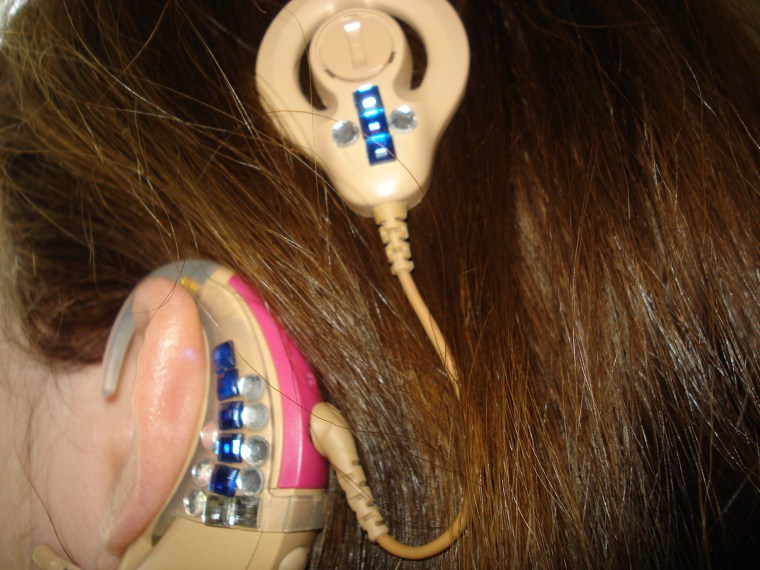
Being surgically implanted with a cochlear implant felt a little bit like a miracle. I could hear my own voice again in most environments and my speech improved dramatically over the period of only a couple of months! Having a cochlear implant does not mean I hear perfectly, however. There are some situations with a lot of background noise or poor acoustical environments that I may have to ask for a “repeat”. I may have trouble following conversations if I’m extremely fatigued. Prior to my implant, I had already adopted bright colored ear molds for my hearing aids and wore my hair up. I found out through a great deal of “trial and error” that it was in my best interests for people to know that I have difficulty hearing. After I received a cochlear implant, I didn’t see the need to change my adopted visibility. I wear “bling” on my CI, and it does draw attention to the fact that I hear but not in a normal way. It allows people to quickly identify that they may need to be sure to face me when they talk, or be aware that if I ask for a repeat it is not because I’m not paying attention. I really believe my “bling” helps other people as much as it helps me.

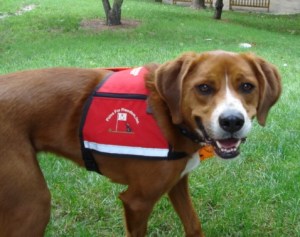
Having a hearing assistance dog who also does balance related tasks for me, brings attention to my disability as well. If you’ve ever thought about having an assistance dog, but do not like to field questions or have people notice you, then you may want to reconsider. Chloe comes from Fidos For Freedom in Laurel, Maryland. It’s not her bright red vest that gets attention. What makes people notice is simply the fact that she is a DOG! It’s not very often you see a dog in a store, restaurant or even church!

B asically L iving I nvisible is N ot G ood

Recently, God allowed a very mean person to be a part of my life for a short time. I say that GOD allowed this person, because it actually served to remind me that there are bigoted mean people who not only do not understand disabilities, but choose not to understand. Through FaceBook, I ended up “accepting a friend invite” because they were involved with someone I trusted. It didn’t take very long for this person’s true colors to be revealed. Comments left on my uploaded photos or “Notes” and eventually conversations between this person and myself and my husband through “instant messaging”, all revealed how there are still people who don’t “get it”. We received over 45 comments and messages from people astonished that there were still people like this out there! Some people do not realize that disabilities are often invisible. They do not understand that there are good reasons to make an invisible disability… visible! Some people do not understand that disabilities are not chosen. There are some that do not understand that disabilities may not only be life changing, they can be terminal. Many diseases and disabilities are those that shorten a life. God used this person in my life to remind me that some people are not only uneducated about disabilities, but they may willfully choose to believe the worst about those who have them. (It’s a great relief to not have to put up with this person anymore, but I do thank God that it was used to open my eyes!)

For me… basically living invisible is not good. There may be other people with Meniere’s disease or deafness who choose to live another way. I respect that! “Bling” works for me. It reminds even those I know well that in spite of my speaking perfect English (with the exception of a southern accent), I do not hear normally. It reminds them that if I repeat part of what I heard and wait for a repeat of what I didn’t… that it isn’t because I chose to stop paying attention. If I say, “whoa” under my breath and touch the wall in order to snap my visual field back into focus, they are reminded why I have a dog who picks up things for me and “braces”.

“Bling” and an assistance dog both serve to allow me to live with some independence. I don’t have to have family members with me now just to go to the post office or a store.

Invisible Awareness Week   0e1c199b505195ca9883a3faad5994b4

There are others who know what it is like to have an invisible illness or disability. September 14-20 is “Invisible Awareness Week“. If you or someone you know have an invisible illness, I encourage you to check out this site!

If you do not have an invisible disability, chances are you know someone who does. Do you know some of the strongest advocates for people with disabilities are those who do not have one? Think about it… who will get further with a person who misunderstands the needs, reactions, or communications from a person with an invisible illness or disability? Certainly people who live with invisible illnesses or disabilities should learn to advocate in a positive way. Their ability to do so helps us all! However, if you take a person aside and teach them… explain to them a little bit about another person’s disability or illness, it may mean even more! Every person can be a strong advocate for others.

Denise Portis

© 2009 Hearing Loss Journal

A Strong Bond

Tethered together helps to create that bond...

You Want Me to WHAT?

When I first started working with Chloe over two years ago, one of the first things my trainer told me was, “Chloe is to remain tethered to you at all times. Where you go, she goes… for 30 days”.  She was to be at the end of my leash and if I needed my hands free, she had to be tethered to me. No one could pet her, feed her or interact with her but me for 30 days. (It almost killed my family!)

If I did laundry, Chloe did laundry. If I fixed supper, Chloe (on a longer leash and out of harm’s way from the stove) fixed supper. If I went to the bathroom, Chloe came to the bathroom in a stand/stay. (You don’t want a service dog laying or sitting on public bathroom floors – EWWW!). Needless to say, it was probably harder on me than it was her. She was trained to be with someone 24/7. I had to learn to be responsible for this canine at the end of a four foot leash.

It’s amazing how someone could overlook a dog the size of Chloe, but it does happen. People look over her head and come close to tromping on her at times. A friend of mine is training her Great Dane pup as a service dog. I would like to think that Kenai could not be overlooked even in a down/stay!

Now Over Two Years Later

Chloe is rarely out of sight. At home she doesn’t wear her vest, but I still rely on her “working”… her hearing alerts throughout the day. On a day like today (pouring down rain), I need her to retrieve things when I drop them too. I am almost to the point of believing Chloe actually knows to stay a little closer on a rainy day. You wouldn’t think a dog would pick up on that but you never know!

If Chloe loses track of me, for example a squirrel caught her attention outside so she stands to stare while I head downstairs to get a load of laundry in the dryer, she races to find me as soon as she realizes I’m gone. If a gate is up, or door closed she’ll howl her anxiety of the fact. It’s created a rather unique bond between she and I. Honestly, on the days she is in her crate and not at the end of a leash has me feeling like I’ve left my right foot at home by mistake. There are infrequent times that Chloe isn’t feeling well and if I find I have to leave home, she remains in her crate. There have been a few times that she had to stay at home when we were going someplace she could not go safely. (For example, a zoo!) When we are reunited, you would think it had been a month since she saw me last and not a couple of hours! The bond we share serves its purpose, for a service dog and partner should have a close bond in order to establish a healthy working relationship.

It wouldn’t work with people!

Perish the thought should a person have to be leashed to another person for a “30 day bonding period”! I’ve been married for 23 wonderful years to the same man. I wouldn’t dream of attaching myself to him and staying in his vicinity indefintely. We’d strangle each other! (grin) Dogs who have been trained to assist a partner in some fashion do not seem to mind the constant companionship. They thrive in this atmosphere. Perhaps this is why dogs make such terrific service animals… they love to be with their partners.

Two great organizations that you can find more information about assistance/service dogs are:

Assistance Dogs International: Click here

International Association of Assistance Dog Partners: Click here

What the ADA says about service dogs: Click here

Denise Portis

© 2009 Hearing Loss Journal

If I’m Part of a Majority, Then What is Our Identity?

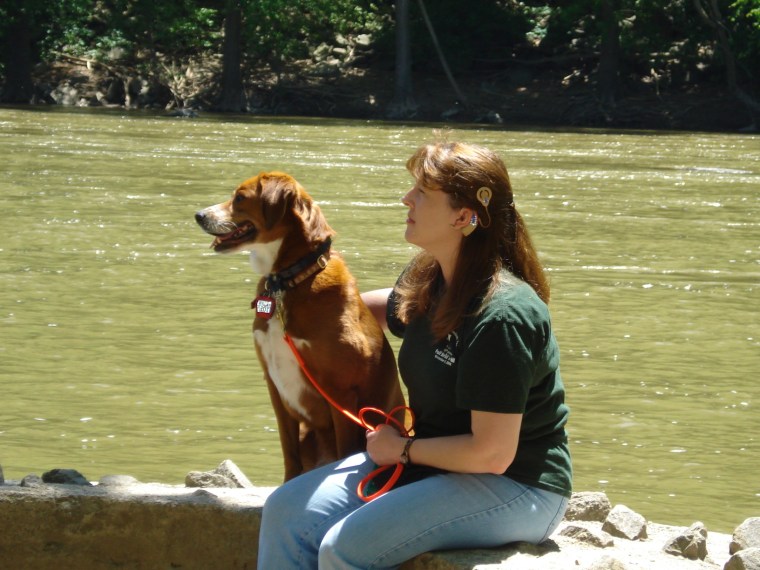
Denise and Chloe sit next to the Potomac at Harper's Ferry, WV

According to data provided by the National Center for Health Statistics (NCHS, 2006)), 37 million adults in the United States have a hearing loss. This is approximately 14.9% (2007) of persons over the age of 18 living in the United States. Gallaudet Research Institute (2007) states that anywhere from 2 to 4 adults out of every 1000, is “functionally deaf”, but of that number more than half became deaf after the age of 18-years-old. (NOTE: this would be after the acquisition of oral language). As many as 22 out of every 1000 adults in the U.S. consider that they have a “severe hearing impairment”. (Their hearing loss affects their lives and impacts the way that they communicate).

Who am I?

I began losing my hearing when I started having children. At the age of 25-years-old when my daughter was born, I have a very vague and fuzzy memory of thinking I may have a cold as speech sounded muffled to me. At the age of 27-years-old, my son had come along as well and at that point my husband and I both knew that something was up with my hearing. I went to an audiologist and was diagnosed with a moderate hearing loss… “did I want to buy a hearing aid for my ‘worse’ ear?”

Although I am deaf (with a small “d” as opposed to the capital “D” for culturally Deaf folks), I don’t consider myself deaf. I don’t think it’s a matter of denial either. I speak with my voice, and use a cochlear implant and hearing aid to maximize what I hear. For me… this is “normal hearing”. My “new normal”. I’m comfortable and happy with what I hear.

I know sign language, but it is highly unusual that I do. I learned ASL in college because I had two friends in my dorm who were culturally Deaf. I’ve been learning sign and taking classes ever since. I don’t use sign language with other hard-of-hearing people because the vast majority of them do not use sign language. Think about it for a moment. If like most people who lose their hearing, you do so after having learned oral language… won’t you try to continue to communicate in a way that more closely resembles the way that you did before your hearing loss? On top of trying to live with a newly acquired disability, would you want to learn a new language including it’s syntax and grammar, only to accomplish being able to sign to other people who happen to know sign? Doesn’t make sense does it? That is why the vast majority of people who lose their hearing turn to technology, surgery and/or reading lips.

Is ASL a bad thing if you are an oral deaf adult?

I’ve been to numerous hearing loss conventions where the attendance was anywhere from 500-800 hard-of-hearing people. These conventions often hire interpreters for the twenty or so people who use ASL as their primary means of communication. CART (Communication Access Real-time Translation using a court reporter) is also usually being paid for and the many workshops and sessions are also looped or have infra-red technology so that people with t-coils on their hearing aids and cochlear implants can hear more clearly. The small nucleus of folks who use primarily ASL tend to “hang out” together at these conventions. I have seen some very strong bonds and friendships develop. However, they are also isolated at times because they cannot speak to the hard-of-hearing majority who do not use sign. Sure! You can write notes, but I’ve rarely seen the effort made.

So should a HoH (hard-of-hearing) person learn ASL? My personal opinion is that learning a little bit of ASL is a good tool to use at home when you happen to have your hearing aids or cochlear implant out… or should your batteries die. Actually, HoH folks tend to learn Pidgin sign language, or exact signed English. They tend to sign exactly as they would speak in English (which isn’t ASL). I’ve been trying to talk my HLAA (Hearing Loss Association of America) chapter into doing one meeting on “often used phrases in ASL”. I believe knowing these phrases at home will facilitate communication in the situations I mentioned above. It can also be fun to learn a “hand full” of sign. However, most HoH people do not try to use sign language outside the home when they are at work, church or in public. They normally read lips, try to set up ideal listening environments, use technologies available, and often have hearing aids and/or cochlear implants.

I get a little aggravated when I make a doctor’s appointment and they offer to set up “Deaf Talk” for me since my chart is flagged with “deaf”. First of all, I’m on the PHONE making an appointment with them! I explain that I use a cochlear implant to communicate and that I speak English and prefer oral language. I suppose my preference is unusual in that I actually teach ASL as an alternative foreign language part-time. However, I do not associate myself with the Deaf (note the capital D) as I use my voice to talk in public. When I had jury duty this last year, the Frederick County court system had a CART reporter for me to use during that time. It was a very positive experience for both Chloe and I, as the courthouse doesn’t get a lot of service dogs either.

Having a CI and meeting a Deaf person

For lack of a better way to explain it, I have been “mistreated” far more often by the culturally Deaf than I ever have been by people with normal hearing. I’m not sure if it is distinctive to our area of the country, or if the attitude is nationwide now. However, it seems the culturally Deaf as a whole tend to feel pretty threatened by cochlear implants. I suppose I make it worse in that I wear “bling” on my CI, and my hearing aid has a bright red ear mold. I wear my hair up in part, because I really am NOT ashamed of my disability, but also because it helps me in the long run should I miss something someone says. They can immediately see that I “hear differently”. Many culturally Deaf are afraid that if those born deaf are implanted between the ages of 10 months and 2 years (indicative of the current trend) that their very culture is being threatened. Nine out of every 10 infants identified with hearing loss are born to hearing parents. These parents are often choosing the safe, non-invasive surgery of a cochlear implant to give their child the best opportunity at oral language. I don’t believe ASL is in any danger of becoming extinct, however,  because there will always be Deaf children born to Deaf parents who chose ASL. The Deaf have worked long and hard for equal access and equal rights and have a rich history and long-term success at being identified as a culture.

I have been stopped in stores and handed notes by the Deaf asking why I would choose a cochlear implant. “What is wrong with Deaf?” I put the notes down and sign to them (making their eyes pop open wide), and explain that I was born with normal hearing and that my choice allowed me to continue to participate in the same way that I was born. Some get angry and stomp away, and some try to argue. Only one or two have ever said that I had a right to my choice and that they respect that. The vast majority of encounters were not “pretty”. Most encounters involve the middle finger! (from them… not me!) I’ll never forget waiting for my daughter at Pet Smart, and a Deaf couple stopped and pointed to me and began signing to their son (who was hearing I believe) that “sad, not right. people embrace ‘who they are’, God finish create – appreciate, accept”. I signed to the parents and little boy, that the only “shame” was when people could not make individual choices that they feel is in their own best interests and that choice be respected by others. (At least they had the grace to turn red).

Don’t get me wrong. I love ASL, and use it far more than many HoH people do. However ASL is not my native language. It is not the language of the group of Americans with hearing loss that I have chosen to identify myself with since losing my hearing.

Why are the oral deaf not as visible as the culturally Deaf?

The culturally Deaf have learned to stand up for their rights and have learned to be proud of who they are and accept it without reservation. The HoH crowd, however, tend to buy the hearing aid, and then refuse to even acknowledge they have a hearing loss. They often try to keep it hidden and rarely admit to someone that they may be struggling to hear in a poor listening environment. They may rarely disclose that they have a hearing loss at work, church, etc. They often do not identify with even having a disability. Why is this I wonder? HLAA and AGBell are wonderful organizations for those with hearing loss. Yet, the vast majority of members are those whose hearing loss has become so poor, that it has really begun to affect their lives. In desperation they reach out for the support and information that they need. I often wonder why those who have a mild to moderate loss never seek out organizations like this? I suppose it is because they “get by” just fine. If their hearing loss is not progressive, they choose to live life without the added help and membership of organizations like this. I cannot cast stones, for I did not seek out help until my hearing loss had reached the point that I needed help.

I was pleasantly surprised a couple of weeks ago, to attend an open-captioned Star Trek movie at our local theater. The room was packed, and I only saw a handful of people signing. I saw plenty of hearing aids and cochlear implants. I think it is so important to support showings of feature films with open-captioning. I always thank the theater manager in person or via email. Many in attendance were the hearing spouses, family or friends. My children have grown up with closed captioning, and actually have trouble watching television without it. I never have to twist arms to get my hearing family to attend an open-captioned movie. When you’ve distinct Russian accents and alien tongues in a movie like Star Trek, you can bet that those with normal hearing got more out of the movie thanks to open-captioning!

Many of the organizations who serve those who have a hearing loss and are oral are in financial difficulty. They’ve been that way for over a decade and with the current economy they aren’t due for a major influx of cash or membership. They often have difficulty obtaining grants. My personal opinion is that they should do a major overhaul in the way they reach out to those with hearing loss. They need to change the way they try to raise an interest in order to gain membership. The majority of people with hearing loss do not have a significant loss. These organizations certainly shouldn’t turn their backs on those with significant hearing loss, but new programs and ideas should center around how to raise awareness among those with a mild to moderate loss. Things like the hearing aid tax credit are a step in the right direction as everyone will appreciate some financial help for the expense of hearing aids. The only problem with this tax credit, is that it will be years before it is available to all age groups regardless of their health coverage. I believe more effort should be in providing information to this largely untapped group. What can be done to provide helpful information to this group? What programs can be developed to help them at work, church, and in public? I think if the struggling non-profits who are membership based reach out to this group, it will help to raise awareness. How could it not? The majority of those with hearing loss (those who are oral), will be finally identified as a cohesive group of individuals striving for equal access, and recognition. How do you help a group of people who want to remain invisible, to see the value in becoming a visible and active group? I don’t know the answers to these questions.

I sign when I misunderstand

Although I identify with the oral hearing loss community, I have something rather humorous to share. If I am trying to communicate with someone who has a heavy foreign accent, or with someone in a very poor listening environment (like a mall or restaurant), I tend to sign while I’m talking. It really tickles my kids, for I have tried to communicate with someone who only speaks Spanish and found that I started to sign and voice when I discovered I couldn’t understand them. My daughter has told me that she can tell it is totally unconscious, that she can see me just naturally start to sign when I cannot hear well or understand someone’s speech. My family has actually learned to step up to help when they see me signing as they know that I read their lips and “hear their voices” better. They know if I start signing, that I’m not hearing very well. Sometimes I sign when I’m really tired… fatigue causes me to not hear as well. I asked my husband (who has devoted six years of his life to the hearing loss community in the past) why he thinks it is that I sign when I’m not hearing well. He’s a psychologist and likes to be asked “what do you think?” He believes that it is not that I am switching identities or loyalties by starting to sign in a “pinch”. He thinks it’s a subconsious decision and acknowledgement that I’m not hearing well. He said that other HoH people who don’t hear well stop and say “huh?” or “fake it”. He said that because I know ASL, I start to sign. He’s stepped up to wide-eyed friends with normal hearing and simply said, “perhaps you should find a quieter place to talk… Denise is having trouble. See? She’s signing!”

I do wish the oral hearing loss community could erase the stigma associated with hearing loss. Would it be that we could develop a positive internal locus of control and believe that we are valuable and viable adults in spite of hearing loss. I wish… I wish we could REALLY find our voice.

Denise Portis

© 2009 Hearing Loss Journal

Learning NOT to be Afraid

wr-lightening_jpg

React with Calm

Last night Frederick, Maryland, experienced a violent thunderstorm. As I remove my cochlear implant at night to sleep, you might wonder how I came to this knowledge? Well… I’m deaf, but I’m not blind. Our bedroom was lit up with light again and again with what seemed like only seconds between strikes. I reached over and tapped my husband and mumbled out, “Lightning”. I think he said something in response, but in the dark I could only guess that it was something along the lines of “no kidding?”

Chloe, my assistance dog, sleeps in her bed right next to me. She acts as my alarm clock in the morning (although there are days I wish she had a snooze button), so her proximity is key. During the storm, I could see from the light bursting into the room that she was asleep on her bed. Not only was she ASLEEP, but she was laying on her back belly up. This is her “I’m very, very relaxed” position. The storm was so violent, the hair on my arm was standing straight up, and eventually our power was knocked out. Chloe slept through it all.

Many dogs are afraid of thunderstorms. I did not know Chloe when she was a puppy but from what I know of Fidos For Freedom, they make certain their puppy raisers know how to use calming signals to help dogs feel more relaxed in stressful situations. Dogs are many times conditioned to be afraid of thunderstorms. Sure, they have terrific hearing and startle at the sound of thunder. However saying, “poor dear” and babying them when they appear afraid will only condition them to continue to feel fear.

Arachnophobia

I have been afraid of spiders as long as I can remember. I have some “stories” to tell, but it would take several boring posts to relay them all. I can’t leave out the one when I almost jumped out of a moving vehicle 7 months pregnant because a spider was crawling up the windshield! Or the time I walked through a spider web and went screaming into the woods only to careen into a tall oak? Yup… I have plenty of spider stories. A post where I discuss it further can be found here.

I have learned in my 43-years of “living”, that if I try to react in a calm way towards things that frighten me, I will be much better off. About a year ago, I caught sight of a spider flying through the air from the top of our old refrigerator to land in the laundry room sink. I screamed one short squeal, and then stood and pointed. My two teens and husband came running to see what had caused me to scream. All I could do was point to the sink. My husband peered into the sink while I attempted to keep my bladder from emptying. As I still was unable to do anything more than point, he turned on the faucet. A silver-dollar-sized, black hairy spider came crawling up out of the drain.

Holy, 8-legged FREAK, Batman!” yelled my husband who watched a lot of old superhero t.v. shows.

Over time, I have learned to react with CALM so that I will not be so afraid (and eliminate the possibility of injury). I can’t go to Catoctin Wildlife Preserve and enter their “creepy crawlies” building to oooh and ahhh over spiders big enough to suck the brains out of your head. However, I can now look at a spider and scoop him up and toss him outside, or find an old shoe if the pathway to the door seems like a “galaxy far, far away”. I’m proud of the progress I’ve made, and I am far less arachnophobic now compared to where I was.

Why Learn?

Life is short. There are a number of very scary things in life. Where I have the will and the power to do so, I have chosen to be more calm and face my fears.

I don’t fear death. I am secure in where I’ll be one second after my last breath.

I don’t fear deafness and disability. I have found support, help and satisfaction in my life.

I don’t fear growing older. The longer I live, the better I like myself.

I don’t fear financial security. God has seen my family and I through tough times already.

I don’t fear spiders. Unless they are on my person.

I don’t fear thunderstorms. I’m “belly up” in blissful ignorance of a storm overhead.

Don’t let fear shorten your life. It will if you let it.

Denise Portis

© 2009 Hearing Loss Journal

What’s Mine is Yours – What’s Yours is Yours (Most of the Time!)

Sharing some things is not difficult for Chloe

Sharing “Stuff”

Having an assistance dog, means that I should strive to understand the “pack” in which I’ve brought Chloe to live. An assistance dog is not ever suppose to be “pack leader”. That’s my job, and the hierarchy trickles down through various family members until the canine members of the pack are finally represented. I’m not sure an assistance dog should be “head honcho” of the canine crew, but frankly the dogs in our family could never be “leader”.

Tyco, our Elkhound adolescent and family dog, is a major pushover and adores the ground on which Chloe treads. He follows her around with major PUPPY LOVE written all over his face. It practically oozes from ever pore of his wiggle, curly-tailed body. He’d let her eat his food, and sleep in his bed and simply lick her with infatuation while stepping aside to let her do so. I have to keep an “eye on it”, as she would take advantage if I let her!

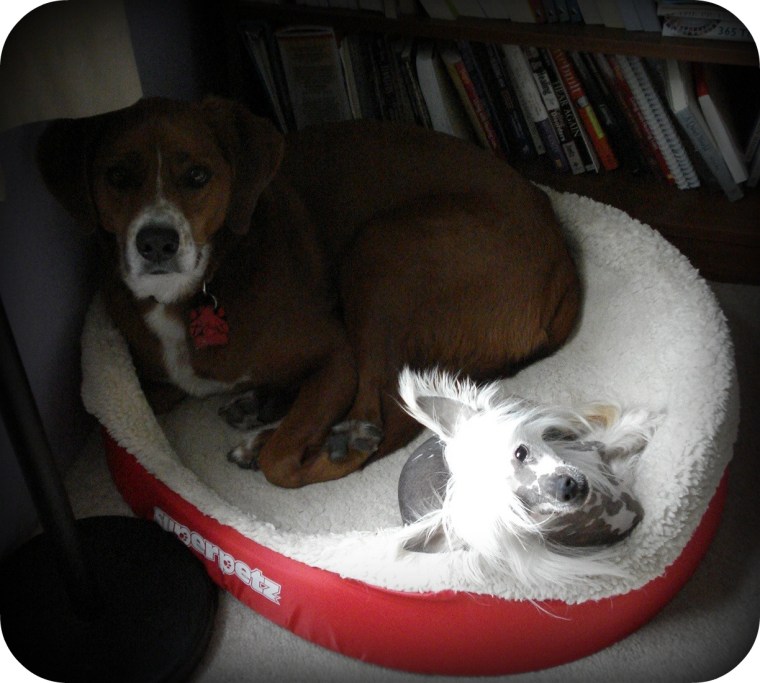
Gingery’s Baby Pegasus (or Peg for short) is a naked juvenile ex-show dog with a shock of flashy white hair in all the right places. Frankly… I don’t think Chloe is completely certain he even IS a dog. When he barks, all the dogs stop dead in their tracks to turn and observe. Chloe will share her bed with Pegasus; after all, who can say no to a shivering “ain’t got no hair”, pack member?

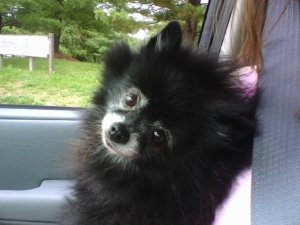
Ebony is an ancient, black Pomeranian who sleeps 22 hours a day. When she walks I can hear her bones creak, and folks? I’m deaf. She has an enlarged heart, cancer “somewhere”, collapsing trachea, alopecia, kidney disease, and she’s deaf and blind. One drops like a rock if the “little bit” should happen to breathe on you. Chloe doesn’t have any problem sharing with her, for frankly she rarely sees her.

Chloe shares with the other dogs very well, and she shares with one of the three cats like Kiki is her best friend come over for “milk and cookies” and girly talk.

One thing Chloe will not share is the loveseat in the family room, and her walks with me. The latter I don’t mind, for honestly I haven’t a clue how I’d walk yet one more dog as I have enough problems walking with just Chloe on really bad balance days. The “MY LOVESEAT” in the family room gets a little old sometimes. I watch television (thanks to TIVO’d programing) about twice a week. When we go to the family room, Chloe knows I’m there for an hour or two and I give her a major “love on” scratch, massage, and belly rub the entire time we share that seat. It’s a wonder I don’t have carpal tunnel. If any dog even comes close to the loveseat she growls a threat and a row of hair stands up along her spine that has my daughter convinced she’s part Rhodesian Ridgeback. I let her know that growling is simply not allowed. I can’t very well fuss at her for giving a “look” if any dog creeps too close, but by golly they have sure learned to respect that knowing LOOK. As there are plenty of comfy and warm places to curl up all over our family room, I don’t worry to much that anyone is being neglected.

People normally have a fairly good idea what can be shared. It normally begins long before kindergarten, and we learn that sharing is “nice” and it makes mama happy. As we get older, sharing is still one of those ingrained rules but we do draw the line at items regarding hygiene, or perhaps requested Double-Stuffed Oreos when one is responsibile enough to write it on the list. (I added that last part for a 19-year-old daughter that rarely requests anything, and even more rarely writes it on the list to be purchased and then practically HIDES her stash!) People who share are defined as “giving, generous, considerate, charitable, unselfish and magnanimous”. (Actually, that last word has never actually crossed my lips, but it certainly looks appropriate!)

Sharing Feelings

Dogs just do not seem to have any trouble sharing feelings. If their entire body has gone “all a-wag”, you know they are happy. If they avoid eye contact and look away, they are feeling nervous and uneasy. If they stick their hind end in the air they want to play. If they bring you their leash and sit and stare at you until you “notice”, they may be trying to share their joy of exercise. Dogs rarely have trouble opening up, and if you are really good at it, canine body language can really help you get to know your dog. (Thanks to trainer Tracy at Fidos For Freedom, I’m a big fan of Canine Body Language – A Photographic Guide by Brenda Aloff).

People are more difficult to read, and often have trouble sharing feelings. People have to practice being vulnerable and readable. I’ve been reading the daily journal at Caring Bridge from a fellow mom who was recently diagnosed with cancer. She doesn’t have any trouble sharing her feelings, and frankly I’m often compelled to sit and reflect after reading what she views as most important on any given day.

I’ve a friend whom I’ve knitted my heart too for simply experiencing disability and life much as I do. (Small wonder THAT being that I cannot knit, but only crochet). She shares her feelings in two different blogs, and for a moment in time I’m sitting along side her seeing, hearing, tasting, and experiencing everything that she is. She’s THAT good at writing.

If you’ve lived enough of life, you know that it isn’t always safe to share your feelings. Tragic that we live in the kind of world that we do where there are situations that warrants keeping your feelings hidden. All of us know someone who is “toxic” to our lives. They’ve burned us so many times, we have scar tissue. When they are around we don a hazmat suit and deliberately hide who we are to them in hopes they’ll simply leave as quickly as possible. If we were a dog, we’d yawn and look away and pant nervously. Since we are people we smile and “play nice”, collapsing against the door in relief after we’ve seen them off.

Yes, we all have people like this in our lives, but something we should stop and think about is, “Are you this person to another?” May it never be said that someone waits anxiously for me to leave because I’m dangerous to their well being.

Sharing Faith

Why is it so difficult to share something that is so important? My faith is the single most important area of my life. Why? It SAVED my life. I don’t use religion as a crutch, for the truth of the matter is my faith freed me from a lot of negative things. I don’t think being a person of faith makes me a weak person, for people who have REAL faith are normally very strong. (Not that I don’t have my weak moments!)

My son loves “The Rebelution” and has read the book, joined the “cause” and challenges himself to make a difference in the lives of those who are IN HIS. A “funny”, yet true video clip posted there recently really made me think. You can view it here.

I hope that when people spend any time with me at all, it doesn’t take them long to learn the following:

1. I have a disability, and am ok with it. I wouldn’t change it if I could.

2. I love dogs, and welcome the addtion of an assistance dog in my life. She gives me independence.

3. I have a cochlear implant and don’t care who sees it. As a matter of fact seeing it will remind you that I don’t hear like you do.

4. I love my family, and joyfully color my hair to disguise all the gray hair living and loving them have brought.

5. I love others, and may unexpectedly throw my arms around your neck to prove it true.

6. I love my God, and do not mind sharing why my faith is so important to me.

7. It doens’t bother me if you believe differently than I do. I respect others, and have found most people respect my views as well.

8. I like green tea, white cheddar popcorn and blackberries.

(Actually I just threw #8 in to confuse you. If you knew this already, then we are pretty TIGHT).

The best kind of faith sharing is that which simply “happens” because you are living life as you always do. I want my faith to be such a natural “side-effect” of Denise, it just naturally creeps up and gooses you from time to time.

Denise Portis

© 2009 Hearing Loss Journal

Graduation Fidos For Freedom 2009

My “speech” is below the pictures…

Chloe has had a "crush" on our photographer for a long time. This "shoot" was hard for her!
Smiling for the camera!
It's hard to wait under a table for 2 hours with other dogs when there is a long tablecloth!
Lots of pictures for the 5 graduates...
Getting ready for the "speech"
Denise gives a speech w/ Chloe in a down/stay. Puppy Raiser L, Trainer at R of Denise
Listening to the therapy dogs being "caped"
our graduate board... someone did a great job

I’m so excited to be here this evening, graduating with Chloe from Fidos For Freedom’s training program. Chloe and I have been working together for almost two years now and it’s pretty exciting to finally be attending the Tux & Tails Banquet as a graduate!

Tonight is a night of thanks, and I wanted to take the time to include my own. First of all, I wanted to thank Chloe’s sponsor, Judy. The training of these special pups all begins with their sponsorship. I’ve had the privilege of seeing Chloe’s sponsor at a number of events, and I’m thankful there are people out there who agree to pay for the supplies, vet bills and other expenses while these special puppies are being trained. All this is made possible by the generous heart of a sponsor. Thank you Judy!

I wanted to thank Chloe’s Puppy Raiser, Linda Odom. Linda has raised numerous puppies for Fidos, and she raised my Chloe as well. Chloe still recognizes and adores Linda. In the beginning, everyone guessed that Chloe must be a beagle mix, but she continued to grow larger and larger. I have a picture of Linda holding Chloe when she was still a puppy, but not a lot smaller than she is now! Believe, me she had her hands FULL! Not just literally either, but figuratively as well! I have been told by training staff that Chloe was a very incorrigible puppy. Annette told me once that she put Chloe in a sit/stay and walked deliberately away for a long recall. When she turned to call Chloe, it seemed Chloe had disappeared! One quick look down was all it took to see the happy tail wag greeting from this puppy that had followed her quietly the whole way.

Pat Jarvis, my trainer and Chloe’s trainer, told me that they continued to see “glimpses of what might be” in Chloe. As she matured, and began to finally grow up, they were finally seeing the working dog in her that they’d hoped for. When I first began working with Chloe, she seemed to respond very well to me. Things weren’t perfect, but then I had worked with Nordic a great deal, so she was hard pressed to compare. The longer we worked together, the more attached we became. She was just as excited to see me at training sessions as I was to see her.

One Wednesday night in January of 2007, Pat put me with Chloe to work and then later called me back to the conference room. She told me that they were going to match Chloe tonight. I managed to squeak out, “With me?”  I almost tackled Pat I was so excited!

Chloe has traveled with me to conferences and speaking engagements, and represents Fidos so well. In our short time together, she has alerted me to a fire in our basement, and has alerted me to literally thousands of phone calls, timer alerts, and other sounds around me that I do not hear.  With help from Pat, Ann and Tracy, I was able to teach Chloe some additional skills to help me with my balance.  I teach part time, and Chloe loves to be in the classroom. I’m fairly certain some of my students drop papers and pencils on purpose so that Chloe will come and pick them up for them.

Before I had Chloe, I never went anywhere without someone in my family with me. Even going to stores was extremely intimidating, because I would often not hear if people needed to get by me. If I dropped something on the floor on a rainy day and my balance was bad, it was really difficult to pick it up without passing out. Now that Chloe is my partner, we go everywhere together. If I drop something… NO PROBLEM. Chloe picks it up with a happy tail wag and is always eager to assist. She alerts me to sounds like someone needing by, intercoms, buzzers and more.

To those who sponsored this little red-head puppy – I thank you.

To every person who had a part in helping Chloe the puppy, investigate new sights, sounds and smells – I thank you.

To every person who acted as a vacation home for this lovable, mischievous puppy – I thank you.

To my family who allowed me to take time for myself in order to train for Chloe – I thank you.  I have spent many miles on the road from Frederick.

To every trainer who had a part in teaching Chloe the skills she now uses so naturally – I thank you. Thank you for seeing past the frustrating little puppy to the lovely and intelligent working dog that Chloe is. Because of each of YOU, Chloe and I have this wonderful, unique relationship only found in the partnership of person and dog. THANK YOU.

Denise Portis

© 2009 Hearing Loss Journal

Off Vest

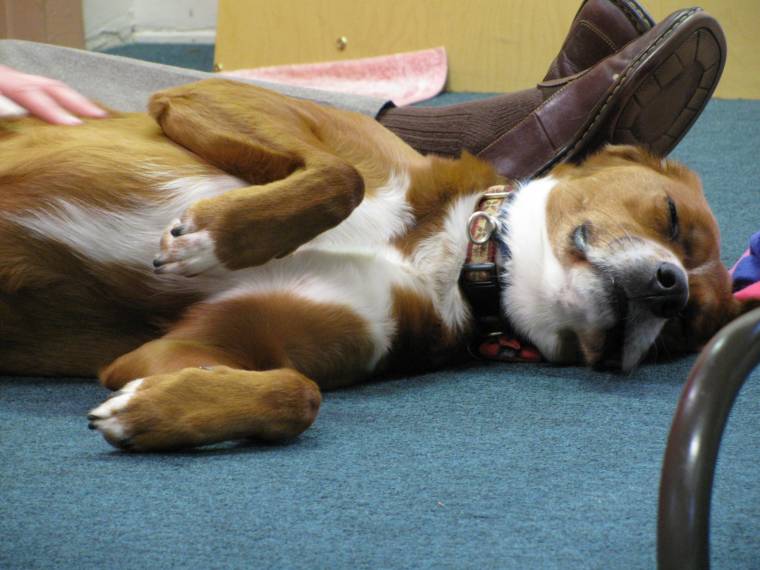
Coffee break for Chloe... or rather tummy rub

One of my students snapped this picture of Chloe off vest while I was on the floor with her one afternoon.

Off Vest

Our work day on Thursday is a long one. Thankfully, I have a whole hour break between classes at 3 PM. When possible, I take Chloe’s vest off and take her for a quick walk. I chase her around the classroom with a squeaky toy, or “mess with her” a bit. It usually ends up with some Chloe lovin’, and we just chill for a bit before the next class starts.

Ever once in awhile I have a student meeting, or parent/teacher conference. When that happens, Chloe waits patiently by my side but I can tell she knows it’s past 3 PM. Have you ever heard a dog sigh? If I’m close enough, I can hear her heave a big sigh that is just a big exaggerated. It cracks me up actually!

Chloe’s “off vest” time at home means our nightly walk. It only takes about 20-25 minutes and I walk REALLY fast. My husband teases me that it’s practically a sprint. We can only go when it’s not rainy out, b/c I don’t walk when the weather is bad… I weave! (grin) During our walks, Chloe knows she is “off vest”. She sniffs around, walks in “heel” if she feels like it, switches to “place” if she wants. I make her sit in heel and wait when we come to a crossroad. Once we cross the street, I let her know she’s free to sniff around again. This is her time to just be a “dog”.

Off Duty

It’s important that we learn to take some time to be “off duty” each day. Likely, you play many different roles each and every day. You may be an employee, or adviser. Perhaps you are a chaueffer for those who don’t make the car payment in the home (grin). Some of us make the appointments, are the personal shopper, take care of the yard, and scoop the poop. Maybe you are the cook and accountant. You may be the housekeeper and laundress. It is very possible you are someone’s cheerleader. Thank goodness pom-poms are optional…

Even if it’s only for 30 minutes or so, don’t do anything “necessary“. Stop and investigate, sniff around a bit if you like. Literally take the time to smell the roses. If you’ve allergies like me, “smelling the roses” may mean sneezing like crazy later. But I find my own way to “rest and reflect”. It may be with a cup of green tea and a good book on proverbs or “famous quotes”. These brief forays away from “your job that defines you” is very important.

Women are the world’s worst about removing their vest. They think they have to be “Super Mom”, or “Super Woman”. They wear so many hats, these defining headpieces lean precariously off the tilt of their weighted down head. We do so many things, we end up not doing any one thing well. Take the time to unwind.

Breathe deeply.

Meditate and/or pray.

Write in a journal.

Burp if you want too.

(Sorry… I had to throw that in b/c Chloe gets such a rub down and vigorous massage when she’s off vest, she burps in contentment)

Denise Portis

© 2009 Hearing Loss Journal