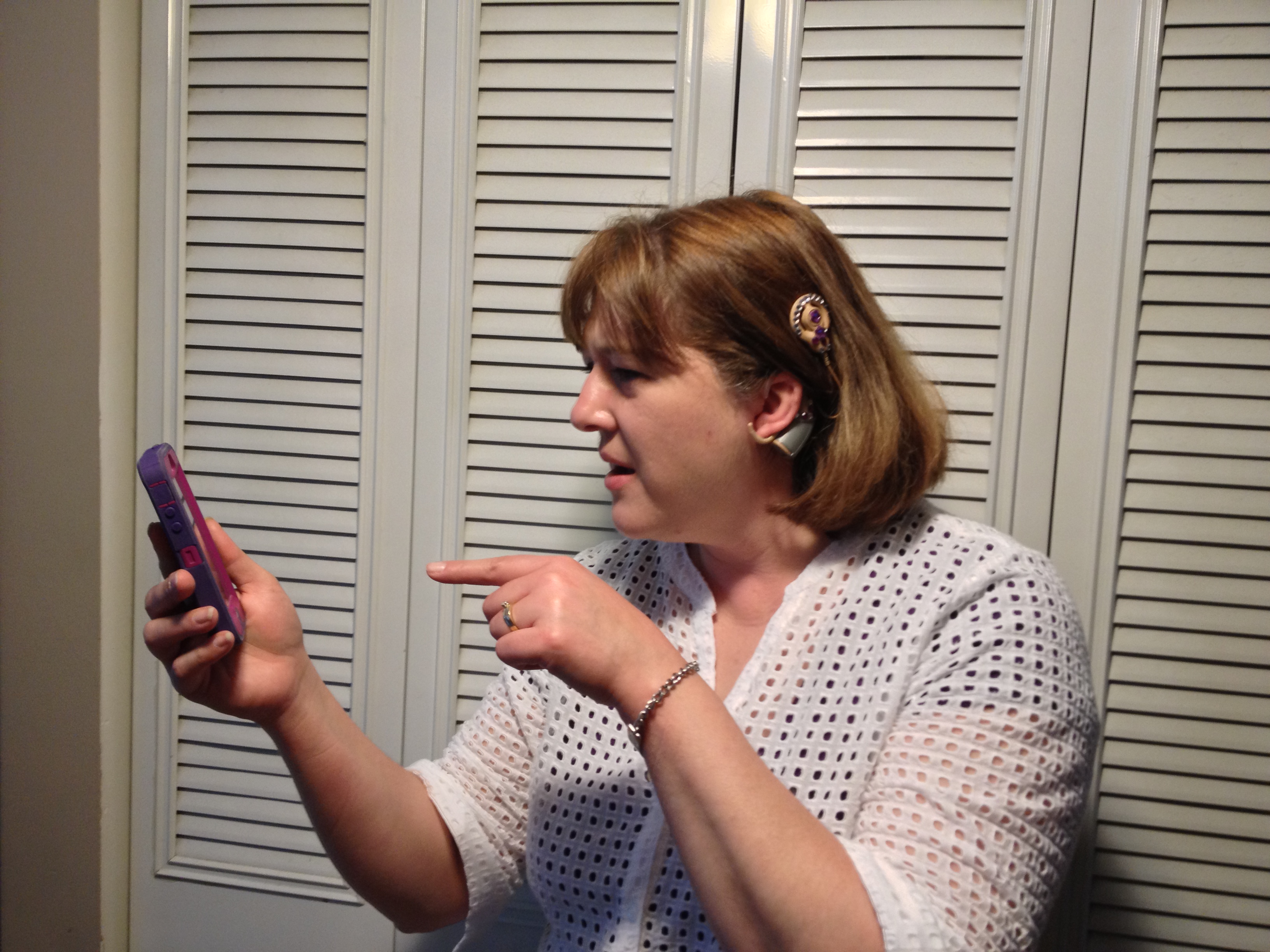
I Stare at my Phone and LAUGH!

If I'm not married to you or if I didn't birth you... I'm just not going to talk to you on the phone! :-)
If I’m not married to you or if I didn’t birth you… I’m just not going to talk to you on the phone! 🙂

Last week after a meeting with Anne Arundel County Commission on Disabilities, I received a follow-up phone call about changes in a training that I would be participating in for the Public Safety committee. There are five of us on the committee, two of which (including myself) have hearing loss. I never give out my cell phone number, but do have a number that we use as our “home phone” through Google Voice. The reality is that Google Voice isn’t a phone at all. It transcribes messages from a messaging service when people call the number and leave a message. I receive both a written transcription and the taped message.

So I received the message with changes about our training and read/heard at the end: “Call me to let me know you received this”.

I laughed.

Out loud.

Twice.

I don’t use the phone. On rare occasions I will speak to my husband or grown kids on my cell phone. However, I know their voices VERY well. Sometimes I will talk to my mother but only long enough to ask her to switch to FaceTime. (Always helps to see the face to pick up more of the conversation). With all other people, however, I do not use the phone.

It isn’t that I cannot use the phone. It simply isn’t my first choice (or second, or third choice). If I want to talk on the phone I have to stop everything. No multi-tasking such as continuing what I’m doing on my computer, or folding laundry, or working in the kitchen. I have to sit (that’s right… I can’t stand!) switch to t-coil on my cochlear implant and hearing aid, close my eyes (I’m not kidding), and concentrate. How often would YOU be able to talk on the phone if this were the parameters for you to do so? <BIG GRIN>

Email is a Great Choice

email

Email is a great choice for people with disabilities or chronic illness. In my opinion, it is actually a great choice for everyone. Why?

1. Email gives a written record of exactly what was said.

It doesn’t really matter if the conversation is personal or business. A written record of what was actually said can help us better remember dates, times, and other important information.

2. Email fits into our schedule.

You can check email on many phones now. You can check email on devices such as iPods and iPads, and Kindle Fire. Many types of technology allow you to read and respond to emails no matter where you are.

When we need to respond to emails from our desks, something business related or important, we can do so on OUR schedule. No playing telephone tag. Instead you can read and respond at a time that is convenient.

3. Email can eliminate communication problems.

Have a habit of interrupting someone mid-sentence? Do you have attention-deficit disorder and are easily distracted by what is going on around you? Is the person you need to communicate with hard to talk to – angers easily, defensive, mumbles, etc? Email eliminates those kinds of problems.

4. Email is free.

Most of us have a computer at home now. If you do not, you likely have a way to access email through mobile devices or at least have a library nearby where you can access the Internet. There are numerous free email options. I personally use Google’s gmail for my email account. However, there are numerous free email options discussed at About.com. You can access that HERE.

Email can also be a great choice for people with disabilities or chronic illness. I am late-deafened and hear again with a cochlear implant. For me, email eliminates the pressure to HEAR. When folks get a hold of my cell phone number for some reason and call, I really do stare at my phone and laugh. Email can be read by special programs such as JAWS (a Microsoft computer screen reader) and written with Braille displays for folks with low-vision or people who are blind. Email font can be enlarged to assist those with problems seeing smaller type. Email can be a great communication device (along with various social media) for people who have difficulty expressing themselves and using their voice. Email may be easily accessed with various tools for people who have mobility issues. Email is available when you are ready to read/send communications… something that may be important to people who have Chronic Fatigue Syndrome, FibromyalgiaLymes disease, or other disorder where fatigue and pain are a factor. Can you tell I’m a big fan of email?

Some of you are thinking, “But I just want to hear your voice!” I totally understand that. Even as a person with hearing loss, I understand how important inflection, emotion, and accents may be in communication. We do need to be sensitive to the fact that there are a great number of people who do not feel the same way. Just because you like to hear someone’s voice with a phone tucked under your ear, doesn’t mean that others are able to have a hands-free, low-anxiety audible communication with you. Perhaps Skype would be a good choice for you – free to anyone with a computer or modern cell phone. FaceTime is rising in popularity with people who have Apple products. These communication devices allow people to both hear and see when communicating. You can even have conference calling!

I think the only thing I love more than email is texting! Unless, you want to discuss a major problem called autocorrect… but hey! That’s a topic for another post!

Denise Portis

© 2013 Personal Hearing Loss Journal
Unplug…

unplug

In today’s world of media overload, with technology and electronics in every household, the word “unplug” usually means when an individual deliberately steps away from these items to recharge.

For many with chronic illness or invisible disability, to unplug might mean something different. Saturday night my small living room was seething with emotions. There were five adults, including myself, parked around a television watching the Ravens beat the Broncos. We had hoped. We had prayed. But all the experts had convinced us the Ravens didn’t stand a chance. To watch the game unfold and the Ravens take the win in double overtime, my senses were in crippling overload. Long ago I conceded using closed captions during a NFL football game. I admire and appreciate the hard work of those who work for the captioning organizations, but the captions really do interfere with watching sports as there is no “perfect” place to put the captions and not cover up a play or stats. So I was watching the game by only utilizing my cochlear implant and hearing aid.

I watched five minutes of the post-game show and quietly headed upstairs. Once in my bedroom, I flipped on the light and opened my Dry ‘n Store in one practiced motion. Off came my “ears”, off came my shoes, and I threw myself onto the bed with all the grace of a wet noodle. Chloe hopped up and snuggled close, perfectly content to escape all that testosterone downstairs. I think I laid there with my eyes closed for an hour – not napping – just coping. I needed the quiet. I love my bionic hearing, but there are times I literally suffer from sensory overload. My eyes, ears, brain, and yes VOICE were worn out. I needed to unplug.

There have been times I have pushed through that feeling of “I need to unplug” and only regretted my choice to do so. I am more prone to fall when worn out. I miss things when communicating. My speech actually deteriorates when I reach the breaking point. Hearing takes work – at least for me it does. You might not be able to tell by looking at me that I need a “senses” break because hearing loss and Meniere’s disease are both invisible. Goodwin and Morgan (2012) explain that, “many chronic illnesses have highly variable symptoms that are largely invisible to others. The symptoms can cause fatigue and pain, affect cognitive function, create sudden emotional shifts, and even impair speech (para. 6). It is in my best interest to know when I need to unplug.

I know many people with hearing loss who unplug in their own way. One bilateral friend takes long walks with just her camera. She has a real knack for connecting with nature and sharing that connection through her camera lens. I suspect it is her way of unplugging. She may have her “ears on” still, but nature’s melody is a distinctly different sound than what one hears in a crowded cafe or work environment. Another friend with bilateral cochlear implants actually takes yearly retreats. She not only unplugs, she truly isolates herself in order to fully rejuvenate and refresh her soul. Many with hearing loss, however, simply go to bed early. It doesn’t bother me at all that my family teases I’m the first one in bed every night. I require a full eight hours of sleep – hard to do in the day and age in which we live!

Use a Calendar

My calendar is very important to me. However, it is not because I forget appointments if I don’t schedule things carefully. My calendar is actually a tool I use to help me know when to unplug! By carefully tracking what I do in addition to just a normal workday, I can avoid serious physical and mental fatigue. Having Meniere’s disease means that I have to be responsible for how tired I allow myself to become. If I’m seriously fatigued and weak, I am more susceptible to falls and injury. With my doctor’s recent warning ringing in my ears about doing everything in my power to avoid anymore head injuries, I carefully plan each and every week. Many people with various disability or invisible illness must do the same. The Multiple Sclerosis Foundation Medical Advisory Board encourages us to be careful planners. “Conduct an energy audit. Ask yourself how much energy do I have? What time of day do I have the most energy? What time of day do I have the least energy? What do I want to do? What must be done? What can wait? Keep a journal and record your daily activities along with the times that you do them. This will enable you to recognize your patterns of fatigue more readily. Monitor these patterns and plan your day accordingly” (MS Foundation, 2009, para. 14).

When I see that a day is as full as I dare allow it to become, I block off any other available times. I know I will need the latitude to unplug if needed. I may even have to turn down opportunities to visit with a good friend, or going to something I would really like to do. My calendar enables me track what I know I’m capable of doing in any given day.

Using a calendar can also help people with invisible disability or chronic illness to determine what is really important. I have become an expert on running errands… making sure to do things all in the same area of town so that I do not have to make any special trips – which are time thieves. Having to do spur-of-the-moment errands may mean I do not get to do things that are really important to my mental, emotional and spiritual health. Morgenstern (2008) is adamant about controlling your schedule, and failure to do so creates a life that not only runs you ragged, but regularly throws you curve balls and prevents you from focusing on the things that matter most. For those of us who live with disability or invisible illness, this may mean we set ourselves up for injury, debilitating fatigue, mistakes, or relapse. Getting control of your schedule can only benefit you.

I hope you have learned to unplug when needed. One doesn’t need to lay in the dark, isolated from all sense-sapping triggers. You can relax on the deck with a cup of coffee. Take a bubble bath! Read a good book. Immerse yourself in a hobby. All of these things can help you unplug and recharge!

Denise Portis

© 2013 Personal Hearing Loss Journal

Goodwin, Stephanie A. and Morgan, Susanne (2012). Chronic Illness and the Academic Career. American Association of University Professors, May-June. Retrieved January 12, 2013 from http://www.aaup.org/article/chronic-illness-and-academic-career#.UPQg_mdyHTo

Morgenstern, Julie (2008). SHED your Stuff, Change Your Life. Fireside Publishers, New York.

Multiple Sclerosis Foundation (2009). Fighting Fatigue. Coping with Multiple Sclerosis, July issue. Retrieved January 14, 2013 from http://www.msfocus.org/article-details.aspx?articleID=48

A Stolen Life

stolen life

It’s that time of year again. The end of a semester. The beginning of “panic week” for students in colleges all across the country. For my own classes, this means that students are rushing to get it the extra credit because their grade isn’t going to be  what they’d hoped. I offer a fairly easy, yet time-consuming extra credit incentive.

– Read “A Stolen Life” by Jaycee Dugard

– Take a quiz on it (and pass)

– Turn in a 3-5 paragraph essay of your own reflections on the book

I’m always tickled at reading the student’s responses to this book. It’s an “easy read”, but difficult material. Jaycee Dugard writes about her long-term confinement after being kidnapped. Students normally respond with one of three attitudes.

1. They are ticked off. The theme of their essay is how unfair and unjust this case was. They are upset at all the many “players” along the way that should have seen, should have intervened. They yearn (and demand) justice.

2. They are shocked. Many are fully aware these horrible crimes occur, but to read a first-person account of someone who SURVIVED really leaves them wondering how the world can be so evil.

3. They are grieved. Some feel very down – even depressed – after reading the book. Many actually try to contact Jaycee through forums or email to let her know they look up to her and wish her the best. Some may have experienced some form of abuse themselves so they feel empathy as well. They admire Jaycee’s courage and resilience.

How Do We Respond?

While reading essays this weekend and assigning extra credit points to hyperventilating students, it struck me how similarly we tend to react to life’s problems and challenges.

I know plenty of folks who have responded to invisible illness or disability by being ticked off. They feel it is unfair they have to shoulder this burden. They may enter “offensive mode”. They make sure everyone around them are aware of the unfairness of it all, and to make sure everyone treats them with continued respect – disregarding the changes in their lives. After all, they didn’t ask for them.

Some people are shocked. The rug has been jerked out from under them and they are still sitting on their fannies watching the room spin. How did this happen? Why did this happen? I’m all ALONE! Someone HELP ME! They are often at risk to isolate themselves or become depressed.

Many people feel grief, actually going through the stages of grief as they learn to cope with their “new normal”. They may reach out to others – their peers who face the same struggles that they face each and every day. They eventually find – and become – heroes.

Do you feel that your invisible illness or disability has essentially “stolen” your own life? Do you feel out of control and unable to cope? Have you responded with anger, shock, or grief?

The Internet is a wonderful thing. I truly believe that people with invisible illness or disability are at an advantage compared to the lives of those who experienced the same before the Internet. It is a simple thing to go to your browser to search, discover, and benefit from online forums, support groups, and advocacy communities. You are not alone.

Do you feel as if your life was stolen? Jaycee eventually confided in someone, was rescued and reunited. Need a listening ear? I may be deaf but I listen very well. Or, there are many other avenues that you may find peers to help you through this time. Take part in your own rescue by reaching out. Reunion and a victorious, purposeful life may be just around the corner.

Denise Portis

© 2012 Personal Hearing Loss Journal

 

They May Not Get It

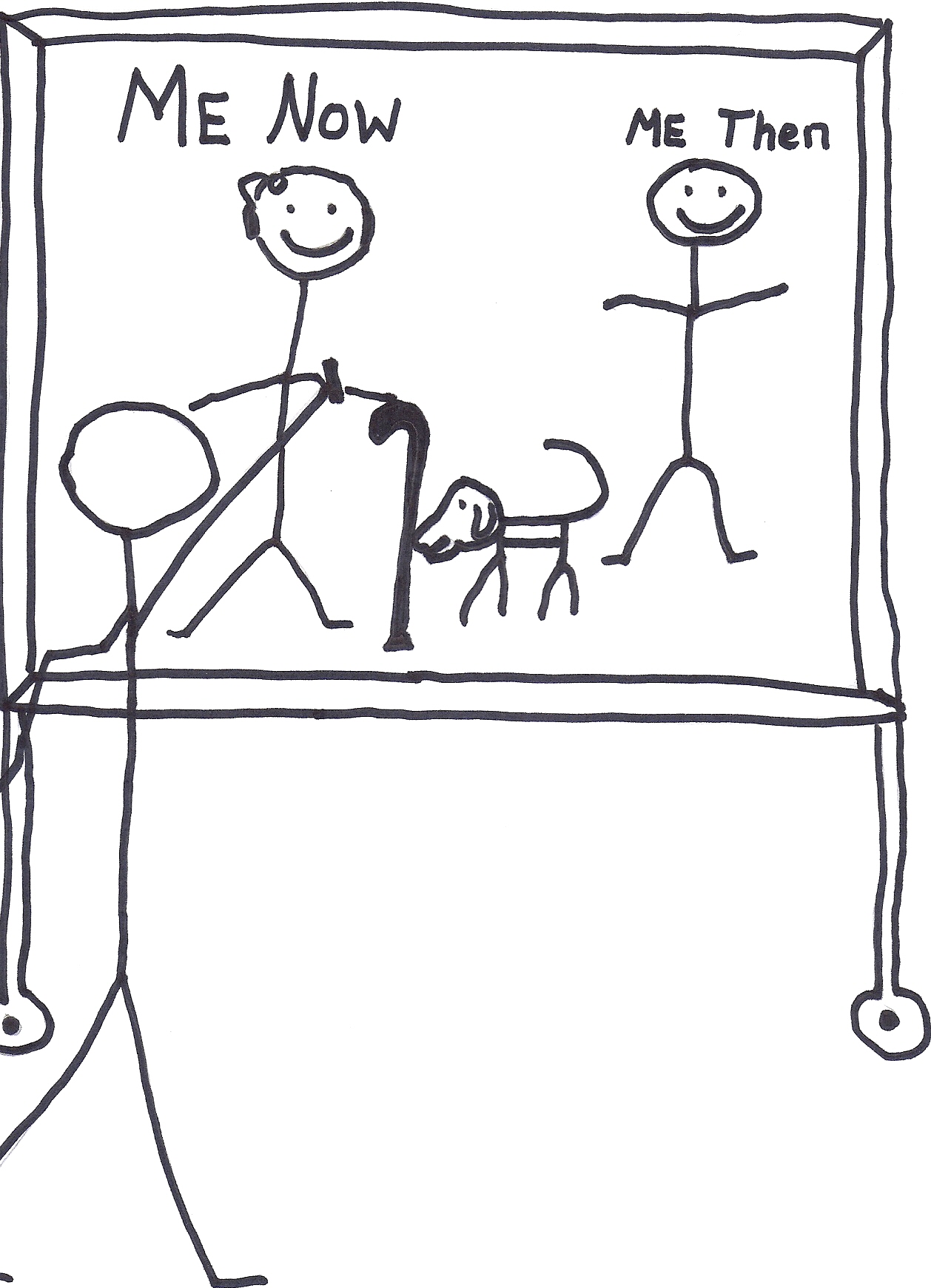
(Hey… I’m not an artist! But have you ever felt this way?)

One of the questions I am asked the most by folks who contact Hearing Elmo, is “Why doesn’t my family accept and understand who I am NOW?”

Before I even begin writing, let me express my hope that many of you will respond and share as I am very aware I do not have all the answers.

Why It Hurts

1. It hurts because the transition from “normal” to where you are was painful.

The school of hard knocks is – well – hard. Acquired disabilities and invisible/chronic illness are not easy to get use to when they first change a person. The journey from diagnosis to acceptance is a hard one. It hopefully has made us “better” and not “bitter”. I can attest to feeling stronger, more confident, and much more in tune with who I really am post-disability. Some of us have progressive symptoms and illnesses. We may adjust, only to have to do so again in a year or so. This too can grow us. But honey? It isn’t easy.

However, BECAUSE it was hard, it is hurtful when folks who knew us WHEN (back before our diagnosis), don’t accept or try to understand who we are NOW. We are still the same people. Our personalities have not changed. Our strengths and weaknesses are all still present – although you may have developed some new strengths because of your life path. So it is difficult when family members may sometimes be the hardest to teach how to talk to us now that we have a hearing loss. Or perhaps you are frustrated because a family reunion at a theme park is not ideal for you because you cannot ride any of the rides. Maybe you are utilizing a wheelchair, walker, or cane. A picnic and hike may not be a good way for you and your siblings to catch up – even if it has been a year since you’ve seen each other.

It’s not like we want recognition for the pain we’ve experienced. We aren’t looking for a medal. However, seeing any eye rolls or hearing frustrated sighs serve only to remind us our family

STILL

DOESN’T

GET

IT.

2. You expect your family members to care enough to accept you.

It’s not wedding vows. “In sickness and in health, for richer or for poorer…” But we have a reasonable expectation that our family members are going to love us and be there for us regardless. It doesn’t matter if we acquire a disability. We are still the same person. If Lymes disease has you aching and feverish a week out of every month, we expect compassion, not disdain. If CFS or MS has you weary, tired, and feeling as energetic as a centenarian, you expect understanding and maybe an offer to run an errand for you. If your eyesight is worsening due to various illness or disorders, you never expect frustrated outbursts when you explain you don’t have a ride to go to your nephew’s graduation.

But friends? Family members can need educating. Advocacy may begin at home. We wish it wasn’t necessary, but it may be very necessary. My kids grew up with me at best, hard-of-hearing. My husband, however, knew me before hearing loss. So I have to be willing to tell (nicely) him what works and what doesn’t. Don’t be surprised if it takes numerous lessons. Some heads are thicker than others.

What to Do

Talk to them. I’d elaborate, but honestly? You need to talk to them. Explain how you feel. Be willing to be vulnerable. Start with phrases that explain specifics and not general accusations. Example:

“When you sigh as I wobble into a shelf at the store it really hurts my feelings. I can’t help it when my world ‘twirls’. It’s hard enough to face the stares and hear the whispered remarks from strangers. I expect better from you. I expect your support.”

They May Never Get it

We can choose our friends, but we don’t choose our family. Blood is blood and it simply cannot be changed. However, you do not have to put up with people who ridicule you or try to injure you with words. You do not have to deliberately spend time with people who only make you feel worse. Sometimes? Sometimes those toxic people are family members. I hate it for you. I hate it for me. But it can be the painful truth.

Sometimes those friends that we choose? They become family. Maybe not by blood. Perhaps not by legal adoption. But folks who encourage us, lift us up, make us better people, understand, lend compassion and energy? They can become like family members. My heart’s desire is that you will find some folks like this if you haven’t already.

I welcome your thoughts on this. Knowing family members may grieve the person they once knew, or have trouble adjusting to the fact you are “differently abled” is important. Be patient. But also put healthy boundaries in place to keep unhealthy people from de-railing your progress with your own adjustments.

Denise Portis

© 2012 Personal Hearing Loss Journal

A Whispered Thank You

Praying Mantis calisthenics – photograph by Deborah Marcus (NC), friend and nature photographer

Not long ago while visiting in NC, I spent an afternoon with my friend, Deb, at the North Carolina Zoo. Deb takes pictures of life in nature; everything from plant life to animal life (and everything in between). She sees things that most folks miss and often stopped and pointed out things I would have just walked right by as my “notice-er” is out of practice. When Deb takes a picture she always whispers, “thank you”. When I first caught her doing it we were just thrilled and tickled that I was actually hearing her whisper of thanks! Cochlear implant sisters-in-arms, we always celebrate those moments.

However, since my visit I have given her habitual murmured thanks a lot more thought. When I tend to think on somethin’, I ponder, speculate, question, and soul-search. Eventually I write about it – even if it takes me almost 15 months to get around to it!

Like a Dangling Spider Cares?

I have to admit, when I first heard her thank a lily-pad, skimming dragonfly, I thought, “Umm. This critter does NOT care if she thanks it for the Kodak moment or not”. But it’s deeper than that. An attitude of gratitude and respect is cultivated. We certainly aren’t born with it. I remember teaching my toddlers “please” and “thank you”. Sure… some of that can be a learned behavior from appropriate modeled examples. Some folks are just naturally friendly and easy-going. Some walk around like a sour puss (I’ll not mention any names) and thanks is a foreign language. Most of us fall somewhere in between, our emotional health dependent on life circumstances. This is why an attitude of gratitude must be created and exercised faithfully to instill a HABIT.

It starts with the small things. Walking out underneath my porch to dispose of an empty plastic container, I thank the spider who just snagged that mosquito. (No. I haven’t found it in my soul yet to thank any skeeters). I try to thank my family members for doing things – EVEN IF IT IS THEIR JOB TO DO SO. I thank my students for turning their work in on time; or, if late, for eventually turning it into me! I thank the very pregnant, adjunct coordinator for my department, as she certainly has better things to do (like nesting) than to email all of us our reminders for the semester. I thank the person in training at the U.S. Post Office for waiting on me – which they stuttered out a very surprised “Your welcome!”. (Doin’ everything I can to assist in a decrease of “goin’ postal”). I thank the cashiers at the grocery store, Wal-mart, and CVS. (I thank the produce department workers, which is only funny to you if you know me well). I thank my waiter/waitress every time they do the smallest thing for me at a restaurant… even though it is their job. I thank “hound dog” for every task she does for me, which only increases the tempo of her wag. Do you see how far this attitude of gratitude can go?

Sitting with a friend waiting for small group to start one Sunday morning, I startled her by saying, “thank you for being my friend”. She sat there with her mouth hanging open waiting for “more” or for “the other shoe to drop” (like… would you DO THIS FOR ME?) She said, “That’s it? Well gee. I’ve not received a thanks like that in awhile!” I grinned at her but thought, ►well why not?◄  Why do we not thank the folks in our life even when there is no real reason? Keeping it to ourselves doesn’t bless anyone.

“Silent gratitude isn’t much use to anyone.”

~ Gladys B. Stern

Expressing our thanks must be EXPRESSED. William Ward said, “”Feeling gratitude and not expressing it is like wrapping a present and not giving it.” According to “Happy Life U” (you should check it out!) expressing thanks can actually improve emotional happiness.

New research shows that practicing gratitude may be the fastest single pathway to happiness, health, long life, and prosperity. In a remarkable study performed by Dr. Emmons, people who kept a gratitude journal for just 3 weeks measured 25% higher on life satisfaction after wards. They exercised more, drank alcohol less, and their families and friends noticed that they were nicer to be around. And the effects lasted for several months beyond the initial 3 week study. Other studies on gratitude are confirming these results. People who take the time to notice and appreciate the good things that come their way through grace, or luck, or the goodness of others are happier and more peaceful. They do better on cognitive tests and tests of problem solving skills. They practice healthier habits, have better relationships, are more optimistic and live longer. Gratitude is one powerful emotion (Happy Life U, 2011-2012, para. 5).
 

So What Has This Taught Me?

I already explained I’ve been thinkin’ on this topic for better than 15 months. I’ve even followed up with a conversation or two with my friend, Deb, about this which likely has her wondering why this is so important to me. I write a great deal about invisible and chronic illness, acquired disabilities, and living victorious lives in the bodies in which we find ourselves living.

Naturally, I had to research if being thankful could help folks in the community of souls of which I self-identify. Wood, Joseph, and Linley (2007), suggest that gratitude can be a powerful social support tool that folks with disabilities can use to help them. They asked 236 folks with various burdens (disabilities, chronic and terminal illnesses, addictions, etc.) to participate in a study that asked them to keep a gratitude journal. Folks discovered their written “thanks” eventually jumped off their pages and out of their mouths. “Gratitude correlated positively with seeking both emotional and instrumental social support, positive reinterpretation and growth, active coping, and planning” (Wood, Joseph, & Linley, 2007, p. 1076).

Allison Shadday has MS. She believes we need to shift our attention. “Sometimes we all have to slow down intentionally before we’re able to genuinely appreciate the many positive aspects of our lives. If you find yourself feeling critical or negative during the day, take a deep breath and redirect your attention to something for which you’re grateful. Notice if your body becomes more relaxed and your breathing more steady. Tune in to how your attitude shifts when you focus on the sweetness in life. This is living consciously” (Shadday, 2006, p. 51).

It seems… being thankful makes us healthy. More than that… it can make us HAPPY. The recipient of our thanks may not deserve it. They may not look like they need it.

Do

It

Anyway.

I think you will find it can change YOUR life, for the better.

Denise Portis

© 2012 Personal Hearing Loss Journal

Note:  You can “see” and “hear” more from Deb at http://visionsofsong.wordpress.com/

Happy Life U. (2011-2012). New Science of Happiness. Retrieved August, 12, 2012, from http://www.happylifeu.com/Attitude-of-Gratitude.html

Shadday, A. (2006). Embracing an attitude of gratitude. Inside MS, 24(6), 50-51.

Wood, A. M., Joseph, S., & Linley, P. (2007). Coping style as a psychological resource of grateful people. Journal Of Social & Clinical Psychology, 26(9), 1076-1093.

Decisions, Decisions…

For a totally unrelated reason, I was reminded this week that my husband cannot swim. I hate it when a discussion brings up old nightmares about the topic too! Goes to show how much our subconscious is at work… especially when sleeping. Anyway, this conversation about the fact that my husband cannot swim had me dreaming about one of the most terrifying events that led up to my banning him from going into the ocean.

The year was 2001, and my family and I were in Siesta Key, Florida. Terry was taking some classes to finish up his doctorate. Always nice when degree completion requires on-site classes in Sarasota, and you can time it where the whole family can be dragged down with you! Terry wasn’t getting much rest and relaxation. Going to class all day and putting the finishing touches on his dissertation were exhausting. At night he was glad to just catch whatever sunshine was left in the day and rest on the beach while I corralled the kids into a distance I could easily manage their activities.

I’m not sure what prompted a non-swimmer without a life vest to decide to get on an inner tube, launch one’s self into the ocean, and drift off to sleep. He swears up and down he had no idea he’d drift out to sea. After all, when he got past the breakers and could just snooze, the ocean was calm and serene. I’m the one with hearing loss (a fact I’ve made plain on this blog). But exhaustion and FREAKIN’ DISTANCE FROM SHORE will dissipate sound waves and keep someone from hearing shouted warnings; even from hearing ear-drum piercing screamed warnings. That’s right. Picture me on shore with kids, jumping up and down, screaming warnings that a riptide had caught him and he was oblivious to the danger. I remember thinking, “he has the room key around his wrist so I can’t even get into our condo and have one of the kids call my parents to let them know Terry drowned”. Morbid, yes? But I knew Terry could not swim AT ALL. The man cannot even dog paddle (something Chloe has told me since that she’s a little embarrassed about actually).

We may not have been able to attract Terry’s attention, but we did other folk’s. Soon a small crowd of people were whistling and hollering for “Terry!” A man, likely a native, stopped close to me and said something. I could hear the rumble and pitch of his voice. I stopped screaming long enough to sputter, “I have a hearing loss and have to see your face to hear”. So he touched my shoulder to get my attention and said, “He can’t swim? Want me to go after him?” I looked out at my still sleeping husband and agreed immediately. “YES PLEASE!!!!” (At least I’m polite...)

So the man went after my husband. He must have been shouting as he swam, because when he got closer to Terry, I could barely make out that Terry finally woke up. I saw a flail of hands, legs, and arms and prayed he’d hold on to that inner tube! The rescuer had started further up the beach to Terry and I think the tide and his strokes eventually got him safely to Terry’s side. He must have given him instructions to kick, which he did as well along with some steering, and eventually ended up on shore about a mile from where we all started. The small crowd of people had followed the kids and I down the beach. Some kind soul had picked up our things and carried them with us, knowing I wasn’t cognizant enough to even do that.

Drifting Off

A very popular topic for writers who discuss acquired disabilities and chronic illness, is social isolation. Isolation does not happen all at once. It is a gradual process; a series of small decisions and choices that eventually yield a self-perpetuated aloneness. We become “deaf” to the shouted (and well-meaning) warnings of people around us. Can we be rescued? Will we even allow a “strong swimmer” to intervene?

For people with hearing loss, isolation is almost a part of the process of learning to live with it. I know few people who are late-deafened that did not have at least a short period of self-imposed isolation. Why? Well experts have said of the late-deafened, “They no longer felt they belonged in the hearing world, and neither did they belong in the prelingually deaf world. Onset of deafness had left them in a twilight zone between worlds and had robbed them of their identity” (Barlow, Turner, Hammond, & Gailey, 2007, p. 442). Other acquired disabilities can produce the same isolation, however.

Physical difficulties can prevent people with a mobility impairment from creating social networks. Even the weather can keep some folks with mobility issues away from others. If you have a power wheelchair or scooter, you do not want to go out in the pouring rain or blistering heat. Despite the intentions of the ADA, not all places where friends get together are accessible. Whether you are born with some limitations, or acquired them later in life, disabilities or chronic illness may result in feelings of loneliness and isolation, and a lack of access to support information (Matt & Butterfield, 2006).

Not As It Seems

Not all decisions to RSVP to invitations with a “No, thank you” are because of isolation, however. Friends and relatives need to understand and trust that sometimes? Those “no’s” are not a pity party nor decision to pull back. I don’t go to pool parties. I have technology that cannot get wet and a husband who cannot be in the heat because of having one kidney. (And have you picked up yet that THE MAN CAN’T SWIM?) Sometimes there are very legitimate reasons for declining an invitation. A person may not be able to do evening gatherings because they have legitimate needs for an early night. Folks with disabilities and chronic illnesses often require more sleep than the average adult. It is not always possible to nap the afternoon before in order to go to some evening “shin dig”. Some people have to offer late apologies to activities they had planned to go to… but they have a “flare” when it comes time to prepare for an outing of fun and fellowship. The weather gets the final say for some of us. I can agree to go to a “Girl’s Night Out” a week in advance, only to have a weather system move in to where I can barely move in an upright position.

But…

I have also fudged about going to things I really could have had I really wanted to attend. Sometimes we say “no” because that is

EASIER or

HABIT.

We have to learn to police ourselves and ask ourselves some legitimate questions when our first impulse is to decline an invitation.

Social Networks

Nothing gets on this female’s nerves more than when I hear someone ‘pooh-pooh’ social networks like FaceBook, My Space, Blog networks, online support groups, and message boards and forums. I have heard holier-than-thou folks spout that these avenues “aren’t real people” and therefore are not “real relationships”. Drs. Patricia Obst and Jana Stafurik refute this much better than I can. “Online we are all able-bodied“. Online there is a “psychological sense of community and social support found through membership of disability-specific websites” (Obst & Stafurik, 2010, p. 525). These researchers looked at 160 different individuals who had various disabilities or chronic illnesses. “Results indicated that users did receive moral support and personal advice through participating in such online communities. Further, results indicated that online social support and feeling a sense of community online were positively associated with participants’ well-being in the areas of personal relations and personal growth” (Obst & Stafurik, 2010, p. 526).

I am always thrilled to have guest writers here on Hearing Elmo. (Interested? Email me at denise.portis@gmail.com). This forum has provided information and support to individuals “living it” and to family members and friends for information. I have been invited to write in other forums and welcome the opportunity. Ever heard the phrase, “dissemination of information”? The Internet makes us equal. It provides an easy, inexpensive way to find support, learn, advocate, and connect.

It can also serve as an avenue in which a warning comes through loud and clear… even to those of us who are late-deafened.

Are you avoiding outside activities?

Are the reasons you are doing so legitimate?

Are you connecting with others?

Are our decisions prompted by necessity or the result of anxiety, depression, and an attitude of giving up? These are important questions to ask ourselves. Please don’t find yourself adrift on an ocean with the shore out of reach. Ask for help. Discover a hero swimmer on their way to rescue you.

Denise Portis

© 2012 Personal Hearing Loss Journal
Barlow, J., Turner, A., Hammond, C., & Gailey, L. (2007). Living with late deafness: insight from between worlds. International Journal Of Audiology, 46(8), 442-448.

Matt, S. B., & Butterfield, P. (2006). Changing the disability climate: Promoting tolerance in the workplace. American Association of Occupational Health Nurse, 54, 129–134.

Obst, P., & Stafurik, J. (2010). Online we are all able bodied: Online psychological sense of community and social support found through membership of disability-specific websites promotes well-being for people living with a physical disability. Journal Of Community & Applied Social Psychology, 20(6), 525-531. doi:10.1002/casp.1067

Commencement

This past Sunday, my pastor spoke on discipleship. In discussion of what discipleship actually is (growth), he discussed how some people may get confused that at the end of twelve years of high school they graduate and participate in commencement. Commencement is not the end of something; rather, commencement is the beginning of the rest of your life. However, for some that may be the defining moment of their life – the culmination of all they will accomplish.

According to dictionary.com, commencement is a beginning, or a start. Merriam-Webster defines it as a point in time in which one “enters upon the next”. In just a few months, commencement will take place at a number of schools. At the community college where I work, reminders are going out to students reminding them to petition to graduate by a certain date. At Fidos For Freedom, a service dog and therapy dog organization, commencement takes place at the banquet that takes place each May. Clients who are “graduating” this year are already gearing up for speeches, festivities, and recognition of a completion of training.

Yet these exercises are not an ending to anything. Rather, they are a beginning. For college students they may be transferring to a four year college to obtain a higher degree. It may mean looking for that ideal career. For clients at Fidos For Freedom, it is the start of a new life of independence – with trainers and “family” in the wings should any further assistance be needed.

Safe People

The topic of my favorite book, “Safe People”, has been a recurring theme in many of my discussions with family and friends lately. I actually dug my copy out to read it again, because I found myself recommending it to several different people. Learning to identify and avoid unsafe people and relationships can be a hard-learned lesson. I think the truths that have permanently etched themselves on my heart and mind from this book, are how to be a safe person MYSELF. For me, it was reaching a point in time when I could turn my back on the past and boldly face my future. Sure! I took lessons learned from the past – in my relationships, problems, and successes – but armed myself with those lessons to be better equipped for my future.

It has been a commencement for me. Like Merriam-Webster explains… it is a period of time where I chose to “enter upon the next” chapter of my life.

Progressive Illness/Disability

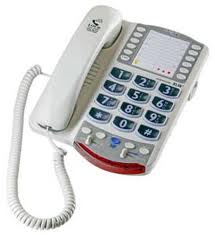
I think one of the frustrating things about having progressive hearing loss, or chronic illness/disability, is that one may commence living life with a new charge for life , equipped to be as independent as possible, only for changes in our health to take us back to square one. Prior to my cochlear implant, I remember learning to cope with the telephone, conversations in crowded places, and learning to speak with people with poor communication habits. However, in a matter of months my hearing would take a dive and I would discover that what worked last month, didn’t work at all now! Like most families with small children at home, we lived paycheck to paycheck. We pinched pennies and scrimped and saved to purchase an amplified telephone for me. For five or six months I was in telephone heaven! I used the phone every single day with confidence and enthusiasm. It didn’t take long, however, before I was struggling to even use that new gadget. I earned a little extra time by using it when the kids were outside and the house was relatively quiet. What was once easy became increasingly difficult. Eventually, the frustration of what I wasn’t hearing, despite hearing aids set to t-coil and begging people on the other end to speak clearly into the phone, had the phone collecting dust from lack of use. I’d talk to other HoHearies and get some new ideas. At some point though? The phone became a thing of my past. I had to come up with ways to contact people other than the phone. For the late-deafened community, the emergence of email, texting, and even FaceBook became very real “life-savers” in terms of being able to freely communicate with others. Although I hear well enough on the phone now that I have a cochlear implant, these other forms of communication are still my own first choice.

Resilience is a Special Kind of Strength

Many readers of Hearing Elmo have various disabilities, invisible illnesses or chronic health problems. For some, those difficulties are progressive and force them into a constant state of evolution. This can actually be healthy. (I see some of you grimacing out there!) Yet progressive illness can produce resilience – the likes of which create a strong and capable individual who can face life’s problems with the confidence earned through experience. Resilience is a special kind of strength. These individuals know that living successfully with progressive health problems is simply adopting an attitude of commencement.

Some people never graduate. They never enter that next stage of life. Even though the past may be painful, they cling to it with a tenacity that may stun family and friends. If they have progressive health problems, they may be stuck in the grief process. The grief process is a PROCESS. In a healthy situation, one moves from one stage to the next, eventually reaching acceptance and a new normal. Even psychologically we can get stuck in the past. Everyone else has moved on, but we have super-glued ourselves to unresolved situations instead of letting go and moving on with our lives (like everyone else has). Living this way yields toxicity to both ourselves and to others. We become “unsafe people”. It can have a negative influence on our relationships, self-esteem, and emotional/mental health. Dr. Seavey addresses how to face the future in a terrific article that can be accessed HERE.

Can you look back and see different points in your own life where commencement took place? Using all you learned in a specific period of your life, you chose to begin the next chapter of your life. May we all view commencement as springboard to usher in a successful, victorious future and not as a monument that designates an END!

Denise Portis

© 2012 Personal Hearing Loss Journal

Why I Love Winter: Expectation

(Part Two of Four)

I like having things to look forward to in the future. “Beats” dreadin’ it, right? It doesn’t even have to be something BIG. In fact, some of my favorite things – are “small” things. Is the song by Julie Andrews who plays, Maria, going through your head now?

Raindrops on roses and whiskers on kittens
Bright copper kettles and warm woolen mittens
Brown paper packages tied up with strings
These are a few of my favorite things

One of the many reasons I love Winter is that I love the feeling of expectation… of anticipation. You see… I know in a couple of months, the earth will awake. I love seeing frosty, ice-crystal tree buds, bright green with new life and colors peek-a-boo’ing at me all around my neighborhood. Nature holds it’s breath all Winter. As the temperatures warm and sap begins flowing in the trees, as the frost dissipates from the thawing ground to allow the first flowers to push up through the warming earth… nature exhales.

Perhaps I have a good imagination. But one thing I love about Winter is that there is a feeling of expectation, renewal, and life that builds a yearning in my heart even while the icy-cold fog greets me every morning. I know change is coming.


In many ways, this mirrors how I am slowly adapting to life. Life can be hard. If you haven’t learned that yet, sit down and brace yourself. It’s coming. Difficult days and trying times are a part of life. I realize I’m talkin’ like I’m as old as the hills. But at 45-years-old, I have lived enough of life to know there are hard times and good times in life.

When I’m going through a particularly tough time, I remind myself that this time will pass. Better times are ahead and I only need to persevere. Yes, I realize that there are times in our lives where it seems like “when it rains it pours… and our umbrella is broke”! You may be experiencing that kind of time. I’ve experienced them myself. Do you know what I’ve learned?

When I am experiencing a short-term, tough time, I’m able to grin and bear it and push ahead with this thing called “life”. However, sometimes it seems nothing is going right. Medical problems, personal loss, destroyed relationships, financial strain, and new challenges do NOT give us a feeling of exhilaration – rather, one of defeat. “That’s it, God!” (waves a white flag) “I give up. I’m done. Hello? Yup it is me, here! Chucking it all in… finished, quitting, stoppin’ right now. Stop the train, I’m gettin’ OFF”.

That’s when we need someone else to remind us of the days ahead. Ask for help. If you notice another who is shell-shocked by current life crisis, be their “someone”. We need someone to gently jog our memory about the coming tomorrow and the new opportunities, a “new normal” physically, and that “joy comes in the morning” (Psalm 30:5 “… weeping may endure for a night, but joy comes in the morning“). You see… this “Winter” in life is temporary. There’s an “exhale” coming!

Problems suck. We all want a problem-free life. I remind myself as I’m experiencing new (and sometimes, old) problems, that good can come from these tough times. I grow stronger, more resilient, and even more content. During this Winter there is a feeling of expectation. I can feel my very soul stir and my senses tingle as anticipation races through my veins! There is very little we are guaranteed. But friends? Spring is one them. Spring is coming!

Denise Portis

© 2012 Personal Hearing Loss Journal

Imagine!

Emmanuel Kelly The X Factor 2011 Auditions.

Click on above link for short performance!

I’m not a huge YouTube fan, because captions on music and video are not “perfect”. It’s better than it use to be, but it isn’t good enough that I could say I really enjoy it.

However, this past year I discovered “The X Factor”. It is now in the U.S. and the FOX network is underway on season one. I still like watching the shows in other countries as well. I came across this very special one this past week.

I was so impressed with Emmanuel Kelly’s performance. I think he and his brother’s adoption story and courage can teach so much. Bravery, courage, and “spunk” are not narrowly defined by a body that wields these attributes. Imagine what our world would be like if everyone saw with filtered eyes what Emmanuel’s mother did. Imagine what it would be like if everyone had someone in their corner during developmental years to mold and shape phenomenal human beings. Imagine if every individual with bodies that are broken, damaged, disABLED, or diseased learned to refine and use their gifts.

Learning to live with an acquired disability can be hard. There are always harsh lessons. Yet… acquired disability is not the end of life. We all have talents, skills, and gifts that are not affected by any changes you may find that define “the new me”. Sure… you may lose a few opportunities. I use to sing in choirs. (SMILE). Yet, I still choose to discover, refine, and eventually use the gifts that I DO have. You can do the same. May we all learn to look past first impressions and appearances… learning to IMAGINE.

Imagine there’s no Heaven
It’s easy if you try
No hell below us
Above us only sky
Imagine all the people
Living for today

Imagine there’s no countries
It isn’t hard to do
Nothing to kill or die for
And no religion too
Imagine all the people
Living life in peace

You may say that I’m a dreamer
But I’m not the only one
I hope someday you’ll join us
And the world will be as one

Imagine no possessions
I wonder if you can
No need for greed or hunger
A brotherhood of man
Imagine all the people
Sharing all the world

You may say that I’m a dreamer
But I’m not the only one
I hope someday you’ll join us
And the world will live as one

Denise Portis

© 2011 Personal Hearing Loss Journal

Timeless Reminders

In 483 B.C., Medo-Persian King Xerxes (also known as Ahasuerus) threw a huge, 7 day party. What was strange about this party is that it FOLLOWED a 180 day, kingdom-wide celebration. I mean… who has THAT kind of money? I guess Xerxes did – and he had no qualms about spending it. At some point in the party, Xerxes makes a mistake. He assumes his queen, the beautiful Vashti, will want to come to the men’s party and parade around for everyone. She set him straight pretty quickly… all through the channels of the first private messaging system… eunuchs. After consulting the fellas in his “boys club”, Xerxes boots Vashti to the curb… or actually to a part of the harem where he’ll never see her again. ‘Cept… now he’s lonely. This lonliness sets in play a kingdom-wide search for all the beautiful single women in the kingdom. That’s right… there’s a job opening in the palace.

Hadassah was a young Jewess being raised in Susa by her cousin Mordecai. Was it because she was near the palace at Susa that she was picked up so quickly? We don’t know, but we do know she was a “hottie”. Beautiful in form and face. Her name was changed to Esther and she began the year-long process of getting her chance with Xerxes to see if he liked her well enough to become his new queen. History tells us that in 478 B.C., Esther becomes queen. Guess she made an impact…

Xerxes was a “strange ‘un”. He paid attention to seemingly unimportant things and completely overlooked really important details… like signing a law from a “Jew hater” named Haman to wipe out and annhilate all the Jews on a specific day. Haman is conniving and manipulative and leaves out the little detail about exactly WHO the race was to be destroyed. Xerxes didn’t have a problem with the Jews – one saved his life even (wouldn’t you know it was Esther’s cousin Mordecai?) – but Haman certainly did. If you are familiar with the story, you know that Queen Esther is given the opportunity to save her people from this vengeance edict that was drawn-up and pushed through into law by Haman. During a pep talk from her cousin Mordecai via that early private messaging system… he tells Esther something that has reverberated down through the years to words we all know. “FOR SUCH A TIME AS THIS”. Those six words are profound, aren’t they? Unfortunately, Esther 4:14, has an even greater timeless reminder that is often overlooked. Mordecai actually says, “And who knows whether you have not attained royalty for such a time as this”. Yup. Esther saves her people by exposing Haman and suggesting to Xerxes to write a counter-law that will allow the Jews to fight for their very lives instead of rolling over and giving up. It seems no one wants to face a Jew with a sword. They are saved.

I think we miss an important reminder when we take only those six words out of context. All the pieces were in play at the right time, right place… all for a very important reason. I’ve often thought about my own life and tried to look at opportunities available to me that I have as a result of – all the pieces being in play at the right time and right place. Who knows whether or not I became deaf for such a time as this?

You Have a Disability. Now what?

I’m reasonably certain that if I asked for a show of hands for anyone who signed up for developing a disability or acquiring an invisible illness, I’d see a “room” full of people sitting on their hands. To be painfully honest with you, there are days that I really hate being deaf and only being able to hear if I wear bionics. I can get extremely depressed after experiencing a day where I had to navigate my space hanging on to walls or using a cane. I didn’t ask to become deaf, nor aspire to being a person with Meniere’s disease. Yet I firmly believe that everything has a purpose. So I’m deaf and hear again with a CI. What can I do with that?

Do you know that you have access to people that may be unique to YOU? The Internet may bring like-minded people together for discussion and support, but many of these people you may never meet face-to-face. Yet in YOUR life, there are real people that you have contact with that I do not. You don’t know the sad-eyed waitress at my favorite locally-owned restaurant. You don’t buy stamps from the grumpy postal worker I see once a month. You don’t stop and wait your turn at the crosswalk where a harried, sweaty, “I can’t take much more of this”, crossing guard faithfully sees school children across the busy street each weekday. These folks are unique to me, just as specific individuals you know at work, school, church, and PTA are unique to YOU.

Do you literally navigate life by using a power-scooter or walker? Then you are mobile in a manner I do not understand. Do you have fibromyalgia? I don’t understand that kind of pain – symptomatic of an invisible illness often misunderstood. Even those I know who have hearing loss and Meniere’s disease face different problems, frustrations, and symptoms than I experience. Hearing loss is often as unique as the individual. Yet all that is YOU, puts you in a unique position to make a difference where you are. I cannot influence the people that are unique to you.

You know something? It helps me to remember this timeless reminder when I am feeling particular frustrated about my life. I’m in a specific time and place with specific gifts, skills, and personality to influence those around me in a positive way. What is frightening is remembering that I can also influence others in a negative way. Going back to Mordecai’s pep talk to Queen Esther, he also reminds her that if she keeps her mouth shut and doesn’t ask Xerxes for the life of her people, then deliverance will come from another place.

Esther 4:14, “For if you remain silent at this time, relief and deliverance will arise for the Jews from another place and you and your father’s house will perish. And who knows whether you have not attained royalty for such a time as this?”

I don’t know about YOU, but I want to seize my opportunities. Sure… some may seem like small opportunities for impacting the life of another, but who is to say that opportunity is without worth? If I don’t live my life actively looking for opportunities to make a difference, then someone else will be in a position to do it instead. Especially if it is an opportunity to be a blessing and to make a positive difference in another. You are unique. The opportunities available to YOU are unique.

President Harry Truman said, A pessimist is one who makes difficulties of his opportunities and an optimist is one who makes opportunities of his difficulties”. Yup. I realize there is some therapeutic value in the occasional pity party. However, don’t stay as a permanent guest. You are missing opportunities if you keep your eyes on SELF. I believe living a life looking for opportunities makes life worth living. I try to re-evaluate where I am in finding and seizing opportunities every Monday. Mondays are dreaded by most; however, I’ve come to look forward to them as I’ve discovered self-evaluation can be invigorating – or at least a KICK IN THE PANTS.

Denise Portis

© 2011 Personal Hearing Loss Journal