A Special Kind of “Stupid”


On Monday evening, May 14th, David Walters of Bel Air, MD, pulled a fire alarm in  a crowded theater. He was issued a criminal summons the following day and faces a $5,000 fine and up to 5 years in jail. You can read about the story HERE. More on the story HERE.

It seems David was upset that the movie was open captioned for patrons who are deaf or hard-of-hearing. Specific movies (identified at the ticketing counter) allow people with hearing loss to enjoy newly released movies on the big screen. It allows equal access. Sure… we can purchase the movie later after it goes to DVD and watch it at home. But who wants to miss out on the buttery popcorn, movie candy, cherry Icee‘s and being with friends and family at the theater? Nothing beats the big screen! David marches out and complains – evidently loudly. He is offered a refund which he refuses. He goes back in to finish the movie. When finished he comes out again and loudly complains – now demanding a refund. When denied (because he went back into the movie), he gets angry and pulls the fire alarm. This shuts down all the theater’s screens and panics movie goers.

This is a special kind of S.T.U.P.I.D. When I first read about this story, I have to admit. I had some “AVENGER” feelings going on in my own heart and mind for this idiot. I thought, “Wow. If he could live one day in my shoes. It would be poetic justice for him to lose his hearing someday!”

Deaf For A Day

Because I live with both deafness and a balance disorder, I can tell you honestly that really? I wouldn’t wish deafness on anyone. Yeah. This jerk probably deserves it, but hopefully what he’ll get is justice. I hope because he endangered so many people that they make an example of him. I hope everything was done correctly in his arrest so that he doesn’t get off on some kind of technicality.

Each year I ask my students in my ASL1 class to voluntarily participate in a “Deaf For a Day” assignment. Later, they write about it. Most “get it”. They understand what the assignment was about and why they are asked to participate. Each year, however, I have either a student or two, or a parent or two, very disgruntled about the assignment. In the follow-up writing assignment, some disclose how poor of attitudes family members had because they were unable to communicate with their student in a “normal” way.

Yes.

I like to think that should something happen to their child and they lost their hearing, these parents would do all that they could do to be supportive and loving in the transition to a new way of communicating. They may not use ASL even, but technology is not a 100% fix. Even cochlear implant surgery is not 100%. I’m bi-modal (both cochlear implant and hearing aid) and although I hear really well, I still am considered a person with hearing loss. There are times I have to ask for a repeat, or ask someone to follow me to a quieter location.

Put Yourself in Their Shoes

Before you think to yourself that you would never be this “special kind of stupid”, consider this.

Have you ever parked in a handicapped space to save time because you were only running into the Post Office for 5 minutes?

Have you ever sat at a table clearly marked for handicapped patrons at a local fast food place because there were no free tables, and then failed to keep a look-out for anyone coming into the establishment that may need that table?

Have you ever reached to pet a service dog without requesting permission of it’s owner?

Ever felt exasperated (and let it show) while waiting in line behind a mom with a child with autism or other special needs who was having a meltdown?

Have you ever felt impatient as someone with mobility issues that fumbles and drops items while you are waiting in line at the cashier?

Ever see someone stumble or walk funny and immediately think they’ve been drinking instead of thinking they may have a balance disorder?

Ever honked your horn and grimaced at an elderly driver who cautiously entered a very busy intersection during peak rush hour?

Not understanding what chronic fatigue syndrome, fibromyalgia, or Lyme disease actually are, have you inwardly cringed and rolled your eyes while listening to a seemingly endless list of complaints about pain from a co-worker, fellow church member, or acquaintance?

Ever see someone mistreating a homeless person or person with mental illness and not intervened?

Ever stepped into a handicapped stall in a public restroom because the others were full? Exactly how are you going to know someone is there who needs it when you are actually in there doing “business”?

You may not be pulling fire alarms and endangering hundreds of people, but you are still choosing to be a part of this special kind of stupid group. I’ll admit that I’ve made some of these mistakes myself. We all have.

I’m asking that all of us take a minute, however, to think about how we can do better. I don’t know about you, but I don’t want to be a special kind of stupid.

Ever.

Let’s love our fellow man, offer a helping hand when we can, and smile at someone just because it’s Monday. Buy a cup of coffee for the next person in line. Hold the door for someone.

Maybe.

Just maybe…

it will be contagious.

Denise Portis

© 2012 Personal Hearing Loss Journal
Time Off

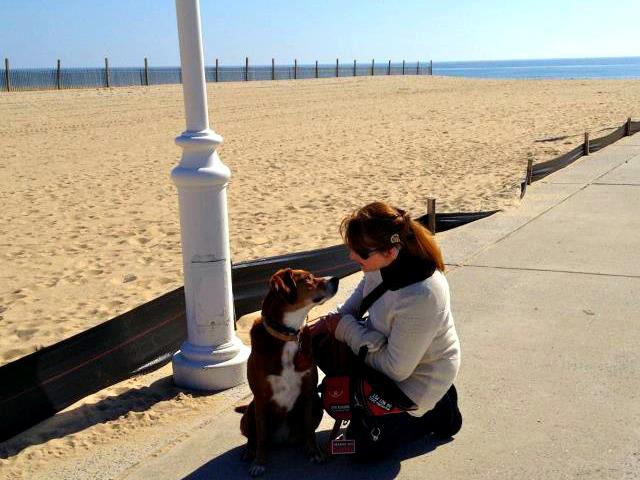
Chloe's vest comes off and she gets the "beach rules" from Denise. Unaccustomed to being "vestless" in public, she was very attentive and unsure in the beginning


As a surprise, my husband reserved a couple of  nights in a motel at Ocean City, MD, while we were on spring break from work. (One of the perks in working for a college). Apparently March is the time to go if you are not a crowd lover – or “sun” lover. Too cool to lay out or play in the surf, but beautiful weather for walking and many opportunities for quiet time.

Chloe is normally “working” when she is in public. Determined to give her some time to just be a dog, I removed her vest for large amounts of time. She was at first a little timid about being without her vest. Once she saw some other canines on leash though, the wag was back in her tail. Even working dogs need down time. People ask me all the time if Chloe gets to relax. I always have to grin. Chloe is almost 8 years old and at home? Well, let’s just say she knows how to relax. She doesn’t wear her vest at home, but she still alerts to timers, my phone, or my name being called. But she naps (and snores), she plays with her buddy, Tyco (our family dog), she has several squeaky toys, she squirrel watches, and eagerly awaits family members coming home.

Chloe enjoys working though. She danced her way on campus just this morning and wagged her way all the way to the elevator. Sometimes I wish some of her “wag” would rub off on me as 7 AM classes on Monday seemed awfully early to me after a week off!

Everyone needs time off. It can be hard to do if you are working to pay bills, save money, or try to get out of debt. But time off can be in small, “mini” vacations. Even an hour or two here and there can be very beneficial in helping a person re-group.

People with DisABILITIES Need R&R too!

I have met a number of people with various disabilities that have confided that they rarely do what others call “fun” things. Think about it for a minute. If people who walk without assistance, hear without assistance, see without assistance, and speak without assistance enjoy things like movies, walking, reading a good book, or hanging out with friends, well? It just may not be that easy for others.

I like going to the movies. I went to see “The Hunger Games” over spring break with my husband and 21-year-old son, Chris. But I don’t get the same level of enjoyment out of movies that they do. Even with Chloe by my side, I am very disoriented in the dark, especially if my cochlear implant is picking up the very loud commercials and previews on the screen. As I make my way to a vacant seat, I am often fighting the effects of vertigo. After I get seated – hopefully in a place where people won’t have to crawl over my assistance dog and I – it takes a number of adjustments to find a good program on my CI to best hear the movie. If I do that, I sometimes find it difficult to converse to the person right next to me too. At times I miss things said in the movie. If I’m with someone I know well, I’m not bashful and will lean over and ask, “What did they say?” There are not any captioned theaters close to my home (although I am glad there are some within an hour’s drive), so most of the time I go to the same movies you would attend. However, not having captions mean I have to really pay attention! Can I just be honest and say that I’m unable to eat popcorn and catch an on-screen conversation at the same time? (BIG GRIN). I have to really focus and concentrate to understand what is going on. So it is still “fun” for me… just not perhaps the same level of “fun” it may be for you because it does take WORK.

For some, sitting down and reading a book may not be “fun”, and it doesn’t mean they don’t enjoy a good book. Some folks have trouble even holding a book, or turning pages easily. Taking a walk may relax YOU, but for someone who has Meniere’s disease it can be difficult to do a simple walk. My world constantly turns counter-clockwise. It is a slow rotation, mind you, but a rotation nonetheless! On high humidity days, the rotation picks up speed – one of the reasons I just don’t try to walk on days like that! So walking on a sidewalk in a straight line takes concentration. I have given up walking with family members. Although I enjoy the conversation, I cannot talk and walk at the same time! I can talk to my walking buddy, Chloe, and she just listens. I don’t have to worry about her end of the conversation and my having to make sense of what she said while still putting one foot down in front of the other. We love to go into the woods on trails and in grassy areas too. This requires even more concentration. I usually shut up at this point as I have to carefully balance each step. So yes… I enjoy walks but probably not on the same level you do.

Despite having to make adjustments and find a new way of doing seemingly mundane things, even folks who are differently-abled need to take breaks. Perhaps even a lot of them! They may be in the form of naps. I am learning that napping or resting is a necessary requirement for many people with certain kinds of invisible illnesses. I require 8-10 hours of sleep a night. (When I tell people that, they FALL OUT, but if it helps you get through a day “hearing well”, you do anything necessary). Others may require a nap – or TWO. They aren’t lazy. They aren’t depressed (although just like anyone, people with disabilities can and do get depressed). They simply require some extra rest in order to continue a day’s work.

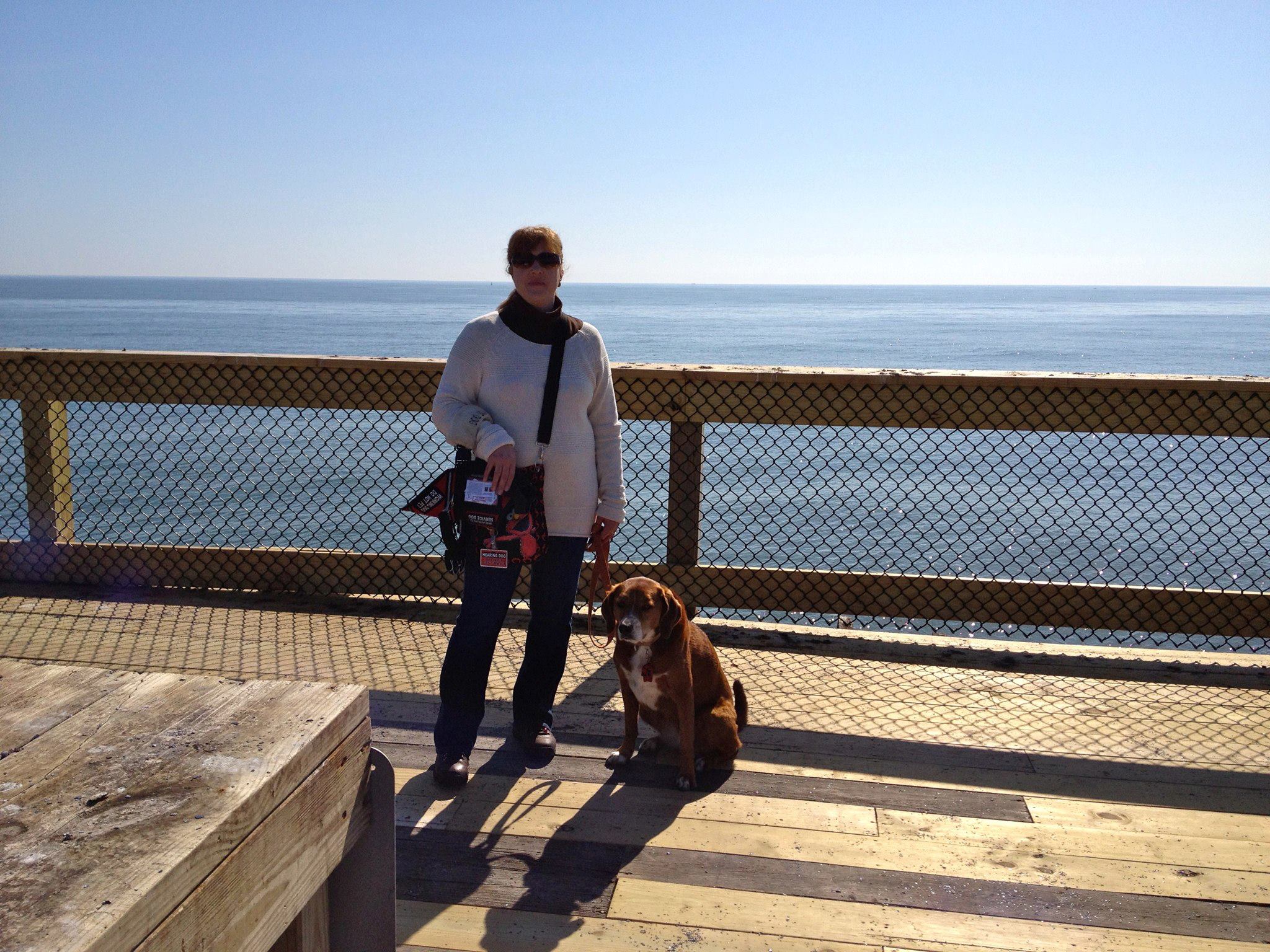
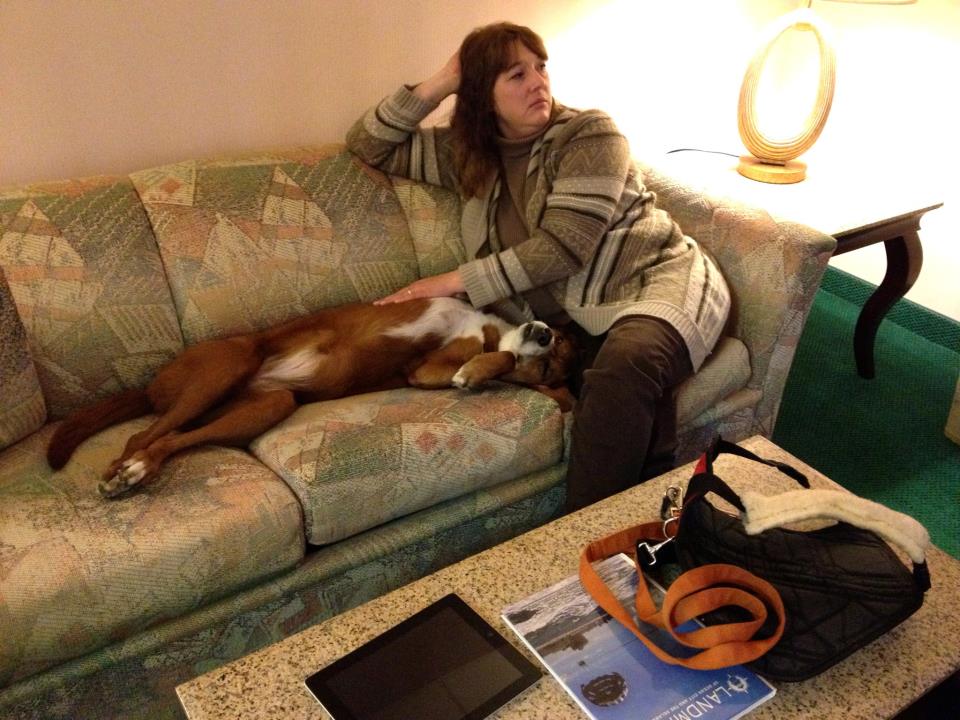
Chloe "relaxing" on a mini vacation at the beach. She really knows how to de-stress!

Careful not to judge. You may wonder why someone doesn’t enjoy the same kind of “down time” you do even though you have the same disability. Each person has individual differences in their disability. I have a friend who enjoys running in his spare time. I’m talking about REAL races… the kind where you take off after hearing a starting pistol! He’s an incredible runner and does very well. He is a bi-lateral cochlear implant user. When I first met Sam, I was astonished to hear what he did for fun! Having hearing loss and balance issues, running isn’t something I can enjoy.

I’m not saying we shouldn’t look for others who are struggling with some of the same issues. We can mentor, give advice, and support someone else in a way that will give them the tools they need to live a victorious life. But do be aware that you may share a diagnosis, but have different symptoms, struggles, and issues. We can still be a listening ear and give encouragement. Just be careful about insisting on something that works really well for YOU, because it may not work really well for them.

I’d really love to hear about some of the ways you choose to unwind! What do you do to relax? What is FUN for you? What do you need to do in order to enjoy some of the things others do without accommodation?

Denise Portis

© 2011 Personal Hearing Loss Journal


Commencement

This past Sunday, my pastor spoke on discipleship. In discussion of what discipleship actually is (growth), he discussed how some people may get confused that at the end of twelve years of high school they graduate and participate in commencement. Commencement is not the end of something; rather, commencement is the beginning of the rest of your life. However, for some that may be the defining moment of their life – the culmination of all they will accomplish.

According to dictionary.com, commencement is a beginning, or a start. Merriam-Webster defines it as a point in time in which one “enters upon the next”. In just a few months, commencement will take place at a number of schools. At the community college where I work, reminders are going out to students reminding them to petition to graduate by a certain date. At Fidos For Freedom, a service dog and therapy dog organization, commencement takes place at the banquet that takes place each May. Clients who are “graduating” this year are already gearing up for speeches, festivities, and recognition of a completion of training.

Yet these exercises are not an ending to anything. Rather, they are a beginning. For college students they may be transferring to a four year college to obtain a higher degree. It may mean looking for that ideal career. For clients at Fidos For Freedom, it is the start of a new life of independence – with trainers and “family” in the wings should any further assistance be needed.

Safe People

The topic of my favorite book, “Safe People”, has been a recurring theme in many of my discussions with family and friends lately. I actually dug my copy out to read it again, because I found myself recommending it to several different people. Learning to identify and avoid unsafe people and relationships can be a hard-learned lesson. I think the truths that have permanently etched themselves on my heart and mind from this book, are how to be a safe person MYSELF. For me, it was reaching a point in time when I could turn my back on the past and boldly face my future. Sure! I took lessons learned from the past – in my relationships, problems, and successes – but armed myself with those lessons to be better equipped for my future.

It has been a commencement for me. Like Merriam-Webster explains… it is a period of time where I chose to “enter upon the next” chapter of my life.

Progressive Illness/Disability

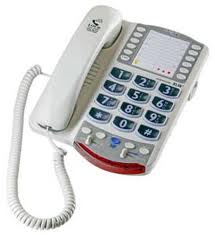
I think one of the frustrating things about having progressive hearing loss, or chronic illness/disability, is that one may commence living life with a new charge for life , equipped to be as independent as possible, only for changes in our health to take us back to square one. Prior to my cochlear implant, I remember learning to cope with the telephone, conversations in crowded places, and learning to speak with people with poor communication habits. However, in a matter of months my hearing would take a dive and I would discover that what worked last month, didn’t work at all now! Like most families with small children at home, we lived paycheck to paycheck. We pinched pennies and scrimped and saved to purchase an amplified telephone for me. For five or six months I was in telephone heaven! I used the phone every single day with confidence and enthusiasm. It didn’t take long, however, before I was struggling to even use that new gadget. I earned a little extra time by using it when the kids were outside and the house was relatively quiet. What was once easy became increasingly difficult. Eventually, the frustration of what I wasn’t hearing, despite hearing aids set to t-coil and begging people on the other end to speak clearly into the phone, had the phone collecting dust from lack of use. I’d talk to other HoHearies and get some new ideas. At some point though? The phone became a thing of my past. I had to come up with ways to contact people other than the phone. For the late-deafened community, the emergence of email, texting, and even FaceBook became very real “life-savers” in terms of being able to freely communicate with others. Although I hear well enough on the phone now that I have a cochlear implant, these other forms of communication are still my own first choice.

Resilience is a Special Kind of Strength

Many readers of Hearing Elmo have various disabilities, invisible illnesses or chronic health problems. For some, those difficulties are progressive and force them into a constant state of evolution. This can actually be healthy. (I see some of you grimacing out there!) Yet progressive illness can produce resilience – the likes of which create a strong and capable individual who can face life’s problems with the confidence earned through experience. Resilience is a special kind of strength. These individuals know that living successfully with progressive health problems is simply adopting an attitude of commencement.

Some people never graduate. They never enter that next stage of life. Even though the past may be painful, they cling to it with a tenacity that may stun family and friends. If they have progressive health problems, they may be stuck in the grief process. The grief process is a PROCESS. In a healthy situation, one moves from one stage to the next, eventually reaching acceptance and a new normal. Even psychologically we can get stuck in the past. Everyone else has moved on, but we have super-glued ourselves to unresolved situations instead of letting go and moving on with our lives (like everyone else has). Living this way yields toxicity to both ourselves and to others. We become “unsafe people”. It can have a negative influence on our relationships, self-esteem, and emotional/mental health. Dr. Seavey addresses how to face the future in a terrific article that can be accessed HERE.

Can you look back and see different points in your own life where commencement took place? Using all you learned in a specific period of your life, you chose to begin the next chapter of your life. May we all view commencement as springboard to usher in a successful, victorious future and not as a monument that designates an END!

Denise Portis

© 2012 Personal Hearing Loss Journal
It’s the Little Things

Deborah is a bilateral cochlear implant recipient. She experienced familial progressive hearing loss, which presented at age 10. Her first ear was implanted in 2005, the second ear in 2008. A native New Yorker, she presently resides in the central Piedmont of North Carolina. She is involved with HLA-NC, is a volunteer at the Wildlife Rehab Center of the NC Zoo, and is a board member of the Brain Injury Association of North Carolina. In her spare time she takes courses at the local college, and enjoys walks and photography in the nearby Uwharrie National Forest

I love being out in nature, taking long walks and observing the world around me. I often capture some of what I see with my camera.  Trees, sky, colorful blooms, rivers and streams, rocks, fungi, ferns. All are a delight to my senses. However, there is nothing I enjoy photographing more than bugs. Yes, bugs. From the stingers to the crawlers, the colorful to the camouflaged, the loners and occasionally those in flagrante delicto. From the time I was a young girl, I loved the outdoors. When my family and I still lived in the city, you could find me in the back of the apartment building, climbing a small fence so I could wander around the grassy patches that remained among the asphalt yard. When we moved to the suburbs, on a dead end street that had many acres of woods adjacent to it, I was delighted! This was still a time in our culture where folks were not so afraid to let their children run around the neighborhood, playing at friend’s homes and backyards. I chose to run around in the woods, usually by myself. I was not yet so hard of hearing that it was a concern, nor was it an explanation for why I preferred solitude. I am still this way today.

I’ve been thinking a lot about how my love for observing and photographing bugs ties in with my experience as a cochlear implant recipient. I was recently in New York for a visit, and one day a friend and I went to visit some museums. She, an artist and therapist, had been curious about my fascination with bugs. As we all know, bugs do not have a great reputation. Much time and resources goes into controlling or eradicating them. No one had ever asked me about this, and I can honestly say I’d never really wondered. I thought about all the people who seem to hate these fascinating beings! Nevertheless, my response was immediate and striking to both of us: it is in the little things that we learn the most about life. The whole world can be found in one of those little creatures. From the smallest of them we can receive the greatest lessons. When I observe a spider building a web, or an ant carrying an object many times its own body weight, and when I consider the role that each bug plays in the scheme of life, I am awed and humbled.

Seemingly Inconsequential

It is the seemingly inconsequential experiences of hearing with my cochlear implants that offer the most striking images of the radical impact that “hearing again” has had on my life.  When I mentor someone who is considering getting a cochlear implant, I have found that sharing the smallest CI moments, such as the one that follows, best illuminates the impact of the ability to hear with the technology.

Six months post activation of my first cochlear implant, I was driving across Colorado to visit with clients I served in a statewide program for individuals with traumatic brain injury. I made a stop at a gas station, and went inside to buy a soda. It was a busy time, and the gal at the register was moving customers through fairly quickly. We spent about a minute together as she rang up the purchase, collected my money and made change, made a joke about the crazy weather we’d been having which made us both laugh and to which I offered a humorous rejoinder. (No, I don’t remember what it was anymore, but she thought it was funny, and that’s all we need to know J ). She wished me a good day and I left the store, still smiling over our enjoyable interaction. Suddenly, a realization hit me with such force that I came to a complete standstill: I was able to have a quick, light-hearted interaction with the girl at the gas station. Tears welled up in my eyes, and I was half laughing, half crying: I had joined the living. Before I could hear again with my cochlear implants, my days were filled with experiences I call “smile and get the hell out of there” moments. If you are not hard of hearing, you cannot imagine how difficult it is to read the lips of everyone encountered each day. Struggling to accept that along the way I left any number of people with the impression that I was very pleasant but a bit slow was a fact of my life. But now I was one of those people who could banter, who could have lots of marvelous little interactions with people if I so wished, and I recognized right then the enormous impact this was going to have on my quality of life. I am sure that until that moment I had not fully comprehended that this is what people do, this is what is meant by “small talk”. It wasn’t long before I realized that I could also eavesdrop. LOL! To my hearing friends I say: Don’t act so shocked! You do it all day long and don’t even think about it! Six years hearing again and I can confirm that it’s not all brilliant commentary. But I like being able to decide that for myself.

So, the next time you see a little bug, think of me, and stop and watch it for awhile. If it’s in your house, don’t stomp on it. Scoop it up and put it outside, and observe it. Discover all those insights and life lessons right in front of you, free of charge.

Guest Writer, Deborah Marcus

© 2012 Personal Hearing Loss Journal
Walk a Mile in My Shoes

Gonna change directions here today as the death of Whitney Houston coincides with something I am seeing more and more in the disability community.

It doesn’t matter whether or not you like Whitney Houston. What I am disappointed to see is some of the comments and “hatin’ on” this artist since her death. I actually saw on one person’s Facebook that drug addicts and alcoholics get what they deserve. “Someone with so much talent shouldn’t have wasted it”

Wow. I mean REALLY?

Unless you were thrust into fame and fortune at a relatively young age…

Unless you had to deal with the media on a daily basis, giving up any hope of privacy…

Unless you married for love and were crushed by disappointment…

Unless you raised a child as best you could in the backdrop of an industry that can be unforgiving…

Unless you developed an addiction because of life’s crushing problems and entered rehab while the whole world knew it…

Unless you made mistakes and fell back into bad habits – all while the whole world watched…

… then keep your mouth shut about Whitney Houston.

Why Does This Upset Me? Why Should it Upset YOU?

Anytime people begin to criticize and judge someone else a change takes place. Amnesia.

I rarely hear someone criticize and judge someone who is just like THEM. It usually happens when someone is different than you are. Criticizing is easy when we don’t walk in that person’s shoes. Judging is a simple task when we cannot hope to understand what really caused someone to do something when they are different than we are. We forget all the times we have been hurt for being judged and criticized by people who do not understand our own choices in life.

Wanna get me ticked off? Criticize and judge someone who chose to mitigate their disability with a service dog when you don’t live with a disability. Sometimes even others within the disability community may scratch their head and wonder why a person would choose a service dog when “they have the same disability you do”. What they may not know is that there ARE various differences between your disabilities. Your lives may be different. They may have 24/7 help that you do not have access to in your own life. Why don’t we celebrate “whatever works”?

In the hearing loss community, I know people who criticize people who don’t allow “nature to take its course” and embrace their deafness. To some, if you do not learn ASL then you are shunning a community that could be your family. For others who have accepted technology and/or surgery to stay connected to the hearing world, they may criticize those who have learned ASL for various reasons – personal reasons! I know people who criticize other people’s choices about hearing aids or cochlear implants. Why are we prone to criticize anyone who makes a different choice than what we have made for ourselves?

I think perhaps it is a form of self-protection. We may somehow feel that if someone who is very similar to us chose another path, that their choice may mean that our own path was a wrong one. It may be a form of defensiveness. If we see someone successful at living life with a disability, we may feel the need to criticize because we still have some problems with our own disability. If we see someone floundering at living life with a disability – and they chose another path? Many point and say, “I told you so”.

We could all learn to be more compassionate. We could all learn to listen more and keep our mouths shut.

When you judge another, you do not define them, you define yourself.” –
Wayne Dyer

If you judge people, you have no time to love them.” –
Mother Teresa

What May Happen if You Reserve Judgment

If you can keep your opinions to yourself, you may just make some discoveries:

You didn’t understand why they did what they did until you got to know them better.

You misunderstood their choice

After learning more about the person, you actually agree with their choice.

After time you find that you still would have done it differently yourself, but it seems to work for them.

If you can keep your negative opinions to yourself and instead pray for and encourage that person, you may discover a…

FRIEND who has the same taste in shoes!

Denise Portis

© 2012 Personal Hearing Loss Journal

Why I Love Winter

The woods near our home without their usual foliage…

(PART ONE OF FOUR)

Chloe and I took a walk after lunch today. I had to smile as I saw the snowflakes falling softly around us even though it wasn’t cold enough to “stick”. I just love winter. I love actually getting out IN the cold weather as well. I love bundling up and walking briskly – something I can do even with Meniere’s as my symptoms are usually much more mild in the winter. I love being able to see my breath in the air and being able to smell various fireplaces in use in homes as I pass. However, one of the biggest reasons I love winter might surprise you. As a person with hearing loss, one doesn’t expect to enjoy QUIET.

Winter Can Be So Quiet

When walking, many people are inside where it is warm. So in the wintertime, my walks are often much more quiet than when I go during other seasons. I love the quiet. Don’t get me wrong! I love being able to hear, but I hear best when it is quiet. Am I contradicting myself? (BIG GRIN). Eh… maybe.

Hearing with a cochlear implant is a mind-boggling thing. I hadn’t expected to hear this well again this side of Heaven. When my husband and I realized that my progressive hearing loss would ultimately mean I would not hear at all, we were concerned. Thankfully, through the support and relationships of the Hearing Loss Association of America, we learned that being late-deafened does not necessarily mean the end to hearing. We learned about cochlear implants and I took almost three years researching and “talking the much needed ears off” numerous cochlear implant recipients. As thankful as I am for my cochlear implant, it does not mean that I now hear perfectly. As a matter of fact, I become a little aggravated when people act as if my cochlear implant “fixed” my hearing. Yes, I can hear. But it’s a different kind of hearing, and one made more difficult when trying to understand speech in the midst of noise.

So I love the quiet. I hear better. When walking, as the world around me is more quiet compared to other times of the year, sounds that are present are crisp and clear. If it is quiet on our walks, I can actually hear much of what Chloe is hearing.

Chloe can HEAR the squirrels even though she hasn’t yet spotted them…

I love listening to nature. I pick up many more sounds in the winter because of the quiet. The lack of foliage also assists in allowing sound to carry. In some spots of our neighborhood I can even enjoy an “echo-like” effect in the world around me.

We Need the Quiet

I have had numerous late-deafened folks tell me that they too, go “deaf” on purpose. For those of us who are thrifty, it saves on battery life. However, for many it is simply a matter of being mentally fatigued. It takes a lot of effort to understand and communicate using technology and speech reading. People with hearing loss must employ a number of senses to communicate. Those with normal hearing are not required to use much more than their sense of hearing to communicate. I believe this is part of the reason I need 8-10 hours of sleep a night. (Yes… you read that right!) I am mentally exhausted at the end of every day just because I’m communicating with family, friends, and co-workers. It takes work to hear! Listening requires active participation for those of us with hearing loss.

The forest is sleeping during the winter…

When there is a great deal of background noise, I don’t hear well. As a matter of fact? There are times I don’t even try. Case in point… my church:


Want to know the noisiest part of every church service? I think it is before and immediately after the actual service. Or, how about when the pastor or minister of worship says, “Everyone take a few minutes to meet and greet those around you!” ? AAAARGH! I try to make myself invisible if you must know. I am petrified someone will come and talk to me because I know I won’t hear them. I’m getting better though when someone approaches with their hand out and a big smile. I’m taking a risk but “betting on” that they are saying, “Hello, how are you today?” I have learned to smile, shake their hand and say a simple “Hello!” My preference in communicating is definitely one-on-one.  I do really well – IF – it is in a quiet atmosphere.

But you know something? My exposure to multiple disabilities at Fidos For Freedom has taught me one very important lesson. We could ALL do with more “quiet” in our lives. Quiet can foster introspection – and friends? I’m big on reflection, meditation, and soul-searching! For many of us, we face many physical battles on a daily basis. We really NEED quiet time. Contemplation may provide us with resolve, a new “plan of attack”, time to absorb new information about our disease/disability, and the ability to recuperate emotionally and mentally. As a person of faith, it is my quiet moments that I can humbly ask for guidance or assistance… or scream for help!

It is often when we are quiet that we can plan and “gear up” for the journey ahead. Victor Hugo said, “One is not idle because one is absorbed. There is both visible and invisible labor. To contemplate is to toil, to think is to do. The crossed arms work, the clasped hands act. The eyes upturned to Heaven are an act of creation.” For some of you, life’s journey requires a little planning. I have a friend who cannot do anything spontaneously. Errands are planned, cleaning specific rooms of the house are planned a whole day in advance. Errands rely on the goodwill of family and friends who are willing to cart her “here and there” as her eyesight has deteriorated. Cleaning is done when the body isn’t on “strike”. Lyme’s and Chronic Fatigue insist that she double-up on recipes when she has enough energy to cook. That way she can freeze things so that she doesn’t go hungry on days she cannot cook meals. She requires a lot of quiet time. For her… it’s not a communication issue. She needs time to plan and to take strategic steps in organizing as best she can her journey. She even needs quiet time to COPE with her disease.

Winter allows me more quiet time. Outside – fewer people are out and about. Inside – family members at home tend to curl up and do quiet things on their computers or may catch up on reading. Like hibernating bears they tend to sleep more. Co-workers are quieter during the winter. Hubby says it is because of S.A.D. Who knows? I do think winter generates a feeling of “quiet” in many people.

I encourage you to find more quiet time. Winter, spring, summer, or fall – the season isn’t important. Finding time to be QUIET and use the time wisely is important to all. Even if you use the time for a power nap…

Denise Portis

©2012 Personal Hearing Loss Journal

My Clipboard

Vivid Acoustics

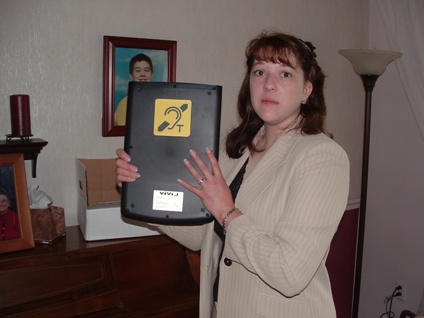
Can I just say that I LOVE, LOOOOOOOOOOOve, this product? I got mine for Mother’s Day in 2006 and I have used this thing to death! Because I do not have to attach anything to the boot of my CI (like a lapel mic, etc), AND because I don’t have to wear a neck loop, I have found the ease of this portable device is 2nd to none. I simply press a button and wa-lah! (hey… it’s a word! Look it up!) I have an immediate 5 foot radius induction loop around me. The clipboard allows me to take notes and to jot down reminders as I’m talking to students or “others”. The back of the clipboard has a “can’t miss” symbol that reminds everyone that they do need to speak “towards me”.
I don’t usually brag on one particular product, but this is one that should anything ever happen to it? I’d purchase one again the very next day. It is simply a “must have” for me! 🙂

You can visit Vivid Acoustics at:  http://www.vivid-acoustics.com/portable.html

Denise Portis

© 2011 Personal Hearing Loss Journal

Untreated Hearing Loss

An initiative by Phonak – http://www.hear-the-world.com/

I just loved the movie UP! Not just because it had main characters that were dogs – and ones that could talk at that! Carl, a 70’s something animated actor sported hearing aids and spunk. Mostly the latter…

I recently ran into a 70’s something gentleman at the gas pump. I was leaning against the car waiting for my tank to fill, trying desperately to avoid looking at the high numbers scrolling across the screen as my 12 gallon tank drained my bank account. It was a pretty fall day, so I had the car windows down and was talking to Chloe. She could really care less about the price of unleaded, but she does like to flirt with other people nearby. I caught sight of a low tire, and changed positions so as to look at it better. This gentleman caught my eye and said, “I noticed that too… you need air in that tire”.

With some apprehension I looked around the station and could not see an air pump. I responded, “Oh dear, I don’t see an air pump!”

The gentleman cupped his ear and said, “teardrops and dare what?”

I think my eyes popped wide. Another person with hearing loss! I just beamed at him and turned to face him while repeating, “I don’t see an air pump, do you?”

He dropped his cupped hand and turned in a circle looking around the islands of pumps at the station. “Nope! I don’t see one either. You may have to go to another station and get some air in that tire!”

I pointed to my head and said, “I have a hearing loss too…”

He looked at me quizzically and moved to see the side of my head. “Oh! I thought that was one of those new-fangled gadgets people use to talk into. Is that a hearing aid?”

I beamed again, always excited to share and said, “No. It’s a cochlear implant.” I pointed to my other ear,… “but I have a hearing aid in this ear even though it doesn’t do me much good”.

He shook his head sadly and said, “Yes, I tried them for awhile but all I got was squeals and whistles. I never could hear better.”

Pointing to my CI again I said, “You should go to your audiologist and get evaluated for a cochlear implant. I hear much better than I ever did with just a hearing aid.”

He moved closer to me, still occasionally cupping his ear. I couldn’t tell if he was understanding all I was saying, so I really concentrated on speaking at a moderate pace and clearly. At least as clear as a pronounced southern accent would let me.

He stood within a yard from me and looked longingly at my CI. “If I were young again, I’d get that surgery!”

I put my hand on his arm and said, “Oh! You shouldn’t let age stand in your way. I know plenty of folks who are older who get the CI. They do very well!”

“No… no. I’m too old. It’s too late for me”, he said sadly. His eyes glistened and his chin dropped. It was all I could do not to throw my arms around him and hug him tight. Demonstrations of physical affection and empathetic squeezes were not likely to be accepted by a total stranger. So I restrained my impulses and instead said clearly, “You should think about that some more. It’s the quality of life that matters.”

My tank was full, as was his and cars were in line. I gave him my card and told him to email me. I hope he does.

Untreated Hearing Loss

Untreated hearing loss may result in depression, anxiety, little to no social activity, and insecurity (cited by Zounds). Helen Keller, who was both blind and deaf, said that deafness cuts one off from people, whereas blindness cuts one off from things. Even those who have received treatment for hearing loss may experience some of these same results, but in different degrees.

I recently went to a small group Bible study and had trouble hearing when I first came in since everyone was talking at the same time. Someone addressed me and I didn’t hear them. They ended up reacting negatively to that and I sat in shock at having been misunderstood and unfairly judged – and “I’m a veteran!” I thought to myself. But I think as a result of taking concrete steps towards hearing better, those of us who have made an effort to communicate with assistive listening devices and technology have also developed coping skills towards dealing with bouts of depression, anxiety, and insecurities. We have very likely also made great strides in being more socially active. In my case, having a negative experience at least meant I could email my peers and belly-ache about it and get some great advice!

But what if your hearing loss is untreated? If your hearing loss began as an adult, do you remember those early days of not hearing well? I sure do. I can tell you they aren’t GOOD memories either. Slowly, but surely I dropped out of nearly everything. When Terry and I first got married we vowed to continue to date. So even after the kids were born, we’d swap baby-sitting favors and go out on dates. After I began losing my hearing (when our 2nd child was born), those dates dwindled away and eventually stopped. I’d have hubby “order in” so that I could eat something I didn’t have to fix but would not have to face the noise of a restaurant. Now that I have a CI, I’m enjoying dining out again.

If you are still a working adult when hearing loss occurs, it can greatly impact your ability to do your job. You can only “fake it” so long. Hearing loss can be treated discreetly and privately. I have met some people at work, church, or in public who I didn’t realize had a hearing loss until they noticed my own “bling” (or hearing assistance dog) and mentioned it to me. For many, disclosing hearing loss is a choice you can make, whether you are at work or another place you often hang out (ballgames, church, community events, etc).

If you know of someone who may have a hearing loss, you may discover they can be stubborn about agreeing to go get evaluated by an audiologist. Encourage them to do so! Many times audiologists will do a hearing test for free. Even if you do not yet need a hearing aid or other technology in order to maximize hearing, it is good to get a baseline audiogram to chart where your hearing is “going”. Not all types of hearing loss are progressive – but then again there are many that ARE. Having a real way to chart what is happening to your hearing is important.

We use to get our hearing checked regularly in school. Because of budget cuts few schools do hearing tests anymore. Parents should be diligent about periodic hearing tests for their children. Especially those who had tubes put in when young, or suffered from numerous ear infections. If hearing loss runs in the family, it is even more important to religiously set up audiograms for members of the family.

Don’t Chalk it Up to “Age”

I have heard many say that they expected some hearing loss when they reached their late 60’s or 70’s. Age-related hearing loss is not uncommon. However, many choose not to do anything about it. Hearing aids have “come a long way baby”. They come in all sizes, shapes, and COLORS. (Yeah, of course I would mention THAT!) They can be worn discreetly or worn all “be-dazzled”. You may find that you hear fine in “most” situations, but perhaps you have trouble understanding and hearing in noisy places. Hearing aids are also able to isolate voices close and zero in on direction of the listener. You’ll never know what is available until you go see an audiologist and talk to them about your options!

If you tried hearing aids and hated them, but know your hearing loss has worsened – please don’t discount cochlear implants without sitting down and talking to recipients. All three cochlear implant manufacturers have message boards and forums in which you can ask questions and discover answers from actual cochlear implant recipients. Age doesn’t matter either – the oldest person I personally knew who was implanted was 87-years-old. I have read stories of others who are even older. A person does need to be healthy enough to undergo outpatient surgery and anesthesia, but age doesn’t disqualify anyone!

The American Academy of Audiology reported the findings of a study done by the National Council on the Aging. Over 2,300 individuals participated in the study, and 2,090 hearing family members were also surveyed. The results of the study can be viewed here. The study noted that, “Hearing loss is one of the most prevalent chronic conditions in the United States, affecting more than nine million Americans over the age of 65 and 10 million Americans age 45 to 64. But about three out of five older Americans with hearing loss and six out of seven middle-aged Americans with hearing loss do not use hearing aids”.

If you or someone you know has a hearing loss, go get an audiogram and information about your hearing loss. What have you got to lose?

Denise Portis

© 2011 Personal Hearing Loss Journal

10 Year Anniversary of 9-11

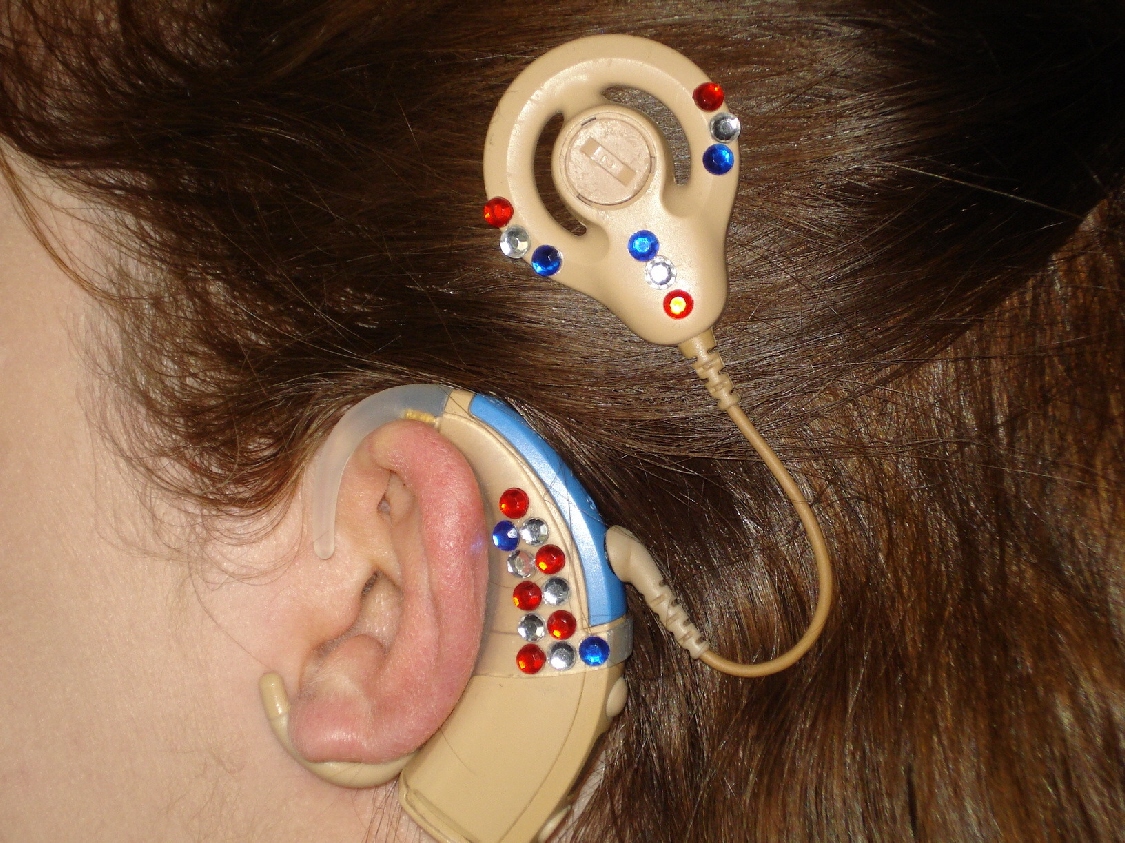
Patriotic Cochlear Implant "Bling"

It is hard to believe we’ve seen the 10 Year Anniversary of “9-11” come and go already. It really put it into perspective for me when my 21-year-old daughter relayed an amusing anecdote to me. She had gone to Union Station to pick up “the boyfriend“. They walked around a bit before getting on the METRO and she spied a police car outside with “9-1-1” on the side. Because of the anniversary of 9-11, and a result of what I think those numbers MEAN to someone of her generation, she pointed at the car and said, “Oh look! I guess that is on there to commemorate the 10 year anniversary!”  I think “the boyfriend” was hard pressed not to laugh.

Hers is a generation that grew up without William Shatner and his “Rescue: 9-1-1” television show. Although 9-1-1 was covered in school, for her it left a permanent link to a different meaning other than how to call in the event of an emergency. For her, those 3 numbers meant something far different. She was old enough to understand that the world had changed for those here in the U.S.A., but young enough to experience different kinds of fear, anxiety, and apprehension experienced by parents and their peers.

On 9-11 I was “only” hard-of-hearing at the time. The progressive loss and downward spiral of my own hearing had not left its life-changing mark as yet. However, even with my first hearing aid, I still relied on closed captioning. I think if I had to put my finger on ONE memory of 9-11, it would be being afraid and confused about what was happening because those professionals who did closed captioning were FREAKING OUT. At times, the closed captioning was just gibberish, and there was a great deal more of instantaneous corrections being made for “Live” television. When the first tower came down I remember sitting – quicklySTUNNED.

Ten years later I am a different person. Hopefully, all of us can say we are “different” after a decade of life. Our goal should be to mature, learn, and even blossom. I am completely deaf now, but “hear again” through cochlear implant technology. Who I count as friends are peers who also live with hearing loss, live with invisible disability/illness, or work with those populations. Sometimes we live victoriously and sometimes there are setbacks. I have found a “community”, however, and they have become family and friends to me. I watched a number of specials about 9-11 and still used closed captioning. However, it was with some confidence that I also HEARD the commentary and watched the speeches at various memorials. I am grateful for my cochlear implant and for the privilege of living in America.

We will never forget…

Denise Portis

© 2011 Personal Hearing Loss Journal
30 Things

From Invisible Illness Week

30 Things About My Invisible Illness You May Not Know:

1. The illness I live with is:

Invisible if I want it to be, but I wear bling and use a service dog so that it is not.
2. I was diagnosed with it in the year:

1993
3. But I had symptoms since:
I was 6 years old after a car accident.

4. The biggest adjustment I’ve had to make is:
Learning to hear with a cochlear implant and learning how to adjust on days my Meniere’s disease symptoms have me wobbling around with poor balance.

5. Most people assume:
My cochlear implant has “fixed me”.

6. The hardest part about mornings are:
Not being able to hit “snooze” on my alarm clock since that happens to be my service dog, Chloe. When the alarm goes off, she kisses me awake and there is no going back to sleep. The dog is definitely a “morning dog”.

7. My favorite medical TV show is:
Not really a medical show but I do like Dr. Phil. He’s a “reality therapist” and I think everyone who has an invisible illness needs to have a healthy dose of reality!

8. A gadget I couldn’t live without is:
FM Clipboard for classes.

9. The hardest part about nights are:
Trying to ignore the tinnitus that comes roaring into play after removing my cochlear implant.

10. Each day I take __ pills & vitamins. (No comments, please)
1 prescription (blood pressure) and 9 different vitamins – one of which is Manganese. Studies have shown that people with Meniere’s disease may have a Manganese deficiency.

11. Regarding alternative treatments I:
Have tried numerous ones including acupuncture, chiropractor, and vitamins.

12. If I had to choose between an invisible illness or visible I would choose:
Visible – no question. This is why I try to make my invisible illness – VISIBLE.

13. Regarding working and career:
I am proud that I am able to work having made a number of adjustments and having chosen to be partnered with an assistance dog.

14. People would be surprised to know:
That I dread group activities because I don’t hear as well as they think I do.

15. The hardest thing to accept about my new reality has been:
That I must sometimes choose not to do things I once enjoyed because of my symptoms. For example: If there is a movie I wanted to see that is coming out, but the weather is bad and my Meniere’s disease has flared up, I cannot go and have to put it off.

16. Something I never thought I could do with my illness that I did was:
Go back to school and finish my MS.

17. The commercials about my illness:
There are none. I’ve never seen a late-deafened/cochlear implant commercial, nor a commercial about Meniere’s disease.

18. Something I really miss doing since I was diagnosed is:
Listening to music.

19. It was really hard to have to give up:
Friends who couldn’t cope with the new me accompanied by a service dog.

20. A new hobby I have taken up since my diagnosis is:
Blogging/writing

21. If I could have one day of feeling normal again I would:
Go to an amusement park and ride every roller coaster there!

22. My illness has taught me:
That the disability community is live and well and fully utilize the Internet to connect, support, share information and to be proactive.

23. Want to know a secret? One thing people say that gets under my skin is:
“Nevermind”. If you aren’t willing to repeat it for someone who hears differently are you not behaving as if it doesn’t matter to THEM?

24. But I love it when people:
Include me.

25. My favorite motto, scripture, quote that gets me through tough times is:
Helen Keller:  “Blindness separates us from things but deafness separates us from people. “

26. When someone is diagnosed I’d like to tell them:
Email me. Ask questions. I want to help!

27. Something that has surprised me about living with an illness is:
How family members who once knew you “when” are not willing to learn about the new you.

28. The nicest thing someone did for me when I wasn’t feeling well was:
Email me and ask how I was doing.

29. I’m involved with Invisible Illness Week because:
Many illnesses and disabilities are invisible. I want to raise awareness.

30. The fact that you read this list makes me feel:

Appreciative that you care enough to learn more!

Denise Portis

© 2011 Personal Hearing Loss Journal