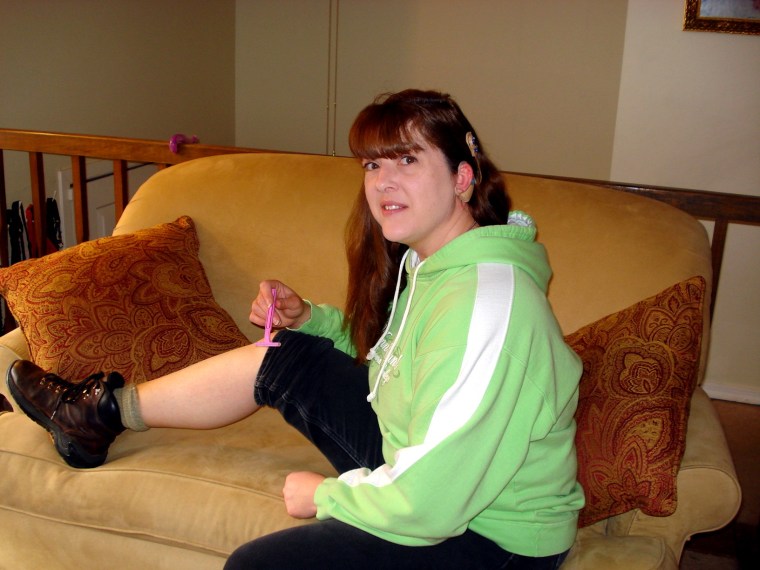
Six Year Post Activation Mapping at Johns Hopkins

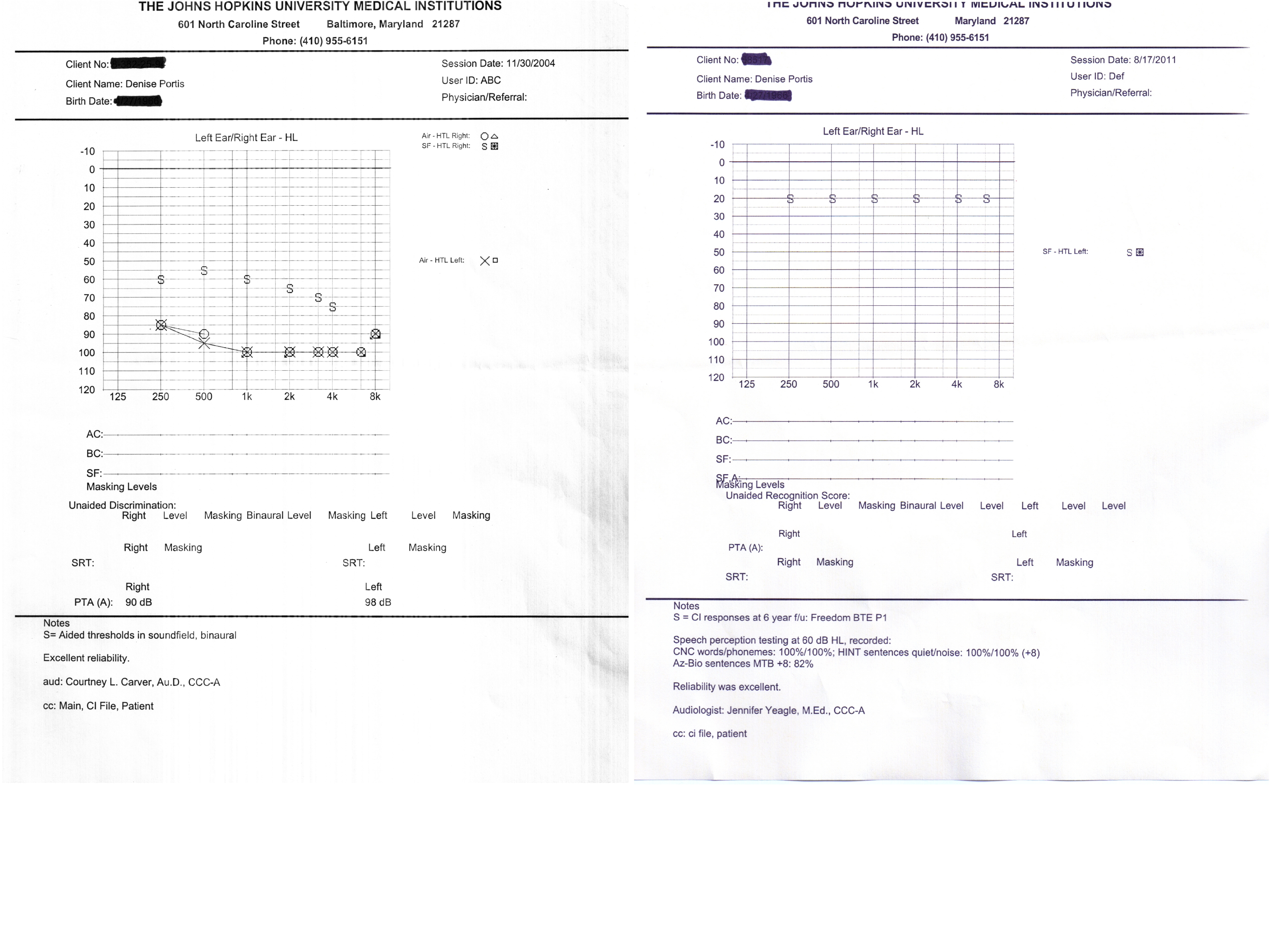
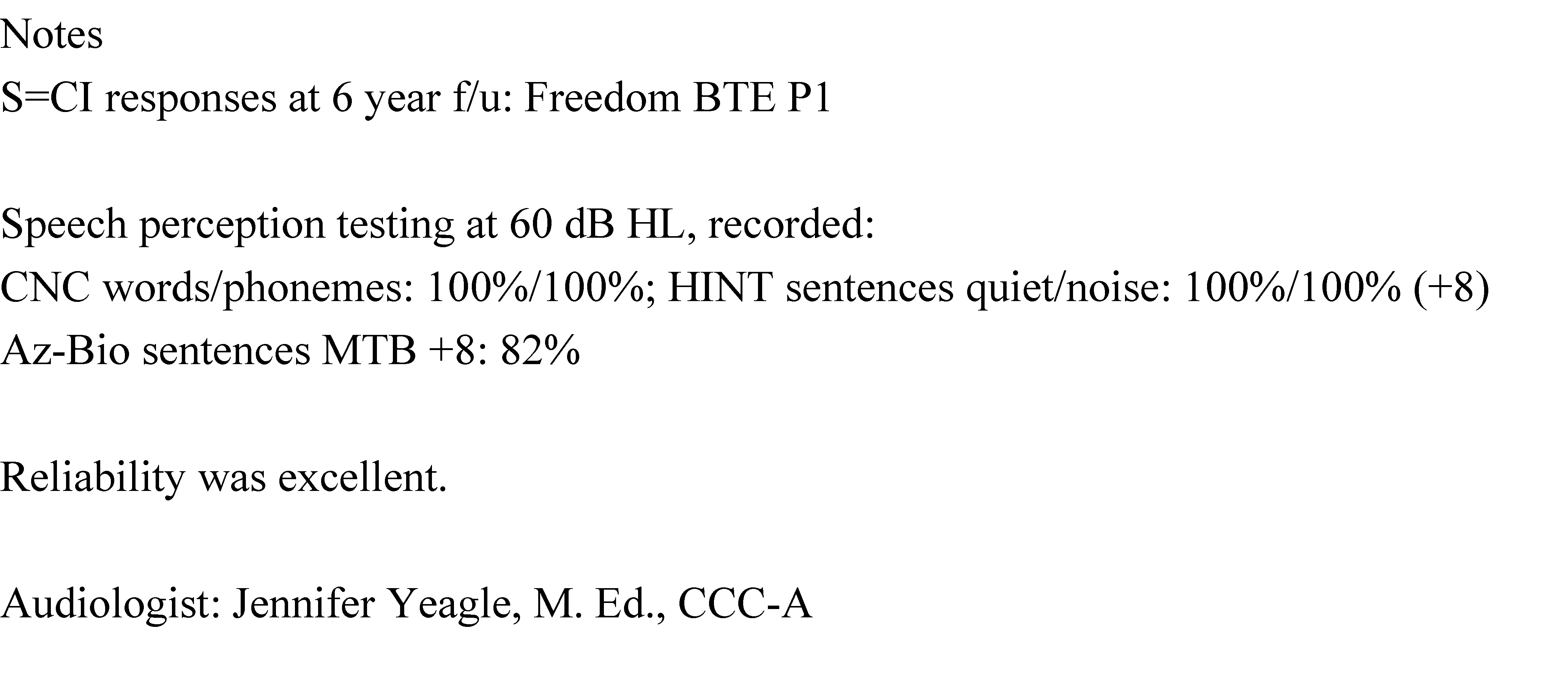
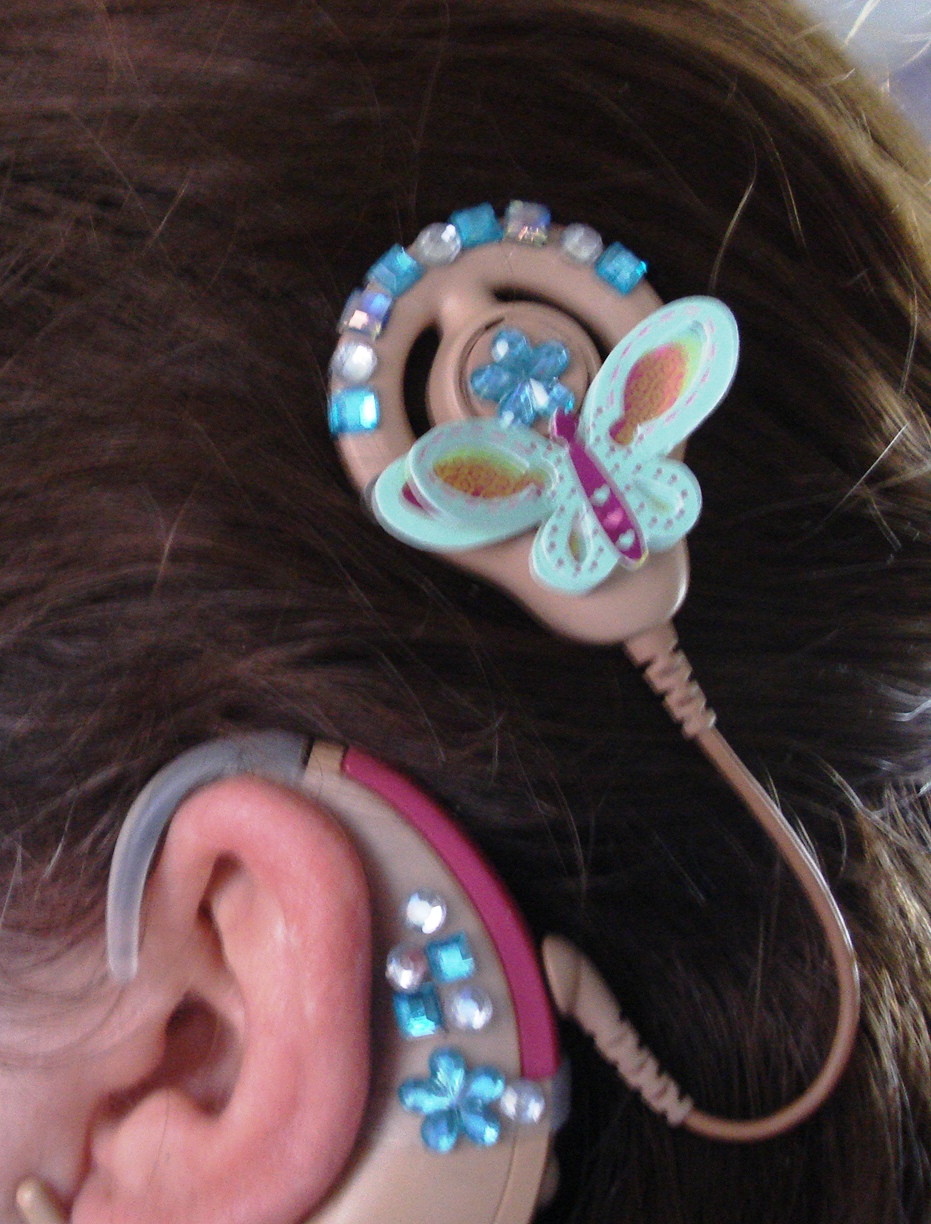
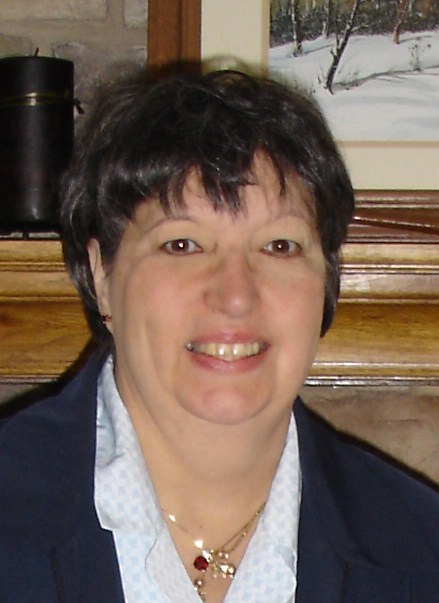
(left) 2004 Pre-CI (right) August 17, 2011


(Click on photo above to enlarge)

Today I traveled to Johns Hopkins for my 6 year post-activation mapping of my cochlear implant. A number of things went through my head as I traveled a familiar road to my audiologist at the Listening Center. For one thing, I listened to the GPS give directions and didn’t glance at it once – for I was hearing it. I talked to my assistance dog, Chloe, in the back seat when I pointed out the stadium as we passed and heard her bark in response to let me know she was an Oriole fan.

As I entered the parking deck for Johns Hopkins Outpatient Center, I mashed the button to give me a ticket. I heard the instructions to pay before returning to my vehicle prior to leaving. Walking across the enormous lobby I could hear families chatting while they waiting to check in, and admissions counselors quietly talking to patients ON MY DEAF (implanted) SIDE. As I approached the elevators I heard a series of “dings” as different cars reached the lobby level waiting to take patients “up” or “down”. The elevator announced the floor level on each concourse and warnings to stand clear of the door echoed through the car.

All of these sounds were silent for me in 2005. Six years later I hear them all and do so with relative ease. When I was originally tested to see if I qualified for a CI, I entered the sound-proof booth with my husband. I waited to hear sounds in order to “mash the button” and turned to my husband to say, “Gee… when will it start do you think?” My voice drifted off when I saw the look on his face. SHOCK.

He gestured to the window and then the speakers and said, “Denise, the test has been going for 2 or 3 minutes already”. Neither one of us realized how poorly I was hearing since I relied on speech reading so much. Today I entered the booth with confidence and even took a test “brand new” for me. With crowd noise I had to repeat different voices (male and female) of a conversation. My audiologist was very impressed. She said she could see “the switch turn on” after a sentence or two when my CI picked out the important voices from among all the others.

I realize cochlear implants are not an option for everyone with hearing loss. I also know that some people get a cochlear implant and are not 100% happy with the outcome. For me… the Nucleus Freedom cochlear implant changed my life. I hear SO well, in fact, that I’ve chosen not to go bi-lateral like many in my peer group have done. On my “bad” balance days, I cannot risk having my balance worsen because of a 2nd implant at this time. I was diagnosed with Meniere’s disease PRIOR to my first CI, and my family and I cannot tell that it made my symptoms any worse. I have, however, found some research that may indicate a 2nd CI could worsen Meniere’s symptoms – so for now? I wait to see what the future may bring. My audiologist believes I hear as well with one as well or better than many do with two. I’m happy with how I am hearing!

Denise Portis

© 2011 Personal Hearing Loss Journal


Get Their Attention

I recently attended the annual national convention of the Hearing Loss Association of America because it was actually held in my area this year. At one point, I was in the crowded convention hall perusing the numerous hearing loss vendors and booths. At a distance, I saw an old acquaintance scoot by in their scooter. I tried to wave them down but I was not in their peripheral so they did not see me. After they quickly rolled out of my sight, it hit me! I could have raised my voice and said, “Hey Bob!” This friend did not have a hearing loss, but attended these conventions alongside of his wife who WAS deaf and hearing again with two cochlear implants. I had to smile at my mistake, because I forget that people with normal hearing do not have to have a visual cue in order to get their attention. (Thankfully we ran into each other later…)

I see this all the time in my kids. Kyersten and Chris (now 21 and 20-years-old) attend college but live at home. They really have no memories of my not having a hearing loss. Even though I had a progressive loss, it took twelve years before my hearing was completely gone. They have both told me that they don’t remember my ever hearing well. They are so accustomed to speaking with someone who has a hearing loss, they automatically do things that are more difficult for someone who isn’t in constant contact with someone who is deaf. They always come into the same room that I am in, and rarely try to have a conversation from another room with ANY family member… even those with normal hearing. Recently my son came all the way into the family room to ask my husband a question. It was a simple question that could have easily been asked from the kitchen. The television wasn’t on, and the area was fairly quiet. However, he is so accustomed to facing the person he is talking to, it is difficult to remember that he can do some communicating from another room when it comes to his dad. My daughter is often told that even as shy as she is, she has “uncanny eye contact” when communicating with someone.

Teaching Them Early

When my kids were about 2-3 years old, they were already “old hats” at communicating with a person who had hearing loss. They cannot remember watching television without captions. Even “Barney, the Dinosaur” had captions, as did “Sesame Street” and “Thomas the Tank Engine”. I believe it helped them learn to read as early as they did!

If I needed to tell my kids something, I would walk over to them and get down on their level. I would put my hands on each side of their face and say, “I’ve got my GUESS WHAT FACE ON!” I’d then (almost nose to nose) tell them what I wanted to tell them, or simply say “I love you”.

If they came to talk to me, I could hear that they were talking, but not understand what they were saying. So I’d lean down and put my palms on each side of their face and ask, “Wow! Do you have your GUESS WHAT FACE ON?” It didn’t take long for them to begin putting their own palms on the sides of my face when talking to me.  As they grew older, we dropped putting our hands on the face of the other, but they would come and tell me with direct eye contact…  “Mom, I’ve got my GUESS WHAT FACE ON…” and then tell me what they were going to say.

By the time my kids were 5 and 6-years-old, it had become habit. I was eventually able to afford a refurbished hearing aid that gave me some help in hearing for several years. I recall my daughter (from the next room) telling my son, “Wait a minute. Let me put my GUESS WHAT FACE ON and ask Mom!” As they continued to age and mature, what “stuck” was direct eye contact and face-to-face conversations. It was actually a wonderful gift to help nurture in them, for all of us do very well to give the other person the attention they need and deserve when communicating. No competing with electronic games, closed captioning on television, or computers when we talk. We put everything down and LOOK at the other person.

How to Get a Deaf Person’s Attention

Here are some great tips in how to get the attention of a person with hearing loss.

1. Wave your hand in their line of sight.

2. Touch their shoulder or hand before speaking.

3. Move into their line of sight with your body to gain their attention.

4. Turn the lights off and on (this is especially helpful in a room that may have more than one person with hearing loss and you need EVERY person’s attention).

5. If sitting at a table with the person, gently knock on the top to get their attention through vibrations.

Can you think of any others? I welcome your input!

How Service Dogs Get Attention

Hearing assistance dogs are taught to get their partner’s attention by gently bumping them with their nose or touching them with a paw. As I have a balance disorder, Chloe tries to garner my attention by standing and staring and WAGGING LIKE MAD. She only places a paw on me or bumps me with her nose if her 1st efforts have failed. Smaller assistance dogs, may get their partner’s attention by actually jumping up on them.

Even though hearing assistance dogs are trained how to get the attention of their partner to alert them to sounds, the human partner has to be responsible as well. Shortly after being matched with Chloe my trainer, Pat, took me to many different types of public places to train ME. Chloe was already trained. She drilled into me, two important things:

1. WATCH YOUR DOG

2. TRUST YOUR DOG

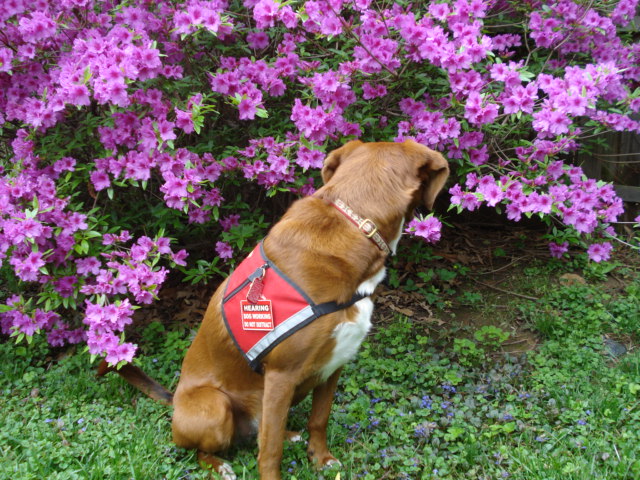
I quickly learned to pay attention to what has Chloe’s attention. Her hearing is not only much keener than my own, it is more sensitive than people with normal hearing. I can now even recognize when she hears something if she is standing in front of me (with my only seeing the back of her head). Chloe has a modified “heel”. “Heel” position is when the dog’s shoulders are parallel to their partner’s left leg. However, I do not have peripheral vision on my lower left. So we taught Chloe a modified “heel” that is slightly forward of a true “heel”. I had to learn how to observe the BACK of her head. Thankfully she has these wonderful hound ears that perk up and she “points with her nose” in the direction from which a sound is coming. She will even cock her head to the side to really tune in.

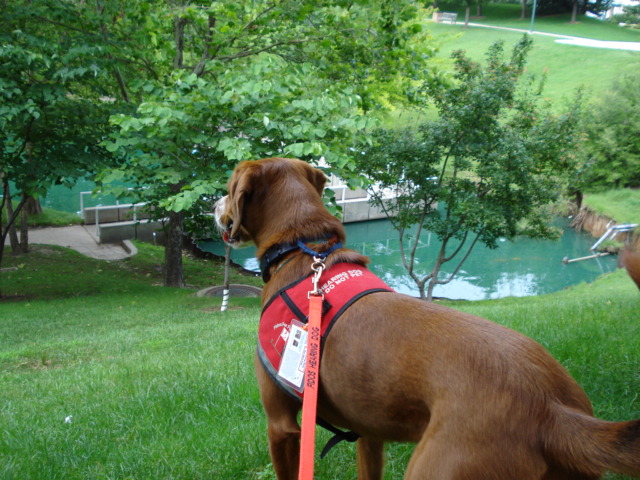
Look the neighbor came out...
Look at that family over there...
something is in the bushes...

If the sound is something she thinks I should hear, she’ll come and get me – phone ringing, door bell, someone calling my name, kitchen timer, etc. These are all trained alerts. However, I have been in situations where I could tell a sound had completely distracted her yet I could not hear or place what it was. When this happens, I ask “Chloe… what is it? Show me!”

Chloe will start to wag and TAKE me to what is making the sound. I have to be careful about this. I don’t want her to take me to every single sound she hears. She may hear the kid’s arguing and cock her head as she listens. I do NOT want her to take me to where they are arguing because they are old enough to work out their own problems! She seems to understand when it is a sound that I need to pay attention to – such as a cat locked in the laundry room, the low-battery sound on the phone in the bottom of my purse, or “Daddy” hollering from the bathroom because there isn’t any toilet paper!

A Word of Caution

I believe that individual’s with hearing loss should get the attention of every person they wish to speak to – even if that person has normal hearing. Do you know how many conversations I have interrupted because I walked up to someone and started talking without hearing that they were talking to someone else? I try to make it a habit (and still sometimes fail) to make sure I have the attention of someone before I begin speaking. This eliminates the likelihood of my talking over someone already talking.

I suspect all of us can improve our communication skills. If you have someone in your life who has a hearing loss, I encourage you to sit them down and ask them in what ways you may better communicate with them. If you have a hearing loss (whether a veteran of deafness or a “rookie” – new to coping with hearing loss), try to sit folks down and have a “heart to heart” about ways they might better communicate with you. This may include family members, co-workers, or even supervisors. Don’t think, however, that once you share with them how to better communicate with you that they will always do “right” from that point forward. I have learned that the people in my life need occasional (positive) reminders.

“Could you put your hand down please? You are covering your mouth”.

“Do you mind looking my direction when you speak?”

“Could you get my attention before you begin speaking? I’m afraid I missed all that you said prior to my looking up and seeing you standing there!”

Stay positive. Few people will put any genuine effort into communicating with you if you belly-ache and whine about it. If you get angry, it may cause resentment and defensiveness. Keep your cool! Smile… be positive! In the end, you are actually helping them better communicate with ALL!

Denise Portis

© 2011 Personal Hearing Loss Journal

Soul Surfer

My daughter was home for Easter weekend so the family enjoyed a rare night out to the movies. The movie “Soul Surfer” had been recommended to us so we chose to attend on Sunday afternoon. I was in a bit of a huff when I arrived due to some family conflict, missing the first part of the movie while I sat and fumed. (Yup… I definitely need to learn to fume a little quicker).

Once I started paying attention, however, I really enjoyed the movie. When you “hear again” with a cochlear implant, you really do have to make the concentrated effort to PAY ATTENTION as listening is no longer a passive exercise – rather an active effort. On occasion, I’m lucky to snag a movie we are attending that is open captioned. I do not have to focus with nearly the same concentrated effort when the movie is open captioned. As it was, I finally TUNED IN and really enjoyed the movie. I won’t spoil it for you in case you haven’t seen it, but basically a teenager learns to live life differently due to circumstances that were neither predicted nor expected. She learned that “in spite of” she can continue to make a difference in the lives of others… to touch souls.

Individuals with acquired disabilities of any kind have to do the same, don’t they? I mean the alternative is isolating yourself and giving up. That isn’t a life I’d wish on anyone. (Believe me I know, because I tried it for a short time!) It takes a lot of courage to persevere and learn to do some things differently when life throws you a curve ball. I’ve always been a lousy “catch”, so wouldn’t you know when my own disabilities took hold and changed my life that I was totally unprepared?

I was at a Fidos For Freedom training with my assistance dog one Saturday and a fellow client that I have come to know quite well wasn’t at all surprised by a blunt question. We had learned to be “straight” with each other early on because we discovered that by doing so we could learn from each other. She is a client who has been matched with a service dog trained to assist her with mobility tasks. Having experienced a recent “wet week” due to spring showers in our area, I asked her how she found the wherewithal to come to trainings after having a “bad week”. She has had to learn to do things differently because of her disability and must prepare well in advance when attending trainings that other people may be able to spontaneously decide to attend! She said, “I simply remember that by coming I have opportunities to encourage someone else. I don’t want to miss those opportunities so I get my butt out of bed!”

I’ve never met anyone that was not able to MAKE A DIFFERENCE in the life of another. I don’t care who you are or what your circumstances are. The only necessary ingredient to successfully touching the life of another is BEING WILLING. If you aren’t willing, it will never happen. People with acquired disabilities have learned to maximize technology. We have learned to perhaps do something DIFFERENTLY in order to accomplish a task. We have also learned when to cut ourselves some slack. People with acquired disabilities have learned to ask for help at times. We are malleable, persistent, and BRAVE. No worries. I’m not “tooting my own horn” here, I’m simply pointing out the obvious having met numerous people with acquired disabilities.

Surfing for Souls

There are numerous ways individuals can make a difference. My “short list” is below. Feel free to leave comments and add to this!

1. Join online support groups and be active in the group. Reach out to others who are perhaps struggling with a new acquired disability.

2. If possible, participate in local support groups or chapters that meet physically each month. Go prepared to learn, but look for opportunities to serve.

3. Be open and honest. Don’t hide the fact on your Facebook. Don’t make your disability invisible. Visibility allows others to see you active in your community, doing things others do without thought. Shopping, church, or GOING TO THE MOVIES are all activities we can still accomplish. Welcome questions and be prepared to be a positive advocate.

4. Have business-card sized cards available to give to people who stop to ask questions about the: Cochlear implant bling, service animal, hearing aids, wheel chair, walker or bright purple cane! In this way they can contact you at a later date and ask questions in a more controlled, confidential way. They may need the information for themselves, or for someone they care about who struggles with their own acquired disability.

5. Don’t apologize for being different. Celebrate it!

6. Advocate, advocate, advocate! When the support groups and organizations to which you belong do annual fundraisers, DEMOS, or community service appearances, do not hesitate to get involved and advocate! At times you will be called upon to write local or state government officials. Take the time to do this!

I remind myself as I encourage you to do the same. I need to be be aware on a DAILY basis. I can surf for souls to touch. I can make a difference!

Denise Portis

© 2011 Personal Hearing Loss Journal

We Are All Ambassadors

We are all ambassadors… of SOMETHING.

We are a living, breathing, advertisement of “something”. How you choose to live your life, and how that choice is reflected in your daily interactions with others is so important. We don’t realize when someone is watching, listening, or studying how we live. I think it is so important that people with invisible and visible disabilities live their lives in a way that reflects how their disability doesn’t overshadow their abilities. I suppose being a mother I have always been cognizant of “who is watching”. But now that my kids are grown and in college, they rarely study mom and her life anymore. Others are watching, however.

I shouldn’t be surprised when people stop me to ask questions or make an observation. In spite of having invisible disabilities (“hearing again” with a cochlear implant, and Meniere’s disease), I try to make them visible so that I’m not taken by surprise by not hearing something or getting bumped by “I’m in a hurry” people. I wear “bling” on my cochlear implant to draw attention to the fact that I hear differently than folks with normal hearing. I am with the constant companion of my hearing assistance dog, Chloe. Let’s face it. Nothing draws attention to “something is different about me” more quickly than entering places of business with a service dog. But in spite of my own mom’s occasional teasing of “you’re such a drama queen”, the biggest reason I am visible about who I am is because I’m not ashamed of it. I welcome questions and curious people. Hearing loss is so misunderstood. People seem to understand the culturally Deaf. People born deaf and then choose to embrace American Sign Language as their primary means of communication seem to be understood better than those who are adventitiously deaf and choose technology, surgery, speech reading, and spoken language.

Baby boomers were recently cited as a fast growing “hearing loss” crowd. (Story can be accessed here). Yet young people are part of a new (and alarming) growing crowd of individuals with hearing loss as the result of iPods, concerts, and environmental noises. (Story can be accessed here). I am proud of my cochlear implant and proud that I am now independent thanks to the assistance of my service dog. I don’t have to worry about what I am not hearing thanks to her alerts, and I know if I drop something she will be right there to pick it up for me. I like being an ambassador.

It’s not always easy. Sometimes I’m in a hurry and do not really want to stop to answer questions. That’s why I try to carry my card with me so that people can contact me through email. I also carry information about my cochlear implant and information about Fidos For Freedom. (We discussed how to handle questions when in a hurry at a recent client chat at Fidos For Freedom!) In this way, even when I am in a hurry I can still be a good ambassador for people with hearing loss and people with service dogs. Am I always a good ambassador?

No. No one is perfect. You are going to have “bad days”.

In spite of those bad days, however, I encourage you to remember that people watch you. Some are people who know about your invisible or visible disabilities. Others may be folks who know nothing about you. I love meeting other “great ambassadors”. If we ever “meet up” in public, don’t be surprised by a HIGH 5 from me!

Denise Portis

© 2011 Personal Hearing Loss Journal

I’d Never Shave My Legs

You know? If I didn’t think what others thought of me was important… I’d never shave my legs.

I would throw my toothpaste away.

I would toss all of my bras.

After all, I do not do these things because smooth legs, peppermint breath and supported body parts do anything for ME.

I’ve heard folks say, “I don’t care what others think of me”. Oh really? If that were true, you wouldn’t have showered this morning and you’d be standing there in purple sweats;

and a red-checkered flannel shirt;

with one green flip-flop;

and one hiking boot!

Instead, your “outfit” (such as it may be) is color-coordinated to a degree. Your body odor reflects you care about hygiene.

OK. Maybe you are sitting there mentally clarifying that you may care what people SEE when they look at you, but – “I don’t care what people think of me personally”. Oh really? If that were true then when your spouse, teenager, co-worker, roommate, or walking buddy asked you this morning, “How are you?”, you would have responded with something much different than “I’m just great! How are you?”

Instead you would have thrown your hands up and said, “Well this is a POOPY day. My dog got in the trash this morning, my daughter forgot to run the dishwasher, I was running behind because I got up 20 minutes late, we were out of eggs so I had to eat CEREAL (face blanches), and I’m standing here with a wedgie if you MUST KNOW!”

But we don’t respond that way, do we? There are societal “niceties” that we adhere too. We know that, “Hi! How are you?” doesn’t mean that the other person really wants a play-by-play of how your day REALLY was. I don’t think that makes us liars. We are simply individuals that are part of a society that interacts somewhat superficially in our everyday greetings.

Yes – I know! There are some people we are just “straight” with and tell it like it is. But most of the time our interactions with others are not with those specific individuals. These special, specific individuals don’t care if we shave our legs.

Stay Positive, PEOPLE!

Take for example something that happened to me this past week.

I was out shopping and maneuvering cart, assistance dog, and SELF up and down the aisles. A woman noticed Chloe, my assistance dog. She came closer with real intent in her body posture and facial expression. I wasn’t getting really “friendly vibes” from her so instead of pretending to continue to shop so that I could keep an eye on her, I boldly faced her approach and waited to see what would happen. She made her way to my side with determination and pointedly read Chloe’s vest:

She then looked at the side of my head and noted my cochlear implant. She actually took two steps to the side to check out my OTHER ear. By this point… I’ll admit that I was a little intimidated!

She looked me in the eye and said, “So you need this dog yourself?”

Now you have to understand my IRE was already “tickled” and there was a part of me that wanted to respond:

“No, stupid. I bring this well-trained dog into public places because I like the attention. This cochlear implant and hearing aid? All for show, lady. As a matter of fact… (and I’d lean close to offer a conspiratorial whisper) I. Don’t. Shave. My. Legs.”

But you know what? I care what people think of me. I care… because I care about others who have hearing loss. I care about others who live their lives with assistance dogs and service dogs. I want this ill-informed lady to walk away with a better appreciation for what I can do “in spite of“. So I plaster a semi-genuine smile on my face and gesture towards Chloe…

“Yes, I have a hearing loss and Meniere’s disease. Chloe alerts me to sounds I cannot hear, and picks up things I drop. Because of her, I can be out shopping without anyone with me and I never have to ask for help”.

Her face gets a lightbulb moment kind of look. “Oh I see”. She looks at me. She looks at Chloe. She walks away. I could still sense the disdain coming off of her. But at that point? It simply didn’t matter. I had taken a deep breath and responded in such a way that I remained a POSITIVE advocate for both people with hearing loss and people with working dogs. As she walked away I pinched myself to keep from stopping her to ask if she shaved her legs. I do admit that I leaned down to Chloe and scratched her head to whisper:

“Imagine that Chloe. It’s not even Halloween!” The witch with hairy legs walked away with some positive information about working dog partnerships.

We Need Each Other

I’m reminded time and again how much we need each other. I know a kindred spirit and dog-trainer who drove all the way to Frederick with her roommate who has a service dog to walk around the mall after my “incident” to show solidarity. These same people were all set to travel to Virginia to attend a vigil to protest that Andrew was not going to be allowed to have his service dog in school. Thankfully, the school board reversed their decision.

I know numerous trainers at Fidos For Freedom that spend countless hours training assistance/service dogs, training and instructing people… all without pay. They take dogs into their homes to spend countless hours OF THEIR FREE TIME, honing skills and modifying behavior so that a dog eventually makes an excellent match with a person that needs them. These are NOT people who “don’t have a life” either. They have families, jobs, pets of their own, ministries, hobbies, and goals. These trainers not only do not get paid, they rarely receive any recognition. They don’t do what they do for the recognition though. They do it because they love people, love dogs, and love to be a part of the connection that takes place between these matches.

I have another friend who constantly challenges herself by going back to school in spite of working full-time. She already has multiple degrees but she is constantly looking for ways to better herself so that she can better help others. She is heavily involved in hearing loss support, traumatic brain injury, enjoys wildlife and supporting her local zoo, and is an avid photographer. She has bi-lateral cochlear implants, but you’d never know she had a disability. She doesn’t live like she has one. She, like many others I know, live life in all the ways they are ABLE and don’t focus on the disability. (I love her… can you tell?)

I know people who volunteer and give of their time, resources, and talents to numerous non-profit agencies. Their goal is to serve their fellow man. They want to make a difference. They DO make a difference.

It takes just one BAD example of a person with a disability or special needs to sort of “spoil it” for the rest of us. As for me? I don’t ever want to be that person. I certainly take the opportunity to “belly-ache” to select individuals who know I just need to “vent”. I know – that THEY know – I may belly-ache about an encounter in private, but in public I will put on a brave face. They let me vent… and then hand me a razor.

Yes… we need each other. Don’t ever think that what you do – does not in SOME way reflect on others. As a person of faith I try to be extra careful. After all, I cannot go around “claiming faith” if I live as if I don’t have any at all. If I express that faith is important to me, I need to remember that my words, actions and life reflect how others see Christ.

Denise Portis

© 2011 Personal Hearing Loss Journal

Hook Up – What Does It Mean?


... even Elmo was surprised!


As I prepped for the blog post this week I found myself astonished. I’m not often ASTONISHED, and even more seldom “at a loss for words”. After all, I’m a motor mouth. I was going to blog about “Hook Up Day”, but started noticing the phrase in odd situations and places. It didn’t take me very long to discover that “hook up” to me meant something entirely different to other people.

I heard the phrase “hook up” on a BONES episode that my husband TIVO’d for us to watch. In the episode… it was very clear that “hook up” meant to meet for the purpose of having sex. I’m fairly sure my mouth dropped open. As a matter of fact – I’m certain. My husband turned to me and said, “Your mouth is hanging open! What’s up?”

With “fear and trembling” I tentatively managed to squeak out, “Ummm… what does HOOK UP mean?”

My husband could tell the response was important so he properly managed to hide a grin and look serious as he responded, “You mean in this show? It means meeting up to have sex”.

Seeing all my preparation for the post swirling around an empty, flushing commode in a colorful mental image, I stammered out, “Well… well… can it mean anything ELSE?”

Survey SAYS…

According to my 20-year-old daughter the phrase can mean a number of things. Yup, it can mean “sex”, but most of the time when she hears it is when it means other things. After all (she assured me) she doesn’t hang out with people that go around having casual sex. She informed me that “hook up” can mean to just meet up with someone… an arranged meeting.

My 19-year-old son said that he has only heard it in the entire phrase of “let’s hook up later and…” (fill in the blank). He insisted (and rightly so being that he was talking to ME) that it never meant sex in the crowd he hung out with at school.

I asked a “30-something” friend her opinion and she said that she has only heard the context of “hook up” meaning sex if you were actually talking about the “crowd” that engages in casual sex. “For the rest of the planet”, she grinned and explained, “it simply means to get together with someone!”

Well WHEW. But…

Isn’t it Interesting?

… how interesting is it that who you ARE may change the meaning of a phrase for you? Prior to losing my hearing, “hook up” may have only meant that we were getting our telephone or cable “hooked up”. Now that I identify with the “hearing again” crowd, the phrase means something much more profound. I hear some CI recipients call their special day – “activation day”, but I still hear “Hook Up Day” a great deal. One “ol-timer” recipient may ask a newbie, “When is your HOOK UP day?”

My own “hook up” story can be found here. I never tire of watching it as I am very aware of all the emotions flooding through my body as I sat there being “hooked up”. My eyes open and stare in amazement as I hear from my left ear for the first time in decades. One of my students told me last week:

“Mrs. Portis, you are so cute when you hear something because you turn your head and look really thoughtful with your eyes SO BIG with surprise!”

I’m not sure I like the description of being “so cute” (grin), but am not at all shocked to hear I LOOK as surprised as I feel when I hear something out of the ordinary. Sometimes it is hard to not make a big deal about it. Making a big deal about it may bring embarrassment to someone else. Examples?

1. One week a student asked to be excused to go to the bathroom. We are in a separate building from the main structure and so we have our own bathroom. When the student was finished I heard the toilet flush from the other room. I paused (and know my eyes got very big) and had trouble continuing with my lecture without missing a beat. I came very close to exclaiming to the student as he re-entered the classroom, “I’m so excited! I just heard you flush the toilet!”

2. Standing talking to the mother of one of my students (near lunch hour), I distinctly heard her stomach growl. Her face pinkened just a bit, but she continued on as if nothing happened. It was all I could do to not throw my arms around her and shout, “I heard your stomach growl! Yipeee!”

When a cochlear implant recipient is activated for the first time (and all subsequent mappings), the individual is literally HOOKED up to the computer. The audiologist can test various electrodes, programs, and “tweak” settings to maximize and individualize the processor to the person. As the result of being a part of a wonderful network of “hearing again” people, I have learned that not everyone has a wonderful Hook Up day. Sometimes it is frustrating… even disappointing.

Various causes of hearing loss, number of years the individual was without sound, and concurrent health factors can influence Hook Up day. What I love, however, is that it always gets BETTER. Those who may have a very disappointing Hook Up Day, eventually (and with a lot of hard work and aural rehab) get to where they are very happy with the results. I have met very few who regret getting a cochlear implant. Much more frequently the “hearing again” people I meet only wish they had done it sooner.

I have been in contact with numerous “hearing again” people who have only recently been Hooked Up. The first weeks and months can be very frustrating. Especially for those who have some memory of sound and are disappointed that it isn’t perfect hearing… right away… just exactly as we remember. The robotic squeals and whistles, “tin-like” voices and mechanical whirring can be very disappointing at first! I always encourage people to 1) don’t ever miss a mapping, 2) insist on 3 -4 visits the first month, and 3) take lots of notes so that you can describe for your audiologist exactly what you hear.

Identifying with a “Crowd”

Isn’t it interesting how we identify with a culture group, or crowd of people that are like us? Perhaps you are into “going green”,  “breast cancer awareness”, some specific disability group, religious identification, or political affiliation. A group may have a specific language and use of words that others outside the group do not use in the same manner. I think these words, phrases and language help to define the group in many ways. If you are “hearing again”, the phrase “hook up day” is simply a natural default to the day in which a cochlear implant was activated. What are some of your “default” phrases that are indicative of a culture group or identification that you have? We all have them!

Denise Portis

© 2010 Personal Hearing Loss Journal
Walking in the Autumn

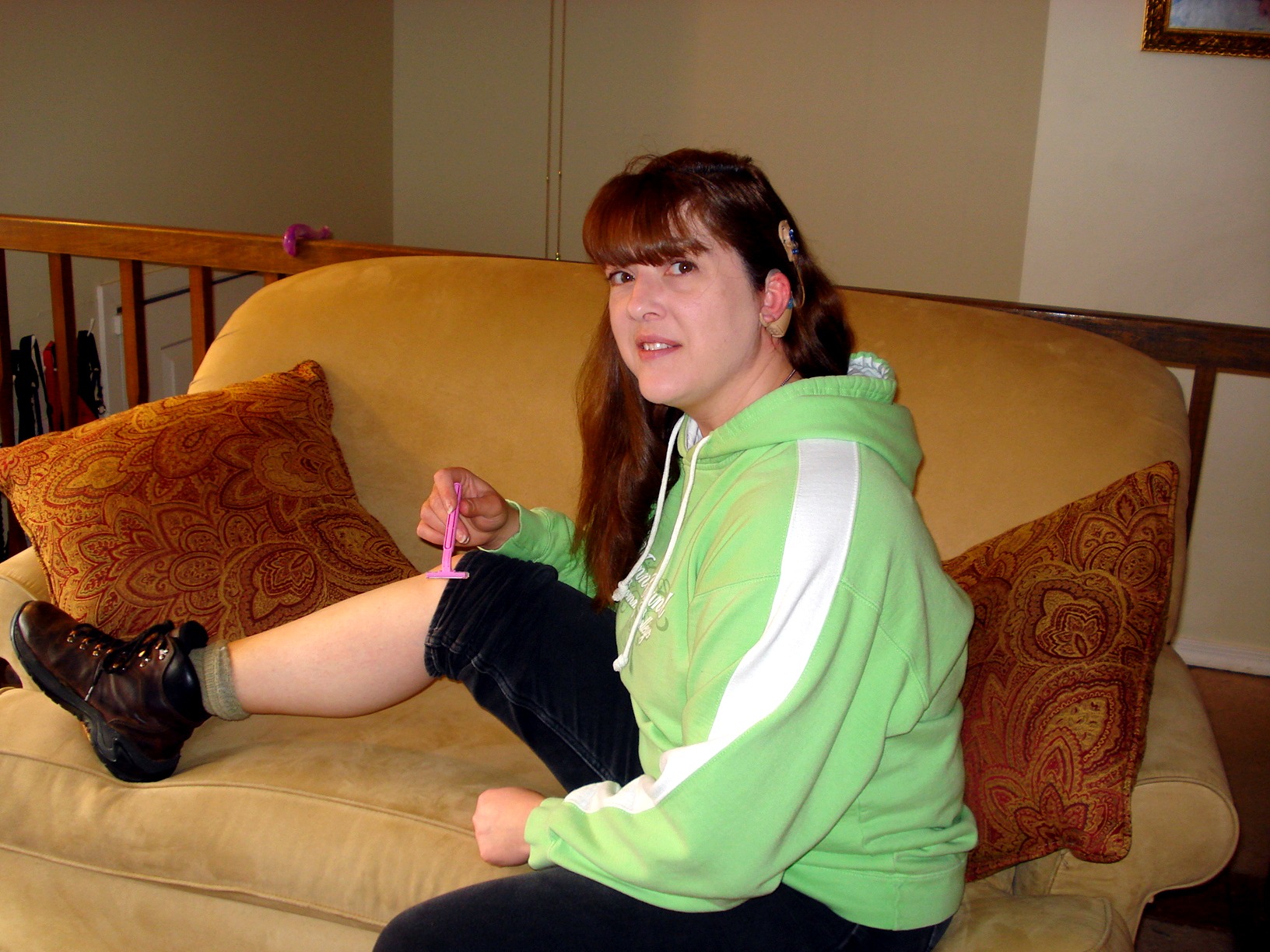
One thing I love about cooler temperatures, is that when “Chloe takes me for a walk” I can do so – HEARING. I’ll probably get “wrung out to dry” for this, but I do not usually exercise with my CI processor on my head. It’s not that I CANNOT, but more about a choice I made. I know people who run races with their cochlear implant! When I use to go to the gym, I would lift weights with my CI and my hearing “intact”. I don’t have a gym membership anymore, so my primary means of exercise is walking.

This summer I made the choice to walk in the cool of the evening without my cochlear implant. It is “wicked hot” here in Maryland on summer evenings, and I tend to perspire a lot. Oh gee… that’s stretching it a bit, because I honestly? I sweat! I walk “very fast”, much to the delight of my beloved assistance hound. It’s just short of a “jog” and because I move at a pretty good clip, I tend to perspire a great deal. I got tired of having to stick my CI in the “Dry ‘n Store” when I got home. After all, when I arrive back home I’m walking into a house full of people I care about. I want to hear them and interact with them. That doesn’t really happen if I have to go “deaf” upon my return from a walk!

However, it looks like cooler temperatures are here to stay for the season. (Hope I don’t jinx that!). One thing I love about the fall, winter, and early spring is being able to walk with my CI on and “working” since I do not perspire as much. It’s especially fun when walking for the first time in a long time WITH SOUND. I had forgotten that Chloe’s feet can actually be heard on the sidewalk. The sound of the breeze in the branches above the sidewalk sounds like music to these ears! Squirrels scamper about and “fuss at me” from lower branches of the trees as I pass. Those dogs we always see in fenced yards that either greet with a friendly bark and wag, or snarl/bark with a territorial warning, each have a unique sound, tone and “voice”!

I can hear the leaves skitter on the sidewalk in front of me as the breeze picks a few up and scatters them ahead. I can hear the distant traffic, occasional siren, or overhead jet… these peripheral sounds that make up the noisy world in which we live. Some of the “pressure is off” in walking with sound. I don’t have to concentrate so intently on the direction of Chloe’s attention, or worry about unheard traffic as I cross streets.

I think Chloe enjoys our walks more because I actually talk to her more. Isn’t that strange? I wonder why my voice tends to go SILENT when I cannot hear? I’m much more “chatty” as we walk along when I can hear the world around us. I realized I must talk infrequently when I took note that Chloe would turn her head to look at me. I realized she was startled to hear me talk! (I’ll have to make a better effort next summer of talking even when ‘deaf’)

In anticipation of winter, I look forward to hearing my boots on icy sidewalks and the sound of skeletal branches click-clacking in the cold wind!

Seasons of Life

Re-adjusting to hearing while walking at night brought a reminder of a parallel I’m currently experiencing. I’m at a “new place” in my life. At the age of 44, I have a child living on a college campus away from home. The “baby’ of our family is almost twenty and as a young man has really begun asserting some independence. (This is a good thing… though hard to adjust to not being needed like I was!) I’m in my last semester of school and feel the pressure of finding more part-time work come January!

It’s funny how different seasons in life we may “hear” differently. Specifically in hearing God, this often changes depending on the season of life one finds themselves living. At times, hearing Him is by choice… after all, He’s never the One who “leaves” or temporarily disconnects with us. Much like the choice to deliberately not wear my CI, I can choose to disconnect with God. It has happened in times of anger, depression, and even when everything was going “swell”.

It’s not that I’m coming back to the place of a LOUDER relationship with God. However, this season of my life I have found that I am having to lean more heavily on Him and on the power of our relationship. I guess you could say that right now, I really need God in my life… in an ever-present, constant sort of “coil connected to my head” kind of way! I have numerous little “worries” and concerns that seem to weigh heavily on my heart and mind. It’s just a season I’m going through. I’m thankful I’ve deliberately and consciously chosen to listen more carefully to God during this time.

Denise Portis

© 2010 Personal Hearing Loss Journal
Who Is That Person?

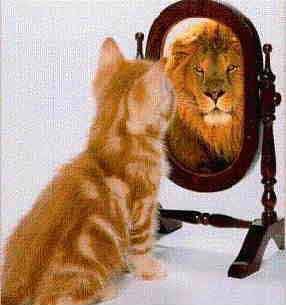
The bathroom downstairs is decorated with cats. Lots of them. (Yes I know… decorating a bathroom with “cat stuff” is unusual, but it is what my cat-loving children picked out!). The above picture hangs in the bathroom near the sink. As a result, I’ve given a lot of thought to this painting!

Who IS that?

This morning I was getting ready and caught sight of myself in the mirror. I had already fixed my hair, put on my make-up and “made pretty”. Yet, I was taken by surprise at what I saw in my reflection.

It’s raining today. We really need it too. Yet… I really dread rainy days. I usually know it’s raining even before I roll out of bed in the morning. I get this “sense” that all is not right. Weather systems do a number on my balance and I walk like a drunken sailor if bad weather prevails for more than a day or two. Looking at my reflection I could see IT on my face. Fatigue, dread, worry, and acceptance of the unavoidable. There it was in the reflection in the mirror. You would have to really know me to notice. Something in the eyes… tension in the facial muscles. Since I know myself pretty well (grin)… I could spot it right away.

Am I Defined or REFINED by Acquired Disability

The people I find most difficult to be around are those who “knew me when”. Folks who grew up with me – my parents, siblings, and family members – have a hard time being around me I think. I’m not who I was. My family are spread out all over the United States. We are currently in four different states, and unfortunately this necessitates rather infrequent visits. (Thank goodness for Facebook, email and SKYPE so that we can at least touch base virtually). My immediate family (husband and children) transitioned along with me as my life gradually changed from “what was” to “what is”. It seemed less like CHANGE to them, for life changes gradually grew who they were as well. However, when you haven’t seen someone in a very long time and then have the opportunity to be with them, changes are not only obvious they can be surprising!

I’ll never forget shortly after receiving my bionics and cochlear implant, I was visiting my sister while I was in Texas on business. I reached up to remove my CI to hand it to her so she could look at it because she seemed a trifle intimidated by it. She screeched, and said, “No, NO! Don’t take it off!” I got the impression she thought I was going to remove it from my brain or something! As if removing it meant you could peer down into the cavity of my skull! Her grimace and horror at what I was trying to do really threw me off! At first I was REALLY hurt (I’ll just be honest here). I couldn’t believe that in something so life changing for ME, that someone this close to me had done so little investigation themselves about what my having a cochlear implant would mean. But honestly? Researching and finding out more information about the CI that would change MY life is not HER job. I should continue to be the best DENISE I can be, using whatever means necessary to “do a good job” at that. It isn’t her job to completely understand what that transition will look like nor to completely understand the technologies I use to cope and HOPE.

Adaptation is “A change by which an organism or species becomes better suited to its environment” . My family and I have made adaptations. I don’t believe my disability DEFINES me, but it’s ridiculous to pretend it isn’t part of who I am now. I do believe it REFINES me. This isn’t a NEGATIVE thing. I’m still me… but a BETTER me because of the things I’ve adapted to as the result of having an acquired disability.

But sometimes… like this morning… I do a double-take when I see IT in the reflection of the mirror. I suppose it’s because there are days – thankfully few and far between – where my hearing loss and Meniere’s disease get the best of me. It would be so easy to just turn around and crawl back into bed. Heck! Honestly? There are days that would be the WISEST thing to do! I think of the people I know who are living with Lyme disease, Chronic Fatigue Syndrome, Fibromyalgia, MS, HIV, or cancer. Invisible disabilities and chronic illness that, unless you knew the background and testimony of the person standing in front of you, one would never know the courage it takes to live life each and every day with some semblance of normalcy.

Standing and looking in the mirror – you may notice a little bit of IT peeking out at you from time to time. I walked away from the mirror this morning totally OK with the fact that the stress of my life was showing a bit in my reflection. I don’t have to let how I FEEL influence the way I BEHAVE. Frankly? I think every person has days they have to try a little harder to PUT ON A HAPPY FACE. They don’t have to be people who live with invisible disabilities. It’s normal to have bad days. And normal? Well… that’s just exactly how I want to be.

I’ll leave you with a super song that I discovered long ago when that animated movie “Mulan” first came out in 1998. It wasn’t until I saw the lyrics for the first time that it was really driven home – the truths of reflection for every woman, every person, every individual living with invisible disabilities or chronic disease. When will my reflection show, who I am inside?

Truthfully it shows every single day. You just have to look harder on some days than on others. I don’t ever stop being ME though. I usually walk away from the mirror pretty satisfied with the evidence of things not seen on the surface. May we all be great reflections of who we are INSIDE

Denise Portis

© 2010 Personal Hearing Loss Journal

People are like stained-glass windows. They sparkle and shine when the sun is out, but when the darkness sets in, their true beauty is revealed only if there is a light from within.”(Elisabeth Kubler-Ross)

Prepared For It?

We simply do not take ANY chances

“The dog days of summer”… whew! Has it ever been hot here in my home state! I could take a repeat of last winter’s snows, believe me! I’ve always preferred 3 feet of snow to 3 weeks of 95 + temperatures! Because of the heat, Chloe and I have been forced to walk pretty late at night. At “twilight” it is dark enough that it isn’t safe to be walking. At least not in my neighborhood where people go 40 mph in a 15 mph zone.

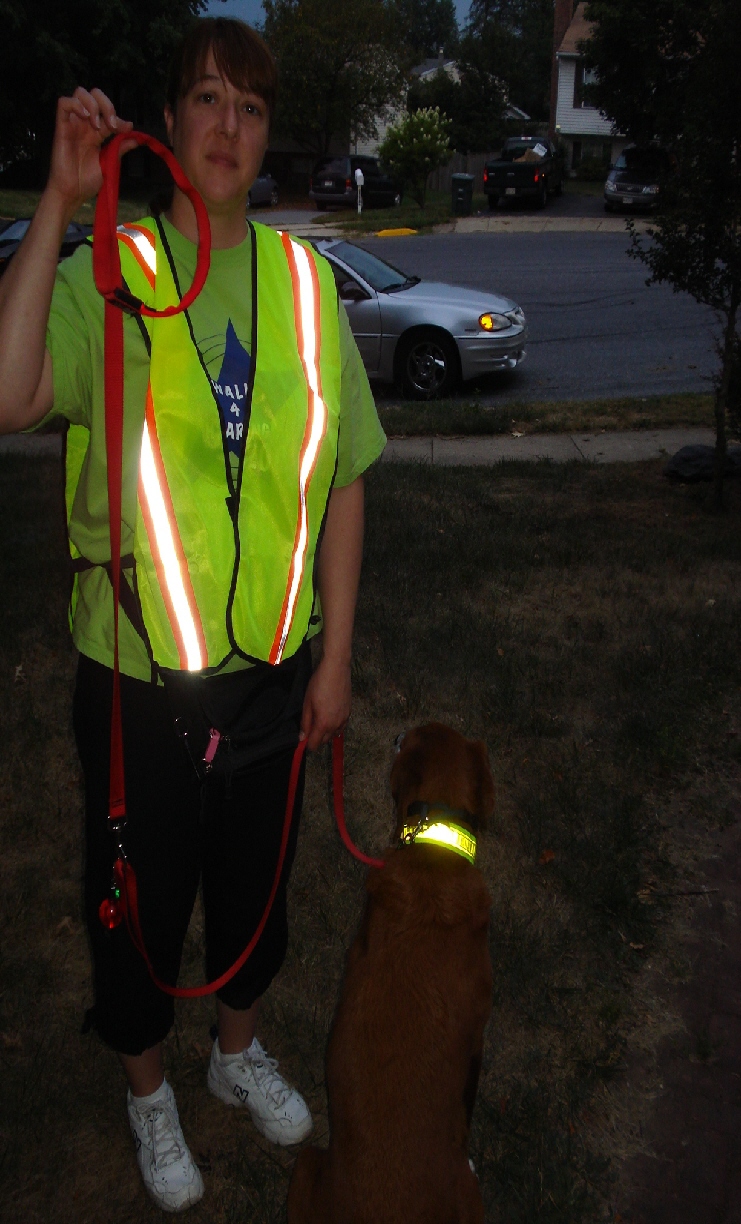
To placate my husband, I make sure Chloe and I are decked out in a number of things that are reflective. I wear a reflective vest, and Chloe a reflective collar. The leash I carry actually lights up near the handle end, and it also sports “lighted bling” of various kinds. I’m sure from a distance we must look like Santa and his team of reindeer! Small price to pay … this GLOW IN THE DARK preparation — for a safe walk! I didn’t anticipate having to walk so late at night, yet preparation has made all the difference.

I’m safe.

It is cooler.

We walk faster.

No… really! Not sure why that is, but the big “loop” we walk is usually 7-8 minutes faster than if we walk when there is more light. Perhaps because we aren’t having to stop to get Chloe re-collected after startling a bunny? Either the bunnies have an early bedtime, or they simply are not seen as easily.

Just Because it Wasn’t Planned, Doesn’t Mean You Don’t PREPARE

I know of very few people who planned to acquire a disability or to be diagnosed with chronic illness. I have become acquainted with people who have progressive hearing loss or are deaf, people who have lost their eyesight due to Usher’s Syndrome, people with MS, Parkinson’s, Meniere’s disease, and Chronic Fatigue Syndrome, people with fibromyalgia and many others who find that they are living a life they didn’t exactly “sign up for”.

So what do you do?

Give up? Try to get a refund? Sue?

Well… most of the people I know “deal with it”. They do so in their own way, and for some it may mean working through it. Working through it for some people may mean that they have a pretty long period of time either denying the problem or grieving the problem. Each of us do this, but some spend more time on these steps than others. That’s OK. I get really aggravated when I hear someone tell a person learning to live with changes that affect their life that they need to “get over it” and “get on with life”. I guess I’m aggravated because the person saying that usually does not have the same diagnosis as the person they are preaching at! However, I do sometimes see someone who DOES share the diagnosis “preach” the same. Just because YOU did not grieve your hearing loss — or whatever it may be that you are dealing with — doesn’t mean that other people deal with the loss the same way.

Once you do work through that process, however, you can start to prepare. Preparation is key. For me preparation looks like this:

1. I always have #13 hearing aid/cochlear implant batteries. I carry some in Chloe’s vest, the car, my pocket book, and Chloe’s treat bag. I have them in my bedroom and my office.

2. My cane is right by the front door. If it is rainy or if there has been a pressure system come into the area, having my cane “handy” insures I actually take it with me out the door. No one “messes” with where I put my cane. If you move it, you risk life and limb (grin).

3. I leave early to arrive early. Let’s face it. It takes me longer to get to where I’m going. For one thing I travel with an assistance dog, and I have to spend a couple of minutes allowing her to “do her thing” before going into a public place. I have to load her up safely in the car. I have poor peripheral vision on one side so I drive the speed limit in a world where no one else does. I allow extra time to get to places ON TIME. Sure! I’m early sometimes, but I am rarely late.

4. I never walk out the door without my cell phone… and I am ZEALOUS about making sure my phone has a full charge. As a matter of fact… I have my cell phone on my person almost every waking moment. (Perhaps something to do with having a kid in college in another state now?)

5. I make it a PRIORITY to get eight hours of sleep. This is so important, I schedule myself to get at least eight hours. Heck! I’ll be honest… I actually do better with nine, so if I can schedule that I do! Having a cochlear implant is terrific! I love being able to communicate without having to actually be in the same room with someone. I’m fairly certain it’s not AGE… it simply takes a LOT of brain power to communicate now! Who’d have “thunk” that communicating with a hearing loss could be so exhausting. It doesn’t seem fair that no calories are burned! It is mentally (and sometimes emotionally) exhausting to communicate with hearing loss. If I get less than eight hours of sleep, it is very noticeable that I do not communicate as well. Fatigue will do that.

6. I make sure I travel with information about service/assistance dogs. You never know when you may have access issues. As a matter of act this has been a pretty prevalent part of our lives lately. (See the links here (with a video too!), here and here).

7. I avoid sodium, limit caffeine (something I find nearly impossible), and take Manganese! These three things I have found to be very helpful in limiting the effect Meniere’s disease has on my own life. Manganese is hard to find too! (Magnesium is plentiful… Manganese not so much). Remembering to make these “BIG 3” a priority, really makes a big difference in how severe my symptoms may be when an episode hits.

8. I memorize and use lines that best describe my communication issues and how I can solicit positive responses. These include:

A. You speak wonderful English! However, I have a hearing loss so I have trouble with accents. Could you repeat that a little slower please?

B. I have trouble understanding in background noise. If you would face me when you talk, I should be able to speech read and hear with my CI (point to it) and hear you much better!

C. I missed what you said. What I heard was (and I repeat the parts I heard). Could you repeat what I missed? (This way folks aren’t having to repeat EVERYTHING).

D. It’s so noisy in here that I am having trouble pulling your voice from “all this chaos”. Can we step over there (points) to a quieter spot? I really want to hear what you are saying.

E. Do you mind if we sit down? My balance is “off” today and if we sit it will give me one less thing I have to deal with!

F. Let’s step over here to talk so that I can put Chloe in a “safe place” so she won’t get stepped on.

There are many more… but it pays to rehearse and have specific examples to communicate to others your attempt at being proactive to help yourself. I have never… not even one time… had someone respond to these types of explanations in a negative way. Preparing explanations like this keep me from slipping and offending someone by spouting off:

A. Geesh, your accent is killing me! I can’t hardly understand what you are saying!

B. Would you quit mumbling and speak slower please? Gee whilackers!

C. HUH?

D. WHAT DID YOU SAY? (In a super loud voice trying to drown out all the noise. Now ever eye is on you and the person who was trying to talk to you).

E. (Denise is bumped and falls to the floor in a tangle of arms and legs… including doggie legs).

F. STOP STEPPING ON MY DOG!

Preparation = Ownership

In preparing and planning, a person with an acquired disability or chronic illness in essence choose to take ownership of their own life. It isn’t another person’s responsibility. It is ours. What ways do you prepare and “own” your life to better live with a disability or chronic illness?

Denise Portis

© 2010 Personal Hearing Loss Journal


Follow-up to “Community”

It’s so nice to have guest writers from time to time if not for any other reason, than to give you a break from me! Today I am posting a well-written and thought-provoking comment from Dr. M.E. Osborne, whom I share a “community” with at the Cochlear Community. Feel free to leave your comments (as always), and if you like I can forward personal messages to her via email.

Dr. M. E. Osborne

Denise : We are all thankful you are a member of the Cochlear Community. You bring us different, clear viewpoints and concepts to think about.

Your description of the grocery store incident put me there as if I had been a butterfly on the top shelf. Some thoughts flew instantly to mind, and others developed as I thought about the incident throughout the day.

FIRST: How sorry I am for the little boy; he is being taught prejudices. If a parent actively, consciously imparts a narrow connotation of “normal” – for 7 years – you know there are other interrelationship terms that are also skewed.

SECOND: I take it she also was hearing impaired and was referring to “normal” in the “deaf community” through her experiences and the results of the choices she made. By 7 years of age a child’s basic personality and framework of values are 80% set. But the input of details that determine our ability to make our own choices is only about 30% set [Kaugher, 2004] That little boy is on the cusp of making important choices for himself.

His language development is still open. Unless his parents permit his examination, it will be another 11 or 14 years [depending on “legal age for self-care” in the state where he is then living]. Those of us in the Cochlear Community each know at least three people who had no hearing until Cochlear Implant[s] happened. That might be case for that little boy. He would be eligible for speech/ auditory/ aural/ oral services. He might come to speak as clearly as a couple of Cochlear Volunteers. IF THE MOTHER’S ATTITUDE PREVAILS, HE WILL NOT HAVE THAT CHANCE EARLY IN HIS LIFE. HOW TRAGIC.

THIRD: You were SO much more polite than I would have been. I would have flown after her to “ask” her, HOW DARE SHE MAKE THAT IMPORTANT CHOICE FOR HIM!  No matter how I had to communicate – sign with the ASL I remember, spell words one letter at a time, or write it. She would understand my intense furor with her making life choices for another person.

She is exactly the type of parent who drives people in my chosen area of expertise out of our minds. She is afraid of technology and teaching that prejudice to a child, not describing options.

[For those of my Cochlear Cousins who do not know, one of my doctoral concentration areas is Special Education Administration. The program I completed was heavy in being an advocate for the client – especially for youngsters.]

Then I would have emphatically flown off into “WHAT IS ‘NORMAL’ IS SITUATIONAL.” The two of them “out in the usual world in a grocery store, using ASL to communicate,” was not normal right then – unless everyone in the store at the same time was using ASL

“Normal” implies behaviors, clothing, manners, foods, rules, customs etc. that are highly predominant among a group of people.

THERE IS NO ONE NORMAL FOR EVERYWHERE, ANYTIME.  I have lived both as a citizen and as a military member, literally around the world; traveled extensively on four continents, and have been privileged to be part of many social communities. Communities may be defined internally – people who have chosen to be self-segregated from interaction/ participation with those outside. Communities may be people forced to separate, by customs, laws, etc. Communities may be segregated from each other on some binding reason the members consider enough – an example is the “upstate homies” and the “downstate homies” in a juvenile prison.

While teaching in a southern city, I was accepted by the Deaf Community as one of them because I tutored/ taught the children. The same reason was in force in a northern city as I taught three young people for 6 years. Their three “accompanying interpreters” in public school, agreed to provide a concentrated ASL class for the 24 teachers involved.

What are perceived as communities, sometimes must merge, not just function, but each individual interact successfully. Consider the situation: Nancie was one of the school interpreters; Black; attending an active Catholic church with an almost total Black congregation, and the congregation kept many traditions of Black, southern churches – the Mother of the Church and the Sodality Members wore white, all other members wore navy blue, to any church service. Nancie’s mother passed away. The three students, the two other interpreters,  all 24 teachers, students close to the signing student’s, & the students’ families, piled into a school bus at the school located on the fringes of the city, to ride deep into the city,  down to the river. In the melee of people were Black, European, Hispanic, Jews, Catholics, Baptists, Methodists, hearing, partial hearing, and totally deaf. We were greeted and welcomed by the Priest and the Mother of the Church. You bet we had it together … because it meant something to Nancie, and us. We sat behind the Deaf Community – one of the two interpreters signed in the front – the other about in the middle, both up high enough to be seen. All teachers, families, etc were in navy blue dresses or suits. The Catholics spread out through the group to help the others get through a completely sung, old fashioned, high Mass. [For those of you who wonder, the cemetery was a short drive to the north. Yes, our bright yellow school bus was in it.]

Imagine the chaos, the pathos, the inflicted insults and injury had every individual clung only to what made them comfortable.

Currently I am in the USA, living in a SC rural area near an average small city, 50K people.  Permit me to list some things that might not be the norm, the usual, in public situations:

  • ASL, or for that matter, any language other than English;
  • an assistance dog, lemur, ferret, or tree monkey;
  • a lady who covers the left side of her head, but puts a finger in her right ear when eight F-16s go fly low, landing/ taking off.    [Guess who with a BAHA]
  • people using heavy, metal, leather braces and cup crutches;
  • families of 21 children;
  • people wearing clothing that openly indicates their choice of religion/ religious practices – Hutterite plain clothes, burqa, nuns in habits, yarmulke/ Kippah;
  • people with little screens on their head attached to a weird looking hearing thingy – you can see one on Rush Limbaugh.

Some things that here are the norm:

  • No matter the time of day, lots and lots of men and women in military uniforms for the Air Force or Army  [NOT Navy or Marines] Shaw AFBase is in Sumter, Ft. Jackson Training facility is in Columbia, and the 3rd Army is coming to Sumter piece by piece
  • Many large, off road capable, pick-ups with a full gun rack inside the back window of the cab. Often there is not a need to lock the truck, there are a couple sets of large barking teeth on guard
  • After people have been home from medical, banking, other “white-collar” jobs, welding shops, construction, several groups of motorcycle riders gather – Legion Riders, Sons of God, Hyundai Hots – each in a different huge, parking lot
  • Men and women who proudly have Concealed Weapons Permits, carry their handgun, and love to take them out [unload all] and compare. [Me too]

NONE OF THE LAST FOUR ITEMS WOULD BE “NORMAL” IN DOWNTOWN CHICAGO AND ZIP CODE 60625.

Thank Our Lord for people in the Cochlear Community who

  • chose to create and maintain an open, welcoming community
  • accept input from professionals, family, and friends in making decisions; and also welcome the prayers of us who offer them
  • respect and embrace the decisions community members make
  • have the personal courage – sometimes at the cost of pride – to ask for support from others who also live with Cochlear technology
  • encourage us who are slugging our way through our CI/Baha  journey by sharing in both disappointments and joys
  • are ready to show their own personal hearing technology to people – recently I listened to a campaign manager explain that a car magnet was worth 300 votes for a political candidate – so I was thinking,  can we assume every CI magnet explained will bring 300 more people to hearing ?  Maybe the person spoken to, maybe someone they talk to ?
  • belong to SEVERAL social communities and move comfortably from one to another – even if we make a mistake now and then – such as when I heard my name called in exasperation in Eastern Star meeting, and snapped to my feet, smartly made a Navy military about face, to attention, and said sharply, “Ma’am”. Wrong community. The response should have been to stand graciously, make a small bow, and say respectfully, “Worthy Matron.”
  • are not afraid to risk making new friendships, that begin in the ether of the Internet, and because of geography, might never move to in-person friendships.

Dr. M.E. Osborne