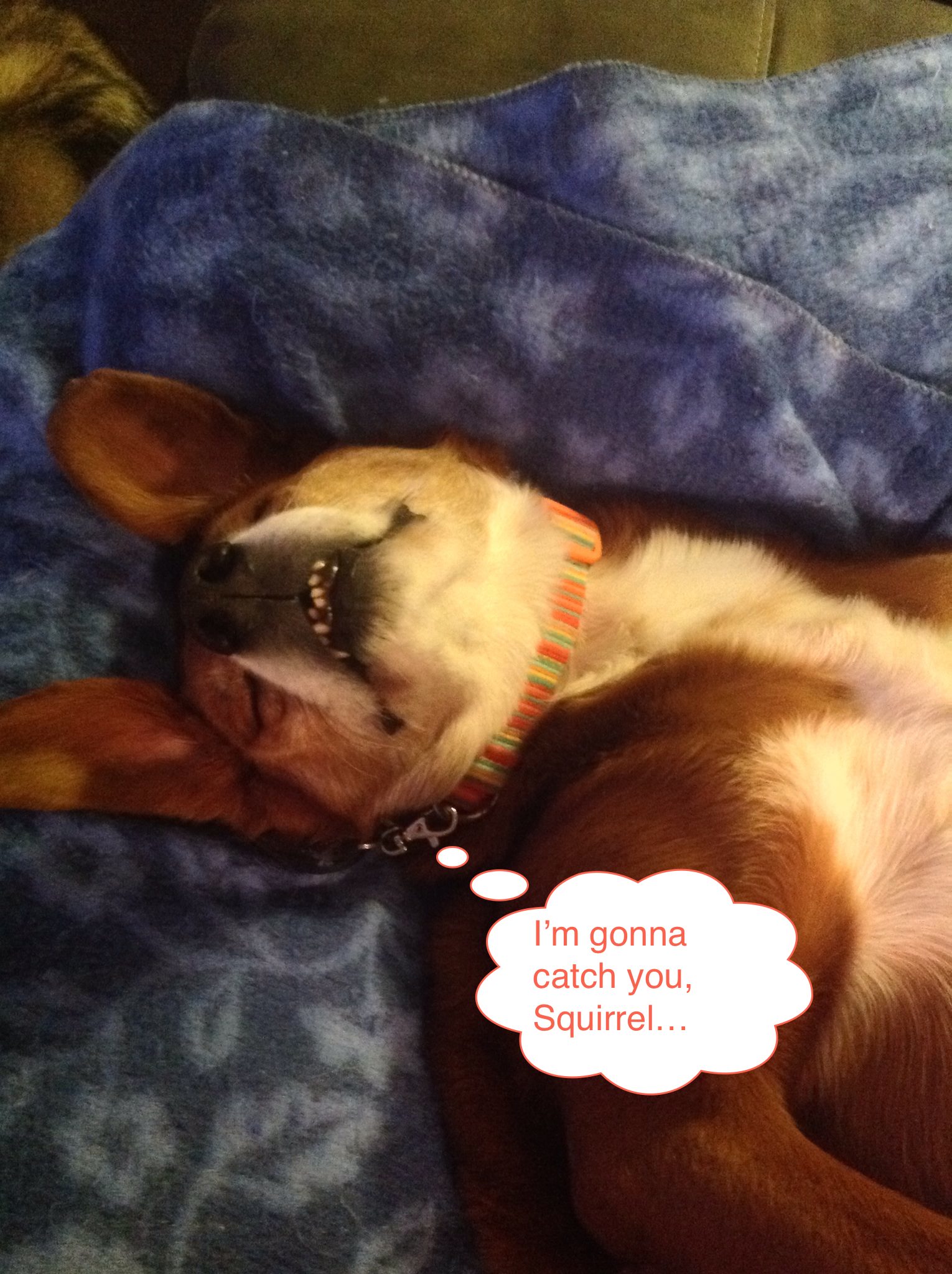
When They SHOULD… but they DON’T

support

Do you know the #1 topic of emails to Hearing Elmo (or face-to-face for those of you who know me personally) is support or the lack thereof? I have not met a single person with acquired disability, chronic illness, or invisible condition that took on their “new normal” by choice. We need support.

People need other people. I don’t care if you are an introvert and “loner”, or a gregarious, extrovert. All of us need human connections to some degree. I hypothesize that those of us who live with acquired disability, chronic illness, or other invisible condition may need solid, supportive relationships even more than those who do not face daily challenges. Coping is TOUGH stuff, and geesh… don’t I hate we don’t burn calories for all the work we put into COPING? In psychology,  we have a special term for how important our relationships are to adjustment – psychosocial adaptation. Bishop (2005) explains this better than I could: Psychosocial adaptation “may be conceived as a process of responding to the functional, psychological, and social changes that occur with the onset and experience of living with a disability, chronic illness, or associated treatments” (p. 6). There is a ridiculous amount of research on how important relationships are to an individual’s psychosocial adaptation. Intimate relationships are imperative to the quality of life for individuals who are differently-abled. All very interesting STUFF, in my humble opinion, but not at all the goal of or intended topic of this post.

Intimate Relationships

When we hear the word “intimate” we may think of sexual expression. Maybe we think of fancy-smancy underwear. (So aren’t “we” the weird ones?). Intimate relationships are interpersonal relationships that are physically OR emotionally intimate. This means that we can have close friends or family members who have an intimate personal relationship with us in that they know us very well. We have let down our guards at some point and shared things with them that others have no clue about nor care. Yes, intimacy is often physical as well, and those of us who have a physically intimate partner in a spouse or significant other, count it a major blessing to also be a friend to this individual.

Our expectation of our intimate relationships is “through thick and thin” (and I don’t mean WEIGHT). We expect these folks to love us on our good days and our bad days. We know we can belly-ache to them and they won’t think less of us. For those of us who took traditional vows, we put a lot of faith in “till death do us part”. These folks know us – and love us anyway.

When acquired disability or chronic illness enters a life unexpectedly, we rest in the knowledge that our spouse or significant other, and intimate connections with friends and family members will strengthen us and help us adapt. We have this HOPE and expectation, yet so many share with me that they were let down by someone they had counted on to BE THERE for them. Some of you have even had to deal with broken relationships. Others may have partners and friendships that have stuck like super-glue, but you cannot help but feel as if you are a burden and that these folks feel “stuck” with you.

Perhaps someone shared with you that they get tired of how tired you are. Maybe they shared or insinuated that life with you sure is HARD. As if things weren’t hard enough, someone you depend on is tired of your diagnosis too? Thanks so much for that…

I know. Not a single person reading this post hasn’t at some point wished they could have just ONE day of normalcy. “If I could just have 24 hours of normal, it would re-set my gripe-o-meter box”, shared a long-time reader. Yup. I get that! So for someone in our intimate circle to complain that they are tired of all that WE are tired of? It’s enough to make you want to spit. Or hit someone. Or SPIT while HITTING someone…

So what do you do when you realize that those who support you are having trouble supporting you? I have three tidbits to share.

1. If the Shoe Were On the Other Foot

Please don’t lash out and tell your significant bozos (cuz at the point you are mad at them for their lack of support means they have morphed from close relationships to close BOZOS), that if things were “the other way around” you would TOTALLY be there for them – ALWAYS.

This, my friends, is impossible to prove. YOU are the one dealing with a significant, life-changing diagnosis. We don’t know how we would react to “the shoe being on the other foot”. Criticizing and attacking another by insisting we would support and behave differently is not fair, nor is it justified. There are numerous studies that support that stress and anxiety can be vicarious experiences by those who support people who are struggling.

I believe one of the very best things we can do for those who support us is to acknowledge up front that WE KNOW THIS IS HARD ON THEM TOO.

2. Engage in Active Listening

All relationships benefit from active listening. Active listening was made popular by psychologist, Carl Rogers, in the 50’s. Many different counseling approaches now incorporate active listening to engage in good communication. One of the best descriptions of active listening that I’ve read can be found HERE. It is five WONDERFUL pages of all that is Active Listening. So I’m not going to take the time to explain it here and instead am giving you a “homework assignment” <wink>.

3. Yes, They Should. But… They Don’t

I cannot boast of 100% supportive relationships, nor brag that I’ve handled my own acquired disabilities with grace and diplomacy. Even though I’m in a “good place” right now with numerous supportive relationships, I have been disappointed by some of my relationships, and have even lost some folks along the way.

It hurts.

The biggest mistake one can make in shouldering all that encompasses living with significant challenges, is trying to do it alone. You are not alone.

For one thing, you are reading THIS. I care.

The Internet insures that we are NOT alone. The Internet is accessible to even those with significant challenges. If your intimate relationships and friendships have let you down, please know that you need others. Find them.

Places you can find support:

1. The newspaper: Many list various support groups and networks available for numerous types of challenges and health issues.

2. Churches: Many have support groups and networks available to both members and non-members.

3. Libraries: Many have community services bulletin boards (both physical and on-site, as well as electronic) that list numerous support groups.

4. Online forums: One only has to “Google” their diagnosis to find numerous avenues of support online. One great searchable database can be found HERE.

5. National non-profit and for-profit organizations: Most diagnosis also have organizations that provide education, advocacy, and support at the local, state, and national levels. Search the Internet for organizations that provide resources for your specific population. Many have support networks as well.

6. FaceBook and other Social Media Outlets: You’d be surprised what support resources are available on FaceBook. Many are closed groups as well as have confidentiality tenants of membership.

7. Start your own: I’m not a big fan of “wiki” anything (I suppose it is the teacher in me), but I have to admit, WikiHow did this up right. Check it out HERE.

Cut ‘Em Some Slack

Finally, I’d be a poor advocate if I didn’t give you heads up that people are going to disappoint you. Forgive them.

You are going to have a really bad day and need all kinds of support, practically draining those around you DRY. Dehydrated people can lash out. Forgive them.

You will struggle with having to live your life yet another day – so very tired of it all. Someone will point this out. Mock you. Complain about you. Forgive them.

Someone will try really hard to support you and come up short. Their personality or own needs simply do not allow them to be exactly what you need them to be. Forgive them – and support THEM.

You are going to have the kind of day where you are just done with EVERYONE. You burn your bridges, isolate yourself, and find yourself very, very alone. Forgive yourself. And rebuild.

Denise Portis

©2015 Personal Hearing Loss Journal

Bishop, M. (2005). Quality of Life and Psychosocial Adaptation to Chronic Illness and Acquired Disability: A Conceptual and Theoretical Synthesis. Journal Of Rehabilitation71(2), 5-13.

Rogers, C. R., & Farson, R. E. (1957). Active listening. Lexington, Massachusetts: D.C. Heath and Company.
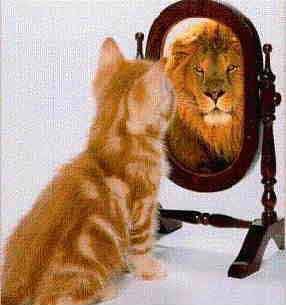
Cats Get a Bad Rap

CatAndMirror

I love dogs. However, I do love cats, too! I don’t currently own a cat which is just weird for me. Cats have a bad reputation though, don’t they? Think of the phrases we use about cats:

1. Tom-cattin’ around.

Males (or even females) slinking around at night looking to get some-some. (Jus’ tellin’ it like it is, folks). Apparently the name of said feline is also Tom.

2. Caterwauling

This is usually a female cat screeching and yowling around while in heat. It is used to describe humans at great risk to the idiot males who determine it would be funny to do so.

3. Like herding cats

This is impossible. They don’t run in herds so aren’t we the stupid ones?

4. Let the Cat out of the Bag

This means to tell a secret. Frankly if my cat was ever in a bag it would not be a secret. The whole house would know. If you don’t understand, you’ve never owned a cat. They are either playing in it by choice, or stuck in it due to HUMAN error.

5. Cattin’ around

Similar to “tom-cattin’ around”. To wander aimlessly looking for entertainment – usually resulting in feline delinquent behavior.

6. Fat cat

Evidently this means loaded, or very rich. I do NOT use this phrase this way.  At the time I was talking to an overweight cat.

7. Curiosity killed the cat

Cuz evidently even though it 1) looked dangerous, 2) smelled dangerous, 3) sounded dangerous, they couldn’t help but investigate anyway. Which leads to #8

8. Cats have nine lives

They get killed a lot. Or, at least do really stupid things that almost result in their demise.

9. Cat got your tongue

Ewww. Just ewww. Yet, it means speechless. This happens to me a lot. *rolls eyes*

10. Cat walk

To walk with splendid balance and grace with a sexy little swing of the hips. Evidently models walk on this. Perhaps cat calls came from this practice.

Cats can be pretty special critters though, and even better fur-babies. They sure get a bad rap, however. People seem to either love ’em or hate ’em. I find few who are indifferent. I’ve met some pretty special cats that behaved very un-cat like at times. And frankly? I’ve had some cats climb up in my lap and allow me to pet them while they purred my cares away more than once. They can be extremely intuitive.

People with Disabilities Get a Bad Rap

I don’t like identifying as a person with a disability. It is the language used by the laws that protect my rights as a person with unique challenges, however, so I accept the “label”. Folks with disabilities get a bad rap though.

Here are just a few of the things I have heard:

1. We complain. A lot.

Evidently about anything and everything; but mostly about our disability. I mean… it’s as if we live with it 24/7 or something. Pretty lame, aren’t we?

2. We are lazy.

In the decades I have mentored and worked as an advocate for persons with disabilities, I believe one of the toughest diagnosis is that of CFS (Chronic Fatigue Syndrome). There are some other diagnoses that are closely related in which the primary symptom is extreme and debilitating fatigue and/or pain. It hurts to do anything. So sometimes, complaints just slip out of the mouths of these brave people. Maybe curse words too, but STUFF SLIPS OUT. It is very, very difficult to live with one of these diagnoses and I admire these folks. I do.

3. We are extremely dependent.

Most of the people I know who are differently abled – work very hard at learning to do things DIFFERENTLY so that they can remain as independent as possible. If you knew how hard it is to ask for help you’d never roll your eyes at a request from someone living with chronic illness or disability.

4. We will never contribute to society.

Geesh. This is so, SO wrong. Most of those I know living with a chronic illness or disability are super busy working in their community. They “give back” at times to the point of going to far and doing to much. Everyone has a desire to be needed – to matter. This includes people with disabilities.

5. We are drama queens/kings.

I’m a bit of a drama llama. I prefer this term because I am crown-less yet recognize I, at times, spit for attention. But seriously… most of us HATE attention. We are trying to just “be normal”. We haven’t created our own song and dance in expectation of applause.

6. We are hypochondriacs.

The thing about long-term disability or chronic conditions, is that you become an expert on your diagnosis. As a matter of fact, at times, you know more than your doctor does. You have researched and investigated everything about your diagnosis and in so doing have learned about similar diagnosis or co-morbid diagnosis. We seek to understand it because we are trying to survive.

7. It’s all about us.

There are selfish people with disabilities and selfish people without disability. Many of us (just like you) work hard at making a difference for others. We actually hate the attention and don’t want it to be about us. We love being able to do even small things to help someone else.

8. We will die young.

Many people with disabilities live an average life span. But folks? They do so never ditching the diagnosis. This makes them WARRIORS. This makes them courageous. This means we could take some lessons from these people.

There are also those whose diagnosis mean their life span will be cut short. These people are still warriors. They simply have less time to prove it to you. So make it a little easier for them and stop judging and embrace their uniqueness. None of us are promised tomorrow. Even those without serious and permanent diagnosis could be gone tomorrow. Shouldn’t we all work to make a difference TODAY instead of write people off as if they have no future?

9. We don’t care about our health.

Yes. Some diagnosis make it really difficult to move, to exercise, and to live a healthy lifestyle. Sometimes people who are differently abled gain weight. But added pounds does not mean they don’t care about their health. As a matter of fact, most of us have learned that dietary changes, moderate (doable) exercise, and holistic approaches can improve the quality of our life. Don’t preach at us to become “juicers” or vegan, or organic shoppers. Don’t tell us to just get out and MOVE. Folks who live with a long-term illness or disability are often avid health nuts. They may not look it, but they work to keep things such as blood sugar, cholesterol, and blood pressure in control. Please don’t judge.

10. We are disabled.

Being disabled does not mean not being able. We are very able. We likely just do things differently. We are still more LIKE you, than not like you. We feel. We love. We get pissed. We yearn to connect. We throw our dog’s ball and scratch our purring fur-balls. We are very able. If in doubt, get to know us and discover it for yourself.

Denise Portis

© 2015 Personal Hearing Loss Journal

Cognoscente, Aficionado, and Cutting the Crap

The bunny is currently resting...
The bunny is currently resting…

It may or may not be news to you that I am in grad school. Part of the program I am in requires academic residencies. I just completed another one on Dec. 27-30th and there are few things I despise more.

It isn’t because I don’t enjoy the workshops and expert speakers. I do.

It isn’t because I hate the schedule. It’s hard, but I can do it.

It isn’t because I am not learning anything. I am.

Academic residencies are very tough for me because a lot of blow-hards attend and I consider myself lucky to exit the residencies having met one or two people who ARE NOT.

I’ll admit it. I am a bit of a loner. It isn’t that I don’t LIKE people. I do. As a matter of fact, I love people. However, if I have 30 minutes to eat lunch, I’m not going to go to a crowded restaurant, nor stand in line for a turkey sandwich that costs $11.00 plus tax. I’m going to pack my own lunch, sit in a nearly deserted room at the next location of a required workshop, and work on my homework while I regenerate. (Did I explain I was part Borg?)

On Sunday, a longer residency day for me, I was holed up in a large room eating my lunch and tossing Chloe’s pink bunny while completing an essay on boolean phrases (aren’t I talented?) Unfortunately, by day two, other people are also figuring out these empty workshop rooms are great places to eat lunch. Some of these people are talkers. *grimace*

I suppose an “off vest” service dog playing with her toy, wagging her tail like crazy,  and huffing quietly to me so I’ll throw it again, invites spectators and conversationalists. Sometimes I really want to PLAY DEAF. I cannot, however, for I feel a certain responsibility to be a good testimony and example of a “hearing again” person. So darn it. I am pulled into conversations.

“Oh this is great that you allow your service dog an opportunity to unwind. That is a great stress diversion instrument!” said a very well-meaning (I’m sure) observer.

I know I looked at her funny. I’m pretty sure an eyebrow went up. Unfortunately, funny looks and raised eyebrows invite further conversation.

“Will your dissertation be about the place of service animals in the lives of persons with disabilities since you are a cognoscente in this area? I know many of us who are scholar-practitioners are aficionados in our area of interest”, said the now expectant observer.

I may love people, but sometimes? Sometimes I’m not very good with people.

I snorted.

That’s right. It’s a good thing my sinus were clear because lord knows what would have flown out.

I pointed to Chloe who was currently rolling around “scenting” her pink bunny and said, “You know that is a slobbery toy? It’s not an INSTRUMENT. I am doing my dissertation on something I believe in and yes, know well because I live it. But let’s cut the crap on the big talk. It’s lunchtime and I’m relaxing so you don’t have to impress me. Heck. I hardly even know what you are saying!”

Are you as horrified as I was? I wanted to slap my hand over my mouth and then immediately apologize. What happened next had me exchanging emails and finding a new friend.

“Oh thank God. My partner tells me to cut the crap all the time. Don’t you hate feeling like you have to ‘play doctoral program’ when you are here? I mean we are all just trying to get done, doing our best to reach goals. Holy realist, Batman. Can I eat lunch with you tomorrow?”

(In case you are wondering if that is her quote, I can’t make this stuff up. I even emailed her later and asked to “quote her” in an upcoming post).

I howled with laughter. I mean, I had tears rolling out of the corners of my eyes. Chloe was a bit concerned but continued to take advantage of her off-vest playtime.

Stop Trying So Hard

In the years I have chosen to identify as a person who is “differently abled”, I have met two kinds of kin.

One group of folks I feel a certain amount of kinship with since they, too, live with a chronic condition, disability, or invisible illness, are commitment-aholics. They choose to be involved in everything – just to prove they can. (A friend wrote an excellent post about this – click here to read it). They work so hard at making sure they are independent, they smack the back of the helping hand reaching towards them.

They work so hard at proving themselves at work, they are over-committed to volunteer committees and focus groups. They strive so hard to show the world (and themselves) that they CAN, they do very little well. They bust their butts to impress us. The reality is they walk around with – erm… – busted butts.

My other “cousins” are people who refuse to participate in much of anything for fear of letting others down. Instead of learning what their own physical, emotional, and mental limitations are and living an abundant life within those boundaries, they isolate themselves and refuse to put themselves in a position that they may blow it. They get around making poor choices by choosing not to make any choices at all. Their souls are withering and they don’t even know it.

Use Your Talents and Skills. Just STAY REAL

We all have talents. These are gifts we are born with while a skill, on the other hand, is something we are good at because we’ve worked hard at being good at it. We can even take natural born talents, work hard, become skilled, and use these abilities in our personal and professional lives.

It is very important to use what is available (talents) and work hard (become skilled) so that each of us can make a difference (with our abilities). Yet, too many times we get side-tracked by making sure folks recognize what we are good at doing. Cut the crap. Be real, but be nice. Be who you are – which means at times you are wearing a cape, and other times you are asking for assistance. Share who you are (why keep abilities to yourself?) but be a humble expert in who you are. Don’t be an over-achiever. Don’t be an under-achiever. Just be real!

Denise Portis

© 2015 Personal Hearing Loss Journal


It Can Be Small Things…

Deborah Marcus, friend and photographer, explains, "I love to hear how what I capture and share gets people to notice stuff they'd probably overlook". I have learned much through seeing what she sees through her camera lens.
Deborah Marcus, friend and photographer, explains, “I love to hear how what I capture and share gets people to notice stuff they’d probably overlook”. I have learned much through seeing what she sees through her camera lens.

A dear friend and fellow “hearing again with a CI” friend, Deborah Marcus, has a knack for capturing the kind of photos that has me sucking in my breath and having to pinch myself to remember to continue breathing. She finds the smallest detail and creates a visual memory by “pointing and clicking”. It’s a talent, and one I don’t have. So I enjoy seeing the small things through her camera lens that I would normally miss. Why do I miss them? I’m not looking…

The Problem With Health Challenges

One of the biggest problems with health challenges isn’t pain. It’s not fatigue. It’s not the stigma. It isn’t depression, anxiety, or any other comorbid diagnosis. In the years I’ve lived as a disability advocate, writer, and mentor, the biggest danger of living with chronic health conditions and challenges is that it can make a person extremely self-centered.

It’s easy to do. No one understands except perhaps others we’ve connected with who “live the same”. The people we love may be supportive or stumbling blocks. They may be our biggest advocates, or the pain in our… erm… behind.

Take Deborah’s photo above. Now me? I love daisies and any type of flora that is yellow and white. But ya know? I’d walk right by this flower and only think, “what a pretty flower!” I don’t stop, grow quiet, get down on my knees, and really open my eyes. If I did that more often, I’d see the gorgeous wee bug. (Entomologist, I’m not…)

It can be the small things that make an ordinary moment in time, something to be celebrated. When we become self-focused, it is impossible to see those small things and we miss celebrations.

Pity Parties are still Celebrations

Don’t get me wrong. I believe it is healthy to have a good ol’ pity party from time to time. After all, a party is a celebration … of sorts. ♪♫ It’s my party, and I’ll cry if I want too…♫♪

Learning to adjust to new challenges can be exhausting. Some folks with chronic illness or invisible disabilities may find it very therapeutic and healing to bawl their eyes out (Borchard, 2014). In “7 Good Reasons to Cry Your Eyes Out”, Borchard (2014), explains all the GOOD that can come from a good ol’ pity party.

But self-pity is dangerous and different than an occasional pity party. Self-pity begins and ends with self-focus. When we are entirely focused on ourselves and our own problems and difficulties, we cannot see the small things and miss the celebration. “We are bombarded with opportunities to feel sorry for ourselves” (Smith, 2004, para. 2) and if we become self-focused our camera not only fails to capture the beautiful bug, but we miss the flower as well. As a matter of fact, we may only see the dusty road in front of us as we trudge along feeling sorry for ourselves.

My Life is Hard. Can I Learn to “Really Look” Again?

Life is hard. I have heard from many readers who live with chronic conditions and invisible illness who know that they will wake up with pain and fatigue, stress and anxiety, and go to bed holding hands with the same bed fellows. However, many of these same people have learned that in spite of their circumstances, they can make a difference.

They have set short and long term goals… and are seeing them fulfilled.

They have reached out to mentor and volunteer… forever changing the life of another.

They have learned to adjust and evolve, rolling with the “punches”… teaching others by example and living with courage and perseverance.

They have learned to stop focusing on self… and can see the small things. They are celebrating.

I’m still learning how to do this myself. Believe me, when I reflect on “things we should do”, I’m sitting in the front row of my own classroom. And sometimes, it isn’t fun. Last week we had StRaNgE weather. It was in the mid-70’s one day, and in the low 30’s the next. Sunshine to snowflakes. For folks with Meniere’s disease this means you walk as if strolling on the deck of a ship – IN THE MIDDLE OF A FREAKING HURRICANE.

Rushing from my car to my 11 o’clock class, I was trying to hurry Chloe out of the wind and drizzle and hustle 100 yards into the building. One thing folks with Meniere’s disease do not do well is hustle. Not even with blinged-out cane and service dog. So I slipped on some leaves plastered to the sidewalk and fell on my hip and rolled to my caboose. I sat there a second with Chloe, wagging her tail beside me, perfectly content for a spontaneous pit stop. Since I was already SITTING, I let her go leash length to do her thang. As I moved to get up, my “no slip” (*rolls eyes*) boots slid some leaves out of the way as I struggled to rise. I noticed that the leaves had left perfect “leaf footprints” on the white sidewalk in a beautiful display of “peek-a-boo” gone right. I stood there and said, “well celebrate THAT!” I’m learning to look, and it only took 10 seconds. I remembered that leaf pattern long after my britches dried out. It was worth remembering; worth celebrating.

I hope each of us who live with significant challenges can learn to see the small things. We can only do it if we learn to look and if we take the time to do so. We can only do it if we stop with what is natural – self-focus and self-pity. I believe no human is stronger than those who live with invisible illness and disability. I’m a wimp with little to no ability to see what is right in front of me. If I can learn, you can as well.

Denise Portis

© 2014 Personal Hearing Loss Journal

Borchard, T. J. (2014). 7 good reasons to cry your eyes out. Retrieved November 28, 2014, from http://psychcentral.com/blog/archives/2009/06/06/7-good-reasons-to-cry-your-eyes-out/

Smith, R. (2004). Self-pity will destroy you. Retrieved November 28, 2014, from http://www.ncbi.nlm.nih.gov/pmc/articles/PMC437127/


But, Butt, Buttocks and Butte

Isn’t the English language crazy sometimes? Did you know that it is actually one of the hardest languages to learn? (Oxford Royal Academy, 2014). Since most who are reading this likely know and use English as their first language, that may come as a surprise to you. We bellyache about how difficult it is to learn Spanish, French, German, etc., because most of us were born into English speaking households. Yet, many scholars argue that English is quite difficult to learn.

Take homophones for example. “Butt” can mean to “be adjacent to” or it can be your hiney, your buttocks, your butt, your behind, your gluteus maximus, your CABOOSE. Talk about confusing! You have to look at words in context to figure out the meaning. Then… we have acceptable shortened versions of words. For example BUTT is an acceptable, widely used word in the place of BUTTOCKS. However, BUT is not short for BUTocks. As a matter of fact, that isn’t a word! Add an “e” to BUTT and it even changes the pronunciation of the word. Now it is BUTTE (pronounced \ˈbyüt\). However, you don’t ever add an “e” to BUT. The word BUTE is not a word (unless you mean the derivative of the medical word phenylbutazone). You just ran screaming from the room, didn’t you?

Get it Right

But ya know something? Sometimes we use words and think we know what they mean when we do not. It is my opinion, that those of us who live with disability, chronic illness, or invisible diagnosis, should know our own SELF very well. I have Meniere’s disease and am late-deafened. I sought to learn everything I could about both conditions. When I later developed extremity peripheral neuropathy, I learned all I could about this condition as well. However…

I cannot expect everyone I meet to be experts on what is wrong with ME.

Aren’t we guilty of that sometimes? Heck, even with our loved ones we really can expect too much from them. So we have to be careful about our expectations. If I tell a colleague that I’m late-deafened and they respond with, “Oh… OH! I know some sign language!” (and they start to slowly and painfully finger spell their name)… don’t have a COW. (Besides… that is just MESSY!) Not everyone knows that the vast majority of people with hearing loss are late-deafened and do not use ASL. Try gently educating instead.

I told a student who was walking down the hallway and then into an elevator with me, all the things Chloe does for me. She asked about my condition, so I tried to explain Meniere’s disease in layman’s terms. When we exited the elevator, she helpfully took my elbow, and said, “Here… let me help you“. I stopped (after making sure hound dog and my bags were on the right side of the closing elevator door) and dug in my heels. I looked at her in astonishment. I had just walked down a hallway with her, wheeling my bags behind me and juggling leash of faithful service dog not five minutes before! After helpfully disclosing and explaining Meniere’s disease now I’m incapable of walking on my own? Because I knew she meant well, I didn’t scream, spit, or throw a hissy fit (*pats self on back for rhyming so nicely right there*).

I said, “I can walk on my own. Chloe helps me“. She stared and then said, “But… But you are WOBBLING“.

I cheerfully retorted, “Yup. Welcome to my life!” and walked off.

Everyone’s an Expert!

Another problem you may encounter if you have a long-term or permanent diagnosis, is that helpful folks sometimes act “the expert”. I’ve tried to explain that I am late-deafened and hear again with a cochlear implant, only to be interrupted by the person exclaiming, “Oh yeah. I have to turn the volume up now that I’m in my 40’s!” (I’m like… whaaaaaa…?)

I told an employee of my favorite grocery store a little bit about Meniere’s disease. Chloe and I always meet him stocking bread in the same aisle almost every week. After hearing my brief explanation of Meniere’s, he said, “Oh yeah, I walk into things after I’ve been drinking even just one beer!” I stood there trying to determine if my brain heard what I thought it heard. Ever been taken by surprise before and your mouth just blurted out what you were thinking before you had a chance to filter it through your state-of-the-art “Maturity Meter”?

I said, “That’s the dumbest thing I have ever heard“. He stared and then stomped off. We only see the tail end of him leaving the bread aisle when we go to the store now.

All my buddies who are late-deafened joke about this response after telling someone that they are late-deafened: “Oh yeah, I have an aunt who is death“.

Rest in peace, auntie.

Cut ‘EM Some Slack

Just as our English language can be confusing, so can your explanations of who you are to others. Even invisible conditions such as mental illness are so misunderstood. Many folks who try to explain a mental illness diagnosis are then treated like:

1. Fragile porcelain that may break under pressure

2. They are suddenly contagious

3. They are more dangerous than Freddy Krueger

All we can do, is do our BEST. In the end, we need to work hard at trying to understand that others – even those who may care about us the most – may not completely understand your new normal. That’s OK. A healthy acceptance and ability to BE GOOD TO OURSELVES is not dependent on the understanding of others.

Denise Portis

©2014 Personal Hearing Loss Journal

Oxford Royale Academy (2014). Why is English so hard to learn? Retrieved on October 27, 2014, from http://www.oxford-royale.co.uk/articles/learning-english-hard.html

Sometimes? All You Can do is LAUGH

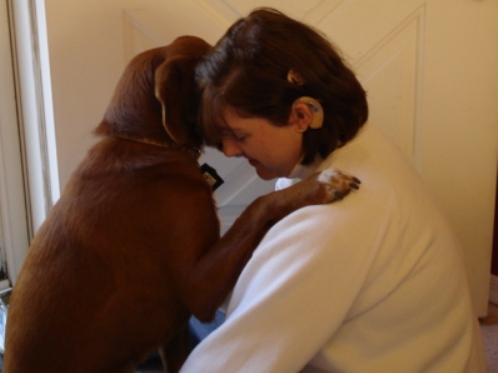
chloe hug

You’d think by now hound dog was accustomed to me bustin’ out into peals of laughter. I’ve done it often enough, after all! But I still take her by surprise sometimes!

I had a “Murphy’s Law” kind of day just recently. One of those days where if something COULD go wrong, it WOULD. Some interesting facts about Murphy’s Law and where it all began, visit this link. “Whatever can go wrong will go wrong”.

Chloe and I were walking one evening and the weather was DIVINE. Hardly any clouds, low humidity, and I had a “pep in my step”. For once, my Meniere’s disease was allowing me to walk at a pretty good clip with very little weaving. When I walk, I talk to my dog. Chloe would probably freak if I took a walk and was totally silent. It helps her pay attention to me, and I throw her name in there from time to time. However, sometimes I’m just…

Yackin’

Yup. Just talkin’ about anything and everything. It helps me to think out loud and I tend to go on and On and ON. I actually said out loud, “Wow, Chloe. Look at how easily I’m walking this evening! No wobbles! Moving along at a good rate! I’m smokin’!

Chloe gave me this LOOK. Almost as if she anticipated something going wrong after that lofty observation. Within 30 seconds (I kid you NOT), I stumbled on an ornery piece of elevated sidewalk and opened my mouth to shriek (for I do precious little QUIETLY) only to have a bee swoop in my open mouth as I began to fall into a nearby bush. So here I am choking on a bee, trying like crazy to spit it out while being impaled on various twigs and branches of a bush… a ROSE bush – wouldn’t ya know? So thorns grabbing me everywhere. Worse, it was damp earth under the bush thanks to recent rains so when I connected with the ground there was a obvious squishy sound and splat as my hip, knee and foot connected. So there I lay in the mud INSIDE a bush, choking on a bee, covered in thorns, desperately trying to hang on to my leash because Chloe was …

OUT THERE

SOMEWHERE

outside the BUSH.

I laid there a minute trying to go through my Meniere’s “play list” that automatically begins playing after I fall.

It’s a cute little jingle.

I’d share the wonderful lyrics with you so that you can sing along… but frankly I can’t carry a tune in a bucket and it’s one of those songs one whines and sings to oneself. So anyway… I run through the steps.

1. Am I dead?

2. Is anything broken?

3. Where is Chloe?

4. Can I move?

5. Do I need help?

So I was able to answer, No, No, *POINTS – somewhere outside the bush*, Barely, Yes.

I tried to turn to see if I could reach my bag. You know… the one with my cell phone in it that I carry in case of emergency? I can see it just out of reach out *there* near Chloe’s legs.

So… I asked Chloe to fetch the bag for me. She grabbed it up and ducked down to look under the bush at me. What she saw, made her drop her jaw and the bag tumbled back to the ground. Crap. Now my phone is laying outside the bag. So I tell Chloe to “fetch phone” – which is actually easier for her to do as it is something  she does several times a day. She grabs the phone, looks down under the branches again to where I lay and squirmed to reach my outstretched hand to give me the phone. Success!

Only… the phone is dead. That’s right, I carry around a phone with a dead battery on walks because it is SO helpful to do that. *rolls eyes*

So I decided that I needed to get out from under the bush. Easier said than done. I’m hung up, slightly injured, dizzy, muddy and on the verge of crying. Not a good combination. I thought, “Oh my gosh. I’m going to have to lay here until somebody walks by to help. How embarrassing! How will I explain this?” I didn’t have to lay there very long before I noticed that Chloe was now snuffling at my hung up hoodie sweatshirt.

TUG. YANK. R…I….P! Unbelievable! She tugged me free!

I rolled to one side to get out from under the bush and was wise enough to sit there a minute. Chloe plopped down and waited for me to “collect myself”. I fall SO OFTEN, if I am able to just go down without hitting my head I consider that a coup. So I checked out all my scratches and now torn clothing and thought that – heck. It could’ve been worse. It HAS been worse. So I started to laugh. Sometimes? All you can do is laugh. Chloe looked at me and just panted and “grinned”. It’s not the first time I’ve sat laughing covered in mud and trying to find the wherewithal to get up and keep going! (Likely won’t be the last time either!)

Can You Laugh at Yourself? Should You?

If you live with an invisible illness, have a disability, or a chronic condition, it can be helpful to learn to laugh at yourself. A great little article about the benefits of laughter can be found HERE.

But if you don’t believe in the power of endorphins or social connectedness, you still should learn to laugh at yourself. At least… that is my opinion. Here are some reasons I have learned to laugh at myself:

1. If I am laughing, it can reduce anxiety that others may feel when my disability pops up and causes me to do something like fall, mishear something, or other “Denise blooper”. Does it matter if someone else’s anxiety is lessened? Well… I don’t want people to feel uncomfortable around me. If I can laugh at myself, hopefully they will learn that I take who I am and my new “life parameters” in stride and am fine with it.

2. It reduces MY anxiety. Endorphins are real. It’s not some kind of borg nanotechnology that only re-routes and fixes sci-fy actresses. I FEEL BETTER after laughing.

3. If I laugh, it really helps me accept myself – just the way I am. You can’t change the unchangeable. I’m a klutz. I’m going to fall. As long as I’m in one piece and don’t have any odd bits of bone poking out anywhere, (Yeah, I know. Right?) laughing at myself helps me just accept what happened. It is MY WAY of embracing my flaws. This is who I am.

3. It helps me put things in perspective. While cackling like a hyena, I can take stock too. My little “jingle” may re-play. Some deep breaths – a mirthful hiccough or two, and I’m good as new!

4. Laughing helps me de-stress. Likely I’m laughing because I just did something that COULD cause me stress. (What if someone saw? Bet this mud will NOT come out of my jeans! Chloe tore my hoodie! I’m never walking again! As a matter of fact I’m just going to sit here on the sidewalk and feel sorry for myself! I’m going to stomp on my phone – when I finally get up. I hate my life! I want my mother… ) Laughing… de-stresses me. I can feel the tension roll off of my shoulders.

So I do believe “laughter is good medicine”. But…

There are perfectly good reasons to take the time to CRY too.

Or Scream.

… but those are best left for another writer to touch on! 😉

Denise Portis

© 2014 Personal Hearing Loss Journal


Watch Me

Chloe and Lewis

Want to get on my last nerve? Enjoy listening to me Sputter as I desperately try to spit out a response? Want to see this kitty’s claws?

this puppy’s teeth?

this chicky’s – erm – umm – BEAK?

Then tell me I can’t do something. Heck, I’m not even the “first born” in my family! The birth order norm fairy forgot to send the memo when I was born – “2 of 4”. I can be a stubborn behind. Sometimes this is very, very BAD. But sometimes? Sometimes this is very, very GOOD.

Do you know that I credit my “can do” attitude to my hound dog? The fact that I can say, “Watch me!” can be attributed to the fact that I am partnered with an assistance dog from Fidos For Freedom, Inc.

Yes. Perhaps I would have found my courage without her. I may have discovered I am resilient on my own. I may have responded to a “Hey! You can’t do that!” with the response of “Oh yeah? WATCH ME!” by simply growing and maturing. However, I can exactly pin point the moment in time when I grew self-esteem muscles.

Chloe jumped into my bubble bath with me when my phone rang. Her hearing alert was so ingrained, she was oblivious to the water and naked partner.

I was matched with Chloe in May of 2007. Shortly after that, Chloe came home to live with me and to do what she’d been trained to do. Alert me to sounds I could not hear. (Eventually she received additional training and skills to help me with my balance). I use to really enjoy bubble baths. This was before numerous concussions and worsening Meniere’s disease made the risk of drowning to real. Chloe was parked on the bath mat while I enjoyed that lazy bubble bath. I can’t tell you how startled I was to suddenly find my dog IN the bathtub with me and licking my face. My husband popped his head in the door and said, “Your phone was ring… ing. Ummm. Why is Chloe in the bathtub with you?

From that moment on, I knew I’d never miss a phone call.

… or alarm clock, or not be able to pick up something I’d dropped, or climb stairs safely, or know if someone was behind me in a store, and friends? The list goes on…

Watch Me

One of the early commands I learned was “Chloe – WATCH me“. Because I talk to my dog and would often say, “Chloe – look-it that squirrel, – or – look-it that bunny”, I learned NOT to say, “Chloe LOOK”. It would make her eagerly look around at whatever CRITTER I had seen before her! However, if I say, “WATCH me“, she looks right at me. She may cock her head and obviously listen for a command; much more than just meeting my brown eyes. However, she knows that “WATCH me” means “make eye contact – pay attention”.

Chloe actually tells me “WATCH me” as well. Chloe does it with her ears and head. When her head swings in a specific direction and her ears go up, I :  1) look at her and pin point where she is looking/listening, 2) turn to look myself. It may mean I need to step out of the way of something or someone.

Not LITERALLY

“WATCH me” doesn’t always mean literally, however. I was so cracked up at a meeting I attended recently. I was seated next to a person with low vision. We were in between speakers and were visiting while we waited for the next session to start. About 10 yards away, I noticed this man and lady plug up a power strip and run an extension cord over to their row in the auditorium. I interrupted my friend and said, “Hang on – they can’t do that! I’ll be right back. Watch me!

I stood up and walked over to the couple now fussin’ with how the cord should lay across the aisle. I put Chloe in a sit/stay and said, “Oh I’m sorry. You can’t put that cord there as there are a bunch of us in this area who cannot navigate safely with it stretched across the aisle“. They looked at me with a startled eyes and then around me to the section I was sitting in. I could tell by the dawning comprehension on their faces, that they spotted the service dogs, walkers, scooters, and canes.

Ooops. Sorry about that!” and they worked together to pick it up and roll it back into a nice handful of cords and plugs.

I casually walked back to my group and my friend said, “I saw that! Fist bump!” and she held up her fist for a “you go girl” moment.

Then it hit me. When I walked away I had told my friend with low vision, “WATCH me“. When I returned she said, “I saw that!” I started laughing. Not the kind of southern girl lady-like giggle. Oh no. I was hee-hawing. I managed to snicker out loud in between SNORTS what I had said – and what she had said. I nearly laughed myself into the floor. Yup. The kind of laugh where I had tears of mirth running down my cheeks and very unladylike hiccoughs to boot. My friend was laughing just as hard. She said, “We’re a pair, aren’t we?

You “see”, my friend? You don’t have to have 20/20 vision to be able to WATCH ME. You can pay attention with your eyes, your ears, or your hands. You can pay attention with your heart. You can pay attention – by PAYING ATTENTION.

It’s a focus.

It’s an attitude.

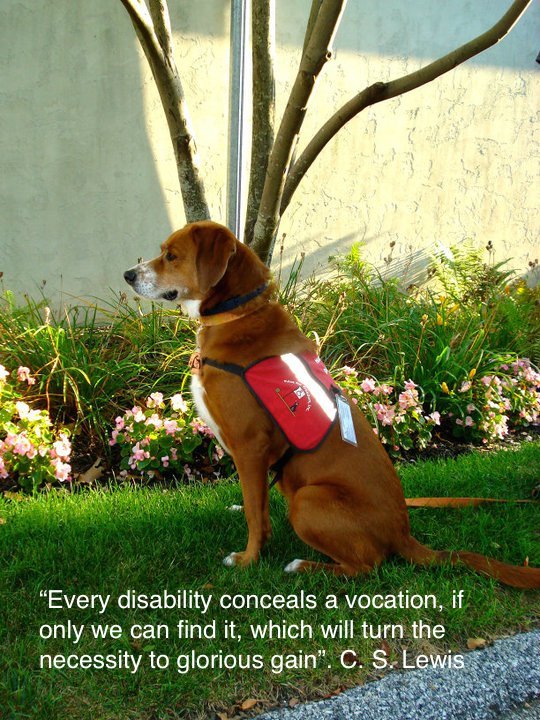
One of my favorite quotes (in the opening picture above) is by C.S. Lewis: “Every disability conceals a vocation, if only we can find it, which will turn the necessity to glorious gain”.

I recently had someone take me to task for self-identifying as a person with disABILITY. She argued that I was basically admitting I was unable to do something. I thought, “Well how wrong is THAT?”

Every person I know who lives with disability is actually someone who has learned how to do something IN SPITE OF challenges. You find a new way to do something. You learn how to do things safely even though it may not be the way a task is done by most folks. Perhaps you have assistance because of a device, service dog, or have simply learned to ask for help.

Yesterday while on campus, I needed to drop something off at the Disability Support Services office. My balance was “good” yesterday, so I exited a door that actually opened into a courtyard that had stairs bordering the perimeter. I felt confident to go up the 20 some odd stairs with Chloe. When I reached the top, an employee was standing there with big eyes, having seen me take a slow but steady climb to the top.

Hey!” I said cheerfully, and stepped around her. I looked up and was startled by a mass of people coming out of the gymnasium towards me on a very narrow sidewalk. I looked for an alternative path and spotted a way around through the mulch and picnic area.

Sensing what I was about to do, the lady beside me said, “Maybe you should wait“. I know she meant well. I felt no criticism, nor did I feel she was talking down to me. But… I was in a hurry, and I was having a good balance day. I had my service dog right beside me.

So I responded, “Oh, I’m ‘good’, no worries…” and proceeded to carefully pick my way around tree roots, pine cones, mulch and twigs. I didn’t retort, “WATCH me“, but if one could interpret the courage and attitude from my squared shoulders and confident stride, you would have “read that” in my departure.

Chloe and Fidos For Freedom were the “shot in the arm” I needed to become confident and independent. You may have found your own way to adapt. Having a disability does NOT mean you cannot do something. As a matter of fact, chances are if you tell someone who is differently-abled they cannot do something, you may discover by the set of their jaw, the determined look, and confident square of their shoulders that they most certainly CAN. Their body language screams,

WATCH me“.

Denise Portis

© 2014 Personal Hearing Loss Journal

Recurring Dreams… Life Goes On

1531649_10202502950992038_1907354485_o

One of my favorite chapters in “Introduction to Psychology” is the one where we study dreams, sleep, and the subconscious mind. Everyone dreams – though you may not always remember your dreams. If you have furry family members, you’ve learned that even pets dream. I’ve seen evidence of REM sleep in dogs, cats, hamsters, even cows!

Very likely, if you do remember a dream it is because it was a bad one. Or, you may remember it because it is a recurring dream. Interpreting dreams is tricky. Yes, yes, I know! Abraham, Jacob, Joseph, Daniel, and numerous others in the Bible made it look easy. It really is NOT that easy. If you have dreams that are bothering you, or have recurring dreams, don’t be afraid to talk about them with someone you trust. It can be a friend, counselor, or peer with a supportive role in your life. However, just remember, YOU are the expert on your dreams… they are YOUR dreams. Tartakovsky (2011) explains that there are indeed some universal symbols in dreams, however what those symbols mean to the DREAMER is what really matters. Someone else analyzing and interpreting the dream on your behalf is very likely inaccurate. In spite of knowing WE are the expert  when it comes to our dreams, recurring dreams usually end up making us “talk out loud” about what we are dreaming. Because you dream this dream OFTEN, you start thinking about it when you are awake. Most dream analysis experts agree that “recurring dreams reflect feelings and awareness that have not been successfully resolved in our waking lives” (Psychology Campus, 2004-2008, para. 4).

My Recurring Dream Had a Specific Trigger

I (like many of you) have a recurring dream and it always follows the same conscious scenario. Every time I fall and actually sustain an injury, I can guarantee I will have the same dream. I actually call it my “falling dream“.

Yes.

I do understand that by anticipating the dream, I am likely precipitating the dream itself. I get that. Now before you jump to conclusions, my dream isn’t about falling. Heck, I do enough of that in my conscious activity! I certainly don’t need it to happen in my subconscious mind – grin!

After a fall, I have a dream where I’m walking in a busy location with people everywhere, and all of sudden I’m frozen and cannot continue walking. Perhaps even more telling, my service dog, Chloe, is also frozen mid-step. Everyone around us continues to walk, talk, and move. Sometimes in the crowd I recognize people from my family, work, church, etc. Most of the time the faces are strangers, however. I can “hear” myself in the dream screaming (of course my mouth is not moving), “Help me! I can’t move! I can’t speak! Why aren’t you helping me? Can’t you see I’m frozen?”

So… yeah.  Please have fun with that and if you feel like commenting or emailing me what YOU think this probably means, go for it! I’m always interested in other’s opinions. Because the dream always follows a significant “Denise fall down – go boom” moment, I think I have this one figured out. I’ve had this same dream for over 12 years. The only thing that has changed in the dream is the addition of Chloe, my service dog. I was matched to Chloe in 2007. Goes to show the significant impact a service dog has on their person that she ended up in a recurring dream. <BIG GRIN>. Another change in the dream occasionally happens… but I’ll get to that later! <wink>

I believe this dream “for me”, means that I recognize that my “new normal” has an affect on ME, but not so much others. All the feelings, fears, bruises, even shame, is something I deal with in being differently-abled. However, it isn’t something that impacts others. Ever want to scream at the world to stop a moment and acknowledge that…

DARN IT. I’m dealing with this! Don’t you see? 

or

DARN IT. I suck at this! Don’t you see? HELP!

Life goes on. That’s hard, isn’t it? Isn’t it frustrating when you are sucker punched with a personal crisis of some kind and life just goes on as usual for everyone else? Worse? Life goes on for YOU!?

You lose someone close to you and crap. Life goes on.

You receive a diagnosis that will change your life. This sucks but life goes on.

Someone you trusted betrays you. It hurts but life goes on.

A progressive illness progresses. You adapt and life goes on.

You are sick and tired of being sick and tired. Life goes on.

Simple Acknowledgement

Most folks who live with invisible disability or a chronic illness will tell you that it is hard for them to share with others when they are struggling. This may be because they always seem to be struggling and figure everyone around them is sick and tired of hearing about it. We don’t want to be labeled as a “bellyacher”. Maybe you only rant to someone close to you. Perhaps you write. Maybe you pray. You may have some type of “release” that allows you to vent.

Sometimes my frustrations get the best of me and I bellyache out loud. However, most of the time I keep it quiet or at most confide in a trusted friend who “gets it” on a level that others cannot. I have a friend with MS who once told me, “Denise? I always feel like crap. I can’t respond to ‘How are you today?‘ with, ‘actually I feel like crap!‘. So I respond the way all of us respond, ‘I feel great, how are you today?‘. I can’t respond truthfully. People who do not have MS cannot understand what it is like to wake up tired, go to bed tired, and hurt all over each and every day. So I lie and say, ‘I’m great! How are you?‘ I don’t think this makes me a liar. This is how I convince myself I’m OK. I try to convince others I am.” 

You know? I don’t know very many people who live with significant challenges who want someone who will allow them to dump for hours each day. Griping for hours on end does not help physically, emotionally, or mentally. Most of us learn early on that perseverating on the negative only provides the ingredients for a significant meltdown. It is HUGE, however, to know we have a trusted peep or two that we can say, “Today is a bad day, but I’m going to be OK“.

Most of us simply long for a quick acknowledgment. Perhaps a short hug. I have a friend who has a seizure disorder and lives with chronic fatigue and pain whom I see about once a week. Like most folks, when we greet we say, “How are you doing?” I know this person well enough that both of us can say (on a day things aren’t going so well), “I’m not doing that great today, but things can only get better“. Or, “I’m not doing that great but I’m OK. Tomorrow will be better“. A pat on the shoulder and an understanding hug goes a long way. My friend doesn’t want me to grab her hand, drag her over to the side, and make a big production out of her “horrible, no good day”. If I say, “I’m thinking about ya“, or “How can I pray for you today?“, that is enough. You can see some of the tension roll off their shoulders. Simply acknowledging another’s pain or distress is A BIG DEAL. Salovey, Brackett, and Mayer (2004) call this empathy or emotional intelligence, and one can grow their EQ (emotional intelligence) simply by learning to acknowledge someone else’s feelings. It doesn’t have to be time-consuming. As a matter of fact, here are some great tips that will grow your EQ and help someone else:

1. Remember – and follow up.

Did someone tell you that they were having a rough day? The next time you see them ask them how they are doing NOW. By simply remembering they were going through a tough time and you care enough to follow up is HUGE.

2. Send a card.

My life has dramatically changed in that most of my correspondence is electronic. I buy one book of stamps each YEAR, when I use to buy that many stamps each month. However, I do shop for and keep inexpensive cards for “other” occasions (in other words, not birthday or anniversary), so that I can send a card off to someone who let it “slip” they are going through a tough time.

3. Follow up with a text.

It takes 10-15 seconds (depending on how many thumbs you have), to send a quick text. If you’ve limited time, don’t text an open-ended question. Just send off a quick, “Wanted you to know I’m thinking of you today and hope your day is better“. It doesn’t take much time and it likely means THE WORLD to that person.

A Significant Change in the Dream

Ok. I explained earlier that I do have one specific change that happens in my dream and over the years I think I have this figured out as well. Sometimes when I am “frozen”, a person or persons do come up to ICE CUBE Denise and Chloe, and try to help. Guess what? These are usually people I’m thinking about consciously, who are also going through something significant. For example…

I had this dream this past week after a fall on the deck. The injury was significant enough to warrant a doctor’s visit, x-rays, and a cancelled trip. I have been thinking about and praying for two specific people, both of whom showed up in my “falling dream”. One had surgery last week, the other is looking at surgery in her future. Both came and patted “frozen Denise and Chloe” and told my icy self that “everything would be OK”.

You know what? Having a support group MATTERS.

10538663_10204128535430633_9142153402343424683_n

It doesn’t mean that you need to join an organization (although there are benefits to doing so). It does not mean you need to find a group in which you stand up in a circle and say, “Hello. My name is Denise and I have invisible disabilities“. However, there is significant HELP in having a person or two who GET IT.

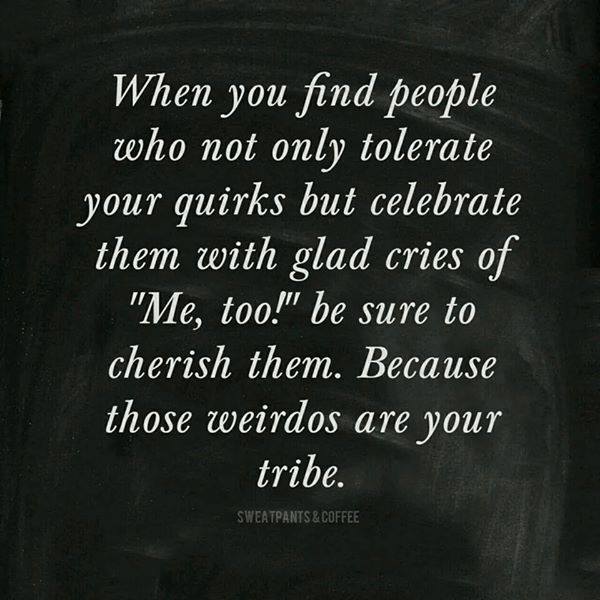
A tribe.

People who understand where you are coming from when you experience your life – your “normal”.

Thankfully, it is fairly easy to find those folks. The Internet has opened the door to really connecting with others who are like-minded, live what you live, and provide support simply because they truly GET IT. Maybe you have a friend or confidant who is that support for you, but they don’t actually share your diagnosis. But folks? Everyone has something. Life is hard. We all have difficult times. The two folks who showed up in my “falling dream” last week do not share my diagnosis. They do share living a difficult life but PERSEVERING. That’s why these folks show up in my dream. Support makes a difference.

You can be that kind of support. It will grow you. It may be time consuming at times. You may find a reciprocated “shoulder”. You may not. I don’t know about you, but at the end of my life I want to be the kind of person who patted a few ice cube people. I want to be that person who tells someone THEY matter. What they are GOING THROUGH matters. One of my dream goals is to eventually see a puddle under every person in my crowd.

Because we all deal with something.

We can help each other to thaw out by caring, listening, hugging.

Denise Portis

© 2014 Personal Hearing Loss Journal 

Psychology Campus (2004-2008). The possible meanings of dreams. Retrieved August 11, 2014 from http://www.psychologycampus.com/dream-psychology/

Salovey, P., Brackett, M. and Mayer, J. (2004). Emotional intelligence: Key readings on the Mayer and Salovey model. New York: Dude Publishing.

Tartakovsky, M. (2011). How to Analyze Your Dreams (And Why It’s Important). Psych Central. Retrieved on August 11, 2014, from http://psychcentral.com/lib/how-to-analyze-your-dreams-and-why-its-important/0005975

Turn On Date

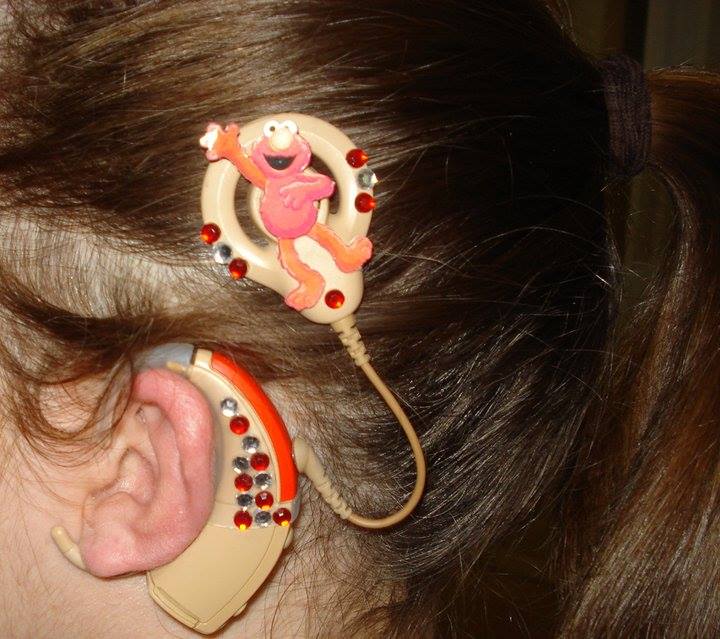
Elmo bling

One of my favorite discussions to have with people who have chronic illness, invisible or visible disabilities, or living a “new normal”, is sharing stories of how their adopted vernacular throws others they communicate with for a loop. We probably all have stories to tell. If your life is different because of a surgery, technology, or diagnosis, you may be using words and phrases that confuse and irritate folks who don’t live a similar life. I try to be careful and take a quick look around at WHO I’m talking to when having a conversation, but that is after really screwing up a lot in the early years. Here are some of my more memorable screw ups:

Your Turn On Date

Johns Hopkins sends folks my way when they are considering a cochlear implant, especially if they have Meniere’s disease as well. I have learned that when talking to someone new to the idea of cochlear implants, you cannot talk to them like someone who has already had the surgery. Cochlear implant peeps throw around terms that make perfect sense to US, but not so much to others. Case in point: I met with a lady with Meniere’s at a library who was investigating cochlear implants. At some point in the conversation I said, “Now the date you are turned on, you need to have a designated driver if possible. Everything will be so strange and you may not be able to drive safely if you don’t have someone to drive for you after you are turned on“.

Her eyes got big and she paled. She stuttered out, “Wha…wha… WHAT!?!?” I’m savvy enough to figure out by the way she answered that she didn’t understand my terminology. I thought I’d clear it up but succeeded in only making it worse…

Yes, when you go to the audiologist and they turn you on…” I stopped. Seeing her dropped jaw will silence me. I backed up and tried again, using “activation date” instead of “turn on date”. Do you know something? Unlike others who meet with me, she never followed up with post-surgery emails or meetings! <BIG GRIN>

I Lost My Ears

I had only been activated 8 months when I lost my ears. Now for CI folks, they get that when we talk about our “ears” we are talking about the external technology… not about our “listening appendages”. I was in a super Walmart, looking for a very specific jar of dill pickles (because yes… I’m that picky), when my cochlear implant – which has a magnetic coil to keep it on my head – flew off my ear and into the pickles.

Had I stayed still and searched the immediate jars I would have found it right off. As it was, being new to “hearing again”, I immediately stood up and screeched because my world had suddenly and completely gone SILENT. An older lady shopping amongst the same shelved pickles looked at me strange. I nervously picked up jars of pickles looking for my “ear”. The lady came closer and joked, “Are you pregnant?“. I turned to her with big tears in my eyes which made her come closer and immediately quit teasing me.

Are you OK?” she asked kindly. I looked at her and wailed, “I lost my ear! I can’t find it!

She looked at me bug-eyed and walked away. Quickly.

Thankfully I found my CI attached to the metal lid of some nearby olives. No wonder I couldn’t find it amongst the pickles.

I’m Not Turned On

When we lived in another part of Maryland, we use to have to drive a long way to go to church on Sunday. We actually went into another county to do so. Normally my family doesn’t listen to the car radio because they know that I’m totally incapable of tuning out the radio and hearing just the conversation. However, on longer trips, I often say, “I’m turning my ears off” so that they can listen to the radio and they know if they need me they only need to tap my shoulder. In truth, it is nice being able to sit in “total silence” from time to time. It is certainly conducive to “deep thinking”.

So one Sunday on our way to church, I gave the family heads up that I was going silent on purpose. I must have moved from “deep thinking” to day dreaming. We got to church, got our stuff out of the car, and Terry and I waved goodbye to the kids as we headed over to the building where we had small group Bible study. I’m still deaf at this point and I couldn’t tell ya if Terry was talking to me. I know my mind was somewhere else – that’s for sure! We went into the classroom and sat down at the big table. Some other couples were already there. One of the ladies leaned up so that she could see around Terry and said something. It was then I realized I still hadn’t turned my cochlear implant back on. “Oh! Wait, I’m not turned on!

I reached up and punched the correct button and looked around at a bunch of stunned faces. Terry was actually embarrassed. (If you know Terry, you know he rarely gets flustered). A few who caught on a little late began to snicker. Me? Well I thought it was just HYSTERICAL. So I managed to get out in between laughs, “Oooops. I need to find a better way to say I don’t have my CI on“. Terry quickly said, “Yes Denise. Yes you do!“. It took a number of months for me to live that one down.

Remember Your Audience

Do you live with a chronic condition or acquired disability? Have you become an expert in navigating your “new normal”? Can you “talk shop” with the rest of your population?

It’s hard to remember that just because WE understand what we mean, others may not. We tend to use words and phrases that become a part of our vocabulary. Try to pay attention to your audience. A good advocate learns to do that. You may have to deliberately choose to use a different word or phrase if no one really connects with it but you. For example, I had to stop referring to my bright purple cane as “my third leg”. I’m fairly naive and had no idea the shocked looks were from folks who had heard that phrase in a completely different context.

In order to really educate and advocate, you need to use terminology that the general public will understand. You may think a word or phrase is very obvious, but others may not ever hear that word in conversation. I was trained at Fidos For Freedom, Inc., to know how to advocate for accessibility with my service dog. The trainers didn’t tell us, however, that not everyone in the general public knows what the ADA is! (Thankfully, they also equipped us with great little brochures and handouts with the law explained on them).

Fibro fog” may only mean something to other folks with fibromyalgia. “CFS zombie” may only be a phrase others with chronic fatigue syndrome use. HoHearies can be figured out by most of the population, but is only self-identified by those who are hard of hearing. The general public may even make incorrect associations just because they don’t understand your chosen words. I had no idea anyone would ever think “tinnitus” was something caused by a cut from a dirty tin can.

You are a more effective advocate when you “consider your audience” and appropriately explain symptoms, treatment, and diagnosis. The goal is to educate after all. If you only succeed in confusing those around you, you haven’t really helped to educate.

What’s REALLY fun is when those closest to you start to confuse others as well. Terry often asks if I “have my ears on” now.

Denise Portis

© 2014 Personal Hearing Loss Journal

Folding Fitted Sheets and “Good ‘Nuff”

fitted sheet2

My newlywed daughter bragged to me recently that her husband can fold a fitted sheet. Pressing for details I found out that he evidently can fold them where they are laying flat.

… like they just came out of the package.

… making Martha Stewart proud.

I think I hate him (just kidding…)

I’ve seen various videos, blog posts, articles and pictures explaining how to fold a fitted sheet. I once saw a 5 step-by-step diagram of how to fold a fitted sheet on a beautifully laminated bookmark.

Because evidently we worry about that while reading…

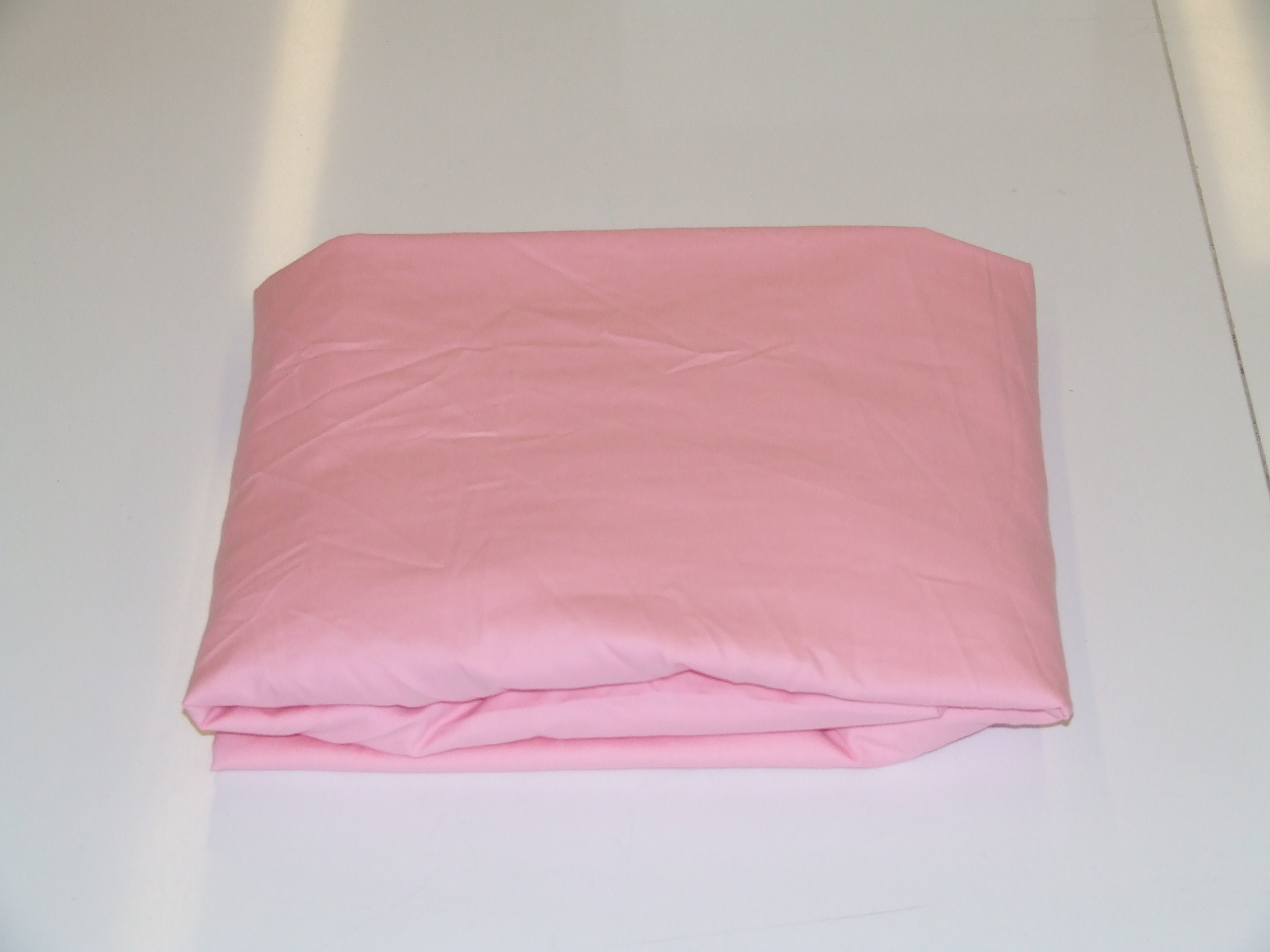
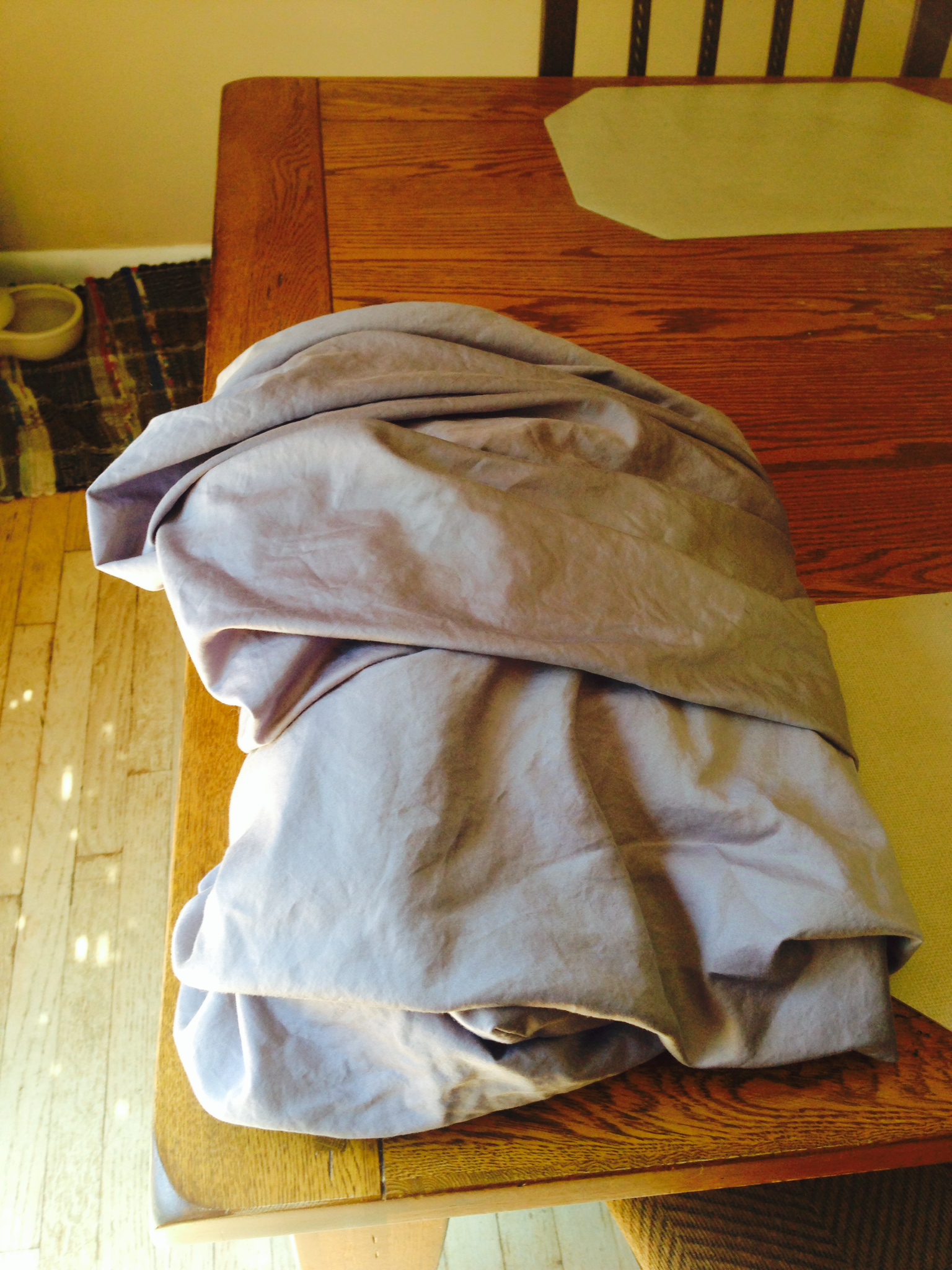
Evidently a newly laundered fitted sheet can look like this after folding...
Evidently a newly laundered fitted sheet can look like this after folding…

As a student and professor of psychology, it is fun to “look back”. Although I didn’t know it at the time, I definitely had OCD (Obsessive-Compulsive Disorder) as a kid. I’ve given some examples of things I would do to help me feel like I was coping and controlling in class before that made jaws drop. OCD can look different lived out in different people. For me, it meant ordering, organizing, labeling, etc. I had a full-size bed growing up with bright yellow “sunshiny” sheets. I’ve often wondered how that young, OCD Denise dealt with folding fitted sheets. Because you see? I can’t. 

Fold fitted sheets I mean. I must have gotten around that by only having one pair of sheets. When laundered, they went right back on the bed.

I’ve come a long way from that OCD Denise. Now some of you who know me WELL are saying to yourselves, “Honey? You’ve still got a long ways to go!”

But to give you an idea about how far I’ve come, look at the fitted sheet I folded this morning straight out of the dryer. As a matter of fact, I have my very own 5 step-by-step instruction guide:

photo-3


1. Remove from dryer and hold up high to avoid pet fur.

2. Shake to allow dryer sheets to fall to the floor.

3. While holding up high, match corner to corner.

4. Fold.

5. Admire work. It ain’t purty. But it’s GOOD ‘NUFF.

Stacked in a linen closet, it does not take up anymore space than one folded perfectly. At least… that’s what I tell myself. You see? I had to learn something. Sometimes you pat yourself on the back, murmur, “Good job!” and go on to something else. It’s “good ’nuff“. The sheets are clean, stacked neatly and await being put in use for the next time I change the sheets out.

Allowing a Fitted Sheet to Rock Your Boat

So when do you determine by reviewing your priorities, when to keep at that “fitted sheet” or when to determine it’s “good ’nuff”? Only YOU can decide.

I’m pursuing a Ph.D. in Psychology. I’m over half-way through and doing well. However, now I’ve reached the detailed statistics phase. And folks? I haven’t had statistics since the 80’s and long before the sophisticated analysis softwares were available. This past week I hit a wall. I mean that both literally and hypothetically. I have been staying up really late reviewing videos and media, reading, Reading and doing more READING, learning SPSS and writing like crazy. As a person who lives with invisible disabilities that include post-concusive syndrome, hearing loss, and Meniere’s disease, I require 8-10 hours of sleep each night just to live a “normal for me” day. I’ve not been getting that. I’m almost cross-eyed with fatigue. So this past week, falling more than usual as a result of that fatigue, I walked into my husband’s home office, showed him a new bruise from hugging a wall with ridiculous and unbridled passion, collapsed on the floor and bawled my eyes out. Do you know what my very wise husband reminded me? “You may not be understanding all of this. Just keep plugging away. By the time your dissertation is complete you will look back on this and realize you are very knowledgeable about your research and understand it well. For now you are doing ‘good enough’ and passing. You don’t need perfection at this stage“. Sometimes we have to “let go” of needing something to be perfect and accept that it is “good ’nuff”.

This past week a lady who has admired Chloe several times sat behind us in church. She leaned up and said something and honestly? I caught about 10% of what she was saying. (In case that doesn’t sink in, I was missing 90% of it <big grin>) I already had my cochlear implant on a special program to utilize the hearing loop in our auditorium. I’m one of the first people to tell folks new to hearing loss, “Don’t fake your way through a conversation“. However, it was obvious she was just saying something about Chloe again. She had a smile on her face, and I was set up to hear through the loop, not someone sitting on my “non CI” side and behind me. So I smiled and nodded my head and turned back to the front. Yup. Poor form on my part. But…

I have learned that if it is important and I responded with a smile inappropriately, someone will respond with a shocked or hurt look, confusion, etc., and I can hasten to explain I wasn’t hearing well. I didn’t see any of that on this lady’s face. She smiled, I smiled, and I determined then and there this “fitted sheet didn’t need to be folded perfectly”. For a few minutes I sat there thinking, “I have no idea what she just said!” I re-analyzed what I saw on her face, her indication of Chloe in a perfect down/stay and sleeping at my feet, a returned smile and decided, “You know? This fitted sheet (conversation) is not folded properly, but it is good ’nuff“! I brought my attention back to the service and felt OK about my decision.

This past Saturday, a fellow client from Fidos For Freedom rolled up to me in her scooter with service dog at her side. She has been with Fidos longer than I have and I consider her a friend and mentor. Another friend of mine and fellow client, Cara, is taking ASL (American Sign Language). She has been practicing her ASL with me during trainings. She is doing great (You rock, girl!). Cara noticed that I was talking to this other client who at times is hard to understand – especially when you have a hearing loss. Cara stopped behind the lady I was talking to and I know she was hesitating to see if she could interpret for me. I wanted this fitted sheet folded perfectly. I said, “I’m not catching what you are saying“. No faking nor presumptions on my part. This fitted sheet needed folded the right way because it was important to me. I love this lady and wanted to “hear” what she was saying. So she got out her little electronic board and began writing. It was what I needed to “hear” too. Cara waited long enough to see if I was “getting it” and then went on her way. I continued to communicate with this lady and left that conversation encouraged and with some great advice. I needed to hear her. I worked to hear her. She worked to communicate with me. Good ’nuff, wasn’t good enough. I needed to communicate 100% effectively with her. So… I did.

Living with invisible disabilities or chronic illness means that YOU have to decide what your priorities are and when to determine a task is “good ’nuff”. Only YOU can determine when you need to make sure something is accomplished to your satisfaction – to your personal standards. There are things you will decide to do that require work. It may mean you use up all of your reserves for the day. If you are into the “spoon theory“, you use every single one of your spoons. There are other things that happen during the day that result in the decision that, “this is good enough”. The worst thing you can do is stubbornly work at folding a fitted sheet that belongs to someone else. Worse, you allow someone else to bully you into re-folding one that you already decided was “good ’nuff”.

Are you one of those (annoying) people who can fold a fitted sheet perfectly? Well:

If-you-can-fold-a-fitted-sheet


Denise Portis

© 2014 Personal Hearing Loss Journal