B.L.I.N.G and Invisible Disabilities

B asically L iving I nvisible is N ot G ood

My 19-year-old daughter came up with the witty acronym of B.L.I.N.G. (B asically L iving I nvisible is N ot G ood). It can be tied to a variety of life lessons.

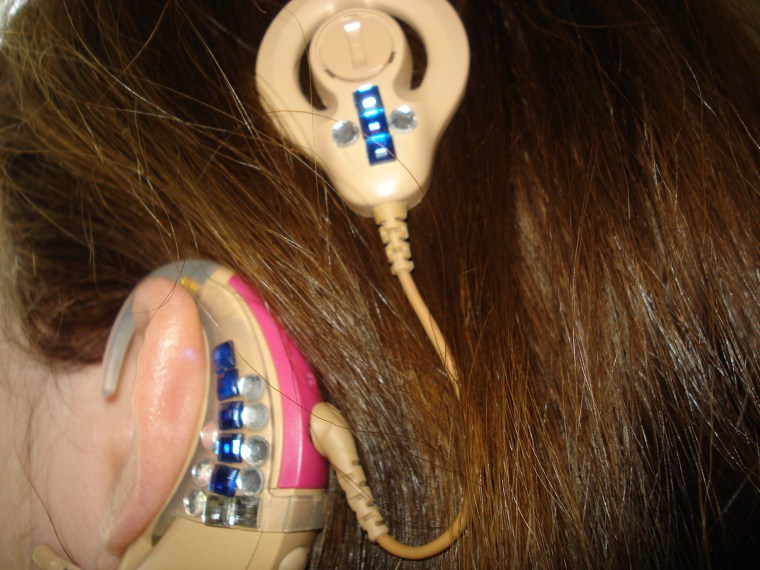
Cochlear implant “bling” and Assistance Dogs

I am a late-deafened adult and I also have Meniere’s disease. Being “late-deafened” is a fancy way of saying that I lost my hearing after I learned oral language. Hearing loss can be mild, moderate, severe or profound. Although all levels of hearing loss affect the way in which a person freely communicates, a person obviously has more serious problems the more severe their hearing loss is. I think part of the reason that HLAA (Hearing Loss Association of America), ALDA (Association of Late-Deafened Adults), and other non-profit organizations for people with hearing loss have trouble attracting new members is that for most people, hearing loss is a nuisance and not a life-changing disability.

According to NCHS (National Center for Health Statistics), there are 37 million Americans who have trouble hearing (NCHS, 2006). A study done by Gallaudet in 2001 reveals that 8 million Americans have difficulty hearing even with the use of a hearing aid (Gallaudet Research Institute, 2007). This leaves approximately 29 million Americans who communicate effectively in spite of a hearing loss. This vast majority of people with hearing loss enjoy the invisibility of their disability as they function well “in spite of”. They “look” like everyone else. They do not have a need for support groups, advocacy or a connection to a non-profit organization because they have no need to identify with the hearing loss group. (I discussed why some people choose to not seek help when they DO have a significant loss here.)

When it became obvious that my own hearing loss was progressive, I began to realize how difficult it is to have an invisible disability. Prior to my cochlear implant in 2005, you would never know I had a disability unless I opened my mouth to speak to you. My speech was beginning to deteriorate just a little bit due to the fact I had not heard my own voice in a number of years. I may have interrupted conversations, not realizing someone else was speaking. I had trouble balancing the volume of my voice and more often spoke to softly than to loudly! Meniere’s disease kindly bestows noticeable symptoms for me when it’s a rainy or overcast day. You would never know it, however, unless I tried to walk a straight line or go up or down steps!

Being surgically implanted with a cochlear implant felt a little bit like a miracle. I could hear my own voice again in most environments and my speech improved dramatically over the period of only a couple of months! Having a cochlear implant does not mean I hear perfectly, however. There are some situations with a lot of background noise or poor acoustical environments that I may have to ask for a “repeat”. I may have trouble following conversations if I’m extremely fatigued. Prior to my implant, I had already adopted bright colored ear molds for my hearing aids and wore my hair up. I found out through a great deal of “trial and error” that it was in my best interests for people to know that I have difficulty hearing. After I received a cochlear implant, I didn’t see the need to change my adopted visibility. I wear “bling” on my CI, and it does draw attention to the fact that I hear but not in a normal way. It allows people to quickly identify that they may need to be sure to face me when they talk, or be aware that if I ask for a repeat it is not because I’m not paying attention. I really believe my “bling” helps other people as much as it helps me.

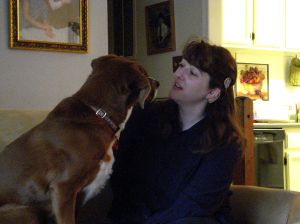
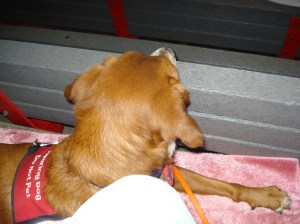
Having a hearing assistance dog who also does balance related tasks for me, brings attention to my disability as well. If you’ve ever thought about having an assistance dog, but do not like to field questions or have people notice you, then you may want to reconsider. Chloe comes from Fidos For Freedom in Laurel, Maryland. It’s not her bright red vest that gets attention. What makes people notice is simply the fact that she is a DOG! It’s not very often you see a dog in a store, restaurant or even church!

B asically L iving I nvisible is N ot G ood

Recently, God allowed a very mean person to be a part of my life for a short time. I say that GOD allowed this person, because it actually served to remind me that there are bigoted mean people who not only do not understand disabilities, but choose not to understand. Through FaceBook, I ended up “accepting a friend invite” because they were involved with someone I trusted. It didn’t take very long for this person’s true colors to be revealed. Comments left on my uploaded photos or “Notes” and eventually conversations between this person and myself and my husband through “instant messaging”, all revealed how there are still people who don’t “get it”. We received over 45 comments and messages from people astonished that there were still people like this out there! Some people do not realize that disabilities are often invisible. They do not understand that there are good reasons to make an invisible disability… visible! Some people do not understand that disabilities are not chosen. There are some that do not understand that disabilities may not only be life changing, they can be terminal. Many diseases and disabilities are those that shorten a life. God used this person in my life to remind me that some people are not only uneducated about disabilities, but they may willfully choose to believe the worst about those who have them. (It’s a great relief to not have to put up with this person anymore, but I do thank God that it was used to open my eyes!)

For me… basically living invisible is not good. There may be other people with Meniere’s disease or deafness who choose to live another way. I respect that! “Bling” works for me. It reminds even those I know well that in spite of my speaking perfect English (with the exception of a southern accent), I do not hear normally. It reminds them that if I repeat part of what I heard and wait for a repeat of what I didn’t… that it isn’t because I chose to stop paying attention. If I say, “whoa” under my breath and touch the wall in order to snap my visual field back into focus, they are reminded why I have a dog who picks up things for me and “braces”.

“Bling” and an assistance dog both serve to allow me to live with some independence. I don’t have to have family members with me now just to go to the post office or a store.

Invisible Awareness Week   0e1c199b505195ca9883a3faad5994b4
There are others who know what it is like to have an invisible illness or disability. September 14-20 is “Invisible Awareness Week“. If you or someone you know have an invisible illness, I encourage you to check out this site!

If you do not have an invisible disability, chances are you know someone who does. Do you know some of the strongest advocates for people with disabilities are those who do not have one? Think about it… who will get further with a person who misunderstands the needs, reactions, or communications from a person with an invisible illness or disability? Certainly people who live with invisible illnesses or disabilities should learn to advocate in a positive way. Their ability to do so helps us all! However, if you take a person aside and teach them… explain to them a little bit about another person’s disability or illness, it may mean even more! Every person can be a strong advocate for others.

Denise Portis

© 2009 Hearing Loss Journal
Falling on STEP 2

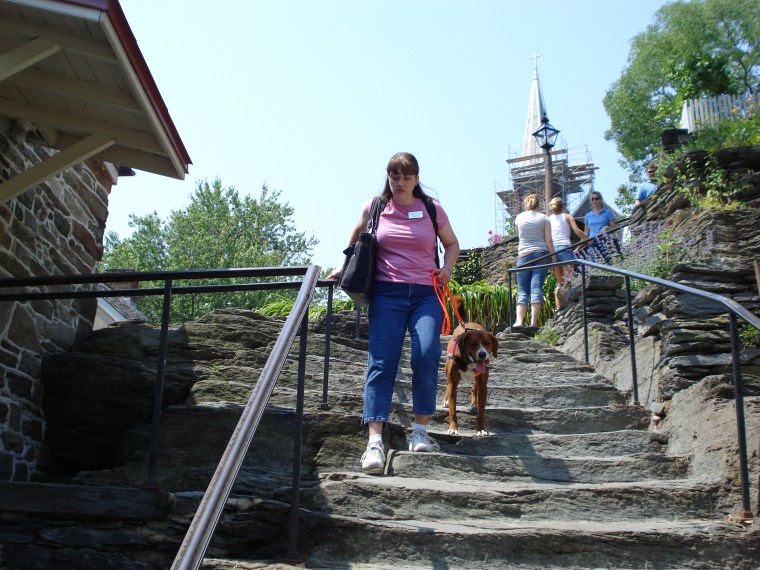
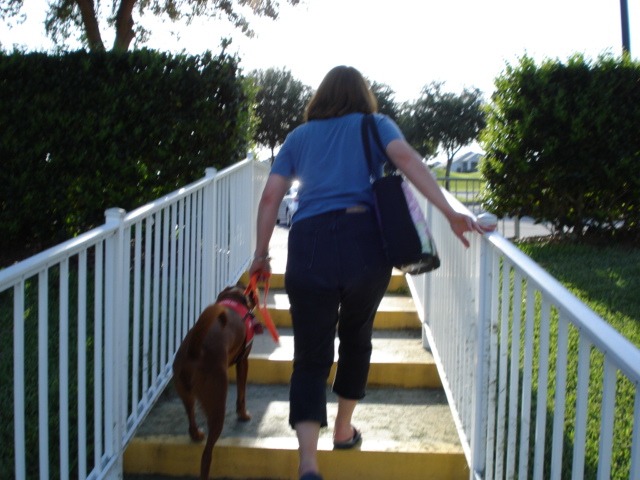
Chloe on stairs in Leesburg, Florida

Not All Stairs Are Created Equal

Sunday, my kids were scheduled to help clean up after the service. In an effort to save time, Kyersten handed us her library books that she had planned to return through the book drop. C. Burr Artz Library is only about 1 block from where our church currently meets. Books are often returned on Sunday since we are in the right vicinity. As it was Father’s Day, I was anxious to “shave off minutes” where I could and so agreed to drop them off for her. We were in separate cars, and the plan was that Terry and I would drop off the books and then reserve a table at Outback. Outback normally opens at 4 PM, but on Father’s Day they were opening earlier – a fact Terry was very excited about since the choice was his given the special day. Terry and I left the kids cleaning up the foyer and coffee corner, and hurried to stop by the library before proceeding to Outback.

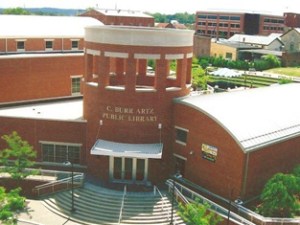
C. Burr Artz Library in downtown Frederick

It may be difficult to see from this aerial shot of the library, but the book drop is to the left as you face the main doors. There is a set of stairs you cannot see, and a handicap accessible ramp leading right up to the book drop. Terry pulled into the circular drive in front of the library and the plan was for me to hop out, drop the books in, and hop back into the van. Sounds deceptively simple, correct?

I hopped out after telling Chloe “quiet” and “stay”. She tends to have a cow when I leave the vehicle without her. It rarely happens and only when someone else is in the car. Even so, she behaves as if I’ve left her in a foreign country! In order to keep Terry from having to listen to her belly-ache, I had high hopes my “quiet” would keep her calm for the several minutes it would take to drop the books into the slot. After all, she would be able to see me the whole time, and I would be no more than ten feet away.

There were only 4 big books, and easy to carry under my left arm. I approached the stairs and considered my options. Funny how having a balance disorder forces you to look at something as simple as a short staircase in a new light. The day was sunny and I am less apt to be dizzy on clear days. I was momentarily distracted by the appearance of a young man I go to church with as it seems he walked to the book drop and beat us there! He made a comment about that fact, and I grinned and waved goodbye.

My world tends to rotate counterclockwise. This is actually a huge boon in my humble opinion, as most people walk to the right on sidewalks, stairwells, etc. This means my strongest side… my right side… is closest to the handrail and “checks” my skewed impression of things moving towards the left. I confidently stepped up to the staircase.

Decisions to Make on Step 2

Within one step I found myself sprawled out in the stairwell. I grimaced and pulled myself back up and took inventory of the various scrapes, abrasions and new bruises. I felt an immense relief that I fell on STEP 2! At least I fell “forward” instead of “backwards” and didn’t have very far to fall. If I had been on step 5, it may have been worse as the fall would have been farther. If you fall IN the staircase, your fall is cut short by the slant of the stairs. (Are you grinning? Hey these things matter, believe me!)

“OUCH”, I muttered.

Now as falling is as much a part of my day as breathing, I really do not tend to sit around contemplating the fact that I’ve just fallen… again. I could hear Chloe “losing it” in the idling van behind me. A dog’s bark comes in loud and clear with a cochlear implant. I gathered up the strewn books, made it up the final stairs and dropped them into the book drop. Every time I use the book drop, I’m reminded of the time my son told me that it “talked to you” when you fed it books. I believed this for a number of years until he overheard me talking about our book drop one day and figured he’d better set me straight that he had been pulling my leg. Ornery little booger… anyway, I digress:

I returned to the van, hopped in and buckled up. Before I could say anything, Terry said,

“Good night, Chloe was NOT quiet while you did that. She cried the whole time!”

I sat there contemplating that comment a moment, perhaps hoping he’d notice my bloody knuckles and disheveled appearance. I’m not a patient person and so blurted out,

“Well gee it could be because I dropped out of sight when I fell on the stairs!”

I can only imagine what poor Chloe saw from her perspective inside the van. Wisely, Terry cluck-clucked like a good little mother hen and was appropriately conciliatory about my new “fall down and go boom” scratches.

Stairs are not all the same. A new discovery for me has been the realization that the width of the stairwell, angle of the slope, width of the stair itself, and whether or not the stairwell is “open” or “closed”  has an effect on perception when you have a balance disorder. You can learn the “feel” of a familiar stairwell; for example, I traverse the stairs at home at a pretty good pace and rarely fall even on a rainy day. (I might clarify that I rarely fall on the STAIRS at home… grin!). When I come to a “new” staircase, it is wise to take some time and check out the “lay of the land” so to speak!

We made it to Outback and reserved a table for four. Chloe went under the table and rested her head on my foot. She draped a heavy paw over my opposite foot… yeah I got the impression she wasn’t going to let me get very far without her again!

The Decision is Ours

Sometimes I wish life’s decisions were just made FOR me so that I could get on with living life. However, we all know that making decisions is part of a growing process. I don’t for a moment believe that God forces decisions on us. His word makes it pretty clear that we have a free will. We make the decisions even though He has the power and wisdom to make them for us. God is not a dictator, and much like a loving parent He allows us to make choices that may ultimately cause us pain. Even when it is clear we have made a “poor choice”, we still are able to learn from our mistakes.

I believe we can ask God for wisdom when we make decisions, and that it is wise to seek the counsel of others. In the end, we are left with a choice. Some decisions my family and friends have been faced with in recent days include:

“Do I take this job opportunity, or wait for something better?”

“Do I apply to this college, or another even if it is farther away?”

“What will I major in?”

“Do I buy this used car and clean out my savings account?”

“Do we remove my brother from life support?”

“The company is closing… should I work until the doors close or immediately start to seek a new position?”

“Do I go for a consultation for a bilateral cochlear implant?”

Granted, many of our decisions are not life-altering. I inwardly shake my head in exasperation when I hear people piously declare that they need to “think and pray about” whether or not to make a simple decision. I believe God gave us discernment to make decisions on whether or not to buy Kraft or the ingredients for homemade mac & cheese. Do we take the long way to Walmart or the short-cut and risk heavy traffic? I have heard people who have the time, means and talent try to determine if God wants them to serve in some capacity or another. For goodness sake… just serve! We can’t all be ushers, greeters, or nursery workers, but every individual can be “used” in some fashion. Don’t dare to call something God gives you to do “small” or “unimportant”.

I have made decisions about important things before only to discover rather quickly I have made a mistake. When I make a decision, I try to keep my head up and eyes focused for further direction and confirmation. By staying in a state of awareness, I can more quickly discern if I’m on the right path. If I’m not, I should come to that conclusion fairly quickly. Instead of being bummed about having wasted time, I make necessary adjustments and continue with a new plan of action. I feel an immense relief that I fell on STEP 2!

What is far more difficult is when you discover a mistake after a greater period of time has gone by… perhaps even years! You may feel incredibly “bummed” that you wasted so much time on the wrong path. Perhaps the wrong decision has you bearing new consequences even after adjusting and finding the right path. It’s hard to fall on STEP 5. Taking a fall late in the game, is still a fall “forward”. We can learn from our mistakes. Experience can be a great teacher.

As a parent of an 18 and 19-year-old, I offer advice WHEN ASKED but then allow my children to make decisions on their own. I think we should ask God for advice, for discernment, and for clarity. After I make a decision, my Heavenly Father sits back and watches far more attentively than a hound dog in an idling van. He may “bark” a warning, or alert others that care for me that I am in trouble. He may see me make adjustments and then fine tune my own decision so that I can continue on life’s path. May we all learn to make decisions with more confidence!

Denise Portis

© 2009 Hearing Loss Journal
A Strong Bond

Tethered together helps to create that bond...

You Want Me to WHAT?

When I first started working with Chloe over two years ago, one of the first things my trainer told me was, “Chloe is to remain tethered to you at all times. Where you go, she goes… for 30 days”.  She was to be at the end of my leash and if I needed my hands free, she had to be tethered to me. No one could pet her, feed her or interact with her but me for 30 days. (It almost killed my family!)

If I did laundry, Chloe did laundry. If I fixed supper, Chloe (on a longer leash and out of harm’s way from the stove) fixed supper. If I went to the bathroom, Chloe came to the bathroom in a stand/stay. (You don’t want a service dog laying or sitting on public bathroom floors – EWWW!). Needless to say, it was probably harder on me than it was her. She was trained to be with someone 24/7. I had to learn to be responsible for this canine at the end of a four foot leash.

It’s amazing how someone could overlook a dog the size of Chloe, but it does happen. People look over her head and come close to tromping on her at times. A friend of mine is training her Great Dane pup as a service dog. I would like to think that Kenai could not be overlooked even in a down/stay!

Now Over Two Years Later

Chloe is rarely out of sight. At home she doesn’t wear her vest, but I still rely on her “working”… her hearing alerts throughout the day. On a day like today (pouring down rain), I need her to retrieve things when I drop them too. I am almost to the point of believing Chloe actually knows to stay a little closer on a rainy day. You wouldn’t think a dog would pick up on that but you never know!

If Chloe loses track of me, for example a squirrel caught her attention outside so she stands to stare while I head downstairs to get a load of laundry in the dryer, she races to find me as soon as she realizes I’m gone. If a gate is up, or door closed she’ll howl her anxiety of the fact. It’s created a rather unique bond between she and I. Honestly, on the days she is in her crate and not at the end of a leash has me feeling like I’ve left my right foot at home by mistake. There are infrequent times that Chloe isn’t feeling well and if I find I have to leave home, she remains in her crate. There have been a few times that she had to stay at home when we were going someplace she could not go safely. (For example, a zoo!) When we are reunited, you would think it had been a month since she saw me last and not a couple of hours! The bond we share serves its purpose, for a service dog and partner should have a close bond in order to establish a healthy working relationship.

It wouldn’t work with people!

Perish the thought should a person have to be leashed to another person for a “30 day bonding period”! I’ve been married for 23 wonderful years to the same man. I wouldn’t dream of attaching myself to him and staying in his vicinity indefintely. We’d strangle each other! (grin) Dogs who have been trained to assist a partner in some fashion do not seem to mind the constant companionship. They thrive in this atmosphere. Perhaps this is why dogs make such terrific service animals… they love to be with their partners.

Two great organizations that you can find more information about assistance/service dogs are:

Assistance Dogs International: Click here

International Association of Assistance Dog Partners: Click here

What the ADA says about service dogs: Click here

Denise Portis

© 2009 Hearing Loss Journal
If I’m Part of a Majority, Then What is Our Identity?

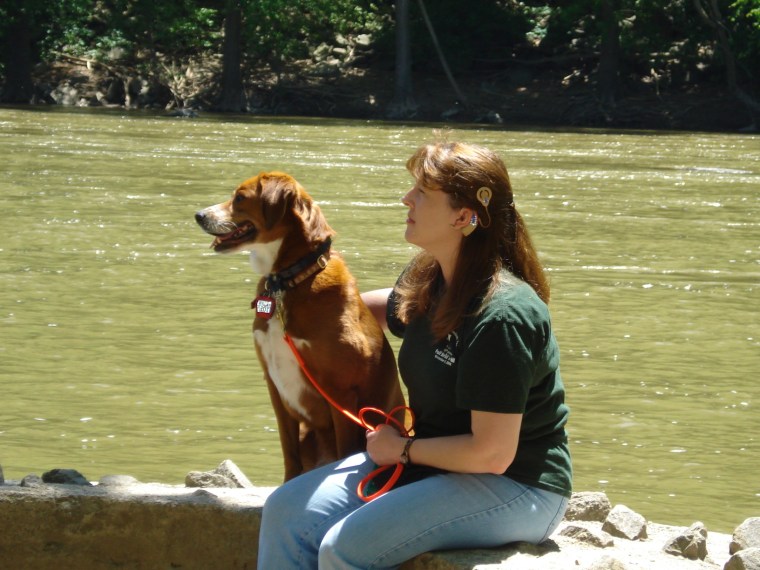
Denise and Chloe sit next to the Potomac at Harper's Ferry, WV

According to data provided by the National Center for Health Statistics (NCHS, 2006)), 37 million adults in the United States have a hearing loss. This is approximately 14.9% (2007) of persons over the age of 18 living in the United States. Gallaudet Research Institute (2007) states that anywhere from 2 to 4 adults out of every 1000, is “functionally deaf”, but of that number more than half became deaf after the age of 18-years-old. (NOTE: this would be after the acquisition of oral language). As many as 22 out of every 1000 adults in the U.S. consider that they have a “severe hearing impairment”. (Their hearing loss affects their lives and impacts the way that they communicate).

Who am I?

I began losing my hearing when I started having children. At the age of 25-years-old when my daughter was born, I have a very vague and fuzzy memory of thinking I may have a cold as speech sounded muffled to me. At the age of 27-years-old, my son had come along as well and at that point my husband and I both knew that something was up with my hearing. I went to an audiologist and was diagnosed with a moderate hearing loss… “did I want to buy a hearing aid for my ‘worse’ ear?”

Although I am deaf (with a small “d” as opposed to the capital “D” for culturally Deaf folks), I don’t consider myself deaf. I don’t think it’s a matter of denial either. I speak with my voice, and use a cochlear implant and hearing aid to maximize what I hear. For me… this is “normal hearing”. My “new normal”. I’m comfortable and happy with what I hear.

I know sign language, but it is highly unusual that I do. I learned ASL in college because I had two friends in my dorm who were culturally Deaf. I’ve been learning sign and taking classes ever since. I don’t use sign language with other hard-of-hearing people because the vast majority of them do not use sign language. Think about it for a moment. If like most people who lose their hearing, you do so after having learned oral language… won’t you try to continue to communicate in a way that more closely resembles the way that you did before your hearing loss? On top of trying to live with a newly acquired disability, would you want to learn a new language including it’s syntax and grammar, only to accomplish being able to sign to other people who happen to know sign? Doesn’t make sense does it? That is why the vast majority of people who lose their hearing turn to technology, surgery and/or reading lips.

Is ASL a bad thing if you are an oral deaf adult?

I’ve been to numerous hearing loss conventions where the attendance was anywhere from 500-800 hard-of-hearing people. These conventions often hire interpreters for the twenty or so people who use ASL as their primary means of communication. CART (Communication Access Real-time Translation using a court reporter) is also usually being paid for and the many workshops and sessions are also looped or have infra-red technology so that people with t-coils on their hearing aids and cochlear implants can hear more clearly. The small nucleus of folks who use primarily ASL tend to “hang out” together at these conventions. I have seen some very strong bonds and friendships develop. However, they are also isolated at times because they cannot speak to the hard-of-hearing majority who do not use sign. Sure! You can write notes, but I’ve rarely seen the effort made.

So should a HoH (hard-of-hearing) person learn ASL? My personal opinion is that learning a little bit of ASL is a good tool to use at home when you happen to have your hearing aids or cochlear implant out… or should your batteries die. Actually, HoH folks tend to learn Pidgin sign language, or exact signed English. They tend to sign exactly as they would speak in English (which isn’t ASL). I’ve been trying to talk my HLAA (Hearing Loss Association of America) chapter into doing one meeting on “often used phrases in ASL”. I believe knowing these phrases at home will facilitate communication in the situations I mentioned above. It can also be fun to learn a “hand full” of sign. However, most HoH people do not try to use sign language outside the home when they are at work, church or in public. They normally read lips, try to set up ideal listening environments, use technologies available, and often have hearing aids and/or cochlear implants.

I get a little aggravated when I make a doctor’s appointment and they offer to set up “Deaf Talk” for me since my chart is flagged with “deaf”. First of all, I’m on the PHONE making an appointment with them! I explain that I use a cochlear implant to communicate and that I speak English and prefer oral language. I suppose my preference is unusual in that I actually teach ASL as an alternative foreign language part-time. However, I do not associate myself with the Deaf (note the capital D) as I use my voice to talk in public. When I had jury duty this last year, the Frederick County court system had a CART reporter for me to use during that time. It was a very positive experience for both Chloe and I, as the courthouse doesn’t get a lot of service dogs either.

Having a CI and meeting a Deaf person

For lack of a better way to explain it, I have been “mistreated” far more often by the culturally Deaf than I ever have been by people with normal hearing. I’m not sure if it is distinctive to our area of the country, or if the attitude is nationwide now. However, it seems the culturally Deaf as a whole tend to feel pretty threatened by cochlear implants. I suppose I make it worse in that I wear “bling” on my CI, and my hearing aid has a bright red ear mold. I wear my hair up in part, because I really am NOT ashamed of my disability, but also because it helps me in the long run should I miss something someone says. They can immediately see that I “hear differently”. Many culturally Deaf are afraid that if those born deaf are implanted between the ages of 10 months and 2 years (indicative of the current trend) that their very culture is being threatened. Nine out of every 10 infants identified with hearing loss are born to hearing parents. These parents are often choosing the safe, non-invasive surgery of a cochlear implant to give their child the best opportunity at oral language. I don’t believe ASL is in any danger of becoming extinct, however,  because there will always be Deaf children born to Deaf parents who chose ASL. The Deaf have worked long and hard for equal access and equal rights and have a rich history and long-term success at being identified as a culture.

I have been stopped in stores and handed notes by the Deaf asking why I would choose a cochlear implant. “What is wrong with Deaf?” I put the notes down and sign to them (making their eyes pop open wide), and explain that I was born with normal hearing and that my choice allowed me to continue to participate in the same way that I was born. Some get angry and stomp away, and some try to argue. Only one or two have ever said that I had a right to my choice and that they respect that. The vast majority of encounters were not “pretty”. Most encounters involve the middle finger! (from them… not me!) I’ll never forget waiting for my daughter at Pet Smart, and a Deaf couple stopped and pointed to me and began signing to their son (who was hearing I believe) that “sad, not right. people embrace ‘who they are’, God finish create – appreciate, accept”. I signed to the parents and little boy, that the only “shame” was when people could not make individual choices that they feel is in their own best interests and that choice be respected by others. (At least they had the grace to turn red).

Don’t get me wrong. I love ASL, and use it far more than many HoH people do. However ASL is not my native language. It is not the language of the group of Americans with hearing loss that I have chosen to identify myself with since losing my hearing.

Why are the oral deaf not as visible as the culturally Deaf?

The culturally Deaf have learned to stand up for their rights and have learned to be proud of who they are and accept it without reservation. The HoH crowd, however, tend to buy the hearing aid, and then refuse to even acknowledge they have a hearing loss. They often try to keep it hidden and rarely admit to someone that they may be struggling to hear in a poor listening environment. They may rarely disclose that they have a hearing loss at work, church, etc. They often do not identify with even having a disability. Why is this I wonder? HLAA and AGBell are wonderful organizations for those with hearing loss. Yet, the vast majority of members are those whose hearing loss has become so poor, that it has really begun to affect their lives. In desperation they reach out for the support and information that they need. I often wonder why those who have a mild to moderate loss never seek out organizations like this? I suppose it is because they “get by” just fine. If their hearing loss is not progressive, they choose to live life without the added help and membership of organizations like this. I cannot cast stones, for I did not seek out help until my hearing loss had reached the point that I needed help.

I was pleasantly surprised a couple of weeks ago, to attend an open-captioned Star Trek movie at our local theater. The room was packed, and I only saw a handful of people signing. I saw plenty of hearing aids and cochlear implants. I think it is so important to support showings of feature films with open-captioning. I always thank the theater manager in person or via email. Many in attendance were the hearing spouses, family or friends. My children have grown up with closed captioning, and actually have trouble watching television without it. I never have to twist arms to get my hearing family to attend an open-captioned movie. When you’ve distinct Russian accents and alien tongues in a movie like Star Trek, you can bet that those with normal hearing got more out of the movie thanks to open-captioning!

Many of the organizations who serve those who have a hearing loss and are oral are in financial difficulty. They’ve been that way for over a decade and with the current economy they aren’t due for a major influx of cash or membership. They often have difficulty obtaining grants. My personal opinion is that they should do a major overhaul in the way they reach out to those with hearing loss. They need to change the way they try to raise an interest in order to gain membership. The majority of people with hearing loss do not have a significant loss. These organizations certainly shouldn’t turn their backs on those with significant hearing loss, but new programs and ideas should center around how to raise awareness among those with a mild to moderate loss. Things like the hearing aid tax credit are a step in the right direction as everyone will appreciate some financial help for the expense of hearing aids. The only problem with this tax credit, is that it will be years before it is available to all age groups regardless of their health coverage. I believe more effort should be in providing information to this largely untapped group. What can be done to provide helpful information to this group? What programs can be developed to help them at work, church, and in public? I think if the struggling non-profits who are membership based reach out to this group, it will help to raise awareness. How could it not? The majority of those with hearing loss (those who are oral), will be finally identified as a cohesive group of individuals striving for equal access, and recognition. How do you help a group of people who want to remain invisible, to see the value in becoming a visible and active group? I don’t know the answers to these questions.

I sign when I misunderstand

Although I identify with the oral hearing loss community, I have something rather humorous to share. If I am trying to communicate with someone who has a heavy foreign accent, or with someone in a very poor listening environment (like a mall or restaurant), I tend to sign while I’m talking. It really tickles my kids, for I have tried to communicate with someone who only speaks Spanish and found that I started to sign and voice when I discovered I couldn’t understand them. My daughter has told me that she can tell it is totally unconscious, that she can see me just naturally start to sign when I cannot hear well or understand someone’s speech. My family has actually learned to step up to help when they see me signing as they know that I read their lips and “hear their voices” better. They know if I start signing, that I’m not hearing very well. Sometimes I sign when I’m really tired… fatigue causes me to not hear as well. I asked my husband (who has devoted six years of his life to the hearing loss community in the past) why he thinks it is that I sign when I’m not hearing well. He’s a psychologist and likes to be asked “what do you think?” He believes that it is not that I am switching identities or loyalties by starting to sign in a “pinch”. He thinks it’s a subconsious decision and acknowledgement that I’m not hearing well. He said that other HoH people who don’t hear well stop and say “huh?” or “fake it”. He said that because I know ASL, I start to sign. He’s stepped up to wide-eyed friends with normal hearing and simply said, “perhaps you should find a quieter place to talk… Denise is having trouble. See? She’s signing!”

I do wish the oral hearing loss community could erase the stigma associated with hearing loss. Would it be that we could develop a positive internal locus of control and believe that we are valuable and viable adults in spite of hearing loss. I wish… I wish we could REALLY find our voice.

Denise Portis

© 2009 Hearing Loss Journal
Rain, Little Debbies, Saving a Turtle and Home & School Connection

Rain. Sigh... what's a dog to do?

Rain

The farm girl from rural Colorado would never complain about the rain. I don’t mind days like today as it saved me from having to water my flowers, and sweep the deck. I do get a bit whiney when it rains day after day, for I’m usually crawling around the house by Day 3. As it is suppose to be sunny this weekend, I find I’m in a good enough mood to write about the rain in a positive way! I “met” another person with Meniere‘s online through our blogs about 2 weeks ago who fears weather systems as much as I do. It seems very little is “the same” about symptoms of Meniere’s.

What to do with a dog when you can’t go outside and chuck balls for them to chase? Our poor Elkhound, Tyco, really looks forward to his daily scrambles after the ball. He and Chloe have been looking forlornly out at the deck.

Little Debbies

I had to make a quick run to the grocery store this morning to tide us over until my bigger grocery shopping trip on Monday. You know how you need one more trip to get the things you forgot? And I shop with a LIST! How does that happen?

A member of my family is going on a picnic Saturday, so I had written down Little Debbies. My dad worked at the factory in Chatanooga that made the creme that goes in the oatmeal cakes when he was in college! How is that for a random tidbit of Intel? Anywho… I bent down to grab the box, and had a major head rush. Everything went black for a second, so I did what any person with Meniere’s would do… I dropped everything and sat. Chloe sat next to me in the aisle and we both looked at that box. She was wagging her tail, I think in part because she knew I was going to need her help. She is always so eager to help out, it is almost comical! I used the cart to stand, and then pointed to the box and said,

“Chloe… fetch box”. She checked to make sure that I was pointing to the box, and went to retrieve it. Little Debbie boxes are kind of heavy (all that CREME ya know?) and the cardboard is cheap so it gives… it isn’t stiff. It took her a couple of tries, but she finally got it up off the ground and into my hand. Her tail wag indicated she knew she had really accomplished something. When I got home, I tried to take a picture of her retrieving the box, but Tyco got in the way. Oh well… you get the idea…

Chloe retrieves the Little Debbies

Saving a Turtle

I’ve always called Chris, “Eagle Eyes”, because he has always had a knack for spotting things the rest of us seem to overlook. Last night he went out to the front to bring the trashcan back around back. He saw some birds swooping down on something in the grass. He went to investigate and found this turtle. He was covered in thick mud and hightailed it across the cul-de-sac. Have you ever seen a turtle “high tailing it”? Me either! This one could MOVE. Anyway, we carried it two blocks south of us to the creek and set it free. Thank goodness for Chris’s “Eagle Eyes”, for this guy looked in bad shape as he was so far from water!  DSC02869

Home & School Connection

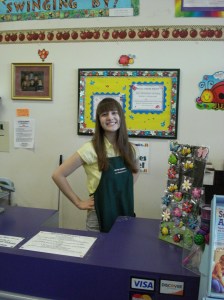
Kyersten has worked at the Home & School Connection for three years. She looks so cute in her little apron! She doesn’t really like to be called “cute” at 19-years-old though. At least… not by her mother. It’s a very cool store. There is one in Hagerstown as well. If you’ve never been, you’ll have to drop by… and at the very least bug Kyersten! They sell some pretty cool things. I almost bought a praying mantis set. They send you some praying mantis eggs and everything! I decided against it when I saw what they ate. How in the heck do you catch aphids for a praying mantis?

Kyersten looking cute in her apron


Denise Portis

© 2009 Hearing Loss Journal

To Boldly Go Where No Dog Has Gone Before…

startrekcrewbanner

I finished my research paper an entire day early, so the family and I headed for the movie theatre on Mother’s Day. Hubby and I have always been Star Trek fans, although the past couple of movies almost had me hangin’ my “fan hat” up for good!

Bottom line?   TWO THUMBS UP

What a great movie! There was a great deal of scifi action, and some pretty funny moments as well! Word of caution to those with hearing loss… wait for it to come out on open caption if you’ve any hope of understanding 17-year-old Chekov. Our own local theater has open captioned films, so I’m keeping my eyes peeled for when it might include Star Trek.

There’s a Dog in Here

Chloe is quite accustomed to going to the movies. I go about once a month, although sometimes it stretches to two months if there isn’t anything decent showing. Occasionally, I’ll hear someone say, “there’s a dog in here!” Many times a parent will take the opportunity to discuss “helper dogs” to a child, and occasionally people ask to pet Chloe. I always say “sorry, but no… catch me outside and I’ll take her vest off and you can pet her”. No one ever “catches me” outside. The hardest part about taking her to the movies is actually my own fear, not hers. When you have balance problems, it is very difficult to go –

Up stairs

in the dark

with “runway lights”

in a cavernous room.

Chloe is use to my shuffle step going up and down steps. She patiently plods along and adjusts her proximity to whether or not she feels me wobbling. I suppose I get a little aggravated when someone seated along the aisle tries to get her attention. Perhaps I shouldn’t blame folks because Chloe is beautiful and friendly and it’s hard to ignore her. But if the person on the other end of the leash has a death grip on the handrail, a worried husband with his hand on her back, and a 6′ 3″ son clearing the path in front, would YOU bother the assistance dog? Her vest says, “Do not Pet”, and in case people miss the meaning, she also wears a large tag on the side that says “Do not Distract”. Actually, I’ve learned a great tip.

When Chloe is being distracted by someone who just doesn’t know better, I carry on a dialogue with Chloe. I usually say something like, “Oh Chloe, please stay close! I’m really dizzy and if I fall, I’ll break my neck!” I say all of this in a really pleasant voice, and Chloe just wags her tail and continues up the stairs. Well “normally” whatever hand was trying to call her over to be petted, drops as fast as their jaw does. Most people get the fact they could be the cause of a “fall down and go BOOM“. Chloe doesn’t care at all that I’m fussin’, because I’m doing so in a pleasant voice. If she doesn’t hear a word she recognizes, she thinks I’m just babbling along to her like I usually do.(Yeah… I babble – sue me!)

I then put down her blanket and she is usually out for the duration of the movie. I try very hard not to drop popcorn on her head, as this will very likely cause her to stir. She rarely moves around during a movie, so I was surprised when she sat up to look at the screen at one point. The young Kirk was being chased by some kind of growling snow beast. She had to check out if it was a dog I guess. The theater was really crowded. Right as the movie was starting a lady came over and said, “is that seat taken?” It was dark and the movie was already loud. She couldn’t see Chloe at my feet.

I said loudly, “SERVICE DOG”.

She said, “Oh! It’s broken?” and went to find another vacant seat. I think even folks with normal hearing have trouble hearing in the dark with a lot of background noise.

Hey? Have you ever seen a dog on Star Trek? (Scratchin’ my head and ponderin’ on it…) I saw a cat once that belonged to Data. Went by the name of “Spot”. I don’t think I’ve ever seen a dog, however! Not even when the crew was hangin’ out on Earth. Are dogs extinct in the future? Perish the thought!

(yeah… the southern comes out once in awhile)

live long

Denise Portis

© 2009 Hearing Loss Journal

Demo at AACC

aacc-demo-010

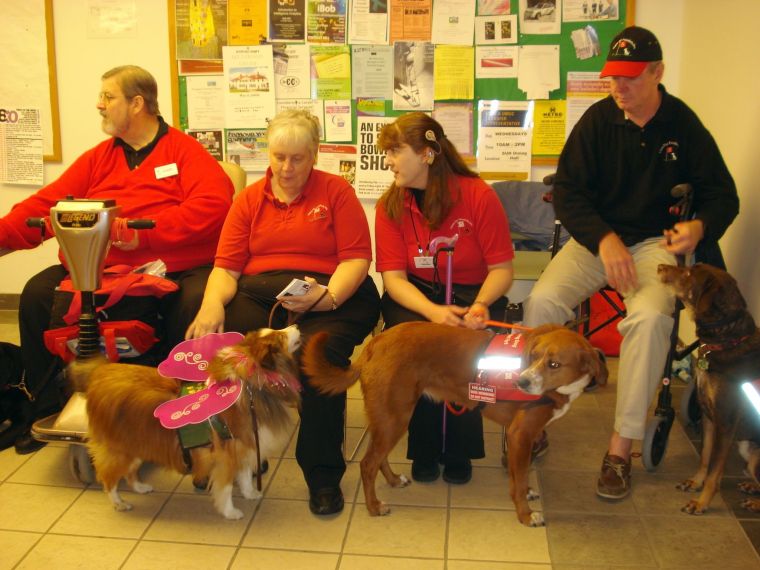
Chloe and I had a great time at AACC today doing a DEMO. I’ll write more about it when I find some time this weekend. Chloe and I comprised the “hearing team” (which is funny actually because I’m deaf… but that’s what they call it), and Joe and Ace (a black lab), Geoff and Theo (a Doberman mix) made up the service teams. We had 3 therapy teams present, all of whom go to Bethesda Naval Hospital as well. Judy and Dazzle (a Sheltie), Susan and Mackie (a standard poodle) and Debbie and Nicholas (a collie), always are popular as the students ARE allowed to pet them.

Wouldn’t you know a young man came through the Student Union where we were and spotted Mackie and recognized him? When he was on base at Bethesda Naval, Mackie came to visit him over a period of time. He had big tears in his eyes, but had a smile a mile wide! Mackie acted like he knew him too!

Whew! I’m tired!

Denise Portis

© 2009 Hearing Loss Journal
Meniere’s Help

A "modified brace"
A "modified brace"

harpers-ferry-may-07-on-stairs2

Today is a rainy, dreary day. I actually love the rain, because it makes everything so green and keeps me from having to water everything! However, when it’s rainy I do take the extra time to “walk safely”. I’m extra careful on stairs, and I stand up slowly. I don’t do anything in a “hurry” that might move my head’s altitude quickly!

Chloe loves to pick things up for me, so I think when she sees me wake up with a little bit of “weave” to my step, she’s actually looking forward to a day of retrieving “every little thing”. Sometimes I don’t need the gum wrapper, or leaf brought in on the bottom of someone’s tennis shoe, but I thank her and praise her just the same. Actually, it’s probably good she brings me everything, for our Elkhound teenager will eat everything!

Meniere’s is not a disease widely known. Even amongst the hearing loss “crowd”, it is just beginning to get a little more “press”. Here are some of my favorite “Meniere’s helps”:

Hearing Loss Web:  http://www.hearinglossweb.com/Medical/Meniere/mn.htm

NIDCD: http://www.nidcd.nih.gov/health/balance/meniere.asp

The Meniere’s Page:  http://oto2.wustl.edu/men/

Meniere’s Organization:  http://www.menieres.org/

Denise Portis

© 2009 Hearing Loss Journal
Stupid Is as Stupid Does

Major tail wag... guess who isn't normally allowed up here?
face-to-face-0021
What's a dog to do when YOU are down THERE?

Limited by YOUR Barriers

I’ve gone “round and round” about even sharing this with you, as I’ve already caught a lot of GRIEF from my beloved family. I decided to go ahead and post about it, however, because I did learn some things about myself and limitations.

About a week and a half ago, I got what SEEMED like a wonderful idea. I was sitting on my deck drinking my morning tea in the brisk air. Not a cloud in the sky, which meant I was going to have a “good balance day“. Chloe was dozing at my feet. The kids were still in bed. I had a great night’s sleep.

For the past several weeks I had noticed a dead vine hanging on the corner of my house. I also noticed that it was level with the deck in my backyard. Being the intelligent woman that I am (clears throat) I ALSO noticed that it was within arm’s reach of my deck if one was but to “lean a little”. When I first noticed it, my thought was that “I need to get Terry to remove that vine. It bugs me”.

Well sitting there on my deck and feeling particularly FINE, I decided that I would reach around the corner of the deck and grab the vine and jerk it off. Eyesore gone… and I didn’t even have to bother Terry!

Now our deck has a barricade at the staircase, because the stairs are dangerously steep. We plan to replace our deck in the next year, and my biggest “plan of action” is to make a more gradual staircase to the yard below. For now it is barricaded so dogs do not injure themselves going 100 mph down the stairs. (It also keeps ME from thinking I can descend it safely!)

I told Chloe, “Chloe STAY. I’m going to just step over here and grab this vine.

As soon as I put my leg over the rail of the deck she SHOT out of her sit/stay and looked at me with “fear and trembling“. If she could have said, “What the HECK are ya doin’?” she would have!

I perched on the rail and pointed my finger at her and said, “Chloe! Sit! Down! STAY!” She lay there with her forehead all wrinkled up and eyes wide as I slipped my other leg over the rail. I remember thinking, “She is really a piece of WORK! I mean this is easy, it’ll take me 10 seconds!”

That’s the last thought I had.

Stupid Is as Stupid Does

If a person with hearing loss has a balance disorder as well, it just isn’t smart to do things… UP. High. On. Purpose.

Sigh.

I’m not sure how long I was out. When I came too, I could see Chloe barking from the deck above me. She was no longer in a down/stay. (Obviously, I didn’t fuss at her).

I lay there a minute to evaluate “where it hurt“. It only took a second to realize that it was my leg. A stick was poking out of my calf near my ankle and it certainly hurt!

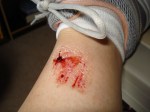
Here’s a picture of:

STUPID:

STUPID
STUPID

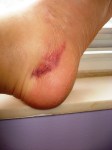
LONG-TERM CONSEQUENCES OF STUPID:

My ankle 10 days following STUPID

Chloe couldn’t get to me, and was barking like crazy. I couldn’t have been out very long, because I’m sure her barking would have eventually woke up one of my kids. She has a really loud hound bark, (not at ALL feminine!).

Barriers Put Up by ME

As I sat there pulling the stick out of my leg I began to talk to Chloe. As I talked, she stopped barking and just sat there looking down at me with a look of panic on her face.

The real dilemma? All the doors were locked! I was going to have to get to the staircase across the yard, get up the steps and over the semi-permanent barrier we had erected “for safety’s sake”. The door from the deck to the house was the only one unlocked. I could have knocked, but the metal security door under the deck to our laundry room is solid and doesn’t produce a very loud knock.

To make a very long … somewhat boring story – SHORTER (grin), I made it inside. It took me awhile, and I had to find my cochlear implant before even starting on the “trip”! Chloe whined her encouragement the entire way.

My kids were pretty surprised to come upstairs for breakfast to find me with my foot in the air with ice on it. Ok… actually I’m stretching the truth here. My kids know me. They weren’t at ALL surprised to come upstairs to find me with my foot in the air and ice on it.

They DID call dibs on who got to call “Dad” and tell him what happened.

Barriers Can be Good

I put up that barrier for a reason. It should have been a reminder to me just how high off the ground I was. The barrier was to serve as a preventative for descending to the yard below from the deck. By-passing the stairs all together was just a little bit STUPID. That barrier should have served as a reminder AND a preventative.

Sometimes we put up barriers in our lives to protect ourselves. Maybe you’ve learned the hard way to avoid critical people. You put up a block… a barrier to not allow people like that close to you. The barrier can keep people who aren’t “safe” for you emotionally, at a distance that is healthier for YOU.

But why do we sometimes slip a leg over the railing to by-pass the barrier? Why do we seem to embrace people who have a history of causing us emotional duress? Perhaps someone with an expression like Chloe’s, looks on in concern and asks carefully, “do you know what it is you are doing?” Ignoring the possibility that they may be right, you slip your leg over the rail anyway and think, “Gee! They are a piece of WORK!”

Friends? The only work is that long walk “home” after falling on your butt. It may take years even to get back to a healthy place. Almost “home“, and you step over a familiar looking barrier that you had up as a warning and preventative prior to being duped again.

Safe People

Surround yourself with “safe people“. These folks are individuals who bring out the best in you. They love you warts and all. They are an encouragement to you, and cheer lead you to reach for your dreams.

What’s tough is when some of those people who aren’t safe are related to you. There are times you have to interact, but you can learn to do so in a way that they don’t breach even the barriers you put up for them.

I am not encouraging an unforgiving heart either. If someone is truly repentant (meaning they have made a CHANGE) and want to be a friend to you again, you should be willing to trust they mean it. If their efforts fail, however, and they still are a “toxic person”, at least you have the experience and “supplies handy” to put that barrier right back up.

Sigh.

You know the BOOGER of it?

That. Vine. Is. Still. There.

Denise Portis

© 2009 Hearing Loss Journal

Passing with FLYING Colors

aquarium-007

Dolphin Show? Nooooo Problem!

We’ve been to the National Aquarium in Baltimore since my “match” with Chloe, but I choose to sit out during the Dolphin Show. We were “new enough” that I did not know what to expect. This past Saturday we met some new friends at the Aquarium. After soliciting the advice and opinions of fellow Fidos For Freedom folks (geesh… say that 5 times really fast!), I decided to take Chloe to the Dolphin Show. I went a little early so I could pick my own seat. I knew I didn’t want in the “Splash Zone”, but I also did not want to sit as close as where the hearing assistive section was situated. I hear “voices” well enough with my CI, so I decided we’d sit where it was best for CHLOE.

This decision meant in the back and up HIGH – grin! With my poor balance, it took some quickly whispered prayers, Chloe’s steady counter-balance, and a husband walking immediately behind my weaving, dizzy, umm…. BEHIND, for me to get where I felt “safe” for Chloe’s sake.

aquarium-005 Most of the time she stayed down on her blanket, and I was not even forced to reinforce the behavior with her treats. She was OK until she heard the dolphins making sounds. I couldn’t hear it, of course, but my husband said they chattered, chirped and made other interesting noises. Chloe would “pop up” to take a look, but would immediately go back down when I reminded her to do so.
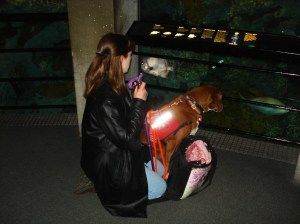
At one point, the crowd burst into applause and exclaimed, “OH!” very loudly. Chloe popped up to take a look, and I found her staring in astonishment! A dolphin was doing the “high jump”, where it burst from the water to touch a ball extended high above the water. If Chloe’s jaw could have dropped open, I’m sure it would have. (I did have to ask her twice after that to go back to a “down”!)

Chloe did great at the Aquarium. aquarium-001 I suppose the biggest “chore” was just keeping her from being stepped on by the crowds, and insuring she was in a “safe place”. I had to put her in “place” a couple of times (opposite of “heel”, to the right). I can’t leave her there very long due to…

… As the World Turns

Meniere’s disease is different in every individual. Although symptoms may be similar, they are never identical. Some people develop Meniere’s along WITH unexplained hearing loss, some people have it without any evidence of hearing loss at all! Some people experience tinnitus (ringing, buzzing, whistling), nausea, dizziness, vertigo, blackouts, blurred vision, and much more.

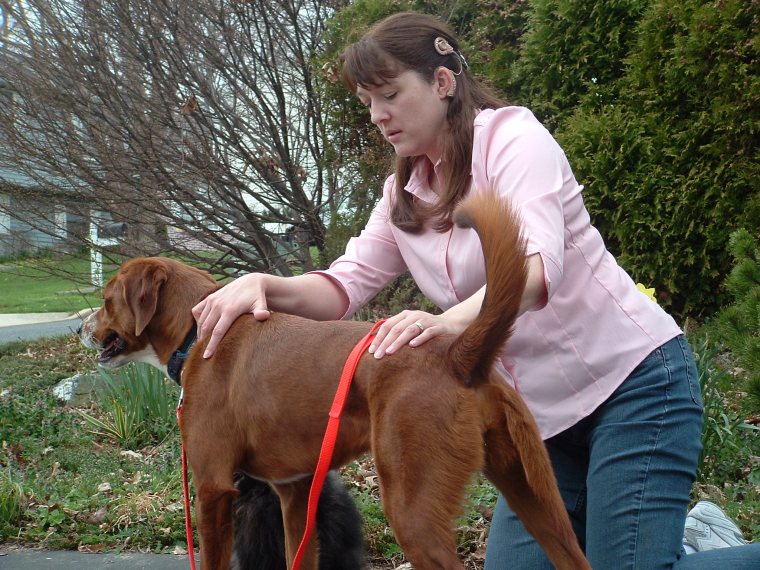
In a simple, layman’s description:  my world spins counter-clockwise. With Chloe in “heel” (although a modified one as she is slightly forward of a formal “heel” due to my inability to see lower, left peripherally), she actually provides a “check” to my slowly, moving world. As my visual field and brain cause me to feel as if I’m spinning left, her “brace” in “heel” sort of SNAPS my visual field back to where it belongs. She is standing, or sitting STILL, which allows my focus to re-establish center as I am NOT “sitting still”. When she is in “place” however, her body isn’t in a position where it enters my counter-clockwise “spin”. Confusing? (grin) Try explaining the individuality of Meniere’s someday!

Let’s just say I’m glad she is in “heel” MOST of the time. I practice “place” and “circle right” as they are occasionally needed.

All So “Normal” for Us

We also went to the shops near the Aquarium, and then waited for about 45 minutes to eat at The Cheesecake Factory. I can hear voices in quiet environments at normal speaking levels. I cannot hear voices in places with a great deal of background noise, nor can I hear whispered things. I tend to miss all of the exclamations from the general public when they see Chloe do something for me.

When she rolls her own blanket up for me so that it is high enough to reach, or picks up her own leash to hand it to me, I do not give it a 2nd thought anymore. She picks up the end of my cane until it’s high enough for me to grab, picks up dropped items like menus or pamphlets, and just has a GRAND time doing it! Although my family are also accustomed to Chloe being by my side and “helping”, they hear those comments that I do not when we are in a new place.

What can be really fun is to see the look on everyone’s face when I remove Chloe’s vest outside for a short break. My dog morphs into “Miss Congeniality”.

Something is ALWAYS Learned

Even when everything does NOT go as smoothly as Saturday did, I still learn important lessons. The least significant lesson may be a reminder of what should be worked on with more diligence. “Reality checks” are great teachers.

Having a working dog does not mean that I do not have to WORK at adapting. My cochlear implant allows me to hear, and yet I am still deaf. I use a bright purple cane, but I still fall sometimes. Chloe acts as my ears, but I will still misunderstand even a noise I am alerted to at times! How we react when everything does NOT go “great” is a good measure of how we are “really” coping with an acquired disability.

Tomorrow I may have a different opinion, but right now I think I’m “passing with FLYING colors!

Denise Portis

© 2009 Hearing Loss Journal