DisAbility Etiquette (part ONE)

DisAbility Etiquette (Part ONE)

You cannot know how long I struggled with what to TITLE this piece! Having recently left a nearly 3-decades-long career in teaching (Psychology and ASL), I know how preoccupied folks are with being “inclusive” and equitable. Some even fully embrace being <GASP> WOKE. Folks who do not identify with any marginalized person group have shared with me (at least in the field of education and higher learning) that workshops, required certifications, and mandatory inclusive components more and more feel like “hoops to jump through”. 

I can tell you that as a person with disabilities, the last thing I want abled people to feel about inclusive practices is relief at having a checkmark on their HR records. I love the way Emily Ladau (2021) simplifies best practices with an easy to incorporate “rule” in interacting with those who are differently-abled. “The Golden Rule” is simple and easy to live out with true authenticity. Treat others in the same way you would want to be treated. “You don’t need to start overthinking everything you say or do. That just makes things weird. Disability etiquette isn’t about tiptoeing around us and treating us like strange, delicate flowers (in fact, that’s pretty ableist in and of itself.) It’s about treating us like full and equal human beings” (Ladau, 2021, p. 89). 

I truly believe (most) people mean well. Sometimes well-meaning intentions go awry, however. Yesterday, my husband and I went out to eat at a restaurant. My husband knows not to linger and hover over me as my service dog, Finn, gets me from “point A” to “point B” safely. Besides, he needed to make a “pit stop” so I walked out alone. As I navigated the last section near the door, I passed a booth with a family who had young children in it. Having lived the majority of my life with profound hearing loss, I do speech read fairly well. I saw one of the dads say to those at the table, “there’s a dog coming with a disabled person… don’t look, don’t stare, DON’T STARE”. Two of the three children (with age-appropriate ability to fully comply), dived under the table with one screeching, “I’m not looking at the dog! I’m not looking at the woman!” 

I tell you what, I was so cracked up I had to stop and lean against my cane for a second before giggling my way to the door. As I passed the booth one dad was doing a classic “face palm” while the other mouthed, “SORRY” as I hobbled by. When I got outside, I had to do a “cane lean” again as I seriously nearly fell over laughing. Those dads didn’t need to warn the kids about my coming by. Finn is gorgeous, smart, and talented. I don’t mind the “look at the dog!” comments. I know the dad’s comments were meant in respect, but please… just treat me like a normal person. I have bling on my cane, cochlear implant, and hearing aid. My dog is an 85-pound, solid Golden Retriever. I’m not invisible nor do I care to be. If someone says, “What a pretty dog” as I walk by, I simply smile and say, “Thank you! He’s amazing”. I don’t consider noticing something that is VERY noticeable as being rude.
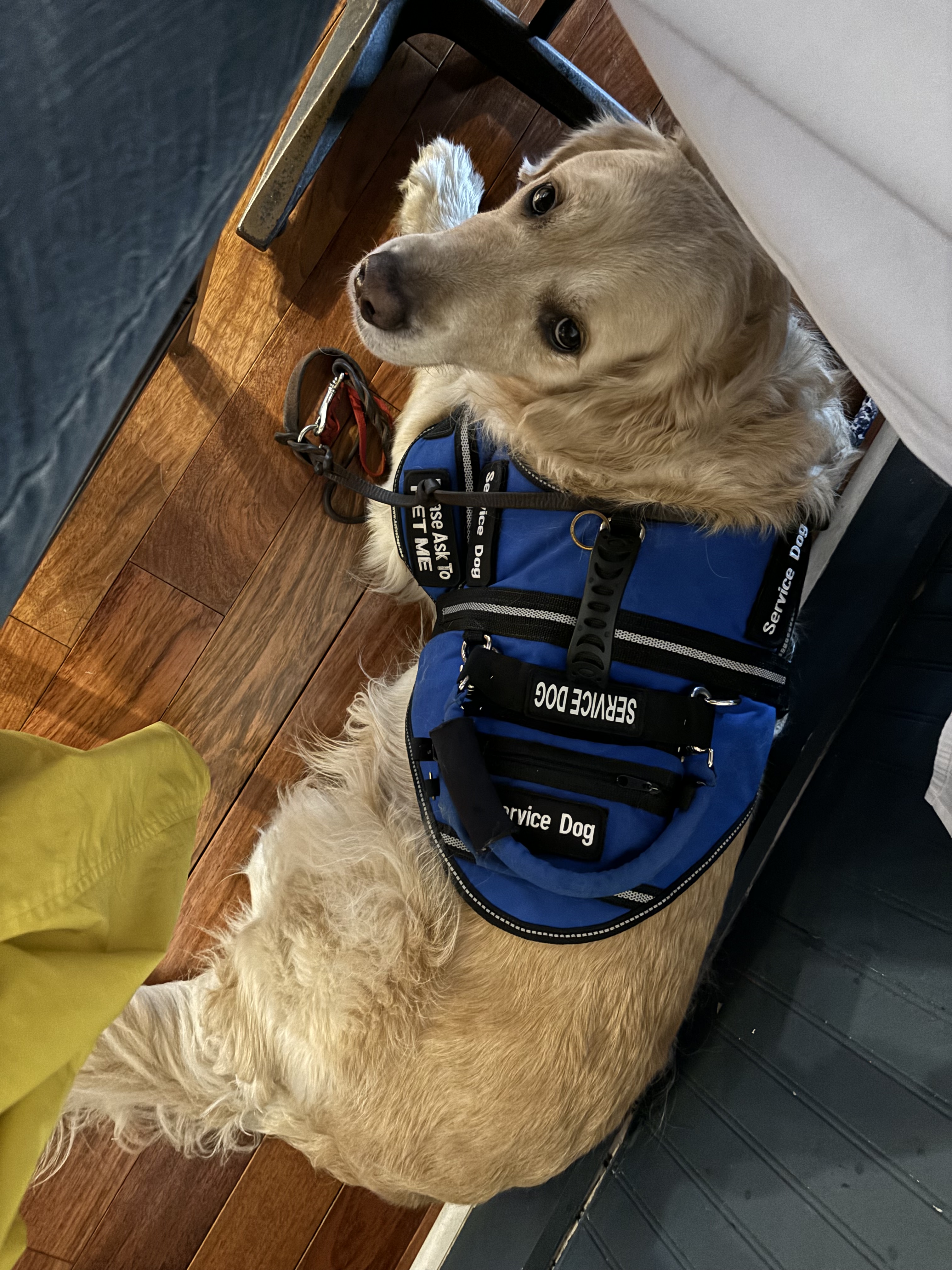
Photo description: Large Golden Retriever with royal blue service dog vest under a table at a restaurant. 

To close out this two-part series on “DisAbility Etiquette”, I wanted to share some do’s and don’ts of two disabilities I have. [CHALLENGE: If you have other disabilities and would like to write for “Hearing Elmo” and share your own “do’s and don’ts” please contact me at denise.portis@gmail.com. I love having guest writers!]

In part two, I want to discuss some do’s and don’ts for people who use canes and service dogs for mobility challenges. In part one, I’d like to share some tips for interacting with people who have hearing loss. NOTE: I do “hear again” with a cochlear implant but these tips work for anyone with any degree of hearing loss, even those who are culturally Deaf.

DO:

  1. The Golden Rule (I won’t reiterate it again – smile)
  2. If you know someone has a hearing loss and you are hosting a workshop, meeting, or get-together, send an email or text to the person and ask what you could do to make the venue more accessible.
  3. Follow-up (especially work-related) meetings with an email to ask if they have any questions or missed any topics. (Careful with this one… don’t be condescending).
  4. If possible, secure captioning (transcription) for the meeting. Transcripts can be emailed to EVERYONE which only helps all present.
  5. Avoid small group activities where everyone is talking in small groups at the same time.
  6. If a person uses ASL, please provide an interpreter.
  7. Flicker the lights to bring the meeting to order. Yelling or wildly gesturing is rude.
  8. If there is a microphone present, USE IT. Don’t say, “my voice carries” or “I think everyone can hear me”. 
  9. Insist others use a microphone from the audience, or repeat any questions asked. 
  10. Write out on a white board or include a slide in a presentation if you are going to do any type of ice-breaker question, detailing what is being asked of participants. 

DON’T

  1. Announce or otherwise bring attention to any one individual who may have trouble hearing.
  2. Raise your voice to a near shout. 
  3. Turn your back to the audience to point to or gesture towards a screen or whiteboard.
  4. Talk to the interpreter of a culturally Deaf person, instead of talking to the person themselves. 
  5. Play music or “theme songs” in between speakers.
  6. Use videos without captioning turned on
  7. Talk at the same time someone else is.
  8. Over enunciate speech
  9. Chew gum or have other items in your mouth when speaking.
  10. Hesitate to ask the person with disabilities if you are not sure how to proceed.

Ladau, E. (2021). Demystifying disability: What to know, what to say, and how to be an ally. New York: Ten Speed Press

L. Denise Portis, Ph.D.

© 2023 Personal Hearing Loss Journal
What if… ?

My husband teases me because my favorite movie genre is apocalyptic themes. My favorite book as a kid was “The Long Winter” in the Little House series because the circumstance and outlook was so dire! I’m a pessimist and very, VERY hard on myself. Even though I’m 57 and had decades of practice of “doom, despair, and agony on me” (let’s see if any of you catch that reference jingle), I have learned to change my “what if…” inner dialogue to promote happiness and health.

Persons with disability often worry, fret and are anxious about many “what if” scenarios. Things like:

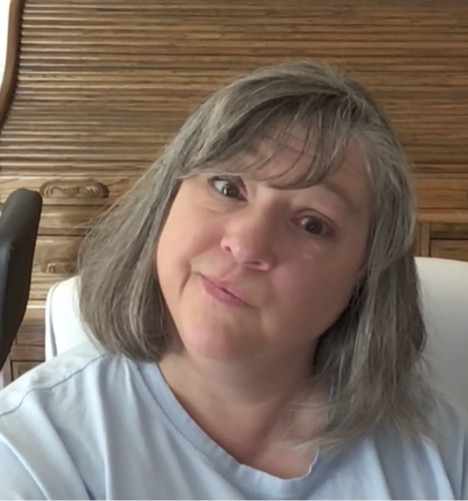
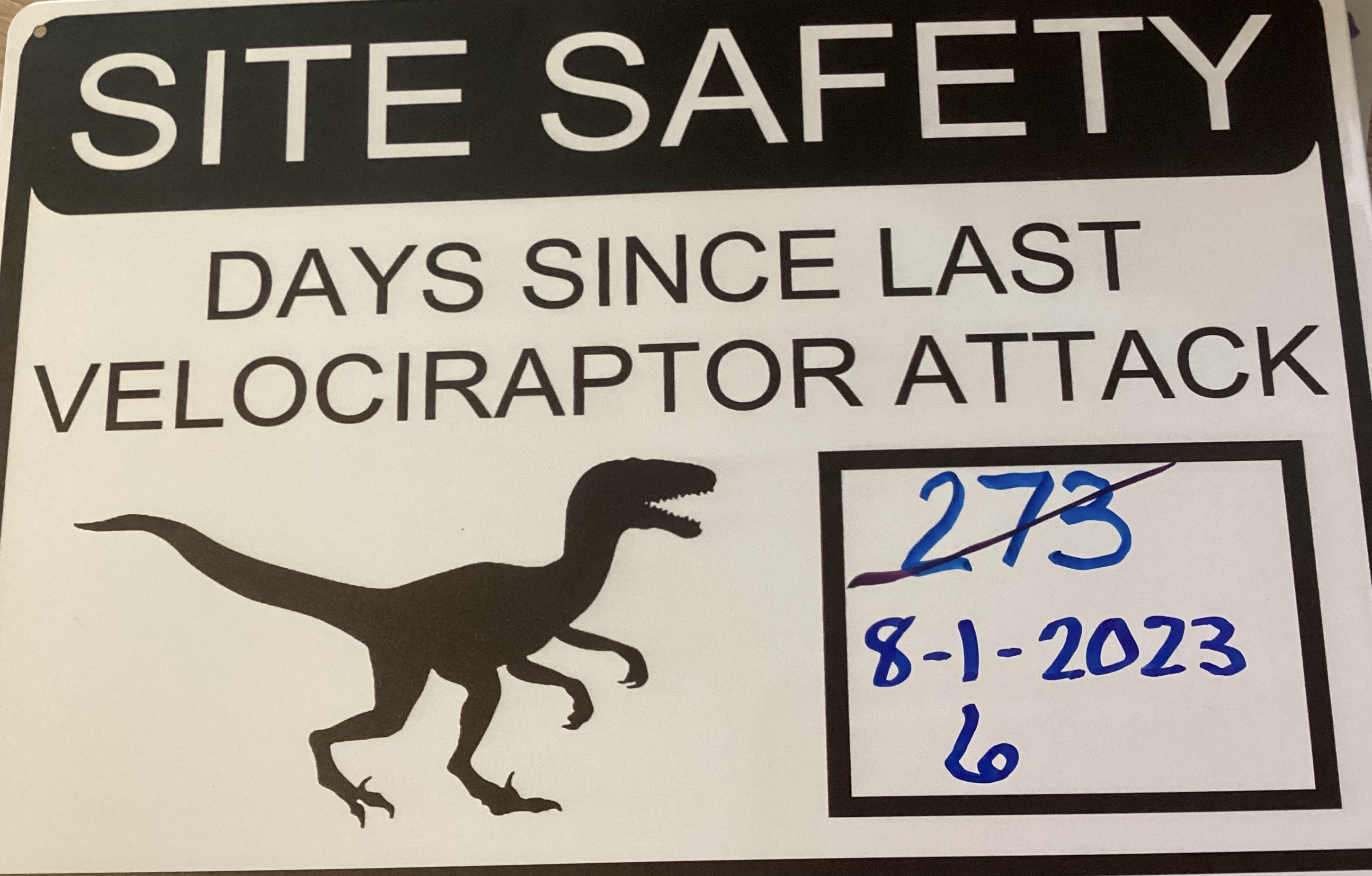
What if I suffer another concussion? (I was so aggravated at myself to have to update my sign a week ago):

What if I become legally blind?

What if I have to have my cochlear implant removed to get an MRI and accurate MS diagnosis?

What if I get ALS like my Mother?

What if… ?

I mean seriously it could go on and on! I’m grateful my interests and subsequent training and education meant I pursued psychology. Yes, yes, occasionally I grieve being rejected by Hogwarts, but psychology likely saved me! Seriously! I use snippets of cognitive behavioral therapy (CBT) every SINGLE DAY! I know that I’m prone to cathastrophizing my life. I know this bad habit is detrimental to my emotion self and mental health. It also takes a toll on my physical health.

When I find myself perseverating on negative “what if’s…?” I have to deliberately pause and choose to say the opposite.

What if I go another year without any new concussions? I’m taking great pains to walk safely, work around the house safely, etc. That last concussion may have been my last!

What if the meds I am taking save my eyesight?

What if the MRI (after surgical removal of my CI magnet) shows a definitive MS diagnosis? Then I can find proper treatment!

What if I live as long as my Mom did (78) and die from “old age” and not ALS?

In CBT, you have to start with your thinker. If you can change your thinker, it will aid in changing your feeler (heart) and in turn change your behavior (anxious thoughts, depression, self-harm, etc.) Change your THINKER to change your FEELER to change your BEHAVIOR.

So there isn’t anything wrong with “what if…?” thinking. Just make sure most of your “what if’s…?” are positive thoughts and affirmations. It’s hard enough being a person with disabilities and invisible or chronic illness. Don’t become your own worse enemy. Cue the music and summon your Mission: Impossible chi and see if this CBT tool can at the very least improve your mental health and personal regard.

L. Denise Portis, Ph.D.

© 2023 Personal Hearing Loss Journal
You can do ANYTHING!  Well… MOST THINGS!

I anticipate that what I write this week will upset some folks who live with disABILITY or chronic conditions. If you would, “hear me out” until the end of the post. If you still disagree, I can easily “agree to disagree” and even concede that the power of optimism is often the key to overcoming real obstacles.

My main point? Do not tell a person with disABILITY that: YOU CAN DO ANYTHING!

This standard platform statement is normally accompanied by volume and higher pitch, with a pom-pom smacked to the face of anyone not paying attention. Educators like myself sometimes misuse this encouraging statement. Administrators may assume the statement is standard for any mandatory attendance meeting, certain to help liberate the doubtful and unify the group, lighting them on fire with enthusiasm. 

Last semester I sat and cried with a student having to drop my class. Like me, she is a TBI survivor. Her dream job was to work in a big hospital and oversee support groups for individuals and families who are experiencing life with traumatic brain injury. She wants the “shingle”, the Ph.D., the training to really make a difference. I believe she will reach her goal. She will reach her goal after a longer road than most. There will be setbacks. There will be obstacles. I shared with her that it took me 16 years and a lot of outright stubbornness to finish school. Accommodations made the attempt more equitable but honestly, I shared, “it took not giving up and recognizing my pathway to goal was a longer one”. 

I have had short-term mentors tell me YOU CAN DO ANYTHING! (My long-term mentors had a more realistic approach). However, pom-poms, enthusiasm, and genuine hopefulness will never:

… allow me to hear normally.

… walk without a limp.

… have vertigo-free days.

… help me be as sharp at the end of the day as I am at the first.

… keep me from needing more sleep than others.

… prevent me from ever falling again.

… alleviate my communication challenges.

… prevent me from feeling isolated and left out occasionally.

… stop the loss of vision in my right eye brought about by 11 concussions.

… interrupt every single panic attack.

… defeat persistent depressive disorder.

… keep me from missing my Mom, the primary REALIST in my life.

Frankly, there are some things I CANNOT do. Any successes or “wins” are the result of stubborn persistence. Any recognitions or awards are from finding a different way to accomplish the same tasks. Many “end results” were not something originally targeted. There are things I CANNOT do and tasks I will NEVER be able to do. Instead, I have learned to set my sights on something obtainable. I have learned to align my goals with things that are possible. I have even learned to dream and “pin my hopes on” goals that are doable for even one such as I. In the end, most of us aspire to make a difference. If you find yourself looking around at the place your training, hard work, and experience have landed you thinking, “Well gee. This was a major detour but gosh darn it! I’m happy and I’m making a difference!” 

Perhaps the big DIFFERENCE we make was something outside our imagination originally. Reality redirected our purpose with an unexpected detour. Yet here you are, thriving…influencing… and KILLIN’ IT! Having a sense of real purpose looks good on EVERYONE. 

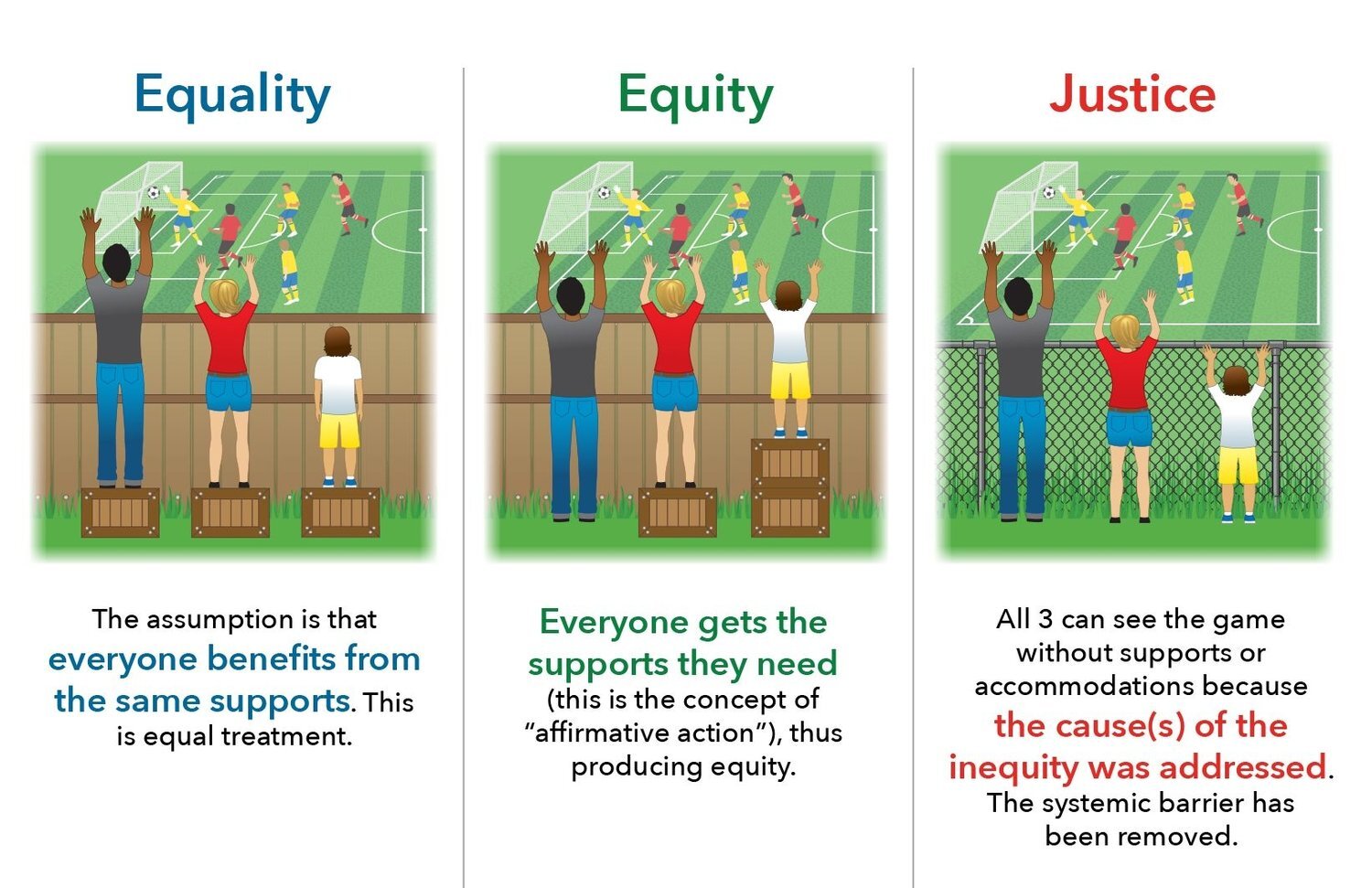
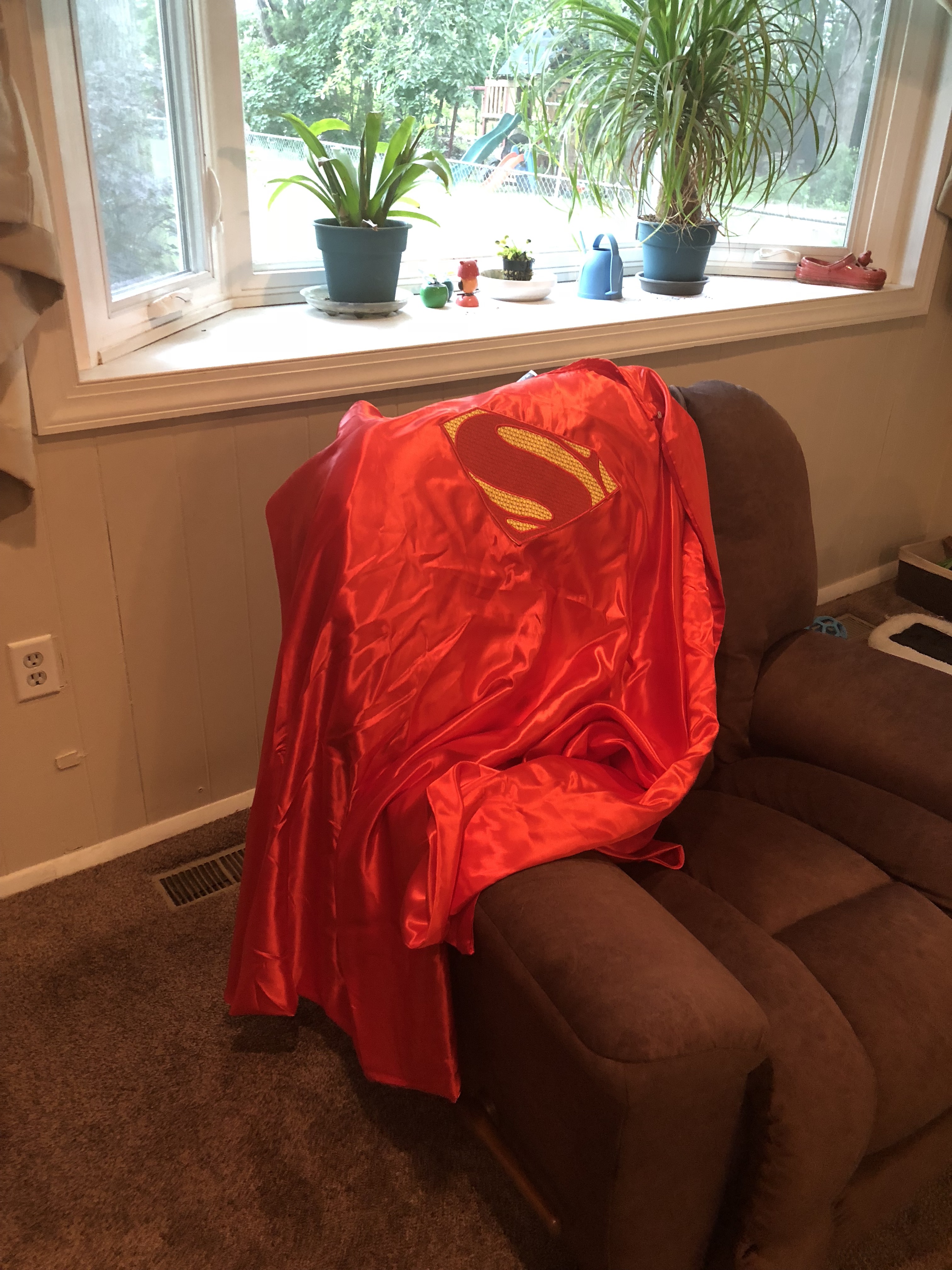
I have talked with students and colleagues hesitant to ask for some extra time or an equitable accommodation because they fear being judged that their performance is only possible through props others do not need. Y’all? There is a heck of a lot of difference between equitable accommodations and “hand holding”. This photo says it all:

I received an email from a follower of Hearing Elmo around Christmas. They are on disability, with limited transportation and even more limited opportunities. They shared that at times they are discouraged because they feel limited in what they can do. But folks? The opportunities this reader has are golden, the lives they touch are valuable. They consider their purpose and mission to advocate, educate, and touch just one life at a time. They support and encourage LGBTQ+ young adults with disability and act as a sounding board, a shoulder to cry on, and are a stout champion to a truly marginalized group. 

Are you an abled administrator, director, co-worker, or friend? I encourage you to use realistic encouragement and language as you lovingly support the folks in your life who have special challenges to overcome. Having YOU helps them overcome. Be careful not to balk at a seemingly unrealistic goal. If people with disability are anything y’all, they are realists! If you are blessed with an invitation to chart a path alongside someone who is determined, then LISTEN, research, encourage, and advocate on their behalf. 

A well-meaning friend and I had our behinds parked on a bench on campus catching up with each other. Some geese flew overhead, flying in a perfect “V” and heading South for the winter. My friend said, “Wow, what a racket!”

I grinned at her and said, “Well I don’t hear anything!”

Abashed, she said, “Well at least you can see them, right?”

I said, “Sure! And I do LISTEN with my EYES sometimes!”

However, unless a big ol’ goose comes waddling up to my side and honks right in the direction of my cochlear implant, I’m not gonna hear it’s unique sound y’all. This doesn’t mean that I do not have a purpose since I cannot hear a goose honk from high above while flying in formation. My disAbilities make me uniquely qualified and effective to make a difference in the lives of those in Denise Portis’ sphere of influence. Y’all have a sphere too. Manage it. Own it. Thrive. Because all of us are pretty…

FABULOUS.

L. Denise Portis, Ph.D.

2023 Hearing Loss Journal

What do you care, right?

Oh I care, believe me…

#ResolutionRENEW

I’m a co-advisor for a campus student club/chapter of Active Minds. One of the things we talk about in our meetings at LEAST once a semester is that using the right word does matter. Check out this great (short) video that emphasizes some of the things we share with our students: MUST SEE VIDEO

Two words I habitually say are “CRAZY” and “INSANE”. Truthfully, I had achieved a point where most of my verbal language (well… and SIGN for that matter) had eliminated these two words. I don’t know if it was the break between semesters or what – as I’m certainly not making excuses. To my dismay (with a little bit of HORROR thrown in) I discovered that these words were back — being used again as a common descriptor in my everyday language.

As a matter of fact when my epiphany occurred, I was actually having a Zoom meeting with the co-advisor of our much loved club, Active Minds. At least twice I said something about how “CrAzY” something was in regards to the total and normal OVERWHELM that accompanies this ongoing pandemic. My friend and colleague (to her credit) didn’t call me on it (though I wouldn’t have minded if she had), but y’all? American Sign Language is my second language! Therefore, facial expression, body language, posture, etc. are something I just pick up on as a normal part of any kind of communication, including verbal. So she tensed and her eyes popped wide; she calmly agreed with what I was saying but used better words like “disappointing”, “frustrating” and so on. I left that meeting determined to get back on track with using better words. Words that do not have negative connotations and stigma attached to them. It’s a “speech rule” that is important to me, so renewing this pledge to do better was also important to me.

Other Kinds of Poor Choice Phrases

This past week I was painfully reminded of other types of habitual words and phrases that are shockingly an eye-opener to the receiver. These are the kinds of phrases that make me WINCE – and I’m not always good at hiding that wince. I have a student in one of my face-to-face classes that says “what do you care, right?” and sometimes “what do I care, right?” It is very obviously a verbal habit because it rolls off the tongue almost like it is “filler”. For this student, I can only guess that it was habit, but self-fulfilling prophecy, Pygmalion effect, and abuse are likely culprits of using a phrase so frequently and out of context.

To explain how tragic this repeated verbal phrase is, we’ve only had two classes so far this semester and yet I know for a fact that I and others have noticed. Sure, the phrase was verbalized along with an eye roll, a self-deprecating chuckle, and failure to make eye-contact. It was not difficult to register the

PAIN

FEAR

LONLINESS

S.O.S.

in this oft-uttered phrase during our 10 minute after class “chat. Trust me. I’m no conversation guru nor interpreter police. However, I do pick up things like this because I *do* pay attention to facial expression, body language, posture, hand shapes (tense fists) and more when I communicate because I hear with bionics. I need those other cues for total understanding and clarity.

PERSONAL GOAL: Somehow, some way, let this student know during our semester together that I do. I do care. I care a great deal.

Check Yourself

I would like to put out a challenge to every person reading this post who also lives with visible or invisible conditions or disability.

DO YOU FREQUENTLY AND HABITUALLY USE ANY LANGUAGE THAT UNDERMINES WHO YOU ARE?

It may not be words or phrases you even say out loud. Perhaps you only THINK these words that are ultimately harmful to who you are. You may need some help with this challenge. Ask someone else if you ever habitually utter negative words or phrases. Maybe even ask them to get back to you on it so that they can think about it. (BONUS: Perhaps they will also discover that they do this as well!)

If you are like me, we have been saying these things (or thinking them) so long that they are firmly entrenched in the way we respond and communicate with others. One of my siblings constantly smacks their head and says, “stupid, Stupid, STUPID” to themselves. Yup. That one is obvious.

Maybe (like me) self-deprecating humor is a way you cope or “deal” with your disability. Heck, many diversity champions and comedians use this means to educate and advocate. But y’all? You and I know when we are in advocate mode or bad-habit negative talk. Having a balance disorder, I am a klutz. I am constantly tripping, stumbling, and weaving my way around campus. For a very long time I would laughingly tell a concerned member of my “village” that “GRACE is not my middle name“. That is mild negative response really. However for ME, it started to fester a little. Every time I said this after an awkward stumble, I felt…

less.

Now when I “skid around a corner and clutch at Finn’s vest while correcting my sliding right foot and over-compensating for a bounce of my shoulder off the nearest doorframe” (I kid you NOT), I simply say, “Whoa. That was a close call”. That’s enough for me now. I don’t feel less when I say it. Saying NOTHING does not work because I will be bombarded by well-meaning people in my “village” who ask if I am OK. Acknowledging my “close call” for some reason reassures everyone that I really am OK. “I’ve got this”. Recognizing negative language and learning to use BETTER words really does make a difference. It impacts self-esteem. Choosing BETTER words strengthens diversity advocacy and pride.

Words matter. Self-talk matters. You matter.

L. Denise Portis, Ph.D.

2022 Personal Hearing Loss Journal

Deaf Ears Hearing in the Middle of the Night

Deaf Ears Hearing in the Middle of the Night

I gasp and sit straight up in bed.

What is that noise? 

I grab both sides of my head and curl my fingers behind my ears.

……………………………..

No. My bionics are asleep in that little gray box.

What is that noise?

I clutch at my chest and listen closely, breathing in and breathing out.

…………………………….

My eyes leak; tears running down my face and soaking my nightshirt.

What is that noise?

A sob chokes at my throat and I gasp, fisting my hands under my chin.

…………………………….

I stretch, clutch and fumble for my phone, almost out of reach.

What is that noise?

No messages, no texts, I search in a panic, swiping through every screen.

…………………………….

I feel my faithful service dog flop his tail; fluffy, golden feather brushing my leg.

What is that noise?

I collapse back down on my waiting pillow, peering into the darkness.

…………………………….

My eyes adjust, I turn my head just so and find the florescent numbers on the clock.

What is that noise?

I cannot hear anything. I’m very deaf, truly, and completely in this moment.

…………………………….

What if… what if I woke to my mother’s goodbye?

Was THAT the noise?

My heart pounds, the tears leak, a tail flops against my side.

Sorry? Wait a minute! No I’m NOT!

Words matter. As I have aged (and hopefully matured) the discovery of what we say and how we say it has evolved as I have learned to communicate with focused intent.

As a person with hearing loss, a typical response for me after you first say something ranges from:

Sorry? (or I’m sorry)

Pardon?

HUH?

My mama raised me to be polite I suppose. However, I have lived with acquired disability nearly twice as long as I did with “normal” hearing and “normal” balance. Even people with a normal range of hearing for their age may respond with an “I’m sorry? What was that?” if they miss something in an overly noisy room. Because I am more likely to miss what was said or miss the context and fully understand what was said, I am more likely to use these phrases.

After some length of time living with these ingrained habitual responses, I realized how it was actually making me FEEL. I’m all about good manners. I noticed that I was having to say, “I’m sorry?” so much that I was a really, REALLY sorry individual. I also realized that I had nothing to apologize for when I said it. More importantly, it served no purpose. Heck, I give workshops on how to convey to someone you didn’t hear what they were saying.

It is best to educate and advocate. Don’t complain or apologize. I am best served by responding in one of the following ways:

“I did not hear most of that because of the background noise in here. Would you repeat that please?” (Maybe even suggest a quieter location)

“I heard you say, “ya-da yada”, but missed the last part”. (Obviously we can fill in the yada with what you actually heard).

Beware of your volume. Be careful not to “guess”. After all, you are trying to educate folks that pieces of their sentence was lost but not EVERYTHING they said was.

My husband once said to me in a crowded room, “I will see you later. Plan on dinner at six?”

I heard, “… see… later. Dinner and sex?”

YES PLEASE.

When you become more proactive about what you heard and did not hear, you can also suggest synonyms. When my kids were in elementary school, they would joke that they knew more synonyms than anyone else. Having been to all of those hearing loss conferences (thanks HLAA) they learned that if your loved one was having trouble understanding all you said, throw out some different key words. It may end up being a consonant blend they have no trouble hearing at all!

“Grandma called this morning and asked you to call back when you can”.

“What?”

“I spoke to Grandma this morning. Be sure to call her back tonight!”

I hope you do not misunderstand the purpose of this post. There is nothing wrong with being polite. There is everything right about letting someone know you did not hear them.

– – – – – – – – –

Let me quickly chase a rabbit here and insert that faking that you can hear is much different than faking you are listening. The latter may result in hurt feelings or a punch in the arm. To fake that you heard someone has heftier consequences. 

– – – – – – – – – –

What matters is letting them know you did not hear them in the right way. Our age-old habits of apologizing do not fix the problem. You are more likely to encounter people who are tired of repeating something, or start to do so LOUDLY. This only distorts the words making it even harder to understand.

By suggesting a quieter place to go, explaining you may do better with a different choice of words that can be understood in context better, or repeating the part you DID hear so that they don’t have to repeat everything can go a long way to better communication.

Depending on the environment, some other great options to take the place of constantly apologizing are:

  1. If in the car, suggest turning the radio and/or music off so that your ears do not have to compete with their voice.
  2. Ask to step into a building so the acoustics assist you in catching more of what they said to you. Outside, voices can D   r…      i  f…    t…   a way…
  3. If you know them well enough, ask them to ditch the gum 🙂
  4. Make sure by word and deed that the problem is not something you should apologize for as no one did anything wrong. They didn’t either – so work on making sure they do not think you are criticizing them.
  5. Do not let others say, I will tell you later. They won’t. If you hear this, let them know you will be following up by email to discover what they said because it is important to you.
  6. If you see a conversation going sideways and frustration is evident on the face on the person you are speaking to, ask for an email. Explain you simply cannot hear them in this environment and that you ask they follow-up with a text or an email. Assure them you want to respond as needed.

L. Denise Portis, Ph.D.

©2020 Personal Hearing Loss Journal
Overcoming It

A hero is just someone who is brave a little bit longer

For a former “farm girl”, I recognize it goes against the grain to say I HATE RAIN.

Besides… I don’t HATE rain, I hate the consequence of rain.

Not the consequence of providing necessary water to growing plants.

Not the consequence of washing the world clean.

I hate the consequence of navigating a rainy day. It promises bruises, headaches, falls, and sudden yelps and “CRAP, woah!” exclamations.

The irony is not lost on me that although I am profoundly deaf (when not wearing my cochlear implant),

although I have post concussive syndrome from numerous falls,

although I have a bum ankle that I badly sprained 4 years ago and wish to God I had broken instead,

… Meniere’s disease is the battle for which I must “don the cape”. Something that falls into the “invisible illness” category. A disease/disorder with no cure and few agreed upon symptom smashers.

Meniere’s and weather changes are incompatible. On bad weather days I sometimes have to psych myself up and recognize that I cannot change the weather today and I cannot cure my Meniere’s. What I can do is “don the cape” and make the best of it.

Today I had my heart set on going to training at Fidos For Freedom, Inc., the organization from which I received both of my service dogs. My current service dog, Milo, loves going and the extra practice does us both good. I usually don’t wave the white flag on a day until I actually get up and go look at the sky. Lord knows, our weather forecasters are not very accurate about a “3 day” or “5 day” outlook. (Super strange that it seems the m0re technology available to us, the more meteorologists miss the forecast). I usually know it’s raining outside as soon as my feet hit the floor. I certainly cannot hear it <grin> as I don’t “have my ears in yet”. This morning I knew as soon as I swung my feet out of bed that it was raining. It’s fairly easy to guess when the entire room is spinning and the floor seems to be missing under my feet.

I always start out strong. I CAN DO THIS. I let the dogs out and start my coffee. Something I do each and every morning. No matter that I am doing it while hugging the nearest wall or counter.

I didn’t sink to the floor this morning, sobbing, after letting the dogs in for breakfast. I hung on to the chair rail molding on the wall and shook, said a few choice words, immediately asked for forgiveness and pled in genuine prayer to help me let go and walk to the kitchen. I’ve learned that caving to the despair only exacerbates my symptoms.

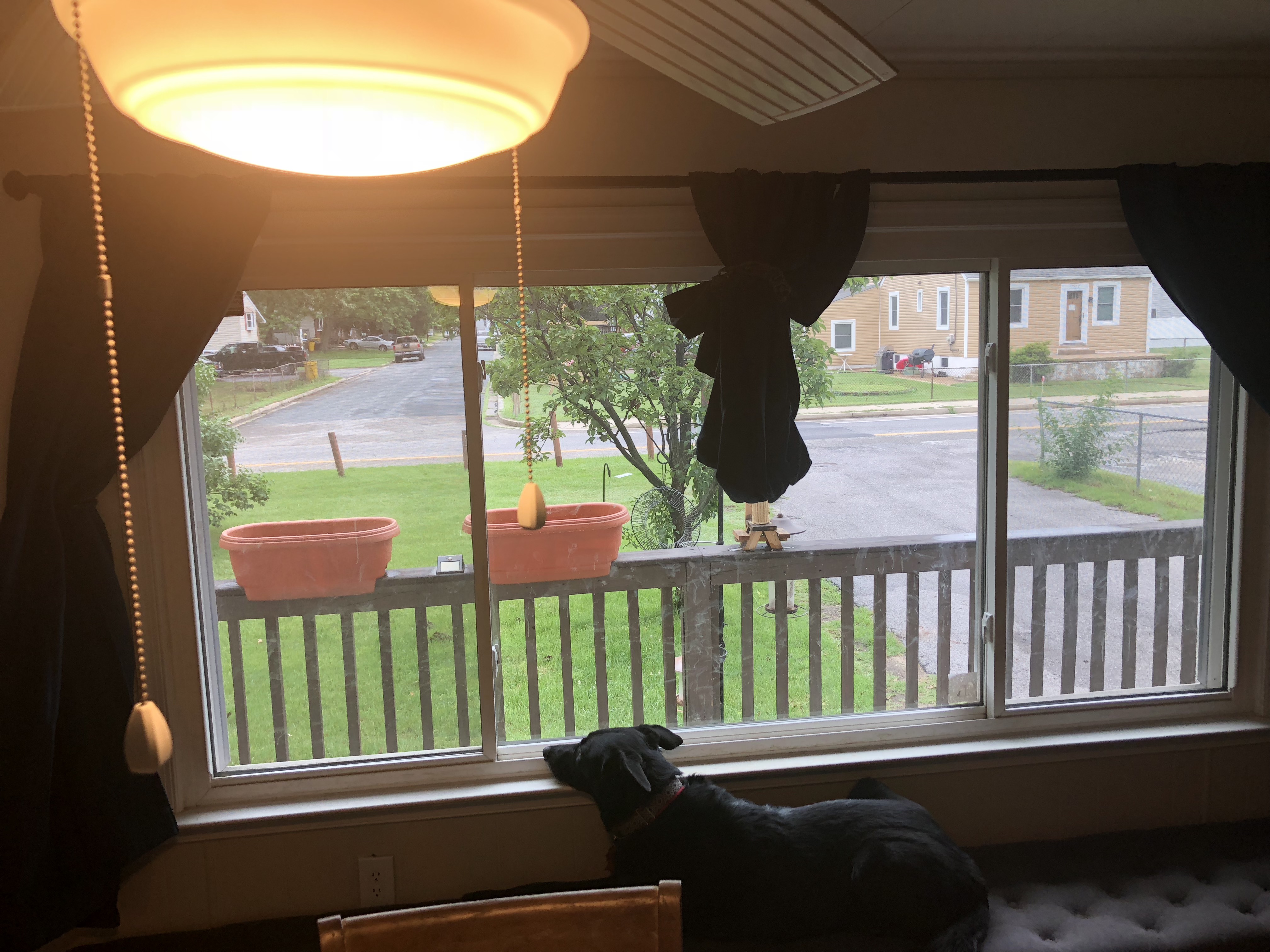
So I’m not going to Fidos For Freedom, Inc. today even though Milo-bear is looking forlornly out the window wishing we weren’t at home.

Please do not misunderstand this post. I’m not looking for sympathy. I am not inviting you to my pity party. I simply want to share what it is like to live with a chronic, invisible illness. It might also surprise you that I am glad

happy

untroubled

delighted

pleased 

… at peace with having this disease. If I did not have Meniere’s disease, I know that I would not have the heart and passion for people who live with invisible illness. When I am the one tagged to produce a post for “Hearing Elmo”, I do not do so from the keyboard of an expert. I don’t have the answers. I don’t have anything profound to share today.

NOTE: Like to write? Want to share your journey? Hearing Elmo welcomes guest writers!

Instead I can salute and encourage all who must “don the cape” and simply make it through today. Overcoming one hour at a time and making the best of it. Shauna Niequist said, “… what I can do is offer myself, wholehearted and present, to walk with the people I love through the fear and the mess. That’s all any of us can do. That’s what we’re here for.” 

We are super heroes because simply “overcoming it” is our default and salvation. It’s not always pretty and I don’t always “rock my cape” with grace, drive, and power. Sometimes I just feel pissed. But…

I’m overcoming it. I’ve had practice. I’ve got this.

And friend? So do you.

Nope. It ain’t easy. You can overcome it. You have before. You will today. “Don the cape” and get through today.

L. Denise Portis, Ph.D.

© 2018 Personal Hearing Loss Journal

Let Sleeping Dogs Lie

My sweet Sheprador
My sweet Sheprador

In my opinion, one of the more frustrating truths about positive advocacy is the need for repetition. I understand that because my challenges and disabilities are a part of my life, adapting, coping, and sometimes “making do” are a natural part of each and every day. I also understand that because many people with whom I interact do NOT live with hearing loss and balance issues, what is second nature for ME never crosses their minds. The trick… and something I have been struggling with, is how often do I have to ask for accommodations? How often do I repeat the same ol’ request so that I can simply interact with others equally?

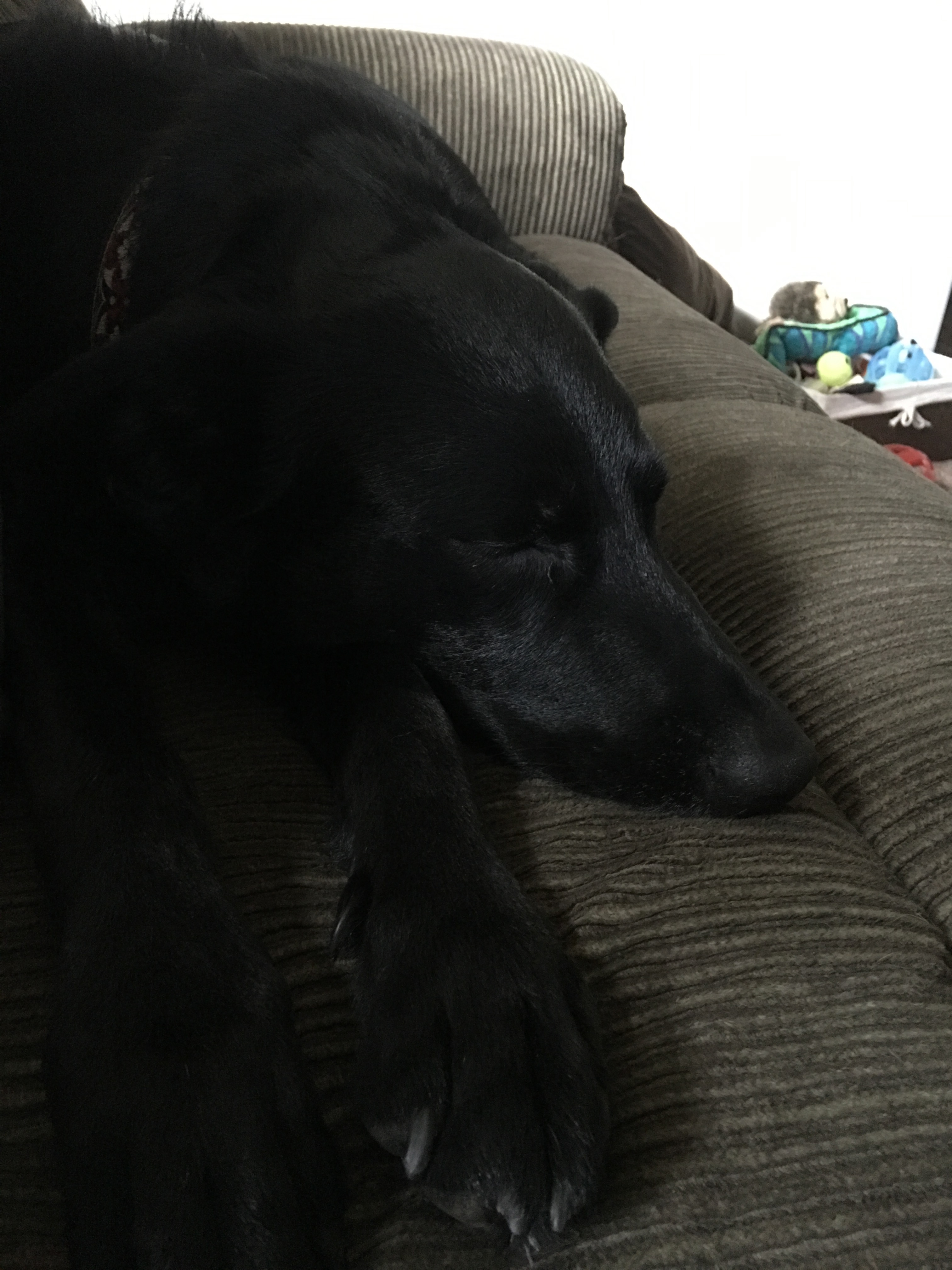
The above photo is of my current service dog, Milo, from Fidos For Freedom, Inc. Milo is a young Sheprador (German Shepherd/Laborador Retriever mix) who rarely sleeps. When he does, he sure is cute. ‘Course I’m a tad bit prejudiced being Milo’s partner. The phrase, however, “Let Sleeping Dogs Lie” originates from a proverb that means to leave something alone if it is going to cause trouble, or dredge up old arguments.

However, when we strive to promote positive advocacy and request accommodations (that were asked for before and are still not a habit for those providing the service, workshop, or seminar), when do we just “leave it alone”? One of my longtime requests is that speakers use the microphone, and repeat questions asked from the audience INTO THE MICROPHONE. Yet, time after time speakers say, “Oh I don’t think I am going to use the mic. My voice carries…” or, “I’m just going to put the microphone over here… you can all hear me, correct?” I’ve even had speakers have everyone in the audience introduce themselves and give some information about their background WITHOUT A MICROPHONE in sight!

I wave like a crazy person and “shake my head no” when speakers say this, and yet time after time I sit in meetings like this with no one using the microphone. At the end of conferences I fill out surveys about my conference experience and have tried to relay how important the microphone is to me. I’m to the point that I may stand up and create a mini-scene, asking them to use the microphone. As a person with hearing loss, in a large, cavernous room, I go from hearing 95% with microphone in use, to about 20% when it is not. Any idea how hard it is to get anything out of a meeting if you are only getting 20%?

I don’t even go the extra mile and request CART. It’s expensive. In spite of people with normal hearing asking for a copy of the transcript as well and my knowing it helps more than just ME, I don’t make formal requests for CART as a simpler solution WILL actually meet my needs. Entering a new school year with loads of meetings on my calendar already, I am to the point of “letting sleeping dogs lie”.

The only problem is, it isn’t in my nature to roll over and give up. So wake up, DOG.

Denise Portis

© 2016 Personal Hearing Loss Journal


Feeling Like a Weirdo

Always thrilled to have a guest writer here at Hearing Elmo. If you live with chronic illness or a visible/invisible disability and love to write, I invite you to post in this venue to share your story.

I don’t remember when Deb and I first met. I feel like I’ve known her “forever”.  We just “clicked” early on and she is now one of my dearest friends. Deb has taught me so much just by example. We have a lot in common, but are also different in many fun ways. C.S. Lewis said, “Friendship is born at that moment when one person says to another, ‘What! You too? I thought I was the only one!” I’m thrilled to share a post from her and hope you will check out her photography site as well. Visions of Song

apropos of nothing

I was a little bit grumpy when I went into work this morning. Just your ordinary kind of grumpy, at least I think that’s what it was at the time. We had a staff meeting scheduled for 9:30. I was walking down a hall at 9, about to get some water from the kitchen, when I saw a teammate who said “we’re meeting in the first floor conference room”. Thinking I’d lost track of time, I said, doesn’t it start at 9:30? He shrugged and said “sometimes it’s different”. Later, I found out what he meant, but at that moment I was walking in the wrong direction, sans water, notepad, calendar, and orientation. I rushed to grab my things and when I walked in, everyone was seated. Now, let me mention that I am relatively new on this job, and the folks are really nice and teach me a lot about what goes on there. Today, though, I was already grumpy, and now I was LATE (and still didn’t have anything to drink because I’d forgotten to fill up in my haste). I sat at a place around the large, squared set up of tables, strategic for what I knew would be best for me, able to see the faces of everyone should I have trouble hearing anyone. My supervisor said “sit where there are papers” meaning the agenda and other materials. Well, the seats available were not strategic for me, and I was already feeling grumpy and it was obvious that I was late and slightly holding things up. I said “everyone forgets that I am hard of hearing and need to sit where I can best follow what’s going on. So, if it’s alright by you, I’m just going to get these papers and sit over here”, walking to where I intended to sit and feeling quite determined about that fact. Meanwhile, supervisor gestured as if to say “come sit by me”. I did not want to explain why that would not be ideal, and she was trying to be helpful, but it wasn’t helpful, and by the way I was feeling more and more like a grump at this point. Further, I was feeling like a weirdo. An oddball. Someone who needs something special. I deeply dislike standing out, or seeming like I need something unusual. Everyone else was sitting wherever they wanted to, and I had to have this mini-scene because, as I stated rather unprofessionally, no one seems to remember that I’m deaf and use cochlear implants to hear. At the risk of sounding like I’m bragging, among cochlear implant users, I am a super high performer. I am pleased and even thrilled by what I am able to do hearing-wise. Then I get in a typical work situation, and suddenly: I’m a weirdo. It does not help that I am also something of an introvert, friendly, social, smart, funny, but I need tons of time to process and recharge. I really don’t think it has much to do with my hearing, either, as I had relatively normal hearing for the first 10, 12 years of life but was always this way. So I seem a little odd compared to the norm in terms of social interaction to begin with, and then there’s the hearing loss and the special needs.

Grumble.

You know? Most of the time, really and truly most of the time, I am OK with being deaf and hearing again with cochlear implants. I am glad to educate and inform and certainly to advocate for myself (although I have work to do in this regard, and tend to be much better at advocating for others). Today, I wasn’t in the mood. I finally got something to drink, and good thing, because I ended up sitting through three meetings before the day was done.

beverage at Davids Diner

It did give me time to forgive myself, for feeling badly, for not feeling comfortable about asking for what I needed. I was also glad that I have become that person who knows what she needs and while the sending of the message might be a challenge at times, I can say no, I don’t need that, I need another thing, and know how to pursue what enables me to perform and participate at work. I walked through my apartment door at the end of the day thinking I either needed a drink (the after-five kind), or a good cry. I remembered I had some delicious food to make for supper, and having eaten and cleaned up, I sat and wrote this down. I don’t feel so grumpy anymore.

Deborah is a bilateral cochlear implant recipient. She experienced familial progressive hearing loss, which presented at age 10. Her first ear was implanted in 2005, the second ear in 2008. A native New Yorker, she presently resides in the central Piedmont of North Carolina. She is involved with HLA-NC, and is passionate about issues related to substance abuse, addiction, and mental health, serving as coalition coordinator for Project Lazarus of Randolph. In her spare time she enjoys traveling as much as possible, and can frequently be found wandering the backroads and practicing nature photography in the nearby Uwharrie National Forest.

My iPhone Lasts Longer Than I do

iphone 6+

The other day my iPhone died before I was getting ready for bed. I was a little shocked, because I rarely have it just “die” on me. The new ones have batteries that last much longer – even if you are a frequent user of the device like I am. I stood there with dead phone in hand trying to figure out if I had charged it overnight — the night BEFORE — like I usually do. After hitting <rewind> in my head and backtracking over how my day BEGAN, I realized that I fished my smartphone out of my pocketbook before heading out the door this morning. That means I did not charge it last night. That means my iPhone lasted over 36 FREAKING HOURS! I was impressed. As impressed as I was, I STILL went and hooked it up to the charger. It was dead. It had to be charged.

As I fiddled around with the (stoopid) cord, (made difficult when you lack any kind of pincer grasp in your fingers), I thought, “Wow. My iPhone lasts longer than I do! I could never go 36 hours without being recharged!” And ya know? That made me a little sad.

My next thought was, however, “NOW WHY DOES THAT MAKE ME SAD?

STOP Apologizing

I hate that my default to what is normal for ME, is to feel sad about it or to apologize to myself and others. Why do we do this?

Well according to Wright (1983) and Nosek et al., (2003), people who are differently-abled and chronically ill, default to apologizing and providing unnecessary explanations and dialogue about their condition to smooth the way of acceptance. These same authors point out that this often backfires. We instead bring attention to something others may not even notice. Apologies convey regret over intentional or unintentional offenses or failures. Apologizing for needing a nap, needing to relocate to a quieter room, asking someone for a repeat, or request to stand closer to a wall to keep from toppling, is not something we should REGRET. It is not a failure. It is what it is.

I would argue that falling into the habit of apologizing for our “normal” creates a dangerous pitfall and trap that our disabilities or chronic illness are an undue burden on others. This could lead to becoming preoccupied with how hard you are making life for others. Russell, Turner, and Joiner (2009) found that individuals with disability or chronic illness already have a higher tendency towards suicidal ideation. Apologizing for something we are not responsible for only creates a perfect and toxic breeding ground for suicidal thoughts.

Putnam et al., (2003) explain that true independence and self-determination falls closely on the heels of acceptance… that can only take place when we stop apologizing for our “normal“. I use to apologize a great deal. In spite of using every piece of adaptive equipment I could find and afford, in spite of partnering up with a service dog, and in spite of reading everything I could get my hands on about positive advocacy and independence, I would still apologize for putting someone else out for helping me cope with a situation. I’m trying to do better. For example:

Instead of “I’m sorry. Could I get you to move over to that wall over there so that I may lean against it and have Milo (my service dog) on the left while we speak? I hate to ask you to move, but…

… at which point they would say, “Oh, it’s no problem. Let’s move…” However, my apologizing for having to move infers that I had a choice. Apologizing makes it seem that I regret I am who I am.

I’m trying to learn to say, “I need to move to that wall over there for balance reasons. Let’s move over there and continue our conversation?

… and their response would be, “Sure!

I was in a super crowded common area once in which a colleague was trying to talk to me about something important. Not only could I not hear her, my balance was REALLY off and I stood there wobbling like a buoy. There were no walls available, and I was really starting to feel ill. I said, “I am having difficulty in this listening environment. Let me follow up with an email because what you are saying is really important to me“. They were pleased to do so and I think grateful enough that I cared to communicate WELL with them. I had to bite my tongue to keep from saying, “I’m really sorry about this…” I had nothing to feel sorry about so an apology would only have infused my confidence with negativity.

Yes, But FATIGUE is just EMBARRASSING

What if your (seemingly) undue burden on others is simply that you cannot keep up? Perhaps you need a mid-day nap to finish the day strong. Yorkston et al., (2010) found that differently-abled individuals USUALLY have accompanying pain, fatigue, or BOTH. We tend to want to apologize for this. We shouldn’t.

I have a friend with chronic (and sometimes debilitating) ankle pain. Mid-day she goes to her office and puts her feet up. If she has to go to a meeting, she unapologetically claims an additional chair so that she can rest her feet. I walked into a meeting once and saw she had her feet up on an adjacent chair. Someone walked by and said, “Are you saving that for someone?” She smiled, pointed to her feet, and said, “No. Bad ankles!” The person didn’t question her. They didn’t shoot her a pitying look. They also didn’t steal her footrest. It was a smooth and succinct explanation for her claiming an additional chair.

Several weeks later I ran into her and talked to her about what I observed. She said, “I use to apologize for having to put my feet up. But then I thought, ‘WHY am I APOLOGIZING?’ I knew that only made ME feel badly. I decided then and there to stop being sorry for having tired feet“.

If I’m at work during a meal time and the weather is nice, I often go out to my car. I load my dog up, crank the air or heat (depending on the season), turn my cochlear implant and hearing aid off, and eat my meal in the quiet. Understanding my propensity for hearing fatigue, means I take time to unplug when needed. I need to recharge. I’m not anti-social (ok… well, not VERY) and I’m perfectly capable of going to the staff lounge or faculty dining room if I want to do so. Taking a mid-day recharge in the quiet enables me to complete my day STRONG… and unapologetic. Isn’t that what independence is about?

My iPhone may hold a charge longer than I do, but I take responsibility for recharging my own battery. Do what you need to do to recharge.

Need a nap? Take one.

Need some tylenol and a twenty minute break? Take them.

Need a “mental health day”? Take it.

Need a vacation? Take one.

Need a coffee break? Take it.

… and don’t apologize.

Denise Portis

© 2016 Personal Hearing Loss Journal

Nosek, M. A., Hughes, R. B., Swedlund, N., Taylor, H. B., & Swank, B. (2003). Self-esttem and women with disabilities. Social Science and Medicine, 56(8), 1737-1747.

Putnam, M., Geenen, S., Powers, L., Saxton, M., Finney, S., & Dautel, P. (2003). Health and Wellness: People with Disabilities Discuss Barriers and Facilitators to Well Being. Journal Of Rehabilitation69(1), 37.

Russell, D., Turner, R. J., & Joiner, T. E. (2009). Physical disability and suicidal ideation: a community-based study of risk/protective factors for suicidal thoughts. Suicide & Life-Threatening Behavior39(4), 440-451. doi:10.1521/suli.2009.39.4.440

Wright, Beatrice A. , (1983). Physical disability – a psychosocial approach (2nd ed.). , (pp. 116-156). New York, NY, US: HarperCollins Publishers


Yorkston, K. M., Johnson, K., Boesflug, E., Skala, J., & Amtmann, D. (2010). Communicating about the experience of pain and fatigue in disability. Quality Of Life Research: An International Journal Of Quality Of Life Aspects Of Treatment, Care And Rehabilitation19(2), 243-251. doi:10.1007/s11136-009-9572-1