Time Off

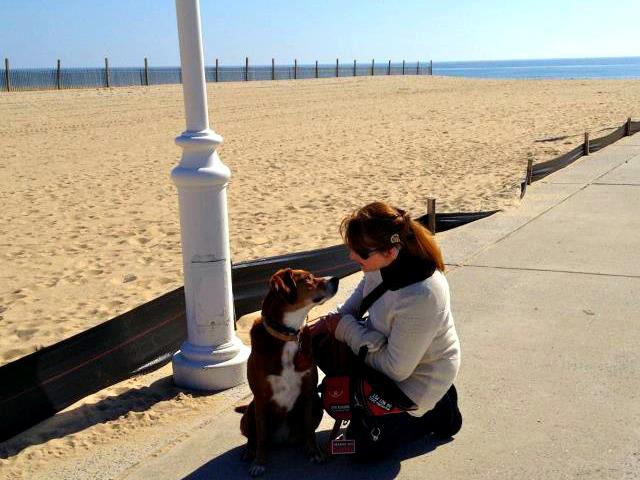
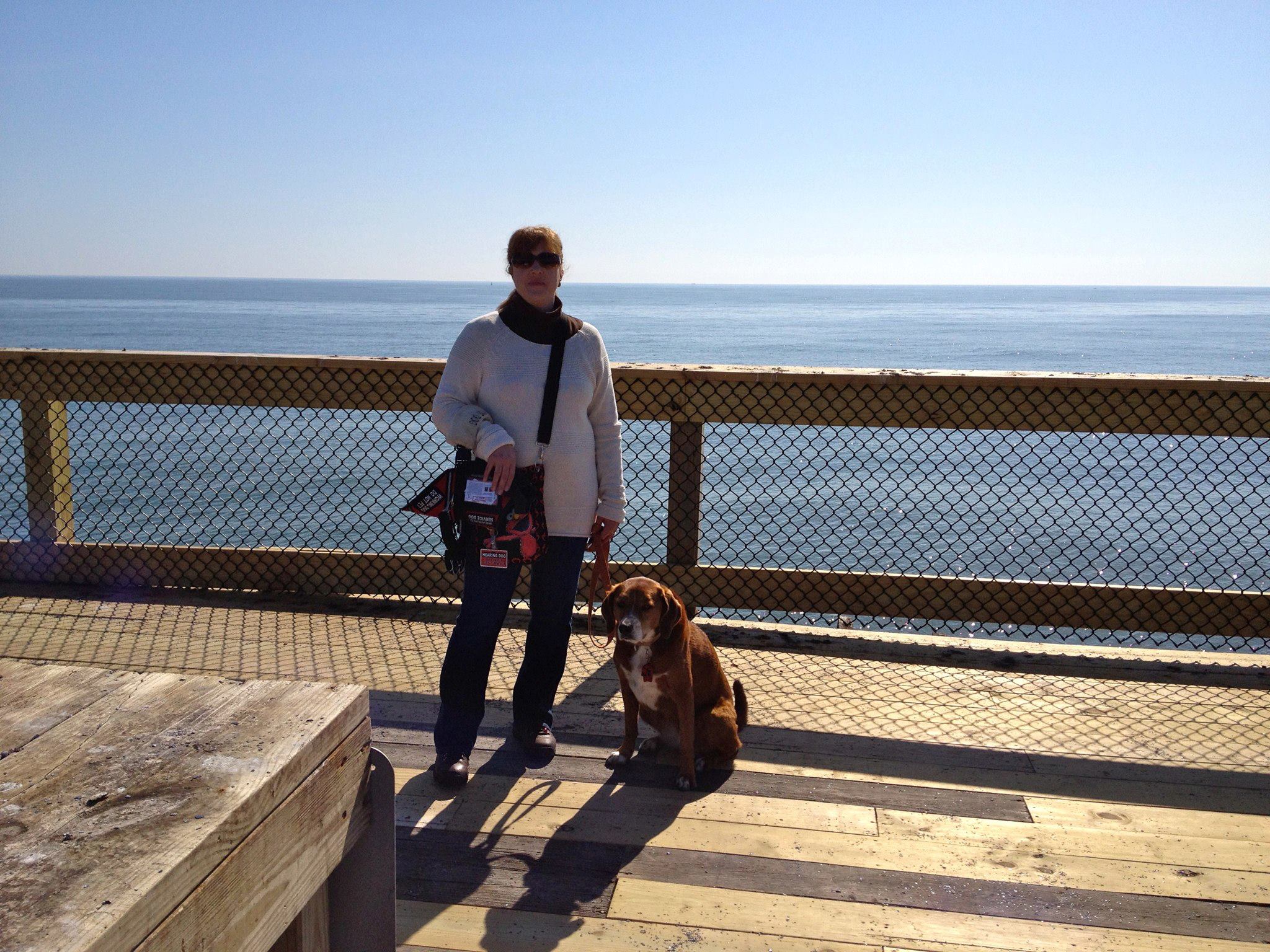
Chloe's vest comes off and she gets the "beach rules" from Denise. Unaccustomed to being "vestless" in public, she was very attentive and unsure in the beginning


As a surprise, my husband reserved a couple of  nights in a motel at Ocean City, MD, while we were on spring break from work. (One of the perks in working for a college). Apparently March is the time to go if you are not a crowd lover – or “sun” lover. Too cool to lay out or play in the surf, but beautiful weather for walking and many opportunities for quiet time.

Chloe is normally “working” when she is in public. Determined to give her some time to just be a dog, I removed her vest for large amounts of time. She was at first a little timid about being without her vest. Once she saw some other canines on leash though, the wag was back in her tail. Even working dogs need down time. People ask me all the time if Chloe gets to relax. I always have to grin. Chloe is almost 8 years old and at home? Well, let’s just say she knows how to relax. She doesn’t wear her vest at home, but she still alerts to timers, my phone, or my name being called. But she naps (and snores), she plays with her buddy, Tyco (our family dog), she has several squeaky toys, she squirrel watches, and eagerly awaits family members coming home.

Chloe enjoys working though. She danced her way on campus just this morning and wagged her way all the way to the elevator. Sometimes I wish some of her “wag” would rub off on me as 7 AM classes on Monday seemed awfully early to me after a week off!
Everyone needs time off. It can be hard to do if you are working to pay bills, save money, or try to get out of debt. But time off can be in small, “mini” vacations. Even an hour or two here and there can be very beneficial in helping a person re-group.

People with DisABILITIES Need R&R too!

I have met a number of people with various disabilities that have confided that they rarely do what others call “fun” things. Think about it for a minute. If people who walk without assistance, hear without assistance, see without assistance, and speak without assistance enjoy things like movies, walking, reading a good book, or hanging out with friends, well? It just may not be that easy for others.

I like going to the movies. I went to see “The Hunger Games” over spring break with my husband and 21-year-old son, Chris. But I don’t get the same level of enjoyment out of movies that they do. Even with Chloe by my side, I am very disoriented in the dark, especially if my cochlear implant is picking up the very loud commercials and previews on the screen. As I make my way to a vacant seat, I am often fighting the effects of vertigo. After I get seated – hopefully in a place where people won’t have to crawl over my assistance dog and I – it takes a number of adjustments to find a good program on my CI to best hear the movie. If I do that, I sometimes find it difficult to converse to the person right next to me too. At times I miss things said in the movie. If I’m with someone I know well, I’m not bashful and will lean over and ask, “What did they say?” There are not any captioned theaters close to my home (although I am glad there are some within an hour’s drive), so most of the time I go to the same movies you would attend. However, not having captions mean I have to really pay attention! Can I just be honest and say that I’m unable to eat popcorn and catch an on-screen conversation at the same time? (BIG GRIN). I have to really focus and concentrate to understand what is going on. So it is still “fun” for me… just not perhaps the same level of “fun” it may be for you because it does take WORK.

For some, sitting down and reading a book may not be “fun”, and it doesn’t mean they don’t enjoy a good book. Some folks have trouble even holding a book, or turning pages easily. Taking a walk may relax YOU, but for someone who has Meniere’s disease it can be difficult to do a simple walk. My world constantly turns counter-clockwise. It is a slow rotation, mind you, but a rotation nonetheless! On high humidity days, the rotation picks up speed – one of the reasons I just don’t try to walk on days like that! So walking on a sidewalk in a straight line takes concentration. I have given up walking with family members. Although I enjoy the conversation, I cannot talk and walk at the same time! I can talk to my walking buddy, Chloe, and she just listens. I don’t have to worry about her end of the conversation and my having to make sense of what she said while still putting one foot down in front of the other. We love to go into the woods on trails and in grassy areas too. This requires even more concentration. I usually shut up at this point as I have to carefully balance each step. So yes… I enjoy walks but probably not on the same level you do.

Despite having to make adjustments and find a new way of doing seemingly mundane things, even folks who are differently-abled need to take breaks. Perhaps even a lot of them! They may be in the form of naps. I am learning that napping or resting is a necessary requirement for many people with certain kinds of invisible illnesses. I require 8-10 hours of sleep a night. (When I tell people that, they FALL OUT, but if it helps you get through a day “hearing well”, you do anything necessary). Others may require a nap – or TWO. They aren’t lazy. They aren’t depressed (although just like anyone, people with disabilities can and do get depressed). They simply require some extra rest in order to continue a day’s work.
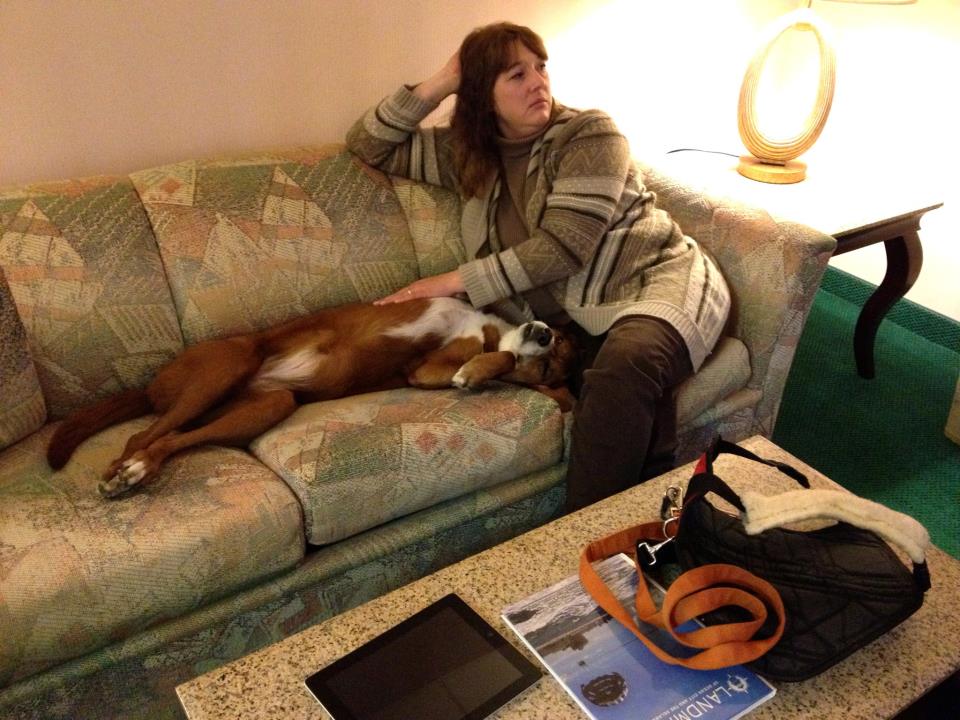
Chloe "relaxing" on a mini vacation at the beach. She really knows how to de-stress!

Careful not to judge. You may wonder why someone doesn’t enjoy the same kind of “down time” you do even though you have the same disability. Each person has individual differences in their disability. I have a friend who enjoys running in his spare time. I’m talking about REAL races… the kind where you take off after hearing a starting pistol! He’s an incredible runner and does very well. He is a bi-lateral cochlear implant user. When I first met Sam, I was astonished to hear what he did for fun! Having hearing loss and balance issues, running isn’t something I can enjoy.

I’m not saying we shouldn’t look for others who are struggling with some of the same issues. We can mentor, give advice, and support someone else in a way that will give them the tools they need to live a victorious life. But do be aware that you may share a diagnosis, but have different symptoms, struggles, and issues. We can still be a listening ear and give encouragement. Just be careful about insisting on something that works really well for YOU, because it may not work really well for them.

I’d really love to hear about some of the ways you choose to unwind! What do you do to relax? What is FUN for you? What do you need to do in order to enjoy some of the things others do without accommodation?

Denise Portis

© 2011 Personal Hearing Loss Journal



Kidney Disease and Hearing Loss

Recently, I read a blog that mentioned kidney disease and hearing loss. You can read the post HERE.

My husband, Terry, and I have been married almost 26 years. He was born with only one kidney, and the one he has doesn’t work ideally. Because he has always lived an “alcohol/drug” free life, he is in good health considering!

I have noticed, however, that he has started showing signs of hearing loss. It started with the television. We “TIVO” everything so that we can watch favorite shows when we have time to sit down and watch them together. In recent months, I have noticed that HE is asking me to turn the volume up. I’ll let that sink in for a minute (grin). I’m deaf. Sure I “hear again” with a cochlear implant, but HE is asking ME to turn up the television. He usually has the remote that fast-forwards through the commercials (as I seem incapable due to vertigo in watching the screen and trying to hit buttons). I have the remote that controls the volume.

He is also saying “huh” more. I’ve noticed it at the dinner table and also in restaurants. Granted, both places can be noisy environments, but it has been a bit of an eye-opener for me to be on the other side of that “huh?”

So as we’ve aged, my hearing has gotten better and his – not so much. I can’t say at this point he will need hearing aids, but I’m thinking the probability in the next 10 years is very high.

I want to be the kind of spouse he has been. Terry has been my biggest cheerleader, support, and source of encouragement. It can’t be easy to be married to someone who is late-deafened when you fell in love with someone who could hear. He has shown me that what happens after “I do” doesn’t impact love, commitment, or a shared life. He hasn’t let it phase him that I have a balance disorder. He picks me up if I fall, brushes me off and helps me see the “funny” in it (as long there isn’t any blood). He encouraged and supports my having a hearing assistance/balance assist dog from Fidos For Freedom. He now actually serves on their board.

So if my husband with kidney disease DOES lose his hearing? I’ll be there for him too. In the meantime, I am helping him navigate living with some adjustments regarding VOLUME.

Denise Portis

© 2012 Personal Hearing Loss Journal

Link to story in Wall Street Journal:  Click HERE.


Commencement

This past Sunday, my pastor spoke on discipleship. In discussion of what discipleship actually is (growth), he discussed how some people may get confused that at the end of twelve years of high school they graduate and participate in commencement. Commencement is not the end of something; rather, commencement is the beginning of the rest of your life. However, for some that may be the defining moment of their life – the culmination of all they will accomplish.

According to dictionary.com, commencement is a beginning, or a start. Merriam-Webster defines it as a point in time in which one “enters upon the next”. In just a few months, commencement will take place at a number of schools. At the community college where I work, reminders are going out to students reminding them to petition to graduate by a certain date. At Fidos For Freedom, a service dog and therapy dog organization, commencement takes place at the banquet that takes place each May. Clients who are “graduating” this year are already gearing up for speeches, festivities, and recognition of a completion of training.

Yet these exercises are not an ending to anything. Rather, they are a beginning. For college students they may be transferring to a four year college to obtain a higher degree. It may mean looking for that ideal career. For clients at Fidos For Freedom, it is the start of a new life of independence – with trainers and “family” in the wings should any further assistance be needed.

Safe People

The topic of my favorite book, “Safe People”, has been a recurring theme in many of my discussions with family and friends lately. I actually dug my copy out to read it again, because I found myself recommending it to several different people. Learning to identify and avoid unsafe people and relationships can be a hard-learned lesson. I think the truths that have permanently etched themselves on my heart and mind from this book, are how to be a safe person MYSELF. For me, it was reaching a point in time when I could turn my back on the past and boldly face my future. Sure! I took lessons learned from the past – in my relationships, problems, and successes – but armed myself with those lessons to be better equipped for my future.

It has been a commencement for me. Like Merriam-Webster explains… it is a period of time where I chose to “enter upon the next” chapter of my life.

Progressive Illness/Disability

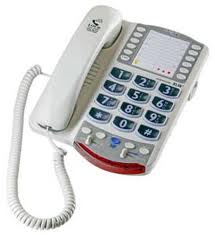
I think one of the frustrating things about having progressive hearing loss, or chronic illness/disability, is that one may commence living life with a new charge for life , equipped to be as independent as possible, only for changes in our health to take us back to square one. Prior to my cochlear implant, I remember learning to cope with the telephone, conversations in crowded places, and learning to speak with people with poor communication habits. However, in a matter of months my hearing would take a dive and I would discover that what worked last month, didn’t work at all now! Like most families with small children at home, we lived paycheck to paycheck. We pinched pennies and scrimped and saved to purchase an amplified telephone for me. For five or six months I was in telephone heaven! I used the phone every single day with confidence and enthusiasm. It didn’t take long, however, before I was struggling to even use that new gadget. I earned a little extra time by using it when the kids were outside and the house was relatively quiet. What was once easy became increasingly difficult. Eventually, the frustration of what I wasn’t hearing, despite hearing aids set to t-coil and begging people on the other end to speak clearly into the phone, had the phone collecting dust from lack of use. I’d talk to other HoHearies and get some new ideas. At some point though? The phone became a thing of my past. I had to come up with ways to contact people other than the phone. For the late-deafened community, the emergence of email, texting, and even FaceBook became very real “life-savers” in terms of being able to freely communicate with others. Although I hear well enough on the phone now that I have a cochlear implant, these other forms of communication are still my own first choice.

Resilience is a Special Kind of Strength

Many readers of Hearing Elmo have various disabilities, invisible illnesses or chronic health problems. For some, those difficulties are progressive and force them into a constant state of evolution. This can actually be healthy. (I see some of you grimacing out there!) Yet progressive illness can produce resilience – the likes of which create a strong and capable individual who can face life’s problems with the confidence earned through experience. Resilience is a special kind of strength. These individuals know that living successfully with progressive health problems is simply adopting an attitude of commencement.

Some people never graduate. They never enter that next stage of life. Even though the past may be painful, they cling to it with a tenacity that may stun family and friends. If they have progressive health problems, they may be stuck in the grief process. The grief process is a PROCESS. In a healthy situation, one moves from one stage to the next, eventually reaching acceptance and a new normal. Even psychologically we can get stuck in the past. Everyone else has moved on, but we have super-glued ourselves to unresolved situations instead of letting go and moving on with our lives (like everyone else has). Living this way yields toxicity to both ourselves and to others. We become “unsafe people”. It can have a negative influence on our relationships, self-esteem, and emotional/mental health. Dr. Seavey addresses how to face the future in a terrific article that can be accessed HERE.

Can you look back and see different points in your own life where commencement took place? Using all you learned in a specific period of your life, you chose to begin the next chapter of your life. May we all view commencement as springboard to usher in a successful, victorious future and not as a monument that designates an END!

Denise Portis

© 2012 Personal Hearing Loss Journal

It’s the Little Things

Deborah is a bilateral cochlear implant recipient. She experienced familial progressive hearing loss, which presented at age 10. Her first ear was implanted in 2005, the second ear in 2008. A native New Yorker, she presently resides in the central Piedmont of North Carolina. She is involved with HLA-NC, is a volunteer at the Wildlife Rehab Center of the NC Zoo, and is a board member of the Brain Injury Association of North Carolina. In her spare time she takes courses at the local college, and enjoys walks and photography in the nearby Uwharrie National Forest

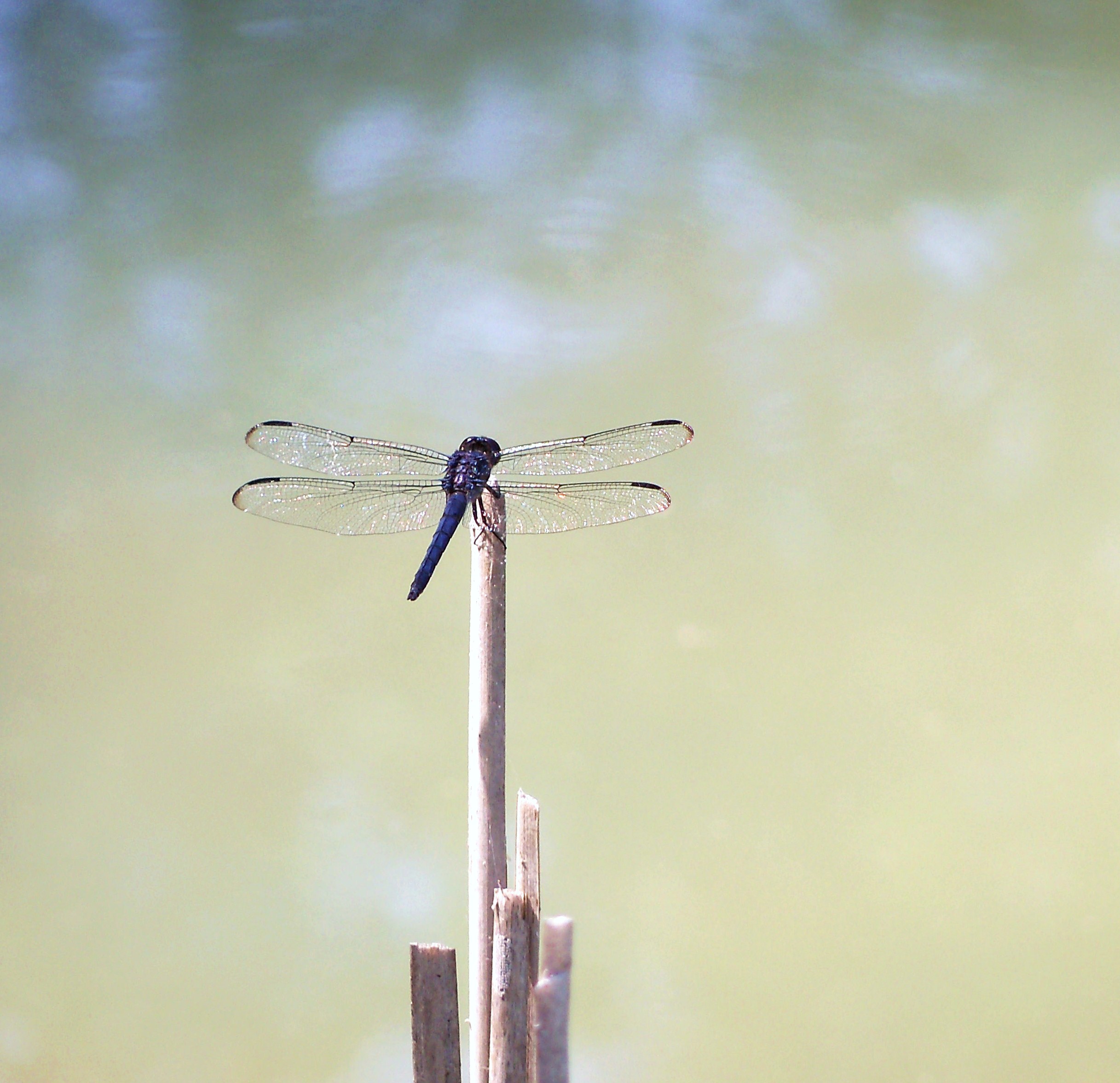
I love being out in nature, taking long walks and observing the world around me. I often capture some of what I see with my camera.  Trees, sky, colorful blooms, rivers and streams, rocks, fungi, ferns. All are a delight to my senses. However, there is nothing I enjoy photographing more than bugs. Yes, bugs. From the stingers to the crawlers, the colorful to the camouflaged, the loners and occasionally those in flagrante delicto. From the time I was a young girl, I loved the outdoors. When my family and I still lived in the city, you could find me in the back of the apartment building, climbing a small fence so I could wander around the grassy patches that remained among the asphalt yard. When we moved to the suburbs, on a dead end street that had many acres of woods adjacent to it, I was delighted! This was still a time in our culture where folks were not so afraid to let their children run around the neighborhood, playing at friend’s homes and backyards. I chose to run around in the woods, usually by myself. I was not yet so hard of hearing that it was a concern, nor was it an explanation for why I preferred solitude. I am still this way today.

I’ve been thinking a lot about how my love for observing and photographing bugs ties in with my experience as a cochlear implant recipient. I was recently in New York for a visit, and one day a friend and I went to visit some museums. She, an artist and therapist, had been curious about my fascination with bugs. As we all know, bugs do not have a great reputation. Much time and resources goes into controlling or eradicating them. No one had ever asked me about this, and I can honestly say I’d never really wondered. I thought about all the people who seem to hate these fascinating beings! Nevertheless, my response was immediate and striking to both of us: it is in the little things that we learn the most about life. The whole world can be found in one of those little creatures. From the smallest of them we can receive the greatest lessons. When I observe a spider building a web, or an ant carrying an object many times its own body weight, and when I consider the role that each bug plays in the scheme of life, I am awed and humbled.

Seemingly Inconsequential

It is the seemingly inconsequential experiences of hearing with my cochlear implants that offer the most striking images of the radical impact that “hearing again” has had on my life.  When I mentor someone who is considering getting a cochlear implant, I have found that sharing the smallest CI moments, such as the one that follows, best illuminates the impact of the ability to hear with the technology.

Six months post activation of my first cochlear implant, I was driving across Colorado to visit with clients I served in a statewide program for individuals with traumatic brain injury. I made a stop at a gas station, and went inside to buy a soda. It was a busy time, and the gal at the register was moving customers through fairly quickly. We spent about a minute together as she rang up the purchase, collected my money and made change, made a joke about the crazy weather we’d been having which made us both laugh and to which I offered a humorous rejoinder. (No, I don’t remember what it was anymore, but she thought it was funny, and that’s all we need to know J ). She wished me a good day and I left the store, still smiling over our enjoyable interaction. Suddenly, a realization hit me with such force that I came to a complete standstill: I was able to have a quick, light-hearted interaction with the girl at the gas station. Tears welled up in my eyes, and I was half laughing, half crying: I had joined the living. Before I could hear again with my cochlear implants, my days were filled with experiences I call “smile and get the hell out of there” moments. If you are not hard of hearing, you cannot imagine how difficult it is to read the lips of everyone encountered each day. Struggling to accept that along the way I left any number of people with the impression that I was very pleasant but a bit slow was a fact of my life. But now I was one of those people who could banter, who could have lots of marvelous little interactions with people if I so wished, and I recognized right then the enormous impact this was going to have on my quality of life. I am sure that until that moment I had not fully comprehended that this is what people do, this is what is meant by “small talk”. It wasn’t long before I realized that I could also eavesdrop. LOL! To my hearing friends I say: Don’t act so shocked! You do it all day long and don’t even think about it! Six years hearing again and I can confirm that it’s not all brilliant commentary. But I like being able to decide that for myself.

So, the next time you see a little bug, think of me, and stop and watch it for awhile. If it’s in your house, don’t stomp on it. Scoop it up and put it outside, and observe it. Discover all those insights and life lessons right in front of you, free of charge.

Guest Writer, Deborah Marcus

© 2012 Personal Hearing Loss Journal

Walk a Mile in My Shoes

Gonna change directions here today as the death of Whitney Houston coincides with something I am seeing more and more in the disability community.

It doesn’t matter whether or not you like Whitney Houston. What I am disappointed to see is some of the comments and “hatin’ on” this artist since her death. I actually saw on one person’s Facebook that drug addicts and alcoholics get what they deserve. “Someone with so much talent shouldn’t have wasted it”

Wow. I mean REALLY?

Unless you were thrust into fame and fortune at a relatively young age…

Unless you had to deal with the media on a daily basis, giving up any hope of privacy…

Unless you married for love and were crushed by disappointment…

Unless you raised a child as best you could in the backdrop of an industry that can be unforgiving…

Unless you developed an addiction because of life’s crushing problems and entered rehab while the whole world knew it…

Unless you made mistakes and fell back into bad habits – all while the whole world watched…

… then keep your mouth shut about Whitney Houston.

Why Does This Upset Me? Why Should it Upset YOU?

Anytime people begin to criticize and judge someone else a change takes place. Amnesia.

I rarely hear someone criticize and judge someone who is just like THEM. It usually happens when someone is different than you are. Criticizing is easy when we don’t walk in that person’s shoes. Judging is a simple task when we cannot hope to understand what really caused someone to do something when they are different than we are. We forget all the times we have been hurt for being judged and criticized by people who do not understand our own choices in life.

Wanna get me ticked off? Criticize and judge someone who chose to mitigate their disability with a service dog when you don’t live with a disability. Sometimes even others within the disability community may scratch their head and wonder why a person would choose a service dog when “they have the same disability you do”. What they may not know is that there ARE various differences between your disabilities. Your lives may be different. They may have 24/7 help that you do not have access to in your own life. Why don’t we celebrate “whatever works”?

In the hearing loss community, I know people who criticize people who don’t allow “nature to take its course” and embrace their deafness. To some, if you do not learn ASL then you are shunning a community that could be your family. For others who have accepted technology and/or surgery to stay connected to the hearing world, they may criticize those who have learned ASL for various reasons – personal reasons! I know people who criticize other people’s choices about hearing aids or cochlear implants. Why are we prone to criticize anyone who makes a different choice than what we have made for ourselves?

I think perhaps it is a form of self-protection. We may somehow feel that if someone who is very similar to us chose another path, that their choice may mean that our own path was a wrong one. It may be a form of defensiveness. If we see someone successful at living life with a disability, we may feel the need to criticize because we still have some problems with our own disability. If we see someone floundering at living life with a disability – and they chose another path? Many point and say, “I told you so”.

We could all learn to be more compassionate. We could all learn to listen more and keep our mouths shut.

When you judge another, you do not define them, you define yourself.” –
Wayne Dyer

If you judge people, you have no time to love them.” –
Mother Teresa

What May Happen if You Reserve Judgment

If you can keep your opinions to yourself, you may just make some discoveries:

You didn’t understand why they did what they did until you got to know them better.

You misunderstood their choice

After learning more about the person, you actually agree with their choice.

After time you find that you still would have done it differently yourself, but it seems to work for them.

If you can keep your negative opinions to yourself and instead pray for and encourage that person, you may discover a…

FRIEND who has the same taste in shoes!

Denise Portis

© 2012 Personal Hearing Loss Journal

Why I Love Winter – Restoration


Part Three of Four…

February starts this week. This winter has been a mild one in my neck of the woods. Very little snow and mild temperatures make many folks exclaiming “What a terrific winter we’re having!” I don’t begrudge the milder winters to those that enjoy them. I do love my snow though! When we have more than our share of winter weather, I’m happily out in it directly after a snowfall, shoveling and scraping and tossing the “white stuff” around!

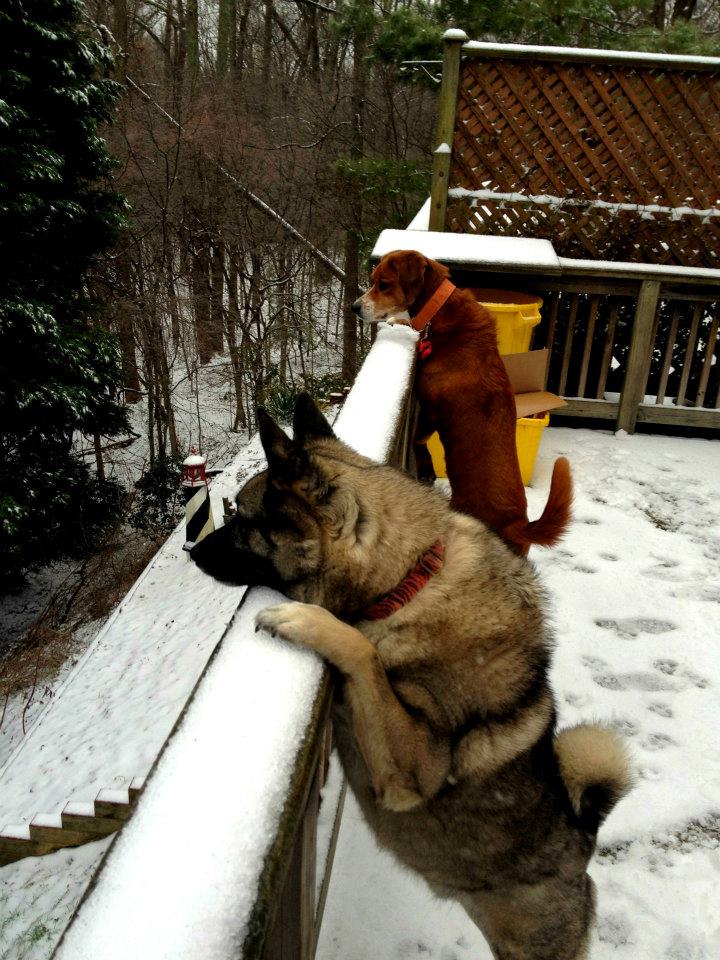
Some of nature goes “dormant” during the winter while other types of plant life may just conduct photosynthesis at a reduced rate. Animals may hibernate, or only move about sparingly to limit calorie burning. Our winter has been so mild the squirrels have been scampering about much like they do in the autumn. I know for a fact the raccoons are out and about for we finally had to break down and purchase “raccoon proof” trashcans. I’ve seen deer near the creek below our home. So have the dogs:

Foxes stare at us from the bushes and shrubs at night when we take the dogs out for the last time. Animals are busy, busy. The trees and perennials are just – C o N f U s E d.

When I think of winter, however, I think about all the restoration that is taking place. Nature may not LOOK alive, but it is. Many types of life are resting, preparing to get very busy producing new growth or replenishing body fat. Growth spurts cannot happen without winter and the dormant phases many types of life experience. This period of restoration actually prepares and allows this growth.

An old, but favored song about the seasons says it much better than I am able to describe:

Every Season

Every evening sky, an invitation
To trace the patterned stars
And early in July, a celebration
For freedom that is ours
And I notice You
In children’s games
In those who watch them from the shade
Every drop of sun is full of fun and wonder
You are summer

And even when the trees have just surrendered
To the harvest time
Forfeiting their leaves in late September
And sending us inside
Still I notice You when change begins
And I am braced for colder winds
I will offer thanks for what has been and was to come
You are autumn

And everything in time and under heaven
Finally falls asleep
Wrapped in blankets white, all creation
Shivers underneath
And still I notice you
When branches crack
And in my breath on frosted glass
Even now in death, You open doors for life to enter
You are winter

And everything that’s new has bravely surfaced
Teaching us to breathe
What was frozen through is newly purposed
Turning all things green
So it is with You
And how You make me new
With every season’s change
And so it will be
As You are re-creating me
Summer, autumn, winter, spring!

Life Restored

In my own life I have periods of “winter”. Frankly and honestly? I have been more dead than alive during specific life seasons. I don’t know if I could even call it “dormant”, but I do know life continued for spring eventually DID come.

Experiencing deafness as an adult and acquiring a balance disorder is never a welcome addition to life. One doesn’t ASK for disability, chronic illness or invisible difficulties. Yet, some of us are asked to walk this road. I wish I could say that I have always accepted what has come with grace, humility, and courage. I cannot.

Depression is an ugly thing. It comes in many forms. Depression also spawns a number of different symptoms and feelings in individuals. For me, it meant I almost lost my life. There were some close calls. Even when I was able to get past the despair, there were days I simply felt numb – going through the motions of being a mother of preteens, working, and barely surviving. It wasn’t until the crisis had passed that I was even able to share with those closest to me what I had gone through and how close I really came to the “end”. Maybe that is why this blog is so important to me and why I open it up to authors of all kinds to tell their story. In 2002, I was reading a lot of things on the Internet. Some of it saved my life.

As I began to learn to cope with everything that was happening and learned to adjust to my worsening hearing and balance, I got a lot of rest. Not even necessarily the poor type of rest that comes with depression. I did begin to slowly heal from the inside out. No (grin). My ears didn’t heal. But I did gain momentum in learning more about HOW to cope with hearing loss and balance issues. I learned to ask questions. I learned what worked for me and what did not. I surrounded myself with people who were ahead of me in the process and along side of me in the journey. Eventually I discovered I could also reach out to those who were still coming to terms themselves with hearing loss. I felt restored.

I want to close this post out with the video (captioned in both English AND Spanish) of “Every Season”. I hope you find as much wisdom in the simple song as I have. If you are experiencing winter as the result of chronic or invisible disability and illness, please write me. I handle all correspondence through this blog confidentially unless you specifically ask me to post your response for some reason. (Please email me at denise.portis@gmail.com    instead of leaving a comment as these DO become public). Despite my hearing loss I am a good listener. (SMILE) I do not claim to have all the answers, but I have a story, too, and we may share many experiences, frustrations, and successes. I hope (and even pray) that your winter is a time of restoration.

Denise Portis

© 2012 Personal Hearing Loss Journal

Why I Love Winter

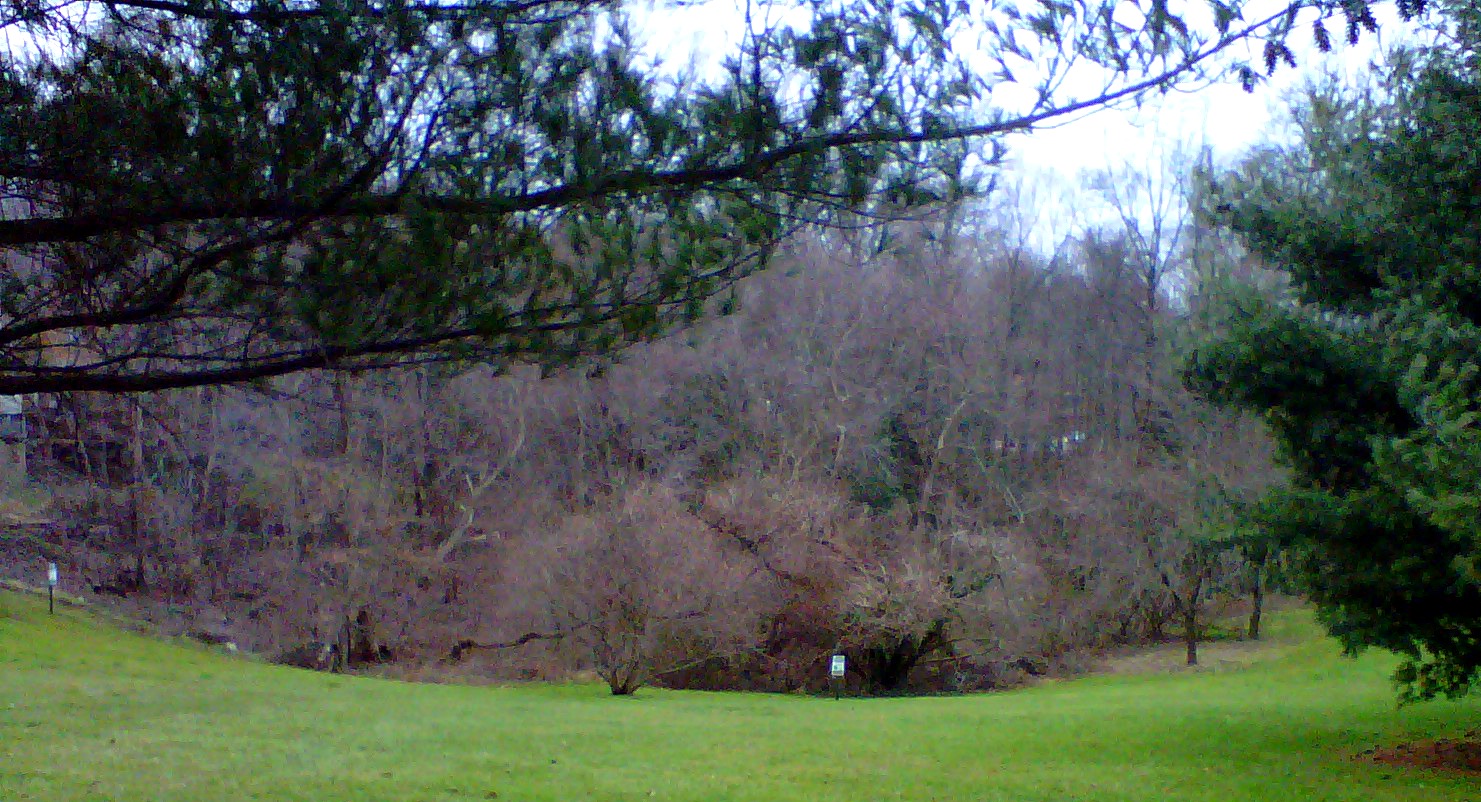
The woods near our home without their usual foliage…

(PART ONE OF FOUR)

Chloe and I took a walk after lunch today. I had to smile as I saw the snowflakes falling softly around us even though it wasn’t cold enough to “stick”. I just love winter. I love actually getting out IN the cold weather as well. I love bundling up and walking briskly – something I can do even with Meniere’s as my symptoms are usually much more mild in the winter. I love being able to see my breath in the air and being able to smell various fireplaces in use in homes as I pass. However, one of the biggest reasons I love winter might surprise you. As a person with hearing loss, one doesn’t expect to enjoy QUIET.

Winter Can Be So Quiet

When walking, many people are inside where it is warm. So in the wintertime, my walks are often much more quiet than when I go during other seasons. I love the quiet. Don’t get me wrong! I love being able to hear, but I hear best when it is quiet. Am I contradicting myself? (BIG GRIN). Eh… maybe.

Hearing with a cochlear implant is a mind-boggling thing. I hadn’t expected to hear this well again this side of Heaven. When my husband and I realized that my progressive hearing loss would ultimately mean I would not hear at all, we were concerned. Thankfully, through the support and relationships of the Hearing Loss Association of America, we learned that being late-deafened does not necessarily mean the end to hearing. We learned about cochlear implants and I took almost three years researching and “talking the much needed ears off” numerous cochlear implant recipients. As thankful as I am for my cochlear implant, it does not mean that I now hear perfectly. As a matter of fact, I become a little aggravated when people act as if my cochlear implant “fixed” my hearing. Yes, I can hear. But it’s a different kind of hearing, and one made more difficult when trying to understand speech in the midst of noise.

So I love the quiet. I hear better. When walking, as the world around me is more quiet compared to other times of the year, sounds that are present are crisp and clear. If it is quiet on our walks, I can actually hear much of what Chloe is hearing.

Chloe can HEAR the squirrels even though she hasn’t yet spotted them…

I love listening to nature. I pick up many more sounds in the winter because of the quiet. The lack of foliage also assists in allowing sound to carry. In some spots of our neighborhood I can even enjoy an “echo-like” effect in the world around me.

We Need the Quiet

I have had numerous late-deafened folks tell me that they too, go “deaf” on purpose. For those of us who are thrifty, it saves on battery life. However, for many it is simply a matter of being mentally fatigued. It takes a lot of effort to understand and communicate using technology and speech reading. People with hearing loss must employ a number of senses to communicate. Those with normal hearing are not required to use much more than their sense of hearing to communicate. I believe this is part of the reason I need 8-10 hours of sleep a night. (Yes… you read that right!) I am mentally exhausted at the end of every day just because I’m communicating with family, friends, and co-workers. It takes work to hear! Listening requires active participation for those of us with hearing loss.

The forest is sleeping during the winter…

When there is a great deal of background noise, I don’t hear well. As a matter of fact? There are times I don’t even try. Case in point… my church:


Want to know the noisiest part of every church service? I think it is before and immediately after the actual service. Or, how about when the pastor or minister of worship says, “Everyone take a few minutes to meet and greet those around you!” ? AAAARGH! I try to make myself invisible if you must know. I am petrified someone will come and talk to me because I know I won’t hear them. I’m getting better though when someone approaches with their hand out and a big smile. I’m taking a risk but “betting on” that they are saying, “Hello, how are you today?” I have learned to smile, shake their hand and say a simple “Hello!” My preference in communicating is definitely one-on-one.  I do really well – IF – it is in a quiet atmosphere.

But you know something? My exposure to multiple disabilities at Fidos For Freedom has taught me one very important lesson. We could ALL do with more “quiet” in our lives. Quiet can foster introspection – and friends? I’m big on reflection, meditation, and soul-searching! For many of us, we face many physical battles on a daily basis. We really NEED quiet time. Contemplation may provide us with resolve, a new “plan of attack”, time to absorb new information about our disease/disability, and the ability to recuperate emotionally and mentally. As a person of faith, it is my quiet moments that I can humbly ask for guidance or assistance… or scream for help!

It is often when we are quiet that we can plan and “gear up” for the journey ahead. Victor Hugo said, “One is not idle because one is absorbed. There is both visible and invisible labor. To contemplate is to toil, to think is to do. The crossed arms work, the clasped hands act. The eyes upturned to Heaven are an act of creation.” For some of you, life’s journey requires a little planning. I have a friend who cannot do anything spontaneously. Errands are planned, cleaning specific rooms of the house are planned a whole day in advance. Errands rely on the goodwill of family and friends who are willing to cart her “here and there” as her eyesight has deteriorated. Cleaning is done when the body isn’t on “strike”. Lyme’s and Chronic Fatigue insist that she double-up on recipes when she has enough energy to cook. That way she can freeze things so that she doesn’t go hungry on days she cannot cook meals. She requires a lot of quiet time. For her… it’s not a communication issue. She needs time to plan and to take strategic steps in organizing as best she can her journey. She even needs quiet time to COPE with her disease.

Winter allows me more quiet time. Outside – fewer people are out and about. Inside – family members at home tend to curl up and do quiet things on their computers or may catch up on reading. Like hibernating bears they tend to sleep more. Co-workers are quieter during the winter. Hubby says it is because of S.A.D. Who knows? I do think winter generates a feeling of “quiet” in many people.

I encourage you to find more quiet time. Winter, spring, summer, or fall – the season isn’t important. Finding time to be QUIET and use the time wisely is important to all. Even if you use the time for a power nap…

Denise Portis

©2012 Personal Hearing Loss Journal

My Goals? Stop Apologizing…

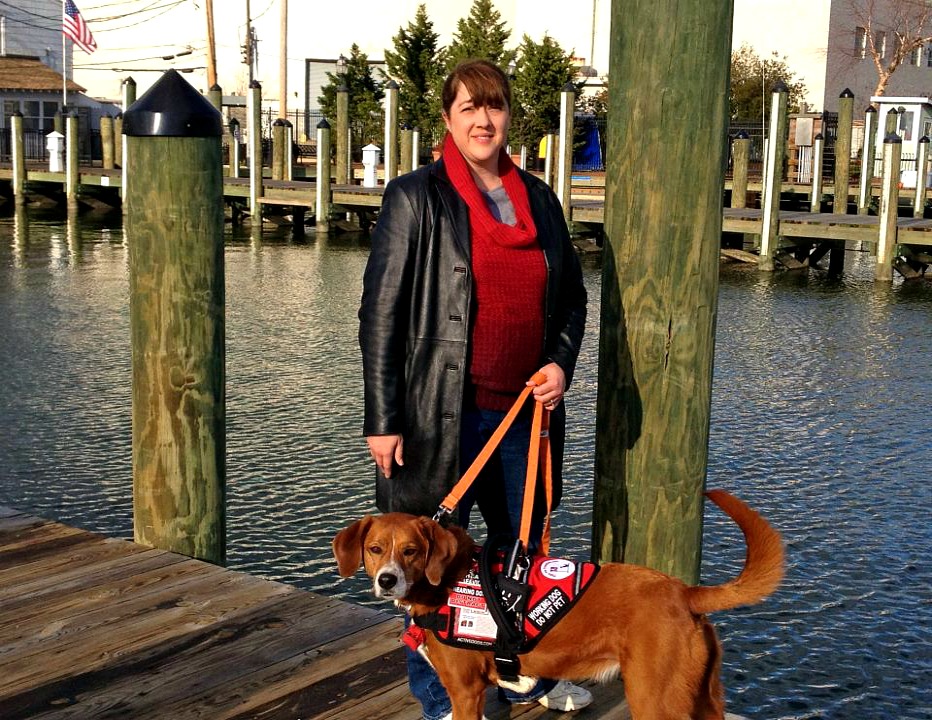
At City Dock in downtown Annapolis near the U.S. Naval Academy

I find it a little hard to believe it is 2012. Normally, the New Year doesn’t sneak up on me. However, this year it certainly did just that. In the past, I’m almost obsessive-compulsive about planning and organizing my resolutions for the New Year. I suppose that I haven’t allowed myself to obsess about it this year, points to the fact that I continue to change and evolve as I age. I think change is important and hope that I will always grow, mature, and change from one year to the next.

Sometimes though? Sometimes I see things in myself that I need to change because they are negative. In my reflection of 2011, I discovered a real negative that I really want to work on in 2012. Introspection did not really help me discover WHY I have developed this bad habit, but I can make some educated guesses.

I apologize. I apologize a great deal. I apologize for things that are not my fault. Some reasons I may do this?

1. I feel as if it will keep others from feeling the blame or reacting in a defensive way.

2. I default to shouldering the blame for most things.

3. I hope to diffuse any uncomfortable thoughts or reactions by others.

4. I hope to garner apologies and acceptance of responsibility by others by my own example.

5. HABIT

Please don’t misunderstand me. I believe that people should accept responsibility and offer apologies when they are warranted. However, I have developed a habit of apologizing for things that are not my responsibility. Sometimes when I say “I’m sorry”, it is simply a matter of miscommunication. I need to say something… but do so in a way it more accurately communicates my real meaning.

An example: “I’m sorry you misunderstood me”.

A better response would be, “I believe I have been misunderstood. May I clarify my meaning and intent?”

As a person with hearing loss I even respond with a “sorry” when I missed something. Example: “I’m sorry. I didn’t catch that”. It may very well be that it is no one’s FAULT that I missed it. After all… I am a late-deafened adult. Yes, sometimes folks may cover their mouth with their hand, or mumble. When that happens it is better to say, “I didn’t catch that. Could you repeat it please?” – or – “You were covering your mouth and I didn’t catch that. Will you repeat it please?” I’m going to try to stop myself before I respond with a habitual “I’m sorry. I didn’t catch that”.

It’s My Choice to Mitigate My Disabilities with a Service Dog

Recently, I “replied all” to an email in which a group of employees were nailing down details about when to meet for a book group. We are reading “Storm” by George R. Stewart. I actually typed out, “I apologize in advance that I will have my service dog with me as she is with me 24/7”. I sat and looked at that sentence for a minute and thought to myself, “WHAT IN THE WORLD?”

I deleted that sentence and re-typed, “Just a heads up so that no one is startled, I will have my service dog with me as she is with me 24/7”. I re-read and re-thought that sentence for several minutes. I like to give people I’ve never met before heads-up about Chloe, but it isn’t required. However, some people ARE afraid of dogs or have allergies. I like to let people know in advance when I can.

When I interviewed at the local community college, before hanging up the phone I let the person know that I would have my service dog with me at the interview. When I arrived to meet with the panel of people interviewing that day, the director let me know that he was glad I told him about Chloe. He normally has his dog with him at work during the summer, and he didn’t want his dog to interfere with my working dog.

Sometimes it cannot be helped. I arrive and people are surprised (or dismayed) that I have a service dog with me. In the past, I have intercepted looks and stepped forward to apologize that I have Chloe with me. I’m not sure why I felt compelled to do this. I’m NOT sorry I have Chloe. She has given me the independence and confidence I needed to follow my dreams! Yet, I often felt as if I needed to apologize for her presence.

When someone asks if they can pet Chloe, I would automatically say, “I’m sorry. She’s a working dog and cannot be pet while she is in vest”. A better response that I’m trying to remember to say is, “She’s a working dog and cannot be distracted right now. Thank you for asking permission though!”

I realize that many people use the “I’m sorry” phrase without thinking about the ramifications of the meaning. To many it is simply a way to break the ice, or begin communicating a difficult idea. For me, I believe that the overuse of the phrase has only served to weaken my own self-esteem and even development as a confident adult with a disability. Please understand that I am talking about ME – and how being overly zealous with apologizing has inadvertently affected ME in a negative way. You will never hear me correct YOU if you choose to use this phrase.

I believe in giving heartfelt apologies when they are needed. In the right circumstances, it conveys the desire to make right a wrong and to restore a good relationship with another person. One of my favorite books is “The Five Languages of Apology” by Chapman and Thomas. I believe in caring about our fellow man and to learn to apologize in such a way it restores good communication and healthy relationships.

It’s no one’s fault I do not hear well. There is no one to blame that I stumble around on rainy days nor am able to retrieve things from the floor. You may be surprised to learn that I wouldn’t change anything about me. Sure… it’s taken a long time for me to accept who I am and to “like me” just the way I am! I do want to correctly communicate my heart, mind, and intent to others. I believe I apologize in far too many circumstances. I want to accurately relay information without demeaning or demoralizing myself.

You may be thinking “poTAtoes” – “po-TAH-toes”. What is the difference? For me… this is something I choose to work on this year. I want to better communicate with others without taking the blame for things that cannot be helped.

In October I was at a training class at Fidos For Freedom in Laurel, Maryland. One of my least favorite exercises is the “Meet and Greet”. I hate it, yet know it is one of those necessary (evil) tasks that I must learn to accomplish with an assistance dog along side of me. Reality check? I will have to communicate with others in a group when there is background noise. It is very difficult for those of us with hearing loss to do this exercise. I have to remember to turn my t-coil off on both cochlear implant and hearing aid. Thankfully, our training room is looped and I hear the trainer very well when commands are given. However, I have to turn these OFF in order to hear a group of people in the “Meet and Greet”. We introduce ourselves and give a little information about our dogs to new people. To folks we know well we simply “catch up”. Our dogs are suppose to remain in a safe place (sit or stay) and we learn to communicate while also keeping an eye on our partners. When you also speech read, it can be very difficult to watch faces while also keeping an eye on your dog. At this particular training, Chloe was in a down/stay for the inevitable “Meet and Greet”. Some of these dogs Chloe has known for a long time. Some of them are newer puppies recently introduced to the training floor to eventually be matched with a client. I spotted Chloe stretching in her down/stay with tail all a-wag and kisses galore for another dog in a down/stay. I corrected her and then realized I missed what the fellow client said.

“I’m sorry. I missed that”, I said with exasperation.

The other client didn’t hesitate and said, “Don’t be sorry. I don’t apologize for weaving around with both a cane and a dog!”

It hit me that I was implying my inability to hear well in this environment could be changed. It is what it is. I do NOT hear well in “Meet and Greets”. It is not anyone’s fault that I do not. No apologies are necessary. I’m learning to ask for repeats without apologizing.

I wish you success in planning your own New Year’s resolutions and goals. I’m keeping it simple this year. Happy New Year and welcome 2012!

Denise Portis

© 2012 Personal Hearing Loss Journal


Once Upon a Time…

Once upon a time, there was a young woman from a small farming community in the mid-West. She was healthy and strong. She loved music, “listening” (but mostly TALKING), and books. She went away to college and met a Southern boy. She had so many dreams! She met a “circle of 8” culturally Deaf friends in college and was welcomed into their small sub-culture on this tiny college campus. She learned sign language.

To her sorrow, she couldn’t have children, so she made big plans to go right into graduate school and eventually be in a place where she could help people. She told her husband, “Someday? I want to adopt some Deaf children”. He knew she had a heart for this culture with hearing loss and also knew she longed to be a mother. He supported her dreams.

Don’t you love “Once Upon a Time…” beginnings? My favorite books begin by transporting the reader back in time. “Time” may be a real time period, oozing with history and descriptions of bygone days. The setting may be in a make-believe time and place. Somehow, it still manages to wrap my mind and heart around the characters and story, despite the make-believe.

When I think of my own “once upon a time…”, I have to smile at my naivety and immaturity. NOT that I continue to be gullible and naive at times – even immature!  However, I find that I am forced to hide my “knowing smile” when I hear my 21-year-old daughter “dream aloud”, or my 20-year-old son outline his “life’s blueprint” for me. Life has a way of taking a person down paths that are only visible through the benefit of hindsight. Our story unfolds one day at a time. Decisions are made – some irreversible. We learn to live with consequences – both good and bad ones. We may “roll with the punches” and work hard to be refined like gold. Unplanned detours have a way of changing our direction in life. Our goals may change in order to accommodate our changed lives.


At the current age of 45, I look back upon my own “once upon a time…” story. I am late-deafened and have a balance disorder. I “hear again” with bionics and navigate life with a service dog. I have two children. I’m a teacher. I am still married to my college sweetheart. It has been over ten years since I have been able to visit my hometown in that small farming community. I am “mostly” shunned by the Deaf community as I chose a different life path. I am integrated and immersed in a new community of people with hearing loss and other disabilities that I did not know even existed. I actually love technology and even my books are now in an electronic library. I don’t listen to music – but I do listen. Better than most, in fact…

Chances are I have many chapters left in my story. Regardless of the number of pages, my heart’s desire is that I may make a difference – in even just one life. Occasionally, I hear from disgruntled readers who are exasperated at my viewpoint. “You don’t know what I live. You can’t understand how few opportunities I have now”. I gently remind them that whether they are using JAWS or Dragon software or are dictating to another, they have reached across miles to touch base with me. They have shared their ideas, frustrations, and heartaches. Others respond at times in frustration that they lack the support I have around me and cannot build a foundation for happiness in their own lives. I share with them some things I am unable to share in this venue – the people who have abandoned me and have turned their backs on my family and I. I remind them that every obstacle helps me to peel back layers of who I really am to reveal strengths that are hidden when “everything is perfect”.

No. Our lives are not the same. Where is the fun in that?

Hearing Elmo is actively soliciting other writers to contribute their own stories. In other words… I’m begging. GRIN! I prefer that 50% of the posts sheltered here be from people other than Linda Denise Portis. You can have a different viewpoint! Won’t you consider sharing your own “Once Upon A Time…”? You may not consider yourself a “good writer”. I’m not… and that hasn’t stopped me sharing my own thoughts and stories. I ask because I’m astonished at what kinds of things make a difference to another. We cannot know what others are going through and whether or not their own invisible disability or chronic illness forces them to reach out for help. Some are “pointed” to Hearing Elmo by others. However, most chance upon this “once upon a time…” venue. Won’t you consider sharing your story? It can be serious or fun. You can relay facts or express dreams. If you or someone you love lives with disability, chronic illness, or mitigates personal obstacles/disabilities with a service dog… Hearing Elmo would love to be your sounding board. Are you a trainer or health professional? I hope you will consider writing!

Denise Portis

© 2011 Personal Hearing Loss Journal

 

Alone “On Purpose”

I recently “re-read” a terrific article by Arlene Romoff, fellow blogger and Hearing Loss Association of America member/leader. She detailed how to navigate the holidays with a hearing loss. (Her article can be viewed here).

I was reminded that these tips work well for most holiday situations, but not ALL. Are you ever invited to holiday gatherings that are not “family” or close friend centered activities? It can be quite difficult to navigate holiday gatherings that you are not in control of – or – that are attended by folks you may not know so well. My husband and I have been attending a terrific church for the past two months and are involved in a small group with similar aged people. A holiday gathering was discussed and planned. Sign-up for the activity began a couple of weeks ago. And you know? For the first time in my life with hearing loss, I explained when asked if I was coming that I’m would not be. I did not feel crushed by the guilt of being so anti-social afterwards!

Perhaps it is because I have learned in recent years that it is OK to be alone “on purpose” on occasion. Now don’t get me wrong! I’m all for relationships, communication, and forging/cementing friendships! I believe in “play time” and in working hard to participate in family and friend activities during the holiday so as to celebrate the season in all its glitter, glory, and historical significance.

I knew from paying attention in this small group at church that “sign up” would begin soon. So I embraced an opportune moment at home with my best friend and husband, Terry, to discuss the issue. I explained that I fully supported his going to “represent us” and that I know from understanding the dynamics and participators in this group… that not all attend with spouse or “significant other” for various reasons. I explained to him that I have chosen to not put myself in extremely unsettling and difficult situations. Sure… sometimes I have no choice. But in this? I did. I explained that the effort was almost debilitating and between fears of being jostled and trying to navigate and hear in an unfamiliar place – in a PARTY no less – well… I was just choosing literally NOT “to go there”. I could see him thinking about my comments and as he is very expressive, I could tell he was thinking back to various activities I had attempted in the past. He was very understanding. He agreed that should things like this come up and he desired to go, he would do so even without me. He knew I’d hound him for details later and appreciate participating vicariously.

It has been a couple of weeks now since that sign-up sheet went around in class. I still don’t feel guilty, but must be so use to that feeling I keep waiting for it to hit me! (GRIN) As it is, I simply think am finally OK with being alone “on purpose”.

Solitary Activities

I love to walk and hike. Thankfully my assistance dog, Chloe, never argues about being a walking buddy so I can depend on her ears and alerts to stay safe while doing something I enjoy. My preference is to walk alone… but I never say “no” to walking with my young adult daughter, Kyersten. However, when walking alone I actually hear better. No one to talk to you see, unless you count a very attentive hound dog. Because of this “lack of people” noise, I’m able to tune into what sounds are going on around me. I’m constantly amazed at what my cochlear implant will pick up – when no one is talking. The sound of crunching leaves, fussing squirrels, the wind blowing the now skeletal branches of the trees around me… autumn is noisy! I can hear traffic sounds both near and far, children on the playground, dogs barking at doors as we traverse the neighborhood, and cats glaring from windows in homes. OK, yeah… that last one was a bit over the top, but I certainly have “holes drilled into my back” by the glares of imperial felines who watch us pass their kingdom’s boundaries!

I love when my house empties out with various family members going to activities, movies, or different shifts at work. I work better in a quiet house. No one interrupts me and I get a lot of work done! When I don’t have work to do, I have learned to not only embrace solitary “down time”, I look forward to it! A hot cup of tea and a good book + turning off my ears “on purpose” = a type of sweet surrender to all that is good in being alone.

I participate in holiday activities and feel close to family and friends. Thanksgiving was at my house (but of course!) and we had company as well… but on my terms. No holiday music, activities were quieter ones, and I heard very well. The experience was not at all stressful. I’m learning, you see…

I DO get to know new people – but usually one-on-one. In large or even small group settings, my focus and concentration are on staying at a place I’m not “lost” in the conversation. That makes it pretty difficult to get to know others! But one-on-one meetings, lunches, or walks allow me to really discover new people. I’m quick to invite and accept the invitations for such outings!

Thankful for… the Internet

Perhaps a bit “off topic”, but as Thanksgiving was this past week, I don’t feel as if I can close this post without mentioning how thankful I am for the Internet. I know people think that you cannot have “real” friends through the Internet. However hearing loss can at times be almost isolating… and not by choice. I have discovered a network of very special friends – all who have hearing loss. I have peeled back layers of “them” to see reveal people who I am proud to call FRIEND. I have met them face-to-face in various locales… usually hearing loss related activities. I never hesitate to participate in groups – even large ones – with my peers. There is no frustration in asking for repeats at these conferences, conventions, and gatherings. I don’t mind folks invading my personal space, for it is always good EAR first. In super noisy environments, paper is always handy and darn if we don’t abbreviate and jot quick notes as good as the younger texting generation! If your batteries go dead, one need simply to remove their implant… scowl at it, and several people nearby will hand you batteries. It isn’t strange to ask hostess or waiters to turn the background music “off”, because no one in the group wants it on anyway. We finish each others sentences and clarify for each other when one voice, timbre, or pitch may not be heard as easily as another. We are comfortable with each other because we live the same kind of life. The Internet allows us to stay in touch “in between times”. For that I am grateful and mindful to acknowledge the power of connecting through this tool – the Internet.

If you are a person with hearing loss and have not yet learned it is fine to be alone “on purpose”, perhaps it is because you have not yet discovered solitary activities that you enjoy. I hope that you will learn to embrace these times. Take up a new activity that is done well as the result of your being alone. I know dynamite photographers, writers, and artists whose skills improved when they learned to embrace their own alone time. What hidden talents and skills have you not yet honed but could do so should you choose to be alone “on purpose”?

Denise Portis

© 2011 Personal Hearing Loss Journal