It’s Not Easy Being Green

I love Kermit. For the record, I loved Kermit before Miss Piggy loved Kermit. In the early 70’s, Kermit first poignantly croaked out that “it’s not easy being green”. Being green was something he could not help. It simply was.

This song has since been associated with people lamenting their own self-identity, yet coming to terms with “it being what it is”. By the end of the song, Kermit admits it’s OK to be green and that it is how he wants to be.

Am I OK Being This Way?

Something I have struggled with in acceptance of acquired disabilities is “the new me”. You see… I wasn’t born green. I can’t even say the transformation was similar to the beautiful miracle and mystery of a caterpillar changing into a butterfly.

And yet… it’s not like I asked to be late-deafened. It’s not like I asked to have a balance disorder like Meniere’s disease. But just like Kermit being green, it is what it is. There is no changing it.

So if this is me now, am I OK with it? Anyone with acquired disabilities ever struggle with that acquisition? If I asked for a show of hands, you’d first notice my own raised palm. I think you’d also notice a great number of hands. You aren’t alone.

Like many of you, I feel good about who I am much of the time. But I’d be lying if I said it’s always easy to be me. It’s not. So what to do?

Acceptance ≠ Resignation

I’ve never heard a person with acquired disability or chronic illness say, “This is easy”. It’s not. Yet do you know what I have discovered? I have this fuzzy, old memory of “life before disability” and IT STILL WASN’T EASY. My friends? Life is not easy. If you haven’t figured that out yet then you are still very young. Or, perhaps you are a frog.

I am discovering that acceptance of where I am (or even where I may end up), does not mean that I give up. Nor does it mean that I am resigned to an unhappy, unfulfilled life with no chance of ever giving back or having a purpose.

I get some “flack” with some of my readers about using the word “disability”. Rest assured, I welcome ALL opinions and discussion about the posts here at Hearing Elmo, as do the guest writers who participate. Some have suggested that using the term disability lowers one’s expectations and influences self-esteem. I understand the argument and point of view by those who believe this. I use the term because it is the terminology used by the ADA which ultimately protects my rights as a person with disability. It is about my freedom as a person who negotiates life a little differently. You may use disabled, differently-abled, special challenges, etc. In the end though it is green; though some may call it lime, olive, or chartreuse.

So today, August, 20, 2012, I am a person with disabilities. It’s not easy. But it isn’t impossible. Bottom line, because of who I am today, I compromise. I’m going to Hershey Park with a big group of couples from our church. I’m the self-designated pocket book holder. I won’t be riding any rides. I cannot. But I anticipate a day of fun and fellowship with other folks my age. I don’t choose not to go. For me, that would be giving up so it is not an option.

I don’t use the phone well, but I can use captioned phones, assistive technology, and my cochlear implant to make do. I use email a lot – and yes, FaceBook too. I walk like the world is in motion – especially on rainy days. Yes, yes, I know. The world IS in motion, but trust me! My earth’s rotation is faster than YOUR earth’s rotation. So I often walk with a cane. I have an assistance dog who counter-balances, and retrieves things I drop. I say, “Whoa!” a lot.

Don’t Pin a Super Hero Cape on Me!

Before you pin a super hero cape on me, please know that I don’t always have good days. I don’t always wake up and believe I can take on the world. I do not always look in the mirror and like what I see. There are times I worry about where I am in terms of what I can and cannot do. What is important, I believe, is what you do after having those very normal feelings. Worried? Totally normal. Depressed? This can be a very normal reaction. Pissed? Believe it not, being angry is a normal response to acquired disability. When you STAY worried, depressed, or pissed it becomes a problem. Don’t be afraid to talk to others. Perhaps you need to see a counselor. Maybe you need to do something just for YOU to work off some of that negative steam.

You will never hear me say it’s easy being green. It’s not. But acceptance of where we are allows us to then LIVE and even to give back – to be productive and have a life of purpose. Just like Kermit croaks, we may not be sparkly and flashy like others. Within each of us is the desire to discover and acknowledge that our being green – is OK. Perhaps even good.

I welcome your thoughts on this!

Denise Portis

© 2012 Personal Hearing Loss Journal

It’s Not Easy Being Green lyrics

It’s not that easy being green
Having to spend each day the color of the leaves.
When I think it could be nicer
being red or yellow or gold
or something much more colorful like that.

It’s not that easy being green.
It seems you blend in with so many other ordinary things.
And people tend to pass you over
’cause you’re not standing out like flashy sparkles in the water
or stars in the sky.

But green’s the color of Spring.
And green can be cool and friendly-like.
And green can be big
like an ocean
or important like a mountain
or tall like a tree.

When green is all there is to be
It could make you wonder why, but why wonder why?
Wonder, I am green and it’ll do fine
it’s beautiful!
And I think it’s what I want to be.

Unexpected Perk, or Bother?

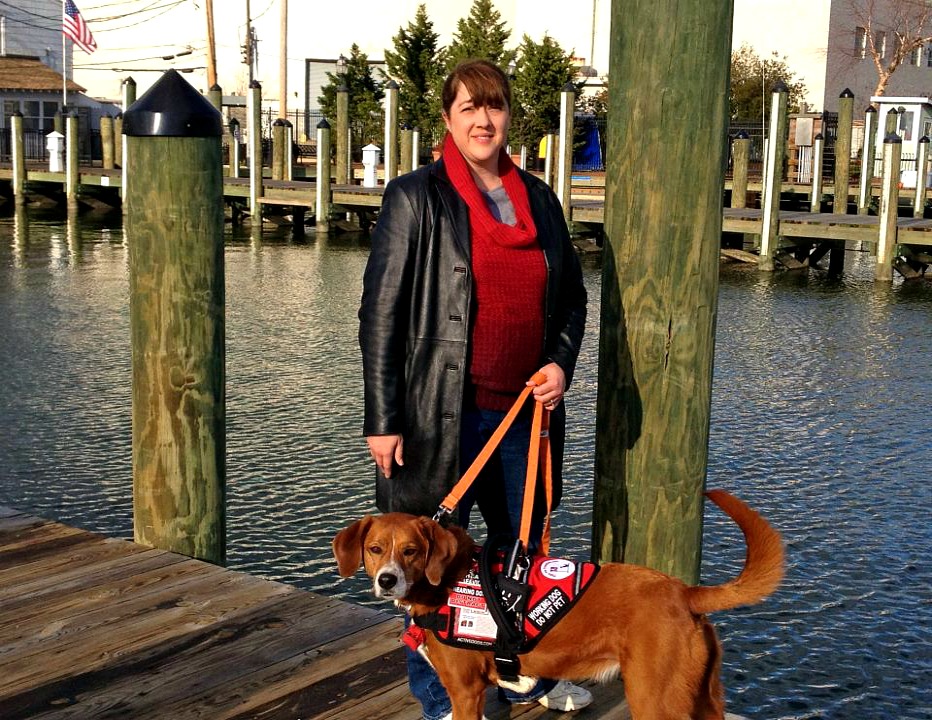
Several of the emails I receive through Hearing Elmo each week are questions about assistance dogs. This week is actually “Assistance Dog Awareness Week“, so I wanted to take a few minutes to talk about life with an Assistance Dog.

The first thing I always tell people who have questions is that if you are not prepared for the fact that an assistance dog will draw attention to you, then PREPARE YOURSELF. More importantly? If you are not comfortable with the attention, then an assistance dog is not for you.

Because I have a hearing loss and because I don’t hear well in stores or crowded places, I am oblivious to all the comments my family members DO hear. “Look at the dog!” “Oh look, a working dog!” “Why is that dog in here?” “Mom, why does that lady have a dog in here and why is it wearing a saddle?”

Assistance dogs lend independence to those who chose to mitigate their disability or illness with these special canines. I never worry about missing a phone call. I can do laundry without assistance from a human family member. I no longer burn supper. I always know when someone is at the door. I can shop and go out in public and never worry about not being able to bend and pick something up – important as I constantly drop things.

Some things you may not know that are actually perks of having an assistance dog?

1. Pre-Chloe, a routine doctor’s visit would result in the 3rd degree about why I always have so many bruises. It can be tiresome to field questions about whether or not I’m in an abusive relationship, when I simply fall or run into things a great deal because of Meniere’s disease. Now, Chloe lends legitimacy to those bruises. She reminds doctors why I have bruises because folks don’t go to the doctor with a dog partner if they didn’t need the assistance.

2. I’m rarely bumped into or shoved out of the way now in public. When you don’t hear well in these venues, impatient shoppers who don’t give a “fig” about why you are standing looking at dancing electronic flowers in the garden department, assume I’m being stubborn about moving to let them by. Now they see Chloe and if she doesn’t notice them and cue me, they carefully maneuver around me.

3. I never receive comments like “It’s a little early to be drinking isn’t it?” or “You should be ashamed of yourself” when I’m seen weaving a bit on rainy weather days (comments that have really been made). In the past, if I slammed into an end cap in a store, those around me assumed I was high or drunk. Now people see Chloe and think OR SAY, “Gee, it’s great she has that dog to help her”.

4. I’ve grabbed onto a fellow client’s scooter before (sorry, John) when I almost fell down. He understood. However, when what you grab is a nearby shopping cart, others aren’t as understanding. I once had a grandmotherly person stick her finger in my face and sternly say, “Let… GO”. I mumbled an apology and went my way. Now that I have Chloe, the most anyone will say in a “near swoon” moment is “Are you OK?”

Assistance dogs help people with hearing loss, mobility issues, seizure alert, PTSD, diabetes/blood sugar alerts, vision loss, balance problems, fine motor skill difficulties, and much more. I hope the next time you see someone with an assistance dog in public that you maybe take a minute and tell them that you think their independence with their canine is a great testament to courageous people. Don’t pet the dog or distract it though (grin).

Denise Portis

© 2012 Personal Hearing Loss Journal

Attracting More Flies

Photo by Deborah Marcus, February 22, 2012, North Carolina

I just purchased a book through Amazon, Benjamin Franklin’s “Poor Richard’s Almanack”. I’ve always enjoyed books like these and have seen a number of quotes from this book over the years.

One American proverb from this book that many people have heard has to do with honey.

and vinegar.

and flies.

 Benjamin Franklin, “Tart words make no friends; a spoonful of honey will catch more flies than a gallon of vinegar” (Franklin, 1980).

When I first heard this quote I remember thinking, “Well who in the heck wants to attract FLIES”? Having grown up on a farm in SE Colorado, I can tell you that flies were a problem. The animals hated them, farmers hated them, and children relegated to policing the house with fly swatter and tissue in hand hated them!

However, like many quotes, you have to look past the surface to get at the true meaning. Gee, had I known vinegar would have kept them away I may have started sprinkling it around and dabbing it behind my ears.

Ok. Maybe not.

We don’t need to go raid our friend’s hives for honey, either. This quote has to do with being tactful – on purpose.

You know what I’ve discovered? To be tactful, I DO have to be purposeful about it. It is super simple to be tactless. Especially when angry! I’ve learned that if I’m to be tactful, thereby attracting more attention with my “honey”, I have to set out with very real purpose ahead of time. It seems we were created to have a lot of excess vinegar on hand.

Tart Words

I think a lot of folks do not realize that the quote begins with, “Tart words make no friends”. Last week I received a lot of private responses about the post “A Special Kind of Stupid“. Some things people with disabilities shared with me made me very upset. You just would not believe some of the things that “normal” people say to folks with invisible illnesses or disabilities. Then again, if you follow “Hearing Elmo”, perhaps you would believe it as you likely have some connection to the disability or chronic illness communities.

Though it may be difficult, we really have to remember to put a cap on our – erm – vinegar when responding to some of the stupid things we hear in our day-to-day lives.

No, She Is Really Unhappy

Take an example from last week in “A Day in the Life with a Service Dog”. At Walmart, as per my usual mid-week major errand, Chloe and I ended up attracting some attention. As I outlined in an article for Gale Hannan at “Hearing Health Mattters“, if you don’t like attention then do not mitigate your disability with an assistance dog. You are going to attract attention. It becomes easy to ignore and if you are deaf like I am, you don’t even hear all the exclamations of surprise. However, sometimes I’m stopped. Dog-lovers like Walmart… or so it would seem. Most of the time I am very glad to stop and answer questions. I carry information about hearing dogs and balance-assist dogs with me for opportunities just like these. I’ve discovered, however, that if I stand around TOO LONG, folks begin to unplug their brains before asking questions. There is this “fine line” of how much time is “long enough”, prompting me to move on with my shopping. I evidently have not discovered that important timeframe yet. As I answered this lady’s reasonable questions, a lull occured in our conversation. That should have waved the red flags for me. Heck I’d take explosions in my underclothes if I could learn to pick up these cues.

But nope.

I stuck around too long.

“So does your beautiful service dog ever get to just be a dog? Does she ever get to play?”

Vinegar began pooling under my tongue. Chalk it up to living with a house full of very sarcastic people. I wanted to say, “You know? As a service dog she needs to earn her keep. The vest comes off at night and she is allowed to finally rest. She’s a working dog – not a playing dog. It wouldn’t do me any good for her to go around thinking she could ever play, right?” (said with saccharin sweetness).

Tactful Responses Ultimately Educate

Instead I swallowed the vinegar (grimace) and plastered on my best “WHAT A TERRIFIC QUESTION” face and replied, “Well she is a dog! She is a beloved member of our family. She gets play breaks at work and doesn’t actually wear her vest at home. She still does alerts and helps while at home, but she is off duty more than she is “on”. A healthy service dog is allowed to just be a dog. That is why she loves working for me. I set very realistic boundaries and expectations”.

Being tactful and pleasant is important if I’m to hope that I play even some small part in helping to educate others about hearing loss, balance disorders, and service dogs. If I’m angry and belligerent, I’m not going to “win friends nor influence people”.

And neither will you.

However…

Is It Ever OK to “Let ‘er Rip”?

I have lived with hearing loss and balance issues more than half of my life now. That means I have some experience. That does not mean that I do everything right. Folks ask me from time to time when it is OK to put others in their place.

We can’t exactly take out a megaphone and announce to everyone within earshot, “This person just said something STUPID”.

To demean others is never the right way to go. For one thing, it only makes US look bad. You certainly won’t promote education, compassion, or understanding in others if you deliberately embarrass or fuss at them. Having said that, I do believe that there are times that responding with sweetness and “honey” may not be the right answer. After all, it may be that you no longer WANT to attract that particular person who simply cannot and WILL not treat you like a normal human being. I believe the right time to load your water pistol with vinegar occurs when:

1. You’ve responded the right way over, and OVER again.

Maybe it is a family member that thinks their comments are funny. Maybe it is a co-worker whose remarks border on the unkind. At some point you may discover that the only way to educate someone is to be a little more FRANK – pardon the pun Benjamin Franklin!

Tired of the eye rolls and deliberate condescending response at a dinner table of “I’ll tell you later” after asking for a second repeat of what someone said? Perhaps it is time you gently laid your hand on their arm and said in a normal tone (for they likely do NOT have a hearing loss), “You know? It hurts my feelings when you say that and sigh and roll your eyes. I only want to hear what you said. You never actually remember to tell me later what it was. Don’t blow me off. What was funny? I want to participate in your life. I care about these moments and we will never re-live them or have them as “do overs”. I want to know what you said because I love you”. Others at the table may have grown quiet at this calm announcement. But that can work in your favor too. Sometimes educating others occurs by observing someone else getting educated. You may have let a little vinegar taint what you said. A little “sting” may be necessary to get through to calloused hearts.

2. You respond in defense of others.

Sometimes you may need to put up the honey aside and gear up with vinegar in order to stick up for someone else. I’m much quicker to speak up to a bully when the person being picked on is NOT ME. This has to be done carefully, however, as you do not want to take away an opportunity for someone else to stand up for themselves. When you live with disability, chronic illness, or invisible differences, you need to learn to be as independent as you can. It is healthy. You may need assistance in technology, puppy power, or by swallowing your pride and learning to ask for help.

However, there are times I believe, that we should step up and even figuratively lock arms with another who is being misunderstood to let them know they are not alone, and let a bully know they are being irrational – or STUPID.

We Won’t Always Do it Right

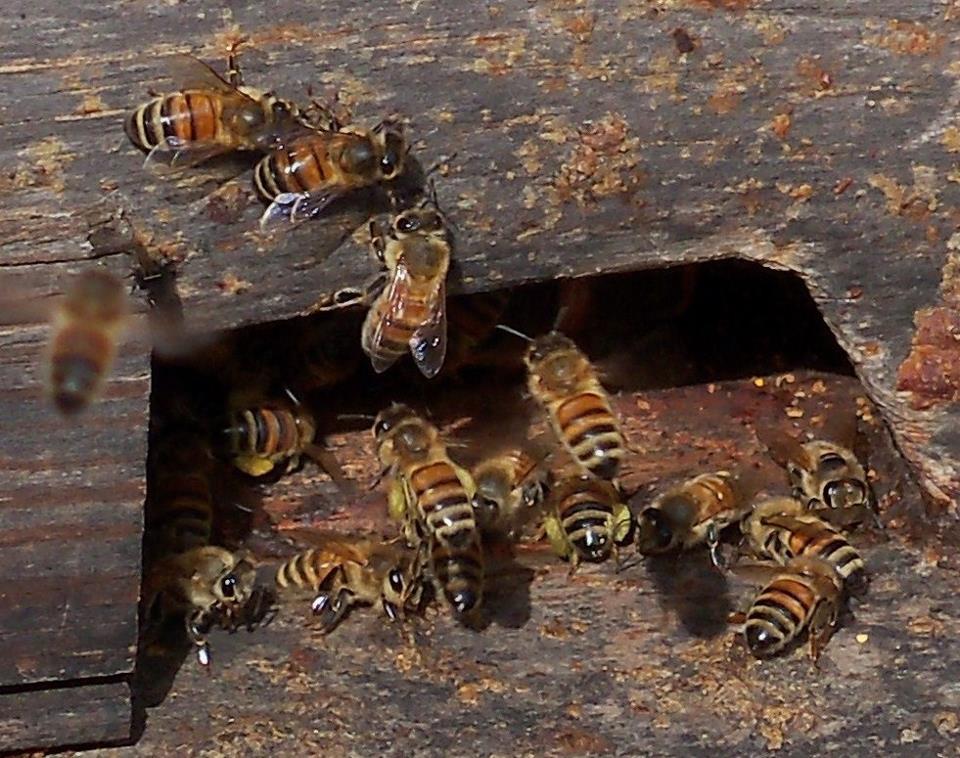
I can be a sour puss. Vinegar is more likely to run through my veins than honey. I’m allergic to bee stings.

Sometimes I blow it. I respond as if I don’t care if someone better understands disability and hearing loss. As a person of faith, I know this dishonors not only me, but also God. I have learned to say “I’m sorry” – and really mean it. Acknowledging that you aren’t feeling well today and mis-spoke or are feeling belligerent and should have kept your mouth shut shows maturity. Did you blow it? Well make it right. You know what to do.

Franklin, B. (2007). “Poor Richard’s Almanack”. Skyhorse Publishing, Inc. New York : New York, p. 44.

Denise Portis

© 2012 Personal Hearing Loss Journal

It Ain’t All Good

George Dawson, “People forget that a picture ain’t made from just one color. Life ain’t all good or all bad. It’s full of everything.”

I didn’t write last Monday. I almost let yesterday (Monday) go without writing as well. My reasoning was “why write when I feel so awful”? Sometimes I feel like I owe my readers and peers the truth… but only if it is pleasant and encouraging. When things are not going so good? Well… I’m less certain about how healthy it is for ME to write about it, and risk losing YOU as “compatriots in the ranks”. Right now, “life ain’t all good”. But because it is also “not all bad” I decided to write anyway.

Some things are changing for me. Not good changes. There are things going on that involve other people, so I cannot discuss it. But there are things going on with “just me” that I DO have the liberty to discuss. So I will. If you tuned in to get a dose of the warm fuzzies – this isn’t the post you want to read.

Tell Tale Signs

I have an incredibly bad habit of ignoring the obvious. Perhaps it is a defense mechanism or a form of denial. When something is scary or unpleasant I will push it down and pretend “it” doesn’t exist. I tell myself what my mother always tells me, “Don’t make a mountain out of a mole hill”. Problem is… sometimes it IS a mountain and not a mole hill.

Life can be hard. I have friends who have lost loved ones recently. I have friends who have been diagnosed with scary-sounding diagnosis, some having a good prognosis and some a dire one. I have friends who have close family members battling major health problems. I have friends who are having financial crisis that will change the course of their life and the life of their families. I have friends with children in trouble. I have friends who have been told to plan their funeral. I have friends who have been betrayed and used.

Makes it sound like I have a lot of friends, doesn’t it? (GRIN) One tremendous PLUS of my now, 9-year-old blog, is that I have met a great number of people “virtually”, and literally as a result of my going public with what it is like to live with hearing loss, invisible disabilities, and an incredible canine partner. I have been blessed with guest writers and friendships that have developed as a result of “Hearing Elmo”. You, the reader, have been a source of encouragement to me, a source of advice, and even a source of constructive criticism when I desperately needed it. I am thankful for the sense of “community” the Internet and blogs have given those with disability and invisible illnesses.

Sometimes I ignore tell tale signs in order to “deal with it”. Yes, I know that isn’t healthy but I’m just tellin’ it like it is. Folks who do not have disabilities still live in a body that ages, changes, and may face both minor and catastrophic health problems. However, people with disabilities, those who have learned to be “differently abled”, also sometimes face these same health problems. I’ve often wondered that if certain disabilities make one more prone to health related problems. For example, if you have arthritis, fibromyalgia, or chronic fatigue syndrome, perhaps you’ve put on some weight because you cannot easily exercise or lack the strength and energy to do so. As a result, diabetes or heart disease are now knocking at your door. If you have paralysis or problems with mobility, perhaps you have also developed circulatory problems. I am late-deafened and have Meniere’s disease. I actually hear voices really well in “prime” listening environments, and even do fairly well in really noisy environments with poor acoustics. I fall a lot though. When I do, I normally hit my head. Usually it is just an “ouch” moment where I rub the sore spot and go on about my business.

However, in the last year I have woken up a couple of times now – sprawled out in a heap with my dogs curled up asleep next to me. One time, a matter of hours had to have passed because it was much darker outside by the time I came to. I discuss these things with my husband and um – sort of with my doctor. I have a feeling that I’ve bumped my noggin’ often enough in my adult life, that there may be consequences to that. Thankfully, I’ve learned what a lot of my triggers are and can identify 95% of the time when I need to sit down,

NOW

no matter where I’m at

or who may be watching

or what I may be sitting in.

My eye prescription has changed 3 times in the last 11 months. Most mornings I wake up and my extremities are numb. On really bad days, I still cannot hardly feel my fingers well enough to type by my afternoon classes. I’m having all kinds of “female issues”. My balance is worse than it ever has been. Much worse. I have tried to tell myself that I am stumbling more because I’m older. I turn 46-years-old this month. I’m very good at justifying things! Don’t we tend to do that when something is “off”? My doctor is working with me. When classes are over in May I will be busy getting a lot of tests. Fun, fun (rolls eyes).

But Gee… It’s Not Fair

I don’t care who you are. The old adage, “when it rains, it pours” is only positive to a farmer. No one likes change. Nobody likes problems. No one embraces tragedy. We may have a “Bad News Not Welcome” here sign on our house door. Heck… it may be tattooed on your forearm. That doesn’t mean that bad things are not going to happen.

Life is just not fair, is it? I mean… we don’t get what we deserve when we’ve done something right. And dang, if we don’t get what we deserve when we do something WRONG.

Oscar Wilde: “Life is never fair, and perhaps it is a good thing for most of us that it is not.”

Bill Gates: “Life is not fair. Get use to it”.

(Unknown): “Expecting the world to be fair to you because you are a good person is like expecting the bull not to charge because you are a vegetarian.”

Matthew 5:45b: “For he makes his sun rise on the evil and on the good, and sends rain on the just and on the unjust.”

Most of you have already learned that life isn’t fair. We deal with it. We have to do so. There are no real alternatives.

We adjust.

We learn.

We fight.

We will lose and we will win. Regardless we DO deal with it. That can mean we do so successfully and with pizzazz. It may mean we do so poorly and like a drowning victim, struggle and pull others down with us. We always have choices. Maybe not about what we get to handle, but HOW we will handle it.

Recently while shopping at the mall with my husband, he said, “Do you realize that in 2007 you trained for a hearing dog because you needed one. Now Chloe performs more balance-related tasks for you than she does hearing alerts. What does that mean?”

Well it means that I’m changing. Thankfully, dogs are smart and so are the trainers at Fidos For Freedom. You really can teach an old dog “new tricks” – or skilled tasks.

More Than You Can Handle

Don’t you hate it when you are going through something hard and someone tells you, “God won’t give you more than you can handle”? Seriously? I mean… for most of us determination, will-power, and a fighting attitude gets us through. For those like myself who consider themselves a person of faith, we rest in the knowledge that He’s got this… and He’s with us. That doesn’t mean He’s gonna bail us out and smooth the way.

My cousin, a breast cancer survivor, blogs a great deal. I always look forward to reading her posts when “Google Reader” lets me know something new has been uploaded. Recently, she wrote “A Hard Place”. She quoted from a book called, “Kisses From Katie” by Katie Davis. I wanted to share that excerpt with you:

“Remember, God will never give you more than you can handle.” People repeat this frequently; I heard it when I was growing up and I hear it now. It is meant to be a source of encouragement, and it would be if I believed it were true. But I don’t. I believe that God totally, absolutely, intentionally gives us more than we can handle. Because this is when we surrender to Him and He takes over, proving Himself by doing the impossible in our lives. I have learned to accept it, even ask for it, this “more than I can handle.” Because in these times, God shows Himself victorious. He reminds me that all of this life requires more of Him and less of me. God does give us more than we can handle. Not maliciously, but intentionally, in love, that His glory may be displayed, that we may have no doubt of who is in control, that people may see His grace and faithfulness shining through our lives. And as I surrender these situations to Him, watch Him take over and do the impossible, I am filled with joy and peace–so much more than I can handle.”

I’m not a brave person. I’m not going to ask God to give me more than I can handle.

I’m a chicken.

a wuss.

a weakling.

You don’t have to ask God for ANYTHING though, and you still are going to get a dose of LIFE. And so I’m back around where I started. Life ain’t all good.

But it is not all bad.

And so we carry on…

Denise Portis

© 2012 Personal Hearing Loss Journal

Sometimes? You Are Going to Have a Bad Week

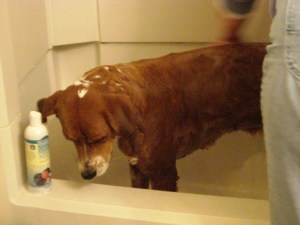
Chloe was having a pretty good week. At least she was until I told her to get in the bathtub. NOT her favorite thing. If “hound dog” could do forlorn, then honey? She’s gonna do FORLORN in the bathtub covered in suds.

While I scrubbed her and told her what an awesome dog she was, intervening during those “I’m gonna shake” moments, I thought about how quickly things can change.

Chloe was happy and excited to get home from class today. She was rough-housing with her buddy, Tyco, when she heard me call her upstairs. She came running with her tail all a-wag. I told her to get in the tub and proceeded to break her ever-lovin’ heart. She is drying and pouting over in the sun as we speak. If I’m lucky, she’ll have forgiven me by suppertime.

Spring has “sprung”, I’m getting a handle on my new schedule, Terry and I just took 2 days away to re-group ALONE (grin), I’m feeling very connected and supported at my primary “free time” activity (Fidos For Freedom Inc., in Laurel, MD), and then it happens. When you can see change coming you can run like mad… or at least brace for it. But sometimes? Well sometimes change smacks you up side the head like Gibbs smacks DiNozzo. It’s completely by surprise. You lay on the floor, dazed and confused, staring up at the ceiling fan thinking, “What just hit me?”

I’ve even let this unexpected negative “change” suck me into an old habit of depression. I could feel it creepin’ up on me. I’m blessed to have a live-in psychologist and I made sure I changed my “8 hours of sleep a night” to 10 hours immediately. That seemed to help. That in addition to some time since the SMACK DOWN, I’m feeling like I can do this thing called life again, despite the newest challenge. Change can be hard and can create a lot of stress. Heck. I was having such a meltdown (as were other members of the family), hubby announced “Let’s go out to eat for supper!” I begged and pleaded and implored him to allow me to fix supper (yeah, right!), but he insisted we go out to eat. We walked out the door discussing these serious issues that “done smacked me up ‘side the head” and half way to the car my husband stopped dead in his tracks and interrupted me saying, “Um Denise? Where’s Chloe?”

You know the service dog who is with me 24/7? The one on the other end of the leash every waking moment of my life? Poor forgotten Chloe stood inside the locked house door whining and whimpering. So yeah. I am THAT distracted by my smack.

There are various proverbs that remind us that life is not easy. Everything is not always going to go well. Sometimes bad things happen. It doesn’t matter if you have disabilities or not. Life can be very, very good. Yet any of us who have lived enough of it know that it can also be hard. I survive because of my 3 “F’s”: Faith, Family, and Friends who care. Surviving is sometimes one day at a time, one week at a time. This is why people with disabilities should take care not to isolate themselves. It’s so easy to do. Isolation is even easier than having to face interacting with others while learning to live successfully with a disability. But isolation is dangerous. We need others. Others help us do that “surviving” thing!

I for one and very glad to see Monday this week.

Chloe, on the other hand, is just glad her monthly bath can be chalked off.

Denise Portis

©2012 Personal Hearing Loss Journal

My Goals? Stop Apologizing…

At City Dock in downtown Annapolis near the U.S. Naval Academy

I find it a little hard to believe it is 2012. Normally, the New Year doesn’t sneak up on me. However, this year it certainly did just that. In the past, I’m almost obsessive-compulsive about planning and organizing my resolutions for the New Year. I suppose that I haven’t allowed myself to obsess about it this year, points to the fact that I continue to change and evolve as I age. I think change is important and hope that I will always grow, mature, and change from one year to the next.

Sometimes though? Sometimes I see things in myself that I need to change because they are negative. In my reflection of 2011, I discovered a real negative that I really want to work on in 2012. Introspection did not really help me discover WHY I have developed this bad habit, but I can make some educated guesses.

I apologize. I apologize a great deal. I apologize for things that are not my fault. Some reasons I may do this?

1. I feel as if it will keep others from feeling the blame or reacting in a defensive way.

2. I default to shouldering the blame for most things.

3. I hope to diffuse any uncomfortable thoughts or reactions by others.

4. I hope to garner apologies and acceptance of responsibility by others by my own example.

5. HABIT

Please don’t misunderstand me. I believe that people should accept responsibility and offer apologies when they are warranted. However, I have developed a habit of apologizing for things that are not my responsibility. Sometimes when I say “I’m sorry”, it is simply a matter of miscommunication. I need to say something… but do so in a way it more accurately communicates my real meaning.

An example: “I’m sorry you misunderstood me”.

A better response would be, “I believe I have been misunderstood. May I clarify my meaning and intent?”

As a person with hearing loss I even respond with a “sorry” when I missed something. Example: “I’m sorry. I didn’t catch that”. It may very well be that it is no one’s FAULT that I missed it. After all… I am a late-deafened adult. Yes, sometimes folks may cover their mouth with their hand, or mumble. When that happens it is better to say, “I didn’t catch that. Could you repeat it please?” – or – “You were covering your mouth and I didn’t catch that. Will you repeat it please?” I’m going to try to stop myself before I respond with a habitual “I’m sorry. I didn’t catch that”.

It’s My Choice to Mitigate My Disabilities with a Service Dog

Recently, I “replied all” to an email in which a group of employees were nailing down details about when to meet for a book group. We are reading “Storm” by George R. Stewart. I actually typed out, “I apologize in advance that I will have my service dog with me as she is with me 24/7”. I sat and looked at that sentence for a minute and thought to myself, “WHAT IN THE WORLD?”

I deleted that sentence and re-typed, “Just a heads up so that no one is startled, I will have my service dog with me as she is with me 24/7”. I re-read and re-thought that sentence for several minutes. I like to give people I’ve never met before heads-up about Chloe, but it isn’t required. However, some people ARE afraid of dogs or have allergies. I like to let people know in advance when I can.

When I interviewed at the local community college, before hanging up the phone I let the person know that I would have my service dog with me at the interview. When I arrived to meet with the panel of people interviewing that day, the director let me know that he was glad I told him about Chloe. He normally has his dog with him at work during the summer, and he didn’t want his dog to interfere with my working dog.

Sometimes it cannot be helped. I arrive and people are surprised (or dismayed) that I have a service dog with me. In the past, I have intercepted looks and stepped forward to apologize that I have Chloe with me. I’m not sure why I felt compelled to do this. I’m NOT sorry I have Chloe. She has given me the independence and confidence I needed to follow my dreams! Yet, I often felt as if I needed to apologize for her presence.

When someone asks if they can pet Chloe, I would automatically say, “I’m sorry. She’s a working dog and cannot be pet while she is in vest”. A better response that I’m trying to remember to say is, “She’s a working dog and cannot be distracted right now. Thank you for asking permission though!”

I realize that many people use the “I’m sorry” phrase without thinking about the ramifications of the meaning. To many it is simply a way to break the ice, or begin communicating a difficult idea. For me, I believe that the overuse of the phrase has only served to weaken my own self-esteem and even development as a confident adult with a disability. Please understand that I am talking about ME – and how being overly zealous with apologizing has inadvertently affected ME in a negative way. You will never hear me correct YOU if you choose to use this phrase.

I believe in giving heartfelt apologies when they are needed. In the right circumstances, it conveys the desire to make right a wrong and to restore a good relationship with another person. One of my favorite books is “The Five Languages of Apology” by Chapman and Thomas. I believe in caring about our fellow man and to learn to apologize in such a way it restores good communication and healthy relationships.

It’s no one’s fault I do not hear well. There is no one to blame that I stumble around on rainy days nor am able to retrieve things from the floor. You may be surprised to learn that I wouldn’t change anything about me. Sure… it’s taken a long time for me to accept who I am and to “like me” just the way I am! I do want to correctly communicate my heart, mind, and intent to others. I believe I apologize in far too many circumstances. I want to accurately relay information without demeaning or demoralizing myself.

You may be thinking “poTAtoes” – “po-TAH-toes”. What is the difference? For me… this is something I choose to work on this year. I want to better communicate with others without taking the blame for things that cannot be helped.

In October I was at a training class at Fidos For Freedom in Laurel, Maryland. One of my least favorite exercises is the “Meet and Greet”. I hate it, yet know it is one of those necessary (evil) tasks that I must learn to accomplish with an assistance dog along side of me. Reality check? I will have to communicate with others in a group when there is background noise. It is very difficult for those of us with hearing loss to do this exercise. I have to remember to turn my t-coil off on both cochlear implant and hearing aid. Thankfully, our training room is looped and I hear the trainer very well when commands are given. However, I have to turn these OFF in order to hear a group of people in the “Meet and Greet”. We introduce ourselves and give a little information about our dogs to new people. To folks we know well we simply “catch up”. Our dogs are suppose to remain in a safe place (sit or stay) and we learn to communicate while also keeping an eye on our partners. When you also speech read, it can be very difficult to watch faces while also keeping an eye on your dog. At this particular training, Chloe was in a down/stay for the inevitable “Meet and Greet”. Some of these dogs Chloe has known for a long time. Some of them are newer puppies recently introduced to the training floor to eventually be matched with a client. I spotted Chloe stretching in her down/stay with tail all a-wag and kisses galore for another dog in a down/stay. I corrected her and then realized I missed what the fellow client said.

“I’m sorry. I missed that”, I said with exasperation.

The other client didn’t hesitate and said, “Don’t be sorry. I don’t apologize for weaving around with both a cane and a dog!”

It hit me that I was implying my inability to hear well in this environment could be changed. It is what it is. I do NOT hear well in “Meet and Greets”. It is not anyone’s fault that I do not. No apologies are necessary. I’m learning to ask for repeats without apologizing.

I wish you success in planning your own New Year’s resolutions and goals. I’m keeping it simple this year. Happy New Year and welcome 2012!

Denise Portis

© 2012 Personal Hearing Loss Journal


Entitlement

When you think of “entitlement”, do you picture someone with their arms crossed and a demanding attitude? Do you associate  negative thoughts with the word? I have heard the word “entitlement” discussed at length in various groups lately. Parents may bemoan the fact that “kids today have a sense of entitlement that promotes a feeling of justification for all they do and all they DESERVE“. My husband and I even “shake our heads” at our own kids from time to time. Don’t get me wrong… our kids are TERRIFIC. They are well-adjusted, do not use drugs or drink alcohol, their language is acceptable, they make good grades, they are responsible and willingly reach out to others. But sometimes? Sometimes they act as if they deserve certain things even before earning the right to have that luxury, trust, or understanding. Thankfully, we can simply remind them about the blessings they have and use a comparison or two between their own lives and the lives of some of their peers and they are quick to apologize for their previous attitude.

Teachers  confess that students in classrooms across the country are morphing into groups of individuals who demand respect and favors they have not earned. Elayne Clift (2011) said, “Whether it’s rude behavior, lack of intellectual rigor, or both, we are all struggling with the same frightening decline in student performance and academic standards at institutions of higher learning (para. 6)… when teachers refuse to lower standards, those students seem to resort to a new code of conduct that includes acted-out rage, lack of respect, and blame”(para. 8). From what I understand, this attitude is reaching epidemic proportions in classrooms. Thankfully, I have not experienced this in my own classrooms yet. I do, however, believe it CAN be a problem and is certainly happening in many schools. Parents and caregivers may unintentionally (or with very real intent) foster and promote this attitude in their children.

What about “Occupy… ” a city near you movement? I’ve listened to some of my peers argue that those camping out and “occupying” locations in cities across America, are individuals trying to make a point about those in power and wealth, yet harbor a sense of entitlement.

I’m not here to debate any of these issues. Instead, I wanted to point out that a sense of entitlement is alive and well in the disABILITY community. I support being a positive advocate and for educating individuals as to what their rights are under the ADA. I’m not here to debate these issues, however, and recognize that there are plenty of examples of people with disabilities being misrepresented, mistreated, and unfairly judged.

What is ENTITLEMENT?

Webster’s defines “entitlement” as:

1. a : the state or condition of being entitled : right b : a right to benefits specified especially by law or contract
2.: a government program providing benefits to members of a specified group; also : funds supporting or distributed by such a program
3.: belief that one is deserving of or entitled to certain privileges

When I first began losing my hearing at the age of 25-years-old, I knew next to nothing about hearing loss and how it can impact a life. I spent the first decade of progressive hearing loss learning about hearing loss in general. I sought support and information about how to better communicate and how to deal with the emotional consequences of an acquired disABILITY. When I developed Meniere’s disease as well, I challenged myself to learn all there is to know about a disease with no cure. As a result, I’ve learned what my own triggers are, what steps I can take to lesson the symptoms experienced, and reduce the severity of flare-ups. I’ve become an advocate for those with hearing loss… especially those who are late-deafened. I support and advocate on behalf of those who use service dogs to mitigate their disABILITY.

I’ve met PLENTY of folks who do the same. This does not mean, however, that I have not met people with hearing loss, Meniere’s disease (or other balance disorder), and people with service dogs who exhibit an attitude of entitlement. Many have taken laws that protect their rights and use them as a weapon of mass destruction. Instead of resting on the assurances these laws were meant to produce in the lives of individuals with disABILITIES, these laws are used to insist on more than what is deserved and intended. Don’t get me wrong! Companies and local and federal government should be compliant with specific criteria the ADA outlines and determines as provisions for equal access. A person with disability should be given any available means and technology at work so as to do their job in such a way they are on equal footing with another who does not have a disABILITY for promotions, raises, and opportunities. My “beef” with people with disABILITIES begins where folks insist everyone else in their life adjust their attitudes to satisfy their fragile egos.

Respect is earned…

Whether you have a disABILITY or NOT… respect is earned. We are not entitled to respect by our fellow man. Let’s face it. There are mean people out there… and mean people SUCK. But we as individuals who live with disABILITIES are going to get a whole lot further if we treat even mean people with – respect.

In the service dog industry mean people can “bring out the mean” in others. I’ve seen it happen time and again, and frankly? It’s happened to ME. Some wise-guy person in “charge” will barrel up into my personal space, put out a hand to physically stop me from entering an establishment with chest puffed out, hand on a hip and a look on their face as if to say, “over my DEAD, lifeless body“. My first reaction? “That can be arranged…

Nothing gets my back up quicker than a cocky, insolent ignoramus who chooses to invade my personal space as well! Especially since the latter may mean I over-compensate and “fall down go boom“. I know my rights. I have copies of the law. I’ve been trained (thanks to Fidos For Freedom). But I have learned that fighting “fire with fire” only leaves me with singed body parts. Sure, I may gain access, but at what cost?

One of my favorite Bible verses is Proverbs 15:1. I just love Proverbs! You could read one verse a day… strive to learn and apply something from it and be busy a very long time… or close to three years since there are 915 verses to be exact, but I digress (grin). Proverbs 15:1 (ESV) says, “A soft answer turns away wrath, but a harsh word stirs up anger.” Pardon my grammar… but AIN’T THAT THE TRUTH? Nothing takes the “wind out of the sails” of an angry store associate quicker than to be gently confronted with the truth of the law. The law is on our side, after all. Some folks are “deaf” to the truth though and because of preconceived ideas will thumb their nose at the law and insist persons with service dogs STAY OUT. Even if you need to call the police to file a report and insist on your right of entry and service, staying poised and in control should be paramount. When we lose control, it only exacerbates the situation. Worse? It sets up the next person with a service dog to encounter this same store associate with an even BIGGER chip on their shoulder.

Tired of paying the same ticket price as person’s with normal hearing at a theater, only to hear VERY LITTLE? If you want to promote open captioning or rear-window captioning… do so with a positive attitude armed with information about who uses it, what the law says, etc. Marching up to a theater manager with both guns a-blazing… accomplishes very little. When theaters do provide these services and use this available technology, be sure to thank the management. I’ve heard some HoHearies say, “why should I? Folks with normal hearing don’t have to thank the management for being able to hear a movie they paid for!” But is that the point? We are trying to raise awareness and help companies like movie theaters to provide these things so that we all benefit. (Hearing Loop.org has a great article here). We need to earn their respect. Thanking management does a number of things:

1) it reminds them who we are… real people who enjoy attending things like movies.

2) it helps them keep the numbers in perspective… many people use and enjoy captions. These “thank you’s” equal number of tickets sold and helps them remember the big picture…

3) it helps them see we ARE appreciative… not demanding snobs or spoiled people with a sense of entitlement.

A great blog post by Shanna Bartlett Groves on this issue can be viewed here and here.

Are you trying to get your church on board with providing an induction loop for people who use hearing aids and cochlear implants? Is the task difficult because there are not very many this would effect… or perhaps there is ONLY you? You will have an attentive audience and lay the groundwork for actually achieving this freedom to hear in church if you handle it the right way. Do not march up to the deacon board with a self-righteous sense of entitlement. Should they care that ALL may hear and participate in church? Well duh – of course they should! But we need to ask in the right way… with the right attitude. Non-profits have more freedom to say “no”. However, we can help them understand what this may mean for those who utilize t-coils in a way that our churches are eager to spend that little bit of money necessary to put in a virtually hassle-free technology that allows us to hear. If you hurl accusations about their lack of “Christian love” and belittle and chastise them… you will only insure they begin to believe that people with disabilities are demanding folks with a sense of entitlement. You may even need to show them how much you care about this issue. Offer to head up fund-raising for this technology. For many smaller churches, funds may be very limited in what they can provide even if they WANT to do so. (Hearing Loop.org addresses this issue here). I have a friend in another part of the country that finally talked her church into purchasing an induction loop system. She then went straight to the local newspapers and pushed for a story to be done on what this small church was doing to provide equal access for those with hearing loss. Her church ended up getting a great deal of positive publicity… reminding all in the community what churches are suppose to be doing in the first place. (A great blog post by fellow HoHearie, Shanna Bartlett Groves can be viewed here).

Yes. I think knowing our rights and standing up for equality is important. It is the “how” that concerns me. Heaven forbid that the way I handle something negatively influence the NEXT person who has a specific life challenge! We influence the thinking of those in the general public as well…

Several weeks ago I was at Costco picking up bulk items that we insist on purchasing in case the world should end. The carts there are ginormous (hey… it’s a word!), if only to hold the huge packages of paper towels, toilet paper, and bottled water we purchase to save a little money. In the pharmacy section I was busy searching for generic antihistamine. An older couple noticed me, first by spotting Chloe and then by noticing the cochlear implant (after reading her vest). They sidled closer with genuine interest on their faces. The lady said, “That’s one of those bionic things that people use to hear better with, right?

Yes,” I replied with no small amusement. Noticing the hearing aids in the ears of the gentleman I added, “I have no regrets about getting one either!” I had to repeat this actually, for he didn’t hear me very well the first time! I started to share a little information about my own hearing loss when the man piped up and said, “Well if God wanted me to hear better than I do now, He wouldn’t have allowed me to lose my hearing.

Now I could have gotten all feisty about someone questioning my own acceptance of what God has allowed in my life. I felt a little “twinge” even – to set this man straight. But I knew this would help very little where as a gentle response would accomplish much more in the long run. “Really? I look at my cochlear implant as using technology available that HE allowed as a blessing in this day and age in which we live!” The man looked confused as he had not heard me very well, but the woman said, “Honey never mind him. He can’t HEAR. You hear so much better than he does! Where did you get your implant?” … and with that I had the opportunity to plant a seed of hope and to share information that may one day provide better hearing for this (ornery) man. It is, after all, all in the attitude!

What is your attitude as a person with disABILITY? Do you at times behave as if you are entitled? Learn to gauge the reactions of those around you as you share what could be done to help you communicate more effectively. Ask for evaluations of how you handle these situations from people who are close to you. Respect is earned. May I never behave or respond in such a way that another person with disABILITY is judged at the onset to be a person with a sense of entitlement.

Denise Portis

© 2011 Personal Hearing Loss Journal

Clift, E. (March 27, 2011). From Students, a Misplaced Sense of Entitlement. The Chronicle of Higher Education. Retrieved November 14, 2011, from http://chronicle.com/article/Students-Should-Check-Their/126890/

I Have Meniere’s Disease – Harsh Reminder

I have Meniere’s Disease. It is easy for folks to forget that as the disease is “invisible”. Amazingly, I sometimes forget I have it myself. So that is just embarrassing! GRIN. Meniere’s disease manifests itself in individuals in a variety of ways. The disease lacks specific symptoms and triggers that are true of everyone. The disease varies person to person. For myself, the weather tends to be a very specific trigger for me. If pressure systems come into the area that include heavy rains or even high humidity, I know that I will have a “bad balance day”. If that day is simply the beginning of a string of similar weather days, I can be so off-balance by day 3 or 4, that I practically have to CRAWL up and down steps. It’s rather embarrassing to crawl when you are 45 – believe me!

Here in Maryland, we have had a significant amount of sunny, low-humidity days. As a result, my balance has been pretty good. Yesterday, I did laundry and actually jogged up and down the steps WITH a laundry basket. Yet I forget sometimes that in spite of my having few visible symptoms, I still HAVE Meniere’s disease even on bright sunny days.

Chloe does a number of things for me, only some of which are hearing alerts (what she was originally trained for at Fidos For Freedom). Chloe has also been trained to help me with a number of “balance assist” tasks which are very helpful on days I am experiencing Meniere’s disease symptoms. As a matter of fact, there are weeks that Chloe actually does more balance work for me than she does hearing alerts. One thing we have taught her to do is to “roll” her own blanket. I carry a blanket that is HERS. The blanket goes to every place I teach. It smells like her and she knows it is her “safe place” to be unless I ask her to do something for me. I usually put it out of the way in the classroom, but where she can easily see me. The blanket and Chloe are usually within 4-5 feet of me at all times. Below is a video of Chloe “rolling” her blanket — she adjusts the carpet square to be high enough that I can easily reach it without having to bend past my limitations.

Harsh Reminders

I get aggravated at family and close friends sometimes when they make suggestions for me to do something or try something that they KNOW I cannot do. It’s easy to forget certain things I cannot do because I don’t walk around with a sign on my shirt that says, “Beware of fall when bending!” You know what? Sometimes the person who forgets what I can and cannot do is – ME. You’d think I’d always be aware of the fact that I cannot bend to get something off the floor without paying the price. For me… bending far enough to retrieve something off the floor means that I lose consciousness for just a few seconds. Everything goes “black” in my vision, and my “hearing” (even with a cochlear implant) turns off. As soon as I stand back up, everything snaps back into focus. If I bend quickly, (for example to try and catch something as it is falling), I usually “join” the item on the floor… only I am sprawled out looking ungainly and mystified as to how I got there.

We’ve had beautiful weather here in Maryland lately. I need to remind myself on days like these that I still HAVE Meniere’s disease. In class this morning, I began gathering my things up to pack into my bag and exit the room. I dropped my roll sheet, so Chloe went over to pick it up and bring it to me (an automatic retrieve). As I was standing next to her pink blanket, I decided to save myself time and reached down to pick up her blanket. I lost my balance and my forehead crashed into the podium. After connecting with a wicked CRACK, the impact popped me back on my caboose. Thankfully, I didn’t lose consciousness. Chloe trotted over to me with the roll sheet and dropped it into my lap. She wagged her tail at me, nose 3 inches from my face.

“Hey Denise! Umm… why are you on the floor?” (Yup. I can read my assistance dog’s mind. Scary, huh?)

“Guess I should have had you roll your blanket, huh Chloe?”

Upon hearing “roll blanket”, she calmly rolled the end of the blanket and then tugged it over closer to where I sat.

I heard a student over my shoulder ask, “Ummm. Mrs. Portis? Are you OK? Was that your HEAD?”

I tried to chirp out in a manner that was convincing, “Oh sure! I’m fine, no problem!”

As I used Chloe in a stand/stay to get off the floor… I thought to myself one word – over and over again.

stupid

Stupid

STUPID!

Harsh reminders are needed from time to time, if not for any other reason than to remind us of the consequences of forgetting our own limitations.

We need to remember our own limitations. As a person with hearing loss, it helps me to remember that I cannot hear well in really noisy, crowded areas. If I need to have a conversation with someone, it is better to ask them to step over to the side out of the “hub-bub” of noise if I need to talk to them. Failure to acknowledge what I cannot do well (hearing in noise) only results in that I will be frustrated and angry at my inability to understand the conversation. If I want to play with my dogs, I need to remember to sit on the floor in order to tug on toys, throw balls, and squeak stuffed animals at them. If I try to “play” standing, I am sure to take an unplanned nosedive.

Have you had some harsh reminders about your own invisible illness or disability? Some lessons are hard to learn!

Denise Portis

© 2011 Personal Hearing Loss Journal

Reflections on National Invisible Illness Awareness Week

According to the Invisible Illness Awareness website, the following statistics are true:

  • Over 100 million people in the U.S. have a chronic illness;
  • 20.6 percent of the population, about 54 million people, have some level of disability;
  • 9.9 percent or 26 million people had a severe disability
  • 1.8 million used a wheelchair
  • 5.2 million used a cane, crutches, or a walker
  • So that is less than 6% who have a visible illness.
  • There are many illnesses that start out being invisible and as the disease progresses it becomes more visible.

Also note that:

  • 26 million persons were considered to have a severe disability;
  • yet, only 7 million persons used a visible device for mobility.
  • Thus, 19 million of the people who were defined as severely disabled, did not use a wheelchair, cane, crutches or walkers.
  • In other words, 73% of Americans with severe disabilities do not use such devices.
  • Therefore, a disability cannot be determined solely on whether or not a person uses visible assistive equipment.

U.S. Department of Commerce (1994). Bureau of the Census, Statistical Brief: Americans With Disabilities. (Publication SB/94-1).U.S. Department of Commerce (1997). Bureau of the Census, Census Brief: Disabilities Affect One-Fifth of All Americans. (Publication CENBR/97-5).

Why Do I “Plug” Invisible Illness Awareness Week?

I have been trying to raise awareness about this week for three years now. This year, a friend noticed my “don’t miss” posting on Facebook and couldn’t resist teasing me about it. After all, I don’t exactly allow my challenges to be INVISIBLE. I wear a bright red ear mold on the hearing aid in my “deaf” ear. I wear sparkly “bling” on the cochlear implant on my “hearing again” ear. I go about my life accompanied by a hearing assistance/balance assist dog 24/7. I learned long ago that it was in my best interests to make an invisible disability – VISIBLE. It kept me from being knocked out of the way, and helped people realize that something about me is different. I can still work, shop, go to movies, hike, and dance… yeah. OK, maybe not that last part…

I just don’t hear well… especially in big, cavernous places, or busy, buzzing atmospheres. Once you get my attention and I know you are talking to me, I can actually hear you great! I may have to ask for a very occasional repeat, but for the most part I do really well. I’m proud of how far I’ve come in my hearing. Despite all my visible reminders and “kissing sidekick”, Chloe, people who know me well (friends, co-workers, and family members) will forget that I may have trouble if you don’t get my attention first and that I can’t move FASTever. Heck… sometimes even *I* forget that I cannot move fast. Nothing reminds me quicker than when I

fall

down

and

go

BOOM!

Through the years I’ve been able to meet some wonderful people. Some examples include:

1) Folks through the training center at Fidos For Freedom.

2) People at Hearing Loss Association of America conventions or conferences

3) “Hearing Again” recipients at Cochlear America conferences

4) Individuals in support groups for tinnitus, Meniere’s disease, hearing loss, and assistance dogs users (both face-to-face and in virtual environments online).

Not every disability can be made visible. Not every person chooses to even try and make something invisible – visible. They have their reasons and it is an individual’s choice how they want to disclose or keep hidden any disabilities they may have. It could influence their work environment, relationships, and even self-esteem. I choose to support ALL individuals who live with chronic illness, invisible illness, or disability. Recognizing these illnesses once a year in a push for national awareness, I hope will eventually dispel erroneous ideas and information about these very populations. This is one of the reasons I “blog”, and invite guest authors to write for “Hearing Elmo” as well. Raising awareness makes a difference… one person at a time.

I read some incredible stories of courage, faith, and perseverance this week at the national website for invisible illnesses. You can check out some of them here. I’m proud to be a part of a community of people who choose to live a victorious life  – “in spite of”.

Take some time this week if you can to recognize the courageous people that you know who live with invisible illness and the choices they have made in order to live life to its fullest!

Denise Portis

© Personal Hearing Loss Journal